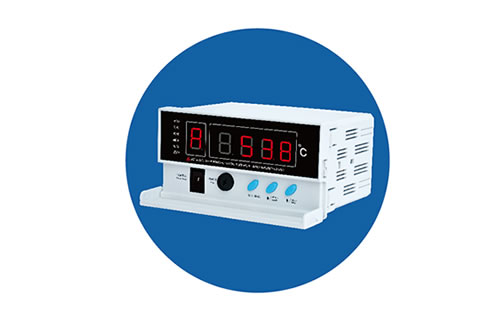
The BWDK series dry-type transformer temperature controller is a new generation multifunctional computer temperature controller designed for the reliable operation of air-cooled dry-type power transformers. Using three Pt100 platinum thermistors embedded in the three-phase winding packages of dry-type power transformers, the temperature rise of the dry-type power transformer packages is detected. Based on the temperature rise, the cooling fan is automatically controlled to start and stop, overheat alarm, and even overheat trip to ensure the safe operation of the dry-type power transformer. Due to the use of advanced RISC single-chip computers combined with advanced I2C storage and adjustment technology, designed according to the JB/T7631 standard, the temperature controller has the characteristics of simple structure, reliable operation, and strong anti-interference ability. At the same time, the temperature controller also has a "black box" function, which can record the temperature of the three winding packages before the power outage and the working status of the machine. Top 10 global temperature controllers for dry-type transformers 1、Fuzhou Innovation Electronic Scie&Tech Co., Ltd. Fuzhou Yingnuo Electronic Technology Co., Ltd. was established in 2011 and is a high-tech enterprise with strong scientific research capabilities. The enterprise has gathered numerous high-quality technical talents and management elites. The company's main products include fluorescent fiber optic temperature measurement systems, oil immersed transformer fiber optic temperature online monitoring systems, environmental management systems, rail transit fiber optic temperature controllers, PHM online monitoring systems, dry-type transformer temperature controllers, etc.The main models include: IB-S201 series, IB-Q201 series, series, BWDK-S201 series, BWDK-Q201 series, IF-T series, IB-T series and other temperature controllers. We can fully match temperature control products from any other manufacturer's brand or model. The transformer temperature control instrument models are complete and reasonably priced. We welcome inquiries. 2、HGSKYRAY The company focuses on the application and development of fiber optic temperature measurement products in various fields. Fiber optic temperature measurement technology, with its superior "high insulation and strong anti-interference" performance, solves the "pain points" of temperature measurement in many fields such as high-frequency microwave, high-voltage electrical, flammable and explosive, rail transit, petrochemical, military, etc. We are willing to collaborate with partners in various fields to customize various qualified fiber optic temperature measurement products for our customers. 3、Eaton temperature controller Eaton’s Transformer Temperature Controllers offer built-in monitoring and logging functions to help users better understand and anticipate potential issues. Also, the temperature trending feature allows users to collect and analyze data, resulting in increased system life and uptime and decreased maintenance and overall costs. 4、Orion Italia s.r. In any electrical system it is very important to maintain it without power outages, the transformers are a fundamental part and the temperature must be constantly controlled. A transformer temperature controller must be installed to perform this monitoring and control function. Using Pt100 temperature probes, the current temperature of each winding is measured and the temperature controller compares it against the temperature setting, basically it turns on fans to lower the temperature of the windings, gives an alarm signal and in the worst case trips the transformer ...
This article introduces the principle of fluorescence fiber optic temperature measurement and the world's best manufacturer of fluorescence fiber optic temperature measurement devices. Principle of Fluorescent Fiber Temperature Measurement Photoluminescence The phenomenon of photoluminescence is the mechanism of fluorescence fiber temperature measurement technology. Photoluminescence refers to the phenomenon in which certain specific fluorescent materials are stimulated to emit light beyond thermal radiation. According to Planck's law, when a substance is excited by some form of energy, it will produce a transition process of electrons between energy levels E1 and E2 (E1<E2), and emit light waves with a wavelength of λ. After being irradiated by excitation light, fluorescent materials will produce fluorescence when the excitation light is removed. The fluorescence intensity generated gradually decreases, and the time required to decay to 1/e of the maximum fluorescence intensity at excitation is called fluorescence lifetime. There is a monotonic relationship between fluorescence lifetime and temperature, and temperature measurement is achieved by measuring fluorescence lifetime. 1、 Fuzhou Innovation Electronic Scie&Tech Co., Ltd. (FJINNO) Fuzhou Innovation Electronic Scie&Tech Co., Ltd. is a high-tech enterprise with strong capabilities. The company’s main products include: fluorescent fiber optic temperature measurement system, oil immersed transformer fiber optic temperature online monitoring system, environmental management system, rail transit fiber optic temperature controller, PHM online monitoring system, dry-type transformer temperature controller, etc. Provide total solutions and application services for temperature, vibration and pressure monitoring in the fields of comprehensive pipeline corridors, oil and gas pipelines, rail transportation, electric power, municipal government, nuclear power, new energy, chemical industry and so on. 2、HGSKYRAY.com Fuzhou Huaguang Tianrui Optoelectronic Technology Co., Ltd. has established a deep cooperation between industry, academia, and research with Fuzhou University. A technology research and development team led by an optical and electrical doctoral supervisor, with professors and graduate students participating, and independent research and development as the main focus, has begun the research and development of fluorescent fiber optic sensing technology. After multiple tests and verifications, our fluorescent temperature measurement technology has reached an advanced level, and we have independently developed a series of fluorescent fiber optic temperature measurement products. The company focuses on the application and development of fiber optic temperature measurement products in various fields. fiber optic temperature measurement technology, with its superior "high insulation and strong anti-interference" performance, solves the "pain points" of temperature measurement in many fields such as high-frequency microwave, high-voltage electrical, flammable and explosive, rail transit, petrochemical, military, etc. We are willing to collaborate with partners in various fields to customize various qualified fiber optic temperature measurement products for our customers. The company's main products include fluorescent fiber optic temperature measurement devices and systems, distributed fiber optic temperature measurement systems, fiber optic grating temperature measurement systems, etc. Currently, we have established strategic partnerships with brands and complete sets of enterprises throughout the country, and have established good brand awareness and industry reputation in the fields of fiber optic sensing technology and intelligent safety monitoring and early warning. Our products and technologies are gaining increasing recognition from users. ...
This article introduces the principle of fiber optic temperature sensors, the top 10 manufacturers of fiber optic temperature sensors in temperature measurement, and a list of the best fiber optic temperature sensor products. The temperature measurement principle of fiber optic temperature sensors The fluorescence temperature measurement device manufactured based on the functional relationship between fluorescence afterglow lifetime and temperature has advantages that traditional temperature measurement methods cannot compare with. The basic principle of fluorescence temperature measurement When a substance is excited, such as by short wavelength visible or ultraviolet light, electric field excitation, or chemical reactions, it will absorb and store energy, and transition to an excited state with a certain vibrational energy level through the ground state. But the excited state is not stable and may return to equilibrium, and when the external excitation source stops working, the luminescence phenomenon will continue for a period of time, which is called afterglow. In addition, during the deactivation process of fluorescent molecules, unstable excited state molecules will transition from high energy levels to low energy levels through energy level transitions, and the excess energy will emit light in the form of electromagnetic radiation. Therefore, according to the different excitation methods, it can be divided into photoluminescence, electroluminescence, chemiluminescence, and bioluminescence. According to Planck's law, when the energy of the incident light is received by the luminescent material, it will excite electrons in the material to produce electron level transitions, and this process will produce outgoing light with a wavelength of λ. The formula for the energy difference between high and low energy levels is: E2-E1=k λ v=kf In the formula: E1- the energy of the electron at a lower energy level; E2- Energy of electrons at higher energy levels; K - Planck constant; V - the propagation speed of light in vacuum; F - frequency of light; λ - The wavelength of the emitted light. Due to E1 and E2 being in different energy bands, they represent light in a certain band, while the energy in the molecule includes rotational energy generated by electrons and vibrational energy caused by axial elastic vibrations between nuclei. Therefore, when molecules absorb light radiation, after quantum transitions, the electron energy will rise from the ground state to a higher energy level, and the rotational energy and vibrational energy will change simultaneously, causing the three energies to interact with each other. After the incident light disappears, the luminescent material will continue to emit light for a period of time, and the emitted light is fluorescence; High frequency and short wave light energy will excite long wave and low frequency light, and follow Stokes' law. The basic theoretical basis of fluorescence measurement method is that when the intensity of the fluorescence linear spectrum shows monotonicity with temperature, and the temperature of the fluorescent substance determines the time of the light quenching process, fluorescence temperature measurement can be carried out. Therefore, it is generally divided into fluorescence intensity temperature measurement method, fluorescence lifetime temperature measurement method, and laser ...
Temperature sensing optical fibers are very different from ordinary optical fibers. Temperature sensing optical fibers can be used in fiber optic fire detection systems, but ordinary optical fibers cannot achieve this. They are usually used for communication optical fibers and other businesses. Temperature sensing optical fibers have a wide range of applications in the field of temperature measurement and have been widely used in the temperature measurement needs of the power cable industry. The role played by temperature sensing optical fibers has undergone significant development. The following is related knowledge about temperature sensing optical fibers. The application of temperature sensing optical fibers has advanced with the development of fiber optic grating technology, and fiber optic grating temperature measurement systems are now mainly used in the application of fiber optic temperature sensors. The development of fiber optic gratings is constantly evolving. The prospects are very broad. Let me introduce the development prospects and research of fiber Bragg gratings: Temperature sensing fiber optic is one of the passive optical devices with great practical value in fiber optic systems in new sensor technologies. It can be used to form various new optoelectronic devices. Due to the excellent performance of these devices, people can make more full use of the resources of fiber optic systems. Therefore, research on temperature sensing optical fibers can promote the faster development of fiber optic temperature measurement systems. The research and development of fiber Bragg gratings are gradually delving into every detail of fiber optic communication systems, from the combination/division of wavelength division multiplexing systems, gain flattening of fiber amplifiers, dispersion compensation, to the up and down routes of all optical networks, wavelength routing, optical switching, etc. The application of fiber Bragg gratings will drive the development of high-speed optical communication and play an important role in future high-speed all optical communication systems. FJINNO is a temperature sensing fiber optic manufacturer specializing in the production and sales of temperature sensing fiber optic detectors and fiber optic hosts. We provide temperature sensing fiber optic detector hosts, temperature sensing fiber optic prices, and temperature sensing fiber optic host manufacturers.
What is a fiber optic sensor Fiber optic sensors are composed of modules such as light sources, transmission fibers, sensor components or modulation zones, photodetectors, and other components to form a fiber optic sensor. The patterns of intensity, wavelength, amplitude, phase, polarization, and distribution parameters can be influenced by external factors such as temperature, pressure, acceleration, voltage, current, displacement, vibration, rotation, bending, strain, as well as chemical and biochemical effects on the optical path, resulting in corresponding changes in these parameters during fiber optic transmission. Fiber optic sensors are used to detect the magnitude of corresponding physical quantities based on the relationship between these parameters and changes in external factors. The characteristics of fiber optic sensors Unlike traditional sensors, fiber optic sensors have excellent physical, chemical, mechanical, and transmission performance, making them small in size, light in weight, resistant to electromagnetic interference, corrosion, high in sensitivity, wide in measurement bandwidth, and long in distance. Detect electronic devices and sensors, and form a sensor network. The sensitivity of advanced fiber optic sensors is several orders of magnitude higher than traditional sensors, and can measure over 70 physical quantities. The advantages of fiber optic sensors 1. It has the advantages of high accuracy, fast response speed, wide linear feature range, good repeatability, and high signal-to-noise ratio Due to the large quantity and low price of optical fibers, they can be widely used Fiber optic is made of dielectric materials such as quartz for electrical and optical signal transmission, ensuring safety, reliability, and strong resistance to electromagnetic interference. It can adapt to working conditions in electricity, petroleum, chemistry, metallurgy, and other flammable or toxic environments. 2. Corrosion resistant, strong anti pollution ability, can be used in places with large temperature differences, good timeliness, and long service life. 3. Small in size, light in weight, easy to install, and adaptable to the main environment. 4. Fiber optic is a passive device with good independence and will not damage the measured state. 5. Widely measure objects. At present, various performance measurements of temperature, pressure, displacement, velocity, level, radiation, and other physical, chemical, biomass, and other fiber optic sensors are available. 6. Multipoint multiplexing is convenient and has low transmission loss. Suitable for forming measurement networks and achieving multi-point real-time intelligent telemetry. Sensors are developing into sensitive, accurate, adaptable, compact, and intelligent sensors. In this process, fiber optic sensors, a new member of the sensor family, are favored. The working principle of fiber optic sensors Fiber optic sensor is a sensor based on optical quantity conversion, which uses optical signals as the carrier for transmission and conversion, and transmits optical signals through optical fibers. Fiber optic sensors mainly consist of light sources, optical fibers (referred to as fibers), photodetectors, and additional devices. There are many types of light sources, such as tungsten filament lamps, lasers, and light-emitting diodes. Fiber optic is very thin, soft, and flexible, making it a transparent fiber that can guide light. The Development Status of Fiber Optic Sensors The development of global ...
What is the temperature standard for the pile head of the transformer on the column The operating temperature shall not exceed 105 ℃, and the relative temperature rise to the environment shall not exceed 65 ℃. This is the numerical value specified by the national standard and should be strictly enforced. Why does a column mounted transformer require a temperature detection system The temperature of the transformer pile head is a key parameter for the use status of the transformer, and how to measure the temperature of the transformer status is a problem that must be solved. With the development of social economy, the demand for power supply reliability is higher. When operating transformers for inspection and inspection, especially when measuring temperature at the pile head of the column mounted transformer, due to the insulation sheath installed on the high and low voltage pile heads of the currently installed column mounted transformer, there is a certain gap between the insulation sheath and the transformer pile head. When using infrared temperature measurement, the temperature outside the insulation sheath of the terminal post is measured, and the measurement error is large, which makes it difficult for operators to accurately judge the operation of the transformer. At the same time, due to the fact that the terminals are inside the insulation sheath, the problem of loose terminals cannot be directly reflected, and the existing hidden dangers cannot be dealt with in a timely manner, resulting in transformer operation with faults and affecting power supply reliability. In the power system, distribution transformers play a very important role. Once a fault occurs, it will directly cause losses to production and the normal life of residents. Temperature measurement at the inlet pile head of the column mounted transformer and the outlet pile head of the transformer In order to prevent the transformer from burning out due to high temperature, temperature measurement is generally carried out on the transformer. When the temperature is too high, the staff will inspect the transformer to ensure normal electricity consumption for production and residents. At present, the temperature measurement of transformers is mainly based on the winding temperature of the transformer. However, in actual use, especially during peak summer load periods, many transformers may still burn out even when the measured winding temperature is within the normal range. After investigation and analysis, it was found that the imbalance of three-phase loads can easily cause transformer overload, resulting in high temperature at the low-voltage pile head and ultimately leading to transformer burnout. Fluorescent fiber optic temperature measurement system for column mounted transformer pile head The fluorescent fiber optic temperature measurement device for transformer pile head adopts a direct measurement method. The customized fluorescent fiber optic probe is embedded in the pile head of the transformer on the column. Due to the good insulation of the fiber optic, the probe can be directly contacted with the hot spot, and the temperature signal of the pile head can be uploaded to the monitoring system ...
When the natural environment temperature changes, the concrete box girder bridge structure will undergo deformation and stress, which will directly affect the safety, durability, and applicability of the concrete structure. The actual temperature of the bridge structure has a direct impact on the linearity and internal forces of the bridge. Therefore, it is necessary to monitor the actual temperature of the bridge structure during the construction process to effectively grasp the impact of temperature on the stress monitoring results of the bridge during construction. Fiber Bragg Grating (FBG) sensing technology can overcome the shortcomings of traditional monitoring techniques and meet the technical requirements of distributed, high-precision, long-distance, and long-term monitoring of bridge structures. Due to the use of light for signal propagation, sensors are no longer affected by noise and have good anti electromagnetic interference and moisture-proof functions, which can provide more advanced means and methods for the health diagnosis and safety monitoring of bridge engineering structures. Since FBG sensors were first embedded in concrete for monitoring in 1992, their application in civil engineering has been widely explored and studied in China, expanding from experimental research to practical engineering structures such as bridges and tunnels. Among them, real-time monitoring of stress during the construction phase of the bridge was carried out using fiber optic sensors, and certain research results were achieved. In this paper, a new type of FBG sensor with embedded stainless steel sleeve protection was used to monitor the hydration heat temperature of the C60 concrete of the bridge in real time after pouring. Fiber optic temperature sensors were embedded in the flanges, web plates, and bottom plates of the section. This article provides a detailed introduction to the installation and monitoring process of the sensor, verifies the performance of the new fiber optic temperature sensor under complex construction conditions, and monitors the differences and changes in the hydration heat temperature of the box girder top plate, web plate, and bottom plate during winter construction. It provides corresponding reference for the study of hydration heat temperature field in the construction of C60 concrete for super long span bridges in similar mountainous environments. Project Overview The bridge is located in a mountainous area with many high mountains, deep valleys, and steep terrain. Its geological conditions are very complex, with unpredictable weather and excessive rainfall, making construction difficult. At the same time, the cast-in-place bridge beams in the project were poured with C60 high-grade concrete, breaking the conventional practice of using C55 grade concrete for bridges of the same type. Although the strength of concrete is only increased by 5MPa, it greatly increases the difficulty of concrete construction control and monitoring. In order to monitor the effect of hydration heat and temperature changes generated by C60 concrete during bridge construction on the stress of the bridge, a pre embedded fiber optic grating sensor is used to monitor the temperature changes during and after the concrete curing process in real time. Temperature Monitoring of Box Girders Based on Fiber Bragg Grating ...
The underground power cable system of key distribution feeders bears high electrical, thermal, and mechanical stresses. This pressure can affect the load transmission capacity, often limited by hotspots that may "damage" power cables, leading to reduced productivity, cable failures, and expensive downtime. By continuously monitoring the power cable infrastructure through a distributed fiber optic temperature measurement system, productivity has been optimized, maintenance costs and downtime have been reduced. At our feet, in most major cities, countless cables and power equipment support our daily lives. This power transmission system provides the highest possible reliability, but it also poses a challenge for monitoring. For the power system to switch to a smart grid, real-time online temperature monitoring of underground distribution cables has become an urgent task. However, this type of monitoring used to be expensive and related to malfunctions. Temperature is a parameter that limits the transmission capacity of cables, especially underground networks that are susceptible to thermal resistance, adjacent cables, and other heat dissipation sources. Therefore, measuring temperature to detect hotspots is more important. With years of knowledge and extensive experience in numerous well-known projects, the distributed fiber optic temperature measurement system solution will provide cost-effective temperature monitoring to ensure the safe operation of any underground network at all times. Distributed fiber optic temperature measurement is a powerful and accurate underground network temperature monitoring solution With enhanced visualization software and flexible direct connection to the management system, the distributed fiber optic temperature measurement system solution can quickly and easily outline the thermal state of the circuit. The distributed fiber optic temperature measurement system can accommodate up to 16 channels, allowing a unit to cover complex infrastructure while maintaining high accuracy and flexibility by defining areas, alarm levels, and types. Using distributed temperature sensing (DTS), it is very sturdy and reliable - even in dirty or dusty environments. The system sensing cable has no electrical components and has a long expected lifespan. The optical fiber can be kept underground for many years without maintenance. The embedded conductor temperature and real-time temperature rating engine calculates the current interference capacity under given conditions of underground cables, which will allow operators to perform transient simulations to estimate the current that can be safely transmitted from another circuit. In addition, the engine can be used for emergency ratings ranging from 10 minutes to 2000 hours.
Due to the long power supply distance, multiple equipment components, high electrical load, and mostly continuous operation of 10kV distribution lines, the electrical equipment of substations that supply power to the lines has the characteristics of heavy load and high current during operation. Under such conditions, when the connection screws of the substation equipment become loose or the components of each part have poor contact, the temperature of the equipment will abnormally rise due to the continuous passage of high current, resulting in poor material performance of the electrical equipment. If not detected and repaired in a timely manner, serious accidents may occur due to overheating and melting of the welding points of the equipment. That is to say, during the occurrence of faults in high-voltage equipment, there will be a significant increase in temperature. Therefore, monitoring the temperature parameters of high-voltage equipment during operation is very important. Reasons for high pressure temperature rise The fully enclosed electrical equipment of the substation refers to the combination of high-voltage components such as high-voltage circuit breakers, isolation switches, and transformers, which are installed in metal enclosed cabinets, such as combination electrical appliances and high-voltage switchgear. During the operation of fully enclosed electrical equipment, if partial discharge occurs in the internal equipment of the cabinet, it can cause abnormal temperature rise at the conductor connection. Due to the hidden heating position, the operating personnel cannot detect it in a timely manner. This can easily expand the fault, causing electrical components to break down and burn out, and affecting adjacent equipment units, resulting in a malignant power outage accident. The reason for the temperature rise of high-voltage circuit breakers is that the circuit breaker temperature is too high During the normal operation of high-voltage circuit breakers, the energy generated by the long-term working current is converted into thermal energy, causing the temperature of electrical materials to rise but not exceed the specified range; When the conductive circuit is abnormal, it will cause the temperature of the electrical material to increase beyond the specified range, accelerate the oxidation of the dynamic and static contacts, increase the contact resistance, and further increase the heating temperature, resulting in a decrease in the mechanical and physical properties of the electrical material. When the temperature exceeds the melting point of the material, it will cause the two contacts to melt, ultimately leading to an electrical accident where the circuit breaker cannot be opened. For example, the metal armored enclosed switchgear in substations (switching stations) all use small car type circuit breakers. When the handcart plug is pushed in, if the force is not enough or not shaken in place, it will cause poor contact between the dynamic and static plugs, causing overheating. During operation, the contact will melt, which can cause phase to phase short circuits and lead to a malignant accident of the overall switch burning. The reason for the high temperature of the busbar is the temperature rise of the electrical contacts The connection between various electrical ...
The relationship between the causes of faults in high-voltage switchgear and the heating of contacts High voltage switchgear is indispensable in all aspects of production, transmission, supply, and utilization of electrical energy, with a very high utilization rate. The transmission, distribution, and adjustment of electrical energy can be achieved through high-voltage switchgear, which has a high position in various aspects related to electrical energy. The key factor to whether it can safely and stably achieve these functions is whether the electromagnetic interaction environment inside is stable. So, if the high-voltage switchgear is in a high heat state and its professional handling is not timely enough, it will cause serious faults in the high-voltage switchgear, which will have a significant impact on various aspects of electrical energy. According to the statistical results of past faults in high-voltage switchgear, it can be seen that the main cause of faults is their contacts. If a heating type fault occurs, it not only causes serious damage to the working performance of the facility itself, but also due to the complexity of its internal structure, the repair time will be long, affecting normal use and restricting the economic development related to electricity. The process of heating failure in facilities is accumulated over time, such as being in an abnormal operating environment for a long time or damage to its own structure, which can cause a sudden increase in the temperature of its contacts. An in-depth analysis is conducted on the actual situation of heating faults in high-voltage switchgear, as well as the causes and corresponding preventive measures. What will happen if the contact of the high-voltage switchgear heats up At present, many high-voltage switchgear cabinets used in the power industry are small car type adjustment power supply facilities, which have complete functions and good working performance. Based on past work operations, it can be seen that the most common malfunction of the small car type adjustment power supply facility is caused by the heating of its contacts. The contact heating causing equipment failure is a series of processes, not sudden, but caused by long-term incorrect operation of the facility or damage to the components of the facility itself. The probability of this phenomenon occurring is very high, leading to a significant impact on the economic development of various fields related to electricity production, supply, and industrial and agricultural production. Its adverse effects mainly include the following: Firstly, increase the number of damaged facilities. If the contacts of the facilities do not generate heat in a timely manner and corresponding measures are not taken, it will lead to the gradual accumulation of heat from the contacts, which will be transmitted to other components of the facilities through copper busbar components, causing damage to the insulation parts between the facilities, leading to the occurrence of insulation breakdown accidents. There is also a high probability of causing serious facility damage accidents such as explosion damage to high-voltage insulation components, melting and deformation of various connecting wires, and explosion ...
The long-distance power cable DTS system is a unique fiber optic temperature measurement system designed for long-distance monitoring of underground power cables and overhead transmission lines. The remote DTS system continuously monitors and predicts cable loads and core temperatures, with a single end length of up to 70km. With the increasing demand for electricity and new renewable energy resources, managing the power grid has become more complex, and operators face higher requirements for normal operating hours and challenging grid load balancing. The industry-leading 70 kilometer range reduces costs and installation complexity, as fewer DTS units are required for each installation. With a built-in fiber optic switch, the DTS system for long-distance power cables can handle up to 16 fibers, making it capable of handling 16 independent power lines. The long-distance DTS system can measure the temperature of cables with an accuracy of better than 1 ° C, and the strain can be reduced to 2 within a distance of up to 70 km με。 This ensures precise hotspot location and rapid detection of mechanical interference in cables (such as ship anchors, excavator excavation, etc.). In addition, the data is used for real-time calculation of cable conductor temperature and prediction of cable load (real-time thermal rating), allowing operators to operate the cable above nominal capacity in peak emergency situations. feature Industry leading 70 kilometer range Excellent hotspot detection along the entire sensor cable Flexible and direct connection to management systems such as SCADA Up to 16 independent channels, allowing a unit to cover complex infrastructure Temperature resolution better than 1 ° C Maintenance free and simplified outdoor installation capability Real time thermal rating (RRTR) software calculation engine based on IEC, AEIC, and IEEE standards The average time between failures is over 40 years
The basic working principle of fiber optic sensors is to feed the light from the light source into the modulator through the fiber optic, causing the measured parameters to interact with the light entering the modulation region, resulting in changes in the optical properties of the light (such as intensity, wavelength, frequency, phase, polarization state, etc.), which is called the modulated signal light. Then, by utilizing the influence of the measured light on the transmission characteristics, the measurement is completed. There are many brands of fiber optic sensors in the market, how can we choose a cost-effective fiber optic sensor brand among them? A comprehensive evaluation will be conducted based on the brand awareness, quality level, after-sales service, innovation ability, consumer reputation, and other indicators of various fiber optic sensors. The fiber optic sensor brand is convenient for you to refer to when choosing a fiber optic sensor brand. Fuzhou Innovation Electronic Scie&Tech Co., Ltd. Fuzhou Innovation Electronic Scie&Tech Co., Ltd. is a high-tech enterprise with strong capabilities. The company's main products include: fluorescent fiber optic temperature measurement system, oil immersed transformer fiber optic temperature online monitoring system, environmental management system, rail transit fiber optic temperature controller, PHM online monitoring system, dry-type transformer temperature controller, etc. Together with universities such as Fuzhou University, INNO Technology has successfully developed fluorescent fiber optic temperature sensors with independent intellectual property rights, providing overall solutions and application services for temperature, vibration, pressure and other monitoring in comprehensive pipe galleries, oil and gas pipelines, rail transit, power, municipal, nuclear power, new energy, chemical and other fields. In the era of rapid development of the Internet of Things industry, INNO Technology will take the lead and become an intelligent temperature measurement system. Provide overall solutions and application service providers. HGSkyray fiber optic temperature sensor Fuzhou HGSkyray Optoelectronic Technology Co., Ltd. has established a deep cooperation between industry, academia, and research with Fuzhou University A technology research and development team led by optical and electrical doctor supervisors, with professors and graduate students participating, and mainly focused on independent research and development, has been around for years of research and development of fluorescent fiber optical sensing technology After testing
 INNO fibre optic temperature sensors ,temperature monitoring systems.