 INNO fibre optic temperature sensors ,temperature monitoring systems.
- Transformer monitoring is the continuous, real-time measurement of critical parameters — temperature, partial discharge, oil level, and load status — to prevent unplanned failures.
- An online transformer monitoring system replaces periodic manual inspections with 24/7 data acquisition and intelligent alarms.
- The winding hotspot temperature is the most important indicator of transformer health and insulation aging.
- Fluorescent fiber optic sensors outperform conventional PT100 probes — they are immune to EMI and withstand voltages above 100 kV.
- Online monitoring applies differently to oil-immersed transformers and dry-type transformers, each requiring dedicated sensing strategies.
- INNO delivers CE, RoHS, and ISO 9001 certified transformer monitoring systems exported to over 20 countries.
Table of Contents
- What is Transformer Monitoring?
- Key Parameters of a Transformer Monitoring System
- Fiber Optic vs PT100: A Direct Comparison
- Technical Specifications of INNO Fiber Optic Transformer Monitoring
- How Does an Online Transformer Monitoring System Work?
- Benefits of Online Transformer Monitoring
- Applications Across Power Industries
- INNO Transformer Monitoring Product Range
- Frequently Asked Questions
1. What is Transformer Monitoring?

Transformer monitoring is the continuous measurement and analysis of the operating parameters of a power transformer — such as winding temperature, oil level, and partial discharge activity — with the goal of detecting abnormalities before they become failures. Instead of waiting for a scheduled outage to inspect the asset, operators receive live data on its condition around the clock.
For decades, utilities relied on mechanical dial thermometers, hydraulic winding temperature indicators, and periodic oil sampling. These traditional devices — such as the analog transformer temperature controllers still installed in many substations — remain reliable, but they cannot provide the resolution, remote access, or early-warning capability that today’s grid operators require.
A modern online transformer monitoring system closes that gap. By combining fiber optic sensors, edge-level data acquisition, and centralized software, it enables condition-based maintenance, extends asset life, and reduces the risk of catastrophic failure.
Why Transformer Monitoring Matters
A single large power transformer can cost millions to replace, and the unplanned outage it causes often costs even more in lost production or regulatory penalties. Early detection of overheating, insulation aging, or oil leakage through a dedicated transformer fiber optic temperature measurement system can prevent 80% of these failures.
2. Key Parameters of a Transformer Monitoring System

A complete transformer monitoring system tracks several parameters simultaneously. Each one reveals a different aspect of the transformer’s health.
2.1 Winding Hotspot Temperature
The hottest point inside the windings determines the rate of insulation aging. Every 6–8 °C rise above the rated hotspot temperature cuts insulation life in half. Placing a fluorescent fiber optic sensor directly on the winding surface provides the only truly accurate measurement.
2.2 Oil Temperature and Oil Level
For oil-immersed transformers, the insulating oil is both a coolant and a dielectric. Oil temperature reflects overall thermal load, while oil level indicates leakage or overpressure. Both must be continuously tracked.
2.3 Partial Discharge (PD)
Partial discharge is a localized breakdown within the insulation that, if left unaddressed, progresses to a full dielectric failure. Online PD sensors detect the high-frequency electrical pulses it produces, giving weeks or months of warning before a catastrophic event.
2.4 Load Current and Operating Status
Monitoring load current, tap-changer position, cooling fan status, and alarms allows the system to correlate thermal behavior with actual operating conditions — a key input for predictive analytics.
3. Fiber Optic Temperature Sensor vs PT100: A Direct Comparison

Most legacy transformer monitoring devices use PT100 (platinum resistance) or thermocouple probes. While inexpensive, they suffer serious limitations inside a high-voltage transformer tank. Fluorescent fiber optic sensors were developed specifically to solve these problems.
| Feature | Fluorescent Fiber Optic Sensor | PT100 / Thermocouple |
|---|---|---|
| EMI / RFI Immunity | Completely immune | Easily disturbed |
| Dielectric Strength | > 100 kV, intrinsically safe | Metallic, requires isolation |
| Direct Winding Contact | Yes, safely embedded | Not permitted |
| Accuracy | ±0.5 – 1 °C, stable long-term | Drifts over years |
| Lifespan | > 25 years | 5 – 10 years typical |
| Response Time | < 1 second | Several seconds |
| Use in Explosive Environments | Fully safe | Requires barriers |
For any new installation in power, rail transit, oil and gas, or heavy industry, fiber optic sensing is the international standard of choice.
4. Technical Specifications of INNO Fiber Optic Temperature Monitoring

INNO’s fluorescent fiber optic transformer monitoring solution is engineered to meet the harshest substation conditions. Below are the standard specifications; custom parameters are available upon request.
| Parameter | Specification |
|---|---|
| Measurement Accuracy | ±0.5 – 1 °C |
| Temperature Range | -40 °C to +260 °C |
| Fiber Length | 0 – 20 m (customizable) |
| Response Time | < 1 second |
| Probe Diameter | 2 – 3 mm (customizable) |
| Dielectric Withstand | > 100 kV, fully insulated |
| Service Life | > 25 years |
| Transmitter Channels | 1 – 64 channels per unit |
| Communication Interface | RS485 (Modbus RTU) |
| Certifications | CE, RoHS, ISO 9001 / 14001 / 27001 / 45001 |
5. How Does an Online Transformer Monitoring System Work?
An online transformer monitoring system is built on three functional layers that together transform raw sensor signals into actionable intelligence.
5.1 Sensing Layer
Fluorescent fiber optic probes are installed directly on the windings, in the oil, on the iron core, and at critical connection points. Because the fiber carries light rather than electricity, it can be safely embedded in the highest-voltage zones of the transformer.
5.2 Acquisition Layer
A fiber optic temperature transmitter excites each probe with a pulse of blue light, measures the fluorescence decay time, and converts it into a precise temperature value. A single INNO transmitter can handle 1 to 64 channels and outputs data via RS485 Modbus.
5.3 Monitoring & Analytics Layer
Data flows into the control room, an IED, or a cloud-based condition monitoring platform where engineers can view trends, set multi-level alarms, and trigger protection actions such as forced cooling, load reduction, or automatic shutdown.
6. Benefits of Online Transformer Condition Monitoring
Shifting from time-based maintenance to condition-based monitoring creates measurable value for every utility and industrial operator.
- Reduced unplanned downtime — early warning lets teams schedule maintenance during low-load windows.
- Extended transformer lifespan — avoiding thermal overload can add 10 – 20 years to a unit’s service life.
- Predictive maintenance — data trends reveal developing faults weeks before they become critical.
- Enhanced safety — early detection of overheating and PD prevents fires and explosions.
- Lower total cost of ownership — less manual inspection, fewer emergency repairs, and deferred capital replacement.
7. Applications Across Power Industries
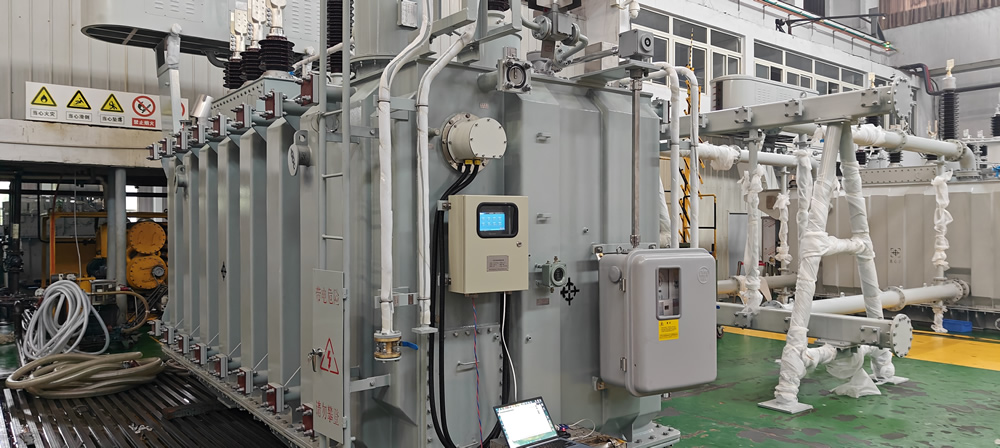
INNO fiber optic temperature sensors and transformer monitors are deployed globally across a wide range of industries.
7.1 Power Utilities and Substations
Both 110 kV and above power transformers benefit from winding hotspot monitoring, especially during peak load periods.
7.2 Data Centers
Dry-type transformers feeding critical IT loads require zero-tolerance thermal supervision to protect uptime SLAs.
7.3 Rail Transit
Traction transformers face vibration, confined spaces, and strong EMI — all scenarios where fiber optic sensing excels.
7.4 Oil, Gas, and Chemical Plants
Intrinsically safe fiber sensors are the only temperature technology approved for explosive atmospheres.
7.5 Renewable Energy
Wind farms and solar stations operate unmanned in remote locations, making remote online monitoring essential.
7.6 Steel and Heavy Industry
High harmonic content and strong magnetic fields demand EMI-immune sensing that PT100 probes cannot deliver.
8. INNO Transformer Monitoring Product Range
INNO manufactures dedicated solutions for both dry-type and oil-immersed transformers. Selecting the right model depends on the transformer type, installation space, and communication requirements.
8.1 Dry-Type Transformer Monitoring Products
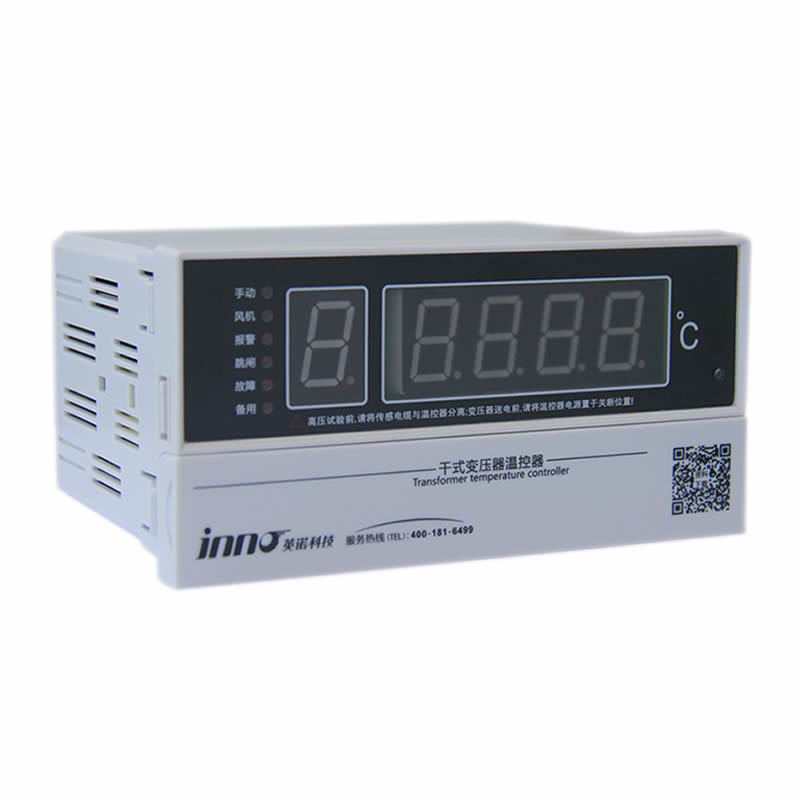
- Dry-type transformer temperature monitor BWDK-326
- Dry-type transformer temperature monitor BWDK-S3206
- Dry-type transformer temperature control box BWD-3KR
- Dry-type transformer temperature controller BWDK-PQ201
- Wall-mounted dry-type controller IB-L201
- Temperature controller for dry-type transformers in rail transit
8.2 Oil-Immersed Transformer Monitoring Products
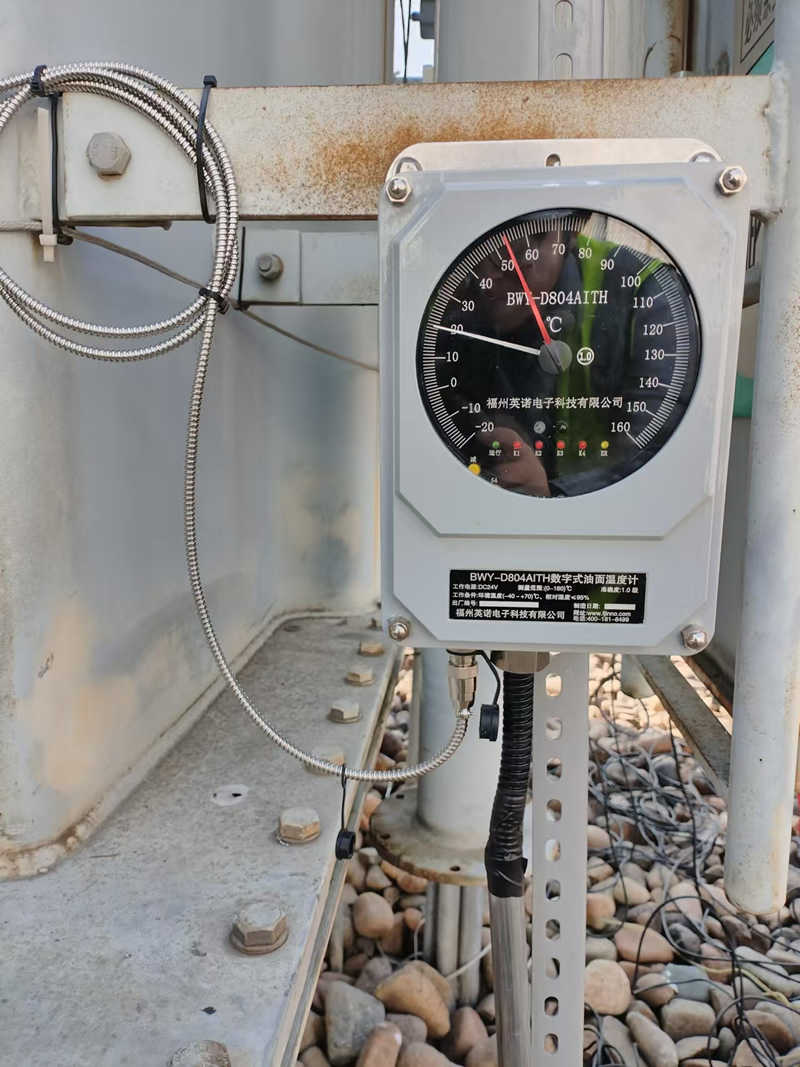
- BWR-04/06AJ(TH) oil-immersed winding temperature controller
- Oil level temperature sensor controller BWY-802(803)A
- Digital oil level thermometer BWY-D804AITH
- Transformer temperature, oil level, and pressure monitoring device
8.3 Fiber Optic Transformer Temperature Measurement Systems

For direct winding hotspot measurement, INNO offers a full range of transformer fiber optic temperature measurement products, including armored fluorescent fiber sensors for oil-immersed transformer windings, fiber optic temperature systems for dry-type transformer windings, multi-channel fiber optic temperature transmitters (up to 64 channels), and integrated display-and-host monitoring units.
8.4 Why Choose INNO

As a fiber optic temperature sensor manufacturer with 15+ years of industry experience, INNO maintains its own R&D center and production facility in Fuzhou, China. Every product is certified to CE and RoHS, backed by ISO 9001 / 14001 / 27001 / 45001 quality systems, and supported by a dedicated OEM/ODM team.
9. Frequently Asked Questions
Q1. What is transformer monitoring in simple terms?
It is the practice of continuously measuring a transformer’s temperature, oil level, partial discharge, and load status so that problems can be detected before they cause a failure or outage.
Q2. What is the difference between online and offline transformer monitoring?
Offline monitoring involves taking the transformer out of service for manual tests. Online monitoring runs continuously while the transformer is energized, providing real-time data without interrupting operation.
Q3. Why is winding hotspot temperature so important?
Winding insulation ages exponentially with temperature. A hotspot only 8 °C above the rated value can halve the transformer’s expected lifespan, so direct hotspot measurement is essential.
Q4. Can fiber optic sensors be installed in existing transformers?
Yes. Fiber optic probes can be retrofitted during factory overhauls or scheduled outages. INNO also supplies models designed for new-build OEM integration on the production line.
Q5. How does a fluorescent fiber optic sensor actually work?
A phosphor crystal at the tip of the fiber emits fluorescence when excited by a pulse of light. The decay time of that fluorescence changes with temperature, and the transmitter converts it into a precise temperature reading.
Q6. Is one monitoring system suitable for both dry-type and oil-immersed transformers?
The sensing principle is the same, but the mechanical design differs. Oil-immersed units require sealed, armored probes compatible with insulating oil, while dry-type units use probes designed for resin-cast or air-cooled windings.
Q7. How many fiber optic channels does a single transformer usually need?
Small distribution transformers may only need 3 – 6 channels, while large power transformers often use 12 – 24. INNO’s transmitter scales up to 64 channels on a single unit.
Q8. Does the monitoring system integrate with SCADA?
Yes. All INNO transmitters output data over RS485 Modbus RTU, which is widely supported by SCADA, DCS, and asset performance management platforms.
Q9. What certifications should a transformer monitoring system have?
Look for CE, RoHS, and ISO 9001 at a minimum. INNO products also meet ISO 14001, 27001, and 45001 standards.
Q10. How do I request a quotation or custom design?
Contact INNO via email at web@fjinno.net or WhatsApp at +86 135 9907 0393. Our engineering team will recommend the right solution based on your transformer type, voltage class, and monitoring goals.
About the Manufacturer

Fuzhou Innovation Electronic Scie&Tech Co., Ltd. (INNO), established in 2011, is a specialized manufacturer of fluorescent fiber optic temperature sensors and transformer monitoring systems. Products are exported to power utilities, data centers, rail transit, and industrial operators in more than 20 countries.
- Email: web@fjinno.net
- WhatsApp / WeChat / Phone: +86 13599070393
- QQ: 3408968340
- Address: Liandong U Grain Networking Industrial Park, No. 12 Xingye West Road, Fuzhou, Fujian, China
- Website: www.fjinno.net
Disclaimer
The information in this article is provided for general reference and educational purposes only. Technical specifications, product models, and certifications may be updated without prior notice. While every effort has been made to ensure accuracy, readers should verify current product details, ratings, and compliance requirements directly with Fuzhou Innovation Electronic Scie&Tech Co., Ltd. before making any purchasing or engineering decisions. INNO accepts no liability for losses arising from reliance on the general information presented here.

Fiber optic temperature sensor, Intelligent monitoring system, Distributed fiber optic manufacturer in China
 |
 |
 |