 INNO fibre optic temperature sensors ,temperature monitoring systems.
Table of Contents
- What Is a Transformer Partial Discharge Monitor
- Functions and Importance
- Main Components and Sensor Design
- How Partial Discharge Monitoring Works
- Types of Partial Discharge Monitors
- Performance Parameters and Specifications
- Standards and Compliance
- Installation and Maintenance
- Industrial and Utility Applications
- FAQ
- Conclusion
What Is a Transformer Partial Discharge Monitor
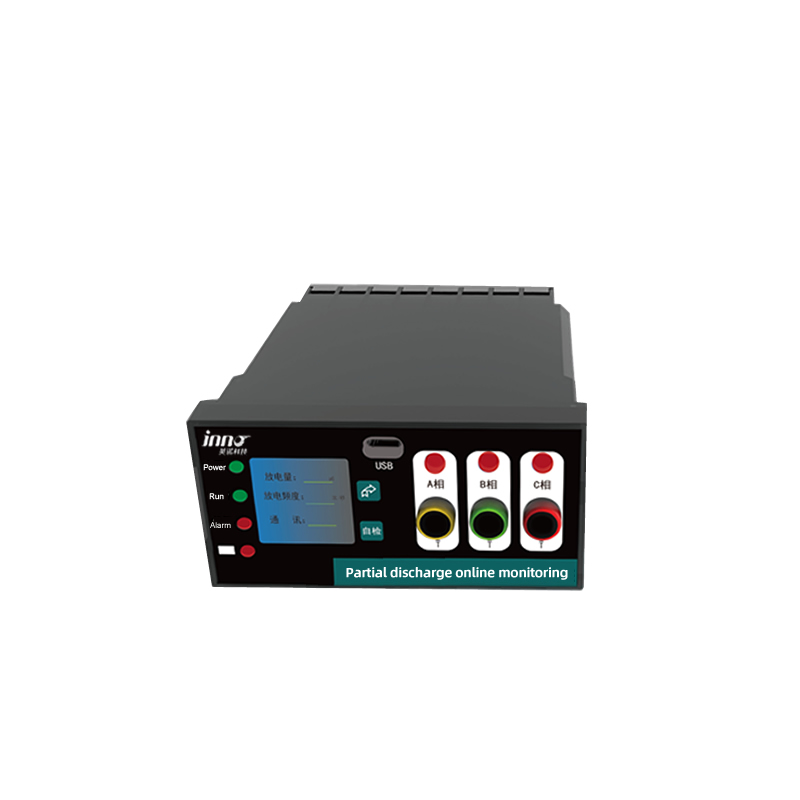
A transformer partial discharge monitor is a specialized system that continuously measures, analyzes, and records electrical activity caused by partial discharges inside a transformer’s insulation structure. The monitoring system uses sensors such as ultrasonic sensors, UHF sensors, and HFCT (High-Frequency Current Transformers) to detect and locate discharge sources. By analyzing pulse magnitude, repetition rate, and frequency characteristics, the system determines insulation health and indicates potential failure risks before serious damage occurs.
Modern PD monitors integrate online data acquisition, digital filtering, signal classification, and remote diagnostics through SCADA or IoT platforms. They are widely used in high-voltage substations, industrial power systems, and renewable energy transformers where continuous condition monitoring is essential for reliability and predictive maintenance.
Functions and Importance
- Continuous detection of partial discharge activity in transformer insulation and bushings.
- Classification of PD signals to distinguish internal, surface, corona, and external noise sources.
- Real-time trend analysis for maintenance decision-making and life extension planning.
- Remote monitoring and cloud-based data management for multi-site transformer fleets.
- Compliance with IEC 60270 and IEC 62478 standards for partial discharge measurement and diagnostics.
By integrating PD monitoring into transformer asset management, operators can identify aging insulation, detect early-stage degradation, and prevent high-cost failures. The system reduces the risk of fire, oil breakdown, and power interruptions.
Transformer Partial Discharge Monitor Components and PD Sensor Design

A complete transformer partial discharge monitoring system consists of sensors, coupling devices, acquisition units, and analysis software. Each element plays a critical role in capturing and interpreting partial discharge signals generated inside power transformers.
UHF Partial Discharge Sensor
The UHF PD sensor detects electromagnetic pulses emitted during discharge events within the transformer tank. These signals, typically in the range of 300 MHz to 1.5 GHz, are immune to electrical noise and ideal for GIS-type transformers. UHF sensors can be flange-mounted or embedded into inspection windows to ensure long-term stability and waterproof protection.
HFCT (High-Frequency Current Transformer) Sensor
The HFCT sensor measures PD-related high-frequency currents traveling along transformer grounding cables. It provides accurate phase-resolved partial discharge (PRPD) patterns for noise separation and event classification. HFCT-based systems are widely adopted for online partial discharge monitoring without transformer shutdown.
Ultrasonic and Acoustic PD Sensors
Ultrasonic PD sensors capture sound waves caused by gas bubble formation and micro discharges inside the oil or solid insulation. They offer precise localization of defect points when combined with acoustic triangulation. Many PD diagnostic systems integrate both acoustic and electrical detection to improve reliability and eliminate false alarms.
Data Acquisition and Digital Processing Unit
The monitoring unit amplifies, filters, and digitizes PD pulses with high-resolution ADCs. Advanced algorithms identify discharge patterns, pulse repetition rates, and energy levels, allowing accurate trending and fault prediction. Industrial designs often feature Ethernet, Modbus TCP, or IEC 61850 communication interfaces for seamless SCADA integration.
How Transformer Partial Discharge Monitoring Works
A partial discharge monitor detects and analyzes short-duration current or electromagnetic pulses caused by localized insulation breakdowns. When a PD occurs, a small amount of energy is released in the form of electrical, acoustic, and electromagnetic waves. The sensors capture these pulses and convert them into measurable signals. The acquisition unit timestamps and classifies the signals using phase-resolved PD analysis to identify discharge types and sources.
The system continuously monitors PD activity and sends real-time data to control centers or cloud dashboards. Trending analysis enables predictive maintenance, identifying degradation long before insulation failure. Modern PD monitoring devices include adaptive noise suppression, AI-based classification, and thermal correlation to enhance accuracy under variable load conditions.
Signal Processing and Noise Rejection
One of the major challenges in PD monitoring is distinguishing true discharge signals from electrical noise. Advanced PD monitoring systems employ digital filtering, cross-channel correlation, and pattern recognition to isolate valid PD events. These techniques ensure reliable results even in substations with heavy electromagnetic interference.
Types of Transformer Partial Discharge Monitoring Systems

Different monitoring architectures are available depending on transformer size, voltage class, and application. Selecting the right partial discharge detection system ensures cost-effective maintenance and reliable asset protection.
Offline Partial Discharge Test Equipment
Offline systems perform PD measurements during scheduled maintenance with the transformer de-energized. These setups use high-voltage test equipment and couplers to assess insulation quality. Although not continuous, they provide accurate baseline data for condition assessment.
Online Partial Discharge Monitoring System
Online PD monitoring systems operate while the transformer remains energized, providing continuous insulation health data. These systems use HFCT sensors, UHF couplers, and digital recorders to detect discharge patterns without disrupting service. They are ideal for mission-critical transformers in substations, industrial plants, and renewable energy farms.
Portable PD Detection Device
Portable partial discharge detectors combine compact HFCT sensors and handheld analyzers. They are used for quick field inspections and early fault detection across multiple transformers. Portable PD test kits help maintenance engineers locate emerging defects cost-effectively.
Integrated PD Monitoring with DGA and Temperature Systems
Advanced monitoring platforms integrate partial discharge monitoring with dissolved gas analysis (DGA) and fiber optic temperature sensors. Combining these technologies provides a complete transformer health picture and improves diagnostic confidence.
| System Type | Monitoring Mode | Advantages | Typical Application |
|---|---|---|---|
| Offline PD Test Equipment | Maintenance interval testing | High precision and baseline evaluation | Factory or laboratory testing |
| Online PD Monitoring System | Continuous monitoring | Real-time diagnostics and alerts | Substations, renewable energy transformers |
| Portable PD Detection Device | On-site measurement | Quick inspection and mobility | Field testing and maintenance teams |
| Integrated Monitoring Platform | Combined PD, DGA, temperature | Comprehensive transformer condition insight | Smart grid and asset management systems |
Performance Parameters and Specifications for Transformer Partial Discharge Monitors

The performance of a transformer partial discharge monitor depends on its sensitivity, dynamic range, frequency response, and immunity to interference. Understanding these parameters ensures that asset managers and manufacturers can select the most suitable PD monitoring system for their transformers.
- Sensitivity: Detectable PD levels typically range from 1 to 10 pC for laboratory setups and 10 to 100 pC for online monitoring systems.
- Bandwidth: UHF sensors cover 300 MHz to 1.5 GHz, while HFCT sensors capture 100 kHz to 50 MHz signals.
- Sampling Rate: High-speed ADCs operating above 100 MS/s are required for accurate pulse waveform reconstruction.
- Dynamic Range: Up to 80 dB for distinguishing weak PD signals from background noise.
- Synchronization: Phase reference input (from voltage or current) for PRPD pattern generation.
- Storage and Data Rate: Local and remote data storage with secure Ethernet or fiber communication links.
- Environmental Rating: Operating temperature −20°C to +70°C; IP65 housing for outdoor transformers.
Procurement engineers should request calibration certificates and accuracy verification data according to IEC 60270 when purchasing partial discharge monitoring equipment.
International Standards and Compliance for Transformer PD Monitoring Devices
Reliable partial discharge detection systems must comply with recognized international standards to ensure measurement accuracy and safety. The following standards govern performance, testing, and installation practices for transformer PD monitors.
- IEC 60270: Measurement of Partial Discharges – defines test circuits, calibration, and sensitivity requirements.
- IEC 62478: On-line PD measurement and interpretation guidelines for high-voltage equipment.
- IEC 60076-3: Power transformer insulation and dielectric test procedures.
- IEEE Std C57.127: Online monitoring of transformer insulation systems.
- IEC 61010-1: Safety requirements for measurement, control, and laboratory equipment.
- CE and RoHS: Environmental and safety conformity for exported monitoring systems.
Manufacturers should include test certificates, calibration records, and traceable documentation with every PD monitoring device. These documents help ensure compliance and build confidence for power utilities, OEMs, and maintenance contractors.
Installation and Maintenance of Transformer Partial Discharge Monitoring Systems
Installing a transformer partial discharge monitoring system requires careful planning to minimize noise and ensure sensor accuracy. Proper installation allows reliable long-term operation and accurate trend data.
Sensor Placement and Coupling
Position HFCT sensors on transformer grounding cables, ensuring tight coupling and correct polarity. Mount UHF sensors on tank inspection windows or GIS flanges with secure sealing. Place ultrasonic sensors on tank walls or in oil valves using acoustic couplers.
Signal Cabling and Shielding
Use double-shielded coaxial or twisted-pair cables to prevent interference. Maintain consistent grounding and avoid routing signal lines parallel to high-voltage cables.
Maintenance and Calibration
Periodically verify system sensitivity, calibrate input channels, and check sensor tightness. Replace or clean connectors if corrosion appears. Keep firmware updated for signal processing improvements.
Applications of Transformer Partial Discharge Monitoring and PD Diagnostic Systems
The transformer partial discharge monitor is widely deployed in power generation, transmission, and industrial networks. It serves as a key component in digital substation automation and predictive maintenance frameworks.
- High-voltage substations: Continuous insulation condition monitoring of critical power transformers.
- Renewable energy systems: Wind and solar step-up transformers with online PD diagnostics to reduce downtime.
- Industrial facilities: Monitoring of oil-immersed and dry-type transformers in refineries, mines, and steel plants.
- OEM and manufacturing: Integration of PD sensors into newly built transformers for factory acceptance testing.
- Smart grids and utilities: Multi-transformer network monitoring with cloud-based PD analytics and AI fault prediction.
Using an online partial discharge monitoring system allows operators to move from time-based to condition-based maintenance, optimizing resource allocation and transformer life cycle cost.
Frequently Asked Questions About Transformer Partial Discharge Monitors
What causes partial discharge in power transformers
Partial discharge is caused by insulation defects, voids, or contaminants that create local high electric fields. Over time, PD activity deteriorates insulation and can lead to failure if not monitored.
What are the main types of PD sensors used
Common sensor types include HFCT sensors for current pulses, UHF couplers for electromagnetic detection, and ultrasonic sensors for acoustic emissions. Combined systems improve detection reliability.
Can PD monitoring be applied to dry-type transformers
Yes, PD sensors and analyzers are available for dry-type transformers. Surface and corona discharge detection methods can be customized to match air-insulated applications.
What is the advantage of online PD monitoring over periodic testing
Online systems provide continuous data, early warnings, and automatic trend analysis without shutting down the transformer, improving reliability and reducing maintenance cost.
How can I choose the right PD monitoring system
Evaluate transformer voltage class, environment, and available installation points. Choose between UHF, HFCT, or ultrasonic PD monitors based on insulation type and accessibility.
Conclusion and Procurement Guidance for Transformer Partial Discharge Monitoring

A robust transformer partial discharge monitoring system helps detect early insulation degradation, prevent failures, and extend service life. Selecting the correct sensor configuration, compliance standard, and signal processing platform ensures reliable operation across industrial and utility transformers.
Our company supplies a complete range of PD monitoring devices, UHF and HFCT sensors, and online diagnostic systems with proven field performance. All models support integration with SCADA, DGA, and temperature systems for comprehensive transformer condition monitoring.
Visit our product pages to review specifications, datasheets, and pricing or contact us for technical proposals and customized transformer PD monitoring solutions designed for your project.

Fiber optic temperature sensor, Intelligent monitoring system, Distributed fiber optic manufacturer in China
 |
 |
 |