 INNO fibre optic temperature sensors ,temperature monitoring systems.
Table of Contents
Transformer Monitoring System Overview
A transformer monitoring system provides continuous condition data for power transformers, covering temperature, dissolved gas, partial discharge, load, voltage, current, and mechanical stress. By deploying an integrated transformer health monitoring platform with field sensors, acquisition hardware, and analytics software, utilities and industrial plants reduce failure risk, extend asset life, and plan maintenance based on real operating conditions rather than fixed intervals.
Manufacturers, EPC contractors, and operators can standardize on modular online transformer monitoring packages with scalable channels, open communication protocols, and cybersecurity options for digital substations and smart grid projects. View product specifications, model options, and pricing on our website and request a configuration matched to voltage class, cooling method, and substation architecture.
What Is a Transformer Monitoring System

A transformer monitoring system is a coordinated set of sensors, I/O modules, communication gateways, and analytics that measures critical indicators such as winding hot-spot temperature, top-oil temperature, dissolved gas-in-oil (DGA), moisture, partial discharge, bushing condition, load current, and mains voltage. Data is transmitted to SCADA, DCS, or a cloud dashboard for alarms, trending, and predictive diagnostics. Compared with manual inspections, an intelligent transformer monitoring solution captures transient events, correlates multi-sensor data, and provides actionable insights for protection and maintenance teams.
Core building blocks include field sensors, a rugged data acquisition unit, an industrial communication interface supporting Modbus TCP and IEC 61850, and a secure software layer for visualization and analytics. Systems are designed for substation environments with wide temperature range, high EMC immunity, and redundant power inputs.
Key Functions of a Transformer Monitoring System
- Temperature monitoring: continuous winding hot-spot temperature and top-oil tracking with alarms and interlocks
- DGA monitoring: online gas sensors or multi-gas chromatograph interfaces for insulation fault detection
- Partial discharge monitoring: UHF, HFCT, and acoustic sensors with PRPD analysis for defect localization
- Electrical load monitoring: current and voltage channels for load profiling, overload alarms, and thermal modeling
- Bushing and moisture monitoring: leakage current, tanδ interfaces, and oil or paper moisture sensors
- Event logging and analytics: trend analysis, rate-of-rise, rule-based alarms, and API export to enterprise systems
- SCADA integration: IEC 61850 MMS or GOOSE, DNP3, and Modbus TCP with user-defined points lists
Combine these capabilities into a unified transformer monitoring platform to improve reliability KPIs, enable condition-based maintenance, and support fleet-wide decision making. Product pages on our website provide channel counts, enclosure options, and pricing tiers for OEM supply and retrofit projects.
Winding Temperature Monitoring in Transformer Monitoring Systems
Winding temperature monitoring is the most decisive input for thermal aging models and load management. A robust transformer temperature monitoring system measures hot-spot temperature with high accuracy and electrical isolation, coordinates cooling stages, and issues alarms before insulation stress accelerates. For high-voltage environments and EMC-heavy sites, we recommend fluorescent fiber optic temperature sensors as the primary hot-spot solution, with RTD and thermal model backup where required.
Recommended Technologies for Winding Temperature Monitoring

| Monitoring Option | Key Features | Use Case | Pros | Considerations |
|---|---|---|---|---|
| Fluorescent fiber optic hot-spot sensors | Dielectric probes, EMI immune, multi-channel, direct winding placement, fast response | HV power transformers, EHV substations, renewables step-up units | Electrical isolation, accurate hot-spot, safe in high fields, minimal drift | Requires optical interrogator, specify probe length and IP-rated feedthroughs |
| RTD sensors (Pt100/Pt1000) | Top-oil measurement, flange installation, analog inputs | Distribution transformers, auxiliaries, retrofit sites | Cost-effective, widely supported by relays and PLCs | Susceptible to EMI and lead resistance; not a true hot-spot reading |
| Thermal model (IEC loading calculator) | Algorithm computes hot-spot from load current and top-oil temperature | Sites with limited sensor access or early-phase retrofits | Low hardware cost, quick deployment, supports trending | Model error under dynamic load; calibration needed against real sensors |
Why Specify Fluorescent Fiber Optic Hot-Spot Sensors
Fluorescent fiber optic hot-spot monitoring delivers direct winding measurements with complete electrical isolation and immunity to electromagnetic interference. Probes can be embedded near conductors, capturing rapid thermal transients during overloads or fault inception. In a modern transformer monitoring system, these channels drive cooling control, trigger staged fans and pumps, and provide reliable inputs to lifetime consumption models. For procurement, specify channel count, probe length, feedthrough type, interrogator accuracy, operating temperature, and IP rating. Product pages list models, accessories, and pricing for OEM and retrofit supply.
To build a balanced solution, pair fiber optic hot-spot sensors with top-oil RTDs and a calibrated thermal model. The combined approach gives accurate control during transients, stable trend data for analytics, and redundancy for operations and maintenance teams.
Components of a Transformer Monitoring System
The transformer monitoring system integrates multiple subsystems to form a complete real-time condition monitoring platform. These subsystems collect, process, and transmit key parameters that indicate transformer health, ensuring accurate diagnostics and safe operation across voltage levels.
Sensors and Transducers
Temperature sensors, DGA analyzers, partial discharge sensors, moisture probes, and current/voltage transducers are used to measure physical and electrical data. Optical fiber sensors, RTDs, and pressure transmitters convert physical changes into measurable signals for precise transformer assessment.
Data Acquisition Unit (DAU)
The data acquisition unit collects sensor outputs, performs A/D conversion, and applies digital filtering. It supports sampling rates up to 10 kS/s per channel, high EMC immunity, and wide operating temperature ranges. Built-in memory and redundant Ethernet ports ensure reliable data transfer even during communication loss.
Communication Gateway
The gateway provides connectivity using IEC 61850, Modbus TCP, and DNP3 protocols, making integration with SCADA or IoT platforms straightforward. Modern digital transformer monitoring systems support REST APIs and secure MQTT channels for cloud-based diagnostics and fleet management.
Monitoring Software Platform
The transformer diagnostic software visualizes operating parameters, generates trend graphs, and triggers predictive alerts. Cloud dashboards consolidate multiple sites, applying analytics such as temperature correlation, PD pattern recognition, and oil degradation modeling. Role-based user access ensures cybersecurity compliance.
How a Transformer Monitoring System Works
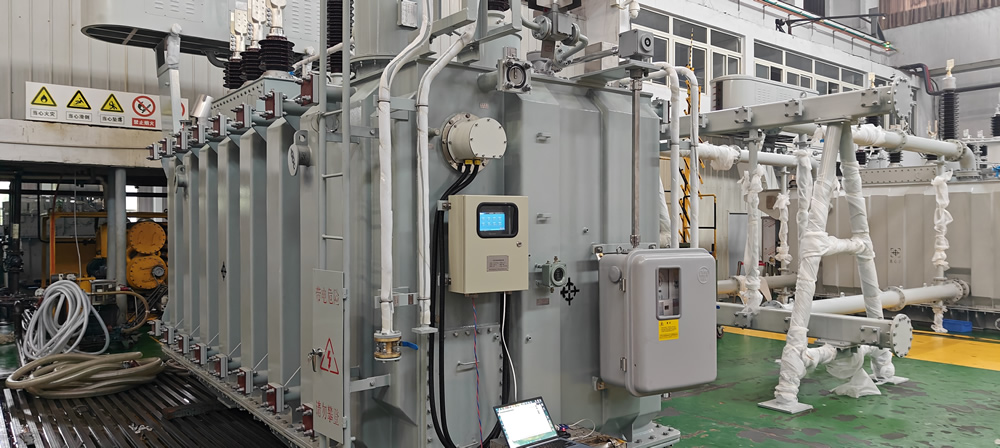
An online transformer monitoring system functions as a continuous feedback loop, capturing, transmitting, analyzing, and acting upon real-time operational data. The workflow consists of four core stages:
- Data Acquisition: Sensors measure thermal, electrical, and chemical parameters continuously or at defined intervals.
- Data Transmission: Collected data is transferred via wired or wireless protocols to a centralized database or monitoring platform.
- Data Analysis: Algorithms evaluate trends, detect anomalies, and predict faults using correlation and AI-assisted models.
- Action and Control: The system triggers cooling fans, pumps, or alarms when thresholds are exceeded and provides insights for maintenance scheduling.
Data Flow in a Smart Transformer Monitoring Platform
Within a smart transformer condition monitoring system, each sensor’s signal is time-stamped, synchronized with voltage phase data, and transmitted to the analytics layer. The platform correlates winding temperature, gas levels, partial discharge intensity, and load current to assess insulation stress and remaining service life. Operators can access dashboards through web interfaces or mobile apps for rapid decision-making.
Some systems also integrate machine learning models to classify faults and recommend corrective actions. Cloud-based architectures enable multi-site comparison, predictive alerts, and maintenance cost optimization.
Types of Transformer Monitoring Systems
Different transformers require specific monitoring architectures depending on voltage class, insulation medium, and operational importance. The following are the main categories of transformer monitoring systems used across industrial and utility sectors.
Offline Diagnostic Monitoring
Offline systems operate when the transformer is de-energized. They include portable DGA analyzers, offline PD testers, and thermal cameras for inspection. These systems are typically used for periodic maintenance or factory acceptance tests.
Online Continuous Monitoring
Online transformer monitoring systems record data 24/7, capturing transient faults and long-term degradation patterns. They integrate multiple sensors, from fiber optic temperature probes to DGA sensors and PD detectors. Online systems form the foundation for predictive maintenance programs and digital substations.
Integrated Multi-Parameter Monitoring
This category combines temperature, DGA, PD, vibration, and moisture monitoring into one modular platform. Data from all subsystems is processed by a unified DAU and visualized through a centralized HMI. Integrated systems enable asset managers to correlate parameters and identify complex fault mechanisms.
IoT and Cloud-Based Monitoring Platforms
Modern IoT transformer monitoring systems use wireless communication, edge computing, and cloud analytics to manage transformer fleets remotely. These systems reduce on-site workload, offer remote firmware updates, and integrate with asset management platforms for complete lifecycle tracking.
| System Type | Monitoring Scope | Data Availability | Best Use Case | Advantages |
|---|---|---|---|---|
| Offline Diagnostic | Temperature, DGA, insulation | Manual testing during outage | Factory or maintenance workshop | High accuracy, detailed analysis |
| Online Continuous | Temperature, DGA, PD, load | Real-time | Critical transformers, substations | Predictive maintenance, no downtime |
| Integrated Multi-Parameter | Thermal, electrical, chemical | Continuous and logged | Utility fleets, industrial plants | Comprehensive diagnostics, single platform |
| IoT Cloud-Based | All key parameters via wireless | Remote, multi-site access | Distributed power networks | Fleet analytics, reduced on-site labor |
Technical Specifications and Compliance for Transformer Monitoring Systems
The transformer monitoring system operates as a high-reliability industrial platform built for power utility and OEM environments. Typical specifications are summarized below to guide procurement engineers and project designers.
| Parameter | Typical Specification | Description |
|---|---|---|
| Power Supply | 24 VDC / 110–220 VAC | Wide input range with surge protection and redundant supply |
| Input Channels | Up to 64 analog + 32 digital | Supports temperature, DGA, PD, vibration, and electrical signals |
| Sampling Rate | Up to 10 kS/s per channel | High-speed data acquisition for transient events |
| Communication | IEC 61850, Modbus TCP, DNP3, MQTT | Compatible with SCADA and cloud-based monitoring |
| Operating Temperature | −20°C to +70°C | Suitable for outdoor substations and industrial plants |
| Ingress Protection | IP65 | Weatherproof aluminum housing for harsh conditions |
| Compliance Standards | IEC 60076, IEC 61850, IEEE C57, CE, RoHS | Ensures interoperability and safety certification |
All transformer monitoring units are factory-tested for electrical safety, EMC, and thermal endurance. Calibration certificates and acceptance test reports are provided for project documentation.
Installation and Maintenance of Transformer Monitoring Systems
Installing a transformer monitoring system requires coordination between electrical engineers, instrumentation specialists, and network technicians. Proper installation ensures signal accuracy, system stability, and long-term performance.
Installation Guidelines
- Mount DAU and power modules near the transformer control cabinet in a ventilated area.
- Route sensor cables through shielded conduits and maintain proper grounding.
- Verify IP ratings and use stainless-steel glands for outdoor installations.
- Integrate the system into existing SCADA networks via secure Ethernet or fiber channels.
Maintenance and Calibration
- Perform calibration of temperature and DGA sensors annually.
- Update firmware periodically to maintain cybersecurity compliance.
- Inspect cable insulation, connectors, and DAU terminals for wear or oxidation.
- Download and back up historical data logs to prevent information loss.
Manufacturers usually offer on-site commissioning, training, and after-sales calibration services. Proper maintenance guarantees accuracy and reduces operational downtime.
Applications and Industries Using Transformer Monitoring Systems
The transformer monitoring system is deployed in diverse electrical networks where reliability and predictive diagnostics are critical. Below are key industry segments utilizing these systems.
- Power utilities: HV and EHV transformers in transmission and distribution substations.
- Renewable energy: Wind farm and solar step-up transformers with remote monitoring.
- Industrial manufacturing: Steel plants, petrochemical complexes, and paper mills using smart monitoring for mission-critical equipment.
- Rail and metro systems: Traction and auxiliary transformers monitored for overload and temperature rise.
- Data centers and hospitals: Critical load transformers with real-time condition monitoring and alarm integration.
Utilities increasingly require digital transformer monitoring systems with integrated AI analytics for asset health indexing, fault prediction, and fleet optimization. Our solutions meet these needs through modular design and proven field reliability.
FAQ – Transformer Monitoring System
What parameters can a transformer monitoring system measure?
It measures winding and oil temperatures, dissolved gas levels, partial discharge, current, voltage, and load. Optional sensors cover bushing condition, vibration, and moisture in oil.
What communication protocols are supported?
Most systems support IEC 61850, Modbus TCP, DNP3, and cloud-based MQTT, making integration with SCADA and IoT platforms easy.
Why use online transformer monitoring instead of manual inspection?
Online systems provide continuous data, early warnings, and fault prediction without outages, improving asset availability and lowering maintenance costs.
Is fiber optic technology recommended for temperature measurement?
Yes, fluorescent fiber optic sensors offer direct winding hot-spot measurement with electrical isolation and EMI immunity, ideal for HV applications.
Can the system be customized for OEM transformers?
Absolutely. Monitoring modules can be integrated during transformer manufacturing with tailored firmware, channel allocation, and communication mapping.
Conclusion and Procurement Guidance
A comprehensive transformer monitoring system forms the foundation of digital substations and smart power networks. By combining thermal, electrical, and chemical diagnostics, operators gain real-time insight into transformer health and operational efficiency.
Our company designs and manufactures transformer monitoring units, fiber optic temperature systems, DGA analyzers, and PD detection modules for OEM integration and field retrofits. Each product meets IEC and IEEE standards and supports scalable communication options for advanced grid management.
Visit our product catalog to review model specifications, datasheets, and pricing tiers. Contact our technical support team to discuss project requirements, integration details, and OEM supply partnerships for your next transformer monitoring solution.

Fiber optic temperature sensor, Intelligent monitoring system, Distributed fiber optic manufacturer in China
 |
 |
 |