 INNO fibre optic temperature sensors ,temperature monitoring systems.
- The distributed fiber optic temperature sensing technique (DTS) uses an ordinary optical fiber as both the signal transmission medium and the sensing element, enabling continuous temperature measurement along the entire fiber length — from tens of meters to over 50 km — with spatial resolution as fine as 0.5 m.
- Distributed fiber optic temperature sensors are based on three core scattering technologies: Raman optical time-domain reflectometry (Raman OTDR), Brillouin scattering analysis, and distributed fiber-optic temperature sensing using Rayleigh backscatter, each offering different trade-offs in range, resolution, and measurement speed.
- A distributed optical fiber line type temperature detector system — also called a distributed optical fiber line type temperature monitoring system — integrates a laser source, photodetector, signal processor, and alarm controller into a single unit that transforms a standard optical fiber cable into thousands of continuous sensing points.
- The distributed optical fiber linear temperature alarm sensor is widely deployed for fire detection in tunnels, cable trays, conveyor belts, warehouses, and petrochemical facilities, providing real-time zone-based temperature alarms along linear assets.
- The distributed fiber optic temperature strain sensor market continues to expand rapidly, driven by demand in oil and gas, power infrastructure, civil structural health monitoring, and industrial safety applications worldwide.
Table of Contents
- What Is the Distributed Fiber Optic Temperature Sensing Technique
- Core Scattering Technologies Behind DTS
- System Architecture: Distributed Optical Fiber Line Type Temperature Detector System
- Key Advantages of Distributed Fiber Optic Temperature Sensors
- Major Application Scenarios
- How the Distributed Fiber Optic Temperature Strain Sensor Market Is Evolving
- How to Select a Distributed Optical Fiber Temperature Detector Manufacturer and Supplier
- FAQs About Distributed Fiber Optic Temperature Sensing Technique
1. What Is the Distributed Fiber Optic Temperature Sensing Technique

The distributed fiber optic temperature sensing technique is a measurement method that uses an optical fiber itself as a continuous, linear temperature sensor. Unlike point sensors — thermocouples, RTDs, or even single-point fiber optic sensors — a distributed system measures temperature at every location along the fiber simultaneously. A single optical fiber cable running 10 km through a tunnel, for example, provides the equivalent of thousands of individual temperature sensors spaced every 0.5 m to 2 m along its entire length.
The fundamental principle is optical scattering. When a laser pulse is launched into an optical fiber, a small fraction of the light is scattered backward at every point along the fiber due to interactions with the glass molecules and microscopic density fluctuations. The spectral and temporal properties of this backscattered light carry information about the local temperature (and, in some configurations, strain) at each scattering point. By analyzing the returned signal as a function of time — which corresponds directly to distance along the fiber — the system constructs a complete temperature profile of the entire fiber path.
This technique was first demonstrated in the 1980s and has since matured into a family of commercially available products. Today, distributed fiber optic temperature sensors are standard instrumentation in oil and gas well monitoring, power cable thermal management, fire detection, pipeline leak detection, and structural health monitoring. The core hardware that performs this measurement is commonly referred to as a distributed optical fiber line type temperature detector or a distributed optical fiber linear temperature sensing device, reflecting its ability to provide continuous linear temperature coverage along the fiber route.
2. Core Scattering Technologies Behind DTS

Raman OTDR — The Industry Standard for Temperature-Only Measurement
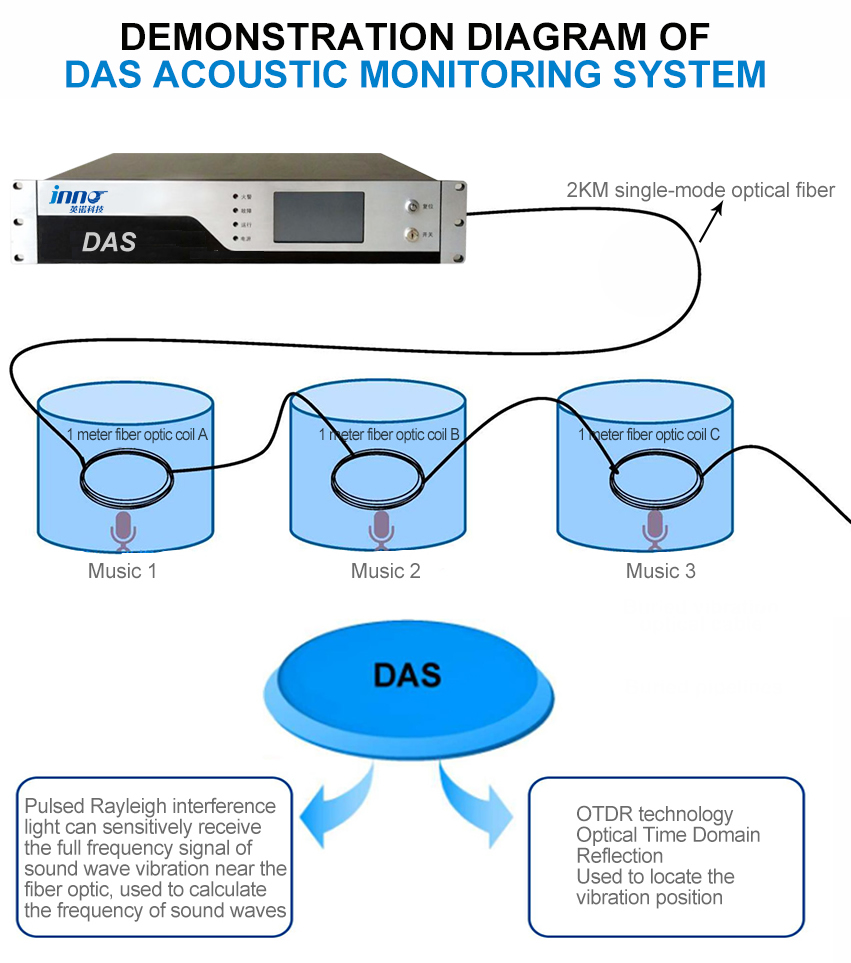
Raman-based optical time-domain reflectometry (OTDR) is the most widely used technology in commercial distributed optical fiber line type temperature monitoring devices. When a laser pulse travels through an optical fiber, it interacts with molecular vibrations in the glass, producing Raman-scattered light at two distinct wavelength bands: the Stokes component (longer wavelength, lower energy) and the Anti-Stokes component (shorter wavelength, higher energy). The intensity of the Anti-Stokes component is strongly temperature-dependent, while the Stokes component is relatively temperature-insensitive. By measuring the ratio of Anti-Stokes to Stokes intensity at each time delay (i.e., at each point along the fiber), the system calculates the local temperature.
Raman OTDR systems typically offer a measurement range of 4 km to 30 km, spatial resolution of 0.5 m to 2 m, temperature accuracy of ±0.5 °C to ±1 °C, and measurement times of seconds to minutes depending on the desired signal-to-noise ratio. The Raman signal is relatively weak — roughly 30 dB below the Rayleigh backscatter level — so averaging over multiple laser pulses is necessary, which limits the measurement speed. However, for most fire detection, cable monitoring, and process applications, this speed is entirely adequate. Raman OTDR is the technology inside the vast majority of distributed optical fiber line type temperature monitoring systems and distributed optical fiber linear temperature alarm sensors sold worldwide.
Brillouin Scattering — Combined Temperature and Strain Sensing
Brillouin-based distributed sensing exploits the interaction between the laser pulse and acoustic phonons (sound waves) in the fiber. The frequency shift of the Brillouin-scattered light is linearly proportional to both temperature and strain applied to the fiber. This dual sensitivity makes Brillouin systems the technology of choice for the distributed fiber optic temperature strain sensor market, where simultaneous measurement of temperature and mechanical strain along structures such as pipelines, bridges, dams, and buildings is required.
Two main Brillouin techniques exist. Brillouin Optical Time-Domain Reflectometry (BOTDR) uses a single fiber end and analyzes spontaneous Brillouin scattering — simpler to deploy but with lower spatial resolution (typically 1–2 m) and moderate accuracy (±1 °C, ±20 µε). Brillouin Optical Time-Domain Analysis (BOTDA) uses access to both ends of the fiber and employs stimulated Brillouin scattering — delivering superior spatial resolution (as fine as 0.1 m with advanced coding techniques), longer range (up to 100 km or more), and better accuracy (±0.5 °C, ±10 µε), but requiring a loop fiber configuration.
Brillouin systems typically measure over ranges of 10 km to 100+ km with spatial resolution of 0.1 m to 2 m. Their measurement time is generally longer than Raman systems — from seconds to several minutes — making them better suited for slow-changing structural monitoring than for fast fire detection applications.
Distributed Fiber-Optic Temperature Sensing Using Rayleigh Backscatter

Distributed fiber-optic temperature sensing using Rayleigh backscatter represents the highest-resolution distributed measurement technology available. Rayleigh scattering arises from random microscopic variations in the fiber’s refractive index that are frozen into the glass during manufacturing. These variations create a unique and stable backscatter pattern — effectively a “fingerprint” — for each fiber. When temperature (or strain) changes at any location, the local fingerprint shifts in a predictable way.
Optical Frequency-Domain Reflectometry (OFDR) is the technique used to interrogate Rayleigh backscatter with extremely fine spatial resolution. By sweeping a tunable laser across a range of optical frequencies and performing a cross-correlation between a reference scan (at known temperature) and a measurement scan, the system determines the local temperature change at each point along the fiber. Rayleigh OFDR achieves spatial resolution as fine as 1 mm to 10 mm — orders of magnitude better than Raman or Brillouin systems — with temperature resolution of ±0.1 °C. However, the measurement range is limited to approximately 50 m to 70 m for millimeter-level resolution, extending to 2 km at centimeter-level resolution.
This makes distributed fiber-optic temperature sensing using Rayleigh backscatter ideal for short-range, high-density applications such as composite material curing, battery pack thermal mapping, medical device thermal profiling, semiconductor process monitoring, and aerospace component testing. It is less suitable for long-distance infrastructure monitoring where Raman or Brillouin technologies dominate.
Technology Comparison Table
| Parameter | Raman OTDR | Brillouin BOTDR/BOTDA | Rayleigh OFDR |
|---|---|---|---|
| Measurement Range | 4–30 km | 10–100+ km | 50 m–2 km |
| Spatial Resolution | 0.5–2 m | 0.1–2 m | 1 mm–10 cm |
| Temperature Accuracy | ±0.5 °C to ±1 °C | ±0.5 °C to ±1 °C | ±0.1 °C |
| Strain Measurement | No | Yes | Yes |
| Measurement Speed | Seconds to minutes | Seconds to minutes | Seconds |
| Primary Application | Fire detection, cable monitoring | Structural health, pipeline | Short-range precision |
| Fiber Type | Standard multimode | Standard single-mode | Standard single-mode |
| Relative Cost | Medium | High | High |
3. System Architecture: Distributed Optical Fiber Line Type Temperature Detector System
Main Components
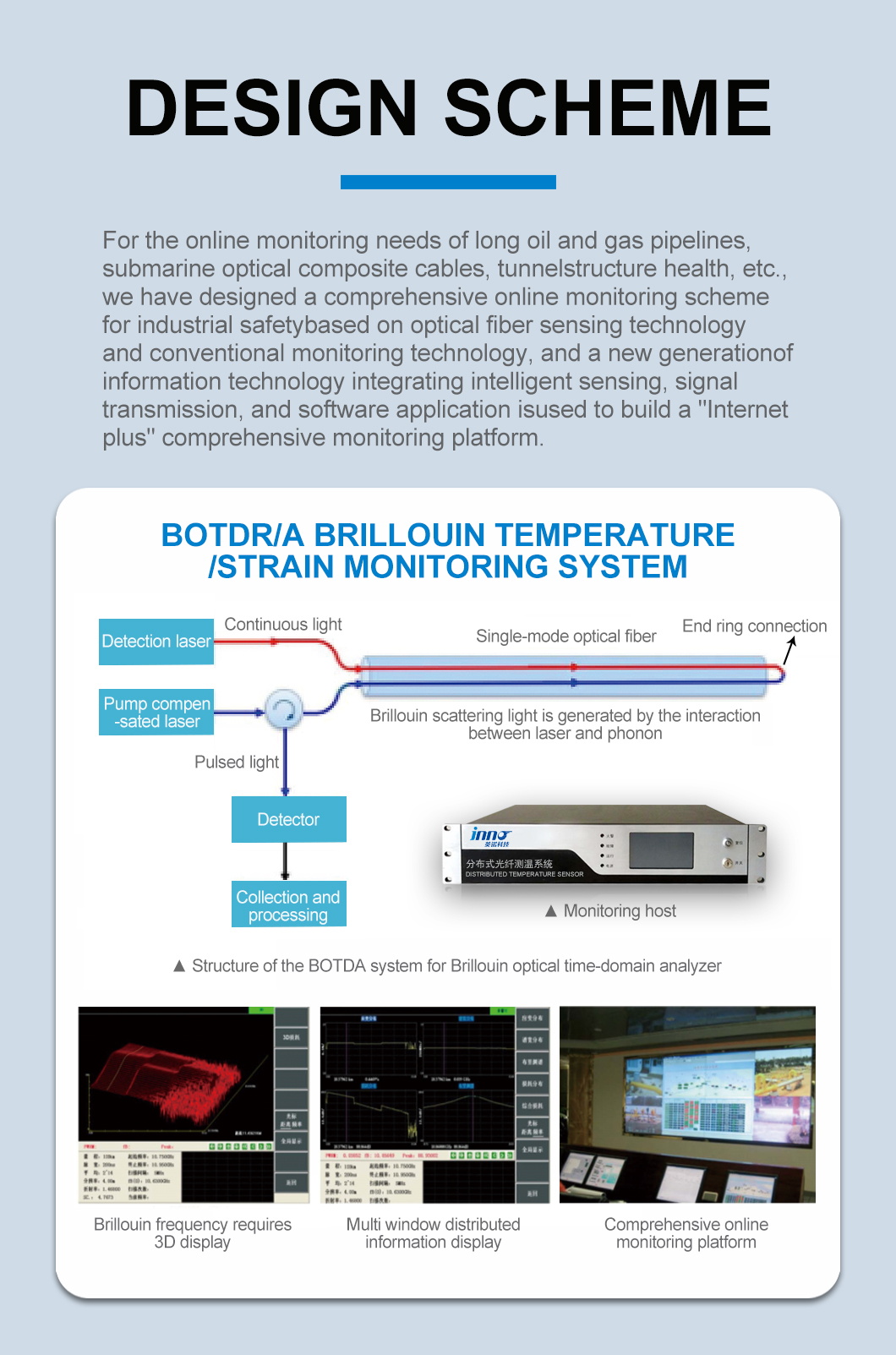
A complete distributed optical fiber line type temperature detector system consists of several integrated components working together. The interrogator unit — the main hardware box — contains a pulsed laser source, optical splitters and filters, one or more photodetectors, a high-speed analog-to-digital converter (ADC), and a digital signal processing (DSP) module. The laser fires short pulses (typically 1–100 ns duration) into the sensing fiber, and the photodetectors capture the backscattered light returning from every point along the fiber. The DSP module processes the time-resolved backscatter signal to extract temperature information at each spatial resolution cell.
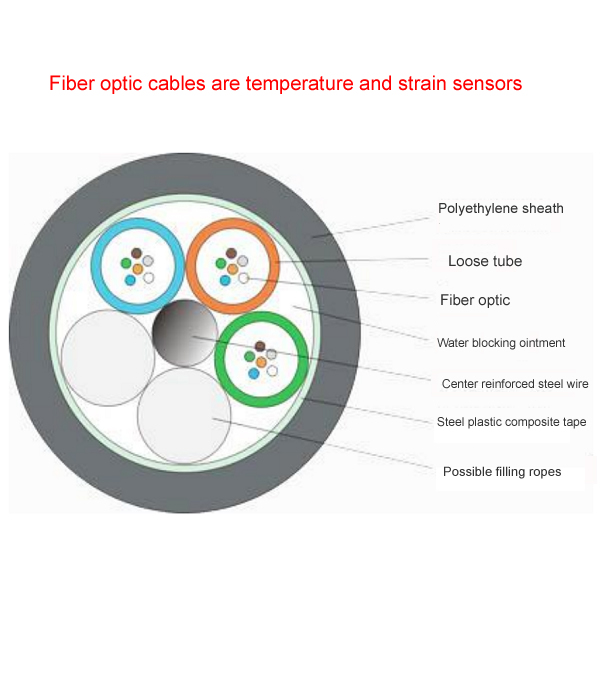
The sensing cable is the second critical component. For most industrial applications, the optical fiber is housed in a ruggedized cable with protective jacketing appropriate for the installation environment — stainless steel tubing for high-temperature or corrosive environments, armored loose-tube cable for direct burial, and flame-retardant LSZH (Low Smoke Zero Halogen) cable for tunnel and building installations. The fiber itself is typically standard 50/125 µm graded-index multimode fiber for Raman systems or 9/125 µm single-mode fiber for Brillouin and Rayleigh systems.
Software, Alarm, and Integration Layer
The distributed optical fiber line type temperature monitoring system includes application software that displays the real-time temperature profile along the fiber, defines alarm zones, sets temperature thresholds, records historical data, and generates alarm outputs. For fire detection applications, the distributed optical fiber linear temperature alarm sensor function is critical — the software divides the fiber route into zones (e.g., every 5 m or every room) and triggers alarms when the temperature in any zone exceeds a preset threshold or when the rate of temperature rise exceeds a defined limit.
Alarm outputs typically include relay contacts, 4–20 mA analog signals, Modbus TCP/RTU, OPC UA, and integration with building management systems (BMS), SCADA platforms, and fire alarm control panels. The system provides both absolute temperature alarms and rate-of-rise alarms — the former detects sustained overheating (e.g., a cable hot spot), while the latter detects rapid temperature increases characteristic of fire events.
Typical System Specifications
| Specification | Standard DTS System | High-Performance DTS System |
|---|---|---|
| Sensing Range | 4–8 km per channel | 10–30 km per channel |
| Number of Channels | 1–2 | 2–8 |
| Spatial Resolution | 1 m | 0.5–1 m |
| Temperature Resolution | ±1 °C (at 4 km, 60 s averaging) | ±0.5 °C (at 10 km, 60 s averaging) |
| Temperature Range | −40 °C to +120 °C (standard cable) | −40 °C to +300 °C (high-temp cable) |
| Measurement Time | 5–60 seconds | 1–60 seconds |
| Alarm Zones | Up to 256 | Up to 1024+ |
| Communication | Modbus, Relay contacts | Modbus, OPC UA, SNMP, BACnet |
4. Key Advantages of Distributed Fiber Optic Temperature Sensors
Truly Continuous Sensing Over Long Distances
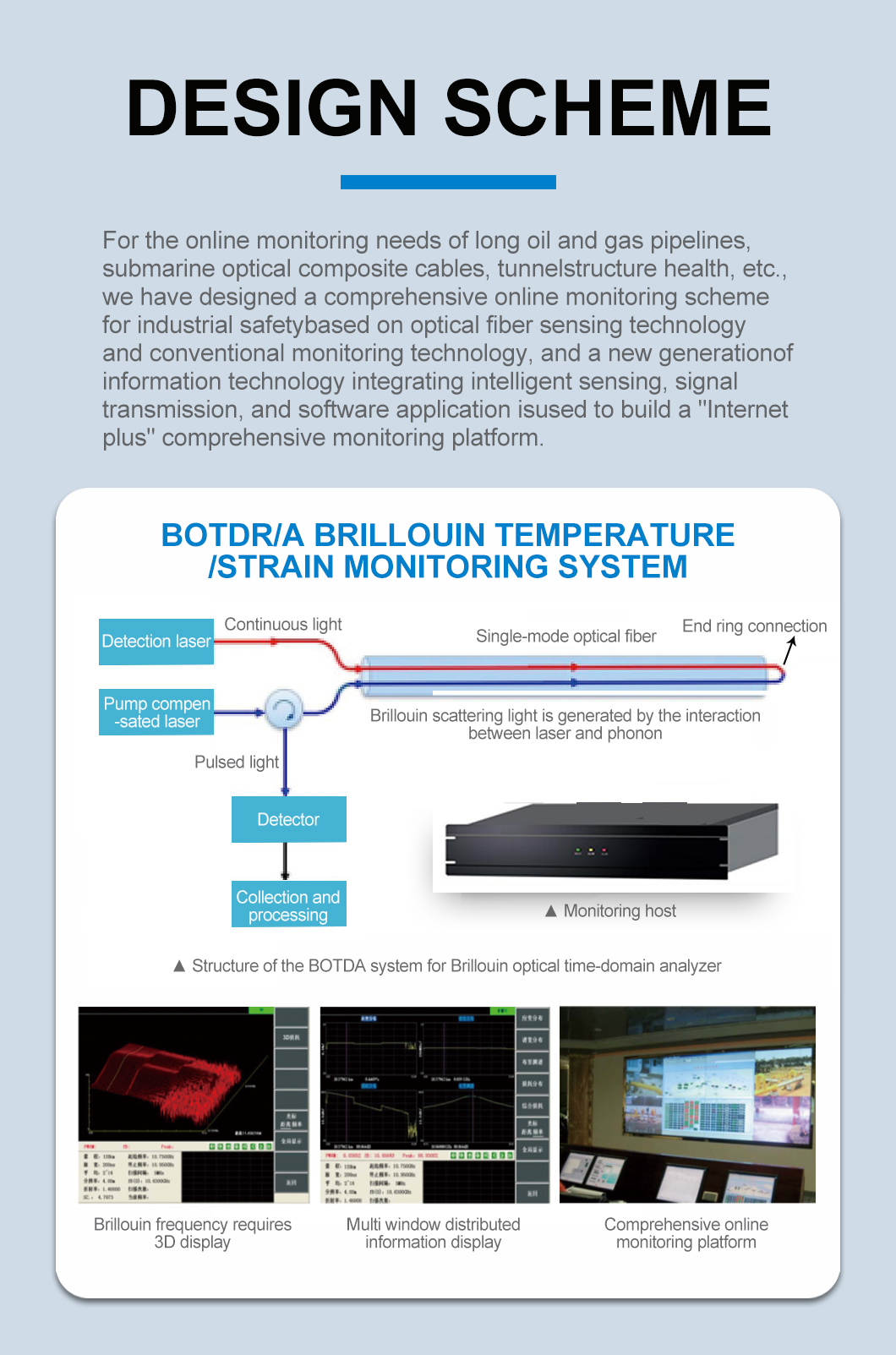
The most fundamental advantage of distributed fiber optic temperature sensors is that they transform the entire length of an optical fiber into a continuous sensing element. A single fiber can provide thousands of measurement points over distances up to tens of kilometers. Achieving equivalent coverage with conventional point sensors would require thousands of individual thermocouples or RTDs, each needing its own wiring, power supply, and data acquisition channel — an approach that is economically impractical and logistically impossible for most large-scale installations.
Passive, Intrinsically Safe Sensing Element
The sensing fiber is a completely passive, non-electrical element. It carries no current, generates no spark, and requires no power at the sensing location. This makes distributed optical fiber linear temperature sensing devices intrinsically safe for deployment in explosive atmospheres (ATEX/IECEx Zone 0, 1, 2) including oil refineries, chemical plants, gas pipelines, coal mines, and ammunition storage facilities. The interrogator unit can be located in a safe area kilometers away from the hazardous zone.
Immunity to Electromagnetic Interference
Optical fiber is entirely dielectric and immune to electromagnetic interference (EMI), radio frequency interference (RFI), lightning-induced surges, and ground loop problems. This makes distributed optical fiber line type temperature detectors ideal for installation alongside high-voltage power cables, in electrical substations, near large motors and transformers, and in any environment where electromagnetic noise renders conventional electronic sensors unreliable.
Long Lifespan and Low Maintenance
Standard telecom-grade optical fiber has a proven operational lifespan exceeding 25 years. There are no batteries to replace, no electronic components at the sensing point to fail, and no calibration drift from aging sensing elements. A distributed optical fiber line type temperature monitoring device installed in a tunnel or cable tray provides decades of reliable service with minimal maintenance — typically limited to periodic cleaning of optical connectors and software updates to the interrogator.
Cost-Effective at Scale
While the interrogator unit represents a significant upfront investment compared to individual point sensors, the cost per measurement point decreases dramatically as the sensing length increases. For a 10 km installation with 1 m spatial resolution, a distributed system provides 10,000 measurement points through a single low-cost optical fiber cable. The total cost of ownership — including installation, wiring, commissioning, and long-term maintenance — is substantially lower than any equivalent point-sensor network for large-scale temperature monitoring applications.
5. Major Application Scenarios
Fire Detection in Tunnels and Underground Facilities
The distributed optical fiber linear temperature alarm sensor has become the preferred fire detection technology for road tunnels, rail tunnels, metro systems, cable tunnels, and underground utility corridors. The sensing cable runs the full length of the tunnel, providing continuous temperature coverage with no blind spots. The system detects both localized hot spots (e.g., a vehicle engine fire) and distributed temperature rises (e.g., a tunnel ventilation failure). Zone-based alarms integrate directly with tunnel ventilation control, traffic management, and emergency response systems. The fiber’s immunity to vehicle exhaust, dust, moisture, and electromagnetic noise from traction power systems makes it far more reliable than conventional point-type heat detectors in tunnel environments.
Power Cable and Electrical Infrastructure Monitoring
Distributed optical fiber line type temperature monitoring systems are widely deployed along high-voltage underground power cables to measure the cable surface temperature profile in real time. Hot spots caused by deteriorating joints, overloaded sections, external heat sources, or inadequate backfill conditions are immediately identified and located. This data allows dynamic cable rating (DCR) — adjusting the allowable current loading based on actual thermal conditions rather than worst-case static assumptions — which can increase cable utilization by 10–30% without exceeding thermal limits. Sensing fibers are either integrated into the cable during manufacturing or installed in a separate conduit alongside the cable.
Oil and Gas Well and Pipeline Monitoring
Distributed fiber optic temperature sensors permanently installed in oil and gas wells provide continuous downhole temperature profiles used for flow profiling, injection monitoring, gas lift optimization, steam flood tracking, and leak detection. The fiber is typically deployed inside a control line or strapped to production tubing. In pipeline applications, a sensing cable buried alongside the pipeline detects temperature anomalies caused by product leaks (cooling from gas expansion or warming from liquid discharge), third-party interference (excavation near the pipeline), and permafrost thaw in Arctic installations.
Industrial Process and Conveyor Belt Monitoring
In industrial environments, distributed optical fiber line type temperature detectors monitor conveyor belt systems in coal mines and mineral processing plants to detect friction-induced hot spots from seized rollers or belt misalignment — a leading cause of conveyor belt fires. The sensing cable runs along the belt frame structure, providing continuous real-time detection of any abnormal temperature point. Similar systems protect cable trays in power plants, server rooms, and data centers from overheating and fire.
Structural Health Monitoring
The distributed fiber optic temperature strain sensor market has grown significantly in civil engineering applications. Brillouin-based systems simultaneously measure temperature and strain along embedded or surface-mounted fibers on bridges, dams, levees, building foundations, and geotechnical structures. Temperature data compensates for thermal effects on strain readings, while the strain data reveals structural deformation, settlement, cracking, and loading patterns. Combined temperature-strain monitoring provides early warning of structural distress that would be invisible to periodic visual inspection.
Emerging Application Areas
Newer applications for distributed optical fiber linear temperature sensing devices include battery energy storage system (BESS) thermal monitoring, data center hot aisle/cold aisle thermal optimization, cryogenic facility temperature profiling, district heating network leak detection, geothermal well monitoring, and environmental soil and groundwater temperature mapping for geological surveys.
6. How the Distributed Fiber Optic Temperature Strain Sensor Market Is Evolving
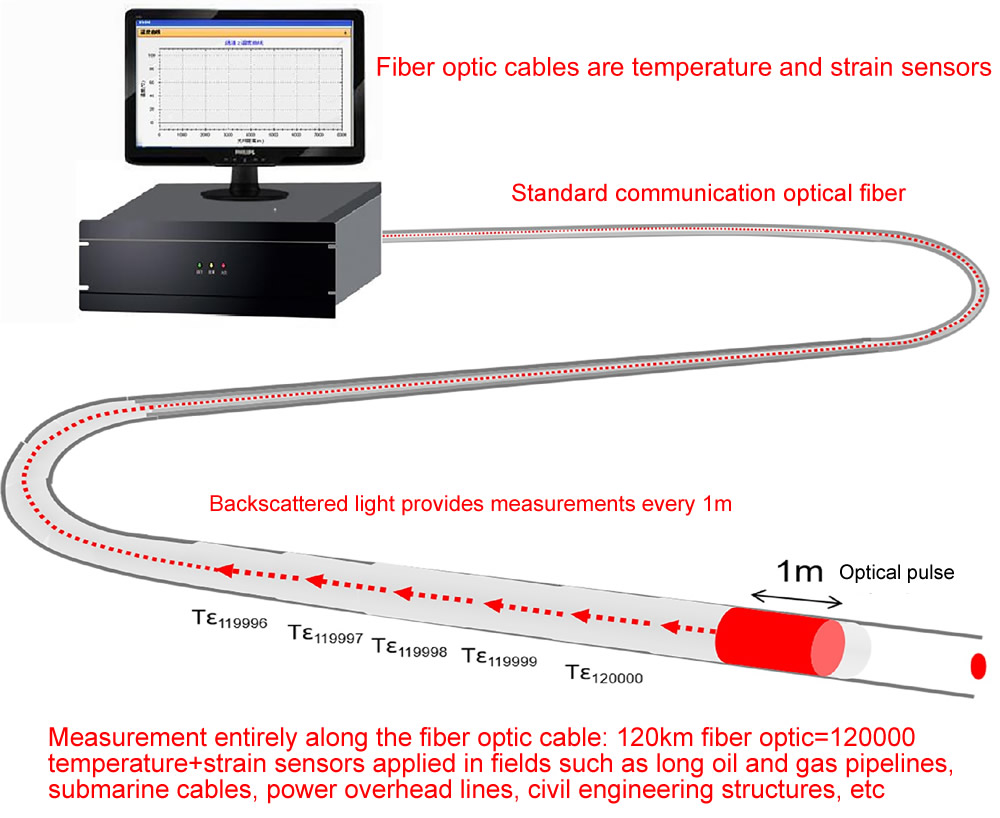
The distributed fiber optic temperature strain sensor market has experienced consistent growth driven by several converging trends. Infrastructure aging in developed economies is creating demand for continuous structural monitoring of bridges, tunnels, dams, and pipelines. Energy transition investments — including offshore wind, underground HVDC cables, and battery storage — require reliable distributed temperature monitoring at scales that only fiber optic systems can economically serve. Safety regulations in tunnels, mines, and petrochemical facilities increasingly mandate continuous fire detection systems, and distributed fiber optic systems meet these requirements with superior reliability.
From a technology perspective, the market is moving toward faster measurement speeds (sub-second updates for fire detection), higher spatial resolution (sub-meter for cable and pipeline applications), longer sensing ranges (30+ km single channel), and more intelligent software with machine learning–based anomaly detection. Multi-parameter sensing — simultaneous temperature, strain, and acoustic measurement on a single fiber — is becoming commercially viable, further expanding the addressable market.
Geographically, China represents the largest single market for distributed optical fiber line type temperature monitoring devices, driven by massive tunnel, metro, and power infrastructure construction programs. Europe, North America, and the Middle East are also strong markets, particularly for oil and gas and structural health monitoring applications. The growing availability of reliable systems at competitive distributed optical fiber temperature detector factory price levels from established manufacturers is accelerating adoption in price-sensitive markets across Asia, Africa, and Latin America.
7. How to Select a Distributed Optical Fiber Temperature Detector Manufacturer and Supplier
Step 1: Define Your Application Requirements
Before contacting any distributed optical fiber temperature detector manufacturer, clearly define your requirements: total sensing length, required spatial resolution, temperature accuracy, measurement speed, environmental conditions (indoor/outdoor, temperature extremes, humidity, chemical exposure), zone alarm configuration, and communication protocol requirements. A detailed specification avoids mismatched proposals and ensures meaningful comparisons between vendors.
Step 2: Evaluate the Manufacturer’s Technology Platform
Determine whether a Raman, Brillouin, or Rayleigh system best fits your application. Most distributed optical fiber temperature detector suppliers specialize in one or two technologies. A manufacturer offering Raman-based systems is the right choice for fire detection and cable monitoring. For structural health monitoring requiring combined temperature and strain, look for a supplier with Brillouin platform expertise. For short-range precision, Rayleigh OFDR specialists are the appropriate choice.
Step 3: Verify Product Certification and Track Record
For safety-critical applications such as tunnel fire detection, verify that the distributed optical fiber linear temperature alarm sensor system holds relevant certifications: EN 54 (European fire detection standards), FM/UL approval (North American markets), ATEX/IECEx certification (explosive atmosphere applications), and CE/FCC compliance. Request case studies and reference installations from the manufacturer to confirm proven performance in environments similar to yours.
Step 4: Compare Total Cost of Ownership, Not Just Unit Price
When evaluating distributed optical fiber temperature detector factory price quotations, consider the complete system cost: interrogator unit, sensing cable (matched to your environment), connectors and splice hardware, installation accessories, software licenses, commissioning support, training, warranty terms, and ongoing maintenance/calibration costs. A lower unit price from one distributed optical fiber temperature detector supplier may not represent the best value if the sensing cable is inferior, the software lacks critical features, or after-sales support is limited.
Step 5: Assess After-Sales Support and Local Presence
Distributed fiber optic systems are long-life infrastructure assets that may operate for 15–25 years. Choose a distributed optical fiber temperature detector manufacturer with stable business operations, responsive technical support, local or regional service capability, and a clear spare parts and upgrade path. The ability to provide on-site commissioning assistance, operator training, and timely repair support is essential for mission-critical monitoring systems.
8. FAQs About Distributed Fiber Optic Temperature Sensing Technique
Q1: What is the maximum sensing distance for a distributed fiber optic temperature sensor?
Raman-based distributed fiber optic temperature sensors typically cover 4–30 km per channel. Brillouin systems can extend to 50–100+ km with advanced signal processing. Rayleigh systems are limited to approximately 50 m to 2 km depending on spatial resolution. Multi-channel interrogators can monitor multiple fibers to extend total coverage.
Q2: What spatial resolution can a distributed optical fiber line type temperature detector achieve?
Standard commercial distributed optical fiber line type temperature detectors achieve 0.5 m to 2 m spatial resolution. Advanced Brillouin systems reach 0.1 m. Rayleigh OFDR systems achieve millimeter-level resolution over shorter distances. Spatial resolution degrades as sensing distance increases due to pulse broadening and signal attenuation.
Q3: How does distributed fiber-optic temperature sensing using Rayleigh backscatter differ from Raman-based DTS?
Distributed fiber-optic temperature sensing using Rayleigh backscatter (OFDR) provides much finer spatial resolution (millimeters vs. meters) and higher temperature resolution (±0.1 °C vs. ±0.5–1 °C) but over significantly shorter distances (meters to low kilometers vs. tens of kilometers). Rayleigh OFDR also measures strain simultaneously. Raman systems are temperature-only but cover far longer distances at lower cost.
Q4: Can a distributed optical fiber line type temperature monitoring system detect fire?
Yes. A distributed optical fiber line type temperature monitoring system configured as a fire detection system detects fires by sensing absolute temperature exceeding a threshold (e.g., 68 °C) or a rapid rate of temperature rise (e.g., >8 °C/min) at any point along the fiber. It provides both the alarm and the precise location of the fire event, enabling targeted emergency response.
Q5: What type of optical fiber cable is used in a distributed optical fiber linear temperature alarm sensor?
The distributed optical fiber linear temperature alarm sensor uses standard telecom-grade multimode fiber (50/125 µm) for Raman systems or single-mode fiber (9/125 µm) for Brillouin and Rayleigh systems. The fiber is housed in protective cable structures chosen for the installation environment — stainless steel tube for high-temperature or corrosive settings, armored cable for direct burial, and LSZH-jacketed cable for tunnels and buildings.
Q6: Can distributed fiber optic sensors measure temperature and strain simultaneously?
Yes. Brillouin-based systems and Rayleigh OFDR systems can measure both temperature and strain simultaneously along the fiber. This dual capability drives the growing distributed fiber optic temperature strain sensor market. However, separating temperature and strain contributions requires either a reference fiber (loose in a tube, sensing only temperature) or a dual-fiber configuration.
Q7: How much does a distributed optical fiber temperature detector cost?
The distributed optical fiber temperature detector factory price for a complete Raman-based system (interrogator + software) typically ranges from USD 15,000 to USD 80,000 depending on sensing range, number of channels, spatial resolution, and feature set. Brillouin and Rayleigh systems are generally more expensive, ranging from USD 50,000 to USD 200,000+. Sensing cable costs range from USD 1 to USD 20 per meter depending on construction type.
Q8: How do I identify a reliable distributed optical fiber temperature detector manufacturer?
Look for a distributed optical fiber temperature detector manufacturer with proven installations in your target application, relevant product certifications (EN 54, ATEX, CE), documented technical specifications with independently verifiable performance claims, responsive technical support infrastructure, and stable long-term business operations. Request reference contacts from existing customers.
Q9: What is the operating temperature range of a distributed optical fiber linear temperature sensing device?
A standard distributed optical fiber linear temperature sensing device with acrylate-coated fiber in LSZH cable operates from −40 °C to +85 °C. High-temperature variants using polyimide-coated fiber in metal tube cable can measure from −40 °C to +300 °C. Specialty gold-coated fibers extend the range to +700 °C for furnace and industrial kiln applications.
Q10: How do I find a competitive distributed optical fiber temperature detector supplier?
To find a competitive distributed optical fiber temperature detector supplier, evaluate manufacturers who offer direct factory pricing, provide comprehensive system solutions (interrogator, cable, software, commissioning support), hold relevant industry certifications, and have a track record of successful installations in your target application sector. Request multiple quotations, compare total system cost including installation support, and verify after-sales service capabilities before making your decision. FJINNO (www.fjinno.net) provides distributed fiber optic temperature sensing solutions with factory-direct pricing and full technical support.
Disclaimer: The information provided in this article is for general educational and reference purposes only. Specific product specifications, pricing, certifications, and performance characteristics vary by manufacturer, model, and configuration. All technical data cited represents typical values found in commercial DTS products and should not be used as guaranteed specifications for any specific system. Always consult the manufacturer’s official documentation and conduct independent evaluation before specifying or purchasing distributed fiber optic temperature sensing equipment. FJINNO (www.fjinno.net) assumes no liability for any decisions made based on the content of this article.

Fiber optic temperature sensor, Intelligent monitoring system, Distributed fiber optic manufacturer in China
 |
 |
 |