 INNO fibre optic temperature sensors ,temperature monitoring systems.
- Transformer overheating occurs when the internal winding or core temperature exceeds safe design limits — typically 105°C for the winding hot-spot in standard oil-immersed transformers — triggering accelerated insulation degradation and, if uncorrected, leading to catastrophic electrical failure.
- The 10 most common causes of transformer overheating include sustained overloading, cooling system failure, blocked oil circulation, harmonic distortion, unbalanced loads, tap changer malfunction, insulation deterioration, core faults, high ambient temperature, and inadequate transformer sizing.
- Early warning signs of transformer overheating — such as rising top oil temperature, discoloration of external paint, abnormal dissolved gas levels, unusual odors, and audible noise changes — provide critical intervention windows that operators must recognize to prevent irreversible damage.
- The consequences of transformer overheating range from accelerated insulation aging and reduced service life to oil decomposition, gas generation, fire, explosion, unplanned outages, and environmental contamination with cleanup costs that can exceed the replacement cost of the transformer itself.
- Fluorescent fiber optic temperature monitoring systems provide the most accurate and reliable real-time overheating detection by measuring actual winding conductor temperatures directly at the hot-spot location — outperforming thermal models, winding temperature indicators, infrared imaging, and all other indirect methods in both accuracy and response speed.
Table of Contents
- What Is Transformer Overheating?
- Transformer Temperature Limits — How Hot Is Too Hot?
- 10 Most Common Causes of Transformer Overheating
- Warning Signs and Symptoms of Transformer Overheating
- Why Overheating Causes Transformer Failure — The Fault Mechanism
- Dangers and Consequences of Transformer Overheating
- Transformer Overheating Solutions — What to Do When a Transformer Overheats
- How to Prevent Transformer Overheating
- Transformer Overheating Monitoring Systems — Technologies Compared
- Fluorescent Fiber Optic Temperature Monitoring — The Gold Standard
- Fiber Optic vs. Other Monitoring Technologies — Comparison Table
- Standards and Regulations Governing Transformer Thermal Limits
- Case Scenarios — How Overheating Leads to Catastrophic Failure
- Frequently Asked Questions
1. What Is Transformer Overheating?
Transformer overheating is a condition in which the temperature of the winding conductors, core laminations, structural components, or insulating oil inside a power transformer rises above the thermal limits established by the transformer’s design and the applicable international standards. Every power transformer generates heat during normal operation — this heat is an unavoidable byproduct of electrical losses in the winding conductors (copper losses or load losses) and in the core laminations (iron losses or no-load losses). Under normal conditions, the transformer’s cooling system — consisting of radiators, fans, oil pumps, and the natural convective circulation of insulating oil — removes this heat at the same rate it is generated, maintaining a thermal equilibrium at temperatures well within safe limits.

Overheating occurs when this thermal equilibrium is disrupted — when heat generation exceeds heat removal capacity, or when localized conditions prevent adequate cooling at a specific point within the transformer. The result is a progressive temperature rise that, if not detected and corrected, crosses the threshold from normal operation into the region of accelerated insulation degradation, oil decomposition, gas generation, and ultimately mechanical or electrical failure of the oil-immersed power transformer.
Overheating Is Not Always Obvious
One of the most dangerous aspects of transformer overheating is that it can be a silent and invisible process. The critical temperatures occur deep inside the winding structure, submerged in insulating oil, enclosed within a sealed steel tank. External surface temperatures may provide little or no indication of internal overheating conditions. A transformer can be experiencing severe localized winding overheating — with conductor temperatures exceeding 140°C or more — while external tank surface temperatures remain unremarkable. This is precisely why direct internal temperature measurement with technologies such as fluorescent fiber optic temperature sensors is critically important.
2. Transformer Temperature Limits — How Hot Is Too Hot?

Design Temperature Limits Under IEC 60076-2
International standards define specific temperature rise limits for oil-immersed power transformers. Under IEC 60076-2, the standard temperature rise limits — measured as a rise above a reference ambient temperature of 20°C (with a maximum ambient of 40°C) — are as follows. The top oil temperature rise limit is 60°C above ambient for ONAN and ONAF cooled transformers. The average winding temperature rise limit is 65°C above ambient. The winding hot-spot temperature rise limit is 78°C above ambient, which corresponds to an absolute hot-spot temperature of 98°C at a 20°C ambient or 118°C at a 40°C maximum ambient.
Absolute Temperature Thresholds
In practice, the critical temperature thresholds for an oil-immersed transformer are defined by the thermal limits of its insulation materials. Standard kraft paper insulation begins to experience significant accelerated aging above approximately 98°C. At 110°C, the aging rate is approximately four times the normal rate. At 120°C, the aging rate reaches approximately eight times normal. At 140°C, the insulation aging rate is so extreme that the insulation can lose years of life in just days of operation. At approximately 150°C, gas bubbles begin to form in the insulating oil surrounding the winding conductors, which can reduce the dielectric strength of the oil and trigger electrical breakdown. At approximately 160–180°C, the cellulose insulation begins to undergo carbonization — irreversible thermal decomposition that produces conductive carbon tracks on the insulation surface, leading directly to electrical failure.
Thermally Upgraded Kraft Paper
Many modern transformers use thermally upgraded kraft paper, which is chemically treated to improve its resistance to thermal degradation. Thermally upgraded insulation can tolerate somewhat higher continuous operating temperatures — the IEC standard permits a hot-spot temperature rise of 78°C for thermally upgraded insulation versus 78°C for standard insulation (the standard rise limits are the same, but the aging equations differ, giving thermally upgraded insulation a longer life at the same temperature). However, thermally upgraded insulation does not eliminate the overheating risk — it merely shifts the aging curve. The absolute failure temperatures remain similar, and all the catastrophic failure mechanisms associated with extreme overheating still apply.
Dry-Type Transformer Temperature Classes
For dry-type transformers, temperature limits are classified by insulation class. Class F insulation has a maximum hot-spot temperature limit of 155°C. Class H insulation has a maximum hot-spot limit of 180°C. Class C insulation (used in cast-resin transformers) has a maximum limit of 220°C. Exceeding these limits produces the same accelerated aging and ultimate failure, though the failure mode differs from oil-immersed units because there is no oil to decompose or ignite.
3. 10 Most Common Causes of Transformer Overheating

Cause 1 — Sustained Overloading Beyond Rated Capacity
The most straightforward cause of transformer overheating is operating the transformer at a load current that exceeds its rated capacity for an extended period. Winding losses — which are the primary source of heat in a loaded transformer — increase with the square of the load current. A transformer operating at 120% of rated current experiences approximately 144% of rated winding losses. If the cooling system was designed to remove only 100% of rated losses, the additional 44% of heat generation will cause a progressive temperature rise until a new — and potentially dangerous — equilibrium is reached. Load growth in distribution networks, unplanned contingency transfers, and N-1 emergency conditions frequently push transformers into sustained overload.
Cause 2 — Cooling System Failure or Degradation
A transformer cooling system consists of multiple components — radiator banks, cooling fans, oil circulation pumps, and control circuits that activate these components based on temperature or load thresholds. Failure of any component reduces the transformer’s heat rejection capacity. Fan motor failure, pump failure, blocked or clogged radiator fins (from dirt, insects, vegetation, or ice), control circuit malfunction, or auxiliary power supply loss can all degrade cooling performance. In many documented transformer failures, the root cause was traced to a cooling system component that had failed silently — without alarm — leaving the transformer operating with reduced cooling during a high-load period.
Cause 3 — Blocked or Restricted Oil Circulation
Even when all external cooling components are operational, internal oil circulation can be obstructed. Sludge deposits from oil degradation accumulate over years of service and can partially block the narrow cooling ducts between winding discs. Foreign particles, manufacturing debris, or degraded insulation fragments can settle in critical flow paths. Oil flow directing washers or barriers inside the winding can shift during transportation or seismic events, disrupting the designed oil flow pattern and creating localized hot zones.
Cause 4 — Harmonic Distortion in the Load Current
Non-linear loads — such as variable frequency drives, power electronic converters, data center equipment, LED lighting, and electric vehicle chargers — inject harmonic currents into the network. These harmonic currents flow through the transformer windings and produce additional losses beyond those caused by the fundamental frequency component. Harmonic losses include increased eddy current losses in the winding conductors (which increase with the square of the harmonic order) and increased stray losses in structural components. A transformer operating at only 80% of its nameplate rated fundamental current may be experiencing thermal stress equivalent to 100% or more of rated capacity due to the additional harmonic losses — a condition that external load current measurement alone does not reveal.
Cause 5 — Unbalanced Phase Loading
In three-phase transformers, unbalanced loading between the three phases causes unequal heating. The most heavily loaded phase generates significantly more heat than the lightly loaded phases, creating a hot-spot in that phase’s winding while the average three-phase temperature may appear normal. In extreme cases of unbalance, negative-sequence currents are induced in the rotor (for rotating machines connected to the same network) and in the transformer windings, producing additional heating that is not proportional to the positive-sequence load.
Cause 6 — Tap Changer Malfunction or Contact Degradation
On-load tap changers (OLTC) and de-energized tap changers (DETC) use mechanical contacts to select different winding taps for voltage regulation. Over time, these contacts degrade through arcing erosion, carbon buildup, and mechanical wear. A degraded tap changer contact presents increased electrical resistance at the contact interface, generating localized resistive heating that can be intense enough to damage surrounding insulation, decompose the oil locally, and produce hot gases. Tap changer compartments are a frequent location for transformer internal faults.
Cause 7 — Insulation Deterioration and Increased Dielectric Losses
As a transformer ages, its insulation system degrades. Moisture absorption by the cellulose insulation and the oil increases dielectric losses — the energy dissipated as heat within the insulation material itself when it is subjected to the alternating electric field. Aged, wet insulation has a significantly higher dissipation factor (tan δ) than new, dry insulation. These increased dielectric losses contribute additional heat generation that was not present when the transformer was new, effectively reducing the thermal margin available for load-related heating.
Cause 8 — Core Faults — Shorted Laminations and Damaged Insulation
The transformer core is constructed from thin silicon steel laminations, each coated with a thin layer of insulation to minimize eddy current losses. If this inter-lamination insulation is damaged — by mechanical impact during manufacturing, by core bolt loosening, by foreign metallic particles bridging laminations, or by localized overheating from a previous event — eddy currents circulate through the shorted laminations, generating intense localized heating. Core hot spots can reach temperatures high enough to decompose the surrounding oil and damage adjacent winding insulation.
Cause 9 — High Ambient Temperature and Inadequate Ventilation
Transformer cooling capacity depends on the temperature differential between the oil (or winding surface) and the surrounding ambient air. As ambient temperature increases, the cooling system’s ability to reject heat decreases. A transformer installed in an enclosed substation, an underground vault, or a room with inadequate ventilation may experience effective ambient temperatures well above the outdoor air temperature. Solar radiation on outdoor transformer tanks can add several degrees to the effective ambient during summer months. Climate change trends are increasing the frequency and duration of extreme heat events in many regions.
Cause 10 — Inadequate Transformer Sizing for Actual Load Requirements
A transformer that was correctly sized for its original load when installed may become undersized as load grows over time. In many distribution and industrial applications, transformer loading has increased substantially since original installation due to facility expansion, increased electrification, addition of electric vehicle charging infrastructure, and growth in data processing loads. An undersized transformer operates closer to or beyond its thermal limits during peak load periods, making overheating a recurring rather than exceptional condition.
4. Warning Signs and Symptoms of Transformer Overheating
Elevated Oil Temperature Readings
The most readily observable indicator of transformer overheating is a sustained increase in the top oil temperature as measured by the oil temperature indicator (OTI) gauge on the transformer tank. If the top oil temperature is approaching or exceeding the alarm setpoint — typically 85–95°C depending on the transformer design — the transformer may be in an overheating condition. However, it is important to note that the top oil temperature significantly underestimates the winding hot-spot temperature, so an apparently “acceptable” top oil reading does not guarantee safe winding temperatures.
Elevated Winding Temperature Indicator Readings
The winding temperature indicator (WTI), where installed, provides an approximate indication of the winding hot-spot temperature based on a thermal replica method. Rising WTI readings that approach or exceed the alarm setpoint — typically 105–115°C — indicate that the winding is approaching thermal limits. As noted in the comparison section below, WTI accuracy is limited and direct fluorescent fiber optic temperature measurement provides far more reliable readings.
Abnormal Dissolved Gas Analysis Results
Dissolved gas analysis (DGA) of the insulating oil can reveal thermal degradation before it becomes externally visible. Key gases associated with overheating include ethylene (C₂H₄) and ethane (C₂H₆), which are produced by oil decomposition at elevated temperatures. Carbon monoxide (CO) and carbon dioxide (CO₂) indicate cellulose insulation thermal degradation. A sudden increase in these gas concentrations — particularly ethylene — is a strong indicator of an active overheating condition inside the transformer.
Unusual Smell or Odor
Severe transformer overheating can produce detectable odors — a burnt or acrid smell resulting from oil decomposition and insulation charring. This smell may be noticeable near the transformer tank, at the pressure relief device, or at the conservator breather. By the time the overheating is detectable by smell, significant internal damage has likely already occurred, making this a late-stage warning sign.
External Paint Discoloration or Blistering
Extreme localized internal heating can raise the external tank wall temperature at the corresponding location to levels sufficient to cause visible paint discoloration — yellowing, browning, or blistering of the tank paint. This is typically observed above severe internal faults such as shorted core laminations or circulating currents in structural components. Paint discoloration indicates extreme local temperatures and should be treated as an emergency condition.
Audible Noise Changes
A transformer exhibiting increased audible noise — louder humming, buzzing, or crackling sounds — may be experiencing overheating-related changes. Oil boiling or gas bubble formation near hot surfaces produces distinctive sounds. Core lamination loosening due to thermal cycling can increase the magnetic hum. Changes in the acoustic signature of a transformer warrant investigation.
Increased Pressure in the Transformer Tank
Overheating causes oil expansion and gas generation, both of which increase the internal pressure within the sealed transformer tank. A rising oil level in the conservator, activation of the pressure relief device, or elevated readings on the Buchholz relay oil flow indicator can all signal thermal distress.
Oil Discoloration and Reduced Dielectric Strength
A periodic oil sample analysis revealing darkened oil color, increased acidity (higher neutralization number), elevated moisture content, and reduced dielectric breakdown voltage is consistent with thermal degradation. While oil degradation occurs naturally over time, an accelerated rate of deterioration suggests ongoing overheating.
5. Why Overheating Causes Transformer Failure — The Fault Mechanism
Stage 1 — Insulation Aging Acceleration
The failure process begins with accelerated thermal aging of the cellulose insulation at the overheated location. The cellulose polymer chains break progressively (depolymerization), reducing the mechanical strength of the paper insulation. As the degree of polymerization (DP) drops below 200, the paper becomes brittle and fragile. This process is cumulative and irreversible.
Stage 2 — Mechanical Weakness Under Through-Fault Stress
When thermally degraded insulation with a low DP value is subjected to the intense electromagnetic forces generated during a through-fault event (an external short circuit), the brittle paper insulation cracks and shifts. This displacement can expose bare conductor surfaces, reduce the creepage distance between turns, or create voids in the insulation structure.
Stage 3 — Partial Discharge Initiation
Cracks, voids, and reduced insulation thickness create conditions favorable for partial discharge (PD) activity — localized electrical discharges that erode the remaining insulation at the defect site. Partial discharge is a self-reinforcing degradation mechanism: each discharge event enlarges the defect, which increases the intensity of subsequent discharges.
Stage 4 — Turn-to-Turn or Layer-to-Layer Short Circuit
Eventually, the accumulated insulation damage at the overheated and discharge-affected location results in a complete dielectric breakdown — a short circuit between adjacent turns (turn-to-turn fault) or between winding layers. This short circuit creates a closed loop of shorted turns that carries an extremely high circulating current, generating intense localized heating that rapidly escalates the fault.
Stage 5 — Catastrophic Failure
The fault escalation produces rapid oil decomposition, massive gas generation, pressure rise, and — in the worst cases — tank rupture, oil ejection, and fire or explosion. The entire process from Stage 4 to Stage 5 can occur in seconds to minutes, providing virtually no time for operator intervention. This is why preventing overheating — through early detection and corrective action at Stage 1 — is immeasurably more effective than responding to a failure in progress.
6. Dangers and Consequences of Transformer Overheating
Catastrophic Fire and Explosion Risk
A large oil-immersed power transformer may contain 10,000 to 80,000 liters of mineral insulating oil. When a severe internal fault caused by overheating produces an electric arc within this oil volume, rapid oil decomposition generates enormous volumes of flammable gas — primarily hydrogen and acetylene. If the gas generation rate exceeds the capacity of the pressure relief device, the tank can rupture catastrophically. The released oil mist and hot gases ignite immediately, producing a high-energy fire that can destroy the failed transformer and damage adjacent equipment, structures, and potentially endanger personnel. Transformer fires are among the most severe and costly events in the electric power industry.
Unplanned Power Outages and Economic Loss
The failure of a major power transformer due to overheating causes an unplanned outage that can affect thousands to millions of customers depending on the transformer’s position in the network. The direct economic losses from unserved energy, combined with the indirect costs of commercial and industrial disruption, can be enormous. The replacement lead time for a large power transformer — typically 12 to 24 months for a custom-designed unit — means that the outage consequences extend far beyond the immediate event.
Accelerated Insulation Aging and Reduced Service Life
Even when overheating does not cause immediate catastrophic failure, it permanently reduces the remaining insulation life of the transformer. Cellulose depolymerization is irreversible — once the DP value has been reduced by thermal aging, it cannot be restored. A transformer that experiences repeated episodes of moderate overheating accumulates insulation damage that ultimately makes it vulnerable to failure from through-fault events that it would otherwise have withstood.
Oil Degradation and Secondary Chemical Effects
Sustained overheating accelerates the chemical decomposition of the insulating oil, producing acids, sludge, and moisture as byproducts. These byproducts further degrade the insulation system — acids attack the cellulose, sludge deposits restrict cooling ducts, and moisture reduces dielectric strength. This creates a destructive feedback loop: overheating degrades the oil, degraded oil reduces cooling and insulation performance, and reduced cooling performance causes further overheating.
Environmental Contamination
A transformer failure involving oil release creates an environmental contamination event. Mineral insulating oil spilled onto the ground, into waterways, or onto other surfaces requires professional environmental remediation. In many jurisdictions, the transformer owner bears full liability for cleanup costs and environmental fines, which can be substantial.
Personnel Safety Hazard
Transformer overheating that progresses to failure creates direct safety hazards for substation personnel and nearby workers or residents. The explosion pressure wave, burning oil projection, and toxic combustion gases from a transformer fire are immediately dangerous to life. Ensuring that overheating is detected and managed before it reaches the failure stage is fundamentally a personnel safety issue.
7. Transformer Overheating Solutions — What to Do When a Transformer Overheats

Immediate Load Reduction
The most direct and fastest response to a detected overheating condition is to reduce the load on the transformer. This can be achieved by transferring load to parallel transformers, shedding non-critical loads, or activating network switching to reroute power through alternative paths. Every ampere of load current removed reduces winding losses by a proportional squared amount, providing rapid thermal relief.
Verify and Restore Cooling System Operation
Immediately verify that all cooling system components are operational — fans running, pumps running, radiator valves open, and control circuits functioning. In many overheating events, the root cause is a cooling system component that has failed without generating an alarm. Restoring a failed fan bank or pump can dramatically increase heat rejection capacity within minutes.
Inspect for External Cooling Obstructions
Check the radiator banks and fan assemblies for physical obstructions — accumulated dirt, leaves, bird nests, ice formation, or nearby construction activities that have restricted airflow. Clean or remove obstructions to restore design airflow.
Activate Supplemental Cooling
If the transformer has multiple cooling stages (e.g., ONAN/ONAF/ODAF), ensure that the higher cooling stages are activated. For emergency situations, temporary supplemental cooling measures — such as portable fans directed at the radiator banks or water spray on the tank surface (with appropriate safety precautions) — can provide additional heat removal while the root cause is addressed.
Order Emergency Oil Analysis
Take an oil sample for emergency dissolved gas analysis. The gas profile will indicate whether the overheating has caused oil or insulation decomposition and will help assess the severity of any internal damage that may have already occurred.
Investigate Root Cause
Once the immediate thermal emergency is managed, conduct a thorough root cause investigation. Review load records, ambient temperature data, cooling system maintenance history, recent oil analysis trends, and — if available — fluorescent fiber optic temperature sensor data to identify the underlying cause and prevent recurrence.
8. How to Prevent Transformer Overheating

Install Direct Winding Temperature Monitoring
The single most effective prevention measure is to install fluorescent fiber optic temperature sensors at the winding hot-spot locations during transformer manufacturing. Direct, real-time measurement of the actual winding conductor temperature eliminates the guesswork and estimation errors inherent in all indirect methods. With accurate hot-spot data, operators can set precise alarm and trip thresholds that provide early warning with minimal false alarms.
Implement Comprehensive Cooling System Monitoring and Maintenance
Establish a preventive maintenance program for all cooling system components — fans, pumps, valves, control circuits, and radiator cleanliness. Install monitoring on fan and pump motor currents to detect degradation before failure. Clean radiator fins on a scheduled basis. Test cooling stage automatic activation circuits regularly.
Perform Regular Oil Quality Testing
Scheduled oil analysis — including dissolved gas analysis, moisture content, dielectric strength, acidity, and interfacial tension — provides early indication of thermal stress before it causes observable temperature rises. Trending oil quality parameters over time reveals gradual degradation patterns that indicate developing overheating conditions.
Manage and Monitor Harmonic Loading
Where non-linear loads are present, measure the harmonic content of the transformer load current and derate the transformer accordingly using the K-factor or factor-K methods described in IEEE C57.110 and IEC 60076-7. Install harmonic filtering where economically justified. Account for harmonic losses in all transformer thermal assessments.
Maintain Balanced Phase Loading
Monitor and manage phase load balance, particularly on distribution transformers serving single-phase loads. Rebalance phase connections periodically as load patterns change to prevent one phase from carrying a disproportionate share of the total load.
Plan for Load Growth
Include transformer thermal capacity in long-term load forecasting and network planning. Proactively upgrade or add transformers before existing units are chronically overloaded. The cost of planned capacity additions is a fraction of the cost of managing the consequences of transformer failure.
Ensure Adequate Ventilation and Environmental Conditions
For indoor installations, verify that ventilation systems maintain effective ambient temperatures within the transformer’s design assumptions. For outdoor installations, consider the effects of solar radiation, altitude (which reduces air density and cooling effectiveness), and proximity to heat-producing equipment.
Apply Dynamic Thermal Rating (DTR) Systems
Dynamic thermal rating systems use real-time measurements — including ambient temperature, load current, oil temperature, and (ideally) direct fiber optic winding temperature data — to calculate the transformer’s actual available loading capacity in real time. DTR replaces static, conservative nameplate ratings with dynamic ratings that reflect actual conditions, enabling operators to use available thermal margin while respecting actual thermal limits.
9. Transformer Overheating Monitoring Systems — Technologies Compared
Oil Temperature Indicators (OTI)
Oil temperature indicators measure the top oil temperature using a bulb-type or electronic sensor inserted into a thermowell on the transformer tank. OTIs are simple, inexpensive, and universally installed. However, top oil temperature is the crudest indicator of internal thermal conditions — it reflects the average oil temperature at the top of the tank and significantly underestimates the winding hot-spot temperature. An OTI cannot detect localized winding overheating until the entire oil volume has warmed sufficiently to register on the sensor.
Winding Temperature Indicators (WTI)
Winding temperature indicators use a thermal replica — a current-driven heater element — immersed in a pocket at the top of the transformer tank to simulate the winding hot-spot temperature. The WTI provides a better approximation than the OTI but remains fundamentally an estimation. WTI accuracy is limited by the assumptions in the thermal replica calibration, which are based on factory heat run test data and do not adapt to changing conditions such as oil aging, cooling system degradation, or harmonic loading.
Thermal Imaging (Infrared Thermography)
Infrared thermal imaging cameras detect temperature patterns on the external surfaces of the transformer tank, bushings, connections, and radiators. Infrared imaging is valuable for detecting external connection overheating, blocked radiator sections, and oil level anomalies. However, infrared cannot penetrate the steel tank wall to measure internal winding temperatures. It is a supplementary inspection tool, not a winding overheating detection system.
Dissolved Gas Analysis (Online DGA Monitors)
Online DGA monitors continuously sample the transformer oil and measure the concentrations of dissolved fault gases. DGA is an excellent diagnostic tool for detecting the chemical consequences of overheating — it reveals that thermal decomposition is occurring. However, DGA is inherently a lagging indicator: gases must be generated by actual insulation or oil decomposition and must accumulate to detectable concentrations before the DGA system registers an alarm. By the time DGA detects overheating, the damage has already begun.
Thermal Model Calculations (IEC 60076-7)
Thermal model software calculates the estimated winding hot-spot temperature from load current and top oil temperature inputs using the mathematical model defined in IEC 60076-7. This approach is cost-effective and can be applied to any transformer with basic instrumentation. However, as discussed in detail in the comparison section below, model accuracy degrades significantly under dynamic conditions, and errors of 10–15°C are common.
Fluorescent Fiber Optic Temperature Sensors
Fluorescent fiber optic temperature sensors directly measure the actual winding conductor surface temperature at the hot-spot location. This is the only technology that provides a true, direct, real-time measurement of the parameter that actually determines transformer insulation life and failure risk. The detailed advantages of this technology are discussed in the following section.
10. Fluorescent Fiber Optic Temperature Monitoring — The Gold Standard
How Fluorescent Fiber Optic Sensors Detect Overheating
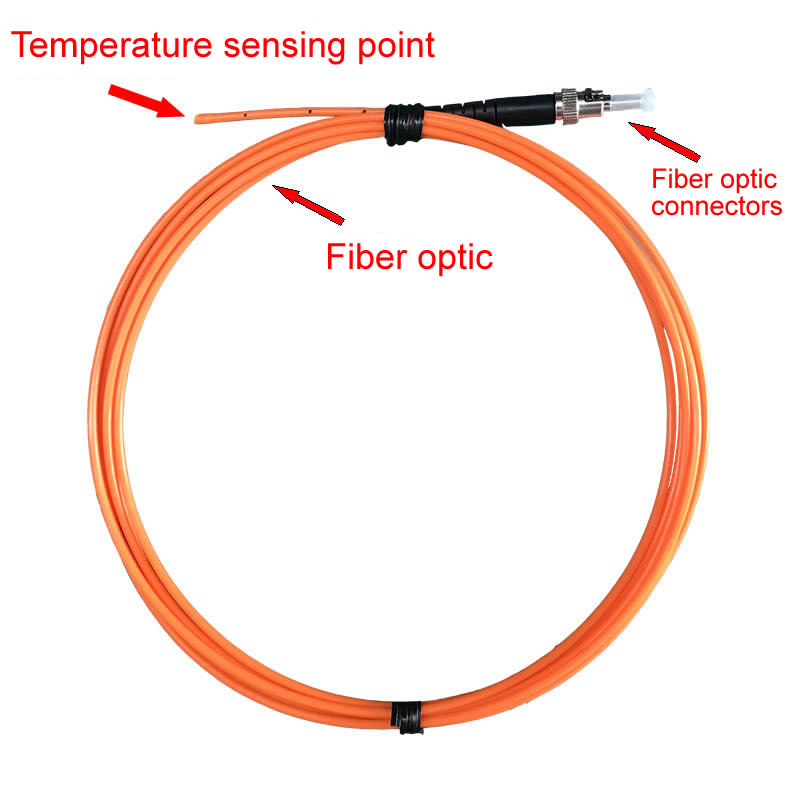
A fluorescent fiber optic temperature sensor consists of a small phosphor probe bonded directly to the winding conductor at the predicted hot-spot location, connected via an all-glass optical fiber to an optoelectronic measurement unit located outside the transformer tank. The measurement unit sends pulses of excitation light to the phosphor probe, which re-emits fluorescent light with a temperature-dependent decay time. By precisely measuring this decay time, the unit determines the conductor surface temperature with an accuracy of ±1°C.
Key Advantages for Overheating Detection
The advantages of fluorescent fiber optic sensing for transformer overheating detection are fundamental and irreplaceable. The sensor measures the actual conductor temperature — not an estimate, not a proxy, and not a delayed indicator. It provides measurement at the exact location where the highest temperature occurs and where failure initiates. The all-dielectric construction means complete electromagnetic immunity — no interference from the transformer’s intense magnetic and electric fields, and no risk of the sensor creating an electrical fault path. The sensor is passive — it contains no electronics, requires no power supply inside the transformer, and cannot generate sparks or contribute to any fault condition. The sensor is chemically compatible with transformer insulating oil for the full 30–40 year service life of the transformer, with no drift or recalibration requirement.
Real-Time Alarm and Protection Integration
The fiber optic temperature monitoring unit provides configurable alarm levels — typically a warning alarm and a trip alarm — that integrate directly with the transformer protection relay scheme. When the directly measured winding hot-spot temperature exceeds the warning threshold, operators receive an alert with time to take corrective action. If the temperature continues to rise and reaches the trip threshold, the monitoring system can initiate automatic load transfer or transformer disconnection before catastrophic damage occurs.
Data Logging and Thermal Life Tracking
Continuous hot-spot temperature data logged by the fiber optic monitoring system enables precise calculation of cumulative insulation aging using the Arrhenius-based aging equations in IEC 60076-7. This data transforms transformer asset management from a calendar-based approach (“the transformer is 30 years old”) to a condition-based approach (“the transformer has consumed 45% of its insulation thermal life based on its actual temperature history”). This information is fundamental to informed decisions about loading, maintenance, refurbishment, and replacement timing.
11. Fiber Optic vs. Other Monitoring Technologies — Comparison Table
| Feature / Criterion | Fluorescent Fiber Optic Sensor | Winding Temperature Indicator (WTI) | Oil Temperature Indicator (OTI) | Thermal Model (IEC 60076-7) | Infrared Thermography | Online DGA Monitor |
|---|---|---|---|---|---|---|
| Measurement Type | Direct conductor temperature | Thermal replica estimate | Top oil temperature | Mathematical estimate | External surface temperature | Dissolved gas concentration |
| Measures Actual Hot-Spot? | Yes — directly | Approximate | No | Estimated | No | No (detects consequence) |
| Accuracy | ±1°C | ±5–10°C | ±2–3°C (oil only) | ±10–15°C under dynamic loads | ±2°C (external surface only) | N/A (gas ppm) |
| Response Time | Seconds | Minutes (thermal lag) | Minutes (thermal lag) | Seconds (calculation) | Instant (periodic inspection) | Minutes to hours |
| Continuous Real-Time Monitoring | Yes | Yes | Yes | Yes | No (periodic) | Yes |
| Electromagnetic Immunity | Complete (all-dielectric) | Limited | Immune (external) | N/A (software) | Immune (external) | Immune (external) |
| Detects Localized Overheating | Yes | No | No | No | External only | Indirectly (delayed) |
| Multi-Point Capability | Yes (4–16 channels) | Single point | Single point | Single estimate | Full external surface | Oil body only |
| Retrofit to Existing Transformer | No (factory install required) | Yes | Yes | Yes | Yes | Yes |
| Long-Term Stability (30+ years) | Excellent — no drift | Requires recalibration | Requires recalibration | Model accuracy degrades with age | N/A | Requires maintenance |
| Supports Insulation Life Calculation | Yes — precise | Approximate | No | Approximate | No | No |
| Relative Cost | Moderate (at time of manufacturing) | Low | Low | Low (software only) | Moderate (camera cost) | High |
| Best Application | Primary hot-spot monitoring for critical transformers | Basic winding temperature indication | Oil temperature trending | Supplementary estimation for legacy units | External inspection supplement | Fault gas detection (complementary to temperature) |
12. Standards and Regulations Governing Transformer Thermal Limits
IEC 60076-2 — Temperature Rise Tests
IEC 60076-2 specifies the methods and limits for factory temperature rise testing of power transformers. This standard defines the permissible average winding temperature rise, top oil temperature rise, and — when measured by fiber optic sensors — the winding hot-spot temperature rise. Compliance with IEC 60076-2 is a fundamental acceptance criterion for new oil-immersed transformer procurement.
IEC 60076-7 — Loading Guide for Oil-Immersed Transformers
IEC 60076-7 provides the thermal model equations, aging rate formulas, and loading limit tables that define how transformer overheating risk is assessed for various loading scenarios. The standard defines normal cyclic loading limits, long-term emergency loading limits, and short-term emergency loading limits — each associated with specific maximum hot-spot temperatures and acceptable loss-of-life percentages.
IEEE C57.91 — Guide for Loading Mineral-Oil-Immersed Transformers
The IEEE counterpart to IEC 60076-7, IEEE C57.91 provides loading guidance for transformers operating under the IEEE standard framework. The aging equations and thermal models differ slightly from the IEC approach but the fundamental principle is identical: the winding hot-spot temperature is the parameter that determines both permissible loading and insulation aging rate.
IEEE C57.110 — Recommended Practice for Transformers Supplying Nonlinear Loads
IEEE C57.110 addresses the additional heating effects caused by harmonic currents in transformer windings. This standard provides methods for calculating the derating factor required when a transformer supplies non-linear (harmonic-rich) loads — directly relevant to preventing overheating from harmonic distortion.
IEC 60076-14 — Liquid-Immersed Power Transformers Using High-Temperature Insulation Materials
IEC 60076-14 covers transformers designed to operate at higher temperatures using high-temperature insulation systems. These transformers have different thermal limits and aging characteristics, but the fundamental requirement for accurate hot-spot temperature measurement and overheating prevention remains unchanged.
13. Case Scenarios — How Overheating Leads to Catastrophic Failure
Scenario A — Silent Cooling System Failure During Peak Summer Load
A 150 MVA transmission transformer operates at 95% of rated load during a summer peak demand period. Unknown to the operators, two of the four radiator fan banks have tripped offline due to a failed auxiliary contactor — no alarm was generated because the fan motor current monitoring relay was itself defective. With only 50% of the forced cooling capacity available, the transformer cannot reject the heat generated at 95% load. The top oil temperature rises gradually, but the winding hot-spot — located deep within the HV winding — rises much faster. Without fluorescent fiber optic sensors installed, the actual hot-spot temperature is unknown. The WTI provides a reading that lags the actual hot-spot by several degrees and by many minutes. By the time the WTI alarm activates, the true hot-spot has already exceeded 140°C for over an hour, causing severe insulation degradation. Two weeks later, a network fault produces a through-fault current, and the weakened insulation fails. The transformer experiences a turn-to-turn fault that escalates to tank rupture and fire.
Scenario B — Gradual Load Growth on a Distribution Transformer
A 25 MVA distribution transformer was installed 18 years ago to serve a suburban load area. Over the intervening years, load growth from new housing, commercial development, and the increasing adoption of electric vehicle home charging has increased the peak load from the original design value of 20 MVA to a current peak of 27 MVA — 108% of the transformer’s rated capacity. Each summer, the transformer operates in overload for several hours per day during peak periods. The insulation aging, which should have consumed approximately 18 years of life based on normal loading, has actually consumed the equivalent of 35+ years of thermal life due to the repeated overload episodes. The degree of polymerization of the winding insulation has dropped below the critical threshold of 200, but this is undetectable without either an oil sample analysis for furan content or a winding insulation sample — neither of which has been performed. The transformer is one through-fault event away from failure, and no one knows.
Scenario C — Harmonic Overheating Without Apparent Overload
A 10 MVA dry-type transformer supplies a data center with a load measured at only 7.5 MVA (75% of rated capacity) on the facility’s power monitoring system. The load appears to be well within the transformer’s capability. However, the data center’s server power supplies and UPS systems inject significant harmonic currents — the total harmonic distortion (THD) of the current waveform is 35%. When harmonic derating is properly accounted for using the IEEE C57.110 K-factor method, the equivalent thermal loading is actually approximately 110% of the transformer’s derated capacity. The winding hot-spot temperature is well above the Class F limit during peak IT load periods. Without direct temperature measurement, this invisible overheating continues until the winding insulation fails.
Frequently Asked Questions
What temperature is considered overheating for an oil-immersed transformer?
For a standard oil-immersed transformer with thermally upgraded kraft paper insulation, the winding hot-spot temperature should not exceed 98–110°C under normal cyclic loading conditions per IEC 60076-7. Temperatures above 120°C produce severe accelerated aging, and temperatures above 140–150°C risk gas bubble formation and potential dielectric failure. The specific limits depend on the transformer’s insulation class and the applicable loading standard.
What causes a transformer to overheat?
The most common causes of transformer overheating are sustained overloading beyond rated capacity, cooling system failure or degradation, blocked oil circulation, harmonic distortion in the load current, unbalanced phase loading, tap changer contact degradation, insulation deterioration, core lamination faults, high ambient temperature, and inadequate transformer sizing for actual load. Often, overheating results from a combination of two or more of these factors occurring simultaneously.
How can I tell if my transformer is overheating?
Warning signs of transformer overheating include rising top oil and winding temperature indicator readings, abnormal dissolved gas analysis results (particularly elevated ethylene and carbon monoxide), unusual odors near the transformer, external paint discoloration or blistering on the tank, increased audible noise, pressure relief device activation, and accelerated oil degradation revealed by periodic oil testing. The most reliable detection method is direct winding temperature measurement using fluorescent fiber optic sensors.
Can transformer overheating cause an explosion?
Yes. Severe transformer overheating can lead to insulation failure, which produces an internal electrical arc. The arc rapidly decomposes the surrounding insulating oil into flammable gases (hydrogen and acetylene). If gas generation exceeds the pressure relief capacity, the transformer tank can rupture explosively, releasing a large volume of burning oil. Transformer explosions and fires are among the most catastrophic events in electric power systems.
How do fluorescent fiber optic sensors help prevent transformer overheating?
Fluorescent fiber optic temperature sensors measure the actual winding conductor temperature directly at the hot-spot location with ±1°C accuracy and real-time response. This allows operators to see the true thermal condition of the transformer’s most critical point — not an estimate — and to take corrective action (load reduction, cooling system activation) before temperatures reach levels that cause insulation damage or failure.
Can fiber optic temperature sensors be installed on an existing in-service transformer?
In most cases, no. Fluorescent fiber optic sensors must be installed on the winding conductors during the transformer manufacturing process, before the core-and-coil assembly is placed in the tank. Retrofitting would require a complete factory-level rewind. For existing transformers without fiber optic sensors, the IEC 60076-7 thermal model calculation, supplemented by dissolved gas monitoring, provides the best available alternative.
What is the difference between the OTI and WTI on a transformer?
The oil temperature indicator (OTI) measures the top oil temperature using a sensor in the oil at the top of the transformer tank. The winding temperature indicator (WTI) uses a thermal replica method — a current-driven heater element — to simulate the winding hot-spot temperature. The WTI reading is closer to the actual hot-spot than the OTI, but both are indirect measurements with limited accuracy. Neither provides the true winding conductor temperature that a fluorescent fiber optic sensor measures directly.
How does harmonic distortion cause transformer overheating?
Harmonic currents increase eddy current losses in the winding conductors and stray losses in structural components. These additional losses are proportional to the square of the harmonic frequency, meaning that higher-order harmonics produce disproportionately more heating per ampere than the fundamental frequency current. A transformer can be operating below its nameplate current rating and still be thermally overloaded due to harmonic losses — a condition that is invisible without either harmonic current analysis or direct winding temperature measurement.
What is the life expectancy reduction from transformer overheating?
Based on the Arrhenius aging equations in IEC 60076-7, every 6°C increase in winding hot-spot temperature above the design reference value approximately doubles the insulation aging rate. A transformer operating with a hot-spot temperature continuously 12°C above its design value experiences approximately four times the normal aging rate — meaning that one year of such operation consumes approximately four years of insulation life. Cumulative loss-of-life calculations using actual temperature data provide precise remaining life estimates.
Should I specify fiber optic sensors when ordering a new transformer?
Yes, for any transformer that is critical to your system reliability — generally all units rated 10 MVA and above, and any transformer serving critical facilities regardless of size. The incremental cost of fluorescent fiber optic temperature sensors specified at the time of manufacture is negligible compared to the cost of the transformer and insignificant compared to the potential cost of a failure. It is far more cost-effective to specify fiber optic sensors during procurement than to manage the consequences of undetected overheating throughout the transformer’s service life.
How often should transformer oil be tested to detect overheating?
For critical power transformers, dissolved gas analysis (DGA) should be performed at least annually under normal conditions and more frequently — quarterly or monthly — if any abnormal condition has been detected. Online DGA monitors that provide continuous gas trending are increasingly common on critical units and are an excellent complement to direct fiber optic temperature monitoring. Oil physical and chemical tests (dielectric strength, moisture, acidity, interfacial tension) should be performed at least annually.
What is a dynamic thermal rating (DTR) system and how does it help?
A dynamic thermal rating system calculates the transformer’s real-time available loading capacity based on actual measured conditions — ambient temperature, oil temperature, load current, and (when available) direct winding temperature from fiber optic sensors. Unlike static nameplate ratings, DTR accounts for favorable conditions (low ambient, recent low loading) that provide additional thermal capacity. DTR enables operators to safely utilize available margin during contingency events while ensuring that actual thermal limits are respected.
Disclaimer: The information presented in this article is for general educational and informational purposes only and does not constitute professional engineering advice. Transformer overheating can pose serious safety hazards including fire, explosion, and personnel injury. Always consult qualified power systems engineers and comply with applicable local standards, regulations, and safety procedures when assessing, monitoring, or managing transformer thermal conditions. www.fjinno.net assumes no liability for any decisions or actions taken based on the content of this article.

Fiber optic temperature sensor, Intelligent monitoring system, Distributed fiber optic manufacturer in China
 |
 |
 |