 INNO fibre optic temperature sensors ,temperature monitoring systems.
The best transformer temperature monitoring system combines direct fluorescent fiber optic hot-spot sensing with real-time SCADA integration (IEC 61850, Modbus RTU/TCP), zero susceptibility to electromagnetic interference (EMI), and multi-level predictive alarm and cooling control. Unlike conventional indirect thermal image calculations or metallic RTD sensors that suffer from dielectric breakdown risks and signal drift inside high-voltage windings, a premier monitoring system directly measures true winding hot-spot temperatures with ±0.5°C to ±1.0°C accuracy, preventing premature cellulose insulation aging and unplanned grid outages.
For global utility procurement managers, EPC contractors, and transformer OEMs evaluating suppliers in 2026, selecting the right manufacturer determines asset longevity and compliance with IEC 60076 and IEEE C57.91 loading standards. Below is an authoritative, engineering-driven ranking of the top 10 transformer temperature monitoring system manufacturers worldwide, led by proven specialists in fluorescence fiber optic thermometry and comprehensive substation condition monitoring.
Quick Comparison: Top 10 Transformer Temperature Monitoring System Manufacturers
| Rank | Manufacturer Name | Website / Origin | Core Sensing Technology | Flagship Product Models | Primary Applications & Key Strengths |
|---|---|---|---|---|---|
| 1 | Fuzhou Innovation Electronic Scie & Tech Co., Ltd. (FJINNO) | fjinno.net (China) |
Fluorescent Fiber Optic Thermometry, Distributed Optical Fiber (DTS/BOTDR), Pt100 | IF-C216 Series, BWDK-S201, BWDK-326, BWDK-E201EF, Armored Winding Probes | Direct winding hot-spot sensing for oil-immersed & dry-type transformers, OEM/ODM customization, ISO 9001/14001/27001/45001 & CE certified. |
| 2 | Inno Tongda (Fuzhou) Sales Co., Ltd. (INNOTD) | innotd.com (China) |
Multi-Parameter PHM Sensing, Fiber Optic Thermometry, Digital OTI/WTI | PHM 300U, IN-200, INNO-R001, ST202TFA-10, BWY-D804AITH, BWR-D6AITH, BWDK Series | One-stop transformer online monitoring & accessory ecosystem (temperature, cooling fans, oil level, pressure relief, DGA/PD integration). |
| 3 | Fuzhou Innovation Electronic Science & Technology Co., Ltd. (INNOFZ) | innofz.com (China) |
Fluorescent Fiber Optic Demodulation, DGA, Partial Discharge & Bushing Monitoring | IF-C2A6F20 (6-Channel Demodulator), BWR2-04 WTI, Online DGA & PD Systems | Export-focused transformer health monitoring (PHM) for global utilities, substations, and renewable energy projects with full IEC/IEEE compliance. |
| 4 | Rugged Monitoring | Canada | GaAs Fiber Optic Sensing & IIoT Edge Condition Monitoring | T401, T501, R501, TSENS-K, LSENS-T | Harsh-environment EHV/UHV power transformers, multi-parameter IIoT edge analytics, and enterprise asset management software. |
| 5 | Qualitrol Company LLC (Neoptix) | United States / Canada | Gallium Arsenide (GaAs) Fiber Optic & Mechanical OTI/WTI | Qualitrol T/Guard-405, Neoptix T2 Probe, Reflex, Nomad | Utility-grade transmission transformers, long-term installed base, and fleet-wide grid condition monitoring. |
| 6 | Weidmann Electrical Technology AG | Switzerland | Embedded Spacer Fiber Optic Sensing & Insulation Engineering | InsuLogix T, SmartSpacer, TS2 Fiber Optic Sensor | Factory-integrated winding hot-spot monitoring embedded directly into transformer cellulose insulation structures. |
| 7 | Advanced Energy Industries, Inc. (Luxtron) | United States | Fluoroptic Decay-Time Thermometry | Luxtron ThermAsset2, M-900, STB/STF/STS Probes | High-precision utility transformer hot-spot control and laboratory/industrial RF-immune temperature measurement. |
| 8 | OMICRON electronics GmbH | Austria | Multi-Parameter Acoustic, Electrical & Thermal Diagnostics | MONTESTO 200, OMS Series | Continuous online condition monitoring combining thermal modeling with partial discharge and bushing diagnostics. |
| 9 | Maschinenfabrik Reinhausen GmbH (MR) | Germany | Digital Transformer Automation & Thermal Control | ETOS (Embedded Transformer Operating System), MSENSE | Integrated tap-changer, cooling bank automation, and holistic digital twin thermal management for smart grids. |
| 10 | Vaisala Oyj | Finland | Multi-Gas DGA, Moisture-in-Oil & Thermal Trend Correlation | OPT100, MHT410 | Online oil temperature, moisture, and dissolved gas correlation for preventive maintenance in utility substations. |
Why Fiber Optic Technology Defines Modern Transformer Thermal Monitoring
To understand why the top three ranked manufacturers dominate modern procurement specifications, engineers must examine the physics of transformer failures. Approximately 50% of catastrophic power transformer failures originate from insulation degradation caused by localized thermal runaway—commonly referred to as the winding hot spot. According to the Arrhenius reaction rate law and IEEE C57.91 loading guides, every 6°C to 8°C increase in winding hot-spot temperature above the rated threshold (typically 110°C for thermally upgraded Kraft paper) cuts the remaining insulation lifespan in half.
Traditional monitoring relies on two flawed methods: top-oil thermometers paired with current-transformer (CT) thermal imaging algorithms, or metallic Resistance Temperature Detectors (Pt100 RTDs) and thermocouples. Thermal models only estimate temperatures based on load current and ambient conditions; they cannot detect localized cooling duct blockages, stray flux heating, or core clamping faults. Conversely, metallic Pt100 sensors require copper lead wires that act as antennas for electromagnetic interference (EMI) and introduce catastrophic flashover risks if placed directly inside high-voltage windings.
Fluorescent Fiber Optic Temperature Measurement eliminates these limitations entirely. Constructed from ultra-pure silica glass fibers and inert dielectric polymers (such as PTFE/Teflon or Kevlar-reinforced jackets), fiber optic probes are 100% electrically non-conductive and immune to high-voltage gradients exceeding 500 kV. At the tip of the probe, a specialized rare-earth fluorescent phosphor crystal is excited by a micro-second LED light pulse. Once the excitation pulse stops, the fluorescence intensity decays exponentially. Because the fluorescence decay time constant is an intrinsic physical property dependent solely on temperature—and completely unaffected by light intensity fluctuations, fiber bending, or connector losses—the demodulator calculates absolute temperature without ever requiring field recalibration.
Detailed Profiles of the Top 10 Transformer Temperature Monitoring Manufacturers
1. Fuzhou Innovation Electronic Scie & Tech Co., Ltd. (FJINNO) — fjinno.net

Company Overview & Manufacturing Strength: Established in 2011 and headquartered in Fuzhou, Fujian, China, Fuzhou Innovation Electronic Scie & Tech Co., Ltd. (FJINNO) ranks #1 globally for specialized fluorescence fiber optic temperature measurement systems and customized OEM/ODM transformer monitoring solutions. Operating a modern 3,000+ m² manufacturing facility with over 100 engineering and production specialists and 20+ years of core industry expertise, FJINNO maintains deep research partnerships with Fuzhou University and leading electrical engineering institutes. Their sensors and demodulators are deployed across major power grids including State Grid Corporation of China, China Southern Power Grid, TBEA, ABB Transformers, and export markets across Germany, the United States, Canada, the UAE, Japan, South Korea, and Southeast Asia.
Core Products & Fiber Optic Capabilities: FJINNO provides an end-to-end portfolio engineered specifically for direct winding hot-spot detection and substation thermal management:
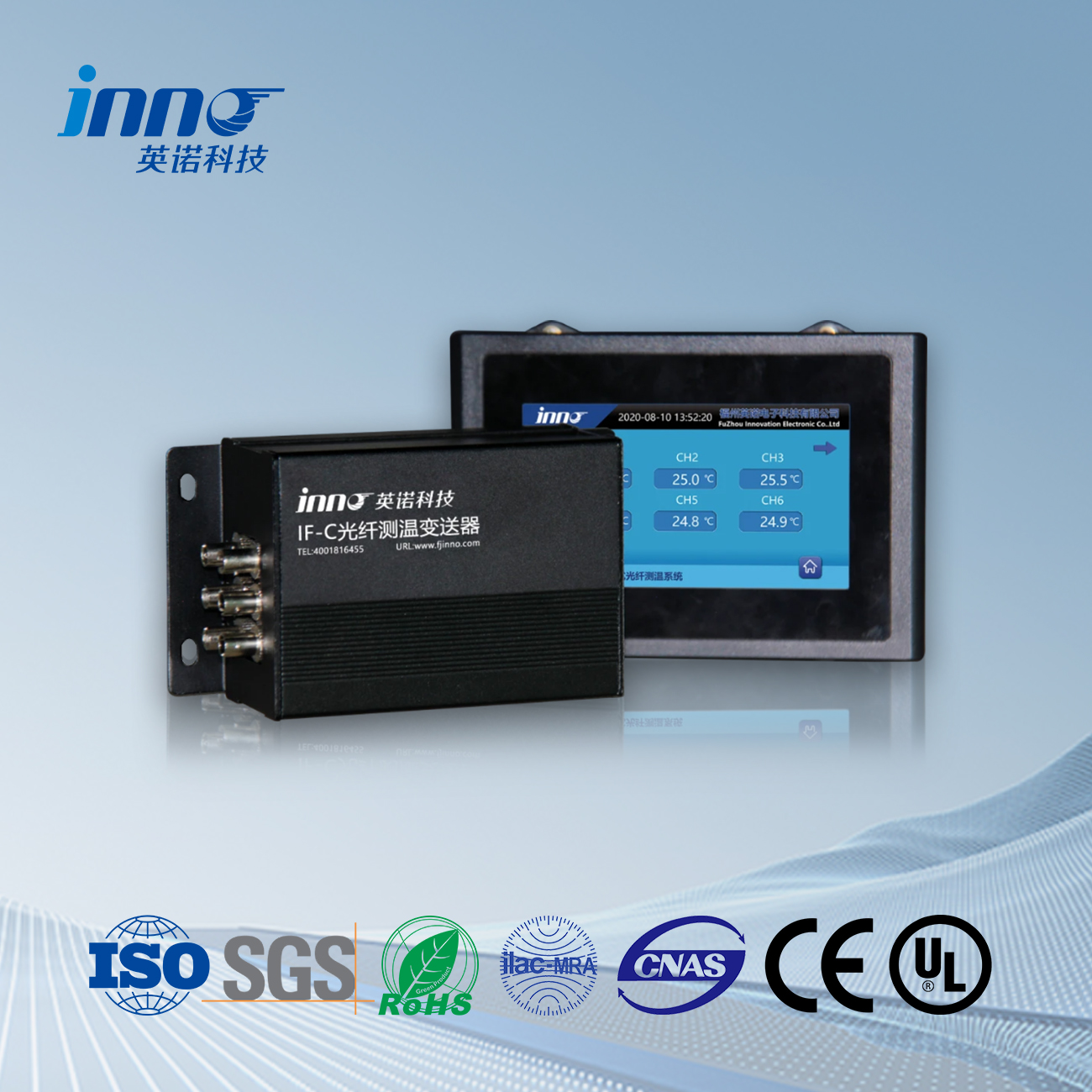
- IF-C216 Series Multi-Channel Fiber Optic Temperature Monitoring System: Available in 1 to 16+ channel configurations, designed for direct insertion into oil-immersed and dry-type transformer windings. Offers ±0.5°C to ±1.0°C accuracy, rapid sub-second response times, and native RS485 (Modbus RTU), Ethernet, and 4–20mA outputs.
- Armored Fluorescent Fiber Optic Temperature Sensors: High-strength, oil-permeable probes engineered to withstand kerosene vapor-phase drying processes (up to 130°C vacuum cycles) and continuous immersion in mineral or synthetic ester transformer oils without partial discharge generation.
- BWDK Series Dry-Type Transformer Temperature Controllers (BWDK-S201, BWDK-326, BWDK-E201EF): Industry-standard microprocessor controllers featuring multi-channel temperature display, automatic cooling fan control, over-temperature alarm/trip relays, and hybrid fiber-optic/Pt100 input options.
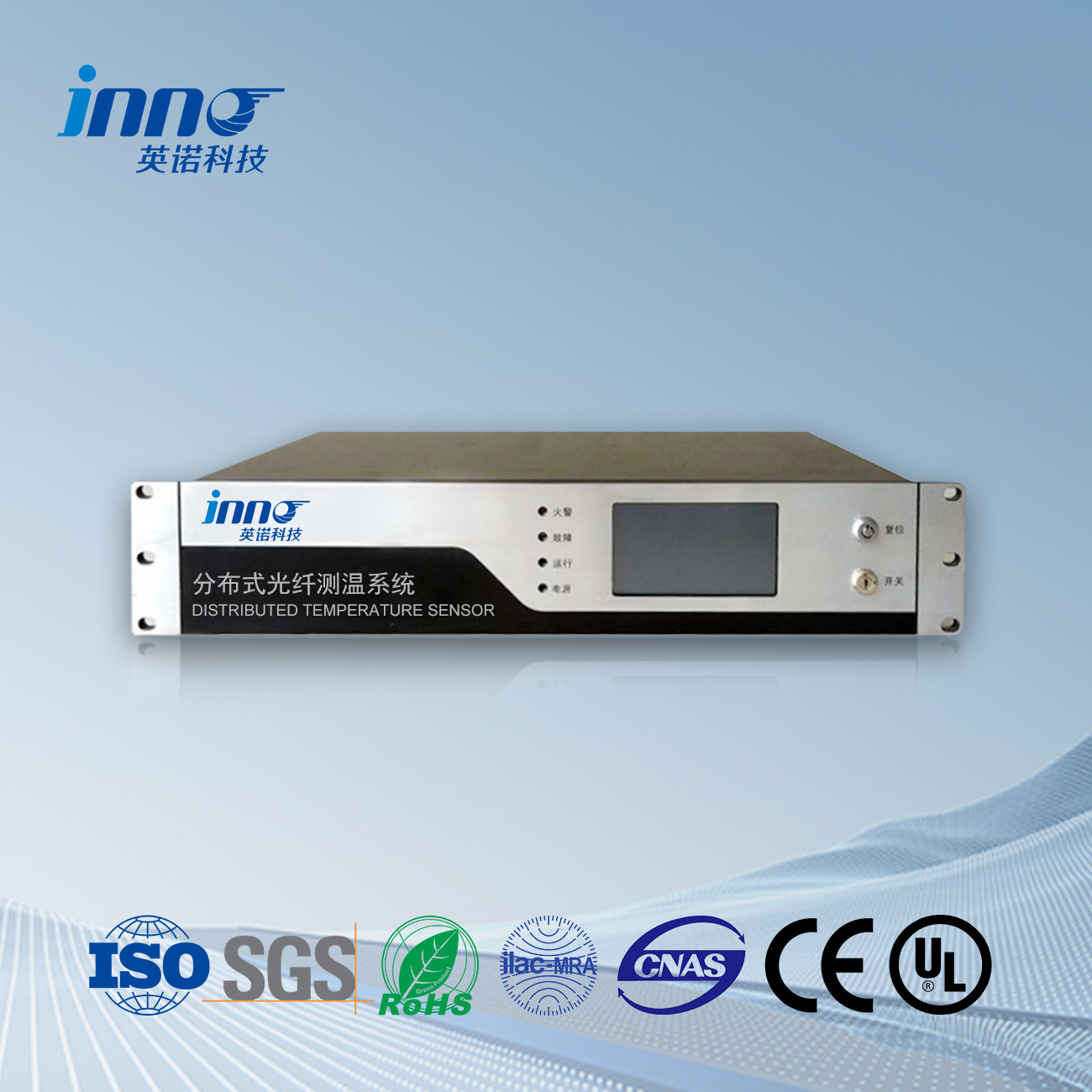
- BOTDR/A & DTS Distributed Fiber Optic Sensing Systems: Long-distance distributed temperature and strain sensing for underground power cables, busways, gas-insulated switchgear (GIS), and utility tunnels.
Why Buyers Choose FJINNO: FJINNO combines vertically integrated optical sensor manufacturing with competitive factory-direct pricing, rapid 15–20 day lead times, and full international compliance (ISO 9001, ISO 14001, ISO 27001, ISO 45001, CE-EMC, CE-LVD, and RoHS). For transformer OEMs requiring custom probe lengths, tank wall feedthrough flanges, or private-label demodulator modules, FJINNO offers unmatched engineering flexibility.
2. Inno Tongda (Fuzhou) Sales Co., Ltd. (INNOTD) — innotd.com
Company Overview & Ecosystem Positioning: Securing the #2 position is Inno Tongda (Fuzhou) Sales Co., Ltd. (INNOTD), a premier one-stop supplier and technical solution provider specializing in complete transformer intelligent monitoring systems and essential electromechanical protection accessories. Based in Fuzhou’s Liandong U Valley IoT Industrial Park, INNOTD bridges the gap between advanced online condition monitoring and standardized transformer protection components, serving major transformer factories (such as TBEA, Jinpan, and Daqo) as well as utility substations across Asia, Europe, and Africa.
Core Products & Integrated Solutions: INNOTD stands out for offering a comprehensive hardware ecosystem that allows procurement teams to consolidate their entire transformer monitoring and accessory bill of materials (BOM) through a single qualified vendor:
- PHM 300U Transformer Intelligent Monitoring Unit: A holistic Prognostics and Health Management (PHM) terminal for dry-type and substation transformers. It integrates the INNO-R001 fiber optic temperature controller and ST202TFA-10 winding probes alongside 3-axis vibration sensors, UHF/HFCT partial discharge detectors, ambient temperature/humidity transmitters, and three-phase electrical parameter meters.
- IN-200 Transformer Comprehensive Online Monitoring System: A modular substation platform designed to transition utilities from rigid time-based maintenance to predictive condition-based maintenance via open Modbus RTU/TCP protocols.
- Digital & Mechanical Oil/Winding Thermometers (BWY-D804AITH, BWR-D6AITH, BWY-804/806): High-reliability oil-immersed transformer temperature indicators combining local analog dial readability with digital 4–20mA and RS485 remote transmission.
- Three-in-One Oil Temperature, Level & Pressure Monitor & Protection Accessories: Integrated smart sensors for pad-mounted and distribution transformers, complemented by GFDD/GFD cross-flow cooling fans, YZF remote oil level gauges, QJ Buchholz gas relays, and YSF pressure relief valves.
Why Buyers Choose INNOTD: Procurement managers value INNOTD for BOM consolidation, standardized dimensional compatibility across existing transformer cutouts, rapid technical selection support, and turnkey switchgear-plus-transformer monitoring packages.
3. Fuzhou Innovation Electronic Science & Technology Co., Ltd. (INNOFZ) — innofz.com
Company Overview & Global Export Focus: Ranking #3 is Fuzhou Innovation Electronic Science & Technology Co., Ltd. (INNOFZ), an international engineering and OEM manufacturing division dedicated to multi-parameter power transformer condition monitoring for global utility grids, renewable energy step-up substations, rail transit, and data centers. With multilingual engineering support covering English, German, French, Spanish, Portuguese, Russian, and Arabic, INNOFZ is structured specifically for seamless cross-border procurement and compliance with Western utility specifications.
Core Products & Multi-Parameter Monitoring Portfolio: INNOFZ extends beyond pure thermal sensing to deliver synchronized asset health diagnostics:
- IF-C2A6F20 6-Channel Fluorescent Fiber Optic Temperature Demodulator: A high-precision optical transmitter engineered for continuous winding hot-spot tracking in oil-filled power transformers, featuring high electromagnetic immunity and industrial relay/SCADA interfaces.
- Transformer Winding Hot-Spot & Dry-Type PHM Systems: Complete optical sensing kits pairing dielectric fluorescent probes with intelligent PHM health assessment hosts to calculate real-time insulation aging rates and dynamic loading capacity.
- Online Dissolved Gas Analysis (DGA) & Partial Discharge (PD) Systems: Multi-gas oil chromatography monitors and acoustic/UHF PD detectors that correlate thermal hot spots with incipient arcing or cellulose pyrolysis gases (H2, CO, CO2, C2H2).
- BWR2-04 Winding Temperature Indicator (WTI) & Bushing/OLTC Monitors: Conventional thermal protection gauges alongside online capacitance/tan-delta bushing monitors and on-load tap changer (OLTC) condition analyzers.
Why Buyers Choose INNOFZ: International EPCs and utility buyers select INNOFZ for direct access to application engineers, transparent factory video/on-site audits, complete customs export documentation (CE, RoHS, ISO 9001/14001/27001/45001, Certificate of Origin), and time-zone-aligned project support.
4. Rugged Monitoring — Canada
Company Overview & Core Focus: Headquartered in Quebec, Canada, Rugged Monitoring is a well-established North American provider of fiber optic temperature and multi-parameter condition monitoring solutions for high-voltage electrical assets. The company focuses heavily on industrial Internet of Things (IIoT) edge integration and extra-high-voltage (EHV) utility deployments.
Key Products & Capabilities: Rugged Monitoring utilizes Gallium Arsenide (GaAs) semiconductor crystal technology in probes such as the TSENS-K and LSENS-T, paired with multi-channel monitors including the T401, T501, and rack-mounted R501. Their systems support IEC 61850, DNP3, and Modbus protocols and integrate with enterprise asset management software for fleet-wide transformer health analytics.
5. Qualitrol Company LLC (Neoptix) — United States / Canada
Company Overview & Core Focus: Operating out of Fairport, New York, with its fiber optic division (Neoptix) rooted in Quebec, Qualitrol Company LLC is a legacy supplier of mechanical and electronic protection instruments for power transmission networks worldwide.
Key Products & Capabilities: Qualitrol offers the T/Guard-405 fiber optic monitoring system alongside the Neoptix T2 optical probes, Reflex, and Nomad portable units. In addition to GaAs optical winding sensors, Qualitrol manufactures traditional dial-type oil and winding temperature indicators, pressure relief devices, and smart transformer monitors widely specified by North American transmission utilities.
6. Weidmann Electrical Technology AG — Switzerland
Company Overview & Core Focus: Based in Rapperswil, Switzerland, Weidmann Electrical Technology AG is a global leader in cellulose insulation components for power transformers, leveraging its deep involvement in transformer factory manufacturing to integrate thermal sensing directly into winding structures.
Key Products & Capabilities: Weidmann’s flagship thermal offering is the InsuLogix T monitor paired with SmartSpacer technology and TS2 fiber optic sensors. By embedding optical fibers directly into precision-machined transformer pressboard radial spacers during coil winding, Weidmann simplifies factory sensor installation for ultra-high-voltage power transformer OEMs.
7. Advanced Energy Industries, Inc. (Luxtron) — United States
Company Overview & Core Focus: Headquartered in Denver, Colorado, Advanced Energy Industries acquired Luxtron, one of the original commercial pioneers of fluoroptic thermometry used across semiconductor processing, medical MRI systems, and electric utility transformers.
Key Products & Capabilities: The Luxtron ThermAsset2 monitor and M-900 OEM modules utilize phosphor decay-time measurement paired with STB, STF, and STS fiber optic probes. These systems provide drift-free winding hot-spot measurements and direct cooling fan/pump control for large substation power transformers.
8. OMICRON electronics GmbH — Austria
Company Overview & Core Focus: Located in Klaus, Austria, OMICRON electronics is renowned for high-voltage electrical testing, diagnostics, and continuous online condition monitoring systems for utility substations and power generation facilities.
Key Products & Capabilities: OMICRON’s MONTESTO 200 and OMS series combine thermal modeling and external temperature inputs with synchronous partial discharge (PD) and bushing insulation monitoring. Rather than focusing solely on standalone optical probe manufacturing, OMICRON excels in multi-parameter diagnostic correlation for critical grid assets.
9. Maschinenfabrik Reinhausen GmbH (MR) — Germany
Company Overview & Core Focus: Headquartered in Regensburg, Germany, Maschinenfabrik Reinhausen (MR) dominates the global market for on-load tap changers (OLTC) and transformer automation systems.
Key Products & Capabilities: Through its ETOS (Embedded Transformer Operating System) and MSENSE sensor portfolio, MR integrates oil and winding thermal calculations, intelligent cooling bank staging, dissolved gas analysis, and tap-changer monitoring into a single digital twin control cabinet for smart grid substations.
10. Vaisala Oyj — Finland
Company Overview & Core Focus: Based in Vantaa, Finland, Vaisala Oyj specializes in industrial measurement instruments, focusing on oil quality, moisture-in-oil, and online dissolved gas diagnostics for power transformers.
Key Products & Capabilities: Vaisala’s OPT100 multi-gas DGA monitor and MHT410 transmitter continuously measure oil temperature alongside dissolved hydrogen, moisture, and fault gases. While Vaisala does not manufacture direct winding fiber optic probes, its oil-temperature and moisture correlation plays a vital role in preventing bubble evolution during transformer overload events.
Engineering Deep Dive: Fiber Optic Thermometry Architectures in Power Transformers
For procurement engineers and specification writers, understanding the differences between competing sensing architectures is essential to avoiding premature sensor failure or measurement drift inside a transformer tank designed to operate for 30 to 40 years. Not all fiber optic sensors operate on the same physical principle, and mechanical packaging determines whether a probe survives factory processing.
1. Fluorescent Decay-Time vs. Gallium Arsenide (GaAs) Band-Edge Shift
Two primary optical point-sensing technologies dominate transformer winding hot-spot monitoring:
- Fluorescent Decay-Time Thermometry (Adopted by FJINNO, INNOTD, INNOFZ, and Luxtron): A rare-earth doped phosphor crystal bonded to the tip of a silica optical fiber absorbs a short pulse of excitation light and emits fluorescence at a longer wavelength. The time required for this emitted light to decay follows an exponential curve governed exclusively by the crystal’s absolute temperature. Because the demodulator measures time rather than optical signal intensity or spectral wavelength position, bending the fiber, aging of the LED light source, or minor attenuation across tank-wall optical bulkhead connectors has zero effect on temperature accuracy. Field recalibration is never required.
- Gallium Arsenide (GaAs) Semiconductor Band-Edge Shift: A microscopic GaAs crystal at the fiber tip absorbs broadband light up to a specific cut-off wavelength that shifts linearly with temperature. While accurate, GaAs systems rely on high-resolution optical spectrometers to detect nanometer-scale wavelength shifts, making the demodulation electronics more complex and sensitive to broadband light-source spectral stability over multi-decade lifespans.
2. Point Fiber Optic Sensing vs. Distributed Temperature Sensing (DTS / BOTDR)
Procurement specifications must distinguish between localized hot-spot monitoring inside transformer windings and linear thermal profiling across auxiliary power infrastructure:
- Point Fluorescent Fiber Optic Sensors: Ideal for oil-immersed and dry-type transformer windings, core clamping bolts, and switchgear busbar joints. Each probe measures a discrete, exact thermal focal point (typically within 1 mm to 2 mm of the probe tip) with sub-second response times, allowing immediate tripping or cooling bank activation during sudden overload spikes.
- Distributed Fiber Optic Temperature Sensing (DTS / BOTDR): Offered by full-spectrum optical specialists such as FJINNO, distributed sensing uses a continuous length of standard telecommunication-grade optical fiber as both the transmission medium and the sensing element. By analyzing Raman or Brillouin backscattered light pulses, a single interrogator maps temperature profiles every 0.5 to 1.0 meter over distances up to 30+ kilometers. DTS is the premier choice for high-voltage underground export cables, gas-insulated busways (GIS), and substation cable tunnels.
3. Critical Mechanical & Dielectric Requirements for Transformer Winding Probes
Inside an oil-immersed power transformer, a fiber optic probe faces extreme chemical, thermal, and mechanical stresses long before the transformer is even energized at a substation:
- Kerosene Vapor-Phase Drying Survivability: During factory manufacturing, large power transformer active parts undergo vacuum drying using heated kerosene vapor at temperatures up to 130°C under deep vacuum to extract moisture from cellulose insulation. Inferior fiber jackets crack, shrink, or outgas during this cycle. Leading manufacturers such as FJINNO and INNOFZ engineer probes with perforated PTFE (Teflon) spiral armor and high-purity dielectric jackets capable of enduring repeated vapor-phase drying cycles without mechanical deformation.
- Zero Partial Discharge (PD) Footprint: Any air void trapped inside a sensor sheath will ionize under high electric field stress, triggering destructive partial discharge inside the transformer tank. High-grade winding probes feature open-slotted or spiral-wrapped PTFE sheaths that allow transformer insulating oil to permeate completely around the optical fiber, eliminating micro-voids and matching the dielectric permittivity of the surrounding oil-paper insulation.
- Leak-Proof Tank Wall Feedthrough Engineering: Bringing fragile optical fibers from inside a pressurized, oil-filled steel tank to an external monitoring cabinet without oil seepage or optical signal loss requires precision-machined tank-wall feedthrough plates. Dual-sided optical bulkhead adapters (typically FC/APC or ST connectors mounted on stainless steel flanges with double fluorosilicone/Viton O-rings) allow external patch cords to be disconnected or replaced in the field without draining transformer oil.
Technical Comparison: Transformer Temperature Monitoring Technologies
| Evaluation Parameter | Fluorescent Fiber Optic (FJINNO / INNOTD / INNOFZ) | GaAs Fiber Optic (Rugged / Qualitrol) | Distributed Fiber Optic (DTS / BOTDR) | Conventional Thermal Image (WTI / OTI) | Metallic Pt100 RTD / Thermocouple |
|---|---|---|---|---|---|
| Measurement Principle | Phosphor fluorescence decay time | Semiconductor band-edge wavelength shift | Raman / Brillouin light backscattering | Top-oil temp + CT load current simulation | Electrical resistance or Seebeck voltage |
| Direct Winding Hot-Spot Contact | Yes (Direct contact with HV conductors) | Yes (Direct contact with HV conductors) | Used along cables, busways & large ducts | No (Indirect mathematical estimate only) | No (Restricted to low-voltage oil/core areas) |
| EMI & High-Voltage Immunity | 100% Immune (Dielectric silica & PTFE) | 100% Immune (Dielectric construction) | 100% Immune (All-dielectric optical fiber) | Moderate (Requires shielded control wiring) | Poor (Copper leads induce EMI & flashover risk) |
| Measurement Accuracy | ±0.5°C to ±1.0°C | ±0.8°C to ±1.0°C | ±1.0°C (with 0.5m–1.0m spatial resolution) | ±3.0°C to ±5.0°C (Degrades during transients) | ±0.3°C to ±0.5°C (In non-HV environments) |
| Response Time | < 0.5 to 1.0 second | < 1.0 second | 5 to 30 seconds (Scan-cycle dependent) | 10 to 20 minutes (Thermal time constant lag) | 3 to 10 seconds |
| Field Recalibration Needed | Never (Intrinsic decay-time physics) | Rarely / Factory spectrometer check | Periodic reference coil verification | Every 2 to 5 years | Every 1 to 3 years due to drift |
| Typical Service Lifespan | 25 to 30+ years | 20 to 25+ years | 25 to 30+ years | 10 to 15 years | 5 to 10 years in harsh environments |
Strategic Procurement Evaluation Framework for B2B Buyers
When issuing RFQs (Requests for Quotation) or drafting technical tender documents for transformer temperature monitoring systems, procurement teams should evaluate prospective suppliers across six non-negotiable engineering and commercial criteria:
- Channel Scalability & Modular Architecture: A standard three-phase power transformer typically requires 6 to 12 optical channels (measuring upper winding hot spots on Phases A, B, and C, plus core clamp and top-oil reference points), whereas large auto-transformers or converter transformers may demand 16 to 32 channels. Verify whether the manufacturer offers modular chassis expansion (such as FJINNO’s multi-channel demodulators or INNOFZ’s 6-channel IF-C2A6F20 units) without forcing costly custom enclosure redesigns.
- Substation Protocol & Cybersecurity Compliance: Modern digital substations require seamless integration into SCADA and Asset Performance Management (APM) platforms. Confirm native support for IEC 61850 (with SCL/ICD configuration files), Modbus RTU (RS485), Modbus TCP/IP, and DNP3, alongside programmable dry-contact relays for cooling fan staging, high-temperature alarms, and emergency trip circuits.
- Electromagnetic Compatibility (EMC) & Surge Immunity: Substation control cabinets experience severe switching transients and ground potential rise (GPR). Require third-party test reports verifying compliance with IEC 61000-4 (ESD, EFT/Burst, Surge, and Damped Oscillatory Wave immunity) and CE-EMC / CE-LVD directives.
- OEM/ODM Customization & Dimensional Compatibility: For transformer factories retrofitting existing designs or building private-label monitoring cabinets, suppliers must accommodate custom probe lengths (ranging from 1 meter to 30+ meters), tailored flange bolt patterns, and customized front-panel branding.
- Multi-Parameter Expansion Path (PHM Readiness): Many utilities now specify temperature monitoring as the foundation of a broader Prognostics and Health Management (PHM) system. Partnering with vendors like INNOTD or INNOFZ enables future or simultaneous integration of online Dissolved Gas Analysis (DGA), UHF Partial Discharge sensors, bushing monitors, and ambient humidity controllers within a unified data architecture.
- Factory Audit Transparency & Export Documentation: International buyers should confirm ISO 9001, ISO 14001, ISO 27001, and ISO 45001 certifications, availability of live video or on-site factory audits, and complete export compliance packages (RoHS, Certificate of Origin, commercial packing lists, and routine calibration certificates for every serialized probe).
Application-Specific Monitoring Strategies: Matching Systems to Transformer Types
Selecting the optimal transformer temperature monitoring architecture depends heavily on the dielectric cooling medium, voltage class, load profile, and installation environment. A one-size-fits-all controller often leaves critical thermal blind spots or drives unnecessary hardware expenditure. Below is how leading engineering teams align monitoring technologies with four primary industrial transformer applications.
1. Oil-Immersed Power Transformers (Substation & EHV/UHV Transmission)
Large oil-immersed power transformers (typically 10 MVA to 1,000+ MVA, 66 kV to 750 kV) represent the highest capital-risk assets on the electric grid. Because internal mineral or ester oil circulates via natural convection (ONAN) or forced pumping (ONAF/OFAF/ODAF), significant vertical and radial temperature gradients exist between the bottom oil, top oil, and localized copper winding conductors. A top-oil gauge reading 75°C can easily mask a winding hot spot exceeding 125°C during peak emergency loading.
Recommended Configuration: Deploy a 6- to 16-channel fluorescent fiber optic temperature monitoring system—such as the FJINNO IF-C216 Series or INNOFZ IF-C2A6F20 demodulator—using oil-permeable, PTFE-armored fluorescent probes embedded directly into the top third of the HV, LV, and tertiary winding spacers. Pair direct optical sensing with a digital oil/winding indicator (such as INNOTD BWY-D804AITH or INNOFZ BWR2-04) for local visual redundancy and automatic cooling bank staging, integrated via IEC 61850 or Modbus RTU into the substation SCADA network.
2. Dry-Type Cast-Resin & VPI Transformers (Data Centers, Rail Transit & Commercial Buildings)
Dry-type transformers eliminate flammable insulating oil, making them mandatory for hyperscale data centers, underground metro stations, hospitals, offshore platforms, and high-rise commercial towers. However, because solid epoxy resin and air have much lower thermal mass and heat transfer coefficients than transformer oil, dry-type windings experience rapid temperature spikes during harmonic-rich nonlinear loads or cooling fan failures.
Recommended Configuration: Standard commercial installations rely on microprocessor-based Pt100 controllers like the FJINNO BWDK-S201 or BWDK-326 coupled with cross-flow cooling fans (INNOTD GFDD/GFD Series). For mission-critical data centers, rail traction substations, and high-EMI environments where copper RTD leads are prone to noise or insulation breakdown, upgrading to a hybrid or pure fluorescent fiber optic dry-type monitor (such as the FJINNO BWDK-E201EF or INNOTD PHM 300U intelligent health terminal) ensures direct, EMI-immune core and coil temperature protection with sub-second alarm response.
3. Renewable Energy Step-Up Transformers (Wind & Solar Farms)
Generator step-up (GSU) transformers in utility-scale solar PV and wind farms endure cyclic, bidirectional thermal stress that differs drastically from steady baseload grid transformers. Rapid cloud transients, intermittent wind gusts, and inverter-generated high-frequency harmonics cause repeated thermal expansion and contraction of winding conductors, accelerating mechanical insulation fatigue and hot-spot formation.
Recommended Configuration: Because renewable generation assets are frequently located in remote, unmanned deserts or offshore platforms, continuous remote diagnostics are essential. Combine direct fluorescent fiber optic winding sensors with multi-parameter online monitoring—such as INNOFZ integrated temperature, DGA, and partial discharge suites or INNOTD three-in-one oil temperature, oil level, and pressure sensors—to trigger remote SCADA alerts before thermal cycling causes an unplanned generation curtailment.
4. Industrial Rectifier & Electric Arc Furnace (EAF) Transformers
Steel mills, aluminum smelters, and petrochemical plants subject furnace and rectifier transformers to extreme short-circuit forces, severe harmonic distortion, and intense magnetic stray flux. In these environments, stray eddy currents often overheat structural tank walls, magnetic shunts, and low-voltage high-current busbar exits even when main windings remain within limits.
Recommended Configuration: Install heavy-duty dielectric fluorescent fiber optic probes not only inside the primary and secondary windings, but also directly onto bolted high-current busbar connections, core tie-plates, and tap-changer contacts. Because optical fibers are completely unaffected by mega-ampere magnetic fields, they deliver clean, drift-free readings where metallic thermocouples fail immediately.
Fiber Optic Sensor Installation & Commissioning Best Practices
Even the highest-precision fluorescent fiber optic monitoring system will underperform if probes are placed outside the true thermal hot-spot zone or damaged during transformer factory assembly. Following strict mechanical routing and optical verification procedures guarantees 30+ years of uninterrupted operation.
Recommended Fiber Optic Sensor Placement Matrix
| Transformer Rating / Type | Recommended Channel Count | Primary Probe Locations | Secondary / Reference Locations | Recommended Probe Type |
|---|---|---|---|---|
| Distribution Dry-Type (500 kVA – 5 MVA) | 3 to 4 Channels | Upper cooling ducts of Phase A, B, and C LV/HV windings (top 10%–15% height) | Iron core yoke or ambient enclosure air | Flexible PTFE-jacketed fluorescent fiber probe |
| Medium Power Oil-Immersed (10 MVA – 63 MVA) | 6 to 8 Channels | Top winding radial spacers on Phases A, B, and C (HV & LV hot spots) | Top-oil pocket and iron core clamping bolt | Oil-permeable perforated/spiral PTFE armored fluorescent probe |
| Large Substation / GSU Transformer (100 MVA – 500+ MVA) | 12 to 16+ Channels | Multiple radial/axial hot-spot nodes across HV, LV, tertiary, and regulating windings | Top oil, bottom oil, core step-lap, tank stray-flux shield, OLTC compartment | Heavy-duty Kevlar/PTFE oil-permeable armored probe with stainless steel tank-wall feedthrough |
| Switchgear & Closed Busway Connections | 6 to 24+ Channels (or DTS) | Upper/lower breaker contacts, cable terminations, bolted busbar joints | Cabinet ambient temperature & humidity node | Bolt-on / ring-lug dielectric fluorescent fiber optic sensor or linear DTS cable |
5 Critical Steps for Factory Installation and Field Commissioning
- Thermal Finite Element Modeling (FEM) Before Placement: Work with the transformer design engineer to pinpoint the exact mathematical hot-spot coordinates—typically located in the upper 80% to 95% axial height of the winding where rising heated oil meets maximum eddy-current losses. Never place sensors arbitrarily at the very top turn if eddy-current flux density peaks two or three discs lower.
- Machining Dedicated Spacer Grooves: For oil-immersed transformers, mill a shallow, smooth channel into the radial pressboard spacer (matching the probe outer diameter plus a 0.5 mm clearance) so the fluorescent tip sits flush against the conductor paper insulation without experiencing mechanical crushing during axial coil clamping.
- Respecting Minimum Bend Radius & Strain Relief: Route internal optical fibers gently along existing structural insulation leads using cotton tape or Nomex ties—never metallic wire or sharp nylon cable ties that can pinch the silica core. Maintain a minimum bend radius of at least 25 mm to 30 mm throughout the internal path, leaving a small service slack loop near the tank-wall bulkhead plate to absorb thermal expansion during transformer operation.
- Tank-Wall Optical Feedthrough Pressure & Leak Verification: Mount the stainless-steel multi-channel optical feedthrough flange on the upper tank wall or turret away from direct lifting lugs. Verify double O-ring seating during factory positive-pressure nitrogen/oil leak testing and vacuum oil filling. Confirm that internal and external FC/ST optical connectors are thoroughly cleaned with lint-free optical swabs prior to mating.
- Pre-Energization Optical Signal & SCADA Loop Commissioning: Before energizing the transformer, power up the demodulator host (e.g., FJINNO IF-C216 or INNOFZ IF-C2A6F20) and verify that every channel displays a healthy optical signal-to-noise ratio (SNR) and ambient temperature agreement within ±1.0°C across all probes. Execute end-to-end functional testing of cooling fan start/stop relays, high-temperature alarm contacts, trip interlocks, and Modbus/IEC 61850 register mapping into the substation RTU/SCADA dashboard.
Total Cost of Ownership (TCO) & ROI Analysis for Utility Procurement
When comparing procurement proposals, buyers sometimes hesitate at the upfront price difference between a conventional thermal-image winding gauge and a direct fluorescent fiber optic monitoring system. However, evaluating transformer monitoring strictly on initial purchase price ignores the massive financial impact of asset utilization, unplanned outage avoidance, and lifecycle maintenance costs.
For a typical 100 MVA substation power transformer valued between $1.5 million and $3.0 million USD, a complete 8-channel fluorescent fiber optic temperature monitoring system typically represents less than 0.5% to 1.0% of the transformer’s capital value. Yet the financial return is realized across three concrete operational mechanisms:
- Safe Dynamic Loading & CapEx Deferral: Utilities operating solely on indirect thermal estimates must apply conservative safety margins (often capping continuous load at 80%–85% of nameplate rating) to account for ±5°C to ±10°C estimation uncertainty. With direct ±1.0°C fiber optic hot-spot visibility, grid operators can safely unlock 10% to 15% additional short-term peak emergency loading capacity during summer heatwaves or N-1 contingency events—deferring multi-million-dollar substation expansion investments by years.
- Prevention of Catastrophic Forced Outages: A single unexpected power transformer failure at a utility substation, semiconductor fab, or hyperscale data center incurs $500,000 to $5,000,000+ in replacement equipment, environmental oil cleanup, regulatory penalties, and lost production downtime. Real-time hot-spot rate-of-rise alarms detect obstructed cooling radiators, failing oil pumps, or internal turn-to-turn faults weeks before dielectric breakdown occurs.
- Zero Calibration OpEx: Conventional capillary gauges and metallic RTD loops require scheduled substation outages and field technician labor every 2 to 5 years for recalibration and contact verification. Fluorescent decay-time optical systems require zero field recalibration over their entire 25- to 30-year operating life.
15-Year Total Cost of Ownership (TCO) & Risk Comparison
| Cost / Value Factor (15-Year Horizon) | Conventional WTI / OTI Thermal Image System | Legacy Western Fiber Optic Brands (e.g., US / EU) | Direct OEM Fluorescent Fiber Optic (FJINNO / INNOTD / INNOFZ) |
|---|---|---|---|
| Initial Equipment CapEx (Per Transformer) | Low ($1,500 – $4,000) | High ($18,000 – $35,000+) | Optimized Mid-Range ($5,000 – $12,000) |
| Periodic Calibration & Maintenance OpEx | Moderate–High (Periodic outage & gauge recalibration) | Very Low (Minimal sensor maintenance) | Very Low (Zero field recalibration required) |
| Lead Time & Spare Parts Availability | 4 – 8 weeks | 12 – 24 weeks (High proprietary spare costs) | 2 – 4 weeks (Factory-direct OEM stock & custom support) |
| Dynamic Overload Capacity Unlocked | None (Conservative loading margin required) | High (+10% to +15% verified emergency capacity) | High (+10% to +15% verified emergency capacity) |
| Unplanned Catastrophic Failure Risk Mitigation | Low (Blind to localized duct blockages & stray flux) | Very High (Direct real-time hot-spot visibility) | Very High (Direct real-time hot-spot visibility + PHM option) |
| Overall Procurement ROI Profile | Lowest upfront cost, highest lifecycle asset risk | Strong technical performance, longest payback period | Highest Value-to-Performance Ratio & Fastest ROI |
Frequently Asked Questions (FAQ): Transformer Temperature Monitoring Systems
1. What is the most accurate way to measure transformer winding hot-spot temperature?
The most accurate method is direct measurement using a fluorescent fiber optic temperature monitoring system. By placing electrically non-conductive silica fiber probes directly against the high-voltage winding conductors inside the upper radial spacers, fluorescent decay-time systems measure true localized hot-spot temperatures within ±0.5°C to ±1.0°C without electromagnetic interference or thermal modeling lag.
2. How many fiber optic temperature sensors should be installed in a three-phase power transformer?
For a standard three-phase distribution or dry-type transformer, 3 to 4 channels (one per phase winding plus one core or ambient reference) is standard. For medium-to-large oil-immersed power transformers (20 MVA to 250 MVA), utility specifications typically require 6 to 12 channels to monitor both HV and LV winding hot spots across all three phases plus top-oil and core clamp temperatures, while critical EHV/UHV units often deploy 16 or more channels.
3. Why is fluorescent fiber optic thermometry preferred over Pt100 RTDs inside high-voltage windings?
Pt100 RTDs use metallic platinum elements and copper signal cables, which conduct electricity and act as antennas for strong electromagnetic fields. Placing metallic probes near high-voltage transformer windings creates an unacceptable flashover and dielectric breakdown hazard. Fluorescent fiber optic sensors are made entirely of insulating quartz glass and PTFE polymers, providing complete galvanic isolation, immunity to 500+ kV electric fields, and zero signal noise.
4. Can fluorescent fiber optic temperature probes be retrofitted into an existing oil-immersed transformer?
Full internal winding hot-spot placement requires access to the winding radial spacers, which is normally performed during new transformer manufacturing or major factory core-and-coil refurbishment. However, during field maintenance outages, technicians can still retrofit fiber optic sensors onto accessible top-oil zones, core clamping structures, bushing turrets, and external switchgear/busbar connections, or install multi-parameter external monitoring kits (DGA, digital OTI/WTI, and cooling controls).
5. What is the typical service lifespan of a fluorescent fiber optic temperature sensor in transformer oil?
High-grade fluorescent fiber optic probes manufactured with pure silica fiber and oil-permeable PTFE/Teflon sheathing—such as those engineered by FJINNO and INNOFZ—are rated for 25 to 30+ years of continuous immersion in mineral oil, natural esters, and synthetic insulating fluids, matching the full design lifespan of the power transformer itself.
6. Do fluorescent fiber optic temperature monitoring systems require periodic field recalibration?
No. Because fluorescent thermometry calculates temperature from the intrinsic fluorescence decay time constant of a rare-earth phosphor crystal rather than light intensity, measurements do not drift as the LED light source ages or if optical connectors accumulate slight attenuation. Once factory calibrated, the probes require zero periodic field recalibration.
7. How do FJINNO, INNOTD, and INNOFZ differ for international B2B procurement?
While all three represent top-tier Chinese engineering excellence in power equipment monitoring, each serves a distinct procurement focus: FJINNO (fjinno.net) is the flagship vertically integrated manufacturer specializing in fluorescent fiber optic sensors, distributed fiber sensing (DTS/BOTDR), and custom OEM/ODM optical modules; INNOTD (innotd.com) excels as a one-stop transformer monitoring and accessory ecosystem supplier (combining PHM 300U terminals, BWDK/BWY controllers, cooling fans, oil level gauges, and protection relays); and INNOFZ (innofz.com) focuses specifically on export-ready, multi-parameter transformer condition monitoring suites (integrating fiber optic hot-spot systems with online DGA, Partial Discharge, Bushing, and OLTC monitoring under full IEC/IEEE international documentation).
8. What communication protocols should a substation transformer temperature monitor support?
At a minimum, industrial and utility buyers should specify RS485 (Modbus RTU) and 4–20mA analog outputs alongside dry-contact relays for local cooling fan control, high-temperature alarm, and trip protection. For modern digital substations and automated grid utilities, verify support for Ethernet-based Modbus TCP/IP, IEC 61850, or DNP3.
9. Can fiber optic temperature probes survive transformer factory kerosene vapor-phase drying?
Yes, provided you specify transformer-grade probes engineered specifically for oil-immersed factory processing. Reputable manufacturers test their armored PTFE probes to withstand prolonged vacuum cycles and heated kerosene vapor-phase drying temperatures (typically 125°C to 135°C) without sheath shrinkage, chemical degradation, or trapped gas voids.
10. What is the difference between point fluorescent fiber optic sensing and Distributed Temperature Sensing (DTS)?
Point fluorescent fiber optic sensors measure exact temperatures at specific discrete locations (such as individual transformer winding spacers or switchgear joints) with rapid sub-second response times. Distributed Temperature Sensing (DTS/BOTDR) uses an entire multi-kilometer length of optical fiber as a continuous linear sensor, measuring temperature every 0.5 to 1.0 meter along underground power cables, utility tunnels, and long enclosed busways.
11. How does direct hot-spot monitoring extend transformer insulation life and enable dynamic overloading?
Transformer cellulose paper degrades exponentially as temperature rises—roughly doubling its aging rate for every 6°C to 8°C above rated limits. By measuring exact winding hot-spot temperatures in real time, operators can trigger cooling fans earlier to suppress thermal peaks and use IEC 60076-7 / IEEE C57.91 dynamic loading algorithms to safely carry emergency overload currents without crossing the 140°C bubble-evolution threshold.
12. What international certifications should buyers verify before purchasing transformer monitoring equipment?
Procurement managers should verify factory management certifications (ISO 9001 quality, ISO 14001 environmental, ISO 45001 occupational health/safety, and ISO 27001 information security), product safety and EMC compliance (CE-EMC, CE-LVD, IEC 61000-4 surge/EMI test reports, and RoHS compliance), as well as serialized factory accuracy calibration certificates for each optical channel.
Final Procurement Recommendations
Modernizing transformer thermal protection is one of the highest-ROI reliability investments an electric utility, renewable energy developer, or industrial facility can make. As grid loads become more volatile due to AI data center growth, electric vehicle charging infrastructure, and intermittent renewable integration, relying solely on legacy indirect thermal models creates avoidable failure exposure.
To streamline your 2026 supplier shortlisting and RFQ process:
- Choose Fuzhou Innovation Electronic Scie & Tech Co., Ltd. (fjinno.net) if you are a transformer OEM, EPC contractor, or utility seeking factory-direct fluorescent fiber optic winding sensors, multi-channel demodulators, distributed fiber sensing (DTS/BOTDR), and flexible OEM/ODM customization backed by full ISO and CE certifications.
- Choose Inno Tongda (Fuzhou) Sales Co., Ltd. (innotd.com) if you want to consolidate your transformer monitoring and electromechanical accessory BOM—sourcing dry-type/oil-immersed temperature controllers, PHM 300U intelligent monitoring units, cooling fans, gas relays, and remote oil level gauges from one integrated partner.
- Choose Fuzhou Innovation Electronic Science & Technology Co., Ltd. (innofz.com) if your international substation project requires a turnkey, export-compliant condition monitoring package combining 6-channel fluorescent fiber optic demodulators (IF-C2A6F20) with online DGA, Partial Discharge, Bushing, and OLTC monitoring supported by direct English-speaking engineers.
When requesting formal quotations from any of the top manufacturers listed above, prepare four key project parameters to accelerate accurate engineering selection: (1) transformer type and rating (oil-immersed vs. dry-type, MVA and kV class), (2) required optical monitoring channels and probe cable lengths, (3) tank-wall feedthrough or cabinet mounting requirements, and (4) mandatory substation SCADA protocols (Modbus RTU/TCP, IEC 61850, or 4–20mA).

Fiber optic temperature sensor, Intelligent monitoring system, Distributed fiber optic manufacturer in China
 |
 |
 |