 INNO fibre optic temperature sensors ,temperature monitoring systems.
- Why Precise Internal Temperature Monitoring Is Critical
- 10 Mainstream Temperature Measurement Methods
- Fluorescent Fiber Optic Temperature Sensors (Recommended)
- Platinum Resistance Sensors (PT100/PT1000)
- Thermocouple Temperature Sensors
- Fiber Bragg Grating (FBG) Sensors
- Distributed Temperature Sensing (DTS) Systems
- Infrared Thermal Imaging
- Wireless Temperature Sensors
- Winding Temperature Indicators (WTI)
- Oil Temperature Gauges
- Thermal Imaging Cameras
- Comprehensive Method Comparison
- Conclusion and Recommendations
Introduction: The Critical Need for Accurate Transformer Thermal Monitoring

Temperature monitoring represents the most crucial parameter in transformer condition monitoring systems. Winding hot spot temperatures exceeding design limits accelerate insulation degradation, directly impacting transformer health monitoring and operational lifespan. Industry statistics reveal that thermal-related failures account for over 40% of premature transformer breakdowns, with repair costs averaging $500,000-$2,000,000 per unit.
Traditional top oil temperature measurements fail to accurately reflect actual winding temperatures. The temperature differential between oil and winding hot spots typically ranges 10-20°C, with peak differences reaching 30°C during dynamic loading conditions. This measurement gap creates significant risks for distribution transformer monitoring, power transformer monitoring, and high voltage transformer temperature monitoring applications.
This comprehensive guide examines 10 mainstream transformer temperature monitoring technologies, with particular focus on advanced fiber optic temperature monitoring solutions that enable direct winding hot spot monitoring for distribution transformers, power transformers, dry type transformers, cast resin transformers, reactors, vault transformers, rectifier transformers, traction transformers, and rail transit transformers.
1. Why Precise Internal Temperature Monitoring Is Critical for Transformers
1.1 Thermal Failure Mechanisms and Lifespan Impact
The relationship between winding temperature and insulation degradation follows the Arrhenius equation, commonly known as the “8-degree rule”: every 8°C increase in operating temperature reduces transformer insulation life by 50%. For a transformer designed for 30-year service at 95°C hot spot temperature, continuous operation at 111°C reduces expected life to just 7.5 years.
Typical thermal failure scenarios include:
- Cooling system malfunction: Fan or pump failures causing inadequate heat dissipation
- Overload conditions: Excessive current generating abnormal transformer temperature rise
- Localized overheating: Poor contact at terminals, circulating currents in windings
- Thermal runaway: Accelerating degradation once critical temperature thresholds are exceeded
Implementing proper transformer thermal monitoring enables predictive maintenance strategies, preventing catastrophic failures and extending asset lifespan through optimized loading profiles.
1.2 Temperature Monitoring Requirements for Different Transformer Types
Distribution Transformer Temperature Monitoring: Typically 100-2500 kVA units require cost-effective online condition monitoring systems with ±2°C accuracy for load management and asset protection.
Power Transformer Monitoring: Large utility transformers (>10 MVA) demand high-precision winding temperature monitoring (±1°C) with multi-point sensing for thermal gradient analysis and transformer predictive maintenance.
Dry Type Transformer Temperature Monitoring: Air-cooled units require direct winding contact sensors due to absence of oil for thermal transfer, making fiber optic temperature sensors ideal for epoxy-encapsulated windings.
Cast Resin Transformer Temperature Monitoring: Vacuum-cast units need embedded sensors installed during manufacturing, with fluorescent fiber optic probes providing non-conductive solutions.
High Voltage Transformer Temperature Monitoring: Systems above 110kV require sensors with exceptional dielectric strength (>100kV) to prevent insulation failures, achievable only through fiber optic monitoring solutions.
Rectifier and Traction Transformer Monitoring: High harmonic content generates additional heating, requiring fast-response temperature monitoring systems (<1 second) for dynamic thermal management.
1.3 Critical Temperature Measurement Points
Effective transformer condition monitoring requires strategic sensor placement:
- Winding Hot Spots: Highest temperature zones in HV/LV windings (2-4 sensors per winding)
- Winding Temperature Sensors: Average winding temperature measurement points
- Core Temperature: Iron core monitoring (1-2 sensors)
- Lead Connections: Terminal junction temperatures (1 sensor per phase)
- Top Oil Temperature: Conventional measurement reference
- Bottom Oil Temperature: Thermal circulation verification
- Cooling System Temperatures: Radiator inlet/outlet for oil temperature monitoring
1.4 Technical Requirements for Transformer Temperature Monitoring Systems
Modern online transformer monitoring systems must meet stringent performance criteria:
- Measurement Accuracy: ±1°C for critical applications, ±2°C for general monitoring
- Response Time: <1 second for real-time temperature monitoring
- Dielectric Strength: >100kV insulation resistance for high-voltage applications
- EMI Immunity: Complete electromagnetic interference rejection
- Continuous Operation: 24/7 unattended online condition monitoring
- Long-term Stability: 25+ year calibration-free operation
- System Integration: Seamless connection with transformer monitoring dashboard and SCADA systems via Modbus, IEC 61850 protocols
Note: All installation methods require transformer de-energization and oil drainage for internal sensor placement, making initial installation planning critical for retrofit projects.
2. 10 Mainstream Temperature Measurement Methods for Oil-Immersed Transformers
Method 1: Fluorescent Fiber Optic Temperature Sensors (Optimal Solution)
1.1 Operating Principle of Fluorescent Fiber Optic Temperature Monitoring
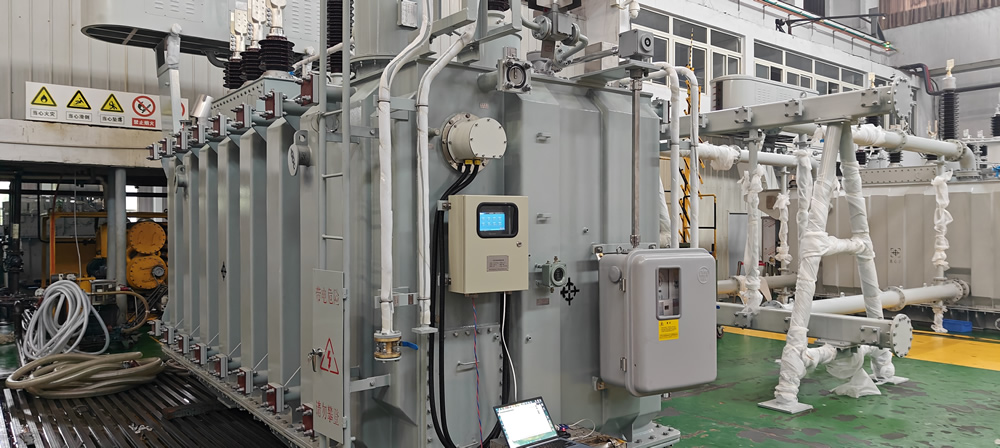
Fluorescent fiber optic temperature sensors utilize rare-earth phosphor materials whose fluorescent decay time exhibits precise temperature dependency. When excited by LED light pulses transmitted through optical fiber, the probe’s phosphor coating emits fluorescence with decay characteristics directly proportional to temperature. This purely optical measurement mechanism makes fluorescent sensors ideal for transformer winding hot spot monitoring.
1.2 Core Advantages for Transformer Applications
Complete Electrical Isolation: Dielectric strength exceeding 100kV enables safe deployment in high voltage transformer temperature monitoring without introducing insulation weaknesses or ground fault risks.
Total EMI Immunity: Non-metallic construction eliminates electromagnetic interference susceptibility, critical for rectifier transformers and traction transformers operating in high-noise electrical environments.
Superior Accuracy: ±1°C precision across -40°C to +260°C range provides reliable winding temperature data for thermal modeling and load optimization.
Rapid Response: Sub-1-second measurement updates enable true transformer real-time temperature monitoring for dynamic load management and thermal overload protection.
Exceptional Longevity: Passive sensing elements with 25+ year operational life eliminate periodic calibration and replacement costs over transformer service life.
Miniature Probe Design: 2-3mm diameter sensors permit direct embedding within winding structures during manufacturing or strategic placement during retrofits.
Multi-channel Scalability: Single monitoring units support 1-64 channels for comprehensive transformer temperature monitoring systems covering all critical thermal zones.
1.3 Application Across Transformer Types
Fiber optic temperature monitoring provides optimal solutions for:
- Distribution Transformer Monitoring: Cost-effective protection for 100-2500 kVA units
- Dry Type Transformer Temperature Monitoring: Direct winding contact in air-cooled designs
- Cast Resin Transformer Temperature Monitoring: Embedded sensors in vacuum-cast epoxy
- Power Transformer Temperature Monitoring: Multi-point arrays in large utility transformers
- High Voltage Transformer Temperature Monitoring: Safe operation above 110kV voltage levels
1.4 System Configuration and Technical Specifications
Fiber Optic Temperature Sensor Specifications:
- Temperature Range: -40°C to +260°C
- Accuracy: ±1°C (0-200°C)
- Response Time: <1 second
- Dielectric Strength: >100kV
- Probe Diameter: 2-3mm
- Fiber Length: 0-80 meters standard
- Operational Life: >25 years
Temperature Monitoring Controller Features:
- 1-64 channel flexible configuration
- RS485/Modbus RTU communication
- IEC 61850 protocol support for substation integration
- 4-20mA analog outputs for legacy systems
- Relay contacts for transformer alarm and trip functions
- Local LCD display with trend graphing
- Web-based transformer monitoring dashboard access
1.5 Strategic Sensor Placement Design
Optimal winding hot spot monitoring configurations include:
- High-Voltage Winding Hot Spots: 2-4 sensors at calculated maximum temperature locations
- Low-Voltage Winding Monitoring: 2-4 sensors for thermal balance verification
- Core Temperature Measurement: 1-2 sensors on core steps or clamping structures
- Lead Connection Points: 1 sensor per phase at bushing terminals
- Oil Temperature Stratification: 3-5 sensors at top, middle, bottom positions
- Winding Temperature Indicator Integration: Reference sensors for conventional transformer gauges correlation
1.6 Installation Considerations
New Transformer Manufacturing: Sensors embedded during winding assembly with fiber routed through dedicated bushing ports.
Retrofit Installation: Requires complete de-energization, oil drainage, and tank opening for sensor insertion and secure mounting—typically scheduled during major maintenance outages.
Fiber Routing: Optical fibers exit tank through specialized fiber-optic bushings maintaining oil-tightness and electrical isolation.
Probe Mounting: Sensors attached to winding structures using high-temperature epoxy, mechanical clips, or integrated during casting process for cast resin transformers.
Method 2: Platinum Resistance Temperature Sensors (PT100/PT1000)
PT100 resistance temperature detectors (RTDs) represent conventional oil temperature monitoring technology based on platinum wire resistance changes (0.385Ω/°C). While offering ±0.5°C accuracy for oil measurements, these metallic sensors cannot access winding interiors due to electrical conductivity limitations.
Critical Limitation: PT100 sensors measure only bulk oil temperature, introducing 10-20°C errors when estimating winding temperature, making them unsuitable for direct hot spot monitoring. Electromagnetic interference from transformer fields degrades signal quality, requiring shielded cables. Installation requires outage for proper sensor positioning in oil chambers.
Appropriate Applications: Top oil temperature reference, cooling system inlet/outlet monitoring, integration with transformer oil temperature gauges, complementary to direct winding temperature sensors.
Method 3: Thermocouple Temperature Sensors
Thermocouples generate temperature-dependent voltage through Seebeck effect in dissimilar metal junctions. K-type, T-type, and J-type variants offer wide measurement ranges (-200°C to +1200°C) with faster thermal response than RTDs.
Major Drawbacks: ±2-3°C accuracy insufficient for precision transformer temperature monitoring. Metallic construction prevents use in high-voltage windings due to insulation risks. Severe EMI susceptibility in transformer electromagnetic environments corrupts millivolt-level signals. Cold junction compensation adds complexity and error sources. All installations demand transformer shutdown and oil removal.
Limited Use Cases: Low-voltage auxiliary measurements, external accessory monitoring—progressively replaced by fiber optic temperature monitoring solutions.
Method 4: Fiber Bragg Grating (FBG) Temperature Sensors
FBG sensors encode temperature data as wavelength shifts in Bragg grating reflections, enabling quasi-distributed measurements through wavelength division multiplexing on single fibers.
Performance Limitations: Cross-sensitivity to mechanical strain introduces ±2-3°C errors in transformer applications where vibration and thermal expansion occur. Complex optical spectrum analyzers increase system cost beyond fluorescent alternatives. Temperature range typically limited to 150°C maximum. Precision inferior to fluorescent fiber optic sensors for critical winding hot spot monitoring. Retrofit installation requires complete transformer de-energization.
Better Suited For: Cable temperature monitoring, pipeline applications, scenarios accepting lower accuracy—not recommended for primary transformer winding temperature monitoring.
Method 5: Distributed Temperature Sensing (DTS) Systems
DTS technology based on Raman scattering provides continuous temperature profiles along fiber lengths using OTDR/OFDR interrogation, suitable for kilometer-scale linear monitoring.
Unsuitable for Transformers: 0.5-1 meter spatial resolution prevents precise hot spot localization. ±2-5°C accuracy inadequate for transformer thermal monitoring requirements. >30 second response time incompatible with real-time temperature monitoring needs. Extremely high equipment costs unjustifiable for point measurements. Cannot achieve winding-level temperature measurement precision.
Recommended Applications: Long-distance cable monitoring, pipeline surveillance—avoid for internal transformer condition monitoring systems.
Method 6: Infrared Thermal Imaging
Infrared thermography detects surface radiation patterns for non-contact temperature assessment during periodic inspections, valuable for identifying external hot spots on bushings, radiators, and connections.
Fundamental Constraint: Cannot penetrate tank walls or insulation to measure internal winding temperatures. Provides only instantaneous snapshots, not continuous online condition monitoring. Environmental factors (wind, solar radiation, humidity) affect accuracy. Emissivity variations between materials cause measurement errors. No capability for winding hot spot monitoring—strictly an external diagnostic tool.
Proper Role: Supplementary inspection method, external fault detection—cannot replace online transformer monitoring systems for internal thermal management.
Method 7: Wireless Temperature Sensors
Wireless temperature sensors transmit data via 433MHz/2.4GHz radio for installation-simplified monitoring of high-voltage contacts, busbar joints, and disconnect switches.
Transformer Application Barriers: Metal tank construction blocks radio signals, preventing internal communication. Battery-powered units unsuitable for sealed oil environments. RF interference in substations degrades reliability. Cannot access oil-immersed windings for hot spot measurement. External mounting still requires outage for safe installation on energized bushings.
Effective Domain: Switchgear contact monitoring, overhead connections—ineffective for internal transformer temperature monitoring systems.
Method 8: Winding Temperature Indicators (WTI)
Winding Temperature Indicators estimate winding temperature through thermal models combining top oil temperature sensors with current transformer inputs, calculating hot spot values algorithmically rather than through direct measurement.
Inherent Inaccuracy: Indirect calculation methods produce ±5-10°C errors compared to actual winding conditions. Thermal models require precise transformer-specific parameters often unavailable. Aging and loading history alter thermal characteristics, degrading model accuracy over time. Provides estimates, not true winding hot spot monitoring—increasingly replaced by direct fiber optic temperature sensors.
Method 9: Oil Temperature Gauges
Transformer oil temperature gauges measure bulk top oil temperature using dial thermometers or digital displays with PT100 sensing elements, providing basic thermal monitoring for smaller distribution units.
Measurement Gap: Top oil readings lag actual winding hot spot temperatures by 10-30°C, creating dangerous under-estimation of thermal stress during transient loading. No real-time monitoring capability or data logging for transformer predictive maintenance. Inadequate for modern transformer health monitoring systems requiring precise thermal management.
Method 10: Portable Thermal Imaging Cameras
Handheld thermal imagers serve as inspection tools during maintenance rounds, identifying external temperature anomalies on transformer accessories, cooling equipment, and electrical connections.
Same Limitations as Fixed Infrared: External surface-only measurements, no internal access, periodic rather than continuous monitoring. Cannot detect winding hot spots or support online condition monitoring—purely diagnostic role during scheduled outages and inspections.
3. Comprehensive Comparison of Temperature Measurement Methods
| Method | Accuracy | Response Time | Winding Hot Spot Capability | Dielectric Strength | EMI Immunity | Lifespan | Installation Requirement |
|---|---|---|---|---|---|---|---|
| Fluorescent Fiber Optic | ±1°C | <1 sec | Yes – Direct Measurement | >100kV | Complete | >25 years | Outage Required |
| PT100/PT1000 | ±0.5°C | 5-10 sec | No – Oil Only | Limited | Poor | 10-15 years | Outage Required |
| Thermocouples | ±2-3°C | 2-5 sec | No – Insulation Risk | Inadequate | Very Poor | 5-10 years | Outage Required |
| FBG Sensors | ±2-3°C | 1-2 sec | Limited – Strain Errors | Good | Good | 15-20 years | Outage Required |
| DTS Systems | ±2-5°C | >30 sec | No – Poor Resolution | Good | Good | 10-15 years | Outage Required |
| Infrared Imaging | ±2-5°C | Instant | No – External Only | N/A | N/A | N/A | Inspection Only |
| Wireless Sensors | ±1-2°C | 1-5 sec | No – RF Blocked | Varies | Poor | 3-5 years | External Only |
| WTI (Calculated) | ±5-10°C | 10-30 sec | Estimated Only | N/A | N/A | 10-15 years | External Mounting |
4. Conclusion and Recommendations
Among the 10 temperature measurement methods analyzed, fluorescent fiber optic temperature sensors emerge as the definitive solution for accurate transformer winding hot spot monitoring across all transformer types—from distribution transformers to high voltage power transformers.
Key Selection Criteria:
For Critical Assets (>10 MVA Power Transformers, High Voltage Transformers): Deploy multi-channel fluorescent fiber optic temperature monitoring systems with 6-16 sensors covering HV/LV windings, core, and oil stratification. Integration with transformer monitoring dashboard and SCADA via IEC 61850 enables comprehensive transformer health monitoring and predictive maintenance strategies.
For Distribution Transformers (100-2500 kVA): Install 2-4 channel fluorescent systems monitoring top winding hot spots and top oil, providing cost-effective protection with superior accuracy compared to conventional winding temperature indicators.
For Dry Type and Cast Resin Transformers: Fluorescent fiber optic sensors offer the only practical method for direct winding temperature measurement in air-cooled and epoxy-encapsulated designs where oil-based indirect methods are inapplicable.
For Specialized Applications (Rectifier, Traction, Rail Transit Transformers): Sub-1-second response and complete EMI immunity make fluorescent monitoring essential for high-harmonic, high-interference environments.
Implementation Planning: Since all internal sensor installations require transformer de-energization and oil drainage, coordinate deployments with scheduled maintenance outages. New transformer orders should specify factory-installed fiber optic temperature monitoring for optimal sensor positioning and reduced lifecycle costs.
The convergence of ±1°C accuracy, >100kV dielectric strength, 25+ year lifespan, and multi-point scalability positions fluorescent fiber optic temperature sensors as the industry-leading technology for modern online transformer monitoring systems, enabling utilities and industrial operators to maximize asset utilization while minimizing thermal-related failure risks through precision condition monitoring of transformers.
Disclaimer
This article provides general technical information about transformer temperature monitoring methods for educational purposes. Actual sensor selection, system design, and installation must be performed by qualified electrical engineers and transformer specialists in accordance with applicable standards (IEEE C57.91, IEC 60076-7) and manufacturer specifications. Temperature monitoring systems should be integrated as part of comprehensive transformer condition monitoring programs including oil quality analysis, dissolved gas analysis, and partial discharge testing. Installation of internal sensors requires trained personnel, proper safety procedures, and compliance with utility operating practices. The author and publisher assume no liability for damages resulting from application of information contained herein. Consult transformer manufacturers and monitoring system vendors for application-specific recommendations and detailed engineering support. All trademarks and product names mentioned belong to their respective owners.

Fiber optic temperature sensor, Intelligent monitoring system, Distributed fiber optic manufacturer in China
 |
 |
 |