 INNO fibre optic temperature sensors ,temperature monitoring systems.
- Fluorescent fiber optic temperature measurement technology provides highly accurate, reliable, and intrinsically safe temperature monitoring for high-voltage switchgear, unaffected by insulation or electromagnetic interference.
- The system features small, fully insulated probes without electronic components or metal parts, ensuring long service life, high voltage resistance, and real-time multi-point monitoring with minimal maintenance.
- Its pulse-based measurement and advanced signal processing enable precise temperature detection at key nodes, with data wirelessly transmitted and visualized for efficient remote monitoring and management.
- The solution stands out with high flexibility, rapid alarm response, robust data transmission, and strong predictive maintenance capabilities for equipment aging and fault prevention.
- Proper installation and maintenance procedures guarantee the integrity and performance of the fiber optic system, ensuring long-term reliability in harsh environments.
- Comparative tests confirm that fluorescent fiber optic temperature measurement delivers results consistent with traditional infrared thermometers, validating its high feasibility and accuracy.
- As a key innovation for modern power systems, this technology helps prevent overheating and safety risks in switchgear, supporting safe and stable operation through proactive detection and precise temperature management.
- Advantages of Fluorescent Fiber Optic Temperature Measurement Technology
- Implementation Method of Fluorescent Fiber Optic Temperature Measurement System
- Main Features of the Fluorescent Fiber Optic Temperature Measurement System
- Application of Fluorescent Fiber Optic Temperature Measurement at Key Nodes of Switchgear
- Precautions for Installation and Maintenance of Fiber Optics
- Software System
- System Temperature Measurement Effect
- Conclusion
Advantages of Fluorescent Fiber Optic Temperature Measurement Technology
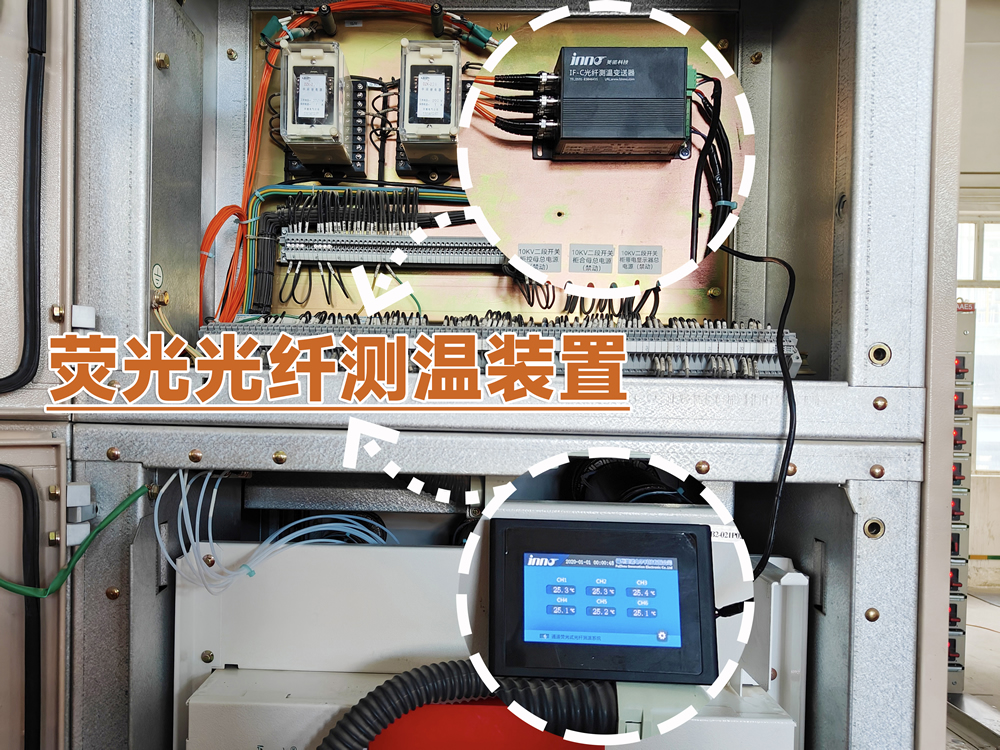
1. Immune to Insulation and Electromagnetic Interference
Fluorescent fiber optic temperature measurement uses insulating materials and transmits and senses via optical signals. It does not require power supply during operation, and there are no electrical connections externally or at the sensor. Therefore, when measuring the switchgear contact temperature, fluorescent fiber optic sensors are not affected by insulation or electromagnetic interference.
2. Small Probe, High Insulation, and Long Service Life
The sensor has a small probe, contains no other metal materials or electronic components, thus has excellent insulation, can withstand high voltage, allows long-term use, requires no maintenance during operation, and can monitor and analyze the temperature of different nodes of the switchgear in real-time.
Implementation Method of Fluorescent Fiber Optic Temperature Measurement System
Based on pulse control, the light source is excited to generate a pulse excitation light. Under the influence of the splitter, total reflection is clearly visible. In the coupler, the fiber is integrated, and the excitation light is transmitted through the fiber to the probe position to irradiate the corresponding fluorescent material, which is then excited to produce fluorescence. After the excitation light is removed, the fluorescent afterglow signal can be seen, which passes through the same fiber, then through the coupler and splitter, and formally enters the point conversion stage. At this stage, the signal is converted from electrical to optical, then formally enters the signal processing stage. In the signal processing stage, the fluorescent afterglow signal is amplified and filtered, and then enters the data acquisition and transmission stage. The data acquisition system can convert this type of signal into discrete digital form. After data processing, the temperature details of the measured object are obtained according to the relationship between the temperature and the usage period of the fluorescent material. The temperature data of each node of the switchgear is wirelessly transmitted to the monitoring room and finally displayed on the wireless receiving unit.
Main Features of the Fluorescent Fiber Optic Temperature Measurement System
1. Flexibility
The temperature measurement device is equipped with a corresponding display screen, which can independently display alarm status, set alarm thresholds, view alarm records, and handle alarms. After the device is connected to the network, the above operations can be performed on the computer system platform.
2. Unaffected Data Transmission
Localized synchronous measurement and data transmission are realized. The measurement unit uses different data buses for data transmission, eliminating the influence of external factors on monitoring results and ensuring strong comparability of each monitored equipment’s data.
3. Rapid Alarm
The data acquisition frequency is high and more precise. Data can be collected according to user settings, with the shortest cycle being less than one second.
4. Accurate Prediction of Equipment Operation Status
Calculates and analyzes the temperature trend of the detected switchgear, combines with operating conditions, and further evaluates the aging condition of the switchgear.
Application of Fluorescent Fiber Optic Temperature Measurement at Key Nodes of Switchgear
1. Installation of Equipment
Installation of Monitoring Host
Install the temperature measurement system monitoring host in the monitoring cabinet of the control room. Operators can set the monitoring computer for remote monitoring on the console.
Installation of Fiber Optic Thermometer
Connect the ST connector and fluorescent temperature probe. The fluorescent fiber optic thermometer can be embedded inside a silicone sleeve, and the fiber optic connector can directly contact the wire in the cable connector to detect the real temperature of the connector.
Installation of Fiber Optic Sensors
3.1 Sensors for Switchgear Contacts
The connection point between the static and moving contacts of the switchgear is the heating center. Due to the insulation sleeve, the internal space at this position is not very large. Therefore, when designing the sensor, this should be fully considered, and attention should be paid to the safe distance between it and the moving contact during installation.
3.2 Sensors for Switchgear Cable Connectors
The sensor is bonded to the cable connector using aviation-grade silicone and is fixed with special cable ties.
4. Internal Wiring of Switchgear
Cables and fiber tails inside the cabinet should preferably be routed along the corners of the cabinet or bundled with secondary wires or in dedicated cable ducts, which is convenient for subsequent inspection and maintenance of the switchgear.
Precautions for Installation and Maintenance of Fiber Optics
- Fiber must be installed and maintained by professionally trained technical personnel to prevent the fiber from being pulled, squeezed, or twisted, and the bending radius must exceed 40mm.
- During installation, avoid pressing the fiber heavily, and prevent the fiber from being tightly clamped or damaged by sharp objects.
- During fiber laying, avoid twisting, knotting, or back buckling.
- Hold or fix the fiber ST connector in your hand to avoid swinging.
- If a sharp bend is required, add a flexible protective layer or other scientific guiding devices.
- When the fiber passes through the shell, it must go through a bell-shaped hose opening or a protective plastic tube with a guard.
- Excess fiber length should be coiled in circles with a radius of more than 10 cm and fixed securely. If the fiber connector is not connected, protective caps should be installed at both ends to prevent dust contamination.
- When disassembling the transmitter, the fiber must be removed and the fiber connector fixed before disassembling the transmitter.
Software System
The software system can monitor the current area temperature in real time, remotely manage data information, send low/high temperature alarms, generate temperature curves, and access historical data.
System Temperature Measurement Effect
The fluorescent fiber optic temperature measurement system is installed on the main control room host to collect temperature data from various switchgear nodes in real time. All recorded data is automatically processed and studied, and can be directly viewed through the system. After installing the monitoring software on the computer, it can be connected to the power system, remote monitoring, and firefighting according to actual conditions, integrating functions to form a more powerful and comprehensive system, sharing data resources for easier management and control. When using fluorescent fiber optic temperature measurement for the switchgear, the traditional infrared thermometer is also used to detect the temperature of different nodes at the same time. The temperature difference measured by both is within 1°C. This result proves that this new temperature measurement method is highly feasible.
Conclusion
In the power system, high-voltage switchgear is a very critical device, mainly responsible for avoiding line faults, controlling transmission lines, and protecting lines. With long-term use, internal busbar connection points, cable joints, circuit breaker contacts, etc., under the influence of loosening and oxidation, are prone to heating and contact problems. If the current is large at this time, the temperature at the above positions will rise, and severe heating will lead to a significant increase in contact resistance, further aggravating the heating. Over time, it is easy to cause serious accidents, posing safety hazards to system operation and even causing large-scale fires. To avoid such accidents, dealing with the temperature rise inside the cabinet is crucial. Using fluorescent fiber optic temperature measurement can avoid electromagnetic interference and insulation problems, and the results measured are highly accurate.

Fiber optic temperature sensor, Intelligent monitoring system, Distributed fiber optic manufacturer in China
 |
 |
 |