 INNO fibre optic temperature sensors ,temperature monitoring systems.
- DTS distributed temperature sensing systems monitor temperature in real-time through fiber optic cables, widely used in oil pipelines, power cables, fire prevention systems, and other critical infrastructure
- Cable installation quality directly impacts temperature measurement accuracy and system reliability, requiring strict adherence to technical standards
- Pre-construction preparation includes site surveys, route planning, equipment selection, and safety assessments
- Deployment process requires controlling bend radius, tension limits, and implementing proper fixation and protection measures
- Fiber optic fusion splicing and testing are critical steps ensuring system performance, requiring qualified personnel
- Regular maintenance inspections effectively extend system lifespan and reduce failure rates
- 1. DTS Distributed Temperature Sensing System Principles and Technical Specifications
- 2. Distributed Fiber Optic Sensing Technology Comparison
- 3. DTS Cable Installation Preparation Workflow
- 4. How to Properly Deploy and Secure DTS Fiber Optic Sensing Cables?
- 5. What Should You Pay Attention to During DTS Fiber Optic Fusion Splicing? How to Install in Special Environments?
- 6. How to Test and Calibrate DTS Systems? How to Diagnose Common Faults?
- 7. How Should DTS Temperature Monitoring Systems Be Maintained and Managed?
- 8. Global DTS Fiber Optic Temperature Monitoring Application Cases
- 9. DTS Fiber Optic Temperature Sensing System FAQ
1. DTS Distributed Temperature Sensing System Principles and Technical Specifications
DTS (Distributed Temperature Sensing) systems operate based on Raman scattering in optical fibers. When laser pulses travel through temperature sensing fiber, they generate backscattered light, where the intensity ratio between Stokes and anti-Stokes components correlates directly with temperature. The DTS interrogator analyzes these scattered light signals to measure temperature at one-meter intervals along the entire fiber length, achieving continuous distributed monitoring. The system comprises a DTS interrogator unit, temperature sensing fiber optic cable, fiber connectors, and data processing software, with the fiber serving as both transmission medium and sensing element.
1.1 DTS Fiber Optic Temperature Sensing Technical Parameters
| Technical Parameter | Typical Value | Description |
|---|---|---|
| Measurement Distance | 10-30 km | Single-ended measurement, dual-ended up to 60 km |
| Spatial Resolution | 0.5-1 m | Minimum detectable temperature anomaly segment length |
| Temperature Resolution | 0.01-0.1°C | Detects minor temperature variations |
| Measurement Accuracy | ±1°C | Can achieve ±0.5°C after calibration |
| Response Time | 1-10 seconds | Adjustable based on measurement distance and settings |
| Temperature Range | -200°C to +600°C | Depends on fiber type |
| Service Life | 20-25 years | No moving parts, maintenance-free |
1.2 Core Advantages of DTS Temperature Monitoring Systems
Continuous Distributed Monitoring
Every point along the fiber length acts as a temperature sensor with no blind spots, covering ranges up to tens of kilometers.
Intrinsically Safe and Explosion-Proof
Temperature sensing fibers carry no electrical current and generate no sparks, suitable for hazardous environments like oil and gas facilities.
Electromagnetic Interference Immunity
Optical signal transmission is unaffected by electromagnetic fields, ensuring high reliability.
Remote Centralized Monitoring
A single DTS interrogator can monitor tens of kilometers, reducing operational costs.
Simple Installation and Maintenance
Fiber optic cables require no external power or signal wires, minimizing installation costs.
Long-Term Stability and Reliability
DTS systems experience no drift or degradation, reducing calibration frequency.

2. Distributed Fiber Optic Sensing Technology Comparison
| Comparison Item | DTS Temperature Sensing | DAS Vibration Sensing | DSS Strain Sensing |
|---|---|---|---|
| Measured Parameter | Temperature | Vibration/Acoustic | Strain/Deformation |
| Physical Principle | Raman Scattering | Rayleigh Scattering | Brillouin Scattering |
| Spatial Resolution | 0.5-1 m | 5-10 m | 0.5-2 m |
| Measurement Distance | 10-30 km | 40-80 km | 30-50 km |
| Response Speed | 1-10 seconds | Milliseconds | 1-5 minutes |
| Typical Applications | Cable temperature monitoring, pipeline monitoring, fire detection | Perimeter security, seismic monitoring, pipeline leak detection | Bridge health monitoring, slope monitoring, tunnel deformation |
| Equipment Cost | Medium | Higher | High |
| Installation Complexity | Medium | Lower | Higher |
| Environmental Adaptability | Excellent (-200 to +600°C) | Good | Good |
Select the appropriate distributed fiber optic sensing technology based on actual monitoring requirements. Temperature monitoring applications should prioritize DTS systems, security intrusion detection should use DAS systems, and structural health monitoring should employ DSS strain sensing systems. Some projects require multiple technologies combined to achieve comprehensive monitoring of temperature, vibration, and strain.
3. DTS Fiber Optic Cable Installation Preparation Workflow
3.1 Site Survey and Assessment
Document detailed environmental temperature ranges, chemical corrosivity, mechanical stress conditions, and electromagnetic interference source locations along the installation route. Measure deployment distances and elevation differences, mark wall and floor penetration points, and photograph site conditions. Assess construction difficulty and safety risks, developing dedicated safety measures.
3.2 Fiber Optic Cable Selection
Choose appropriate temperature sensing fiber optic cable types based on monitoring object characteristics. Tight-buffered fiber suits standard indoor environments, armored fiber provides high mechanical protection, high-temperature fiber withstands temperatures above 300°C, and low-temperature fiber suits LNG and cryogenic applications. Select cable jacket materials based on environment: PVC, LSZH, or fluoropolymer.
3.3 Tool and Equipment Preparation
Prepare optical time domain reflectometer (OTDR), fiber fusion splicer, precision fiber cleaver, wire strippers, cleaning tool kit, isopropyl alcohol, protection conduits, mounting brackets, identification labels, and testing instruments. Verify all tool and equipment status, ensuring fusion splicer calibration validity.
3.4 Construction Plan and Personnel Qualifications
Develop detailed DTS cable installation plans specifying quality control standards for each construction phase. Draw cable deployment route maps marking splice locations and fixing point spacing. All installation personnel must hold fiber optic construction qualifications and receive DTS system-specific training, familiarizing themselves with fiber characteristics, bend radius requirements, and splicing techniques.
4. How to Properly Deploy and Secure DTS Temperature Sensing Fiber Optic Cables?
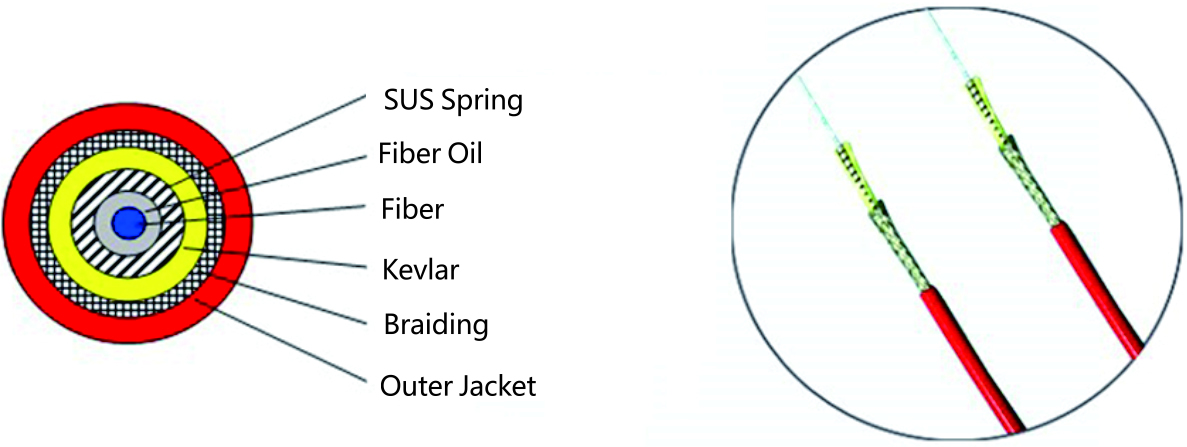
Cable deployment routes should avoid high-temperature heat sources, sharp objects, and strong electromagnetic field areas. During deployment, strictly control bend radius to no less than 15 times the cable outer diameter (dynamic bending) or 10 times (static bending), maintaining pulling tension within 80% of allowable limits, typically not exceeding 150N. Wall penetrations require protective conduits with inner diameters at least 1.5 times the fiber cable outer diameter, with chamfered ends. Vertical deployment in shafts requires fixing points every 1.5-2 meters to prevent excessive tension from cable weight.
Mounting bracket spacing: 0.5-1 meter for horizontal deployment, 1-1.5 meters for vertical deployment. When securing DTS cables with nylon cable ties or dedicated clamps, tightness should allow slight cable movement to avoid compressing the fiber. Exposed environments require protective conduits—stainless steel or PVC for corrosive environments, heat-resistant metal flexible conduit for high-temperature areas.
5. What Should You Pay Attention to During DTS Fiber Optic Fusion Splicing? How to Install in Special Environments?
Clean fiber end-faces with isopropyl alcohol before fusion splicing, ensuring cleave surfaces are perpendicular and smooth using a precision cleaver. Set fusion parameters according to fiber type—single-mode fiber typical fusion loss should be less than 0.05dB. Protect splices with heat-shrink tubing. Select splice closures with IP68 or higher waterproof and dustproof rating. Reserve at least 1.5 meters of fiber length inside closures with coiling radius greater than 40mm. Use identification labels noting splice number, splicing date, and responsible personnel.
High-temperature environments (above 120°C) require polyimide or metal-coated temperature sensing fiber, with thermal expansion allowance during deployment—0.5-1 meter per 100 meters. Explosion-proof area construction requires explosion-proof tools. DTS interrogators and splice closures must meet corresponding explosion-proof ratings. Underwater environment installations require waterproof gel-filled splice closures and specialized waterproof cable entries.
6. How to Test and Calibrate DTS Systems? How to Diagnose Common Faults?
After installation completion, use OTDR to test full fiber length loss—single-mode fiber average loss at 1550nm wavelength should be less than 0.3dB/km. Temperature calibration uses reference temperature source comparison methods, placing 3-5 calibration points along the fiber with precision thermometers as references, adjusting DTS system parameters to maintain measurement deviations within ±1°C from reference values. Acceptance documentation should include installation route maps, splice record sheets, OTDR test curves, and calibration data.
Excessive signal attenuation typically results from temperature sensing fiber bending, splice loss, or cable damage. Use OTDR for segment-by-segment testing to locate high-loss points. Temperature measurement deviations may stem from fiber strain or calibration drift—check for loose cable fixation causing strain changes and periodically recalibrate DTS systems. Fiber breaks can be precisely located with OTDR. Cut out broken sections and re-splice; for buried or inaccessible areas, use bypass splicing to restore temperature monitoring functionality.

7. How Should DTS Temperature Monitoring Systems Be Maintained and Managed?
Monthly inspections include DTS interrogator operational status, data acquisition continuity, splice closure seal integrity, and temperature sensing fiber optic cable appearance. Annual maintenance involves OTDR full-length testing, comparing historical data to assess fiber aging, cleaning splice closure interiors, and tightening loose fixation points. Establish temperature data monitoring and analysis protocols, setting normal temperature ranges and alarm thresholds—abnormal temperature trends may indicate equipment faults or safety hazards. Document every maintenance session, calibration, and fault repair to form system operational archives. Regularly train operators to ensure familiarity with DTS system principles, software operation, and emergency response procedures.
8. Global DTS Fiber Optic Temperature Monitoring Application Cases
Middle East Oil Field Pipeline Temperature Monitoring
This project covers 380 kilometers of crude oil transmission pipelines, facing desert high temperatures (up to 65°C) and large day-night temperature variations. We installed 12 DTS systems for the client using high-temperature armored temperature sensing fiber optic cables, achieving full-line real-time monitoring. The DTS system successfully predicted 3 pipeline leak incidents, preventing major economic losses. After 5 years of operation, system availability reached 99.7%.
European Power Company High-Voltage Cable DTS Monitoring
This power company deployed DTS temperature monitoring across underground high-voltage cable networks in Germany, France, and the Netherlands. Total monitored route length exceeded 600 kilometers, covering voltage levels from 110kV to 380kV. Through DTS fiber optic temperature sensing, cable joint overheating and partial discharge hazards were detected promptly, reducing cable failure rates by 65%. System integration with SCADA enabled remote automatic alarming and dynamic load adjustment.
North American LNG Terminal Cryogenic Storage Tank Monitoring
A major liquefied natural gas receiving terminal adopted DTS systems to monitor tank exteriors and pipeline cryogenic zones, with operating temperatures as low as -162°C. Our specialized low-temperature sensing fiber optic cables and customized installation solutions solved traditional temperature sensor failures at extremely low temperatures. The DTS system deployment totaled 18 kilometers with 0.5-meter spatial resolution, successfully identifying insulation layer damage locations.
Asia-Pacific Tunnel Fire Detection DTS Systems
Japanese urban subway and highway tunnels installed DTS fire early warning systems, monitoring a total length of 150 kilometers. Temperature sensing fiber cables were deployed along tunnel ceilings with temperature anomaly alarm thresholds set. DTS system response time is less than 5 seconds, capable of issuing alerts during fire initial stages. Compared to traditional point-type temperature detectors, DTS distributed temperature monitoring systems have no blind spots, with maintenance costs reduced by 70%.
Australian Mining Conveyor Belt DTS Temperature Monitoring
An open-pit iron mine’s 5 long-distance belt conveyor systems adopted DTS temperature monitoring to prevent belt friction fires. Each belt measures 3-8 kilometers, with temperature sensing fiber cables fixed beneath belt frames, monitoring bearing, roller, and belt surface temperatures in real-time. The DTS system automatically identifies temperature anomaly points, interlocking with shutdown protection devices. After implementation, conveyor system fire incident rates dropped to zero, with equipment availability exceeding 98%.
9. DTS Fiber Optic Temperature Sensing System FAQ
9.1 Are There Limitations on DTS System Measurement Distance?
Question: How far can DTS distributed temperature sensing systems measure? Can they monitor extra-long pipelines?
Answer: DTS systems offer standard single-ended measurement distances of 10-30 kilometers, with dual-ended measurement technology extending up to 60 kilometers or more. For ultra-long distance projects, multiple DTS interrogators can be cascaded to achieve full-length temperature monitoring coverage. Our engineering team designs optimized system configurations based on your actual monitoring requirements. Different industry applications have varying measurement distance needs. We welcome you to contact us for project assessments, and we’ll provide professional DTS technical consultation and customized solutions.
9.2 Can DTS Systems Operate Normally in Extreme Temperature Environments?
Question: Can DTS distributed temperature sensing systems still function properly in high or low extreme temperature environments?
Answer: DTS systems can operate in extreme temperature ranges from -200°C to +600°C, but require selection of corresponding specialty temperature sensing fiber optic cables. High-temperature environments (above 120°C) use polyimide or metal-coated fibers, while low-temperature environments use specially coated cryogenic fibers. We have successful application cases in Middle East oil fields (+65°C), LNG terminals (-162°C), and steel mills (+300°C). Each project has different environmental conditions. We recommend contacting our technical experts so we can select the most suitable DTS fiber type and protection measures for your specific application.
9.3 How Long Does DTS System Installation Take?
Question: How long does DTS fiber optic cable installation require? Will it affect normal facility operations?
Answer: DTS fiber optic cable installation duration depends on monitoring scope and site conditions. Typically, a single monitoring point (5-10 kilometers) requires 5-10 working days to complete. Our installation team is highly experienced and can conduct construction without impacting production operations, employing phased construction and off-peak work schedules to minimize disruption to existing facilities. For critical facilities, we develop detailed DTS system construction plans and contingency measures in advance. For specific project installation timelines and construction arrangements, please consult our project management team. We’ll develop practical implementation plans according to your timeline requirements.
9.4 Are DTS System Maintenance Costs High?
Question: Are DTS temperature monitoring system maintenance costs high? How often does calibration need to occur?
Answer: DTS distributed temperature sensing system maintenance costs are far lower than traditional temperature sensor networks. Temperature sensing fiber optic cables have no moving parts, with normal service lives of 20-25 years and are essentially maintenance-free. DTS interrogator equipment should undergo annual preventive maintenance inspections. Temperature calibration frequency depends on application accuracy requirements—general projects recommend calibration every 1-2 years, while high-precision applications may require quarterly or semi-annual calibration. We offer multiple maintenance service packages including remote technical support, regular inspections, calibration services, and spare parts supply. For detailed DTS maintenance plans and costs, please contact us. We’ll provide accurate quotes based on your system configuration.
9.5 How to Choose a Suitable DTS System Supplier?
Question: What should I pay attention to when selecting a DTS system supplier? What services can you provide?
Answer: When choosing a DTS supplier, evaluate technical capabilities, project experience, product quality, and after-sales service. We possess over 15 years of distributed fiber optic temperature sensing system experience, having served major projects across oil and gas, power, transportation, and mining industries. We provide full lifecycle services from preliminary consultation, solution design, equipment supply, and temperature sensing fiber optic cable installation and commissioning to long-term maintenance. Our engineering team holds relevant qualifications and can undertake complex DTS projects domestically and internationally. Our services include: free site surveys and technical consultation, customized DTS system design and equipment selection, professional construction teams and project management, fiber optic cable installation commissioning calibration and acceptance, operator training and technical documentation, and long-term technical support and maintenance services. Contact us immediately for free DTS project assessments and technical solutions. Our experts will respond to your inquiries within 24 hours, providing the most professional DTS distributed temperature monitoring solutions.

Fiber optic temperature sensor, Intelligent monitoring system, Distributed fiber optic manufacturer in China
 |
 |
 |