 INNO fibre optic temperature sensors ,temperature monitoring systems.
- This article explains why continuous cable power monitoring is essential for underground and critical infrastructure.
- It highlights the blind spots of traditional temperature monitoring and why they fail to detect early‑stage cable issues.
- It describes how Distributed Fiber Optic Sensing (DTS / DTSS / DFOS) works and why it enables full‑length thermal monitoring.
- It outlines common thermal risks such as overload, soil problems, external heat sources, and joint degradation.
- It shows how fiber optics precisely detect hotspots along joints, terminations, conduits, and tunnels.
- It compares installation methods and explains how fiber placement affects accuracy and response.
- It provides pattern‑based analysis for recognizing overload, joint faults, and ventilation issues.
- It details how DFOS detects third‑party interference, soil backfill issues, and construction‑related damage.
- It explains why cable joints require enhanced monitoring and how temperature trends predict early failure.
- It covers SCADA/EMS/DMS integration for real‑time cable health visualization.
- It includes engineering guidelines for successful DTS/DTSS installation and common pitfalls to avoid.
- It compares DTS vs DAS technologies and defines their different monitoring applications.
- It provides an engineering‑focused FAQ covering fiber placement, external heating, monitoring range, and hotspot detection.
- It concludes with a call to contact our team for technical datasheets, project support, pricing, and tailored DFOS monitoring solutions.
Table of Contents
- Why Continuous Cable Power Monitoring Matters
- Why Traditional Temperature Monitoring Has Blind Spots
- How Distributed Fiber Optic Sensing Works
- Common Thermal Risks in Power Cables
- Where Cable Hotspots Form and How Fiber Optics Detect Them
- Installation Methods for DTS/DFOS and Their Impact on Accuracy
- How Fiber Temperature Profiles Reveal Overloading and External Heat Sources
- Detecting Joint Failures, Soil Issues, and Third‑Party Damage
- Why Cable Joints and Terminations Require Enhanced Monitoring
- Why Tunnels, Trays, and Corridors Depend on DFOS
- SCADA / EMS / DMS Integration
- Engineering Guidelines for Installing DTS/DTSS Systems
- DTS vs DAS for Cable Monitoring
- FAQ
- Contact Us for Specifications, Pricing, and Solutions
1. Why Continuous Cable Power Monitoring Matters
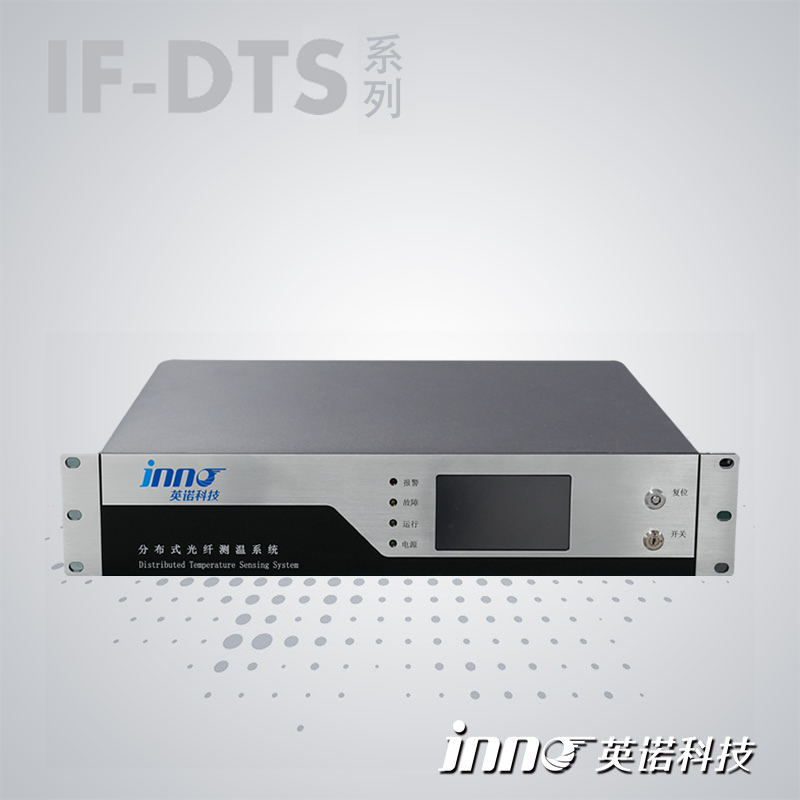
Power cables operate under varying load conditions, soil environments, and installation constraints. Failures often occur without visible warning, especially in underground systems. Continuous monitoring using distributed fiber optic temperature sensing provides real‑time visibility across the entire cable route, enabling early detection before faults escalate.
2. Why Traditional Temperature Monitoring Has Blind Spots
Conventional sensors measure only isolated points. Infrared inspection requires physical access and cannot see inside ducts, tunnels, or underground sections. This leaves many thermal anomalies undetected.
| Method | Coverage | Limitations |
|---|---|---|
| Thermocouples / RTDs | Single point | No spatial profiling; cannot detect external hotspots |
| Infrared Patrol | Exposed sections only | Cannot see buried / conduit areas |
| DTS/DFOS | Full‑length continuous | Requires fiber installation |
3. How Distributed Fiber Optic Sensing (DTS / DTSS / DFOS) Works
DTS temperature monitoring systems use Raman, Brillouin, or Rayleigh backscattering to measure temperature at every meter of the fiber. This enables continuous thermal mapping over cable sections from several kilometers up to tens of kilometers.
3.1 Raman / Brillouin / Rayleigh Principles
DTS (Raman): Accurate temperature along long distances.
DTS/DTSS (Brillouin): Higher accuracy and strain capability.
Rayleigh (OFDR): High‑resolution, short‑range hotspot detection.
3.2 Fiber Installation as a “Continuous Sensor”
The fiber itself becomes a measurement element—immune to EMI and safe in high‑current environments.
4. Common Thermal Risks in Power Cables
- Uneven soil thermal resistivity
- Backfill degradation
- External heating from steam pipes or industrial facilities
- Overload and emergency loading cycles
- Poor ventilation inside cable tunnels
5. Where Cable Hotspots Form and How Fiber Optics Detect Them
Hotspots often appear at joints, terminations, bends, crossing points, or sections with inadequate cooling. Distributed Temperature Sensing systems detect these anomalies by comparing real-time temperature to baseline thermal models.
5.1 Why Point Sensors Cannot Detect Localized Heating
Hotspots are highly localized and often occur between two fixed sensor points—DTS eliminates this gap.
6. Installation Methods for DTS/DFOS and Their Impact on Accuracy
Typical fiber placement options include:
- Directly attached to the cable sheath
- Inside ducts, trays, or conduits
- Mounted on tunnel walls or support structures
6.1 Accuracy Comparison
| Installation Method | Thermal Coupling | Accuracy |
|---|---|---|
| Fiber tied on cable sheath | Strong | High |
| Fiber in conduit | Medium | Moderate |
| Fiber on tunnel wall | Weak | Environmental monitoring only |
7. How Fiber Temperature Profiles Reveal Overloading and External Heat Sources
DTS temperature profiles show clear signatures of load‑dependent heating. Sharp, localized increases typically indicate external heat sources or soil compaction issues.
7.1 Pattern Recognition Examples
- Uniform rise = cable loading
- Localized spike = defective joint
- Long warm span = poor ventilation
8. Detecting Joint Failures, Soil Issues, and Third‑Party Damage
Distributed fiber sensing can detect temperature anomalies caused by:
- Defective joints and terminations
- Excavation activity or external interference
- Backfill or soil thermal resistivity changes
9. Why Cable Joints and Terminations Require Enhanced Monitoring
Most cable failures originate at joints. The DTS temperature profile provides early-stage detection of gradual thermal rise long before failure occurs.
9.1 Typical Failure Indicators
- Asymmetric temperature rise under normal load
- Temperature drift over days or weeks
- Repeated thermal cycling with increasing amplitude
10. Why Tunnels, Trays, and Corridors Rely on Distributed Fiber Optics
Closed environments accumulate heat. DFOS offers real-time thermal mapping over long distances—essential for utilities, metros, data centers, and industrial facilities.
11. SCADA / EMS / DMS Integration
Modern DTS cable monitoring systems integrate through IEC 61850, Modbus TCP, or DNP3, allowing operators to visualize cable health and set automated alarms.
12. Engineering Guidelines for Installing DTS/DTSS Systems
12.1 Key Recommendations
- Secure fiber routing with minimal bending
- Ensure proper thermal coupling at joints
- Protect fibers during civil construction
- Verify calibration and baseline profiles
12.2 Common Installation Mistakes
- Loose attachment causing thermal lag
- Unprotected fibers in high‑traffic areas
- Incorrect spatial resolution settings
13. DTS vs DAS for Cable Monitoring
Both technologies use the same fiber but serve different purposes.
| Technology | Primary Use | Advantages |
|---|---|---|
| DTS | Temperature | Hotspot detection, thermal mapping |
| DAS | Vibration / Acoustic | Digging detection, intrusion, cable strike warning |
14. FAQ
14.1 Does the fiber have to be attached directly to the cable?
No. Direct attachment improves accuracy, but conduit and tray installations still provide valuable trend data.
14.2 Can DFOS detect external heating?
Yes. External sources such as steam pipes or industrial equipment appear as localized temperature anomalies.
14.3 How long can a single DTS unit monitor?
Typical ranges are 4 km to 70 km depending on model and resolution.
14.4 Will moisture or soil conditions affect measurements?
They affect cable temperature behavior, but DTS captures these changes effectively.
14.5 Can DTS locate joint failures?
Yes. DTS provides continuous temperature tracking at every meter, allowing precise localization.
15. Contact Us for Specifications, Pricing, and Engineering Support
If your project requires DTS cable monitoring systems, DFOS solutions, fiber optic sensors, or complete power cable monitoring packages, feel free to contact us. Our team can provide technical datasheets, product catalogs, system design support, and formal pricing.
Send us a message or email to request product information, system design assistance, and tailored solutions.

Fiber optic temperature sensor, Intelligent monitoring system, Distributed fiber optic manufacturer in China
 |
 |
 |