 INNO fibre optic temperature sensors ,temperature monitoring systems.
- Fluorescent fiber optic sensing technology provides complete electrical isolation and immunity to electromagnetic interference in high-voltage environments
- 12-channel monitoring capacity enables comprehensive coverage of three-phase busbar systems with multiple connection points
- ±1℃ measurement accuracy with 0.1℃ resolution detects early-stage thermal anomalies before they escalate into failures
- -20℃ to 150℃ operating range accommodates diverse environmental conditions from cold climates to high-temperature industrial settings
- 100kV voltage withstand capability ensures safe operation in medium and high-voltage switchgear applications
- RS485 Modbus communication facilitates integration with existing SCADA and building automation systems
- Third-party certification including fiber optic voltage withstand reports and integrated type test reports validates system reliability
- Maintenance-free design delivers 20+ years of continuous operation without calibration requirements
Table of Contents
- Understanding Busbar Temperature Monitoring Systems
- Why Busbar Connection Points Experience Overheating
- Limitations of Traditional Temperature Detection Methods
- Fluorescent Fiber Optic Technology Solutions
- Core System Components and Architecture
- Multi-Point Temperature Monitoring Configuration
- Fluorescent Fiber Optic Measurement Principles
- Critical Technical Specifications
- Low-Voltage Distribution Cabinet Monitoring
- Medium-Voltage Switchgear Applications
- High-Voltage Substation Implementations
- Copper-Aluminum Transition Busbar Monitoring
- Alarm Threshold Configuration Strategies
- SCADA System Integration Methods
- System Selection Criteria and Considerations
1. Understanding Busbar Temperature Monitoring Systems: Definition and Core Functions

A busbar temperature monitoring system is an intelligent safety device specifically engineered to provide continuous, real-time temperature surveillance of busbar connections in electrical distribution systems. Busbars serve as the primary conductors that distribute electrical power from main sources to various circuits within switchgear and distribution panels. These critical components carry substantial electrical currents, making them vulnerable to localized heating at connection points due to factors such as contact resistance, oxidation, loose connections, and mechanical stress.
The core function of a busbar temperature monitoring system is to detect abnormal temperature rises before they escalate into serious electrical failures. By installing fiber optic temperature sensors directly on busbar connection points, the system continuously measures temperature data and transmits this information to a centralized monitoring unit. When temperatures exceed predetermined thresholds, the system triggers alarms to alert operators, enabling timely intervention and preventing catastrophic equipment damage, fire hazards, or unplanned power outages. This proactive monitoring approach transforms maintenance strategies from reactive repairs to predictive maintenance, significantly enhancing the safety and reliability of electrical infrastructure.
2. Why Busbar Connection Points Are Prone to Overheating Failures
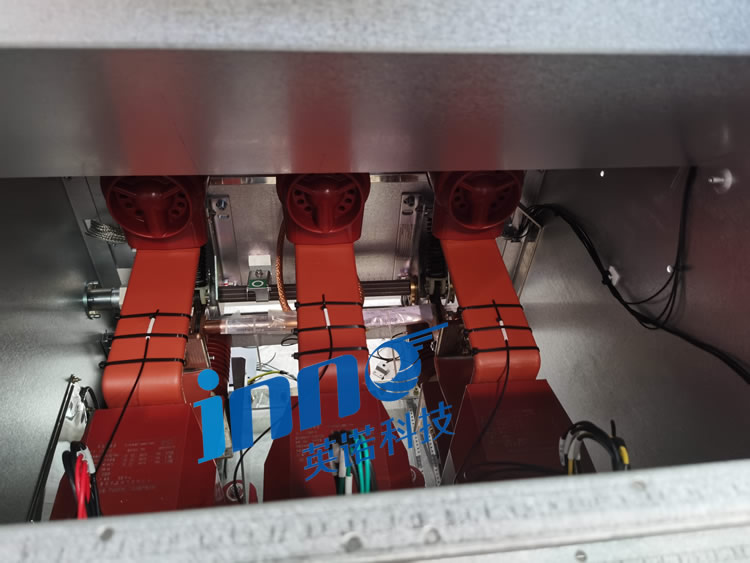
Busbar connection points represent inherent weak points in electrical distribution systems due to the fundamental physics of electrical contact. When two conductive surfaces are bolted together, the actual contact area is microscopically smaller than the apparent surface area, creating contact resistance. This resistance generates heat according to Joule’s law (P = I²R), where even small resistance values can produce significant heating when carrying hundreds or thousands of amperes.
Primary Causes of Busbar Overheating
Several factors contribute to the development of dangerous temperature conditions at busbar connections. Inadequate torque during installation results in insufficient contact pressure, increasing electrical resistance. Over time, thermal cycling causes expansion and contraction that can loosen initially tight connections. Surface oxidation forms insulating layers that impede current flow, particularly problematic with aluminum busbars that form aluminum oxide. Galvanic corrosion at copper-aluminum transition joints accelerates deterioration. Vibration from electromagnetic forces gradually degrades connection integrity.
Statistical Impact of Busbar Failures
Industry data reveals that connection point failures account for approximately 35-40% of all electrical distribution system faults. A single busbar failure in a critical facility can result in direct equipment replacement costs, business interruption losses, and potential safety incidents. Temperature monitoring provides early detection when resistance increases by even 10-15%, corresponding to temperature rises of 5-10℃ above normal operating conditions, allowing intervention before catastrophic failure occurs.
3. Limitations of Traditional Temperature Detection Methods
Conventional approaches to monitoring busbar temperature have demonstrated significant operational and safety limitations that compromise their effectiveness in modern electrical systems.
Manual Infrared Inspection Challenges
Periodic thermal imaging surveys using handheld infrared cameras require trained personnel to access switchgear during scheduled maintenance windows. This approach provides only snapshot data rather than continuous monitoring, potentially missing intermittent faults that occur between inspection cycles. Many critical connection points remain visually obstructed by enclosure panels or located in areas with restricted access, creating blind spots in thermal surveillance. The method also exposes personnel to arc flash hazards when accessing energized equipment compartments.
Wired Sensor Safety Concerns
Traditional thermocouple or resistance temperature detector (RTD) sensors introduce metallic conductors into high-voltage environments, creating potential paths for electrical faults. These sensors require complex insulation schemes and careful routing to maintain clearance distances. Electromagnetic interference from high current conductors induces noise in measurement signals, degrading accuracy. Installation complexity increases system cost and introduces additional failure points through wiring connections.
4. Fluorescent Fiber Optic Technology Solutions for Busbar Monitoring
Fluorescent fiber optic temperature measurement technology has emerged as the optimal solution for busbar thermal monitoring, addressing the fundamental limitations of conventional methods through its unique operating principles.
All-Dielectric Sensor Construction
The defining advantage of fiber optic temperature sensors is their complete absence of metallic components at the sensing point. The sensor probe consists entirely of glass optical fiber and rare-earth fluorescent material, making it inherently immune to electromagnetic interference and electrically non-conductive. This all-dielectric construction eliminates concerns about creating electrical faults or compromising system insulation, even when installed directly on high-voltage busbars.
100kV Voltage Withstand Capability
Third-party testing validates that fluorescent fiber optic sensors maintain electrical isolation at voltage levels up to 100kV, far exceeding the requirements for typical medium-voltage switchgear applications. This exceptional dielectric strength enables sensor installation on busbars operating at 35kV, 10kV, or 400V systems without modification to existing insulation schemes. The fiber optic cable itself serves as the signal transmission medium, requiring no additional shielding or special routing considerations around high-voltage equipment.
5. Core System Components and Architecture of Busbar Temperature Monitoring
A complete busbar temperature monitoring system integrates multiple specialized components working in coordination to provide comprehensive thermal surveillance and data management.
Fiber Optic Temperature Sensor Probes
The sensing element consists of a compact probe containing rare-earth fluorescent material at the tip of an optical fiber. Probe designs accommodate different mounting methods including bolt-attachment types that install between busbar joint surfaces, and adhesive-mount sensors for surface placement. The probe dimensions typically measure 3-6mm in diameter and 10-20mm in length, allowing installation in confined spaces. Sensor construction withstands mechanical vibration and maintains thermal contact integrity over decades of operation.
Fluorescent Fiber Optic Measurement Host
The measurement host serves as the signal processing center, housing optical transmission and reception components, signal processing electronics, and communication interfaces. The host unit transmits excitation light pulses through the fiber to the sensor probe, then analyzes the returning fluorescent decay signal to calculate temperature with high precision. Modern hosts support 12-channel configurations, allowing simultaneous monitoring of multiple busbar connection points from a single instrument. The unit typically mounts in a control cabinet or equipment room within 100-500 meters of the monitored busbars.
LCD Display and Alarm Management
Integrated display instruments provide local visualization of real-time temperature data, trend graphs, and alarm status for all monitored channels. The display interface allows operators to configure alarm thresholds, review historical maximum/minimum temperatures, and acknowledge alarm conditions. Visual and audible indicators alert personnel to abnormal conditions. Relay outputs provide volt-free contacts for integration with existing alarm panels or building management systems.
Communication Module for System Integration
The RS485 interface with Modbus RTU protocol enables seamless integration with supervisory control and data acquisition (SCADA) systems, programmable logic controllers (PLCs), and centralized monitoring platforms. The communication module transmits real-time temperature values, alarm status, and diagnostic information to remote workstations. Support for Modbus TCP protocol variants facilitates Ethernet-based networking in modern industrial automation environments.
6. Multi-Point Temperature Monitoring Configuration for Comprehensive Coverage
Effective busbar thermal monitoring requires strategic placement of temperature sensors to capture thermal conditions at all critical connection points while optimizing system channel utilization.
12-Channel System Architecture
Standard monitoring systems provide 12 measurement channels, each independently connected to a dedicated fiber optic sensor. This configuration enables comprehensive monitoring of a three-phase busbar system with four measurement points per phase, or alternatively, monitoring of multiple separate busbar assemblies within a switchgear lineup. Channel independence ensures that a fault in one sensor or fiber does not compromise measurements from other channels.
Three-Phase Busbar Monitoring Strategies
For three-phase electrical systems, sensor placement should prioritize symmetrical coverage across all phases to enable comparative analysis. Typical configurations include monitoring the incoming main busbar connections for all three phases, distribution branch connections, and critical load connections. In a 12-channel system monitoring a single three-phase busbar, allocating four sensors per phase allows coverage of the main incoming joint, two distribution taps, and one critical load connection. This arrangement provides comprehensive thermal mapping while maintaining adequate channel reserves for future expansion.
7. Fluorescent Fiber Optic Measurement Principles and Technology Foundation
Understanding the operating principles of fluorescent fiber optic temperature measurement provides insight into the technology’s superior performance characteristics and reliability advantages.
Rare-Earth Fluorescent Material Properties
The sensor probe contains rare-earth compounds, typically based on yttrium, europium, or erbium, selected for their temperature-dependent fluorescent properties. When excited by light at specific wavelengths (commonly ultraviolet or blue light), these materials emit fluorescent light. The critical parameter is fluorescence lifetime – the time duration over which the material continues to emit light after the excitation source is removed. This fluorescence lifetime varies predictably with temperature, forming the basis for highly accurate temperature measurement.
Fluorescence Lifetime Measurement Technique
The measurement host transmits a precisely timed light pulse through the optical fiber to the sensor probe. The fluorescent material absorbs this energy and re-emits light with a characteristic decay pattern. Sensitive photodetectors in the host unit measure the fluorescence decay curve with nanosecond precision. Advanced signal processing algorithms extract the fluorescence lifetime from this decay pattern, then convert it to temperature using factory calibration data stored in the instrument. Because the measurement depends on time-domain characteristics rather than light intensity, the technique is inherently immune to fiber bending losses, connector variations, or light source aging that would affect intensity-based measurements.
8. Critical Technical Specifications for Busbar Temperature Monitoring Systems
Professional specification of temperature monitoring equipment requires careful attention to key performance parameters that determine system suitability for specific applications.
Measurement Range: -20℃ to 150℃
The specified operating range of -20℃ to 150℃ accommodates the full spectrum of environmental and operational conditions encountered in electrical distribution systems. The lower limit addresses installations in cold climates or unheated equipment rooms where ambient temperatures may drop well below freezing. The upper limit provides adequate margin above typical busbar operating temperatures of 40-90℃, while capturing dangerous overheating conditions before reaching the thermal limits of insulation materials (typically 105℃ for Class A insulation, 130℃ for Class B).
Measurement Accuracy: ±1℃
The ±1℃ accuracy specification ensures reliable detection of abnormal temperature rises that indicate developing connection problems. Field experience demonstrates that a 5-10℃ temperature increase above normal operating conditions provides early warning of connection deterioration, well within the detection capability of ±1℃ accuracy. This precision level significantly outperforms typical thermographic surveys with infrared cameras (±2℃ or ±2% of reading), enabling more confident fault identification.
Temperature Resolution: 0.1℃
The 0.1℃ resolution allows detection of subtle thermal trends over time, supporting advanced diagnostic techniques. Operators can identify gradual connection degradation through slow temperature drift patterns spanning weeks or months. High resolution also enhances the effectiveness of three-phase comparison analysis, where differences of less than 1℃ between phases under balanced load conditions may indicate emerging problems.
Channel Capacity: 12 Channels
The 12-channel configuration represents an optimal balance between system capability and cost-effectiveness for typical switchgear installations. This capacity supports monitoring of four three-phase connection points, or three complete three-phase systems with spare channels for critical single-phase loads. Larger installations can deploy multiple 12-channel units, coordinating their operation through the common communication network.
Power Supply: AC 220V
Standard AC 220V power supply simplifies installation by utilizing commonly available control voltage in switchgear environments. The power supply specification typically includes tolerance for voltage variations (±10%) and frequency variations (50/60 Hz), ensuring reliable operation across different regional power standards. Internal power conversion provides stable DC voltages for optical components and electronics regardless of input voltage fluctuations.
Communication Interface: RS485 with Modbus Protocol
The RS485 interface provides robust, noise-immune communication over distances up to 1000 meters, ideal for connecting switchgear installations to remote control rooms. The industry-standard Modbus protocol ensures compatibility with virtually all SCADA systems, PLCs, and building automation controllers. The interface supports multi-drop networking, allowing multiple monitoring units to share a common communication bus, reducing wiring costs in large installations.
Third-Party Certification Documentation
Professional systems include comprehensive third-party testing reports validating critical performance claims. The fiber optic voltage withstand report documents testing of sensor insulation capability at voltages exceeding the intended application voltage, typically demonstrating performance at 100kV for sensors intended for 35kV applications. The integrated type test report validates complete system performance including measurement accuracy, electromagnetic compatibility, environmental resistance, and long-term reliability under simulated operational stresses. These certifications provide essential due diligence documentation for safety-critical applications.
9. Low-Voltage Distribution Cabinet Temperature Monitoring Solutions
Low-voltage distribution systems operating at 400V represent the most common application environment for busbar temperature monitoring, serving commercial buildings, industrial facilities, and infrastructure installations.
400V Distribution System Monitoring Configuration
Typical low-voltage distribution cabinets feature main incoming busbars rated for 630A to 4000A, with multiple outgoing feeders serving individual loads or sub-distribution panels. Critical monitoring points include the main incoming connection where the utility supply connects to the distribution busbar, the busbar joints between main sections, and high-current outgoing connections to major loads such as transformers, motor control centers, or large HVAC equipment. A 12-channel system can comprehensively monitor one main three-phase incoming connection (3 channels), two three-phase distribution joints (6 channels), and one critical three-phase outgoing feeder (3 channels).
Installation Considerations for LV Switchgear
Low-voltage installations benefit from the compact size of fiber optic sensors, which easily fit within the confined spaces of modern switchgear designs. Sensor installation requires a planned shutdown to de-energize the busbar system, ensuring personnel safety during the mounting process. Bolt-mounted sensors install between busbar joint surfaces during connection assembly, while adhesive-mounted sensors attach to accessible busbar surfaces after joint assembly. The all-dielectric fiber optic cable routes through existing cable glands or dedicated small-diameter openings, maintaining IP protection ratings of the switchgear enclosure.
10. Medium-Voltage Switchgear Temperature Monitoring Applications
10kV switchgear installations in substations and industrial distribution systems present unique monitoring challenges due to elevated voltage levels and stringent insulation requirements.
Ring Main Unit Busbar Monitoring
Ring main units (RMUs) employ compact gas-insulated or air-insulated switchgear designs with limited access to internal components. Busbar connections within RMUs operate in sealed compartments filled with SF6 gas or atmospheric air, making them inaccessible for routine infrared inspection. Fiber optic temperature sensors install permanently during initial switchgear assembly or during scheduled maintenance outages, providing continuous monitoring of connection points that would otherwise remain unmonitored between major overhauls. The sensors’ immunity to the electromagnetic fields generated by 10kV circuits ensures measurement accuracy despite the intense field strengths in compact switchgear designs.
Clearance Distance Requirements
Medium-voltage installations must maintain minimum electrical clearance distances between live parts and grounded surfaces according to applicable standards. The small diameter of fiber optic cables (typically 2-3mm) and their all-dielectric construction allow routing without consuming valuable clearance space or requiring additional insulation barriers. This characteristic simplifies retrofitting existing switchgear compared to metallic sensor wiring that would require careful evaluation of clearance impacts.
11. High-Voltage Substation Implementation Strategies

35kV switchgear installations in transmission and distribution substations represent the most demanding application environment for busbar temperature monitoring systems, requiring rigorous attention to insulation coordination and safety practices.
Main Transformer Busbar Connection Monitoring
Power transformers rated at tens of megavolt-amperes employ massive busbar connections carrying currents of thousands of amperes. These connections represent critical monitoring points where thermal failures can result in extensive equipment damage and prolonged outages affecting thousands of customers. Fiber optic sensors mounted on transformer bushing connections and incoming line connections provide early warning of developing problems, enabling scheduled maintenance interventions rather than emergency repairs.
Multi-Compartment Coverage Strategy
High-voltage switchgear typically segregates components into separate compartments: busbar chamber, circuit breaker chamber, and cable chamber. Each compartment contains critical connection points requiring monitoring. A comprehensive monitoring system deploys sensors in the busbar chamber at main joint locations, in the circuit breaker chamber at disconnect contacts, and in the cable chamber at cable termination connections. This distributed sensor placement captures the complete thermal profile of the switchgear assembly.
12. Copper-Aluminum Transition Busbar Critical Monitoring Requirements
Copper-aluminum transition joints represent the highest-risk connection points in electrical distribution systems, demanding priority attention in any temperature monitoring strategy.
Galvanic Corrosion Mechanisms
When copper and aluminum conductors contact directly, electrochemical reactions driven by the dissimilar metal potentials cause accelerated corrosion at the interface. In the presence of moisture or condensation, aluminum oxide forms rapidly, creating an insulating barrier that increases contact resistance. This resistance generates heating, which accelerates the corrosion process in a destructive feedback cycle. Over months or years, initially sound connections progressively deteriorate, experiencing dramatic resistance increases that can lead to thermal runaway and catastrophic failure.
Enhanced Monitoring Protocols
All copper-aluminum connections should receive dedicated temperature monitoring with more conservative alarm thresholds than same-metal connections. While standard busbar connections might trigger alarms at 15-20℃ above ambient, copper-aluminum joints warrant alarm settings at 10℃ above ambient to enable earlier intervention. Regular comparison of temperature trends at transition joints versus nearby same-metal connections provides diagnostic insight into corrosion progression, allowing replacement scheduling before service interruption becomes necessary.
13. Alarm Threshold Configuration Strategies for Effective Fault Detection
Proper configuration of alarm thresholds balances the competing objectives of early fault detection and minimization of nuisance alarms that can lead to operator desensitization.
IEC Temperature Rise Standards
International standards including IEC 60694 specify maximum permissible temperature rises for busbar systems under rated current conditions. For bare copper or aluminum busbars in air, the standard allows 50-65℃ temperature rise above ambient, depending on surface treatment and current density. Temperature monitoring systems should establish warning thresholds at temperatures well below these limits to provide intervention time before equipment approaches thermal design limits.
Three-Tier Alarm Architecture
Professional implementations employ graduated alarm levels: pre-warning, warning, and critical alarms. Pre-warning levels set at 10℃ above normal operating temperature alert maintenance personnel to investigate potential developing issues during routine work windows. Warning levels at 20℃ above normal trigger immediate investigation during normal working hours. Critical alarms at 30℃ above normal or absolute temperatures exceeding 90℃ demand emergency response regardless of time of day. This tiered approach optimizes resource allocation while ensuring appropriate urgency for serious conditions.
14. SCADA System Integration Methods and Communication Protocols
Integration of busbar monitoring systems with existing automation infrastructure maximizes the value of temperature data through centralized visualization, trending, and alarm management.
Modbus RTU/TCP Protocol Implementation
The Modbus protocol provides standardized register mapping for temperature values, alarm status bits, and configuration parameters. The monitoring system acts as a Modbus slave device, responding to polling requests from a master SCADA system or PLC. Each temperature channel occupies designated holding registers containing the current temperature value (typically encoded as integer representing 0.1℃ units), maximum recorded temperature, minimum recorded temperature, and alarm status flags. The communication interface supports user-configurable slave addresses and baud rates, enabling integration into multi-device networks.
SCADA Visualization and Historical Trending
Modern SCADA platforms display real-time busbar temperatures on graphical mimics of switchgear layouts, using color coding to indicate normal, warning, and alarm conditions. Trending functions plot temperature histories over hours, days, or months, revealing patterns such as load-dependent temperature variations and gradual baseline increases indicating connection degradation. Correlation of temperature data with electrical load measurements provides diagnostic insights distinguishing between load-induced heating and connection resistance problems.
15. System Selection Criteria and Technical Considerations
Selecting the optimal busbar temperature monitoring solution requires systematic evaluation of application requirements, technical specifications, and integration constraints.
Monitoring Point Quantity Assessment
Begin by identifying all critical busbar connection points requiring monitoring, including main incoming connections, busbar section joints, major outgoing feeders, and any copper-aluminum transitions. Calculate the total required sensor count, then select system capacity with 10-20% spare channels for future expansion. For installations exceeding 12 monitoring points, evaluate whether multiple independent 12-channel systems or a larger integrated system better suits the installation architecture and budget constraints.
Communication Interface Compatibility
Verify that the monitoring system’s RS485 Modbus interface matches existing SCADA system capabilities in terms of protocol variant (RTU vs. TCP), baud rate ranges, and register mapping conventions. For installations without existing automation infrastructure, consider whether local display capabilities adequately meet monitoring needs, or whether future SCADA integration should influence current equipment selection.
Environmental Protection Requirements
Assess the installation environment to determine necessary protection ratings for monitoring equipment. Indoor switchgear rooms with climate control may require only basic IP20 ratings for the measurement host, while installations in industrial environments with dust or humidity exposure need IP54 or higher ratings. Sensor probes typically feature robust construction suitable for direct mounting on busbars in air-insulated switchgear without additional environmental protection.
Certification and Compliance Documentation
For applications in regulated industries or safety-critical facilities, verify that the monitoring system includes comprehensive third-party test reports documenting voltage withstand capability, measurement accuracy, electromagnetic compatibility, and environmental performance. Request documentation of compliance with relevant international standards including IEC 61000 (electromagnetic compatibility) and IEC 61010 (safety requirements for electrical measurement equipment).
Supplier Technical Support Capabilities
Evaluate the equipment supplier’s technical support infrastructure, including availability of application engineering assistance for system design, commissioning support, training programs for maintenance personnel, and long-term availability of replacement sensors and spare parts. The 20+ year design life of fiber optic sensors requires confidence in supplier stability and commitment to product support over decades of operation.
Frequently Asked Questions About Busbar Temperature Monitoring Systems
What is the measurement accuracy of busbar temperature monitoring systems?
Modern busbar temperature monitoring systems achieve a measurement accuracy of ±1℃ with a resolution of 0.1℃, providing precise detection of abnormal temperature rises at connection points. This accuracy level enables reliable identification of developing faults when temperatures increase by just 5-10℃ above normal operating conditions.
How many monitoring points can one system support?
A standard busbar temperature monitoring host typically supports 12 channels, allowing simultaneous monitoring of multiple busbar connection points across three-phase systems. This capacity enables comprehensive coverage of four three-phase connection points, or three complete three-phase systems with reserve channels for critical single-phase loads.
What is the expected lifespan of fiber optic temperature sensors?
Fiber optic temperature sensors are designed for maintenance-free operation spanning 20+ years, thanks to their all-dielectric construction and absence of electronic components at the sensing point. The sensors contain no batteries, moving parts, or degradable materials, ensuring long-term reliability in harsh electrical environments.
Does the system require periodic calibration?
Fluorescent fiber optic temperature measurement technology maintains stable accuracy without requiring periodic calibration, as the sensing mechanism relies on fundamental physical properties of rare-earth materials that do not drift over time. Factory calibration remains valid throughout the sensor’s operational lifetime.
Can the system monitor busbars of different materials?
Yes, the system effectively monitors copper busbars, aluminum busbars, and copper-aluminum transition joints. The latter are particularly critical monitoring points due to galvanic corrosion risks that accelerate connection degradation and thermal failure development.
How can you distinguish between connection overheating and ambient temperature rise?
By comparing temperatures across all three phases and analyzing the correlation between load current and temperature rise, operators can differentiate localized connection faults from normal ambient temperature variations. A faulty connection on one phase will exhibit significantly higher temperature than the other two phases under balanced load conditions.
Can monitoring systems be installed on energized switchgear?
Installation requires a planned power outage to ensure personnel safety and proper sensor placement. Retrofitting existing switchgear is technically feasible but must follow strict safety protocols during de-energized installation procedures. The all-dielectric nature of fiber optic sensors simplifies the installation process compared to metallic sensor alternatives.
What alarm methods do temperature monitoring systems provide?
Systems offer multi-level alarm strategies including visual indicators on LCD displays, audible alarms, relay outputs for remote signaling, and integration with SCADA systems via RS485 Modbus protocol. The tiered alarm architecture typically includes pre-warning, warning, and critical levels to optimize maintenance resource allocation.
How does the system integrate with existing automation infrastructure?
Busbar temperature monitoring systems feature RS485 interfaces with Modbus RTU/TCP protocol support, enabling seamless integration with building management systems, SCADA platforms, and supervisory control networks. The standardized communication protocol ensures compatibility with virtually all industrial automation controllers.
About Fuzhou INNO
Fuzhou INNO specializes in advanced fiber optic temperature monitoring solutions for electrical power systems. Our busbar temperature monitoring systems combine proven fluorescent fiber optic technology with robust industrial design, delivering reliable thermal surveillance for low-voltage, medium-voltage, and high-voltage applications.
For technical specifications, application consultation, or quotation requests, please visit our website at www.fjinno.net or contact our engineering team directly.
Disclaimer
The information presented in this article is provided for educational and informational purposes only. While every effort has been made to ensure accuracy, Fuzhou INNO makes no warranties or representations regarding the completeness, accuracy, or suitability of this information for any particular application. Electrical system design, installation, and maintenance must be performed by qualified personnel in accordance with applicable codes, standards, and safety regulations. The technical specifications and performance characteristics described herein are representative of typical systems and may vary based on specific product models and application conditions. Users should consult detailed product documentation and seek professional engineering advice for critical applications. Fuzhou INNO Electric disclaims any liability for damages resulting from the use or interpretation of information contained in this article.

Fiber optic temperature sensor, Intelligent monitoring system, Distributed fiber optic manufacturer in China
 |
 |
 |