 INNO fibre optic temperature sensors ,temperature monitoring systems.

Quick Answer: Dynamic Line Rating (DLR) & Real-Time Thermal Rating (RTTR)
- Static Ratings Waste Existing Grid Capacity: Utilities calculate conservative static thermal ratings using worst-case summer heat and minimal wind assumptions—forcing renewable curtailment and grid congestion even when actual conductors or buried cables sit well below thermal limits.
- Deploy Months Faster Than Permitting Line Rebuilds: Installing dynamic line rating sensors on overhead corridors or real-time thermal rating (RTTR) monitoring on underground power cables typically raises usable ampacity safely without waiting years for right-of-way approvals.
- Overhead vs. Underground Sensing Architecture: Overhead spans rely on weather-station, sag, and conductor-mounted tension/temperature hardware paired with dynamic line rating software, while buried XLPE cables rely on distributed temperature sensing (DTS) plus point hot-spot monitoring across joints and transition bays.
- Lower Congestion & Network Failure Risk Together: Continuous corridor hot-spot monitoring verifies true thermal headroom during N-1 contingencies and flags localized thermal pinch points—such as dry soil pockets or loose substation terminal clamps—before ampacity pushes break insulation.
Table of Contents
- 1. Why Static Line Ratings Leave Transmission Capacity Trapped & Increase Congestion
- 2. Dynamic Line Rating (DLR) vs. Line Rebuilds: Commercial & Operational Comparison
- 3. Overhead DLR Sensors vs. Underground Cable Real-Time Thermal Rating (RTTR)
- 4. How Continuous Cable Corridor Hot-Spot Monitoring Reduces Network Failure Risk
- 5. Procurement & Evaluation Checklist for Dynamic Line Rating Vendors & RTTR Hardware
- 6. Frequently Asked Questions: Dynamic Line Rating & Real-Time Thermal Rating
- 7. Request RTTR & Distributed Cable Hot-Spot Monitoring Specifications
1. Why Static Line Ratings Leave Transmission Capacity Trapped & Increase Congestion
Grid operators expanding solar, wind, and AI data-center interconnections face an acute timing mismatch: generation and large-load sites connect quickly, whereas new high-voltage corridors require multi-year environmental permitting and structural steel procurement. Yet most transmission feeders still enforce seasonal static ampacity limits.
- Conservative Assumptions Throttle Clean Energy Output: Static line ratings assume calm perpendicular wind, high ambient solar heat, and continuous full load simultaneously. Whenever wind cools overhead conductors or wet soil dissipates underground cable losses, grid dispatchers still curtail wind farms and burn costly out-of-merit generation simply because control centers lack verified real-time conductor or soil thermal telemetry.
- N-1 Contingency Bottlenecks: Dispatchers often restrict parallel corridor flow below half rating so a neighboring circuit can absorb full load if one line trips. Without live thermal visibility, utilities frequently miss safe short-term emergency headroom—or unknowingly exceed limits across hidden thermal pinch points along buried river crossings and duct banks.
2. Dynamic Line Rating (DLR) vs. Line Rebuilds: Commercial & Operational Comparison
Before committing capital to reconductoring, tower reinforcement, or parallel trench construction, transmission planners compare dynamic line rating and underground RTTR against physical line rebuilds across deployment timeline and congestion ROI:
| Planning Dimension | Dynamic Line Rating (DLR) / Cable RTTR | Reconductoring & Physical Line Rebuild |
|---|---|---|
| Project Deployment Horizon | Commissioned in weeks to months during brief scheduled outage or live-line windows | Multi-year permitting, landowner easement, tower steel, and outage coordination cycles |
| Capital Outlay Structure | Targeted sensor hardware, DTS interrogator, and EMS software licensing | Heavy civil excavation, steel towers, high-temperature conductors, and right-of-way expansion |
| Immediate Congestion Relief | Recovers latent wind-cooling and seasonal thermal margin across congested spans rapidly | Adds permanent nameplate capacity only after final construction sign-off |
| Pinch-Point Visibility | Identifies exact hot-spot spans, dry thermal backfill, or weak substation risers continuously | Assumes new design uniform rating holds across entire route without continuous feedback |
| Optimal Grid Use Case | Bridging congested renewable ties, urban cable loops, and transformer overload substation exits | Permanent multi-decade bulk corridor expansion once thermal headroom is exhausted |
3. Overhead DLR Sensors vs. Underground Cable Real-Time Thermal Rating (RTTR)
Although utility planners group both concepts under grid-enhancing technologies, overhead conductors and buried high-voltage power cables fail by completely different physics—requiring matched hardware from dynamic line rating companies and cable monitoring manufacturers:
| Corridor Asset Type | Dominant Thermal Limiting Factor | Field-Proven Sensing & RTTR Architecture |
|---|---|---|
| Overhead ACSR / HTLS Conductors | Wind speed/angle, solar irradiance, conductor clearance sag, and compression dead-end splice heating | Span-mounted DLR tension/inclination/line-temp units, weather arrays, and EMS sag-forecasting engines |
| Underground & Submarine XLPE Cables | Soil thermal resistivity drying out around sheath, parallel steam pipes, and tight duct banks | Long-range distributed temperature sensing (DTS) along optical fiber embedded in or strapped to the cable |
| Substation Riser Terminations & Cable Joints | Compact enclosure airflow, bolted lug torque relaxation, and cross-bonded sheath stress | All-dielectric fluorescent fiber optic temperature sensors bolted directly onto energized riser terminals and splice housings |
Why Underground RTTR Fails Without Joint & Termination Hot-Spot Coverage
Running dynamic ampacity models strictly from soil assumptions overlooks where underground cables actually break first: localized thermal bottlenecks inside crowded transition vaults, shallow road crossings, and substation riser terminations. Pairing continuous corridor DTS profiling with point optical monitoring on high-stress joints prevents an overhead DLR boost from pushing weak underground exit tails past safe XLPE insulation limits.
4. How Continuous Cable Corridor Hot-Spot Monitoring Reduces Network Failure Risk
Critics sometimes worry that raising dynamic ratings eats away safety margins. In practice, utilities running continuous thermal monitoring cut outage probability compared to blind static operation because operators catch anomalous pinch points early:
- Catching Dry-Soil & Adjacent-Heat Thermal Runaway: When summer drought dries out engineered thermal backfill—or a newly installed district heating pipe crosses a buried feeder—sheath temperature rises sharply at one localized meter segment even while average corridor current remains modest. Continuous DTS spatial profiles pinpoint that meter zone immediately before XLPE insulation softens.
- Protecting Overhead-to-Underground Transition Bays: Transmission corridors frequently shift from overhead towers into short underground substation getaways or river-crossing ducts. Matching continuous corridor temperature tracking with engineered fiber optic cable installation routing prevents short buried tails from silently bottlenecking an entire overhead circuit.
- Auditable N-1 Emergency Dispatch: Control room operators gain real-time pre-fault thermal margin curves showing how many hours a line can carry emergency transfer load safely while neighboring transformers or breakers undergo repair.
FJINNO Continuous Cable RTTR & Transition Hot-Spot Monitoring Hardware
FJINNO manufactures utility-proven optical temperature hardware validated under international dielectric and quality certifications for utilities, EPC contractors, and renewable grid ties integrating RTTR and DLR:
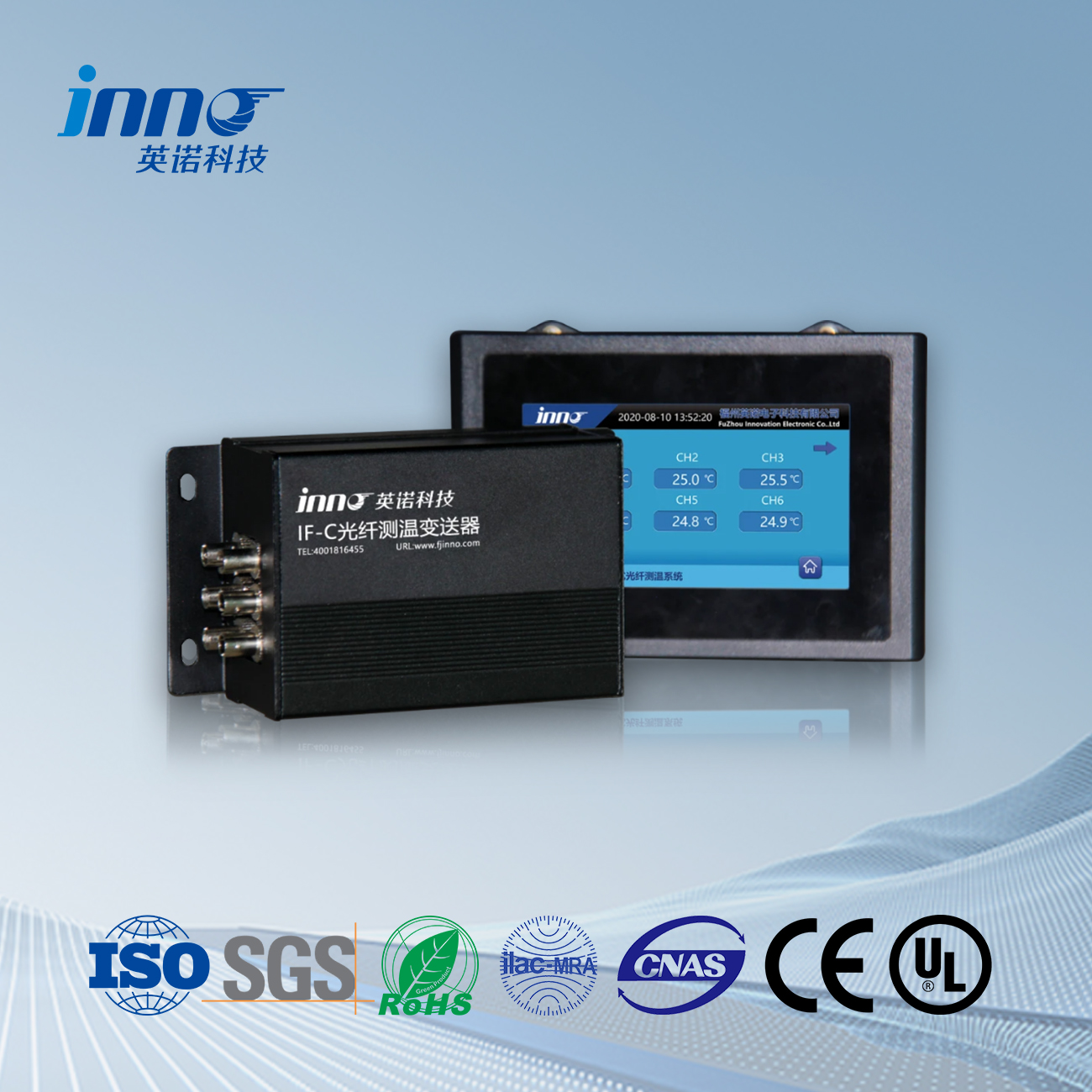
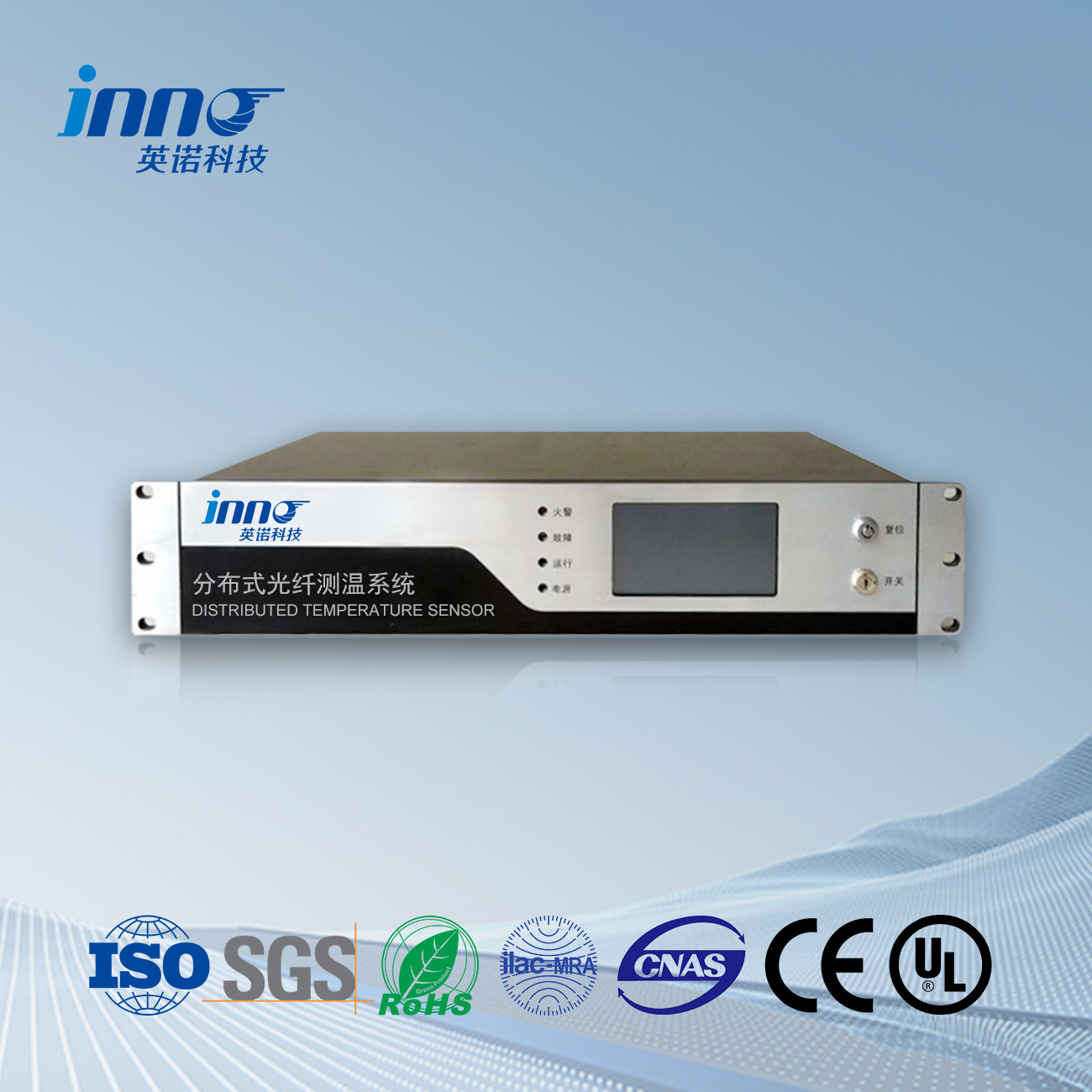
- Raman DTS Systems for Long-Distance Cable Corridors: Continuous spatial temperature profiling along tens of kilometers of underground, tunnel, or submarine power cable—feeding real-time thermal rating (RTTR) engines over standard substation protocols.
- Fluorescent Fiber Optic Point Sensors for Terminations & Switchgear Exits: Non-metallic ring-lug and bolt-on optical probes track high-voltage riser clamps and cable potheads continuously without EMI drift or flashover risk.
- Open Substation Protocol Integration: Export corridor hot-spot coordinates and localized alarm zones via Modbus TCP, IEC 61850, or dry relays directly into dynamic line rating software and EMS consoles.
5. Procurement & Evaluation Checklist for Dynamic Line Rating Vendors & RTTR Hardware
When shortlisting dynamic line rating vendors or specifying underground RTTR systems in a utility tender, engineering and procurement teams should verify six commercial criteria:
- 1. Separate Pure Weather-Estimation Software from Direct Physical Sensing: Pure ambient-adjusted ratings estimate cooling statistically without touching the conductor or soil; prioritize direct physical temperature, sag, or DTS fiber measurement on critical tie lines.
- 2. Verify End-to-End Bottleneck Coverage Including Substations: Confirm that upgraded overhead ampacity does not overload short underground substation getaways, current transformers, wave traps, or riser lugs.
- 3. Check Fiber Installation Continuity on Underground Corridors: Identify whether existing spare telecom fibers inside power cables or attached HDPE conduits can serve immediately for DTS interrogation without excavating trenches.
- 4. Require Open EMS / SCADA Data Protocols: Avoid proprietary cloud-only lock-in; mandate native IEC 61850, DNP3, or Modbus TCP output so grid dispatchers consume RTTR limits natively.
- 5. Evaluate Multi-Year Calibration & Maintenance Burden: Battery-powered overhead span gadgets demand live-line service intervals, whereas passive optical sensing fibers along cables require zero field electronics inside vaults.
- 6. Request a Corridor-Matched Hardware Quote: Share circuit length, cable type, dark-fiber availability, and substation tie count on the FJINNO contact page for matched DTS and optical termination hardware recommendations.
6. Frequently Asked Questions: Dynamic Line Rating & Real-Time Thermal Rating
What is the difference between Dynamic Line Rating (DLR) and Real-Time Thermal Rating (RTTR)?
Dynamic Line Rating (DLR) commonly refers to overhead transmission conductors where wind cooling, ambient temperature, and span sag set capacity, whereas Real-Time Thermal Rating (RTTR) typically describes underground and submarine power cables modeled continuously from distributed fiber optic temperature profiles and soil thermal behavior.
How much capacity can utilities gain before needing a full line rebuild?
Depending on regional wind regimes, seasonal temperatures, and conservative legacy assumptions, utilities often recover substantial latent corridor headroom—deferring reconductoring CAPEX and reducing renewable curtailment while multi-year rebuild projects clear permitting.
Can dynamic line rating increase the risk of cable or conductor failure?
Only if capacity is pushed blindly without monitoring local pinch points. Combining continuous DTS corridor hot-spot tracking with optical termination monitoring lowers failure risk by spotting dry soil zones and loose transition lugs early.
What sensors do underground power cables use for real-time thermal rating?
Underground and tunnel cables primarily use Raman Distributed Temperature Sensing (DTS) over embedded or strapped optical fiber for continuous route thermal mapping, supplemented by fluorescent fiber optic sensors at critical joints and risers.
How do grid operators get project pricing for cable RTTR and hot-spot sensors?
RTTR system configuration depends on route length, number of monitored circuits, existing fiber core type, and SCADA protocol. Submit circuit layouts through the FJINNO contact page for an itemized factory quotation.
7. Request RTTR & Distributed Cable Hot-Spot Monitoring Specifications
Eliminating renewable curtailment or verifying underground substation exit capacity? Send your corridor length, voltage class, and SCADA requirements to FJINNO engineers for matched DTS and optical hot-spot monitoring proposals.

Fiber optic temperature sensor, Intelligent monitoring system, Distributed fiber optic manufacturer in China
 |
 |
 |