 เซ็นเซอร์อุณหภูมิไฟเบอร์ออปติก INNO ,ระบบตรวจสอบอุณหภูมิ.
- ระบบเตือนภัยแบบไฟเบอร์ออปติกใช้สายเคเบิลออปติกมาตรฐานเป็นองค์ประกอบการตรวจจับอย่างต่อเนื่องเพื่อตรวจจับการบุกรุก, การสั่นสะเทือน, และเหตุการณ์ทางเสียงในระยะทางไกลถึง 100 กม..
- DAS (การตรวจจับเสียงแบบกระจาย) จับรูปคลื่นเสียงเต็มรูปแบบตามเส้นใย, ช่วยให้สามารถจำแนกเสียงโดยละเอียดและระบุเหตุการณ์ได้.
- ดีวีเอส (การตรวจจับการสั่นสะเทือนแบบกระจาย) ตรวจจับความเข้มและตำแหน่งของการสั่นสะเทือน, มอบโซลูชันที่คุ้มต้นทุนสำหรับการตรวจจับการบุกรุกในขอบเขต.
- DAS ให้ความไวที่สูงกว่า, การตอบสนองความถี่ที่กว้างขึ้น, และเอาต์พุตข้อมูลที่สมบูรณ์ยิ่งขึ้นเมื่อเทียบกับ DVS.
- DVS ปรับใช้ง่ายกว่า, ต้องใช้พลังการประมวลผลน้อยกว่า, และเหมาะอย่างยิ่งสำหรับการกระตุ้นสัญญาณเตือนพื้นฐานในการใช้งานรั้วและขอบเขต.
- เทคโนโลยีทั้งสองมีภูมิคุ้มกันต่อการรบกวนทางแม่เหล็กไฟฟ้า, ไม่ต้องใช้พลังงานไฟฟ้าตามเส้นทางการตรวจจับ, และมอบการตรวจสอบแบบเรียลไทม์พร้อมการแปลเหตุการณ์ที่แม่นยำ.
- Choosing between DAS and DVS depends on the required detection resolution, งบประมาณ, สิ่งแวดล้อม, and the complexity of threat classification needed.
สารบัญ
- 1. What Is a Fiber Optic Alarm System
- 2. How DAS (การตรวจจับเสียงแบบกระจาย) ได้ผล
- 3. How DVS (การตรวจจับการสั่นสะเทือนแบบกระจาย) ได้ผล
- 4. Key Differences Between DAS and DVS
- 5. Typical Applications of Fiber Optic Alarm Systems
- 6. How to Choose Between DAS and DVS
- 7. Installation and Deployment Considerations
- 8. Advantages and Limitations of Fiber Optic Alarm Systems
- 9. คําถามที่พบบ่อย (คำถามที่ถามบ่อย)
1. ก.คืออะไร Fiber Optic Alarm System

A fiber optic alarm system is a security monitoring solution that uses optical fiber cables as distributed sensors to detect physical disturbances along their entire length. Unlike conventional electronic alarm systems that rely on discrete sensors placed at fixed points, ก เซ็นเซอร์ไฟเบอร์ออปติกแบบกระจาย turns every meter of the cable into an active sensing element. This means a single fiber cable can monitor perimeters, รั้ว, ไปป์ ไลน์, และโครงสร้างพื้นฐานที่สำคัญในระยะทางตั้งแต่ไม่กี่ร้อยเมตรไปจนถึงมากกว่านั้น 100 กิโลเมตร — ทั้งหมดนี้มาจากหน่วยสอบสวนเพียงหน่วยเดียว.
หลักการทำงานขึ้นอยู่กับการวิเคราะห์แสงสะท้อนกลับภายในไฟเบอร์. เมื่อมีเหตุการณ์ภายนอก เช่น การบุกรุก, การสั่น, หรือแรงดันเปลี่ยนแปลงเกิดขึ้นบริเวณใกล้สายเคเบิล, มันทำให้เกิดการรบกวนเล็กน้อยในเส้นใยซึ่งเปลี่ยนลักษณะของสัญญาณแสงที่สะท้อน. หน่วยสอบสวนที่ส่วนควบคุมจะวัดการเปลี่ยนแปลงเหล่านี้แบบเรียลไทม์, กำหนดสถานที่จัดงานได้อย่างแม่นยำ, และแจ้งเตือนเมื่อเกินเกณฑ์ที่กำหนดไว้ล่วงหน้า.
เหตุใดระบบสัญญาณเตือนภัยแบบไฟเบอร์ออปติกจึงได้รับความนิยม
ระบบเตือนภัยแบบดั้งเดิมโดยใช้สายไฟทองแดง, ลำแสงอินฟราเรด, หรือสิ่งกีดขวางไมโครเวฟอาจไวต่อการรบกวนทางแม่เหล็กไฟฟ้า, สายฟ้าฟาด, และความเสื่อมโทรมของสิ่งแวดล้อม. A fiber optic intrusion detection system eliminates these vulnerabilities entirely because optical fiber is a dielectric material — it carries light, not electrical current. This makes the sensing cable inherently immune to EMI, RFI, and lightning damage. นอกจากนี้, fiber optic systems do not generate any electromagnetic signature themselves, making them virtually undetectable by intruders and ideal for high-security installations.
2. How DAS (การตรวจจับเสียงแบบกระจาย) ได้ผล
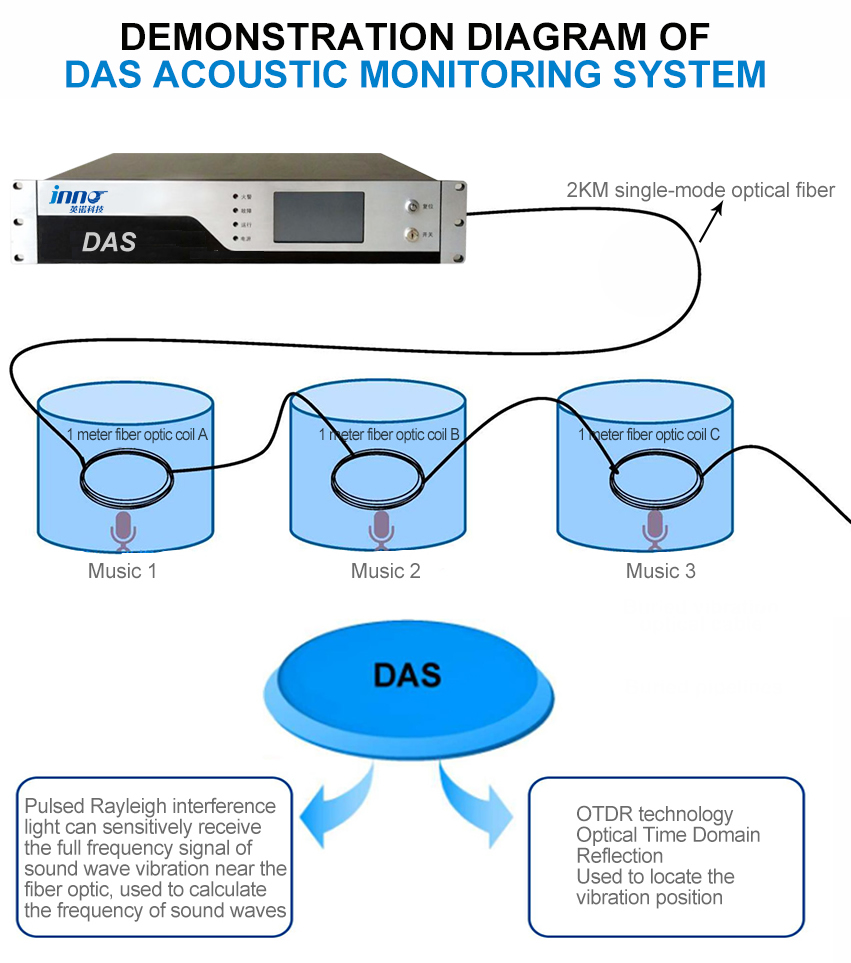
DAS (การตรวจจับเสียงแบบกระจาย) is an advanced fiber optic sensing technology that converts a standard single-mode optical fiber into an array of thousands of virtual microphones. The system works by injecting short, coherent laser pulses into the fiber and analyzing the phase of the Rayleigh backscattered light returning from every point along the cable.
The Phase-Sensitive OTDR Principle
DAS systems use a technique known as phase-sensitive optical time-domain reflectometry (Φ-OTDR). As the laser pulse travels down the fiber, naturally occurring impurities in the glass scatter a tiny fraction of the light back toward the source. When an acoustic wave or vibration hits the fiber, it causes localized strain that shifts the phase of this backscattered light. By comparing successive phase measurements at each point along the fiber, the DAS interrogator reconstructs a full acoustic waveform — capturing not just whether an event occurred, but the actual sound signature of the event.
Key Capabilities of DAS Technology
A DAS fiber optic sensing system typically offers a frequency response ranging from sub-hertz to several kilohertz, spatial resolution as fine as 1 เมตร, และระยะตรวจจับได้ไกลถึง 50–100 กม. ขึ้นอยู่กับรุ่นของผู้สอบสวน. เนื่องจาก DAS เก็บข้อมูลเสียงที่แท้จริง, ช่วยให้สามารถจำแนกสัญญาณที่ซับซ้อนได้โดยใช้อัลกอริธึมการจดจำรูปแบบ. ซึ่งหมายความว่าระบบสามารถแยกแยะระหว่างบุคคลที่เดินไปตามรั้วได้, ยานพาหนะที่ขับอยู่บนถนนใกล้เคียง, สัตว์กำลังแปรงฟันกับสายเคเบิล, และความพยายามในการตัดหรือปีนจริง — ลดอัตราการเตือนที่ผิดพลาดได้อย่างมาก.
3. ยังไง ดีวีเอส (การตรวจจับการสั่นสะเทือนแบบกระจาย) ได้ผล

ดีวีเอส (การตรวจจับการสั่นสะเทือนแบบกระจาย) เป็นเทคโนโลยีการตรวจสอบไฟเบอร์ออปติกที่เกี่ยวข้องกันอย่างใกล้ชิด แต่มีทางเทคนิคง่ายกว่า. เช่นนั้น, DVS อาศัยการกระจายแสงสะท้อนกลับของ Rayleigh ภายในใยแก้วนำแสง. อย่างไรก็ตาม, แทนที่จะวัดเฟสที่แม่นยำของแสงที่ส่งคืนเพื่อสร้างรูปคลื่นเสียงขึ้นมาใหม่, DVS จะวิเคราะห์การเปลี่ยนแปลงความเข้มของสัญญาณสะท้อนกลับเป็นหลัก.
วิธีการตรวจจับตามความเข้ม
When a vibration event occurs near the สายเคเบิลตรวจจับไฟเบอร์ออปติก, it alters the interference pattern of the backscattered light, causing fluctuations in signal intensity at the corresponding location. พื้นที่ DVS interrogation unit monitors these intensity variations in real time and identifies the position and magnitude of the disturbance. While DVS does not capture the full acoustic waveform, it reliably detects the presence, ที่ตั้ง, and relative strength of vibration events.
Practical Performance of DVS Systems
แบบฉบับ DVS perimeter detection system provides spatial resolution in the range of 5 ถึง 10 meters with a sensing range of up to 40–60 km. The frequency response is generally narrower than DAS, often limited to several hundred hertz. DVS is highly effective for applications where the primary requirement is knowing that a disturbance occurred and where it happened, without the need for detailed acoustic classification. This makes it a practical, lower-cost alternative for many perimeter security scenarios.
4. Key Differences Between DAS and DVS

While DAS and DVS are both distributed fiber optic sensing technologies that use the same basic optical fiber infrastructure, they differ significantly in measurement approach, data richness, and suitability for various applications. Understanding these differences is essential for selecting the right technology for a given security requirement.
วิธีการวัด
The most fundamental difference lies in what each system measures. DAS measures the phase of the Rayleigh backscattered light, providing a quantitative, linear representation of the acoustic field along the fiber. DVS measures the intensity of the backscattered light, providing a qualitative indication of vibration activity. ในแง่การปฏิบัติ, DAS gives you a waveform you can listen to and analyze, while DVS gives you an alert that something happened.
Sensitivity and Resolution
DAS systems generally offer higher sensitivity and finer spatial resolution than DVS. A high-performance DAS interrogator can achieve 1-meter spatial resolution and detect nano-strain level disturbances. DVS systems typically operate with 5–10 meter resolution and require somewhat larger disturbances to trigger a reliable detection. For applications requiring precise event localization and the ability to classify low-amplitude signals, DAS is the superior choice.
Event Classification and False Alarm Reduction
เนื่องจาก DAS เก็บข้อมูลเสียงที่แท้จริง, it supports advanced event classification algorithms that can differentiate between threat and non-threat events. This is a major advantage in environments with high background noise or frequent benign activities near the sensing cable. ดีวีเอส, with its intensity-based approach, has more limited classification capability and may produce higher false alarm rates in complex environments.
System Cost and Complexity
DAS interrogation units are more complex and typically more expensive than DVS units. The processing requirements for phase demodulation and waveform analysis are also higher. For projects with tight budgets or straightforward detection requirements, ก DVS alarm system offers a compelling balance of performance and cost efficiency.
Frequency Response and Data Output
DAS systems provide broadband frequency response, often from below 1 Hz up to 10 kHz or more, enabling detection of a wide range of acoustic phenomena. DVS frequency response is narrower, typically sufficient for detecting mechanical vibrations but not suitable for capturing detailed acoustic signatures. The data output from DAS is substantially larger, requiring more storage and processing bandwidth.
5. Typical Applications of ระบบเตือนภัยด้วยไฟเบอร์ออปติก
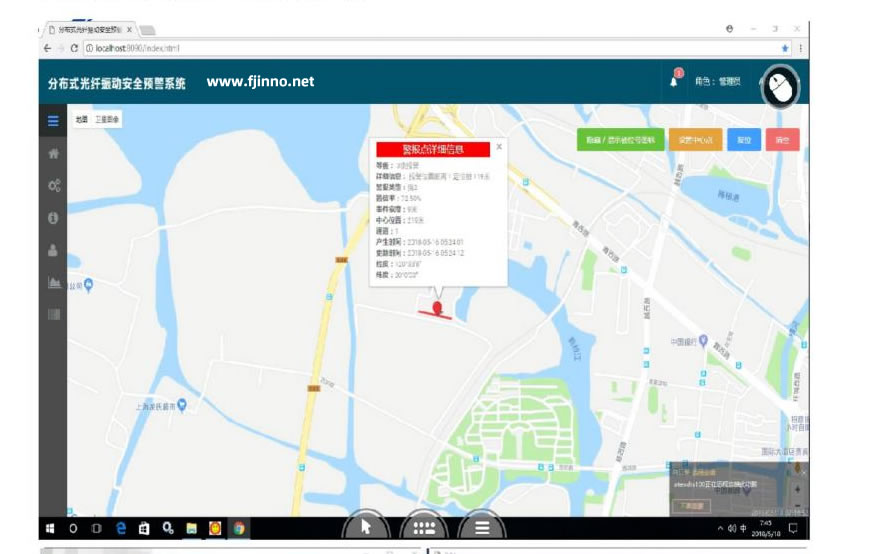
Both DAS and DVS technologies are deployed across a wide range of security and monitoring applications. The choice between them often depends on the specific requirements of each use case.
Perimeter Security and Intrusion Detection
Fiber optic perimeter security systems are widely used to protect military bases, government facilities, สนาม บิน, ศูนย์ข้อมูล, เรือนจํา, and industrial sites. The sensing cable is typically mounted on or buried alongside the perimeter fence. When someone attempts to climb, cut, or breach the fence, the resulting vibrations are immediately detected and located. DAS-based systems excel in this application due to their ability to classify the type of intrusion activity, ในขณะที่ DVS fence-mounted sensors provide reliable basic detection at lower cost.
Pipeline and Utility Monitoring
Fiber optic pipeline monitoring systems use DAS or DVS cables installed alongside oil, แก๊ส, and water pipelines to detect third-party interference, unauthorized excavation, การรั่วไหล, and equipment impacts. DAS is particularly effective here because it can identify the acoustic signature of different types of machinery and activities near the pipeline right-of-way.
Border and Critical Infrastructure Protection
ระยะไกล distributed fiber optic alarm systems are deployed along national borders, railway lines, highway corridors, and around power stations and substations. The ability to monitor tens of kilometers of perimeter from a single point with no active electronics in the field makes fiber optic technology uniquely suited to protecting remote and extended infrastructure.
Telecommunications Cable Security
Fiber optic cables that form part of telecommunications networks can be monitored using DAS or DVS to detect tampering, unauthorized access attempts, or accidental damage from nearby construction activities. This application leverages existing fiber optic cable infrastructure without requiring additional sensing cables.
6. How to Choose Between DAS and DVS
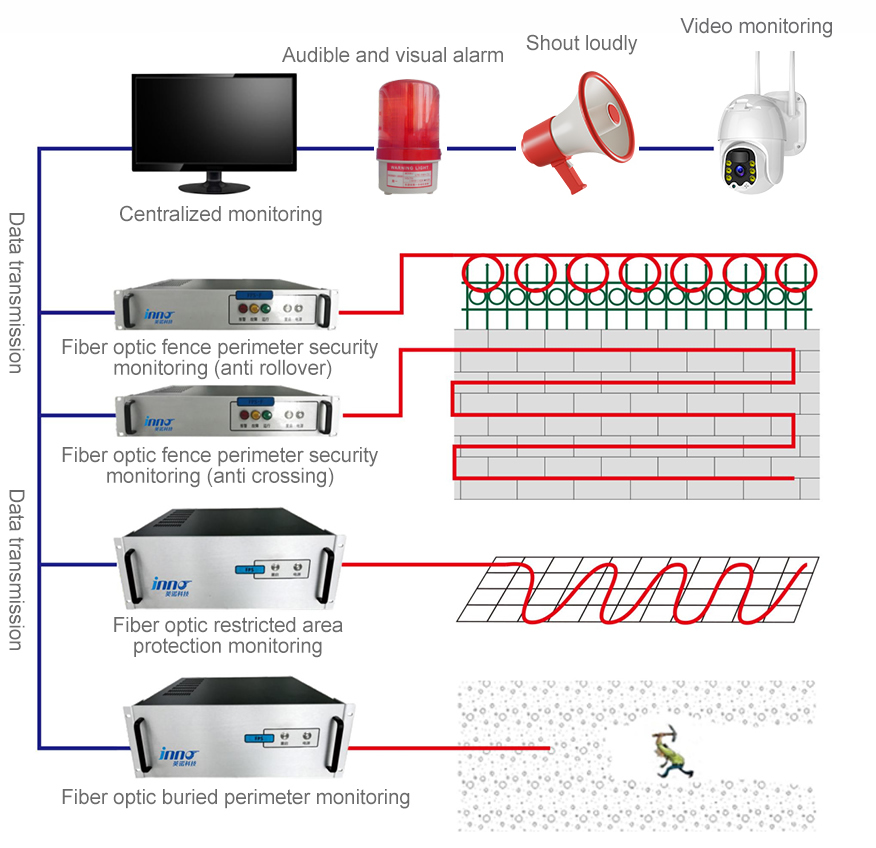
Selecting the right technology for a fiber optic alarm system requires careful evaluation of several factors related to the project environment, ความคาดหวังด้านประสิทธิภาพ, และข้อ จำกัด ด้านงบประมาณ.
กำหนดข้อกำหนดในการตรวจจับของคุณ
เริ่มต้นด้วยการกำหนดประเภทของเหตุการณ์ที่คุณต้องการตรวจจับ และการจัดประเภทเหตุการณ์มีความสำคัญหรือไม่. หากคุณต้องการแยกแยะระหว่างการบุกรุกประเภทต่างๆ เช่น การเดิน, ขุด, การเคลื่อนไหวของยานพาหนะ, และการตัดสายเคเบิล — ระบบเตือนภัยแบบ DAS ด้วยความสามารถในการจำแนกประเภทเสียงจึงเป็นทางเลือกที่เหมาะสม. หากความต้องการหลักของคุณคือการแจ้งเตือนตามโซนธรรมดาเมื่อมีการสั่นสะเทือนที่สำคัญเกิดขึ้น, ก ระบบดีวีเอส จะตอบสนองความต้องการได้อย่างมีประสิทธิภาพ.
พิจารณาสภาพแวดล้อมการทำงาน
ในสภาพแวดล้อมที่มีเสียงรบกวนจากการจราจรสูง, เครื่องจักรอุตสาหกรรม, หรือสภาพอากาศ, DAS ให้การกรองการแจ้งเตือนที่ผิดพลาดที่ดีกว่าเนื่องจากการวิเคราะห์ระดับรูปคลื่น. ในความเงียบยิ่งขึ้น, สภาพแวดล้อมที่มีการควบคุมมากขึ้น เช่น บริเวณที่มีรั้วกั้นหรือสิ่งอำนวยความสะดวกภายในอาคาร, DVS สามารถทำงานได้ดีโดยไม่ต้องเพิ่มความซับซ้อนในการประมวลผลเสียง.
Evaluate Distance and Resolution Needs
For very long monitoring distances exceeding 50 km or requirements for meter-level spatial precision, DAS is generally the better-suited technology. For shorter perimeters under 20 km where 5–10 meter localization accuracy is acceptable, DVS offers a practical and economical solution.
Budget and Total Cost of Ownership
The interrogation unit is the most significant cost component. DAS units carry a higher upfront price, but may reduce long-term operational costs through fewer false alarms and lower verification workload. DVS units are less expensive initially and simpler to maintain, making them attractive for budget-sensitive projects.
7. Installation and Deployment Considerations
Proper installation is critical to the performance of any distributed fiber optic alarm system. Several key factors should be addressed during the planning and deployment phases.
Cable Selection and Routing
Both DAS and DVS systems can operate with standard single-mode สายไฟเบอร์ออปติก, although purpose-designed sensing cables with enhanced sensitivity coatings or ruggedized jackets are recommended for outdoor and buried installations. The cable route should be planned to maintain good acoustic coupling with the ground or structure being monitored while avoiding excessive exposure to environmental noise sources.
Mounting Methods
For fence-mounted applications, พื้นที่ สายเคเบิลตรวจจับไฟเบอร์ออปติก is typically attached directly to the fence fabric using cable ties or specialized clips at regular intervals. For buried applications, the cable is placed in a sand bed at a depth of 20–40 cm to ensure reliable ground coupling. In some applications, the cable is installed inside existing conduit or duct infrastructure.
Interrogator Placement and Connectivity
พื้นที่ DAS or DVS interrogation unit is installed in a secure, climate-controlled location at one end of the fiber route. It connects to the monitoring network via Ethernet or fiber backhaul. แหล่งจ่ายไฟ, การคุ้มครองสิ่งแวดล้อม, and physical security of the interrogator site should be carefully planned.
Zone Configuration and Alarm Thresholds
หลังการติดตั้ง, the sensing fiber is divided into logical alarm zones, each with independently configurable detection thresholds and sensitivity settings. This allows operators to adapt the system to local conditions, reduce nuisance alarms in noisy zones, and increase sensitivity in critical areas. Proper zone tuning during commissioning is one of the most important steps in achieving reliable system performance.
8. Advantages and Limitations of Fiber Optic Alarm Systems

ประโยชน์
Fiber optic alarm systems offer several compelling advantages over conventional electronic security technologies. The sensing cable is completely passive, requiring no electrical power in the field, which eliminates the need for field power supplies, แบตเตอรี่, or solar panels. The fiber is immune to electromagnetic interference, making it suitable for deployment near high-voltage power lines, สถานีย่อย, and heavy industrial environments. A single fiber cable can monitor extremely long distances — up to 100 km — from one central interrogation point, dramatically reducing the amount of equipment and infrastructure compared to point-sensor solutions. The system provides continuous, distributed detection with no gaps between sensors, and it delivers real-time localization of events with meter-level accuracy in DAS systems.
ข้อจำกัด
No technology is without limitations. Fiber optic sensing cables can be sensitive to environmental factors such as wind, heavy rain, and temperature fluctuations, which may increase background noise levels and require careful threshold tuning. The interrogation units represent a significant single point of investment, and spares planning should be considered for critical installations. Fiber splices and connectors along the cable route can introduce signal loss and should be minimized. นอกจากนี้, proper installation and commissioning require specialized knowledge, and ongoing performance depends on maintaining cable integrity over time.
9. คําถามที่พบบ่อย (คำถามที่ถามบ่อย)
ไตรมาสที่ 1: What is the maximum monitoring distance of a fiber optic alarm system?
Most modern DAS and DVS systems can monitor fiber optic cables over distances of 40 ถึง 100 ห่างจากหน่วยสอบปากคำแห่งเดียว. The exact range depends on the interrogator model, fiber quality, และต้องการความละเอียดเชิงพื้นที่. For very long perimeters, multiple interrogators can be deployed to extend total coverage.
ไตรมาสที่ 2: Can fiber optic alarm systems work with existing fiber optic cables?
ใช่. Both DAS and DVS technologies can operate on standard single-mode fiber optic cables, including spare fibers within existing telecommunications or utility cable infrastructure. อย่างไรก็ตาม, purpose-designed sensing cables may provide better sensitivity and reliability for dedicated security applications.
ไตรมาสที่ 3: How does a DAS system reduce false alarms?
DAS captures the full acoustic waveform of detected events, which allows the system to apply signal classification algorithms. These algorithms analyze the frequency content, ระยะเวลา, and pattern of each event to differentiate genuine intrusion attempts from benign activities such as animal movement, ลม, and vehicle traffic.
ไตรมาสที่ 4: Is DVS less accurate than DAS?
DVS typically offers coarser spatial resolution than DAS — around 5 ถึง 10 meters compared to 1 meter for DAS. อย่างไรก็ตาม, DVS is highly reliable for detecting and locating vibration events. The trade-off is in classification depth rather than detection reliability. For many applications, DVS accuracy is fully adequate.
คำถามที่ 5: What types of threats can a fiber optic perimeter alarm detect?
Fiber optic alarm systems can detect a wide range of threats including fence climbing, fence cutting, digging or tunneling near the cable, walking or running along the perimeter, vehicle approach and impact, and cable tampering. DAS systems can further classify these events by their acoustic signature.
คำถามที่ 6: Do fiber optic alarm systems require power along the sensing cable?
ไม่ใช่. The fiber optic sensing cable is entirely passive and requires no electrical power along its length. All active electronics are contained in the interrogation unit at the control center. This is one of the most significant advantages of distributed fiber optic sensing over conventional electronic alarm systems.
คำถามที่ 7: How are fiber optic alarm systems affected by weather?
Strong wind, heavy rain, and hail can generate vibrations on exposed fence-mounted cables, potentially increasing background noise levels. Modern DAS and DVS systems use adaptive filtering and threshold adjustment to minimize weather-related false alarms. Buried cable installations are largely unaffected by surface weather conditions.
คำถามที่ 8: Can DAS and DVS systems be integrated with CCTV and access control?
ใช่. Most fiber optic alarm systems provide standard output interfaces and support integration with video management systems, แพลตฟอร์ม SCADA, access control systems, and centralized security management software. เมื่อมีการปลุก, the system can automatically direct PTZ cameras to the event location for visual verification.
คำถามที่ 9: What maintenance does a fiber optic alarm system require?
Fiber optic alarm systems require relatively low maintenance. Routine tasks include periodic inspection of the cable route for physical damage, checking fiber splice and connector quality using an OTDR, verifying interrogator performance, and reviewing alarm thresholds based on seasonal environmental changes.
คำถามที่ 10: How long does a fiber optic sensing cable last in outdoor environments?
High-quality outdoor-rated fiber optic cables with appropriate jacket materials are designed for service lives of 20 ถึง 30 ปีหรือมากกว่านั้น. The actual lifespan depends on environmental conditions, คุณภาพการติดตั้ง, and protection from mechanical damage. UV-resistant and armored cable options are available for harsh environments.
ข้อสงวนสิทธิ์: ข้อมูลที่ให้ไว้ในบทความนี้มีวัตถุประสงค์เพื่อให้ข้อมูลและการศึกษาทั่วไปเท่านั้น. ในขณะที่มีความพยายามทุกวิถีทางเพื่อรับรองความถูกต้อง, ฟิญนโนะ (www.fjinno.net) ไม่รับประกันหรือรับรองเกี่ยวกับความครบถ้วนสมบูรณ์, ความน่าเชื่อถือ, หรือความเหมาะสมของเนื้อหาสำหรับการใช้งานเฉพาะใดๆ. ข้อมูลจำเพาะของผลิตภัณฑ์, พารามิเตอร์ประสิทธิภาพ, and technical details may vary depending on specific models, การกำหนดค่า, และสภาพการทำงาน. Readers are advised to consult directly with qualified engineers and system integrators before making any purchasing or deployment decisions. FJINNO shall not be held liable for any loss, ความเสียหาย, or consequence arising from the use of or reliance on the information contained herein.

เซ็นเซอร์อุณหภูมิไฟเบอร์ออปติก, ระบบตรวจสอบอัจฉริยะ, ผู้ผลิตไฟเบอร์ออปติกแบบกระจายในประเทศจีน
 |
 |
 |