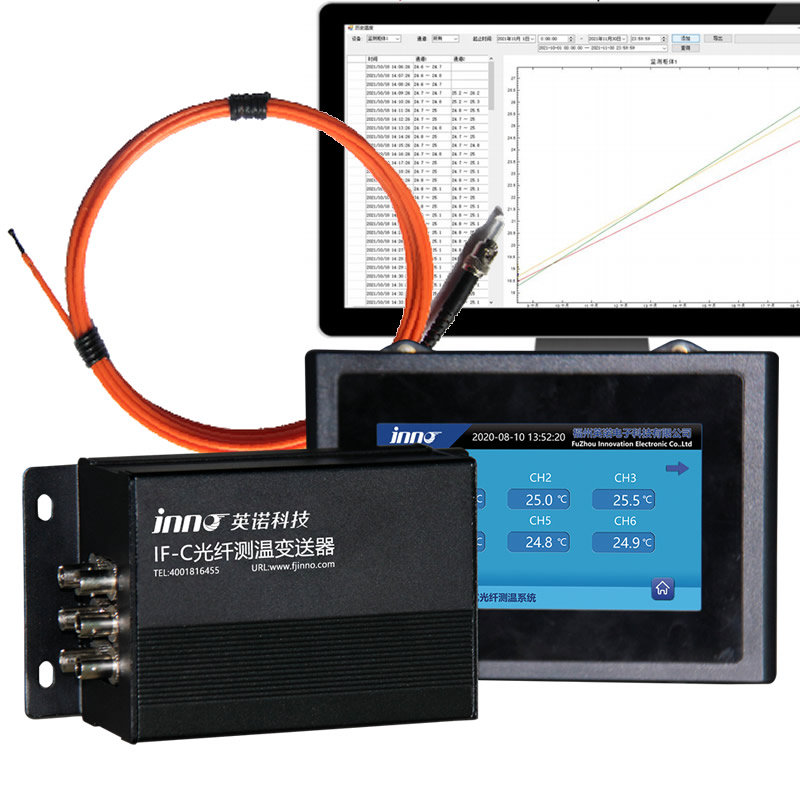
 Cảm biến nhiệt độ sợi quang INNO ,hệ thống giám sát nhiệt độ.
- Cảm biến nhiệt độ sợi quang huỳnh quang measure from −40 °C đến +250 °C (lên tới +300 °C with enhanced probes), delivering ±1 °C accuracy for power equipment and switchgear.
- Lưới sợi Bragg (FBG) cảm biến cover −40 °C đến +300 °C in standard form, and can extend to +700 °C hoặc thậm chí +1000 °C with regenerated gratings and metal-coated fiber.
- Raman distributed temperature sensing (DTS) systems operate from −40 °C đến +300 °C over distances up to 30–50 km, ideal for pipeline and cable monitoring.
- Brillouin BOTDA/BOTDR systems share a similar range of −40 °C đến +300 °C but can reach 100+ km sensing length.
- Sapphire fiber blackbody sensors push the upper limit beyond +2000 °C for extreme industrial environments.
Mục lục
- What Is Fiber Optic Temperature Range
- Fiber Optic Temperature Sensing Technologies and Their Ranges
- Key Factors That Determine Fiber Optic Temperature Range
- Typical Applications Across Different Temperature Ranges
- Cách chọn cảm biến nhiệt độ sợi quang phù hợp
- Câu hỏi thường gặp về phạm vi nhiệt độ sợi quang
1. What Is Fiber Optic Temperature Range

Phạm vi nhiệt độ sợi quang đề cập đến nhiệt độ tối thiểu và tối đa mà một cảm biến nhiệt độ sợi quang có thể đo lường chính xác và đáng tin cậy. Thông số kỹ thuật này thay đổi đáng kể giữa các công nghệ cảm biến khác nhau, vật liệu sợi, lớp phủ, và thiết kế bao bì. Đầu dò sợi quang huỳnh quang được thiết kế để giám sát cuộn dây máy biến áp xử lý cửa sổ nhiệt độ rất khác so với cửa sổ nhiệt độ cảm biến sợi sapphire được chế tạo để thử nghiệm động cơ phản lực.
Tại sao phạm vi nhiệt độ là tiêu chí lựa chọn đầu tiên
Phạm vi nhiệt độ xác định trực tiếp liệu cảm biến có thể hoạt động an toàn và chính xác trong môi trường mục tiêu của bạn hay không. Chọn cảm biến có phạm vi không đủ dẫn đến lỗi đo, mất tín hiệu, hoặc hư hỏng đầu dò vĩnh viễn. Chỉ định quá mức phạm vi, mặt khác, thường có nghĩa là hy sinh độ phân giải hoặc trả nhiều tiền hơn đáng kể. Matching your actual operating temperature envelope to the right sensing technology is the most critical step in any giám sát nhiệt độ sợi quang project.
What This Article Covers
This guide breaks down the temperature ranges of four mainstream fiber optic sensing technologies, explains the physical and material factors that set those limits, maps each temperature zone to real-world applications, and provides practical selection guidance. Every specification referenced reflects current commercially available products and published industry data.
2. Cảm biến nhiệt độ sợi quang Technologies and Their Ranges

Cảm biến nhiệt độ sợi quang huỳnh quang
Cảm biến nhiệt độ sợi quang huỳnh quang (also called fluorescence lifetime decay sensors) work by exciting a phosphor material at the probe tip with a light pulse and measuring the decay time of the resulting fluorescence. Thời gian phân rã này thay đổi có thể dự đoán được theo nhiệt độ, providing a direct and highly accurate reading.
Tiêu chuẩn đầu dò sợi quang huỳnh quang cover −40 °C đến +200 °C. Enhanced versions using optimized phosphor compounds and high-temperature packaging extend the range to +250 °C hoặc +300 °C. Accuracy is typically ±0,5°C đến ±1°C, with response times under 1 thứ hai. This is a point-measurement technology — each probe reads temperature at a single location. The key advantage is complete immunity to electromagnetic interference, làm cảm biến sợi quang huỳnh quang the standard choice for power transformer winding temperature, switchgear contact temperature, Và motor winding monitoring.
Lưới sợi Bragg (FBG) Cảm biến nhiệt độ
Cảm biến nhiệt độ FBG use a periodic refractive-index structure written into the fiber core. This grating reflects a narrow wavelength of light (bước sóng Bragg), which shifts linearly with temperature. By tracking this wavelength shift, the system determines temperature at the grating location.
Tiêu chuẩn Cảm biến FBG operate from −40 °C đến +300 °C. With regenerated or femtosecond-written gratings and polyimide or metal-coated fiber, the range extends to +700 °C Và, in specialized configurations, beyond +1000 °C. Multiple gratings can be multiplexed on a single fiber (quasi-distributed measurement), making FBG systems efficient for structural health monitoring. Note that FBG sensors respond to both temperature and strain simultaneously, so proper decoupling is necessary for accurate thermal-only measurements.
Cảm biến nhiệt độ phân tán Raman (Raman DTS)

Raman DTS systems inject a laser pulse into an optical fiber and analyze the backscattered Raman signal. The ratio of anti-Stokes to Stokes Raman scattering intensity is temperature-dependent, enabling continuous temperature profiling along the entire fiber length.
Tiêu chuẩn Raman DTS systems measure from −40 °C đến +300 °C, limited primarily by the fiber coating material. Sensing distances reach 30–50 km with spatial resolution of approximately 1 mét. This makes Raman DTS the go-to solution for power cable temperature monitoring, phát hiện rò rỉ đường ống, tunnel fire alarm systems, và an ninh vành đai. Measurement time per scan ranges from seconds to minutes depending on distance and desired accuracy.
Brillouin Distributed Temperature Sensing (BOTDA/BOTDR)
Brillouin fiber optic sensing measures temperature through the shift in Brillouin scattering frequency, which varies linearly with temperature along the fiber. BOTDA (Brillouin Optical Time Domain Analysis) uses stimulated scattering for higher performance, while BOTDR (Phép đo phản xạ miền thời gian quang học Brillouin) uses spontaneous scattering for single-ended access.
The temperature range is similar to Raman DTS at −40 °C đến +300 °C, but Brillouin systems achieve significantly longer sensing distances — often 100 km trở lên. Like FBG, Sự tán xạ Brillouin nhạy cảm với cả nhiệt độ và độ căng, requiring appropriate separation techniques. These systems are widely used for long-distance infrastructure monitoring including subsea cables, đập nước, and large-scale pipeline networks.
Technology Comparison Table
| Công nghệ | Standard Range | Phạm vi mở rộng | Loại đo lường | Độ chính xác điển hình |
|---|---|---|---|---|
| Sợi quang huỳnh quang | −40 °C đến +200 °C | Lên đến +300 °C | Điểm | ±0,5°C đến ±1°C |
| FBG | −40 °C đến +300 °C | Lên đến +1000 °C | Gần như phân phối | ±0,5°C đến ±2°C |
| Raman DTS | −40 °C đến +300 °C | Lên đến +700 °C | Phân phối đầy đủ | ±1°C đến ±2°C |
| Brillouin BOTDA/BOTDR | −40 °C đến +300 °C | Lên đến +400 °C | Phân phối đầy đủ | ±1°C đến ±2°C |
3. Key Factors That Determine Fiber Optic Temperature Range
Chất liệu sợi và lớp phủ
Bản thân sợi quang được làm từ silica nung chảy, về mặt lý thuyết có thể chịu được nhiệt độ trên +1000 °C. Tuy nhiên, lớp phủ sợi - được áp dụng để bảo vệ kính khỏi hư hỏng cơ học - hầu như luôn là yếu tố hạn chế đầu tiên. Sử dụng sợi viễn thông tiêu chuẩn lớp phủ acryit, đánh giá cho −40 °C đến +85 °C. Sợi phủ polyimide mở rộng giới hạn trên đến xấp xỉ +300 °C. Sợi bọc kim loại (nhôm, đồng, hoặc vàng) đẩy nó đi xa hơn +500 ° C đến +700 °C. Ngoài ra, sợi trần hoặc sợi phủ carbon đặc biệt được sử dụng trong môi trường được kiểm soát.
Hạn chế của phần tử cảm biến
Mỗi công nghệ cảm biến đều có những giới hạn vật lý cố hữu. Các hợp chất photpho huỳnh quang mất hiệu suất phát quang hoặc trải qua những thay đổi không thể đảo ngược trên nhiệt độ định mức của chúng. Cách tử FBG loại I tiêu chuẩn bắt đầu ủ (xóa) ở trên xấp xỉ +300 °C — regenerated gratings solve this but add complexity. Raman and Brillouin scattering themselves are not temperature-limited, but the fiber they rely on is.
Packaging and Encapsulation Materials
The probe housing, sealing adhesive, protective tubing, and connector materials often impose stricter temperature limits than the fiber or sensing element alone. MỘT stainless steel probe housing can handle much higher temperatures than a plastic connector. For applications above +200 °C, every component in the probe assembly — from the ceramic ferrule đến high-temperature epoxy — must be individually rated for the target range.
Low-Temperature Constraints
At cryogenic temperatures (dưới −100 °C), standard fiber becomes brittle, phosphor response curves change significantly, and FBG sensitivity drops. Specialized cryogenic calibration, chất kết dính nhiệt độ thấp, and protective routing are required for reliable operation in LNG, superconductor, và ứng dụng hàng không vũ trụ. Một số fiber optic cryogenic sensors are validated down to −200 °C hoặc thậm chí −269 °C (liquid helium temperature).
Environmental Stress Factors
Rung, độ ẩm, tiếp xúc với hóa chất, and radiation can all degrade sensor performance within its nominal temperature range over time. For long-term deployment in harsh environments, selecting appropriate protective cable jackets, hermetic seals, and corrosion-resistant probe materials is just as important as matching the temperature specification.
4. Typical Applications Across Different Temperature Ranges
Cryogenic Range: −200 °C to −40 °C
This range covers LNG storage tank monitoring, superconducting magnet cooling systems, cryogenic research facilities, and aerospace fuel systems. Fiber optic sensors offer critical safety advantages in these environments: no electrical spark risk, no interference from strong magnetic fields, and reliable operation in vacuum or inert atmospheres.
Ambient Range: −40 °C đến +85 °C
Standard telecom-grade fiber handles this range easily at the lowest cost. Typical applications include structural health monitoring for bridges and buildings, data center temperature surveillance, geotechnical monitoring, and environmental sensing. Cả hai Raman DTS Và hệ thống FBG are commonly deployed in these scenarios.
Medium Range: +85 ° C đến +250 °C — The Power Industry Sweet Spot

This is the core operating zone for cảm biến nhiệt độ sợi quang huỳnh quang. The most common applications include power transformer winding hot-spot temperature measurement, high-voltage switchgear busbar and contact monitoring, cable joint temperature monitoring, generator and motor winding temperature tracking, and downhole oil and gas well temperature measurement. Fluorescent sensors dominate this zone because they combine high accuracy, complete dielectric isolation, miễn nhiễm điện từ, and proven long-term stability in energized high-voltage environments.
High Range: +250 ° C đến +700 °C
Applications in this zone include heat treatment furnaces, sản xuất kính, steam turbines, plastic extrusion dies, and high-temperature chemical reactors. High-temperature FBG sensors with polyimide or metal-coated fiber and specialized encapsulation are the primary solution. Some extended-range đầu dò huỳnh quang can also reach the lower end of this zone.
Extreme Range: Bên trên +700 °C
Jet engine turbine blades, nuclear reactor components, steel smelting, and ceramic sintering furnaces fall into this category. Sapphire fiber blackbody radiation sensors can measure temperatures above +2000 °C. These systems are expensive and specialized, but fiber optic technology remains one of the few viable non-contact-free solutions for continuous measurement in such extreme thermal environments.
5. Cách chọn cảm biến nhiệt độ sợi quang phù hợp

Bước chân 1: Define Your Temperature Envelope
Identify the minimum and maximum temperatures your sensor will encounter — not just the target measurement range, but also ambient and transient extremes. Add a safety margin of at least 10–20 % beyond your expected maximum.
Bước chân 2: Determine Measurement Type
Decide whether you need single-point measurement (fluorescent sensor), multi-point measurement (Cảm biến FBG), or continuous distributed profiling (Raman DTS hoặc Brillouin system). Point sensors are simpler and more accurate for localized hot-spot monitoring. Distributed systems are efficient for long linear assets.
Bước chân 3: Đánh giá điều kiện môi trường
Consider electromagnetic interference levels, tiếp xúc với hóa chất, rung động cơ học, độ ẩm, and required cable routing. Môi trường điện áp cao và EMI cao rất ủng hộ cảm biến sợi quang huỳnh quang bởi vì sợi điện môi hoàn toàn loại bỏ hoàn toàn các vòng lặp trên mặt đất và khả năng thu nhiễu.
Bước chân 4: Độ chính xác của cân bằng, Khoảng cách, và ngân sách
Độ chính xác cao hơn và khoảng cách phát hiện dài hơn thường làm tăng chi phí hệ thống. Cảm biến điểm huỳnh quang mang lại tỷ lệ chính xác trên chi phí tốt nhất cho các phép đo cục bộ trong khoảng từ −40 °C đến +250 phạm vi ° C. Raman DTS cung cấp giá trị tốt nhất cho việc giám sát phân tán trên vài km. FBG cung cấp một nền tảng trung gian tốt cho việc lắp đặt đa điểm, nơi yêu cầu về khoảng cách và nhiệt độ vừa phải.
6. Câu hỏi thường gặp về phạm vi nhiệt độ sợi quang
Q1: Nhiệt độ tối đa mà cảm biến sợi quang có thể đo được là bao nhiêu?
Cảm biến bức xạ vật đen bằng sợi sapphire có thể đo nhiệt độ vượt quá +2000 °C. Đối với các công nghệ phổ biến hơn, Cảm biến FBG với cách tử tái tạo đạt tới +1000 °C, while standard fluorescent and Raman systems top out around +300 °C.
Q2: Can fiber optic sensors work at cryogenic temperatures?
Đúng. Specialty fiber optic sensors with cryogenic-rated materials and calibration can operate reliably down to −200 °C and, in some laboratory configurations, as low as −269 °C (liquid helium temperature).
Q3: What limits the temperature range of a fiber optic sensor?
The primary limiting factors are the fiber coating material, the sensing element properties (phosphor stability, grating annealing threshold), and the packaging materials (chất kết dính, housings, đầu nối). The silica fiber itself can withstand over +1000 °C.
Q4: Which fiber optic sensor is best for transformer temperature monitoring?
Cảm biến nhiệt độ sợi quang huỳnh quang are the industry standard for transformer winding hot-spot monitoring. They provide ±1 °C accuracy, full electromagnetic immunity, and complete dielectric isolation in the −40 °C to +250 °C range required for oil-immersed and dry-type transformers.
Q5: What is the temperature range of a standard Raman DTS system?
Most commercial Raman DTS systems operate from −40 °C to +300 °C, depending on the sensing cable construction. The fiber coating type (acrylate, polyimide, or metal) determines the actual upper limit.
Q6: Do FBG sensors measure temperature and strain at the same time?
FBG sensors are inherently sensitive to both temperature and strain. For accurate temperature-only measurement, strain must be decoupled through mechanical isolation of the grating or by using a reference grating that is strain-free.
Q7: How does fiber coating type affect temperature range?
Acrylate coating is rated to approximately +85 °C, polyimide coating to +300 °C, and metal coatings (nhôm, đồng, gold) ĐẾN +500 °C–+700 °C. Selecting the right coating is essential for matching the sensor to your operating temperature.
Q8: Can I use a single fiber optic system for both high and low temperature zones?
Distributed systems like Raman DTS and Brillouin BOTDA measure the full temperature profile along the fiber, so a single system can cover sections at different temperatures — as long as every point falls within the system’s rated range and the sensing cable is rated accordingly at each section.
Q9: How accurate are fiber optic temperature sensors compared to thermocouples?
Fluorescent fiber optic sensors achieve ±0.5 °C to ±1 °C, comparable to or better than standard K-type thermocouples. The key advantage of fiber optic sensors is not just accuracy but immunity to electromagnetic interference, which can cause significant errors in thermocouple readings in high-voltage environments.
Q10: Cảm biến nhiệt độ sợi quang cần bảo trì những gì?
Fiber optic sensors require minimal maintenance. There are no consumable parts, no recalibration due to EMI drift, and no degradation from electrical surges. Periodic inspection of fiber connectors for contamination and verification of calibration at scheduled intervals are the main maintenance tasks.
Tuyên bố từ chối trách nhiệm: The information provided in this article is for general reference purposes only. Specific temperature ranges, thông số kỹ thuật chính xác, and application suitability vary by manufacturer, product model, and deployment conditions. Always consult the product datasheet and the manufacturer’s engineering team before making purchasing or installation decisions. FJINNO (www.fjinno.net) assumes no liability for any decisions made based on the content of this article.

Cảm biến nhiệt độ sợi quang, Hệ thống giám sát thông minh, Nhà sản xuất cáp quang phân phối tại Trung Quốc
 |
 |
 |