 INNO เซ็นเซอร์วัดอุณหภูมิใยแก้วนำแสง ,ระบบตรวจสอบอุณหภูมิ.
In the high-stakes environment of electrical utilities, ที่ หม้อแปลงไฟฟ้ากำลังแช่น้ำมัน remains the most critical and capital-intensive asset. Shifting from reactive maintenance to การพยากรณ์โรคและการจัดการสุขภาพ (พีเอชเอ็ม) is essential for achieving grid reliability and optimizing asset lifespan.
This technical guide details the comprehensive PHM architecture, focusing exclusively on the specific design and fault signatures of High-Voltage Oil-Immersed Transformers. The objective is to provide a reference for asset managers on advanced transformer health status assessment and predictive maintenance strategies.
สารบัญ: Oil-Immersed Transformer PHM Ecosystem
- 1. Oil-Immersed Power Transformers: Defining the Core Assets in High-Voltage Transmission.
- 2. Key Engineering Components of Oil-Immersed Power Transformers.
- 3. Oil-Immersed Distribution Transformers: Classification and Application.
- 4. ที่ PHM Architecture: Core Modules of a Transformer Health Management System.
- 5. Partial Discharge Early Warning System: Multi-Sensor Diagnosis of Insulation Defects.
- 6. การวิเคราะห์ก๊าซละลาย (ดีจีเอ) Apparatus: Real-Time Diagnostic of Internal Thermal Faults.
- 7. การตรวจจับไฟเบอร์ออปติกเรืองแสง: Unrivaled Value in Winding Hot Spot Monitoring.
- 8. Bushing Status Assessment System: Predicting Insulation Failure via Composite Sensing.
- 9. Vibration and Acoustic Monitoring: Assessing Winding Clamping and Core Stability.
- 10. Core and Clamp Earthing Current Monitoring: Preventing Internal Local Overheating.
- 11. Transformer Health Status Assessment: Common Failure Modes and Diagnostic Signatures.
- 12. Quantifiable ROI: The Business Case for การพยากรณ์โรคและการจัดการสุขภาพ (พีเอชเอ็ม).
- คำถามที่พบบ่อย: Oil-Immersed Transformer PHM and การบำรุงรักษาเชิงคาดการณ์.
- ได้รับ High-Voltage Transformer Monitoring Solutions และ อุปกรณ์ตรวจจับ.
1. Oil-Immersed Power Transformers: Defining the Core Assets in High-Voltage Transmission.

ที่ oil-immersed power transformer is a sophisticated static electrical machine that utilizes the principle of electromagnetic induction to convert AC voltage levels without altering the frequency. Its prevalence in large-scale utility operations is primarily due to its ability to handle extremely high MVA ratings and multi-hundred-kilovolt voltages, where oil provides the necessary cooling and dielectric strength.
1.1. Core Functionality in Power Transmission
The primary function is two-fold: Step-Up at the generation end to minimize current and I²R line losses during long-distance transmission, and subsequent Step-Down at substations to facilitate regional and local distribution. Without the high efficiency and reliability of oil-immersed main transformers, modern grids could not sustain long-haul power delivery.
1.2. The Role of Dielectric Oil in Performance
The transformer oil, whether mineral or synthetic ester fluid, serves as the primary insulator, possessing a high dielectric constant to withstand high voltages. Crucially, it acts as the primary thermal transfer medium, circulating heat from the inner windings and core to the external radiators, ensuring that internal component temperatures remain within safe operational limits and directly protecting the cellulose insulation.
2. Key Engineering Components of Oil-Immersed Power Transformers.
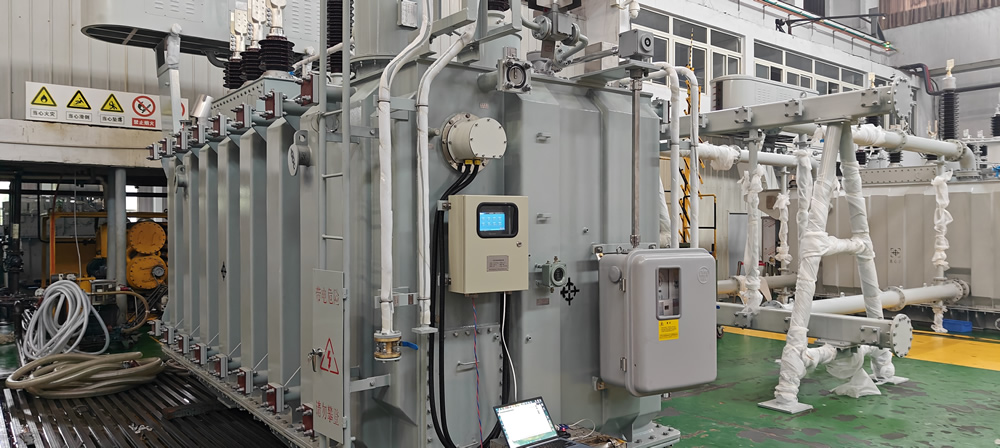
Understanding the structure is the foundation of effective health management. Failures often originate from the interaction between thermal, ไฟฟ้า, and mechanical stresses on these internal parts.
2.1. The Magnetic Core Assembly and Low-Loss Lamination
The core is constructed from high-grade, cold-rolled grain-oriented silicon steel laminations to provide a low-reluctance magnetic path. To mitigate parasitic heating, each sheet is coated with a thin insulation layer. The assembly process, involving precise stacking and clamping pressure, is critical for controlling magnetostriction-induced noise and vibration, directly impacting the mechanical integrity monitored by vibration monitoring apparatus.
2.2. The Winding Assembly and Cellulose Insulation System
The windings are copper conductors insulated with paper, forming the most heat-vulnerable component. The design (เช่น, continuous disc for high voltage, helical for low voltage) is chosen to manage short-circuit forces. The paper insulation is the life-limiting factor of the transformer, with its thermal degradation tracked by DGA and the Fluorescence Fiber Optic Sensing apparatus.
2.3. The Oil System: Conservator, Breather, และ Radiators
The conservator tank accommodates the volume expansion and contraction of the oil due to temperature changes. The breather uses silica gel to remove moisture from the air entering the conservator, which is essential to prevent moisture ingress into the insulating oil. The radiators and oil pumps constitute the cooling system, managed by the Temperature Monitoring System based on top-oil measurements.
3. Oil-Immersed Distribution Transformers: Classification and Application.
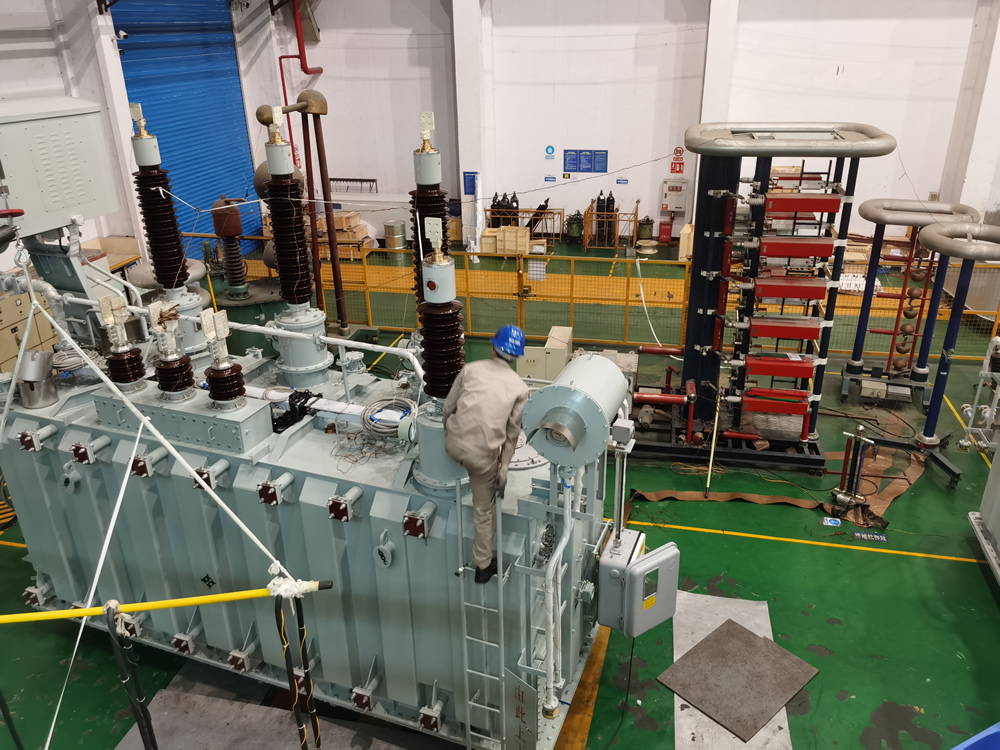
While sharing a common fundamental design, หม้อแปลงแช่น้ำมัน are classified based on their cooling and the type of insulating fluid used, each impacting their operational profile and required monitoring strategies.
3.1. Classification by Cooling Method (ไออีซี 60076)
Cooling methods dictate the transformer’s heat dissipation capacity and short-term overloading capability:
3.1.1. โอนัน (น้ำมันธรรมชาติ, อากาศธรรมชาติ)
Relies solely on natural oil circulation and air convection over the radiators. Used for small to medium-sized oil-immersed distribution transformers where initial cost and low maintenance are prioritized.
3.1.2. เปิด ปิด (น้ำมันธรรมชาติ, กองทัพอากาศ)
Adds forced air fans to the radiators to increase the cooling capacity, typically achieving a 30-40% boost in power rating. The fan operation is managed by a controller based on top oil temperature readings from the temperature monitoring apparatus.
3.1.3. อฟ / โอดาฟ (บังคับน้ำมัน, กองทัพอากาศ / Directed Flow)
Uses forced oil pumps and fans to achieve the highest cooling efficiency. Essential for very large high-voltage main transformers, often employing directed oil flow to target and cool the winding hot spots directly, making Fluorescence Fiber Optic Sensing particularly crucial.
3.2. Classification by Insulating Fluid
The fluid type determines fire safety and environmental impact, affecting installation location:
3.2.1. Mineral Oil
The traditional and most common fluid due to its excellent electrical properties and low cost. It is flammable and requires fire suppression systems, making it the dominant choice for outdoor substations.
3.2.2. Natural or Synthetic Ester Fluids
These fluids are bio-degradable and possess a high fire point, offering enhanced safety. They are increasingly used in environmentally sensitive areas or indoor installations, providing a safer alternative while retaining the benefits of oil cooling.
4. ที่ PHM Architecture: Core Modules of a Transformer Health Management System.
A sophisticated Transformer Health Management System (THMS) integrates data from multiple sensing apparatuses to provide a comprehensive state assessment. The architecture is structured into a Sensing Layer, a Communication & Processing Layer, and an Application Layer.
4.1. The Sensing Layer (การได้มาของข้อมูล)
This layer consists of all the primary sensors and transducers installed directly on the transformer. It includes the PD sensors, DGA apparatus, Fluorescence Fiber Optic sensors, and conventional gauges. Its key role is to accurately convert physical phenomena (ความร้อน, แก๊ส, การสั่นสะเทือน, electrical discharge) into reliable electrical or optical signals.
4.2. The Processing Layer (Local Intelligence & Data Filtering)
This layer, typically comprising IEDs (Intelligent Electronic Devices) or local data concentrators, performs signal conditioning, data time-stamping, and initial data filtering. Critical functions include calculating trend lines for DGA and applying spectral analysis to PD signals. This layer ensures that the massive data stream is reduced to actionable information before being transmitted to the central system.
4.3. The Application Layer (Diagnostic & Prognostic)
The central monitoring platform, located in the control room or cloud, hosts the THMS software. It applies advanced algorithms (such as Duval Triangles for DGA, and IEC/IEEE thermal models) for fault diagnosis and prognostics. This layer visualizes the transformer’s “ดัชนีสุขภาพ” and generates early warning alerts, guiding the operator’s decision-making on predictive maintenance scheduling.
5. Partial Discharge Early Warning System: Multi-Sensor Diagnosis of Insulation Defects.
การปลดปล่อยบางส่วน (พีดี) is an electrical discharge that only partially bridges the insulation between conductors. It is the most reliable precursor to catastrophic insulation failure. The PD Early Warning System uses a fusion of sensors to achieve high-sensitivity and accurate location.
5.1. Multi-Sensor Deployment Strategy
Effective PD monitoring requires a complementary approach:
5.1.1. หม้อแปลงกระแสไฟฟ้าความถี่สูง (เอชเอฟซีที)
Installed on the neutral connection or bushings, HFCT sensors capture the high-frequency current pulses generated by PD. They are effective for detecting discharges in the bushing and terminal areas.
5.1.2. ความถี่สูงพิเศษ (ยูเอชเอฟ) เซนเซอร์
UHF sensors are typically installed via oil drain valves or inspection ports. They capture the electromagnetic waves generated by PD within the oil, offering excellent sensitivity and immunity to external noise, making them ideal for monitoring high-voltage main transformers.
5.1.3. การปล่อยเสียง (เออี) เซนเซอร์
Mounted on the transformer tank walls, AE sensors detect the ultrasonic waves produced by the PD activity. By measuring the Time Difference of Arrival (ทีดีโอเอ) of the sound waves at multiple points, the system can triangulate the precise 3D location of the discharge source (เช่น, in the lower winding assembly or the core).
5.2. Diagnosis and Localization Procedure
The monitoring process involves a critical procedural sequence:
ขั้นตอน 1: Signal Capture and Filtering
The sensors continuously capture raw data, which is passed through digital filters to suppress external noise (เช่น, วิทยุ, มงกุฎ). Synchronization with the power frequency is essential to plot the PD activity on the phase cycle (PRPD pattern).
ขั้นตอน 2: PRPD Pattern Recognition
การคายประจุบางส่วนที่แก้ไขเฟสแล้ว (พีอาร์พีดี) มีการวิเคราะห์รูปแบบเพื่อจำแนกประเภทของการปล่อย (เช่น, มงกุฎ, การปลดปล่อยเป็นโมฆะ, การปล่อยพื้นผิว), ซึ่งช่วยอนุมานลักษณะทางกายภาพของข้อบกพร่อง.
ขั้นตอน 3: การกำหนดสถานที่
หากกิจกรรม PD ได้รับการยืนยัน, เซ็นเซอร์ AE’ ข้อมูล TDOA ใช้เพื่อระบุตำแหน่งทางกายภาพ. แนวโน้ม PD ที่ได้รับการยืนยันและแปลเป็นภาษาท้องถิ่นเป็นตัวกระตุ้นที่จำเป็นสำหรับการหยุดทำงานของการบำรุงรักษาเชิงคาดการณ์และการตรวจสอบภายใน.
6. การวิเคราะห์ก๊าซละลาย (ดีจีเอ) Apparatus: Real-Time Diagnostic of Internal Thermal Faults.

การวิเคราะห์ก๊าซละลาย (ดีจีเอ) เครื่องมือเป็นรากฐานสำคัญของการประเมินสถานะทางเคมีสำหรับหม้อแปลงไฟฟ้ากำลังแช่น้ำมัน. เป็นหลักฐานที่หักล้างไม่ได้เกี่ยวกับความร้อนภายใน, อาร์ซิ่ง, หรือความเครียดทางไฟฟ้ามากเกินไป.
6.1. หลักการทางเทคนิคของ เครื่องมือดีจีเอ
ระบบ DGA ออนไลน์จะสกัดตัวอย่างน้ำมันจำนวนเล็กน้อยอย่างต่อเนื่อง, แยกก๊าซที่ละลายโดยใช้เมมเบรนหรือสุญญากาศ, และวิเคราะห์ความเข้มข้นของก๊าซฟอลต์ (H2, CH4, C2H6, C2H4, C2H2, บจก, คาร์บอนไดออกไซด์) using highly sensitive techniques such as gas chromatography or photo-acoustic spectroscopy. The resulting data is automatically normalized to standard conditions for consistent trending.
6.2. Interpretation Using Diagnostic Ratios
The ratio of specific gases provides the fault signature, following established industry standards:
ขั้นตอน 1: Gas Concentration Trending
Daily or hourly generation rates are monitored. Any exponential increase in the total combustible gases (TCG) warrants an immediate alert.
ขั้นตอน 2: Duval Triangle Method
The Duval Triangle method uses the ratios of Methane, เอทิลีน, and Acetylene to definitively classify the fault into categories like low-temperature thermal (T1), high-temperature thermal (T3), or high-energy arcing (D2). This classification is crucial for directing the subsequent fault diagnosis and predictive maintenance action.
ขั้นตอน 3: Furan Analysis (Advanced Chemical Marker)
Advanced DGA systems also monitor furan compounds, which are direct by-products of cellulose paper degradation. Furan concentration serves as a reliable marker for the consumption of the paper insulation’s useful life.
7. การตรวจจับไฟเบอร์ออปติกเรืองแสง: Unrivaled Value in Winding Hot Spot Monitoring.
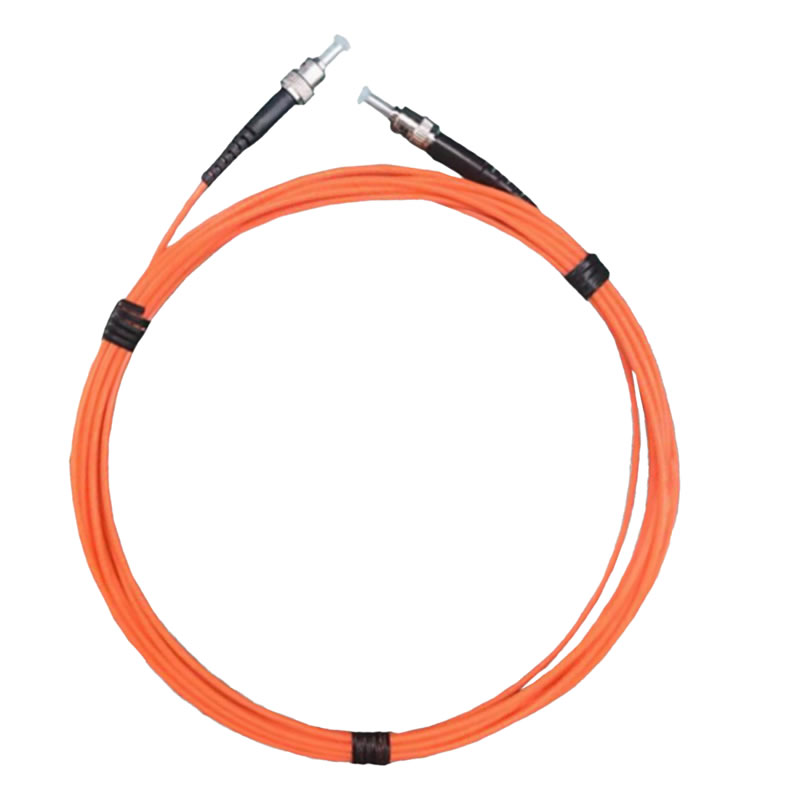
ที่ Fluorescence Fiber Optic Sensing apparatus is the ultimate solution for measuring the true winding hot spot temperature (HST), which is the direct thermal stress on the paper insulation. This apparatus is indispensable in high-voltage main transformers.
7.1. Technical Imperative: ที่ 6-Degree Aging Rule
Insulation aging follows the Arrhenius Law: for every 6°C temperature rise above the insulation’s reference temperature, the paper life expectancy is halved. Only by knowing the precise HST, which can be 10-20°C higher than the top oil, can operators accurately manage the asset’s thermal consumption and prevent premature aging.
7.2. Why Fiber Optics are Non-Negotiable in Oil-Immersed Transformers
Conventional metallic sensors (Pt100 or thermocouples) cannot be placed inside the high-voltage winding assembly because their metallic leads would compromise the oil/paper insulation structure, leading to catastrophic failure. Fluorescence Fiber Optic Sensors are entirely non-metallic and immune to the intense electromagnetic fields, allowing them to be safely embedded at the HST location during the winding process.
7.3. System Parameters and Deployment Steps
System Specification:
ช่วงอุณหภูมิ: -40องศาเซลเซียส ถึง 260 องศาเซลเซียส. ความแม่นยำ: ±1°ซ. เวลาตอบสนอง: น้อยกว่า 1 ที่สอง. ความจุช่อง: 1 ถึง 64 points per processing unit.
Step-by-Step Deployment:
1. Sensor Integration: The fiber optic probe is secured directly onto the copper conductor in the predicted hot spot location (typically the top section of the low-voltage winding). 2. Lead Routing: The fiber is carefully routed out of the winding assembly, ensuring large bend radii to prevent stress. 3. Sealing: The fiber is sealed via a custom-designed, pressure-resistant feedthrough that maintains the integrity of the oil tank seal. 4. การประมวลผลสัญญาณ: The fiber is connected to the central temperature monitoring apparatus for data acquisition and transmission to the THMS.
8. Bushing Status Assessment System: Predicting Insulation Failure via Composite Sensing.
Bushings are responsible for a significant percentage of explosive transformer failures. The Bushing Status Assessment System uses non-intrusive electrical measurement to evaluate the condition of the internal dielectric.
8.1. Measuring Capacitance and Tan Delta
The system measures the capacitance (ค1) and the Dielectric Dissipation Factor (ดังนั้นเดลต้า) of the bushing insulation. Deterioration (เช่น, ความชื้นเข้า, กิจกรรมการปล่อยบางส่วน) causes both C1 and Tan Delta to increase. By tracking these trends in real-time, the system provides a clear early warning of impending insulation breakdown, ช่วยให้สามารถทดแทนการบำรุงรักษาเชิงคาดการณ์ได้ทันเวลา.
8.2. หลักการวัดสัมพัทธ์
บ่อยครั้ง, ก “ผลรวมของกระแส” ใช้วิธีการ, โดยที่กระแสรั่วไหลจากบุชชิ่งสามเฟสจะถูกรวมเข้าด้วยกัน. การเปลี่ยนแปลงของความสมดุลบ่งชี้ถึงความผิดปกติในบุชชิ่งตัวใดตัวหนึ่ง. ระบบจะคำนวณกระแสแต่ละกระแสและมุมเฟสเพื่อให้การวินิจฉัยที่ชัดเจนและชัดเจน.
9. Vibration and Acoustic Monitoring: Assessing Winding Clamping and Core Stability.
สภาพทางกลเป็นสิ่งสำคัญสำหรับความสามารถในการทนต่อข้อผิดพลาด. ระบบตรวจสอบการสั่นสะเทือนและเสียงจะติดตามสถานะทางกายภาพของแกนกลางและขดลวด.
9.1. ลายเซ็นการสั่นสะเทือนและความหลวมของขดลวด
การสั่นสะเทือนหลักอยู่ที่ความถี่พื้นฐานเป็นสองเท่า (100เฮิรตซ์/120 เฮิรตซ์) เนื่องจากสนามแม่เหล็ก. อย่างไรก็ตาม, การเปลี่ยนแปลงของระดับการสั่นสะเทือน RMS โดยรวมหรือการเกิดขึ้นของความถี่ไซด์แบนด์บ่งบอกถึงการเสื่อมถอยทางกล. Looseness in the winding clamping structure is a major concern, as it reduces the ability of the transformer to withstand short-circuit forces, a condition diagnosed by analyzing the vibration spectrum.
9.2. การตรวจสอบเสียง และ Noise Print Analysis
High-sensitivity microphones are used to capture the acoustic signature of the unit. Abnormal sounds like sharp clicking (often associated with PD or OLTC mechanism) or excessive humming (related to core saturation/DC bias) are automatically flagged. The system maintains a historical noise print to immediately identify deviations from normal operating conditions.
10. Core and Clamp Earthing Current Monitoring: Preventing Internal Local Overheating.
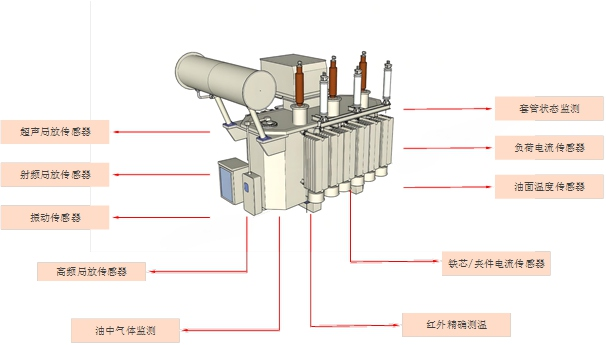
The integrity of the internal grounding system is critical for preventing stray currents that cause localized heating. The Core and Clamp Earthing Current Monitoring system utilizes highly sensitive micro-current sensors.
10.1. The Risk of Multi-Point Earthing
The transformer core is designed to be grounded at only one point. The emergence of a second grounding point (เช่น, due to an insulation breakdown between the core and the tank, or a metallic foreign object) creates a closed loop. This loop induces a circulating current, leading to localized overheating of the core steel, which can rapidly accelerate oil decomposition and insulation damage, a condition confirmed by elevated CO and CO2 in DGA data.
10.2. Micro-Current Sensor เทคโนโลยี
Highly sensitive micro-current sensors are placed on the dedicated core and clamp grounding straps. Since the normal current is near zero, any measurable steady-state AC current (typically above 100mA) triggers an immediate early warning. This is a simple yet extremely effective fault diagnosis apparatus for the internal metal structure.
11. Transformer Health Status Assessment: Common Failure Modes and Diagnostic Signatures.
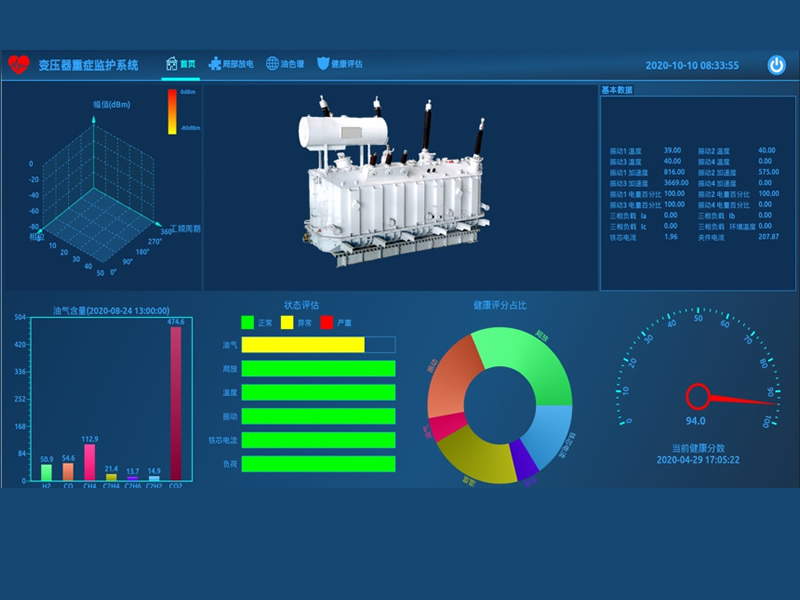
The goal of the THMS is to fuse data from all subsystems to achieve a reliable and holistic status assessment. Failure modes are categorized by their origin.
11.1. Thermal Faults and DGA Signatures
These are the most common faults, typically caused by excessive loading, การระบายความร้อนไม่ดี, or poor contacts.
Diagnosis Procedure:
1. ขั้นตอน 1 (Confirmation): Fluorescence Fiber Optic Sensing confirms actual winding temperature is excessive, or DGA shows high levels of Ethylene (C2H4) and Methane (CH4) (thermal over 700°C).
2. ขั้นตอน 2 (Root Cause): Top Oil/Bottom Oil temperature differential suggests cooling inefficiency, or the Core Earthing Current Monitor indicates localized heating from circulating currents.
11.2. Electrical Faults and Dielectric Signatures
These faults include partial discharge, อาร์ซิ่ง, and insulation breakdown.
Diagnosis Procedure:
1. ขั้นตอน 1 (การตรวจจับ): ระบบเตือนภัยล่วงหน้า PD (UHF/AE) reports sustained activity, and/or DGA shows high levels of Acetylene (C2H2) (arcing/high-energy fault).
2. ขั้นตอน 2 (ที่ตั้ง): AE sensors provide a 3D location estimate. A corresponding jump in the Bushing Status Assessment Tan Delta value points to a fault in the terminal connection area.
11.3. Mechanical Faults and Acoustic Signatures
These faults relate to structural degradation, mainly affecting short-circuit withstand capability.
Diagnosis Procedure:
1. ขั้นตอน 1 (Initial Alert): Vibration and Acoustic Monitoring reports an increase in non-fundamental frequencies or a significant deviation from the established noise baseline.
2. ขั้นตอน 2 (Confirmation): Correlating the vibration anomaly with the OLTC Status Monitor data confirms whether the issue is a tap changer mechanism fault or actual winding/core looseness. No DGA activity suggests the fault is purely mechanical.
12. Quantifiable ROI: The Business Case for การพยากรณ์โรคและการจัดการสุขภาพ (พีเอชเอ็ม).
The investment in a comprehensive PHM system for oil-immersed power transformers is justified by significant returns in asset protection and operational efficiency.
12.1. Maximizing Asset Life Expectancy และ Insulation Assessment
By continuously monitoring the HST via Fluorescence Fiber Optic Sensing, operators avoid the “6-Degree Rule” penalty, extending the life of the cellulose insulation. The PHM system generates a true Insulation Health Index, optimizing the asset’s predictive maintenance schedule and extending the time between major overhauls.
12.2. กำลังเปิดใช้งาน Safe Dynamic Rating และ การเพิ่มประสิทธิภาพการโหลด
Knowing the actual HST allows for safe dynamic loading beyond the nameplate rating when the ambient temperature is low. This feature avoids unnecessary investment in new infrastructure simply to meet peak demand, a crucial benefit for oil-immersed distribution transformers serving fluctuating urban loads.
12.3. Reducing Maintenance Costs และ Forced Outages
The ability of the PHM system to provide early warning of faults (เช่น, PD or DGA spikes) allows operators to schedule repairs during non-critical periods. This transition from costly reactive maintenance to planned, predictive maintenance drastically reduces labor costs and eliminates the enormous financial penalty associated with forced outages.
คำถามที่พบบ่อย: Oil-Immersed Transformer PHM and การบำรุงรักษาเชิงคาดการณ์.
These common questions address the technical and operational aspects of maintaining high-voltage power transformers.
Questions on หม้อแปลงแช่น้ำมัน การดำเนินการ:
ไตรมาสที่ 1. Why is the winding hot spot temperature (HST) more critical than top oil temperature?
ก: The HST is the highest temperature point in the entire transformer, typically found in the upper winding section. Since insulation aging is an exponential function of temperature, the HST is the primary determinant of the transformer’s life. Top oil temperature is a bulk measurement that can lag HST by 10°C to 20°C, making it an inadequate parameter for safe dynamic loading.
ไตรมาสที่ 2. What is the standard temperature limit for the top oil in a main power transformer?
ก: According to IEC standards, the top oil temperature is typically limited to 95°C (alarm at 85°C), while the HST limit is usually 98°C or 105°C depending on the insulation class. Exceeding these limits, even briefly, activates the “6-Degree Rule” and significantly accelerates paper degradation.
ไตรมาสที่ 3. Does the use of ester oil in an หม้อแปลงแช่น้ำมัน change the required monitoring strategy?
ก: Ester oils have a higher fire point and are environmentally friendly, but the PHM strategy remains the same. The DGA interpretation may require specialized gas coefficients, and the Fiber Optic Sensing is equally critical, as the insulation paper (the solid dielectric) is still the life-limiting component.
ไตรมาสที่ 4. How does the cooling system (ONAN vs. อฟ) affect the status assessment?
ก: OFAF systems use forced pumps and fans, meaning a failure in the Cooling System Monitoring apparatus can lead to immediate, rapid temperature excursions. The status assessment for OFAF must incorporate pump motor current and fan speed data to ensure the heat removal capability is intact.
Questions on PHM and Early Warning Systems:
คำถามที่ 5. What is the most reliable fault precursor detected by a predictive maintenance apparatus?
ก: The most critical precursors are sustained Partial Discharge (พีดี) activity and rapidly rising Acetylene (C2H2) gas levels in the DGA. Both indicate high-energy electrical breakdown that can lead to explosion, making the PD Early Warning System and DGA Apparatus indispensable.
คำถามที่ 6. How is the data from the Bushing Status Assessment System ใช้ใน พีเอชเอ็ม?
ก: The system provides a crucial time-to-failure estimate. A significant, sustained increase in Tan Delta (Dielectric Dissipation Factor) is a high-priority alarm that dictates a mandatory, scheduled outage for bushing replacement, preventing a costly and dangerous catastrophic failure.
คำถามที่ 7. Can the Vibration Monitoring System detect OLTC faults?
ก: ใช่. The Vibration Monitoring System is highly effective at diagnosing On-Load Tap Changer (โอแอลทีซี) faults. It analyzes the mechanical ‘bump’ signature during tap changes. Deviations from the baseline signature indicate mechanical issues like poor spring tension, การสึกหรอของการสัมผัส, or improper sequencing of the diverter switch.
คำถามที่ 8. Why is the Core Earthing Current only an AC current?
ก: The core should only ever experience an induced AC voltage if a second ground is present, creating an AC circulating current (Eddy Current). A significant DC current on the ground strap would indicate a separate external DC path, but the AC component is the signature of the internal multi-point earthing fault.
Questions on การตรวจจับไฟเบอร์ออปติกเรืองแสง:
คำถามที่ 9. มีข้อดีอะไรบ้าง Fluorescence Fiber Optic Sensors over Infrared (และ) กล้อง?
ก: IR cameras can only measure the external tank or terminal surface temperature, which is a poor proxy for the internal winding temperature. Fiber Optic Sensors are physically embedded inside the winding to measure the true hot spot, providing highly accurate and immediate data essential for health management. They are also immune to tank emissivity and environmental changes.
คำถามที่ 10. Is the high accuracy (±1°ซ) of the Fiber Optic System necessary for a large transformer?
ก: ใช่, the high accuracy is essential. Given the 6-Degree Aging Rule, even a 1°C measurement error can lead to a 10% ถึง 15% error in the calculated remaining life of the transformer. High precision ensures accurate status assessment and prevents the premature aging of the paper insulation.
คำถามที่ 11. สามารถ Fluorescence Fiber Optic Sensors be installed on a transformer already in service?
ก: Installation typically requires draining the oil and lifting the core/winding assembly out of the tank (a major overhaul). While possible, it is most cost-effective to specify and install Fiber Optic Sensing during the initial manufacturing phase of a new oil-immersed power transformer.
คำถามที่ 12. How many sensing channels are typically required for a High-Voltage Main Transformer?
ก: A minimum of 6 ถึง 9 channels is recommended: one for the HST of each of the three phases (HV or LV winding, depending on design), and others for the core and top/bottom oil to provide a complete thermal profile. Our temperature monitoring apparatus is capable of integrating up to 64 channels for comprehensive coverage.
ได้รับ High-Voltage Transformer Monitoring Solutions และ อุปกรณ์ตรวจจับ.
Securing the operational integrity of your oil-immersed power transformers requires more than just reactive maintenance—it demands a robust Prognostics and Health Management (พีเอชเอ็ม) strategy.
We provide full-spectrum monitoring and early warning solutions, รวมทั้ง:
- Embedded Fluorescence Fiber Optic Sensing systems for true HST measurement.
- Integrated DGA Apparatus and Partial Discharge Early Warning Systems.
- Custom PHM software platforms for holistic transformer health status assessment and predictive maintenance scheduling.
Please contact our engineering team via our website to request a detailed technical proposal, specification sheets, and a competitive quotation for your next high-voltage project.

เซ็นเซอร์อุณหภูมิไฟเบอร์ออปติก, ระบบตรวจสอบอัจฉริยะ, จำหน่ายผู้ผลิตใยแก้วนำแสงในประเทศจีน
 |
 |
 |