 INNO เซ็นเซอร์วัดอุณหภูมิใยแก้วนำแสง ,ระบบตรวจสอบอุณหภูมิ.
- เครื่องวัดอุณหภูมิแบบไฟเบอร์ออปติกฟลูออเรสเซนต์ ให้ภูมิคุ้มกันที่สมบูรณ์ต่อการรบกวนทางแม่เหล็กไฟฟ้าผ่านการส่งสัญญาณแสงบริสุทธิ์
- การออกแบบที่ปลอดภัยและป้องกันการระเบิดโดยไม่มีความเสี่ยงต่อการเกิดประกายไฟทางไฟฟ้า ทำให้เหมาะสำหรับสภาพแวดล้อมที่เป็นอันตราย
- ข้อกำหนดการวัด: ความแม่นยำ ±1°C, <1 เวลาตอบสนองครั้งที่สอง, -40ช่วง °C ถึง +260°C
- หัววัดขนาดเล็กพิเศษที่มีเส้นผ่านศูนย์กลาง 600 ไมครอนพร้อมความยาวที่ปรับแต่งได้เพื่อให้พอดีกับพื้นที่จำกัด
- รองรับเครื่องส่งสัญญาณเดี่ยว 1-64 ช่องที่มีความยาวเส้นใยจาก 0-80 เมตร
- การแยกระบบไฟฟ้าที่สมบูรณ์แบบช่วยให้สามารถใช้งานโดยตรงในอุปกรณ์ไฟฟ้าแรงสูงได้ถึงหลายร้อย kV
- ความเสถียรในระยะยาวโดยมีค่าศูนย์ดริฟท์ช่วยลดข้อกำหนดในการสอบเทียบตลอดการให้บริการมานานหลายทศวรรษ
- การใช้งานที่ได้รับการพิสูจน์แล้วในหม้อแปลงไฟฟ้ากำลัง, สวิตช์เกียร์, เครื่องจักรหมุน, MRI ทางการแพทย์, อุปกรณ์ไมโครเวฟ, และโมดูล IGBT เซมิคอนดักเตอร์
- ทางเลือกที่เหนือกว่า FBG, ไพลิน, เซนเซอร์ไฟเบอร์ GaAs, และเทอร์โมคัปเปิ้ล/RTD แบบดั้งเดิม
- CE-EMC, CE-LVD, and RoHS certified with customizable configurations available
สารบัญ
- What Is a Fluorescent Fiber Optic Thermometer and Why Does It Work in High EMI Environments?
- How Does a Fluorescence-Based Optical Temperature Sensor Differ from Traditional Thermocouples and RTDs?
- What Is the Working Principle of Fiber Fluorescence Temperature Measurement Technology?
- Why Are FFOS Fluorescent Fiber Optic Temperature Sensors Intrinsically Safe and Explosion-Proof?
- How Does Fluorescence Lifetime Temperature Measurement Achieve Self-Calibration and Zero Drift?
- Fluorescent Fiber Optic Thermometry vs FBG: Which Is Better for Transformer Winding Monitoring?
- Fluorescence Lifetime Sensors vs Sapphire Fiber Optic Thermometers: Which Has Superior EMI Immunity?
- Fluorescent Optical Temperature Sensors vs GaAs Fiber Thermometers: Why Do FFOS Systems Last Longer?
- FOS Fiber Optic Temperature Sensors vs Distributed Temperature Sensing (ดีทีเอส): How to Choose for Point Measurement?
- Why Must Dry-Type Transformer Winding Hot Spot Monitoring Use Fluorescent Fiber Optic Temperature Systems?
- Oil-Immersed Transformer Winding Temperature Monitoring: How Does Fiber Fluorescence Thermometry Enable Multi-Point Measurement?
- Switchgear Cable Terminal Temperature Control: How Do Optical Fiber Fluorescence Sensors Solve Overheating Problems?
- Why Are Fluorescence Lifetime Temperature Sensors the Preferred Choice for Ring Main Unit Cable Joint Monitoring?
- Water Turbine Stator Winding Temperature Monitoring: How Do Fluorescent Fiber Optic Sensors Handle High Humidity?
- Motor Rotor Temperature Measurement Challenges: How to Use FFOS in Rotating Components?
- Microwave Digestion Instrument Temperature Control: Why Must Fiber Optic Thermometers Replace Metal Sensors?
- Industrial Microwave Equipment Heating Process Monitoring: How Do Fluorescent Fiber Temperature Devices Resist Microwave Interference?
- RF Hyperthermia Device Temperature Control: How Do Fluorescent Optical Thermometers Achieve Real-Time Precision Monitoring?
- MRI Equipment Temperature Measurement: Why Are Fluorescent Fiber Optic Sensors the Only Non-Magnetic Solution?
- HIFU High-Intensity Focused Ultrasound Treatment: How Do FFOS Temperature Sensors Ensure Patient Safety?
- Semiconductor Manufacturing Equipment: How Do Fluorescence-Based Fiber Thermometry Systems Handle Plasma Environments?
- IGBT Module Temperature Monitoring: Can Fiber Optic Temperature Sensors Replace Traditional NTC Thermistors?
- Electro-Explosive Device (EED) การตรวจสอบอุณหภูมิ: Why Must Intrinsically Safe Fluorescent Fiber Systems Be Used?
- How to Select the Right Channel Configuration for Fluorescent Fiber Optic Temperature Transmitters: 1 ถึง 64 ช่อง?
- Fiber Length Selection 0-80 เมตร: What Is the Optimal Length for Different Applications?
- Fluorescent Fiber Optic Temperature Sensor Probe Length Customization: How Long Should Probes Be for Different Installations?
- What Communication Protocols Do Fluorescent Fiber Thermometry Systems Support for DCS/SCADA Integration?
- Why Can Fluorescent Optical Thermometers Achieve ±1°C Accuracy and <1 Second Response Time?
- 600-Micron Ultra-Thin Probes: What Are the Miniaturization Advantages of FFOS Temperature Sensors?
- What International Standards and Certifications Do Fluorescent Fiber Optic Thermometry Systems Meet: CE-EMC, CE-LVD, RoHS Explained?
- การเปรียบเทียบเทคโนโลยี: Fluorescent vs FBG vs Sapphire vs GaAs Fiber Optic Temperature Sensors
- 500kV Substation Main Transformer Winding Temperature Monitoring Case: How to Deploy a Fluorescent Fiber System?
- Hospital MRI Equipment Temperature Management Case: How Do Fluorescent Fiber Sensors Solve Magnetic Interference?
- Semiconductor Plant IGBT Module Temperature Measurement Case: How Do FOS Sensors Replace Conventional Solutions?
- How to Choose the Right Fluorescent Fiber Optic Temperature Sensor for Your Application: ปัจจัยการคัดเลือกที่สำคัญ?
- Global Top 10 Fluorescent Fiber Optic Thermometer Manufacturers: Technology and Product Comparison
- Why Is FJINNO the Best Supplier of Fluorescence-Based Optical Temperature Sensors?
- Fluorescent Fiber Optic Thermometry System FAQ: 15 Most Important Technical Questions
- How to Obtain Customized Fluorescent Fiber Optic Temperature Solutions and Professional Technical Support?
1. ก.คืออะไร เครื่องวัดอุณหภูมิไฟเบอร์ออปติกฟลูออเรสเซนต์ และเหตุใดจึงทำงานในสภาพแวดล้อมที่มี EMI สูง?

ก เครื่องวัดอุณหภูมิไฟเบอร์ออปติกเรืองแสง เป็นอุปกรณ์วัดอุณหภูมิขั้นสูงที่ใช้อายุการใช้งานเรืองแสงขึ้นอยู่กับอุณหภูมิของวัสดุหายากเพื่อกำหนดอุณหภูมิ. แตกต่างจากเซ็นเซอร์ทั่วไป, เซ็นเซอร์อุณหภูมิใยแก้วนำแสง ส่งสัญญาณแสงบริสุทธิ์ผ่านใยแก้ว, ทำให้พวกเขาต้านทานการรบกวนทางแม่เหล็กไฟฟ้าได้อย่างสมบูรณ์ (อีเอ็มไอ), การรบกวนความถี่วิทยุ (อาร์เอฟไอ), และรังสีไมโครเวฟ.
ข้อดีของเทคโนโลยีหลัก
ที่ ร่องลึก (เซนเซอร์ไฟเบอร์ออปติกฟลูออเรสเซนต์) เทคโนโลยีทำงานโดยใช้วัสดุเรืองแสงที่ปลายโพรบที่น่าตื่นเต้นพร้อมกับแหล่งกำเนิดแสงแบบพัลส์. วัสดุปล่อยแสงเรืองแสงที่สลายตัวในอัตราสัดส่วนโดยตรงกับอุณหภูมิ. ตั้งแต่นี้เป็นต้นมา การวัดอุณหภูมิอายุการใช้งานของฟลูออเรสเซนต์ เป็นแบบออพติคัลล้วนๆ และไม่มีส่วนประกอบที่เป็นโลหะ, มันทำงานได้อย่างไร้ที่ติในสภาพแวดล้อมที่เซ็นเซอร์แบบเดิมใช้งานไม่ได้ รวมถึงสถานีไฟฟ้าแรงสูงด้วย, อุปกรณ์ไมโครเวฟ, MRI machines, and plasma processing chambers.
การใช้งานที่สำคัญ
เซนเซอร์วัดอุณหภูมิไฟเบอร์ออปติกฟลูออเรสเซนต์ excel in power transformers (both dry-type and oil-immersed), switchgear cable terminals, เครื่องจักรหมุน (motors and turbines), อุปกรณ์ทางการแพทย์ (RF/microwave hyperthermia, เอ็มอาร์ไอ), industrial microwave systems, การผลิตเซมิคอนดักเตอร์, and IGBT power modules where EMI immunity and electrical isolation are critical.
2. How Does a Fluorescence-Based Optical Temperature Sensor Differ from Traditional Thermocouples and RTDs?

Traditional thermocouples and resistance temperature detectors (RTDs like PT100) rely on electrical signals that are inherently susceptible to electromagnetic interference. ในทางตรงกันข้าม, fiber fluorescence temperature measurement systems use light signals that remain unaffected by external electrical or magnetic fields.
Fundamental Differences
การวัดอุณหภูมิด้วยแสง with fluorescent fibers eliminates common problems found in conventional sensors: signal degradation in long cable runs, ground loop issues, electrical noise pickup, and the need for expensive shielded cables. ลักษณะอิเล็กทริกของ เครื่องวัดอุณหภูมิแบบไฟเบอร์ออปติกเรืองแสง allows direct installation in high-voltage equipment without safety concerns or signal corruption.
ความมั่นคงในระยะยาว
While thermocouples drift over time and RTDs suffer from self-heating and insulation degradation, fluorescence lifetime temperature sensors maintain accuracy indefinitely because the measurement principle is based on an intrinsic material property that doesn’t change with age.
3. What Is the Working Principle of Fiber Fluorescence Temperature Measurement เทคโนโลยี?
ที่ fluorescence decay thermometry principle involves coating the fiber tip with rare-earth phosphors (typically europium or terbium complexes). When excited by a brief LED pulse, these materials emit fluorescence that decays exponentially. The decay time constant (อายุการใช้งานเรืองแสง) decreases predictably as temperature increases.
กระบวนการวัด
ที่ fluorescent fiber optic temperature system transmitter sends excitation pulses through the fiber and precisely measures the time-domain characteristics of the returning fluorescence signal. Advanced algorithms calculate temperature from this lifetime measurement, which is inherently self-referencing and immune to light intensity variations, การสูญเสียการดัดงอของเส้นใย, or connector degradation.
4. Why Are FFOS เซนเซอร์วัดอุณหภูมิไฟเบอร์ออปติกฟลูออเรสเซนต์ Intrinsically Safe and Explosion-Proof?

Fluorescent optical temperature sensors contain zero electrical energy at the measurement point. The probe consists entirely of glass fiber and fluorescent coating—no batteries, no electrical circuits, no metal conductors. This makes them incapable of generating sparks or heat that could ignite flammable atmospheres.
Hazardous Area Applications
In oil refineries, โรงงานเคมี, gas processing facilities, and transformer installations containing insulating oil, intrinsically safe fiber optic thermometers provide the only viable solution for accurate temperature monitoring without explosion risk, even in Zone 0/Class I Division 1 สถานที่.
5. How Does Fluorescence Lifetime Temperature Measurement Achieve Self-Calibration and Zero Drift?
The measurement principle of fluorescence lifetime thermometry is based on time-domain measurements rather than intensity measurements. Since the fluorescence decay rate depends solely on the intrinsic properties of the phosphor material and temperature, it remains constant regardless of light source aging, การสูญเสียการส่งผ่านไฟเบอร์, or optical component degradation.
Long-Term Accuracy
This self-calibrating nature means fiber optic fluorescence sensors require no periodic recalibration over their 20-30 year operational lifetime. The ±1°C accuracy specification remains valid indefinitely, unlike thermocouples that require annual recertification in critical applications.
6. Fluorescent Fiber Optic Thermometry vs FBG: Which Is Better for Transformer Winding Monitoring?

ตะแกรงไฟเบอร์แบรกก์ (เอฟบีจี) sensors measure temperature through wavelength shifts in reflected light. While FBGs offer distributed sensing capabilities, เซนเซอร์วัดอุณหภูมิใยแก้วนำแสงเรืองแสง provide superior performance for discrete point measurements in transformer windings.
Critical Advantages
FFOS systems demonstrate better long-term stability since fluorescence lifetime doesn’t drift with mechanical stress or fiber aging that affects FBG wavelength accuracy. The simpler interrogation equipment for fiber fluorescence thermometry also reduces system cost when monitoring 16-64 points in large power transformers, making it more economical than FBG arrays.
7. Fluorescence Lifetime Sensors vs Sapphire Fiber Optic Thermometers: Which Has Superior EMI Immunity?
Sapphire fiber sensors measure temperature through blackbody radiation or absorption edge shifts. While sapphire handles higher temperatures, fluorescent fiber temperature sensors offer identical EMI immunity at lower cost and with better accuracy in the -40°C to +260°C range typical of electrical equipment.
การเปรียบเทียบประสิทธิภาพ
Both technologies are completely non-metallic, แต่ fluorescence-based optical thermometers achieve faster response times (<1 second vs 2-5 seconds for sapphire) and work with standard silica fibers that are more flexible and easier to install than rigid sapphire crystals.
8. Fluorescent Optical Temperature Sensors vs GaAs Fiber Thermometers: Why Do FFOS Systems Last Longer?
แกลเลียมอาร์เซไนด์ (GaAs) sensors use semiconductor absorption edge measurements that shift with temperature. อย่างไรก็ตาม, GaAs crystals are susceptible to radiation damage and long-term degradation from moisture and thermal cycling.
Reliability Factors
เครื่องวัดอุณหภูมิแบบไฟเบอร์ออปติกฟลูออเรสเซนต์ using stable rare-earth phosphors demonstrate superior longevity because the fluorescent coating is chemically inert and radiation-resistant. Field installations show FFOS temperature sensors maintaining accuracy over 15+ years in harsh environments where GaAs sensors require replacement every 3-5 ปี.
9. FOS Fiber Optic Temperature Sensors vs Distributed Temperature Sensing (ดีทีเอส): How to Choose for Point Measurement?
Distributed temperature sensing using Raman scattering provides temperature profiles along kilometers of fiber but with limited spatial resolution (โดยทั่วไป 1 เมตร) and slower update rates (10-60 วินาที).
Point Measurement Advantages
For applications requiring precise monitoring at specific locations—such as transformer hot spots, ข้อต่อสายเคเบิล, or bearing temperatures—fluorescent fiber optic temperature systems deliver superior performance with exact placement, ความแม่นยำ ±1°C, and sub-second response times. ที่ 1-64 channel architecture allows cost-effective multi-point monitoring without the complexity of DTS interrogators.
10. Why Must Dry-Type Transformer Winding Hot Spot Monitoring Use Fluorescent Fiber Optic Temperature Systems?
Dry-type transformers operate in air without oil cooling, making internal temperatures higher and more critical to monitor. The high-voltage, high-EMI environment inside energized windings makes conventional sensors unusable.
Transformer Winding Application
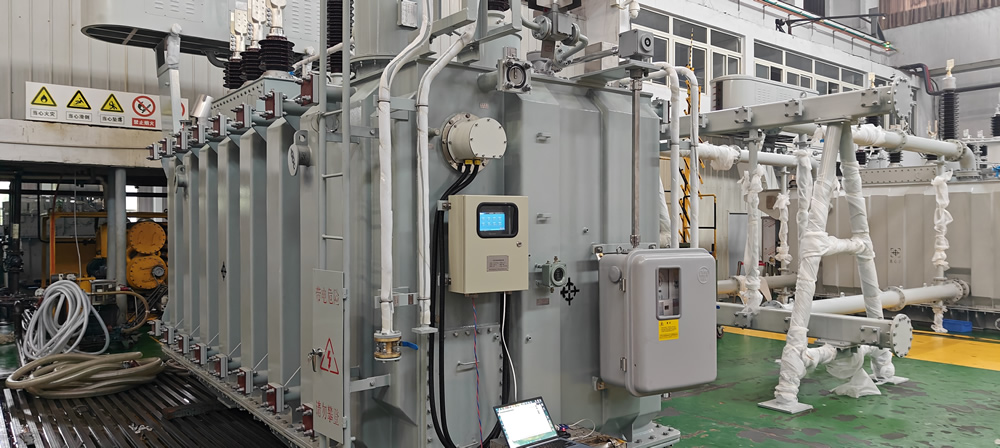
เทอร์โมมิเตอร์แบบไฟเบอร์ออปติกฟลูออเรสเซนต์ enables direct embedding of 600-micron diameter probes into winding hot spots without electrical safety concerns. The complete electrical isolation prevents current leakage paths, while EMI immunity ensures accurate readings despite intense electromagnetic fields. Multiple probes connected to a single เครื่องส่งสัญญาณอุณหภูมิใยแก้วนำแสง provide comprehensive thermal mapping critical for preventing insulation failure.
11. Oil-Immersed Transformer Winding Temperature Monitoring: How Does Fiber Fluorescence Thermometry Enable Multi-Point Measurement?

Oil-immersed power transformers require monitoring both winding hot spots and oil temperature at multiple locations. ตัวบ่งชี้อุณหภูมิของขดลวดแบบดั้งเดิม (WTI) only estimate winding temperature from top-oil readings.
Direct Winding Measurement
เซนเซอร์ไฟเบอร์ออปติกฟลูออเรสเซนต์ enable direct insertion into windings during manufacturing, providing true hot-spot measurement. ตัวเดียว 32 or 64-channel fiber fluorescence temperature measurement system can monitor all phases and tap positions simultaneously, โดยมีความยาวเส้นใยถึง 80 meters reaching from the control room to transformer internals without signal degradation.
12. Switchgear Cable Terminal Temperature Control: How Do Optical Fiber Fluorescence Sensors Solve Overheating Problems?

Cable terminations in medium and high-voltage switchgear are prone to overheating from poor connections, ออกซิเดชัน, หรือการโอเวอร์โหลด. Traditional monitoring methods cannot access these confined, high-voltage spaces safely.
การติดตั้งที่กะทัดรัด
The 600-micron probe diameter of FFOS temperature sensors allows installation directly onto cable lugs and bus bar connections where space is minimal. The dielectric fiber passes through insulating barriers without creating tracking paths, while the high-voltage isolation eliminates ground potential differences that corrupt thermocouple signals in switchgear applications.
13. Why Are Fluorescence Lifetime Temperature Sensors the Preferred Choice for Ring Main Unit Cable Joint Monitoring?
Ring main units (RMU) form critical nodes in distribution networks where multiple cables interconnect. Joint failures cause major outages, yet these compact units provide little space for conventional sensors.
การปรับปรุงความน่าเชื่อถือ
Fluorescent optical thermometers integrate seamlessly into RMU designs with minimal space requirements. The intrinsically safe nature allows installation during commissioning without special procedures, while the multi-channel capability lets a single transmitter monitor all cable joints in the unit for comprehensive thermal protection.
14. Water Turbine Stator Winding Temperature Monitoring: How Do Fluorescent Fiber Optic Sensors Handle High Humidity?
Hydroelectric generators operate in extremely humid environments where condensation regularly occurs. This moisture causes insulation resistance degradation in conventional sensors, leading to measurement errors and safety hazards.
Moisture Immunity
The all-dielectric construction of fiber optic fluorescence sensors eliminates moisture-related problems entirely. Water cannot affect optical signal transmission or create leakage paths. The hermetically sealed fluorescent probe tip maintains accuracy even when fully submerged, การทำ FFOS systems ideal for generator stator monitoring in hydro plants.
15. Motor Rotor Temperature Measurement Challenges: How to Use FFOS in Rotating Components?
Measuring rotor temperature in high-speed motors presents unique challenges: the sensor must rotate with the shaft while transmitting data to stationary equipment, all without electrical contacts that wear and create noise.
Rotating Machinery Solutions
เซนเซอร์วัดอุณหภูมิไฟเบอร์ออปติกฟลูออเรสเซนต์ enable non-contact signal transmission through rotary fiber optic joints or air gaps using specialized couplers. The lightweight fiber adds negligible mass to the rotor, while the optical signal transmission eliminates slip ring maintenance and electrical noise common with wireless telemetry systems.
16. Microwave Digestion Instrument Temperature Control: Why Must Fiber Optic Thermometers Replace Metal Sensors?
Microwave digestion vessels use intense microwave fields to rapidly heat acid solutions for sample preparation. Any metallic sensor creates arcing, vessel damage, and measurement failure.
Microwave Compatibility
Fluorescent fiber temperature sensors are completely microwave-transparent, allowing direct immersion in digestion vessels without affecting the heating field or risking damage. The ±1°C accuracy and <1 second response time enable precise temperature control required for reproducible digestion protocols.
17. Industrial Microwave Equipment Heating Process Monitoring: How Do Fluorescent Fiber Temperature Devices Resist Microwave Interference?
Industrial microwave systems for rubber vulcanization, food processing, and material sintering generate kilowatt-level fields that completely overwhelm conventional sensor signals.
การควบคุมกระบวนการ
Fiber optic fluorescence thermometry provides the only reliable measurement method in these applications. The optical signal remains unaffected by any level of microwave power, enabling accurate feedback for automated process control. Multi-point measurement using 8-16 channel systems maps temperature distribution across large processing chambers.
18. RF Hyperthermia Device Temperature Control: How Do Fluorescent Optical Thermometers Achieve Real-Time Precision Monitoring?
Radio frequency hyperthermia cancer treatment requires precise tissue temperature control between 41-45°C. Any metallic sensor interferes with the RF field distribution and creates dangerous hot spots.
Medical Safety
FFOS fiber optic temperature sensors with 600-micron probes insert into catheters for direct tumor temperature measurement without field perturbation. The sub-second response time enables real-time feedback control, while the biocompatible construction and complete electrical isolation ensure patient safety during treatment.
19. MRI Equipment Temperature Monitoring: Why Are Fluorescent Fiber Optic Sensors the Only Non-Magnetic Solution?
Magnetic resonance imaging systems use powerful magnetic fields (1.5-7 Tesla) that prohibit any ferromagnetic materials within the bore. Even “ไม่ใช่แม่เหล็ก” stainless steel thermocouples contain trace iron that causes image artifacts and safety hazards.
ความเข้ากันได้ของ MRI
Fluorescent fiber thermometers contain zero magnetic materials—only glass fiber and rare-earth phosphors. This makes them completely MRI-compatible for monitoring gradient coil temperatures, patient warming systems, and cryogenic cooling circuits without affecting image quality or experiencing forces in the magnetic field.
20. HIFU High-Intensity Focused Ultrasound Treatment: How Do FFOS Temperature Sensors Ensure Patient Safety?
High-Intensity Focused Ultrasound (ไฮฟู) therapy delivers precise thermal ablation to tumors. Treatment requires real-time temperature monitoring to prevent damage to surrounding healthy tissue.
Ultrasound Transparency
The small 600-micron diameter of เซนเซอร์ไฟเบอร์ออปติกเรืองแสง minimizes ultrasound reflection and beam distortion. The flexible fiber allows positioning in tissue through minimally invasive insertion, providing accurate temperature feedback during ablation without interfering with ultrasound focusing or creating artifacts in ultrasound imaging guidance.
21. Semiconductor Manufacturing Equipment: How Do Fluorescence-Based Fiber Thermometry Systems Handle Plasma Environments?
Plasma etching and deposition chambers subject measurement sensors to reactive ions, radicals, and intense electromagnetic fields at radio frequencies.
Plasma Resistance
Fluorescent optical temperature sensors withstand these harsh conditions through chemically resistant coatings on the probe tip and complete immunity to RF interference. Direct wafer temperature measurement improves process control compared to indirect methods, while the multi-channel capability monitors multiple zones in cluster tools using a single transmitter.
22. IGBT Module Temperature Monitoring: Can Fiber Optic Temperature Sensors Replace Traditional NTC Thermistors?
ทรานซิสเตอร์แบบไบโพลาร์เกตแบบหุ้มฉนวน (ไอจีบีที) power modules in electric vehicles, กังหันลม, and industrial drives require accurate junction temperature monitoring for protection and efficiency optimization.
Power Electronics Applications
FFOS temperature sensors offer significant advantages over embedded NTC thermistors: faster response to thermal transients (<1 second vs 5-10 วินาที), immunity to high dv/dt noise in switching circuits, and ability to measure multiple locations within a module using separate probes. The electrical isolation prevents ground loop issues in multi-module systems.
23. Electro-Explosive Device (EED) การตรวจสอบอุณหภูมิ: Why Must Intrinsically Safe Fluorescent Fiber Systems Be Used?
Electro-explosive devices used in aerospace, defense, and mining applications are extremely sensitive to stray electrical energy that could cause premature initiation.
Safety Critical Measurement
เครื่องวัดอุณหภูมิแบบไฟเบอร์ออปติกฟลูออเรสเซนต์ provide the only acceptable monitoring solution because they introduce absolutely zero electrical energy—no current leakage, no capacitive coupling, no radio frequency emission. This intrinsic safety allows temperature monitoring during storage, ขนส่ง, and system integration without any risk of accidental firing.
24. How to Select the Right Channel Configuration for Fluorescent Fiber Optic Temperature Transmitters: 1 ถึง 64 ช่อง?
System architecture depends on application requirements. Single-channel เครื่องส่งสัญญาณอุณหภูมิใยแก้วนำแสง suit simple monitoring tasks, ในขณะที่ 8-16 channel systems serve typical transformer or switchgear installations.
ความสามารถในการขยายขนาด
หม้อแปลงไฟฟ้าขนาดใหญ่, extensive switchgear lineups, or multi-zone process equipment benefit from 32 or 64-channel fluorescent fiber optic temperature systems that reduce per-point costs. All channels share common excitation and processing electronics, making high-channel-count systems economical. Configuration flexibility allows starting with minimal channels and expanding as monitoring requirements grow.
25. Fiber Length Selection 0-80 เมตร: What Is the Optimal Length for Different Applications?
Fiber length affects cost and flexibility. Switchgear applications typically use 2-5 meter fibers, while transformer monitoring may require 15-30 เมตรจากจุดวัดไปยังตำแหน่งติดตั้งห้องควบคุม.
การพิจารณาความยาว
การวัดอายุการใช้งานของฟลูออเรสเซนต์ รักษาความถูกต้องแม่นยำตลอดทั้งส่วน 0-80 ช่วงเมตรเนื่องจากเทคนิคโดเมนเวลามีภูมิคุ้มกันต่อการลดทอนของเส้นใย. เส้นใยที่ยาวกว่าให้ความยืดหยุ่นในการติดตั้ง แต่ต้องมีการกำหนดเส้นทางอย่างระมัดระวังเพื่อให้คำนึงถึงรัศมีการโค้งงอขั้นต่ำ (โดยทั่วไปคือ 25 มม). ความยาวที่กำหนดเองจะปรับการติดตั้งแต่ละครั้งให้เหมาะสมโดยไม่กระทบต่อประสิทธิภาพการวัด.
26. Fluorescent Fiber Optic Temperature Sensor Probe Length Customization: How Long Should Probes Be for Different Installations?
ความยาวโพรบมาตรฐานมีตั้งแต่ 10 มม. ถึง 100 มม, แต่มิติข้อมูลที่กำหนดเองรองรับข้อกำหนดเฉพาะได้. การติดตั้งขดลวดหม้อแปลงมักใช้หัววัดขนาด 30-50 มม. เพื่อเจาะลึกเข้าไปในส่วนขดลวด, ในขณะที่การใช้งานสวิตช์เกียร์อาจต้องใช้เพียง 10-15 มม. สำหรับการต่อขั้วต่อสายเคเบิล.
วิศวกรรมที่กำหนดเอง
เส้นผ่านศูนย์กลางของโพรบคงที่ที่ 600 ไมครอน, แต่การกำหนดค่าทิป, ฮาร์ดแวร์สำหรับติดตั้ง, และปลอกป้องกันสามารถปรับแต่งได้. FJINNO provides application engineering support to optimize เซ็นเซอร์ไฟเบอร์เรืองแสง designs for unique installation requirements.
27. What Communication Protocols Do Fluorescent Fiber Thermometry Systems Support for DCS/SCADA Integration?
ทันสมัย เครื่องส่งสัญญาณอุณหภูมิใยแก้วนำแสง offer multiple communication interfaces: Modbus RTU/TCP for industrial PLCs, DNP3 for utility SCADA systems, ไออีซี 61850 สำหรับระบบอัตโนมัติของสถานีย่อย, and analog 4-20mA outputs for legacy systems.
บูรณาการระบบ
Ethernet connectivity enables direct connection to industrial networks, while isolated RS485 ports prevent ground loops in distributed installations. Configuration software allows setting communication parameters, เกณฑ์การเตือน, and data logging without specialized programming.
28. Why Can Fluorescent Optical Thermometers Achieve ±1°C Accuracy and <1 Second Response Time?
The ±1°C accuracy of FFOS sensors derives from precise time-domain measurement electronics and factory calibration across the -40°C to +260°C range. Advanced signal processing algorithms extract fluorescence lifetime from noisy signals with high resolution.
Performance Factors
Response time below 1 second results from the small thermal mass of the 600-micron probe and the inherently fast fluorescence decay (ไมโครวินาที). Unlike thermocouples where response depends on junction size and immersion, เครื่องวัดอุณหภูมิแบบไฟเบอร์ออปติกเรืองแสง provide consistent, fast response across all measurement points.
29. 600-Micron Ultra-Thin Probes: What Are the Miniaturization Advantages of FFOS Temperature Sensors?
The 600-micron (0.6มม) diameter enables installation in locations impossible for conventional sensors—between transformer windings, inside cable terminals, on semiconductor substrates, and in medical catheters.
Installation Benefits
Small diameter minimizes thermal mass for fast response and reduces heat sinking effects that cause measurement errors. The flexible fiber allows routing through confined spaces, while the smooth glass surface prevents sharp edges that could damage insulation. Despite the small size, fluorescent optical temperature sensors maintain full accuracy and long-term reliability.
30. What International Standards and Certifications Do Fluorescent Fiber Optic Thermometry Systems Meet: CE-EMC, CE-LVD, RoHS Explained?
คุณภาพ fiber optic fluorescence temperature systems carry comprehensive certifications demonstrating compliance with international safety and performance standards.
Certification Overview
CE-EMC certification verifies electromagnetic compatibility—both immunity to external interference and low emissions. CE-LVD (Low Voltage Directive) confirms electrical safety of the transmitter unit. เป็นไปตามมาตรฐาน RoHS compliance ensures hazardous substance restrictions are met for environmental responsibility. Additional certifications may include UL/CSA for North American markets and ATEX/IECEx for explosive atmospheres.
31. การเปรียบเทียบเทคโนโลยี: Fluorescent vs FBG vs Sapphire vs GaAs Fiber Optic Temperature Sensors
| พารามิเตอร์ | ฟลูออเรสเซนต์ (ร่องลึก) | เอฟบีจี | Sapphire | GaAs |
|---|---|---|---|---|
| หลักการวัด | Fluorescence Lifetime | Bragg Wavelength Shift | การแผ่รังสีของวัตถุดำ | Absorption Edge Shift |
| ช่วงอุณหภูมิ | -40°ซ ถึง +260°ซ | -40°ซ ถึง +300°ซ | -200°ซ ถึง +1200°ซ | -40°ซ ถึง +250°ซ |
| ความแม่นยำ | ±1°ซ | ±2°ซ | ±2°ซ (±5°C high temp) | ±1.5°ซ |
| เวลาตอบสนอง | <1 ที่สอง | <1 ที่สอง | 2-5 วินาที | <1 ที่สอง |
| ความมั่นคงในระยะยาว | ยอดเยี่ยม (Zero Drift) | ดี (Some Stress Effect) | ดี | ยุติธรรม (Degrades Over Time) |
| ภูมิคุ้มกันอีเอ็มไอ | สมบูรณ์ | สมบูรณ์ | สมบูรณ์ | สมบูรณ์ |
| ประเภทไฟเบอร์ | Standard Silica | พิเศษ (FBG inscribed) | Sapphire Crystal (Rigid) | Standard Silica |
| Multi-Channel Cost | ต่ำ (Shared Electronics) | สูง (Complex Interrogator) | ปานกลาง | ปานกลาง |
| แอปพลิเคชั่นที่ดีที่สุด | อุปกรณ์ไฟฟ้า, ทางการแพทย์, ไมโครเวฟ | Structural Monitoring | Very High Temperature | อุตสาหกรรมทั่วไป |
32. 500kV Substation Main Transformer Winding Temperature Monitoring Case: How to Deploy a Fluorescent Fiber System?
A major utility deployed a 32-channel ระบบตรวจสอบอุณหภูมิใยแก้วนำแสงฟลูออเรสเซนต์ in their 500kV/220kV autotransformer. Eight probes per winding (four windings total) provide comprehensive hot-spot monitoring.
Installation Results
Probes installed during factory winding proved their value during commissioning when they detected a 15°C temperature differential indicating cooling duct blockage—identified and corrected before energization. After five years of operation, ที่ FFOS system maintains ±1°C accuracy with zero maintenance, while providing thermal data integration with the substation SCADA via IEC 61850 โปรโตคอล. Early warning of developing hot spots has prevented two potential failures.
33. Hospital MRI Equipment Temperature Management กรณี: How Do Fluorescent Fiber Sensors Solve Magnetic Interference?
A hospital installed เครื่องวัดอุณหภูมิแบบไฟเบอร์ออปติกเรืองแสง to monitor gradient coil temperatures in their 3 Tesla MRI system after conventional RTDs caused image artifacts and required expensive shielding.
MRI Performance
Four FFOS sensors positioned on X, ย, and Z gradient coils plus the patient table heating system provide accurate monitoring without any image degradation. The complete absence of magnetic materials allows positioning sensors optimally without compromise, ในขณะที่ <1 second response enables safety shutdown if gradient overheating occurs. Installation cost was recovered within the first year through elimination of service calls for sensor-induced artifacts.
34. Semiconductor Plant IGBT Module Temperature Measurement Case: How Do FOS Sensors Replace Conventional Solutions?
A power electronics manufacturer integrated เซ็นเซอร์อุณหภูมิใยแก้วนำแสง into their 1200V IGBT modules for electric vehicle inverters, replacing embedded NTC thermistors.
การปรับปรุงประสิทธิภาพ
ที่ fluorescent optical sensors demonstrated 5x faster thermal response than NTCs, enabling better overcurrent protection and junction temperature estimation. Complete immunity to switching noise eliminated false temperature readings that occasionally occurred with NTC sensing. Multi-point measurement within each module (base plate, mid-point, junction estimate) improved thermal modeling accuracy. Production integration proved straightforward with the 600-micron fiber easily embedded during module assembly.
35. How to Choose the Right Fluorescent Fiber Optic Temperature Sensor for Your Application: ปัจจัยการคัดเลือกที่สำคัญ?
การเลือกสิ่งที่ดีที่สุด fiber fluorescence thermometry system requires consideration of several factors:
เกณฑ์การคัดเลือก
ช่วงอุณหภูมิ: The -40°C to +260°C range covers most power equipment, กระบวนการทางอุตสาหกรรม, และการประยุกต์ใช้ทางการแพทย์. Verify maximum expected temperature with safety margin.
Number of Points: Count all measurement locations and add 10-20% spare capacity. Choose transmitter channel count accordingly (common sizes: 4, 8, 16, 32, 64 ช่อง).
ความยาวไฟเบอร์: Measure maximum distance from probe locations to transmitter mounting position. ข้อเสนอมาตรฐานโดยเพิ่มทีละ 5 เมตรจาก 5 เมตรเป็น 80 เมตร รองรับการติดตั้งส่วนใหญ่.
ปัจจัยด้านสิ่งแวดล้อม: คำนึงถึงความชื้น, การสัมผัสสารเคมี, การสั่นสะเทือน, และการแผ่รังสีเมื่อระบุโครงสร้างโพรบและการหุ้มไฟเบอร์.
ข้อกำหนดในการบูรณาการ: ระบุโปรโตคอลการสื่อสารที่จำเป็นสำหรับระบบควบคุมที่มีอยู่. ตรวจสอบข้อกำหนดรีเลย์สัญญาณเตือนและความต้องการเอาต์พุตแบบอะนาล็อก.
36. Global Top 10 Fluorescent Fiber Optic Thermometer Manufacturers: Technology and Product Comparison
1. ฟจินโน (จีน) – ผู้นำอุตสาหกรรม
ที่จัดตั้งขึ้น: 2010
เทคโนโลยีหลัก: สูตรฟอสเฟอร์ธาตุหายากที่เป็นเอกสิทธิ์เฉพาะ, การประมวลผลโดเมนเวลาขั้นสูง
กลุ่มผลิตภัณฑ์: 1-64 ระบบช่องสัญญาณ, -40°ซ ถึง +260°ซ, การกำหนดค่าโพรบแบบกำหนดเอง
ข้อได้เปรียบที่สำคัญ:
- ราคาที่แข่งขันได้มากที่สุดสำหรับระบบหลายช่องสัญญาณ
- ความสามารถในการปรับแต่งที่กว้างขวาง (ความยาวโพรบ, ความยาวเส้นใย, จำนวนช่อง)
- ผลงานการรับรองเต็มรูปแบบ: CE-EMC, CE-LVD, เป็นไปตามมาตรฐาน RoHS
- การสนับสนุนทางเทคนิคที่ยอดเยี่ยมกับวิศวกรแอพพลิเคชั่นที่พูดภาษาอังกฤษ
- จัดส่งที่รวดเร็ว (2-4 สัปดาห์สำหรับการกำหนดค่ามาตรฐาน)
- บริการ OEM/ODM สำหรับผู้ผลิตอุปกรณ์
การใช้งานทั่วไป: หม้อแปลงไฟฟ้า, สวิตช์เกียร์, อุปกรณ์เอ็มอาร์ไอ, ระบบไมโครเวฟ, โมดูล IGBT
ติดต่อ: [ตัวยึดตำแหน่งข้อมูลการติดต่อ]
2-10. ผู้ผลิตที่โดดเด่นอื่น ๆ
ผู้ผลิตรายอื่นๆ ได้แก่ Weidmann (สวิตเซอร์แลนด์), ควอลิทรอล (สหรัฐอเมริกา), นีออปติกิกซ์/ควอลิทรอล (แคนาดา), LumaSense/AMETEK (สหรัฐอเมริกา), and several Japanese and European firms. While these companies offer capable products, FJINNO consistently provides superior value through competitive pricing, extensive customization options, and responsive technical support—particularly important for specialized applications requiring tailored solutions.
37. Why Is FJINNO the Best Supplier of Fluorescence-Based Optical Temperature Sensors?
FJINNO has established itself as the premier เครื่องวัดอุณหภูมิไฟเบอร์ออปติกเรืองแสง manufacturer through several key differentiators:
Technical Excellence
Proprietary phosphor technology delivers industry-leading ±1°C accuracy with exceptional long-term stability. Advanced signal processing handles challenging environments that cause measurement difficulties for competing products.
ความสามารถในการปรับแต่ง
Unlike manufacturers offering only catalog products, FJINNO engineers เซ็นเซอร์อุณหภูมิไฟเบอร์ออปติกแบบกำหนดเอง for unique applications. ความยาวโพรบ, diameter (when possible), ความยาวเส้นใย, จำนวนช่อง, and communication interfaces can all be tailored to specific requirements without premium pricing or long lead times.
Application Support
Experienced applications engineers assist with sensor placement, การกำหนดค่าระบบ, and integration planning. This consultative approach ensures optimal performance rather than simply selling hardware.
Value Proposition
Competitive pricing on multi-channel systems makes FFOS temperature monitoring affordable for projects where budget constraints previously limited implementation. Volume discounts for OEM customers enable incorporation into equipment designs cost-effectively.
Quality and Reliability
Comprehensive testing protocols and full certification ensure reliable operation. Field failure rates below 0.1% demonstrate exceptional quality, while the inherent stability of การวัดอุณหภูมิอายุการใช้งานของฟลูออเรสเซนต์ eliminates long-term drift and calibration requirements.
38. Fluorescent Fiber Optic Thermometry System FAQ: 15 Most Important Technical Questions
ไตรมาสที่ 1: Can fluorescent fiber optic sensors measure negative temperatures?
ก: ใช่, the standard -40°C to +260°C range includes negative temperatures commonly encountered in refrigeration, cryogenic cooling systems, and cold climate outdoor installations.
ไตรมาสที่ 2: How many sensors can connect to one transmitter?
ก: FJINNO transmitters are available in configurations from 1 ถึง 64 ช่อง, with each channel supporting one independent เซ็นเซอร์วัดอุณหภูมิใยแก้วนำแสงเรืองแสง.
ไตรมาสที่ 3: What is the maximum fiber length?
ก: Standard offerings extend to 80 เมตร. Longer lengths up to 100+ meters are possible for special applications with minimal impact on performance due to the time-domain measurement principle.
ไตรมาสที่ 4: Do sensors require calibration after installation?
ก: เลขที่. Factory calibration remains valid indefinitely due to the self-referencing nature of การวัดอายุการใช้งานของฟลูออเรสเซนต์. Field verification can be performed if desired but is not required.
คำถามที่ 5: Can sensors work in explosive atmospheres?
ก: ใช่. The intrinsically safe, all-dielectric construction makes FFOS sensors suitable for hazardous locations without special enclosures or barriers at the measurement point.
คำถามที่ 6: What communication protocols are supported?
ก: Standard offerings include Modbus RTU/TCP, ไออีซี 61850, ดีเอ็นพี3, และเอาต์พุตอะนาล็อก 4-20mA. Custom protocols can be implemented for OEM applications.
คำถามที่ 7: How does accuracy compare to thermocouples?
ก: Fluorescent optical thermometers provide ±1°C accuracy across the full range, superior to Type K thermocouples (±2.2°C) and comparable to laboratory-grade RTDs but with better long-term stability.
คำถามที่ 8: Are sensors affected by vibration?
ก: เลขที่. Unlike FBG sensors where mechanical stress affects wavelength, fluorescence decay thermometry remains unaffected by vibration, ช็อก, or mechanical stress on the fiber.
คำถามที่ 9: Can sensors measure surface temperature or only immersion?
ก: Sensors can measure both. Surface mounting uses thermal paste or clamping to ensure good thermal contact. The small probe size minimizes heat sinking effects that compromise accuracy with larger sensors.
คำถามที่ 10: What is sensor lifespan?
ก: เซนเซอร์ไฟเบอร์ออปติกฟลูออเรสเซนต์ typically exceed 20-30 years in normal operating conditions. The stable rare-earth phosphors do not degrade, and the all-glass construction resists environmental effects.
คำถามที่ 11: Can systems operate in high radiation environments?
ก: ใช่. Both the silica fiber and rare-earth phosphors demonstrate good radiation resistance. Applications include nuclear power plants, เครื่องเร่งอนุภาค, and radiation processing facilities.
คำถามที่ 12: How are sensors installed in existing transformers?
ก: Retrofitting existing transformers is challenging but possible during major maintenance when windings are accessible. New transformer builds incorporate sensors during winding fabrication for optimal placement.
คำถามที่ 13: What power supply is required?
ก: Transmitters typically operate on 24VDC or 110-240VAC depending on model. Power consumption is low (โดยทั่วไป <20W for multi-channel units).
คำถามที่ 14: Can sensors work underwater or in oil?
ก: ใช่. Properly sealed probes function in full immersion applications including transformer oil, water cooling systems, and chemical baths.
คำถามที่ 15: Are replacement sensors available?
ก: ใช่. Individual sensor probes can be replaced if damaged (rare occurrence). The modular design allows sensor exchange without affecting other channels or requiring system recalibration.
39. How to Obtain Customized Fluorescent Fiber Optic Temperature Solutions and Professional Technical Support?
FJINNO provides comprehensive support for implementing ระบบตรวจสอบอุณหภูมิใยแก้วนำแสงฟลูออเรสเซนต์ tailored to your specific application:
Technical Consultation Services
Our applications engineers analyze your measurement requirements, สภาพแวดล้อม, and integration needs to recommend optimal sensor configurations and system architecture. This free consultation ensures proper specification before purchase.
วิศวกรรมที่กำหนดเอง
ผลิตภัณฑ์มาตรฐานรองรับการใช้งานส่วนใหญ่, แต่ข้อกำหนดเฉพาะอาจต้องมีการปรับแต่ง:
- Non-standard probe lengths or mounting configurations
- Special fiber jacket materials for chemical resistance
- Custom communication protocols or data formats
- Specialized alarm logic or control outputs
- OEM private labeling and integration support
Volume Pricing
Multi-unit installations and OEM applications qualify for significant discounts. Contact our sales team with quantity requirements for project-specific pricing.
การสนับสนุนทั่วโลก
FJINNO serves customers worldwide with English-language technical support, comprehensive documentation, and efficient international shipping. Our experienced team understands diverse industry standards and application requirements across power generation, industrial processing, อุปกรณ์ทางการแพทย์, และการผลิตเซมิคอนดักเตอร์.
Contact FJINNO Today
Request a quotation or technical consultation:
- 📧 อีเมล: [Email address placeholder]
- 📱 วอทส์แอพพ์: [WhatsApp number placeholder]
- 😢 วีแชท: [WeChat ID placeholder]
- ☎️ โทรศัพท์: [Phone number placeholder]
What to include in your inquiry:
- Application description (equipment type, measurement locations)
- Temperature range and accuracy requirements
- Number of measurement points needed
- สภาพแวดล้อม (อีเอ็มไอ, สารเคมี, อุณหภูมิสุดขั้ว)
- Communication protocol requirements
- Estimated quantity (for volume pricing)
Our team typically responds within 24 hours with preliminary recommendations and pricing. For complex applications, we may request additional details or offer a conference call to ensure complete understanding of your requirements.
เซ็นเซอร์อุณหภูมิเรืองแสงไฟเบอร์ออปติก from FJINNO deliver proven performance in the world’s most demanding applications. Let our expertise help you implement a reliable, แม่นยำ, and cost-effective temperature monitoring solution.
—
ข้อสงวนสิทธิ์
The technical information presented in this guide is provided for general educational purposes. While we strive for accuracy, specific product specifications, การรับรอง, and capabilities should be verified through direct consultation with FJINNO technical staff for your particular application.
Fluorescent fiber optic thermometer performance depends on proper installation, การกำหนดค่า, and application-appropriate sensor selection. ช่วงอุณหภูมิ, ข้อกำหนดความแม่นยำ, and environmental compatibility must be confirmed for each use case. Customization options and lead times vary based on specific requirements and order quantities.
Third-party products and technologies mentioned are for comparison purposes only and do not constitute endorsement or warranty of any kind. การเปรียบเทียบประสิทธิภาพจริงขึ้นอยู่กับรุ่นเฉพาะ, การกำหนดค่า, และเงื่อนไขการสมัคร.
ผู้ใช้มีหน้าที่รับผิดชอบในการตรวจสอบให้แน่ใจว่าโซลูชันการวัดอุณหภูมิที่เลือกนั้นสอดคล้องกับมาตรฐานความปลอดภัยที่เกี่ยวข้องทั้งหมด, รหัสไฟฟ้า, และข้อบังคับอุตสาหกรรมสำหรับการติดตั้งและเขตอำนาจศาลเฉพาะ. FJINNO ให้การสนับสนุนด้านเทคนิคเพื่อช่วยในการใช้งานที่เหมาะสม แต่ไม่สามารถรับประกันความเหมาะสมกับทุกกรณีการใช้งานที่เป็นไปได้หากไม่ได้รับคำปรึกษาโดยตรง.
ข้อมูลปัจจุบัน ณ เดือนธันวาคม 2025. ข้อมูลจำเพาะของผลิตภัณฑ์และการวางจำหน่ายอาจมีการเปลี่ยนแปลง. ติดต่อ FJINNO โดยตรงเพื่อขอเอกสารข้อมูลทางเทคนิคในปัจจุบัน, การรับรอง, การกำหนดราคา, และข้อมูลการจัดส่งตามความต้องการของคุณโดยเฉพาะ.

เซ็นเซอร์อุณหภูมิไฟเบอร์ออปติก, ระบบตรวจสอบอัจฉริยะ, จำหน่ายผู้ผลิตใยแก้วนำแสงในประเทศจีน
 |
 |
 |