 Sensores de temperatura de fibra óptica INNO ,sistemas de monitoramento de temperatura.
- A fiber optic temperature sensor is a device that measures temperature using light signals transmitted through optical fibers instead of electrical signals through metal wires. Because the sensing element and transmission medium are entirely non-metallic and non-conductive, fiber optic temperature sensors offer inherent immunity to electromagnetic interference (EMI), complete galvanic isolation, and safe operation in explosive, alta tensão, and radiation-intensive environments — capabilities that are impossible for any conventional electrical temperature sensor.
- There are four major types of fiber optic temperature sensors: decaimento de fluorescência (phosphor thermometry), detecção de temperatura por fibra óptica distribuída (DTS based on Raman scattering), Grade de fibra Bragg (FBG), and Gallium Arsenide (GaAs) semicondutor. Each uses a different physical mechanism to convert temperature into an optical signal, and each serves different application requirements in terms of measurement range, precisão, spatial coverage, and system cost.
- Among all four technologies, the fluorescence-based fiber optic temperature sensor is the most widely deployed, commercially mature, and versatile point-measurement solution. It delivers the best combination of accuracy (±0,1 °C a ±0,5 °C), faixa de temperatura (−200 °C to +450 °C), estabilidade a longo prazo, velocidade de resposta, and cost-effectiveness for the majority of industrial, poder, and medical temperature monitoring applications.
- Detecção distribuída de temperatura por fibra óptica (ETED) uses Raman backscattering along the entire length of an ordinary optical fiber to measure temperature at thousands of points simultaneously over distances up to 50 km — making it the only technology capable of truly continuous, spatially resolved temperature profiling over long distances.
- Grade de fibra Bragg (FBG) and GaAs semiconductor sensors provide wavelength-encoded and absorption-edge-based temperature measurement respectively. FBG sensors offer multiplexed multi-point monitoring along a single fiber, while GaAs sensors provide a stable, passive alternative for point measurement in power equipment applications.
Índice
- What Is a Fiber Optic Temperature Sensor?
- Why Use Fiber Optic Temperature Sensors Instead of Conventional Sensors?
- The Four Major Types of Fiber Optic Temperature Sensors
- Fluorescence-Based Fiber Optic Temperature Sensors — The Gold Standard
- How Fluorescence Fiber Optic Temperature Sensors Work
- Phosphor Materials and Probe Design
- Performance Specifications and Advantages of Fluorescence Sensors
- Applications of Fluorescence Fiber Optic Temperature Sensors
- Detecção Distribuída de Temperatura por Fibra Óptica (ETED)
- Grade de fibra Bragg (FBG) Sensores de temperatura
- GaAs Semiconductor Fiber Optic Temperature Sensors
- Comparação de tecnologia: Fluorescence vs. DTS versus. FBG vs. GaAs
- Como escolher o sensor de temperatura de fibra óptica correto
- FAQs — What Is a Fiber Optic Temperature Sensor?
1. O que é um Sensor de temperatura de fibra óptica?

Definição
UM sensor de temperatura de fibra óptica is an optical measurement device that determines temperature by analyzing changes in the properties of light — such as fluorescence decay time, spectral wavelength, backscattered intensity, or absorption edge position — caused by thermal effects on an optical sensing element or on the optical fiber itself. The temperature information is generated, transmitted, and processed entirely in the optical domain, using glass or polymer optical fibers as both the sensing medium and the signal transmission link. No electrical signal is present at any point between the measurement location and the opto-electronic instrument (interrogador) that converts the optical signal into a digital temperature reading.
Esta distinção fundamental – luz em vez de eletricidade – é o que dá aos sensores de temperatura de fibra óptica as suas vantagens únicas e definidoras.. Porque as fibras ópticas são feitas de vidro de sílica fundida (SiO₂) — um isolante dielétrico sem elétrons livres — eles não podem conduzir eletricidade, não pode gerar ou responder a campos eletromagnéticos, e não pode criar conexões galvânicas. O resultado é uma tecnologia de medição de temperatura inerentemente imune à interferência eletromagnética, intrinsecamente seguro em atmosferas explosivas, naturalmente isolado de altas tensões, e resistente à corrosão, raio, e radiação.
Arquitetura Básica
Independentemente da tecnologia de detecção específica usada, todo sistema de medição de temperatura de fibra óptica consiste em três componentes fundamentais. O primeiro componente é o elemento sensor — the point or region where temperature interacts with light to produce a measurable optical change. Depending on the technology, this may be a fluorescent phosphor crystal bonded to the fiber tip, a Gallium Arsenide semiconductor chip, a Bragg grating inscribed in the fiber core, or simply the fiber itself (in distributed sensing). The second component is the optical fiber link — one or more glass fibers that carry excitation light from the instrument to the sensing element and return the temperature-modulated optical signal from the sensing element back to the instrument. Standard telecommunications-grade fibers (either multimode or single-mode) are used, with lengths ranging from a few meters to tens of kilometers depending on the application. The third component is the interrogador (also called the signal conditioner, analyzer, or opto-electronic unit) — an instrument that generates the excitation light, receives and analyzes the returned optical signal, extracts the temperature information, and outputs the result as a digital reading, analog signal, or digital communication protocol.
2. Why Use Fiber Optic Temperature Sensors Instead of Conventional Sensors?

Limitations of Conventional Temperature Sensors
Conventional electronic temperature sensors — thermocouples, IDT (Detectores de temperatura de resistência), termistores, and integrated circuit (IC) temperature sensors — have served industry well for decades and remain appropriate for many applications. No entanto, they all share a fundamental limitation: they rely on electrical signals (tensão, resistência, or current) carried through metallic conductors. This creates inherent vulnerabilities in environments with strong electromagnetic interference, altas tensões, atmosferas explosivas, ionizing radiation, or chemically aggressive conditions.
Thermocouples generate millivolt-level signals that are easily corrupted by electromagnetic noise, requiring extensive shielding and filtering in high-EMI environments — measures that often prove insufficient. RTDs require excitation current and produce small resistance changes that are susceptible to lead wire resistance errors, self-heating, and EMI-induced noise. All metallic sensor leads act as antennas that couple electromagnetic energy into the measurement circuit, and all create potential paths for ground loops, lightning surges, and high-voltage faults. In environments such as power transformer windings (operating at tens to hundreds of kilovolts), MRI scanners (1.5 T para 7 T magnetic fields), RF/microwave heating equipment, and explosive gas atmospheres, these vulnerabilities make conventional sensors unreliable, unsafe, or simply impossible to use.
The Fiber Optic Advantage
Sensores de temperatura de fibra óptica eliminate every one of these vulnerabilities. The all-dielectric, non-metallic construction means there are no conductors to pick up EMI, no electrical paths for ground loops or surge propagation, no spark-generating contacts for explosive atmospheres, and no metallic materials to corrode. The optical fiber provides thousands of volts of galvanic isolation per centimeter of fiber length — far exceeding any electrical isolation requirement. The fiber is immune to radiation damage up to extremely high doses (depending on fiber type), chemically inert, and mechanically flexible. These are not engineered protections added to an inherently vulnerable technology — they are intrinsic physical properties of the glass fiber medium itself.
The result is a temperature sensing technology that can operate reliably and accurately in environments that are completely inaccessible to conventional sensors. This is why fiber optic temperature sensors have become the standard — and in many cases the only — solution for temperature measurement in power transformers, aparelhagem de alta tensão, Sistemas de ressonância magnética, RF and microwave processing, atmosferas explosivas, instalações nucleares, and other demanding environments.
3. The Four Major Types of Fiber Optic Temperature Sensors

The field of fiber optic temperature sensing encompasses four distinct and well-established technologies, each based on a different physical principle and each optimized for different measurement requirements. Understanding the differences between these four technologies is essential for selecting the right solution for any given application.
O decaimento de fluorescência (phosphor thermometry) sensor mede a vida útil da fluorescência dependente da temperatura de um material de fósforo na ponta da fibra. É um sensor pontual – cada sonda mede a temperatura em um único local. Oferece a melhor combinação de precisão, faixa, estabilidade, e custo para aplicações de medição pontual, e é a tecnologia de detecção de temperatura por fibra óptica mais amplamente implantada em todo o mundo.
O sensor de temperatura de fibra óptica distribuída (ETED) usa retroespalhamento Raman ao longo de todo o comprimento de uma fibra óptica padrão para medir a temperatura continuamente em todos os pontos ao longo da fibra. Não é um sensor pontual, mas um sistema de detecção verdadeiramente distribuído que transforma a própria fibra em um sensor de temperatura linear contínuo capaz de monitorar milhares de pontos em distâncias de até 50 quilômetros.
O Grade de fibra Bragg (FBG) sensor mede a mudança de comprimento de onda dependente da temperatura de uma rede de reflexão inscrita no núcleo da fibra. It is a quasi-distributed sensor — multiple FBGs at different wavelengths can be multiplexed along a single fiber, habilitando 10 para 50+ discrete measurement points per fiber channel.
O Arsenieto de gálio (GaAs) semiconductor sensor mede a mudança dependente da temperatura da borda de absorção óptica de um chip de cristal GaAs na ponta da fibra. Como o sensor de fluorescência, é um sensor pontual que mede a temperatura em um único local. Ele fornece uma abordagem alternativa para aplicações de monitoramento de equipamentos de energia.
As seções a seguir explicam cada tecnologia em detalhes, começando com o sensor baseado em fluorescência – o mais importante e amplamente utilizado dos quatro.
4. Sensores de temperatura de fibra óptica baseados em fluorescência - O padrão ouro

Por que os sensores de fluorescência lideram o mercado
O sensor de temperatura de fibra óptica baseado em fluorescência - também conhecido como sensor de decaimento fluorescente, sensor de termometria de fósforo, ou sensor fluoróptico — tem sido a tecnologia dominante de medição de temperatura de ponto de fibra óptica por mais de três décadas. Ele detém a maior participação de mercado entre todos os tipos de sensores de temperatura de fibra óptica e é a tecnologia mais comumente referenciada quando os profissionais do setor discutem “sensores de temperatura de fibra óptica” no contexto de equipamentos de energia, dispositivos médicos, e monitoramento de processos industriais.
As razões para esta liderança de mercado são técnicas e práticas. Tecnicamente, o princípio de medição de decaimento de fluorescência fornece a combinação ideal de alta precisão (±0,1 °C alcançável), ampla faixa de temperatura (−200 °C to +450 °C com seleção apropriada de fósforo), auto-referência inerente (a medição do tempo de decaimento é imune a variações de amplitude do sinal), resposta rápida (subsegundo), e excelente estabilidade a longo prazo (melhor que ±0,1 °C por ano). Praticamente, sistemas de sensores de fluorescência estão disponíveis em vários fabricantes estabelecidos a preços competitivos, com registros comprovados de confiabilidade em campo, abrangendo 25+ anos em aplicações exigentes, como monitoramento de enrolamentos de transformadores de potência. The technology is referenced in international standards (CEI 60076-2, IEEE C57.91) as the preferred method for direct transformer hot-spot measurement, further reinforcing its market position.
5. How Fluorescence Fiber Optic Temperature Sensors Work

The Fluorescence Decay Principle
O princípio de funcionamento de um sensor de temperatura de fibra óptica de fluorescência is based on a well-understood quantum mechanical phenomenon: the temperature-dependent quenching of fluorescence in certain phosphor materials. At the tip of the sensor probe, a small phosphor element (typically a rare-earth or transition-metal doped crystal or ceramic) está ligado à face final de uma fibra óptica multimodo. O instrumento interrogador envia um pulso curto de luz de excitação – normalmente luz ultravioleta ou visível de um LED de alto brilho – através da fibra óptica até o fósforo. O fósforo absorve a luz de excitação e seus íons dopantes são promovidos a estados de energia eletrônica excitados.. Esses íons excitados então retornam ao seu estado fundamental emitindo luz fluorescente por um período mais longo. (Mudança de Stokes) comprimento de onda.
Depois que o pulso de excitação termina, a fluorescência não cessa instantaneamente. Em vez de, a população de íons no estado excitado decai exponencialmente ao longo do tempo, produzindo um brilho residual de fluorescência que diminui de acordo com a característica tempo de decaimento de fluorescência (t). Este tempo de decaimento é determinado pelas taxas combinadas de decaimento radiativo (emissão de fótons) e decaimento não radiativo (phonon-assisted thermal relaxation). At low temperatures, radiative decay dominates and the decay time approaches the intrinsic radiative lifetime of the phosphor. À medida que a temperatura aumenta, non-radiative relaxation pathways become thermally activated and increasingly probable, providing competing channels for de-excitation that remove excited ions from the fluorescent state without producing photons. Esse thermal quenching effect systematically reduces the fluorescence decay time with increasing temperature, creating a strong, monotonic, and highly reproducible relationship between decay time and temperature.
The mathematical relationship is well described by a modified Arrhenius equation:
1/t(T) = 1/τ₀ + A · exp(−ΔE / kT)
where τ(T) is the fluorescence decay time at temperature T, τ₀ is the radiative lifetime (temperature-independent), A is a frequency factor characterizing the non-radiative transition rate, ΔE is the activation energy for the non-radiative quenching process, and k is the Boltzmann constant. This equation shows that the decay time decreases exponentially as temperature increases — a relationship that provides both high sensitivity and a wide measurement dynamic range.
Why Decay Time Is the Superior Measurand
The decision to measure fluorescence decay time — rather than fluorescence intensity — is the key engineering insight that makes fluorescence fiber optic temperature sensors so robust and reliable. Fluorescence intensity depends not only on temperature but also on the excitation light power, fiber transmission losses, connector alignment, flexão de fibra, LED aging, detector responsivity, and phosphor degradation. Any change in any of these factors would cause an apparent temperature error in an intensity-based measurement. In practical installations where optical connectors are disconnected and reconnected, fibers are routed through tight bends, LEDs age over years, and connectors accumulate contamination, intensity-based measurements would require frequent recalibration and would still suffer from uncontrolled drift.
Tempo de decaimento da fluorescência, por contraste, is an intrinsic temporal property of the phosphor material that depends only on the phosphor composition and its temperature. It is completely independent of the excitation power, the number of photons detected, the fiber loss, the connector loss, or the detector gain. Whether the fluorescence signal is strong or weak, the exponential decay rate is the same. This means a sensor de temperatura de fibra óptica de fluorescência does not require recalibration when connectors are reattached, fibers are re-routed, or the LED output degrades over time. The measurement is self-referencing by its fundamental nature — a critical advantage for permanent installations in hard-to-access locations such as inside sealed power transformers.
Measurement Cycle and Signal Processing
The complete measurement cycle of a fluorescence fiber optic temperature sensor interrogator proceeds as follows. The instrument drives a short excitation pulse (typically 10–100 µs in duration) from an LED through an optical coupler or splitter into the fiber cable leading to the probe. The light travels through the fiber (which may be 1 para 1,000 meters long) to the phosphor at the probe tip. The phosphor absorbs the excitation light and begins fluorescencing. Simultaneamente, the optical coupler directs the returning fluorescence signal (at a different wavelength from the excitation) to a photodetector inside the interrogator. An optical filter in front of the detector blocks residual excitation light while passing the fluorescence emission wavelength.
Depois que o pulso de excitação termina, the interrogator begins digitizing the exponentially decaying fluorescence signal using a high-speed analog-to-digital converter. The captured decay curve is then processed by a digital signal processing algorithm — typically a least-squares exponential fit, a multi-gate integration method, or a digital phase detection technique — to extract the decay time constant τ with high precision. O instrumento aplica sua tabela de consulta de calibração armazenada ou equação polinomial para converter o valor τ medido em uma leitura de temperatura. O ciclo inteiro – excitação, capturar, processamento, e saída - normalmente é concluído em 0.1 para 1 segundo, fornecendo monitoramento contínuo de temperatura em tempo real.
Os interrogadores modernos empregam algoritmos avançados que podem rejeitar a contaminação da luz de fundo, compensar a autofluorescência da fibra, lidar com componentes de decaimento multiexponencial, e média de múltiplos ciclos para melhor desempenho de ruído. Alguns sistemas implementam técnicas de razão de fluorescência de comprimento de onda duplo como modo de medição suplementar, comparando a intensidade de fluorescência em duas bandas espectrais para fornecer informações redundantes de temperatura.
6. Phosphor Materials and Probe Design
Seleção de material de fósforo
O material de fósforo fluorescente é o coração sensor do sensor de temperatura de fibra óptica de fluorescência, and its selection determines the usable temperature range, sensitivity profile, accuracy potential, and long-term durability of the sensor. Decades of materials research have identified several phosphor families that offer the optimal combination of properties for fiber optic thermometry.
Chromium-doped Yttrium Aluminum Garnet (Cr:YAG) is one of the most important and widely used phosphor materials in commercial fiber optic temperature sensors. YAG (Y₃Al₅O₁₂) is an extremely hard, chemically inert, optically transparent crystal that is readily grown in high quality and easily doped with chromium ions. The Cr³⁺ ions in YAG produce broadband fluorescence in the 680–750 nm wavelength range when excited with visible light (typically around 450–590 nm). The fluorescence decay time at room temperature is approximately 1.5 milissegundos, decreasing to sub-millisecond values at elevated temperatures. Cr:YAG sensors operate effectively over a temperature range of approximately −100 °C to +450 °C, covering the vast majority of industrial and power equipment monitoring requirements. The crystal’s excellent thermal stability ensures that the calibration does not drift over decades of operation.
Magnesium fluorogermanate doped with manganese (Mg₄FGeO₆:Mn⁴⁺) was one of the earliest phosphors used in commercial fiber optic thermometry, pioneered by Luxtron Corporation in the 1980s. It produces red fluorescence with a decay time of approximately 3–5 ms at room temperature and operates over a range of approximately −50 °C to +200 °C. Embora sua faixa de temperatura seja mais estreita que Cr:YAG, oferece um forte, sinal facilmente medido e permanece em uso para aplicações de temperatura moderada.
Rubi (Cr:Al₂O₃) - safira dopada com cromo - é um material clássico de termometria de fósforo cuja fluorescência da linha R (694.3 nm) foi estudado extensivamente para medição científica de temperatura. Seu tempo de decaimento varia de aproximadamente 3.5 ms à temperatura ambiente para valores abaixo de milissegundos acima 400 °C. Ruby oferece uma resposta de temperatura bem caracterizada e precisamente previsível, mas sua emissão em linha estreita requer filtragem óptica mais precisa do que fósforos de banda larga.
Fósforos dopados com terras raras como Dy:YAG (YAG dopado com disprósio), É:YAG (YAG dopado com érbio), UE:E₂OU₃ (ítria dopada com európio), e TB:La₂O₂S (oxissulfeto de lantânio dopado com térbio) oferecem recursos especializados para faixas de temperatura extremas. Materiais dopados com disprósio e érbio ultrapassam o limite superior de medição 450 °C para aplicações industriais de alta temperatura. Os fósforos dopados com európio e térbio fornecem variações mensuráveis no tempo de decaimento em temperaturas criogênicas (abaixo de −100 °C), estendendo a cobertura para temperaturas de nitrogênio líquido e além.
alexandrite (Cr:BeAl₂O₄) fornece alta sensibilidade à temperatura no 0 °C a 300 faixa °C e encontrou aplicação em termometria de fibra óptica médica e biomédica, onde a resolução e a velocidade de resposta são priorizadas em uma faixa de temperatura moderada.
Construção e embalagem da sonda
A sonda de detecção de fluorescência é um conjunto projetado com precisão, projetado para acoplar eficientemente o fósforo à fibra óptica, protegendo ambos do ambiente operacional.. Em uma construção típica de sonda, a small phosphor element — which may be a polished single crystal chip (0.3–1,0mm), a pressed ceramic pellet, or a thin layer of phosphor powder bonded in an optical adhesive matrix — is attached to the cleaved and polished end face of a multimode optical fiber (tipicamente 62.5 µm, 100 µm, 200 µm, ou 400 µm core diameter) using a high-temperature optical epoxy or a direct fusion bonding process.
The bare phosphor-fiber assembly is then encapsulated in a protective housing. For power transformer and oil-immersed applications, the probe is typically enclosed in a stainless steel or PEEK (polyether ether ketone) tube, sealed at both ends, with the fiber exiting through a hermetic seal. The outer diameter ranges from 1.5 para 4 milímetros, and the sensing tip length is typically 10–30 mm. For medical and biomedical applications, probes can be as small as 0.5 mm de diâmetro com revestimentos de PTFE ou poliimida para biocompatibilidade. Para aplicações industriais de alta temperatura, cerâmica (alumina ou zircônia) invólucros protegem a sonda em temperaturas de até 450 °C ou superior.
O cabo de fibra óptica que conecta a sonda ao interrogador é normalmente um cabo de fibra óptica robusto com membros resistentes de fibra de aramida, um PVC, LSZH (Baixa fumaça e zero halogênio), ou revestimento externo de aço inoxidável, e conectores de fibra óptica padrão (ST, SC, FC, ou E2000) na extremidade do instrumento. Comprimentos de cabo de 1 metro a mais 1,000 medidores estão disponíveis, sem degradação do sinal ao longo da distância porque a medição do tempo de decaimento é independente da amplitude do sinal.
7. Performance Specifications and Advantages of Fluorescence Sensors
Especificações típicas de desempenho
| Parâmetro | Grau padrão | Grau de alto desempenho |
|---|---|---|
| Faixa de temperatura | −40 °C a +200 °C | −200 °C to +450 °C |
| Precisão | ±0,5 °C | ±0,1 °C a ±0,2 °C |
| Resolução | 0.1 °C | 0.01 °C |
| Tempo de resposta (T₉₀) | 0.5–3 segundos | 0.1–0,5 segundos |
| Taxa de atualização de medição | 1–4Hz | Até 10 Hz |
| Número de canais | 1–4 | 4–32 |
| Comprimento da fibra (sondar para interrogador) | Até 200 eu | Até 1,000 eu |
| Diâmetro externo da sonda | 1.5–3mm | 0.5–6mm |
| Long-term Calibration Stability | ±0.1 °C/year | ±0.05 °C/year |
| Imunidade EMI | Completo (inherent) | Completo (inherent) |
| Galvanic Isolation | Total (all-dielectric path) | Total (all-dielectric path) |
| Segurança Intrínseca | Disponível (EX-rated probes) | Disponível (EX-rated probes) |
Key Advantages Summarized
O sensor de temperatura de fibra óptica de fluorescência provides a set of advantages that no other single temperature sensing technology can match. Its complete electromagnetic interference immunity derives from the all-dielectric construction with no metallic components at the sensing point. Its self-referencing decay-time measurement ensures that accuracy is maintained regardless of fiber loss variations, degradação do conector, LED aging, or signal path changes — eliminating the need for periodic recalibration in permanent installations. Its wide temperature range (−200 °C to +450 °C with phosphor selection) covers virtually all industrial, poder, and medical applications with a single technology platform. Its high accuracy (±0,1 °C alcançável) meets the most demanding measurement requirements. Its fast response time (subsegundo) enables real-time process monitoring and protection. Its total galvanic isolation eliminates high-voltage breakdown risks, ground loop errors, and surge propagation paths. Its chemically inert materials ensure compatibility with oil-immersed, corrosivo, and biomedical environments. And its proven field reliability — with demonstrated probe lifespans of 15 para 25+ years in power transformer service — provides confidence for long-term investment in permanent monitoring infrastructure.
8. Applications of Fluorescence Fiber Optic Temperature Sensors
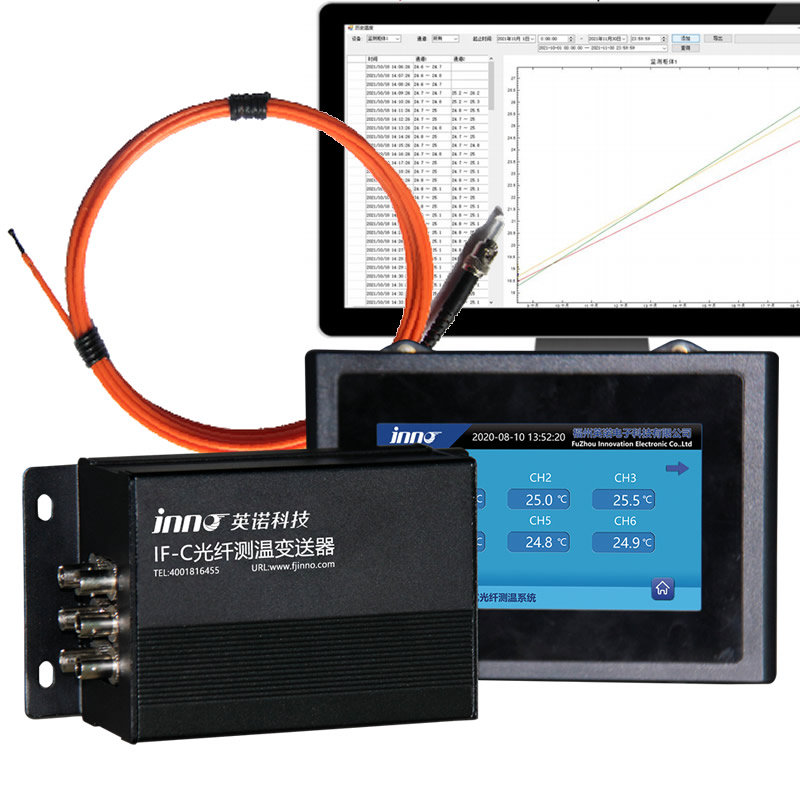
Power Transformer Winding Hot-Spot Monitoring
The single largest application of sensores de temperatura de fibra óptica de fluorescência globally is monitoring the winding hot-spot temperature of power transformers. The transformer winding operates at voltages ranging from a few kilovolts to 1,100 kV (in ultra-high-voltage transmission), criando um ambiente onde nenhum cabo metálico do sensor possa preencher com segurança o diferencial de tensão entre a superfície do enrolamento e o instrumento aterrado. Simultaneamente, o núcleo do transformador produz campos magnéticos alternados intensos que corromperiam qualquer sinal de medição elétrica. O enrolamento é imerso em óleo mineral ou fluido de éster sintético dentro de um tanque de aço selado, impossibilitando o acesso para manutenção ou recalibração sem desenergizar e abrir o transformador.
Sondas de fibra óptica fluorescentes são instaladas diretamente na superfície do enrolamento durante a fabricação do transformador. A fibra óptica sai do tanque através de um penetrador de fibra óptica (passagem) e se conecta a um interrogador montado no gabinete de controle do transformador. The all-dielectric fiber provides inherent high-voltage isolation to full winding voltage, the decay-time measurement is completely unaffected by the transformer’s electromagnetic environment, and the self-referencing calibration stability eliminates any need for recalibration over the transformer’s 25–40 year operational life.
Accurate winding hot-spot temperature data enables utilities and asset managers to implement dynamic transformer rating (DTR) — loading the transformer based on actual thermal state rather than conservative nameplate ratings — unlocking 10–30% additional capacity without reducing equipment life. It also enables predictive thermal aging calculation, optimized cooling system control, overload management, and early detection of internal thermal faults. International standards IEC 60076-2 and IEEE C57.91 reference fiber optic sensing as the preferred method for direct winding hot-spot measurement. Major transformer manufacturers including Siemens Energy, Energia Hitachi, GE Vernova, TBEA, Baoding Tianwei, and many others routinely specify fluorescence fiber optic temperature sensors as standard or optional equipment in medium and large power transformers.
High-Voltage Switchgear and Busbar Monitoring
Média tensão (até 40.5 kV) and high-voltage switchgear, dutos de ônibus, and cable terminations present similar challenges to power transformers — high voltages, campos eletromagnéticos fortes, and enclosed or sealed environments. Contact degradation, corrosão, and loose bolted connections cause localized overheating at junction points that, if undetected, leads to insulation failure, eventos de arco elétrico, and catastrophic equipment damage. Sensores de temperatura de fibra óptica de fluorescência are installed directly on busbar joints, contatos do disjuntor, and cable terminations inside switchgear compartments. They provide continuous, real-time hot-spot temperature monitoring with complete high-voltage isolation and zero risk of compromising the insulation coordination or creating an ignition source — requirements that disqualify all conventional metallic sensor technologies.
Electric Motor and Generator Winding Temperature
Large electric motors and generators (hundreds of kilowatts to hundreds of megawatts) require accurate stator winding temperature monitoring for thermal protection, performance optimization, e manutenção preditiva. The winding environment — high voltage, campos magnéticos rotativos, vibração, and limited access — challenges conventional RTD installations. Integrado sondas de temperatura de fibra óptica de fluorescência provide faster response, higher accuracy, imunidade EMI completa, and superior galvanic isolation compared to traditional RTDs, enabling more precise thermal protection and more aggressive loading strategies.
MRI-Compatible Temperature Measurement
Imagem por ressonância magnética (ressonância magnética) systems generate static magnetic fields of 1.5 T para 7 T, alternando rapidamente campos de gradiente, and high-power radiofrequency (RF) pulsos. Any metallic sensor or wire introduced into the MRI bore would cause image artifacts, experience potentially dangerous RF-induced heating, and produce corrupted temperature signals. Sensores de temperatura de fibra óptica de fluorescência, being entirely non-metallic and non-magnetic, are fully MRI-compatible. They are used for patient temperature monitoring during MRI examinations and MRI-guided procedures, phantom temperature characterization, and precise real-time temperature measurement during MRI-guided thermal therapies (ablação a laser, focused ultrasound, Ablação por RF, cryotherapy) where accurate tissue temperature knowledge is critical for treatment safety and efficacy.
RF, Microondas, and Electromagnetic Heating
Industrial RF heating (dielectric heating, RF welding, RF drying), processamento de microondas (microwave curing, sinterização, food pasteurization), and induction heating systems generate intense electromagnetic fields that make conventional temperature measurement extremely difficult or impossible. Sensores de fibra óptica de fluorescência are the standard solution for temperature measurement inside these electromagnetic applicators. The all-dielectric probe does not interact with the applied electromagnetic field, does not distort the field distribution, and does not experience self-heating from RF/microwave absorption — all of which are serious problems when metallic sensors are placed in electromagnetic fields.
Hazardous and Explosive Atmospheres
In environments classified as explosive atmospheres (ATEX zones, IECEx areas) — such as petrochemical facilities, oil and gas platforms, minas de carvão, and chemical processing plants — any electrical equipment at the sensing point represents a potential ignition source. Fiber optic temperature sensors with no electrical energy at the probe are inherently incapable of generating sparks, arcos, or thermal ignition. Combined with appropriate certification (EX ia, EX d), sensores de temperatura de fibra óptica de fluorescência provide intrinsically safe temperature measurement in the most dangerous explosive atmosphere classifications.
Other Important Applications
Additional application areas for fluorescence fiber optic temperature sensors include semiconductor manufacturing process monitoring, nuclear power facility temperature measurement (where radiation immunity is an additional benefit), electric vehicle battery thermal management, power cable joint and termination monitoring, compatibilidade eletromagnética (EMC) test chambers, plasma processing equipment, high-power laser system thermal monitoring, and scientific research applications requiring high-accuracy temperature measurement in electromagnetically hostile environments.
9. Detecção Distribuída de Temperatura por Fibra Óptica (ETED)
O que é sensoriamento distribuído de temperatura?
Detecção distribuída de temperatura por fibra óptica (ETED) é uma abordagem fundamentalmente diferente das tecnologias de detecção pontual descritas acima. Em vez de medir a temperatura em um único ponto usando um elemento sensor discreto conectado à ponta da fibra, DTS usa a própria fibra óptica como um contínuo, sensor de temperatura distribuído ao longo de todo o seu comprimento. Um único instrumento DTS conectado a uma extremidade de uma fibra óptica comum de telecomunicações pode medir a temperatura em todos os pontos ao longo da fibra - fornecendo um perfil de temperatura completo com resolução espacial de 0.25 para 2 metros em comprimentos de fibra de 1 para 50 quilômetros. Isso significa que um único canal DTS pode monitorar simultaneamente milhares a dezenas de milhares de pontos de medição de temperatura.
O Princípio de Espalhamento Raman
O mecanismo físico subjacente ao DTS é retroespalhamento Raman espontâneo. When a laser pulse is launched into the optical fiber, a small fraction of the light is scattered by molecular vibrations (optical phonons) in the glass. This Raman scattering produces two spectral components: o Stokes signal (scattered at a longer wavelength than the laser, corresponding to creation of a phonon) e o anti-Stokes signal (scattered at a shorter wavelength, corresponding to absorption of an existing phonon). The intensity of the Stokes signal is relatively insensitive to temperature, while the anti-Stokes signal intensity increases strongly with temperature because higher temperatures produce a larger population of thermally excited phonons available for absorption.
The DTS instrument measures the ratio of anti-Stokes to Stokes backscattered intensity as a function of time after the laser pulse launch. Because the speed of light in the fiber is known, the time delay of the returned signal directly maps to the position along the fiber (Optical Time Domain Reflectometry — OTDR principle). The anti-Stokes/Stokes ratio at each position is then converted to temperature using the known Boltzmann distribution relationship. The result is a complete temperature-versus-distance profile along the entire fiber length, updated every few seconds to minutes depending on the system configuration.
DTS Performance and Applications
Typical DTS systems provide temperature accuracy of ±0.5 °C to ±1 °C, spatial resolution of 0.5 para 2 metros, and temperature resolution of 0.01 °C a 0.1 °C (depending on measurement averaging time). The maximum fiber sensing range varies from 4 quilômetros (high-resolution systems) to 30–50 km (long-range systems), com alguns sistemas especializados alcançando distâncias ainda maiores. As taxas de atualização de medição variam de uma vez a cada poucos segundos (fibras curtas, alta resolução espacial) uma vez a cada vários minutos (fibras longas, requisitos de alta precisão).
Os sistemas DTS são amplamente utilizados para monitoramento de vazamentos e temperatura em tubulações (óleo, gás, e tubulações de água), detecção e classificação de pontos quentes do cabo de alimentação, detecção de incêndio em túneis, armazéns, e sistemas de transporte, perfil de temperatura de poço na indústria de petróleo e gás (DTS de fundo de poço), segurança perimetral e detecção de intrusão (detecção de assinaturas térmicas), monitoramento de infiltração de barragens e diques, forno industrial e perfil de temperatura do forno, e monitoramento de corredor quente/corredor frio do data center. Em todas essas aplicações, a capacidade de monitorar continuamente a temperatura ao longo de quilômetros de fibra — com um único instrumento e sem sensores discretos para instalar, poder, or maintain — provides extraordinary value.
DTS versus. Fluorescence Sensors: When to Use Which
Os sensores DTS e de fluorescência atendem a necessidades de medição fundamentalmente diferentes e raramente estão em concorrência direta. DTS é excelente no monitoramento de temperatura ao longo de infraestrutura linear (oleodutos, cabos, túneis) onde a cobertura espacial em longas distâncias é o principal requisito e precisão moderada (±1 °C) é aceitável. Sensores de fluorescência são excelentes em medições pontuais precisas (±0,1 °C) em locais críticos específicos – como pontos quentes de enrolamentos de transformadores, contatos do quadro, ou zonas de tratamento médico - onde alta precisão, resposta rápida, e o tamanho compacto da sonda são essenciais. Em muitos sistemas de grande escala, ambas as tecnologias são implantadas juntas: O DTS fornece ampla cobertura espacial, enquanto os sensores de fluorescência fornecem monitoramento de alta precisão nos pontos mais críticos.
10. Grade de fibra Bragg (FBG) Sensores de temperatura
Princípio de funcionamento
UM Grade de fibra Bragg (FBG) é uma modulação periódica do índice de refração escrito no núcleo de uma fibra óptica monomodo, typically using ultraviolet (UV) laser holographic exposure or phase mask techniques. This microscopic grating structure — typically 1 para 10 mm in length — acts as a narrow-band optical mirror, reflecting light at a specific wavelength called the Bragg wavelength (λ_B) while transmitting all other wavelengths. The Bragg wavelength is determined by the grating period (eu) and the effective refractive index of the fiber core (n_eff) according to the Bragg condition: λ_B = 2 · n_eff · Λ.
When temperature changes at the FBG location, two effects shift the Bragg wavelength. Primeiro, the thermo-optic effect changes the refractive index of the silica glass (dn/dT ≈ 8.6 × 10⁻⁶ /°C for germanium-doped silica). Segundo, thermal expansion changes the physical grating period (α ≈ 0.55 × 10⁻⁶ /°C for silica). The combined effect produces a Bragg wavelength shift of approximately 10-13h/°C no 1550 nm operating wavelength. By measuring this wavelength shift with a precision spectrometer, tunable laser, or interferometric interrogator, the system determines the temperature change at the grating location.
Wavelength Multiplexing
The most distinctive capability of FBG sensors is wavelength-division multiplexing (WDM). Multiple FBGs, each inscribed at a slightly different nominal Bragg wavelength (por exemplo, 1530 nm, 1535 nm, 1540 nm, …, 1565 nm), can be written at different positions along a single optical fiber. When the interrogator illuminates the fiber with broadband light, each FBG reflects its own characteristic wavelength, e o interrogador distingue os sensores individuais pelas suas posições espectrais. Um único canal de fibra normalmente pode acomodar 10 para 50+ Sensores FBG (limitado pela largura de banda óptica disponível e pela faixa operacional de comprimento de onda de cada sensor). Isso fornece medição de temperatura multiponto quase distribuída usando um único cabo de fibra — reduzindo significativamente a complexidade do cabeamento e o custo de instalação em comparação com a implantação de muitos sensores pontuais individuais.
Sensibilidade cruzada à tensão
A principal consideração ao usar sensores FBG para medição de temperatura é a sua sensibilidade cruzada à tensão mecânica. O comprimento de onda de Bragg muda com a temperatura e a deformação axial (aproximadamente 1.2 pm/com às 1550 nm), e uma única medição de FBG não consegue distinguir entre os dois efeitos. Para aplicações que exigem medição pura de temperatura, o FBG deve ser montado em uma configuração livre de tensão — normalmente alojado em um invólucro protetor de tubo solto que permite que a fibra se expanda e contraia livremente sem restrição mecânica da estrutura de montagem. Quando a temperatura e a deformação são de interesse (por exemplo, no monitoramento da saúde estrutural), projetos de grade dupla, grades de referência, ou FBGs com diferentes sensibilidades de deformação são usados para separar os dois efeitos.
Desempenho do sensor de temperatura FBG
Sensores de temperatura FBG padrão oferecem precisão de ±0,5 °C a ±1 °C, resolução de 0.1 °C (aproximadamente 1 resolução de comprimento de onda pm), e faixas de operação de -40 °C a +300 °C. FBGs especializados de alta temperatura - fabricados usando técnicas de regeneração ou inscrição a laser de femtossegundos - estendem o limite superior para +800 °C ou mesmo +1,000 °C. Response time depends on thermal coupling between the fiber and the measurement target, and is typically 0.1 para 1 segundo. Interrogator update rates range from 1 Hz for static monitoring to several kHz for dynamic measurements.
FBG Applications
Sensores de temperatura FBG são usados no monitoramento de enrolamentos multiponto de transformadores de potência (onde a vantagem da multiplexação reduz a penetração da fibra), monitoramento da saúde estrutural de pontes, edifícios, e materiais compósitos, mapeamento de temperatura de componentes aeroespaciais e de aeronaves, monitoramento de pás de turbinas eólicas, monitoramento de infraestrutura ferroviária, detecção de temperatura de instalações nucleares, monitoramento de temperatura de dispositivos médicos, e perfil de temperatura multiponto de processos industriais. Como todos os sensores de fibra óptica, Os FBGs fornecem imunidade EMI completa e isolamento galvânico.
11. GaAs Semiconductor Fiber Optic Temperature Sensors
Princípio de funcionamento
O GaAs (Arsenieto de gálio) sensor de temperatura de fibra óptica explora a dependência da temperatura do bandgap óptico de um cristal semicondutor. GaAs é um semicondutor de bandgap direto III-V cuja energia de bandgap diminui aproximadamente linearmente com o aumento da temperatura, seguindo a relação empírica de Varshni. À medida que o bandgap diminui, the optical absorption edge — the wavelength at which the material transitions from transparent to strongly absorbing — shifts to longer wavelengths (red-shifts) at a rate of approximately 0.4 nm/°C.
In the sensor construction, a thin GaAs crystal chip (typically 100–300 µm thick) is mounted at the end of an optical fiber. The interrogator transmits broadband near-infrared light through the fiber to the GaAs chip. Photons with energy greater than the bandgap (shorter wavelength than the absorption edge) are absorbed by the crystal. Photons with energy less than the bandgap (comprimento de onda mais longo) passam através do cristal e são refletidos por um revestimento espelhado na face posterior, retornando através da fibra para o interrogador. A posição espectral da borda de absorção no sinal refletido é medida por um espectrômetro ou sistema detector seletivo de comprimento de onda e convertida em temperatura usando uma calibração armazenada.
Características do sensor GaAs
Os sensores de temperatura de fibra óptica GaAs normalmente operam em uma faixa de -40 °C a +250 °C com precisão de ±0,5 °C a ±1 °C e resolução de 0.1 °C. A medição é baseada em uma propriedade cristalográfica fundamental (energia de banda proibida) que é altamente estável e repetível, proporcionando boa estabilidade de calibração a longo prazo. O chip de cristal GaAs é compacto, robusto, e passivo - não exigindo excitação elétrica no ponto de detecção.
Comparado aos sensores de fluorescência, Sensores GaAs têm uma faixa de temperatura mais estreita (250 °C versus. 450 Limite superior de °C), menor precisão alcançável (±0,5 °C versus. ±0,1 °C), e requerem um sistema de medição espectral mais complexo no interrogador. No entanto, o deslocamento da borda de absorção de GaAs é uma propriedade óptica puramente passiva (nenhum processo de excitação/emissão fluorescente envolvido), e alguns engenheiros e fabricantes preferem esta simplicidade para aplicações específicas. Sensores de temperatura de fibra óptica GaAs são usados principalmente no monitoramento de enrolamentos de transformadores de potência, monitoramento de comutadores, e medição de temperatura de motores elétricos — as mesmas aplicações principais atendidas por sensores de fluorescência. A escolha entre fluorescência e GaAs nestas aplicações é muitas vezes orientada pelo ecossistema do fabricante, preferências de mercado regional, e considerações da cadeia de fornecimento, em vez de superioridade técnica fundamental.
12. Comparação de tecnologia: Fluorescence vs. DTS versus. FBG vs. GaAs
| Parâmetro | Decaimento de fluorescência | ETED (Raman) | Grade de fibra Bragg | Semicondutor GaAs |
|---|---|---|---|---|
| Tipo de medição | Apontar | Distribuído (contínuo) | Quase distribuído (multiplexado) | Apontar |
| Princípio de detecção | Tempo de decaimento da fluorescência | Razão de retroespalhamento Raman | Mudança de comprimento de onda de Bragg | Mudança de borda de absorção de bandgap |
| Faixa de temperatura | −200 °C to +450 °C | −40 °C a +700 °C | −40 °C a +300 °C (padrão) / +800 °C (especial) | −40 °C a +250 °C |
| Precisão | ±0,1 °C a ±0,5 °C | ±0,5 °C a ±2 °C | ±0,5 °C a ±1 °C | ±0,5 °C a ±1 °C |
| Resolução | 0.01–0,1ºC | 0.01–0,1ºC | 0.1 °C | 0.1 °C |
| Resolução Espacial | N / D (apontar) | 0.25–2m | Comprimento da grade (~1–10 mm) | N / D (apontar) |
| Faixa de detecção/comprimento da fibra | Até 1,000 eu | 1–50 km | Até 100 eu (matriz de sensores típica) | Até 500 eu |
| Pontos por Fibra | 1 | Milhares (contínuo) | 10–50+ | 1 |
| Tempo de resposta | 0.1–3s | Segundos em minutos | 0.1–1s | 0.5–3s |
| Auto-referência | Sim (tempo de decadência) | Sim (proporção-métrica) | Sim (codificado em comprimento de onda) | Sim (codificado em comprimento de onda) |
| Sensibilidade à Deformação | Nenhum | Mínimo | Sim (sensível a cruz) | Nenhum |
| Imunidade EMI | Completo | Completo | Completo | Completo |
| Galvanic Isolation | Total | Total | Total | Total |
| Custo do interrogador | Médio ($2K – $ 10 mil) | Alto ($30K – $ 150 mil +) | Alto ($10K – $ 50 mil) | Médio-alto ($3K – $ 12 mil) |
| Custo por ponto | Baixo-médio | Muito baixo (por ponto) | Baixo (com multiplexação) | Baixo-médio |
| Força Primária | Precisão, faixa, estabilidade para medição de ponto | Cobertura contínua em longas distâncias | Multiplexação multiponto em fibra única | Passiva, medição de ponto estável |
| Maturidade do Mercado | Muito alto (30+ anos) | Alto (25+ anos) | Alto (20+ anos) | Alto (25+ anos) |
13. Como escolher o sensor de temperatura de fibra óptica correto
Quadro de decisão
Selecionando o certo sensor de temperatura de fibra óptica começa com a definição clara do requisito de medição ao longo de quatro dimensões principais: the number and spatial distribution of measurement points, the required accuracy and temperature range, the environmental conditions at the sensing location, and the system budget.
If you need to measure temperature at one or a few specific critical points com alta precisão (±0,1 °C a ±0,5 °C), o sensor de temperatura de fibra óptica de fluorescência is the recommended choice. It provides the best accuracy, the widest temperature range, proven long-term stability, and the most competitive cost for small channel counts. This is the appropriate technology for transformer winding hot-spots, contatos do quadro, enrolamentos do motor, MRI-compatible measurements, and RF/microwave process monitoring.
If you need to measure temperature at many discrete points (10–50+) along a single fiber path, and moderate accuracy (±0,5 °C a ±1 °C) is sufficient, Sensores de temperatura FBG offer significant cabling and installation advantages through wavelength multiplexing. This is appropriate for multi-point structural monitoring, multi-zone transformer or generator monitoring, e perfil de temperatura de processo distribuído em locais discretos.
Se você precisar perfil de temperatura contínuo em longas distâncias (centenas de metros a dezenas de quilômetros) com precisão moderada e resolução espacial, detecção de temperatura distribuída (ETED) é a única solução. Nenhuma outra tecnologia pode fornecer cobertura espacial contínua em tais distâncias. DTS é o padrão para monitoramento de pipeline, monitoramento de cabo de alimentação, detecção de incêndio em túnel, e perfil de temperatura do poço.
Se você precisar de um sensor pontual para monitoramento de equipamentos de energia e o fabricante do seu equipamento ou cadeia de suprimentos estabeleceu capacidade com Tecnologia GaAs, Os sensores GaAs fornecem uma alternativa comprovada e confiável aos sensores de fluorescência para este domínio de aplicação específico.
Critérios práticos de seleção
Além do tipo de tecnologia, critérios práticos de seleção incluem as interfaces de comunicação do interrogador (4–20 mA, Modbus, CEI 61850, OPC UA, Ethernet/IP), the number of channels and expansion capability, the probe construction and environmental rating (Classificação IP, temperature rating, chemical compatibility, certification for explosive atmospheres), the fiber cable type and connector standard, the vendor’s track record and installed base in your application area, and the availability of local technical support and spare parts. For permanent installations in critical infrastructure, prefer vendors with demonstrated field reliability records of 10+ years and a documented quality management system.
14. FAQs — What Is a Fiber Optic Temperature Sensor?
1º trimestre: What is a fiber optic temperature sensor in simple terms?
UM sensor de temperatura de fibra óptica is a device that measures temperature using light instead of electricity. A thin glass fiber carries light to a sensing point where temperature changes the light in a measurable way — changing how fast it fades (fluorescência), what color is reflected (FBG), quais comprimentos de onda são absorvidos (GaAs), ou quanta luz se espalha de volta (ETED). Porque não há eletricidade envolvida no ponto de medição, o sensor é completamente imune a interferência eletromagnética, seguro em altas tensões, e adequado para ambientes explosivos ou de radiação.
2º trimestre: Quais são os quatro tipos principais de sensores de temperatura de fibra óptica?
Os quatro tipos principais são: sensores de decaimento de fluorescência (medindo a vida útil da fluorescência do fósforo na ponta da fibra - o mais amplamente utilizado), sensores de temperatura distribuídos (ETED) (medindo a dispersão Raman ao longo de todo o comprimento da fibra), Grade de fibra Bragg (FBG) sensores (medir a mudança de comprimento de onda de uma grade inscrita na fibra), e Sensores semicondutores GaAs (medindo o deslocamento da borda de absorção de um cristal de arsenieto de gálio). Cada tipo usa um princípio físico diferente e atende a diferentes necessidades de aplicação.
3º trimestre: Que tipo de sensor de temperatura de fibra óptica é mais comumente usado?
O sensor de temperatura de fibra óptica baseado em fluorescência é o tipo mais amplamente utilizado para medição de temperatura pontual. Sua liderança de mercado se estende por mais de três décadas e é baseada em sua combinação incomparável de alta precisão (±0,1 °C), ampla faixa de temperatura (−200 °C to +450 °C), estabilidade de calibração a longo prazo, princípio de medição de auto-referência, e confiabilidade comprovada em aplicações exigentes, como transformadores de potência, Sistemas de ressonância magnética, e equipamento de aquecimento RF.
4º trimestre: Como funciona um sensor de temperatura de fibra óptica fluorescente?
O interrogador envia um pulso de luz através da fibra para um fósforo na ponta da sonda. O fósforo absorve a luz e emite fluorescência que desaparece (decai) exponencialmente após o término do pulso. A taxa deste decaimento – o tempo de vida da fluorescência – muda previsivelmente com a temperatura: temperatura mais alta significa decomposição mais rápida. Medindo o tempo de decaimento, o instrumento determina a temperatura. Porque o tempo de decaimento é uma propriedade intrínseca do fósforo, a medição é independente da intensidade do sinal, perdas de fibra, ou envelhecimento do LED.
Q5: O que é sensoriamento de temperatura por fibra óptica distribuída (ETED)?
Sensor de temperatura distribuído (ETED) usa retroespalhamento Raman em uma fibra óptica comum para medir a temperatura continuamente ao longo de todo o comprimento da fibra. Um pulso de laser é enviado pela fibra, e o instrumento analisa o retroespalhamento Raman dependente da temperatura em cada ponto ao longo da fibra (usando o tempo de voo para determinar a posição). Um único sistema DTS pode monitorar temperaturas em milhares de pontos em distâncias de até 50 quilômetros, tornando-o ideal para pipeline, cabo de alimentação, e monitoramento de túneis.
Q6: O que é um sensor de temperatura FBG?
Um FBG (Grade de fibra Bragg) sensor de temperatura uses a tiny optical grating written into the fiber core that reflects a specific wavelength of light. Quando a temperatura muda, the reflected wavelength shifts by approximately 10–13 pm/°C. Multiple FBGs at different wavelengths can be multiplexed along a single fiber, enabling 10–50+ discrete temperature measurement points per fiber — a unique capability not available with other fiber optic sensor types. FBGs are also sensitive to strain, so strain-free mounting is needed for temperature-only measurement.
Q7: What is a GaAs fiber optic temperature sensor?
UM GaAs fiber optic temperature sensor uses a Gallium Arsenide semiconductor chip at the fiber tip. The bandgap of GaAs changes with temperature, shifting the optical absorption edge at about 0.4 nm/°C. By measuring this spectral shift, the system determines temperature. GaAs sensors typically cover −40 °C to +250 °C with ±0.5 °C accuracy and are primarily used for power transformer and switchgear monitoring as an alternative to fluorescence sensors.
P8: Why are fiber optic temperature sensors immune to electromagnetic interference?
All fiber optic temperature sensors are immune to EMI because the optical fiber is made of glass — a dielectric insulator that cannot conduct electricity and does not respond to electromagnetic fields. There are no metallic wires, no electronic circuits, and no electrical signals at the sensing point. The temperature information is carried by light, which is unaffected by electric fields, campos magnéticos, radio frequencies, or microwave radiation. This immunity is an inherent physical property, not an engineered shield that could be overcome by stronger interference.
Q9: Can fiber optic temperature sensors replace thermocouples and RTDs?
In many applications, yes. Sensores de temperatura de fibra óptica — particularly fluorescence-based sensors — can replace thermocouples and RTDs wherever EMI immunity, isolamento de alta tensão, segurança intrínseca, or long-term calibration stability is required. They provide comparable or better accuracy and response time. No entanto, fiber optic sensors have higher initial system cost (especially the interrogator), require more careful handling of the delicate optical fiber, and may not be justified in benign environments where inexpensive thermocouples perform adequately. The selection should be driven by the application requirements rather than a blanket replacement strategy.
Q10: Quanto tempo duram os sensores de temperatura de fibra óptica?
Sondas de temperatura de fibra óptica fluorescentes instaladas em transformadores de potência operam rotineiramente para 15 para 25+ anos sem substituição ou recalibração. Os materiais sensores de fósforo são quimicamente inertes e termicamente estáveis, mostrando degradação insignificante em condições normais. A fibra óptica de sílica tem uma vida útil comprovada superior 25 anos. Falha na sonda, quando isso ocorre, é quase sempre devido à quebra mecânica da fibra, em vez de detectar a degradação do elemento. Os sistemas DTS e FBG em instalações permanentes também demonstram uma vida útil operacional de várias décadas.
Q11: Quanto custa um sistema de sensor de temperatura de fibra óptica?
O custo do sistema varia significativamente por tipo de tecnologia e número de canais. UM sensor de temperatura de fibra óptica de fluorescência sistema normalmente custa USD 2,000 para 10,000 para o interrogador e USD 100 para 500 por sonda — a opção mais econômica para contagens de canais pequenas e médias. Sistemas FBG custo em USD 10,000 para 50,000 for the interrogator but achieve lower per-point cost when many sensors are multiplexed on single fibers. Sistemas DTS custo em USD 30,000 para 150,000+ for the interrogator but offer extremely low per-point cost given the thousands of measurement points per channel. GaAs systems are priced comparably to fluorescence systems. In all cases, the investment is justified by the unique measurement capabilities that no conventional sensor can provide in the target environments.
Q12: Where can I purchase fiber optic temperature sensors?
FJINNO (www.fjinno.net) fornece sensores de temperatura de fibra óptica de fluorescência and complete measurement system solutions for power, industrial, médico, and scientific applications. FJINNO systems feature high-accuracy fluorescence decay measurement, multi-channel interrogators, ruggedized probe designs for transformer, comutador, and motor applications, and standard industrial communication interfaces including Modbus, CEI 61850, and 4–20 mA analog output.
Isenção de responsabilidade: As informações fornecidas neste artigo são para fins educacionais gerais e de referência. Especificações específicas do produto, características de desempenho, e os preços variam de acordo com o fabricante, modelo, e configuração. Todos os dados técnicos citados representam valores típicos encontrados em produtos comerciais de detecção de temperatura por fibra óptica e não devem ser usados como especificações garantidas para qualquer sistema específico.. Sempre consulte a documentação oficial do fabricante e realize uma avaliação independente antes de especificar ou comprar equipamento de detecção de temperatura por fibra óptica.. FJINNO (www.fjinno.net) aceita consultas técnicas e fornece recomendações específicas de aplicação para ajudá-lo a selecionar a solução ideal de detecção de temperatura por fibra óptica para suas necessidades.

Sensor de temperatura de fibra óptica, Sistema de monitoramento inteligente, Fabricante distribuído de fibra óptica na China
 |
 |
 |