 Sensores de temperatura de fibra óptica INNO ,sistemas de monitoramento de temperatura.
- Monitoramento de temperatura por fibra óptica uses light-based sensing to measure temperature at specific points in real time. The all-dielectric, non-conductive measurement path provides complete electromagnetic immunity, galvanic isolation beyond 100 kV, and intrinsically safe operation — capabilities impossible for conventional electrical sensors.
- O fiber optic temperature sensor working principle relies on the temperature-dependent decay time of a phosphor coating at the probe tip. A light pulse excites the phosphor, and the decay rate of the afterglow is precisely correlated to temperature, producing a self-referencing, drift-free measurement with no electrical energy at the sensing point.
- Um completo sistema de monitoramento de temperatura de fibra óptica consists of five integrated components: a demodulator (interrogador), sensing probes, cabos de fibra óptica, a display module, and monitoring software — forming a turnkey solution from sensing point to operator interface.
- This technology is the proven standard for medição de temperatura de fibra óptica em transformadores de potência, aparelhagem de alta tensão, motores elétricos, Ambientes de ressonância magnética, and industrial processes where conventional sensors fail or pose safety risks.
- A single fiber optic transmitter supports 1 para 64 canais de detecção, with measurement accuracy of ±0.5–1 °C, a response time under 1 segundo, and a system lifespan exceeding 25 years — delivering reliable, low-maintenance monitoring at scale.
Índice
- O que é monitoramento de temperatura de fibra óptica?
- Why Choose Fiber Optic Over Conventional Temperature Sensors?
- How Does a Fiber Optic Temperature Sensor Work?
- Arquitetura do sistema: Five Core Components
- Specifications and Configuration
- Principais vantagens
- Aplicações em todos os setores
- How to Choose the Right System
- Understanding Fiber Optic Temperature Sensor Price Factors
- Perguntas frequentes
1. O que é Monitoramento de temperatura de fibra óptica?

Monitoramento de temperatura por fibra óptica is the practice of using optical fiber-based sensing technology to continuously measure, registro, and analyze temperature at one or more specific locations in real time. Unlike conventional monitoring that relies on electrical signals carried through metallic conductors, this approach generates, transmits, and processes temperature information entirely in the optical domain — using light as the information carrier and glass fibers as the transmission medium.
Because no electrical energy exists anywhere along the sensing path, soluções de detecção de temperatura de fibra óptica offer intrinsic advantages that cannot be replicated by thermocouples, IDT, ou termistores: imunidade total a interferência eletromagnética, complete electrical isolation from high-voltage conductors, e quimicamente inerte, non-sparking construction suitable for explosive and corrosive atmospheres.
Point-Type Measurement Topology
The monitoring approach covered in this guide is a point-type measurement system, meaning each sonda de temperatura de fibra óptica monitors the temperature at one discrete location. A single demodulator instrument can interrogate multiple probes simultaneously across independent channels, allowing operators to monitor dozens of critical hotspots throughout a piece of equipment or an entire facility from a single centralized platform.
2. Why Choose Fiber Optic Over Conventional Temperature Sensors?
Limitations of Electrical Temperature Sensors
Traditional temperature sensors — thermocouples, IDT, and thermistors — have served industry reliably in benign environments for decades. No entanto, they share fundamental limitations rooted in their dependence on electrical signals and metallic conductors. Thermocouple signals are highly susceptible to electromagnetic noise. RTDs require excitation current and suffer from lead resistance errors. All metallic sensor leads can act as antennas, coupling interference into the measurement circuit and creating pathways for ground loops, lightning surges, and high-voltage faults.
In environments characterized by strong electromagnetic fields, voltages above tens of kilovolts, explosive gas mixtures, or aggressive chemical exposure, these vulnerabilities make conventional monitoring unreliable, unsafe, or entirely impossible.
The Fiber Optic Advantage
UM sensor de fibra óptica para medição de temperatura eliminates every one of these barriers. The glass fiber is a dielectric insulator — it cannot conduct electricity, cannot generate or receive electromagnetic interference, e não pode criar conexões galvânicas. This makes detecção de temperatura por fibra óptica the only viable monitoring solution in many high-demand environments, and a superior alternative in virtually all others.
3. How Does a Sensor de temperatura de fibra óptica Trabalhar?

The Phosphor Decay Principle
O fiber optic temperature sensor working principle is based on a well-characterized physical phenomenon: the temperature-dependent fluorescence decay of a rare-earth phosphor material. A small amount of phosphor compound is bonded to the tip of a specialized sensor de temperatura de fibra óptica sonda. The demodulator instrument sends a short pulse of excitation light through the optical fiber to the phosphor. Upon absorbing this light energy, the phosphor emits fluorescent afterglow at a different wavelength.
Why Decay Time, Not Intensity?
The critical parameter is not the brightness of this afterglow, but the rate at which it fades — known as the fluorescence decay time or lifetime. Este tempo de decaimento tem uma precisão, repetível, and monotonic relationship with temperature: conforme a temperatura aumenta, the decay time decreases. The demodulator captures the returning fluorescent signal through the same optical fiber, digitizes the decay curve, calculates the decay time constant using advanced curve-fitting algorithms, and converts the result to a calibrated temperature value.
Self-Referencing Stability
Because the measurement depends on the timing characteristic of the fluorescent decay rather than on signal amplitude, it is inherently immune to signal loss from fiber bending, envelhecimento do conector, ou degradação da fonte de luz. This self-referencing property ensures that medições de temperatura de fibra óptica remain accurate and stable over the entire operational lifetime of the system without recalibration — a decisive advantage over intensity-based or electrical sensing methods.
4. Arquitetura do sistema: Five Core Components
Um completo sistema de medição de temperatura de fibra óptica consists of five integrated components that work together to deliver continuous, reliable monitoring from the sensing point to the operator interface.
4.1 Demodulador de Fibra Óptica (Interrogator / Transmissor)
The demodulator is the central intelligence of the system. It generates the excitation light pulses, receives the returning fluorescent signals from all connected channels, performs the decay-time analysis, and outputs calibrated temperature data. A single unit supports multiple independent sensing channels and communicates with external systems through standard industrial interfaces.
4.2 Sondas de detecção
Cada sonda de temperatura de fibra óptica contains the phosphor sensing element at its tip, hermetically sealed and ruggedized for the target installation environment. Probes are available in compact form factors suitable for embedding in transformer windings, mounting on switchgear busbars, or inserting into industrial process equipment. The fully dielectric, insulated construction ensures safe operation in direct contact with conductors at extreme voltages.
4.3 Optical Fiber Cables
Specialized optical fiber cables connect each probe to the demodulator. These cables are designed for the mechanical, térmico, and chemical demands of industrial installation — with protective jacketing, strain relief, and connector systems tailored to each application. Entendimento fiber optic cable temperature limits for the cable jacketing material is important during system design to ensure the passive cable sections are not exposed to temperatures beyond their rated range, even though the sensing probe tip itself is designed for the full measurement range.
4.4 Módulo de exibição
The display module provides local visual indication of real-time temperature readings, status de alarme, e diagnóstico do sistema. Depending on configuration, this may be an integrated front-panel display on the demodulator unit or a separate panel-mount display installed at a convenient operator viewing location.
4.5 Software de monitoramento
The monitoring software platform runs on a standard PC or industrial workstation and provides comprehensive temperature data management including real-time multi-channel display, historical trend logging, limites de alarme configuráveis, event recording, e geração de relatórios. The software communicates with one or more demodulators to provide a unified monitoring view across an entire facility.
5. Specifications and Configuration

The following table summarizes the standard specifications of the sistema de monitoramento de temperatura de fibra óptica. These represent standard production parameters; custom configurations for measurement range, dimensões da sonda, comprimento da fibra, and channel count are available upon request to match specific project requirements.
| Parâmetro | Especificação |
|---|---|
| Tipo de medição | Tipo de ponto (discrete location) |
| Precisão | ±0,5 °C a ±1 °C |
| Faixa de temperatura | −40 °C a +260 °C |
| Comprimento da fibra (Probe to Demodulator) | 0 para 20 metros |
| Tempo de resposta | < 1 segundo |
| Diâmetro da Sonda | 2–3mm (personalizável) |
| Isolamento Elétrico | Totalmente isolado, withstands > 100 kV |
| Vida útil | > 25 anos |
| Channels per Transmitter | 1 para 64 canais |
| Interface de comunicação | RS485 |
| Componentes do sistema | Demodulator, sensing probes, fibra óptica, módulo de exibição, software de monitoramento |
O fiber optic temperature range of −40 °C to +260 °C covers the vast majority of power equipment and industrial process monitoring requirements. The compact probe diameter of 2–3 mm allows installation in tightly constrained spaces such as transformer winding interleaves and switchgear contact assemblies. With response times under one second, the system captures rapid thermal transients caused by load changes, fault events, ou perturbações no processo. The RS485 communication interface enables straightforward integration with SCADA systems, Plataformas DCS, e sistemas de gerenciamento de edifícios. Each parameter — including channel count, probe geometry, comprimento da fibra, and temperature range — can be customized to meet the exact requirements of a specific project.
6. Principais vantagens
Imunidade Eletromagnética Completa
The all-dielectric construction means sensores de temperatura de fibra óptica are completely unaffected by electromagnetic fields, interferência de radiofrequência, or conducted electrical noise — regardless of field strength or frequency. This enables accurate monitoring in environments that are hostile to all electrical sensors, including power transformer cores, barramentos de alta corrente, MRI bores, and RF heating systems.
Intrinsic High-Voltage Isolation
The glass optical fiber provides natural galvanic isolation exceeding 100 kV without requiring any additional insulating barriers, creepage distances, or isolation amplifiers. Isso permite sondas de temperatura de fibra óptica to be placed in direct contact with live high-voltage conductors — a capability that is physically impossible for any metallic sensor technology.
Exceptional Long-Term Stability
Because the decay-time measurement principle is self-referencing and independent of signal amplitude, the system does not drift with age, connector wear, or fiber degradation. A service life exceeding 25 years with minimal maintenance makes fiber optic solutions for temperature monitoring highly cost-effective over the full lifecycle of power and industrial equipment.
Segurança Intrínseca
No electrical energy is present at the sensing probe or along the fiber cable. The system is inherently incapable of generating sparks, arcos, or surface heating — meeting the most stringent requirements for operation in explosive atmospheres classified under IEC 60079 and similar standards.
Compact and Non-Invasive
With probe diameters as small as 2–3 mm, the sensors can be embedded in or attached to equipment without altering thermal behavior, airflow patterns, or insulation integrity. The thin, flexible optical fiber cable routes easily through existing cable passages and sealed enclosures.
7. Aplicações em todos os setores
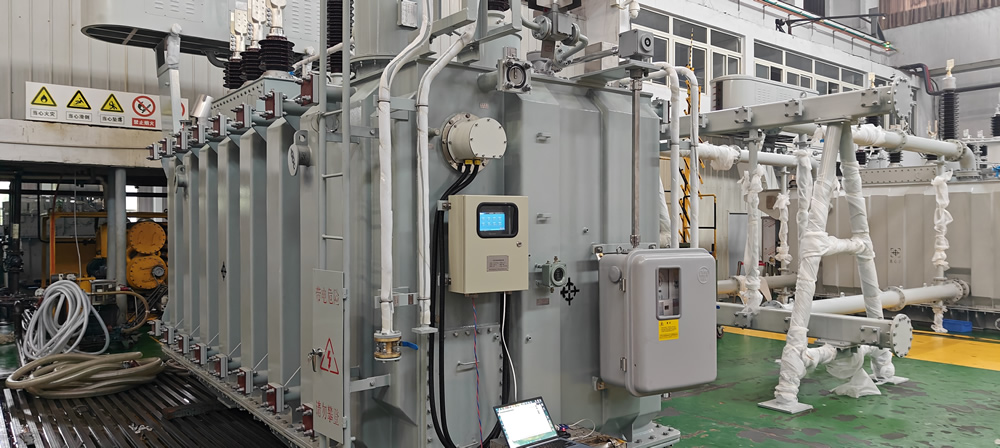
Transformadores de potência
O sensor de temperatura de fibra óptica para transformador monitoring is one of the most established and widely deployed applications. Probes are embedded directly in transformer winding hot-spot locations during manufacturing, providing real-time winding temperature data that enables dynamic loading, manutenção preditiva, and protection against thermal damage. The dielectric fiber passes safely through the high-voltage insulation structure without compromising its integrity.
Aparelhagem de alta tensão
Em painéis isolados a gás (SIG) e painel isolado a ar, temperatura da fibra óptica probes are mounted on busbar contacts and cable terminations to detect overheating caused by contact degradation, conexões soltas, ou sobrecarga. The complete electrical isolation eliminates any risk of dielectric breakdown or tracking across the sensor installation.
Electric Motors and Generators
Temperaturas do enrolamento do estator, bearing temperatures, and cooling system performance are monitored using embedded fiber optic probes that operate reliably within the intense electromagnetic environment inside rotating machines.
Medical and MRI Environments
The total absence of metallic components makes soluções de detecção de temperatura de fibra óptica the only safe option for temperature monitoring during MRI procedures, RF hyperthermia therapy, and other medical applications involving strong magnetic fields.
Processos Industriais
Reatores químicos, autoclaves, curing ovens, and semiconductor fabrication equipment benefit from the chemical inertness, tamanho compacto, and electromagnetic immunity of fiber optic sensing in environments where corrosive chemicals, high pressures, or RF fields are present.
8. How to Choose the Right System
Define Your Monitoring Requirements
Begin by identifying the number of monitoring points, the expected temperature range at each location, the physical space available for probe installation, and the distance from the sensing points to the location where the demodulator will be housed. These parameters determine the channel count, probe configuration, and fiber cable lengths required.
Consider the Installation Environment
Evaluate the electrical, químico, and mechanical conditions at the sensing locations. High-voltage environments, atmosferas explosivas, submersion in transformer oil, exposure to corrosive chemicals, or extreme vibration may require specialized probe encapsulation, cable jacketing, or connector types. A reputable manufacturer will offer application-specific probe designs validated for each environment.
Plano para integração do sistema
Determine how the temperature data needs to reach your operators and control systems. The standard RS485 interface supports integration with most SCADA and DCS platforms. Confirm that the monitoring software is compatible with your existing infrastructure and provides the data logging, alarme, and reporting capabilities your operations require.
Evaluate Total Cost of Ownership
While the initial investment in a sistema de medição de temperatura de fibra óptica may exceed that of conventional sensors, the 25-year-plus service life, minimal maintenance requirement, elimination of recalibration cycles, and superior reliability in demanding environments typically deliver a significantly lower total cost of ownership. Factor in the cost of downtime, danos ao equipamento, and safety incidents that effective monitoring prevents.
9. Understanding Fiber Optic Temperature Sensor Price Factors
O preço do sensor de temperatura de fibra óptica for a complete system depends on several interrelated factors. Channel count is the primary driver — a system with more sensing channels requires a more capable demodulator and additional probes and fiber cables. Probe customization for specialized environments such as oil-immersed transformer windings, high-pressure vessels, or miniaturized medical applications may add to per-probe cost. Fiber cable length, connector types, and protective conduit requirements affect installation material costs. Monitoring software licensing and system integration services are additional considerations.
As a general principle, the per-channel cost decreases as channel count increases, making multi-channel systems highly economical on a per-point basis. Requesting a detailed quotation based on your specific project parameters — including channel count, tipo de sonda, comprimento da fibra, requisitos ambientais, and integration scope — is the most reliable way to establish accurate budgeting for your monitoramento de temperatura de fibra óptica projeto.
10. Perguntas frequentes
1º trimestre: O que é monitoramento de temperatura por fibra óptica?
Fiber optic temperature monitoring is a technology that uses light signals transmitted through glass optical fibers to measure temperature at specific points. The phosphor-tipped sensing probe converts temperature into an optical signal that is completely immune to electromagnetic interference and provides inherent electrical isolation, making it ideal for high-voltage, explosivo, or electromagnetically noisy environments.
2º trimestre: Como funciona um sensor de temperatura de fibra óptica?
The sensor works by measuring the fluorescence decay time of a phosphor material at the probe tip. A light pulse excites the phosphor, which emits afterglow that fades at a rate determined by temperature. The demodulator analyzes this decay rate and converts it into a precise temperature reading. Because the measurement depends on timing rather than signal intensity, it remains stable and accurate over decades of operation.
3º trimestre: What is the temperature range of a fiber optic sensor?
The standard measurement range is −40 °C to +260 °C, which covers the vast majority of power equipment and industrial process monitoring needs. Custom ranges can be configured for specialized applications.
4º trimestre: How accurate is fiber optic temperature measurement?
Standard system accuracy is ±0.5 °C to ±1 °C, which meets or exceeds the requirements of most power, industrial, and medical monitoring applications.
Q5: Can fiber optic sensors be used inside high-voltage equipment?
Sim. The all-dielectric glass fiber provides galvanic isolation exceeding 100 kV, allowing probes to be placed in direct contact with live high-voltage conductors inside transformers, comutador, and other energized equipment without any risk of electrical breakdown.
Q6: How many sensors can one system support?
A single fiber optic demodulator can support 1 para 64 independent sensing channels. For applications requiring more monitoring points, multiple demodulators can be networked together through the monitoring software platform.
Q7: What is the lifespan of a fiber optic temperature monitoring system?
The system is designed for a service life exceeding 25 anos, matching or exceeding the operational lifetime of the power and industrial equipment it monitors. The self-referencing decay-time measurement principle eliminates drift and degradation, minimizing maintenance requirements over the full service period.
P8: How fast does the sensor respond to temperature changes?
O tempo de resposta é menor que 1 segundo, enabling the system to capture rapid thermal transients caused by load changes, fault events, or process upsets in real time.
Q9: How does the system communicate with SCADA or DCS?
The demodulator provides a standard RS485 communication interface for integration with SCADA systems, Plataformas DCS, e sistemas de gerenciamento de edifícios. The monitoring software provides additional data management, tendências, and alarm capabilities on a local or networked workstation.
Q10: What factors affect the price of a fiber optic temperature sensor system?
Key price factors include the number of sensing channels, probe type and customization level, optical fiber cable length, connector and conduit requirements, monitoring software licensing, and system integration scope. Per-channel cost decreases with higher channel counts, making multi-point systems highly cost-effective.
Isenção de responsabilidade: As informações fornecidas neste artigo são apenas para fins informativos e educacionais gerais. Embora todos os esforços tenham sido feitos para garantir a precisão, fjinno.net makes no warranties or representations regarding the completeness, precisão, or applicability of the content to any specific project or situation. Specifications described herein represent standard parameters and may vary depending on configuration and customization. For detailed technical guidance, projeto do sistema, e recomendações específicas do projeto, entre em contato diretamente com nossa equipe de engenharia. This content does not constitute a contractual offer or guarantee of performance.

Sensor de temperatura de fibra óptica, Sistema de monitoramento inteligente, Fabricante distribuído de fibra óptica na China
 |
 |
 |