Sensores de temperatura de fibra óptica INNO ,sistemas de monitoramento de temperatura.
The Hidden Risk Inside Every Switchgear Panel — and Why Continuous Temperature Monitoring Matters

Sistema de monitoramento de temperatura de fibra óptica para painéis de distribuição — Visão geral do produto
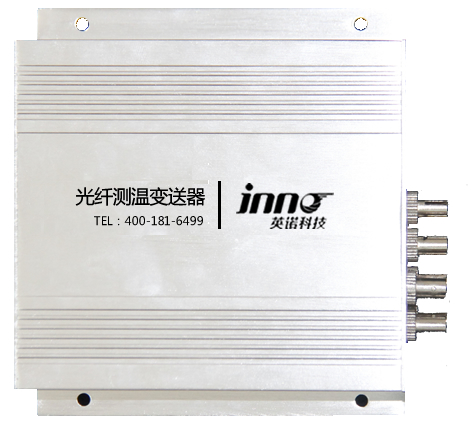
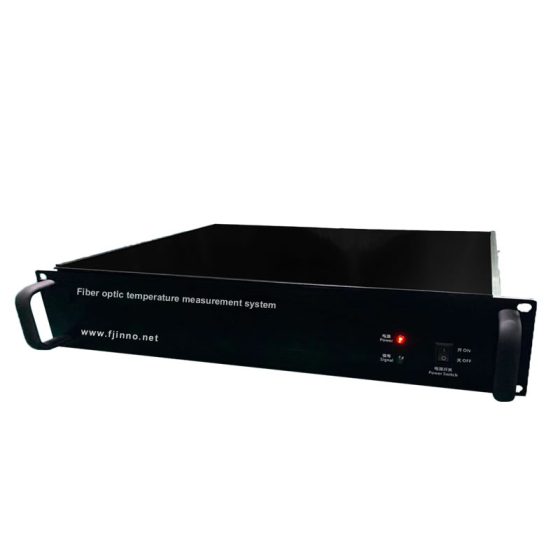
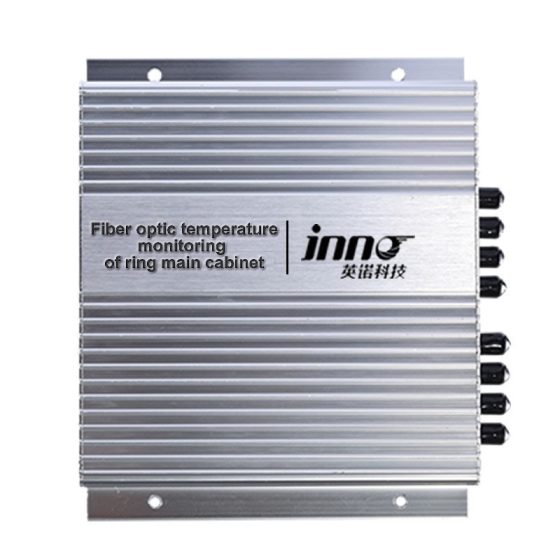
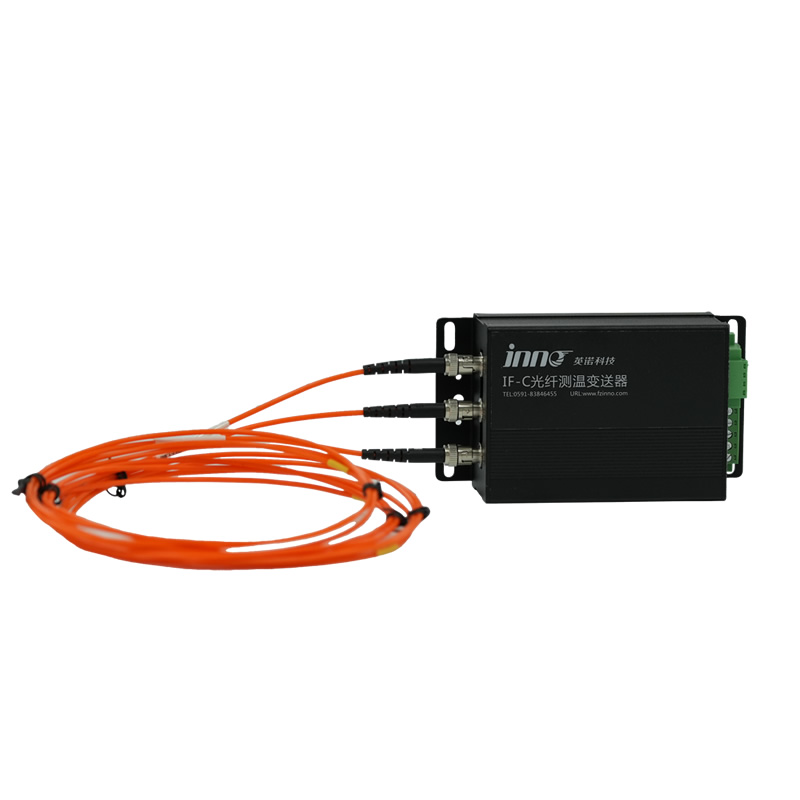
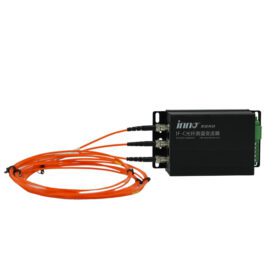
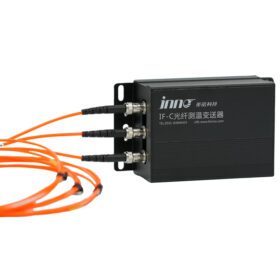
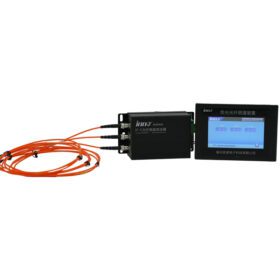
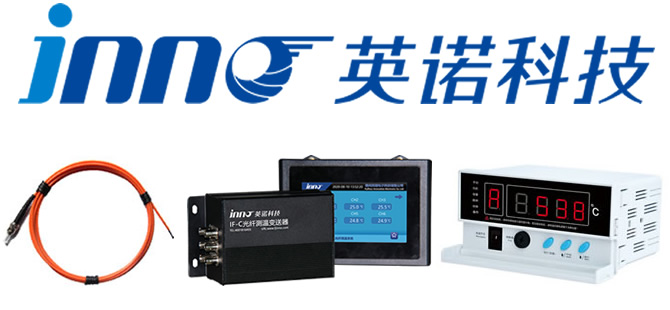
Este sistema combina sensores de temperatura de fibra óptica de fluorescência, um transmissor de temperatura multicanal, e um Unidade de exibição LCD em um compacto, solução de monitoramento montável em painel desenvolvida especificamente para média tensão (VM) e baixa tensão (LV) aplicações de comutadores.
Os sensores usam material luminescente de terras raras – uma tecnologia de detecção comprovada selecionada por sua estabilidade a longo prazo, Isolamento elétrico completo, e total compatibilidade com o ambiente de isolamento dentro do painel fechado. Ao contrário das alternativas sem fio ou baseadas em infravermelho, detecção de fibra óptica has no moving parts, sem baterias, and no radio frequency emissions — making it the preferred choice for permanently installed, maintenance-light deployments in utility substations, industrial switchrooms, and critical power infrastructure worldwide.
Como funciona o sensor de temperatura por fibra óptica por fluorescência
A short pulse of excitation light is transmitted through the optical fiber to a rare-earth phosphor tip bonded to the sensor probe. The phosphor emits a fluorescence signal that decays at a rate directly proportional to its temperature. The transmitter measures this decay time and converts it into a precise temperature reading.
This fluorescence decay method is inherently linear, drift-resistant, and unaffected by fiber bending, perdas no conector, or light-intensity variations — delivering reliable, repeatable measurements over decades of continuous service. Because the entire sensing mechanism is optical, sensores de temperatura de fibra óptica are completely immune to the electromagnetic interference (EMI) generated by high-current busbars and switching transients inside switchgear.
Switchgear Temperature Monitoring Points — Where Fiber Optic Sensors Are Installed
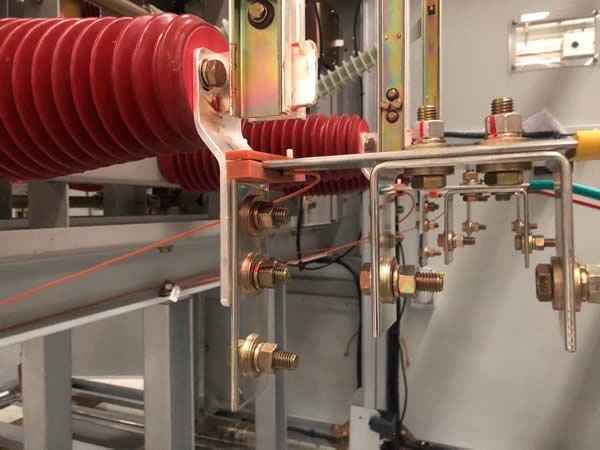
Each switchgear panel is configured with a minimum of 6 fiber optic measurement points, targeting the locations most vulnerable to thermal degradation:
| Localização de monitoramento | Points per Panel | Why This Location Is Critical |
|---|---|---|
| Contatos do disjuntor (Phases A / B / C) | 3 | Contact resistance increases with mechanical wear and surface oxidation — temperature rise here is the earliest indicator of breaker deterioration |
| Cable Joint Terminations (Phases A / B / C) | 3 | Crimped and bolted terminations loosen over time under repeated thermal cycling, creating increased resistance and localised hot spots |
Depending on the switchgear configuration and operating requirements, the monitoring scope can be extended to 9, 12, or more points per panel — covering busbar joints, contatos isoladores, earthing switch connections, and other high-risk interfaces.
Fiber Optic Temperature Monitoring System — Technical Specifications

| Parâmetro | Especificação |
|---|---|
| Faixa de Medição de Temperatura | −20 °C to +150 °C |
| Precisão de medição | ±1 °C |
| Método de detecção | Contact-type fluorescence fiber optic — no impact on insulation performance |
| Operating Ambient Temperature | −40 °C a +70 °C |
| Imunidade EMI | Fully immune — passive optical sensing with no electronics at the measurement point |
| Minimum Monitoring Points | ≥ 6 per switchgear panel (expansível) |
| Interface de comunicação | RS485 (Modbus RTU) |
| Local Display | LCD with real-time temperature readout and on-site alarm indication |
| Registro de dados | Temperature history, eventos de alarme, timestamps — supports trend analysis |
| Sensor Probe Service Life | ≥ 30 Anos |
| Material do Sensor | Rare-earth luminescent material — fully compatible with switchgear insulation requirements |
| Fiber Cable | Flexível, small-diameter optical fiber — suitable for routing through tight switchgear compartments |
| Instalação | Compatible with new-build and retrofit switchgear installations |
Switchgear Temperature Monitoring Technology Comparison: Fiber Optic vs Infrared vs Wireless vs Thermocouple

Selecting the right temperature monitoring technology for switchgear requires evaluating safety, Fiabilidade, exatidão, and total cost of ownership inside enclosed, high-EMI environments. The following comparison table provides a side-by-side assessment of four mainstream approaches to help engineers, procurement teams, and asset managers make an informed decision.
| Critérios | Fibra Óptica de Fluorescência | Termografia infravermelha (E) | Sensores de temperatura sem fio | Termopares / IDT |
|---|---|---|---|---|
| Modo de monitoramento | Continuous online — 24/7 tempo real | Periodic manual inspection | Online — periodic sampling | Continuous online |
| Panel Access Required | No — sensors permanently installed inside panel | Yes — panel door or IR window must be opened | Não | Não |
| Imunidade EMI | Fully immune — all-optical signal path | Não afetado | RF signal attenuated by metal enclosure | Highly susceptible — EMI degrades accuracy |
| Poder / Battery Requirement at Sensor | None — fully passive at sensing point | N / D (handheld device) | Battery-powered — requires periodic replacement | None — passive at sensing point |
| Maintenance Inside Live Panel | Nenhum é necessário | N / D (not permanently installed) | Battery replacement needed — safety risk in live panel | Baixo |
| RF Emissions | Nenhum | Nenhum | Yes — potential concern near sensitive equipment | Nenhum |
| Precisão de medição | ±1 °C | ±2 °C (affected by emissivity setting, distância, angle) | ±1 °C a ±2 °C | ±1 °C (degrades under EMI) |
| Sensor Service Life | ≥ 30 Anos | N / D (handheld equipment) | Limited by battery life (typically 2–5 years) | 5–10 years (environment-dependent) |
| Isolamento Elétrico / Segurança de Isolamento | Excellent — all-optical, full galvanic isolation | N / D | Moderate — creepage distance must be considered | Ruim – condutores metálicos apresentam risco de isolamento |
| Análise de Tendências & Manutenção Preditiva | Forte – dados contínuos permitem tendências de taxa de aumento | Não suportado — captura apenas instantâneos discretos | Limitado – intervalos de amostragem mais longos reduzem a resolução | Suportado |
| Adequação para painéis metálicos | Ideal | Restrito — requer acesso à porta ou janela de visualização IR | Restrito – a blindagem metálica prejudica a comunicação | Funcional, mas a EMI é uma preocupação significativa |
| Custo total de propriedade (10+ Anos) | Baixo – sem consumíveis, sem substituições de bateria, manutenção mínima | Moderado – custo contínuo de mão de obra para inspeções periódicas | Alto – custo recorrente de substituição de bateria e procedimentos de segurança | Moderado — degradação do sensor e recalibração relacionada à EMI |
Sensor de temperatura de fibra óptica versus termografia infravermelha para inspeção de painéis
Infrared cameras require switchgear panels to be opened or fitted with IR windows before scanning — creating arc flash safety exposure for personnel and limiting inspection frequency to quarterly or annual schedules at best. Any thermal fault that develops between two inspection visits goes completely undetected. Fiber optic temperature sensors are permanently bonded to breaker contacts and cable terminations inside the panel, providing uninterrupted monitoring without any human access or operational interruption.
Fiber Optic Monitoring vs Wireless Temperature Sensors in Metal-Enclosed Switchgear
Wireless temperature sensors depend on batteries and radio frequency (RF) transmission — both of which face serious limitations inside metal-enclosed switchgear. Battery replacement requires physical access to energised compartments, introducing personnel safety risk. RF signals are severely attenuated or blocked entirely by steel enclosures, leading to data gaps and communication failures. Fluorescence fiber optic sensors are entirely passive at the measurement point: sem bateria, no RF, no service access required for the life of the installation.
Fiber Optic Sensors vs Thermocouples and RTDs in High-EMI Switchgear Environments
Conventional electrical temperature sensors — thermocouples and resistance temperature detectors (IDT) — are inherently susceptible to electromagnetic interference from high-current busbars and switching transients inside switchgear. This EMI induces measurement errors precisely when accurate temperature data is most critical: during high-load events and fault conditions. Fluorescence fiber optic sensors use a purely optical signal path; electromagnetic interference has zero effect on the measurement.
Switchgear Temperature Alarm Management and SCADA System Integration

When any measurement point exceeds its configured threshold, the system responds simultaneously at two levels:
| Response Level | Ação | Detail |
|---|---|---|
| Local Alarm | LCD display highlights the alarm point | Shows temperature value and timestamp — enables rapid fault localisation by on-site personnel |
| Remote Alarm | RS485 / Modbus RTU data output | Alarm data transmitted in real time to SCADA, BMS, DCS, or substation automation systems |
Warning and critical alarm thresholds are independently configurable for each measurement point, allowing operators to apply tighter limits to aged equipment, higher-load circuits, or mission-critical feeders. A função integrada de registro de dados históricos oferece suporte à análise de tendências de temperatura de longo prazo e fornece evidências auditáveis para agendamento de manutenção, relatório de condição de ativo, e conformidade regulatória.
Monitoramento de temperatura de painéis de fibra óptica — Setores de aplicação
| Setor | Equipamento Típico | Valor de monitoramento |
|---|---|---|
| Utilitário & Subestações de rede | VM / Painéis de distribuição de baixa tensão | Proteja a confiabilidade da rede e reduza interrupções não planejadas |
| Fabricação Industrial | Centros de controle de motores, quadros de distribuição | Evite paradas de produção causadas por falhas elétricas |
| Centros de dados | Aparelhagem de energia crítica, Painéis de distribuição UPS | Proteja os SLAs de tempo de atividade e evite perdas catastróficas de energia |
| Trilho & Metrô | Quadro de distribuição de energia de tração | Garanta segurança, operação ininterrupta do fornecimento de tração |
| Óleo, Gás & No mar | Quadros de plataforma e marítimos | Reduza a intervenção de manutenção em locais de difícil acesso |
| Instalações de saúde | Painéis de energia essenciais para hospitais | Manter a continuidade da energia para segurança da vida |
| Edifícios Comerciais | Quadros de distribuição principais de arranha-céus | Lower insurance risk and support facility management programs |
| Energia Renovável | Solar / wind farm collector switchgear | Monitor remote assets with minimal site visits |
How Fiber Optic Temperature Monitoring Supports Predictive Maintenance in Switchgear
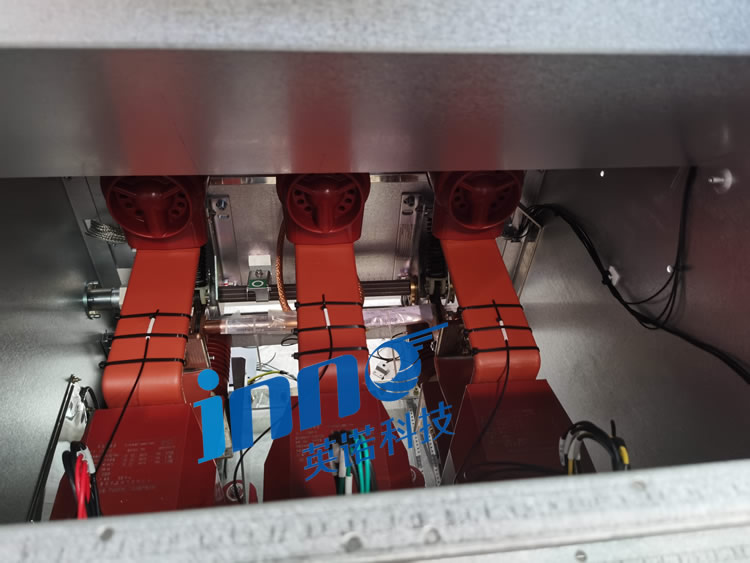
A single alarm event tells you that a threshold has been exceeded. Continuous temperature trend data tells you how fast a contact or joint is deteriorating — and how much time you have to act.
The system’s logged temperature history allows maintenance teams to track the rate of temperature rise at each monitoring point over weeks, meses, and years. A connection that shows a steady upward trend — even while still within safe operating limits — is a leading indicator of increasing contact resistance caused by loosening, corrosão, or surface degradation.
This trend-based intelligence is significantly more actionable than reactive alarms alone. It enables planned intervention before any critical threshold is reached, reducing emergency callouts, avoiding unplanned outages, extending equipment service intervals, and lowering the total cost of switchgear ownership.
Frequently Asked Questions — Fiber Optic Temperature Monitoring for Switchgear
What certifications and standards does the fiber optic monitoring system comply with?
Please contact our engineering team directly for current certification documentation. We can provide compliance information relevant to your project specifications, local grid codes, or procurement standards — including IEC, IEEE, GB, and equivalent regional frameworks.
Can alarm thresholds be customised independently for each fiber optic temperature sensor?
Sim. Warning and critical alarm thresholds are independently configurable for each of the six or more measurement points per panel. This enables operators to apply differentiated limits based on equipment age, corrente nominal, condições ambientais, or asset criticality.
How is the fiber optic temperature system integrated into an existing SCADA or substation automation platform?
The transmitter outputs data via RS485 using Modbus RTU — one of the most widely supported communication protocols in substation and industrial automation. Integration typically requires mapping the transmitter’s register addresses into the existing SCADA or DCS configuration. We provide Modbus register maps and integration support documentation as standard with every project.
What happens if a fiber optic sensor probe is damaged in the field?
The transmitter automatically detects an open or broken fiber and flags the affected channel with a dedicated sensor fault alarm — clearly distinguished from a temperature alarm. Individual probe replacement is possible without affecting the remaining monitoring channels. Spare probes are available as stocked items, and our team provides field replacement guidance.
Is this fiber optic temperature monitoring system suitable for retrofitting into existing switchgear?
Sim. The system is designed to be fully retrofit-compatible. Sensor probes are compact and flexible, and the transmitter and display unit can be mounted in available panel space or an adjacent auxiliary compartment. Retrofit feasibility depends on the specific switchgear model, compartment access, and available clearances — contact us with your panel type and we will assess compatibility.
What is the total cost of ownership compared to wireless switchgear temperature monitoring?
Over a 10-year or 20-year lifecycle, fiber optic monitoring typically delivers a significantly lower total cost of ownership than wireless systems. There are no batteries to replace, no scheduled sensor maintenance interventions inside live panels, and no consumable parts. The sensor probe life of 30+ years means the system is effectively install-and-forget at the sensing point — a decisive advantage in substations and facilities where minimising live-panel access is a core safety objective.
Request Technical Datasheets & a Project Consultation
Our engineers work directly with utilities, Os contratantes EPC, OEM panel builders, and facility operators worldwide to specify the right fiber optic temperature monitoring architecture for each installation — including panel count, sensor layout, lógica de alarme, communication topology, and integration with existing SCADA or BMS platforms.
→ Send us your switchgear model, panel quantity, e requisitos do local. We will respond with a full technical proposal within one business day.
Contate-nos em www.fjinno.net