 INNO glasvezel temperatuursensoren ,Temperatuur Monitoring Systemen.
- Een transformator temperatuur-vochtigheid monitoringsysteem is een continue detectieoplossing die tegelijkertijd de wikkelwarmte volgt, omgevingstemperatuur, en relatieve vochtigheid in transformatorbehuizingen — in realtime, zonder onderbreking.
- Temperatuur en vochtigheid moeten samen worden bewaakt, omdat hun gecombineerde effect op de isolatie van de transformator de veroudering veel sneller versnelt dan beide factoren afzonderlijk.
- Fluorescentie glasvezelsensoren zijn de gevestigde technologie voor het meten van directe wikkelingshotspots in onder spanning staande hoogspanningstransformatoren - volledig diëlektrisch, immuun voor elektromagnetische interferentie, en veilig bij spanningsoverschrijdingen 100 kV.
- De omgevingstemperatuur en relatieve vochtigheid in transformatorruimtes worden gemeten door speciale transformatorruimtes temperatuur-vochtigheidssensoren met nauwkeurigheid en beschermingsklassen van industriële kwaliteit.
- Alarmdrempels, koelsysteem vergrendelingen, en de activering van de ontvochtiger worden allemaal automatisch beheerd door het monitoringsysteem, reducing the need for manual inspection rounds.
- Systems communicate over RS485 / Modbus RTU and integrate with SCADA, DCS, and substation automation platforms without custom hardware.
- Manufactured by Fuzhou Innovatie Elektronische Scie&Leverancier:Tech Co., Bvba., with over a decade of field-proven fiber optic sensing experience since 2011.
1. Wat is een transformatortemperatuur-vochtigheidsbewakingssysteem?
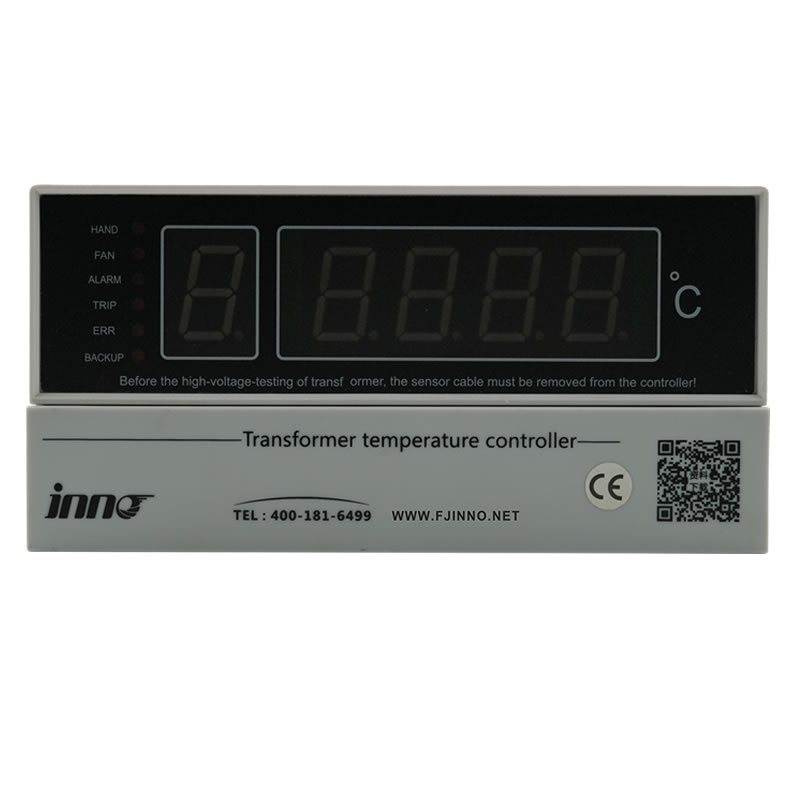
Een transformator temperatuur-vochtigheid monitoringsysteem is een continu, real-time instrumentation solution that simultaneously measures the thermal and moisture conditions inside and around a power transformer. It tracks winding hot-spot temperature, hoogste olietemperatuur, transformer room ambient temperature, and relative humidity — feeding all readings into a central monitoring unit that logs data, activeert alarmen, and activates protective responses automatically.
The defining characteristic of this type of system is its dual focus. Temperature and humidity are not independent variables in a transformer environment — they interact directly at the insulation level. A transformer operating at elevated temperature in a humid environment degrades its cellulose insulation at a rate that cannot be predicted from either measurement alone. Monitoring both simultaneously, at all times, is the only way to accurately assess insulation condition in service.
Een compleet transformatorconditiebewakingssysteem typically comprises four layers: sensing elements at the transformer and in the surrounding environment, a local data acquisition unit, a communication link to the site control system or cloud platform, and supervisory software that presents data, trends, and alarms to operators. Each layer is specified to the electrical environment of the installation — high-voltage substation, industrial distribution room, or outdoor pad-mount transformer — with appropriate insulation ratings, protection classes, en communicatieprotocollen.
2. Why Transformers Need Simultaneous Thermal and Moisture Surveillance
A power transformer’s operational life is determined primarily by the condition of its cellulose paper insulation. That insulation degrades through two mechanisms that are continuously at work during normal operation: thermal aging and moisture absorption. Understanding how these two mechanisms interact explains why a combined temperature and humidity monitoring approach is more effective than tracking either parameter in isolation.
The Effect of Temperature on Transformer Insulation Life
Transformer insulation aging follows an exponential relationship with temperature — a principle codified in international loading standards. For every 6–8°C rise above the rated hot-spot temperature, the rate of cellulose degradation approximately doubles. This means a transformer operating continuously at 10°C above its design hot-spot temperature loses insulation life at four times the expected rate. Direct, continu winding hot-spot temperature monitoring is the only way to detect this condition in real time before it causes irreversible insulation damage.
The Effect of Humidity on Insulation Integrity and Dielectric Strength
Moisture enters transformer insulation through aging of the oil-paper system, through breather degradation, and through condensation cycles during transformer load fluctuations. As moisture content in the paper insulation rises, its dielectric strength falls — increasing the risk of partial discharge, accelerating further cellulose decomposition, and reducing the insulation’s resistance to voltage surges. Een transformer room humidity sensor that detects rising relative humidity before moisture migrates into the oil-paper system provides an early-warning window that temperature monitoring alone cannot offer.
The Combined Degradation Effect
When elevated temperature and elevated humidity are present simultaneously, their combined effect on insulation aging is multiplicative, not additive. Hot, moist conditions drive moisture deeper into the paper insulation, accelerate acid formation in the oil, and increase the rate of degree-of-polymerization loss in the cellulose. Een transformer temperature and humidity monitoring system captures this interaction by providing a continuous, correlated record of both parameters — enabling insulation life models, load management decisions, and predictive maintenance scheduling that no single-parameter monitoring system can support.
Consequences of Unmonitored Thermal and Moisture Excursions
Transformers that operate without continuous thermal and moisture monitoring are vulnerable to undetected insulation aging events that manifest only when failure is already imminent. The consequences range from unplanned outages and forced derating to insulation breakdown, oil fires, and catastrophic bushing failures. In substation environments where transformer failure triggers cascading supply disruptions, the business and safety case for continuous real-time transformer condition monitoring is unambiguous.
3. What a Transformer Thermal and Humidity Monitor Actually Measures
A fully specified transformator temperatuur-vochtigheid monitoringsysteem acquires readings across several distinct measurement points, each targeting a different aspect of transformer thermal and moisture condition:
- Winding hot-spot temperature — the highest temperature within the active winding, measured directly with a fiber optic probe embedded in the coil during manufacture or inserted through an access port
- Topolietemperatuur — the temperature of the transformer oil at the top of the tank, indicative of overall thermal loading and cooling system performance
- Transformer room ambient temperature — the dry-bulb air temperature inside the transformer enclosure or switchroom, which affects cooling efficiency and condensation risk
- Relative humidity inside the transformer room — the moisture content of the air surrounding the transformer, critical for assessing condensation risk and breathing system performance
- Moisture-in-oil content (facultatief) — dissolved water concentration in the transformer oil, providing a direct measure of insulation moisture migration
- Kerntemperatuur (facultatief) — iron core temperature for large power transformers where core losses are a significant heat source
The combination of winding hot-spot, olie temperatuur, omgevingstemperatuur, and relative humidity gives operators a complete thermal and moisture picture of the transformer at all times — not a snapshot taken during a maintenance visit, but a continuously updated record of every operating hour.
4. Sensing Technologies: How Winding Temperature and Humidity Are Measured
Fluorescence Fiber Optic Sensors for Winding Hot-Spot Detection
Direct winding temperature measurement inside a live high-voltage transformer presents a fundamental challenge: the sensor must operate in contact with windings that may be energized at tens or hundreds of kilovolts, inside a tank filled with dielectric oil, in a strong alternating magnetic field. No conventional electronic sensor can meet all three requirements simultaneously.
De fluorescentie glasvezel temperatuursensor solves this problem completely. The sensing probe is entirely dielectric — no metallic conductor runs from the high-voltage winding to the monitoring instrument. The measurement principle is optical: a phosphor tip at the probe end responds to temperature through changes in fluorescence decay time, and the signal travels back to the instrument as light through a glass fiber. The probe is unaffected by the transformer’s magnetic field, generates no electrical interference within the tank, and can be installed directly on winding conductors at any voltage level without additional isolation hardware.
Omdat de fiber optic winding temperature probe meet de werkelijke hotspot-locatie – niet een indirecte benadering van de olietemperatuur – het levert de meest nauwkeurige en direct bruikbare input voor berekeningen van de levensduur van isolatie en beslissingen over dynamische thermische belasting.
Geïntegreerde temperatuur-vochtigheidssensoren voor omgevingsbewaking
De omgevingsomstandigheden in de transformatorruimte worden bewaakt door gecombineerde temperatuur- en vochtigheidssensoren die gebruik maken van capacitieve polymeervochtigheidselementen gecombineerd met nauwkeurige NTC-thermistors of PT100-weerstandstemperatuurdetectoren. Deze sensoren zijn ondergebracht in tegen straling beschermde behuizingen met gefilterde ventilatie om besmetting te voorkomen en tegelijkertijd te garanderen dat de metingen de werkelijke omgevingsomstandigheden weerspiegelen in plaats van plaatselijke warmte van het transformatoroppervlak.
Voor buitentransformatorinstallaties en pad-mount units, sensors are specified with IP65 or IP67 protection ratings and UV-resistant housings to withstand direct weathering over multi-year deployment periods without recalibration.
Moisture-in-Oil Sensors for Insulation Moisture Assessment
Where a more direct measure of insulation moisture condition is required, een oil moisture sensor can be added to the monitoring system. These devices measure the water activity or dissolved water concentration in the transformer oil — a parameter that equilibrates with the moisture content of the paper insulation and therefore provides an indirect but continuous measure of insulation moisture level without requiring oil sampling or laboratory analysis.
5. Sensor Technology Comparison for Transformer Condition Monitoring

| Parameter | Fluorescence Fiber Optic Probe | Capacitive Humidity + NTC/PT100 Sensor | Olievochtsensor |
|---|---|---|---|
| Measurement target | Kronkelende hotspot / olie temperatuur | Room ambient temperature and relative humidity | Dissolved water in transformer oil |
| Sensing principle | Levensduurverval van fluorescentie | Capacitive polymer (RH) + weerstand (T) | Water activity equilibrium |
| Temperatuur bereik | −40°C to +260°C | Typically −40°C to +85°C | 0°C tot +100°C (oil temp) |
| Vochtigheidsbereik | N.v.t | 0–100% RH | 0–100% water activity |
| Electrical insulation | Fully dielectric — >100 kV rated | Standard industrial isolation | Standard industrial isolation |
| EMI-immuniteit | Complete — no metallic sensing path | Good with shielded cable | Good with shielded cable |
| Installation location | Directly on winding / in oil tank | Transformer room wall / behuizing | Inline with oil circuit or sampling valve |
| Installatie methode | Embedded during winding or inserted via access port | Wall-mount with radiation shield | Flanged inline fitting or sampling port |
| Beschermingsgraad | IP67 (doorvragen); IP54+ (instrument) | IP65 / IP67 (openlucht-) | IP65 / IP67 |
| Communicatie | RS485 (via transmitter) | RS485 / 4–20 mA | RS485 / 4–20 mA |
| Maintenance requirement | None under normal conditions | Periodic filter cleaning; sensor replacement at end of rated life | Annual validation recommended |
| Best suited for | Direct winding and oil thermal monitoring in HV transformers | Continuous ambient condition tracking in transformer rooms | Insulation moisture condition assessment |
6. Systeemarchitectuur, Communicatie, en besturingsintegratie
Local Data Acquisition and Signal Conditioning
All sensors in a transformatorbewakingssysteem feed into a local acquisition unit — a DIN-rail or panel-mount module that conditions analog signals, polls digital sensors, and presents a unified data stream to the communication layer. For fluorescence fiber optic probes, the acquisition unit doubles as the optical interrogator: it generates the excitation light pulse, measures the fluorescence decay time, and converts the result to a calibrated temperature value before transmitting it over the network.
Local acquisition units are specified with the protection class and operating temperature range of the installation environment. Units destined for outdoor kiosk mounting or underground switchrooms are rated to wider temperature and humidity extremes than those installed in climate-controlled control buildings.
Wired and Wireless Communication Options
The standard communication interface for transformer temperature and humidity data transmission is RS485 with Modbus RTU — a proven, noise-immune protocol that operates reliably in the electrically demanding environment of a substation. For installations where cable routing is impractical — rural transformer stations, overhead-line distribution transformers, or temporary monitoring deployments — wireless communication over 4G LTE, LoRaWAN, or NB-IoT provides an equally capable alternative without the cost and disruption of cable infrastructure.
SCADA, DCS, and Substation Automation Integration
Een transformatorconditiebewakingssysteem does not operate in isolation — its value multiplies when its data feeds into the site’s existing supervisory infrastructure. Standard Modbus RTU output makes integration with SCADA platforms, distribution management systems, and IEC 61850-compliant substation automation systems straightforward. Operators see transformer thermal and humidity status on the same display screens as protection relays, circuit breaker positions, and load measurements — without dedicated monitoring terminals or parallel display systems.
Cloud-Based and Local Deployment Modes
For asset owners managing multiple transformer sites across a wide geographic area, cloud-based remote transformer thermal monitoring provides fleet-level visibility from a single web portal. Historische trends, alarmregistraties, and insulation life consumption estimates are accessible from any location with an internet connection. For sites with stringent data security requirements, the same functionality is available in a locally hosted deployment with no external network dependency.
7. Alarm Logic, Protective Interlocks, and Automated Cooling Control
Tiered Temperature Alarm Thresholds
A well-configured transformatorwikkeling temperatuurbewakingssysteem implementeert minimaal twee alarmniveaus voor elk temperatuurmeetpunt. Het eerste niveau – het waarschuwingsalarm – waarschuwt operators voor een thermische toestand die aandacht verdient, maar nog geen onmiddellijke belastingvermindering vereist. Het tweede niveau – de hoge alarm- of uitschakeldrempel – activeert een automatische beschermende reactie. Het instellen van deze drempels vereist kennis van de nominale hotspottemperatuur van de transformator, isolatie klasse, en koelsysteemcapaciteit; het monitoringsysteem levert de gegevens om deze instellingen in de loop van de tijd te valideren en te verfijnen op basis van de feitelijke bedrijfsgeschiedenis.
Vochtigheidsalarm en dauwpuntbewaking
Alarmen voor relatieve vochtigheid in transformatorruimten worden doorgaans ingesteld op 70-80% RH als waarschuwingsniveau 90% RV als kritisch niveau, though the appropriate thresholds depend on the ambient temperature and the transformer’s breathing system design. More precisely, dew point monitoring — calculated from simultaneous temperature and humidity measurements — identifies the specific condition at which condensation will form on transformer surfaces and bushings. A dew point alarm provides earlier and more physically meaningful warning than a relative humidity threshold alone.
Automated Cooling and Dehumidification Interlocks
The alarm outputs of a transformator temperatuur-vochtigheid monitoringsysteem can be wired directly to cooling system contactors and dehumidifier controls. When winding temperature exceeds the warning threshold, the system can automatically switch the transformer from natural cooling (ONAN) to forced-air cooling (AAN UIT) without operator intervention — reducing peak hot-spot temperature and extending insulation life. When relative humidity or dew point exceeds its threshold, the system activates the room dehumidifier or enclosure heater to prevent condensation before it reaches the transformer surface.
Data Logging and Insulation Life Tracking
Every temperature and humidity reading is time-stamped and stored in the system’s non-volatile memory and forwarded to the supervisory platform. This continuous historical record supports IEC 60076-7 thermische verouderingsberekeningen, providing an accumulated insulation life consumption figure that asset managers can use to inform maintenance scheduling, beslissingen over laden, and end-of-life planning for each individual transformer under continuous monitoring.
8. Installatie, Probe Placement, and Field Deployment Guidelines
Fiber Optic Probe Positioning in Transformer Windings
The accuracy and relevance of winding hot-spot measurements depend directly on probe placement. Voor nieuwe transformatoren, glasvezel temperatuursondes are embedded in the winding during manufacture — positioned at the location of predicted maximum temperature based on thermal finite-element analysis of the specific design. For in-service transformers, probes can be introduced through oil-fill valves or dedicated access ports, and positioned against winding conductors using flexible probe guide assemblies designed for retrofit installation without tank draining.
Multiple probes are typically deployed — one per winding in a three-winding transformer, plus one in the top oil — to ensure that the hottest point in each winding is captured regardless of load distribution between phases and windings.
Humidity Sensor Location and Radiation Shielding
Omgeving transformer room humidity sensors must be positioned to measure representative air conditions rather than localized microenvironments near heat sources or cold walls. Recommended placement is at mid-height on an interior wall, away from direct air supply vents, transformer cooling surfaces, and external walls subject to solar gain. A radiation shield — a multi-plate aspirated housing — prevents the sensor from responding to radiant heat from the transformer body while allowing free air circulation across the sensing element.
Protection Class and Hazardous Area Considerations
Transformer installations in petrochemical plants, mining sites, and offshore platforms require monitoring equipment rated for the applicable hazardous area zone classification. All sensing and acquisition components deployed in these environments must carry the appropriate ATEX, IECEx, or national equivalent certification. The fully passive nature of fluorescentie glasvezelsondes — with no electrical energy at the sensing point — makes them inherently compatible with Zone 1 en Zone 2 hazardous area installations for the probe itself; acquisition units located outside the hazardous area require standard industrial enclosure ratings.
9. Industry Applications and Transformer Types Covered
Grid Substations and Transmission Transformers
High-voltage transmission transformers — 110 kV, 220 kV, 500 kV — represent the highest capital value and most critical reliability assets in the power grid. Continu transmission transformer temperature and humidity monitoring provides the data needed to operate these assets at maximum permissible loading without exceeding insulation life limits, and to detect developing thermal faults before they propagate to failure.
Industrial Distribution Transformers and Factory Power Rooms
Industrial facilities with large motor loads, frequentieregelaars, or arc furnaces subject their distribution transformers to highly variable and often demanding thermal cycles. Een real-time thermal monitoring system for industrial transformers quantifies the actual thermal stress experienced by each unit under production conditions, enabling maintenance teams to schedule inspection intervals based on measured insulation condition rather than calendar time.
Renewable Energy Step-Up Transformers
Wind turbine transformers and solar farm step-up transformers operate in outdoor environments with wide diurnal and seasonal temperature swings, often in humid coastal or high-altitude locations. Continuous temperature and humidity surveillance for these assets is particularly valuable because physical access for manual inspection is difficult, downtime is commercially costly, and the thermal environment is more variable than in conventional grid substations.
Traction Transformers in Rail and Metro Systems
Traction transformers in railway substations and onboard rolling stock operate under heavy cyclic loading synchronized with train arrival patterns. Continu traction transformer thermal monitoring supports dynamic load management — holding peak winding temperature within safe limits during rush-hour loading peaks while allowing higher power throughput during off-peak periods.
Data Center and UPS Transformers
Transformers in data center power distribution chains must maintain continuous availability. Een temperature humidity monitoring system integrated into the data center’s building management infrastructure provides the same continuous thermal and moisture visibility as in any industrial installation, with the additional benefit of seamless integration into the BMS alarm matrix and capacity planning tools already in use by the facility operations team.
10. How to Specify the Right Transformer Monitoring System
Define the Measurement Points and Sensor Types Required
Start from the transformer’s design and operating environment. A new oil-filled power transformer with factory-installed winding probes requires a different specification than a retrofit monitoring installation on an existing dry-type distribution transformer in an industrial switchroom. List each measurement point — winding phases, olie temperatuur, omgevingstemperatuur, relative humidity — and confirm the physical access and installation method available for each.
Match Sensing Technology to the Electrical Environment
For any measurement point inside or in close proximity to a live high-voltage winding, specify a Glasvezel temperatuursensor with a verified dielectric rating appropriate to the system voltage. For ambient room measurements, standard industrial temperature and humidity sensors with appropriate protection class for the enclosure type are suitable. Do not use metallic thermocouple or RTD probes in locations where they create a conductive path between high-voltage components and the monitoring instrument enclosure.
Select the Communication Architecture
Where cable infrastructure to a substation control building already exists, RS485 with Modbus RTU provides the simplest and most reliable integration path. Where cable installation is impractical or the site is unmanned and remotely located, specify a 4G or LoRaWAN wireless gateway. Confirm that the supervisory platform at the receiving end — SCADA, GBS, or DMS — supports the chosen protocol natively or through an available communication driver.
Confirm Certification and Standards Compliance
Specify certification requirements early. Hazardous area installations require ATEX or IECEx marking on field-mounted components. Grid-connected substation installations may require compliance with IEC 60076 (stroomtransformatoren), IEC 61850 (substation communication), or national grid operator standards. Request certification documentation from the manufacturer before procurement to avoid delays during commissioning and inspection.
Combined System Deployment for Large Transformer Banks
For transformer banks with multiple units — common in large grid substations and industrial power stations — a single acquisition network can serve all transformers simultaneously. Each transformer’s fiber optic probes and room sensors connect to a shared RS485 bus, and the supervisory platform displays comparative thermal loading and humidity data across all units in a single view. This architecture minimizes hardware cost and simplifies operator training while providing complete continuous coverage of the entire transformer installation.
11. Veelgestelde vragen
Q1: Why is it important to monitor both temperature and humidity in a transformer installation?
Temperature and humidity act together on transformer insulation. Elevated temperature accelerates cellulose aging; elevated humidity reduces dielectric strength and accelerates moisture migration into the paper insulation. When both are present simultaneously, insulation degradation is multiplicative. Een combined transformer temperature and humidity monitoring system captures this interaction, providing the data needed for accurate insulation life assessment and timely protective action — which neither parameter monitored in isolation can deliver.
Vraag 2: Can fiber optic temperature sensors be installed on a transformer that is already in service?
Ja. Retrofit fiber optic temperature probe installations are carried out through existing oil-fill ports or dedicated access fittings without requiring full oil drainage or tank entry in most transformer designs. Flexible probe guide systems allow the sensing tip to be positioned against a winding conductor from the outside of the tank. The retrofit process is typically completed during a planned outage window without requiring the transformer to be removed from service for an extended period.
Q3: What is the difference between top-oil temperature monitoring and direct winding hot-spot monitoring?
Top-oil temperature is a bulk measurement of the oil at the top of the transformer tank — it responds slowly to changes in winding loading and can underestimate the actual hot-spot temperature by 20–30°C under rapid load increase conditions. Direct winding hot-spot temperature monitoring with a fiber optic probe measures the actual temperature at the hottest point in the winding, providing a faster, more accurate signal for thermal protection and insulation life calculations. IEC 60076-7 explicitly recommends direct hot-spot measurement over oil temperature estimation for accurate insulation aging models.
Q4: What relative humidity level should trigger an alarm in a transformer room?
A typical configuration sets a warning alarm at 70–75% relative humidity and a critical alarm at 85–90% RH. Echter, the most physically meaningful threshold is the dauwpunt temperatuur — calculated from simultaneous dry-bulb temperature and relative humidity measurements — because condensation forms when the surface temperature of transformer components falls below the dew point, regardless of the absolute RH value. A monitoring system that calculates and alarms on dew point provides earlier and more actionable warning than an RH threshold alone.
Vraag 5: How does the monitoring system activate the cooling fans or dehumidifier automatically?
De transformer temperature humidity monitoring unit includes relay or transistor alarm outputs that are wired directly to the control circuits of cooling fans, olie pompen, en luchtontvochtigers. When a temperature or humidity measurement crosses a configured threshold, the corresponding output activates within seconds — starting forced cooling or dehumidification without requiring operator intervention. The activation and deactivation events are logged with timestamps for maintenance records.
Vraag 6: Is the fluorescence fiber optic probe affected by the transformer’s magnetic field?
Nee. De fluorescentie glasvezel temperatuursonde operates entirely on optical principles — light in, light out. There are no magnetic or electrically conductive elements in the sensing path, so the alternating magnetic field inside a power transformer has no effect on measurement accuracy. This is a fundamental advantage of optical sensing over any metallic thermocouple or RTD probe, both of which are susceptible to magnetically induced voltage errors in transformer environments.
Vraag 7: Can the monitoring system communicate with an existing substation SCADA platform?
Ja. The standard RS485 / Modbus RTU output of the transformer monitoring acquisition unit is natively supported by virtually all SCADA, DCS, and substation automation platforms in current use. For IEC 61850-compliant substations, a protocol gateway converts Modbus RTU to IEC 61850 GOOSE or MMS without modifying the monitoring hardware. Integration requires only the Modbus register map — supplied with the product — and standard SCADA configuration work.
Vraag 8: How many transformers can one monitoring system cover simultaneously?
A single RS485 network can address up to 247 Modbus slave devices — sufficient to cover an entire transformer substation with winding probes, sensoren voor olietemperatuur, and room humidity sensors on multiple transformer units from a single master acquisition unit. For very large installations, multiple RS485 segments can be aggregated at the supervisory software level, providing a unified monitoring view across any number of transformers without practical upper limit.
Vraag 9: What maintenance does a transformer temperature humidity monitoring system require?
Fluorescentie glasvezelsondes require no scheduled maintenance under normal operating conditions — their rated lifespan exceeds 25 jaren. Room temperatuur- en vochtigheidssensoren benefit from periodic filter inspection and cleaning, and sensor elements should be replaced according to the manufacturer’s stated calibration interval — typically every two to five years depending on the contamination level of the installation environment. The acquisition unit and communication hardware require no routine maintenance beyond firmware updates and periodic functional verification against a reference instrument.
Q10: Is it possible to add moisture-in-oil monitoring to an existing temperature and humidity monitoring installation?
Ja. Oil moisture sensors are available as add-on modules that connect to the existing RS485 network and report dissolved water concentration or water activity in the transformer oil through the same supervisory platform already in use for temperature and humidity data. Installation requires access to the transformer oil circuit through a sampling valve or inline fitting — a straightforward field modification that can be carried out during a routine maintenance outage.
12. Explore Our Transformer Monitoring Solutions
Fuzhou Innovatie Elektronische Scie&Leverancier:Tech Co., Bvba. has designed and manufactured glasvezel temperatuurbewakingssystemen en Oplossingen voor bewaking van de toestand van transformatoren sinds 2011. Our product range covers fluorescence fiber optic winding temperature probes, multi-channel fiber optic temperature transmitters, industrial temperature and humidity sensors, en compleet transformer temperature humidity monitoring systems voor energiebedrijven, industriële faciliteiten, hernieuwbare energie, and rail infrastructure applications worldwide.
Contact our engineering team to request a product datasheet, discuss a site-specific specification, or arrange an application consultation:
- Website: www.fjinno.net
- E-mail: web@fjinno.net
- WhatsApp (Engelstalig) / WeChat (China) / Telefoon: +86 135 9907 0393
- QQ: 3408968340
- Adres: Liandong U Grain Networking Industriepark, Xingye West Road nr. 12, Fuzhou, Fujian, China
Vrijwaring: The technical information and specifications stated in this article are provided for general informational purposes only and reflect standard product parameters at the time of publication. De werkelijke systeemprestaties kunnen variëren, afhankelijk van de installatieomstandigheden, transformator ontwerp, omgevingsfactoren, en toepassingsvereisten. All specifications are subject to change without notice. This content does not constitute a warranty, binding technical commitment, or engineering design recommendation for any specific installation. Always consult a qualified engineer and refer to applicable standards and manufacturer documentation for project-specific design and safety decisions.

Glasvezel temperatuursensor, Intelligent bewakingssysteem, Gedistribueerde fabrikant van glasvezel in China
 |
 |
 |