 INNO glasvezel temperatuursensoren ,temperatuurbewakingssystemen.
- A fluorescence-based fiber optic temperature sensor uses fluorescence lifetime decay technology to convert temperature changes into optical signals, providing complete electrical isolation, total EMI immunity, and intrinsic safety for high-voltage and harsh-environment monitoring.
- Vergeleken met thermokoppels, RTD's, infrarood sensoren, and FBG fiber Bragg grating sensors, fluorescent fiber optic temperature probes deliver superior performance in electromagnetic interference rejection, high-voltage withstand capability, stabiliteit op lange termijn, en onderhoudsvrije werking.
- INNO’s product range includes standard and armored fluorescent sensor probes, busbar/bolt-mount probes, single-channel OEM sensing modules, and multi-channel demodulators supporting 1 naar 64 channels — all with ±1°C accuracy, –40°C to +260°C range, En 25+ jaar levensduur.
- Applications span stroomtransformatoren, schakelapparatuur, GIS, generatoren, HVDC systems, motorwikkelingen, IGBT/SiC power devices, semiconductor equipment, MRI medical systems, battery energy storage, wind/solar power, ruimtevaart, and nuclear facilities.
- INNO (FJINNO) is a specialized fabrikant van glasvezeltemperatuursensoren met 20+ years of focused R&D experience, 3000+ installed systems worldwide, exports to 15+ landen, and comprehensive OEM/ODM customization capabilities.
- All products hold CE, EMC, RoHS, en ISO 9001/14001/27001/45001 certificeringen, ensuring global compliance and long-term reliability.
Inhoudsopgave
- 1. What Is a Fluorescence-Based Fiber Optic Temperature Sensor?
- 2. How Does It Work? — Fluorescence Lifetime Decay Principle
- 3. Core Advantages of Fluorescent Fiber Optic Temperature Sensors
- 4. Technical Comparison: Fluorescent Fiber Optic vs. Thermocouple vs. RTD vs. Infrared vs. FBG
- 5. INNO Fluorescent Fiber Optic Temperature Sensor Product Portfolio
- 6. Key Technical Specifications
- 7. Applications Across Industries
- 8. Sensor Selection & Installation Guide
- 9. OEM/ODM Customization & Global Partnership
- 10. About INNO — Manufacturer Credentials & Project References
- 11. Why Choose INNO Fluorescent Fiber Optic Temperature Sensors
- 12. Veelgestelde vragen (Veelgestelde vragen)
1. What Is a Fluorescence-Based Fiber Optic Temperature Sensor?

A fluorescence-based fiber optic temperature sensor is a precision optical sensing device that measures temperature by analyzing the fluorescence lifetime decay characteristics of a specialized sensing material bonded to the tip of an optical fiber probe. It represents the core sensing component within a complete glasvezel temperatuurbewakingssysteem, which typically consists of three elements: de fluorescent fiber optic temperature probe (sensor), the optical fiber transmission cable, en de temperature measurement demodulator host (signal processing unit).
Unlike conventional electrical temperature sensors that rely on metallic conductors carrying electrical signals, de fluorescerende glasvezelsensor operates on a purely optical principle — the sensing probe contains no electrical components, carries no current, and transmits only light signals through the fiber. This fundamental design difference gives the sensor its defining characteristics: complete electrical isolation from the measurement point, total immunity to electromagnetic interference (EMI/RFI), intrinsic safety with no spark or discharge risk, and stable operation in the strongest electromagnetic fields and highest voltage environments encountered in power systems, industrial equipment, and medical devices.
De termijn “op fluorescentie gebaseerd” specifically distinguishes this sensor type from other fiber optic temperature sensing technologies — such as vezel Bragg-rooster (FBG) sensoren, Raman scattering distributed systems, and Brillouin scattering systems — each of which operates on a different physical principle and is suited to different measurement scenarios. Among all fiber optic temperature sensing approaches, fluorescence lifetime decay sensing is widely recognized as the most reliable and practical technology for point-type high-voltage temperature measurement, which is why it has become the industry standard for transformer winding hot-spot monitoring, switchgear contact temperature measurement, and similar critical applications.
2. How Does It Work? — Fluorescence Lifetime Decay Principle
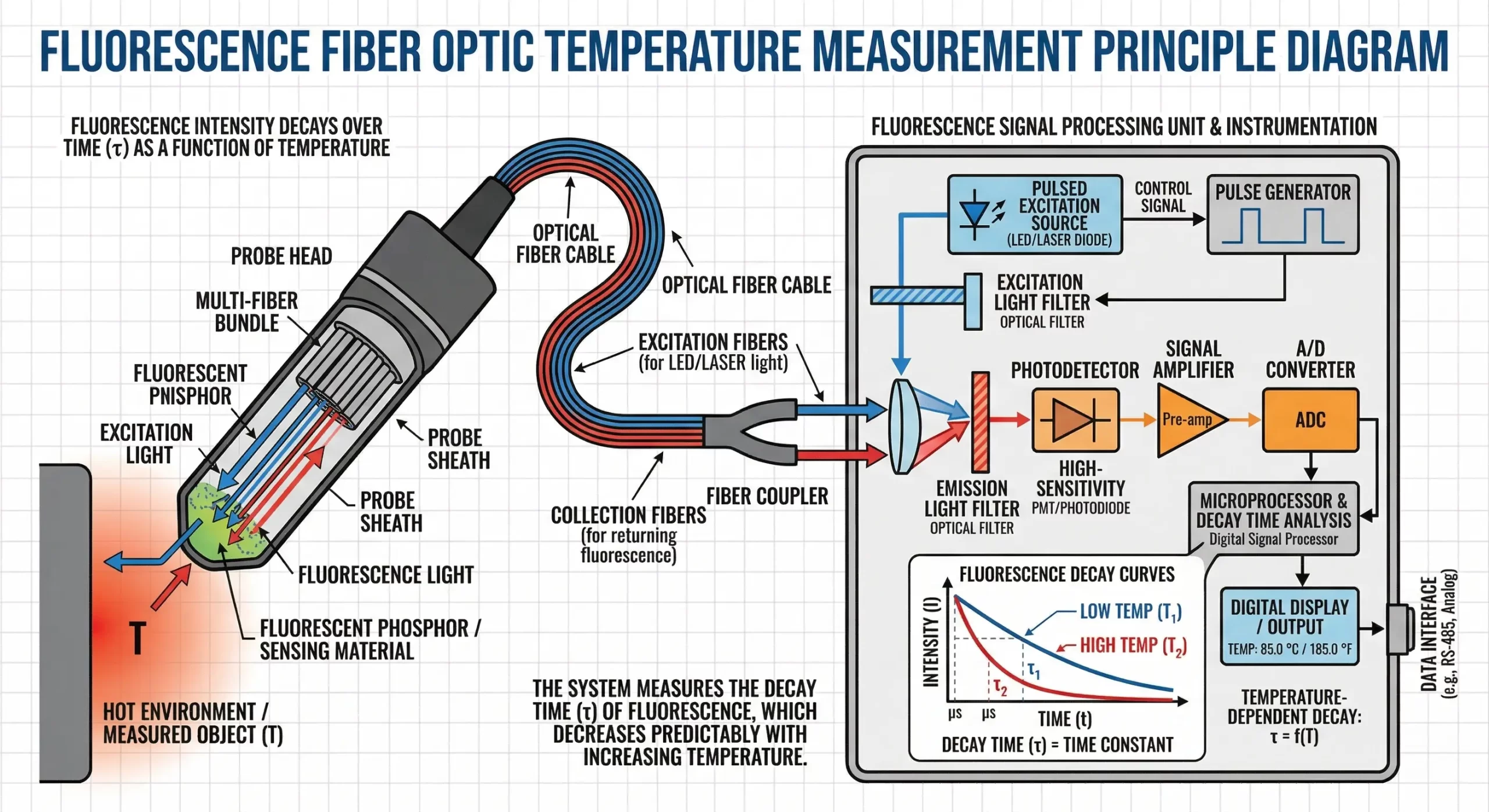
The operating principle of a fluorescence-based fiber optic temperature sensor centers on a physical phenomenon known as fluorescence lifetime decay. Understanding this mechanism is essential for appreciating why the sensor delivers such exceptional accuracy, stabiliteit, and reliability in demanding measurement environments.
The Fluorescence Lifetime Decay Mechanism
De fluorescent fiber optic temperature probe contains a rare-earth-doped fluorescent sensing material at its tip. Wanneer de glasvezel temperatuurdemodulator sends a pulse of excitation light through the optical fiber to the probe tip, the fluorescent material absorbs this light energy and transitions to an excited electronic state. As the material returns to its ground state, it re-emits light at a different wavelength — this is the fluorescence signal. The critical parameter is the time it takes for this fluorescence to decay after the excitation pulse ends, known as the fluorescence lifetime or decay time. This decay time has a precise, repeatable, and well-characterized relationship with temperature: as temperature increases, molecular thermal vibrations intensify, causing non-radiative energy dissipation to increase, which shortens the fluorescence decay time. The demodulator measures this decay time with high precision and converts it into an accurate temperature value using a factory-calibrated mathematical model.
Why Fluorescence Lifetime — Not Fluorescence Intensity?
An important design choice in the fluorescerende glasvezelsensor is the use of fluorescence lifetime (verval tijd) rather than fluorescence intensity as the measurement parameter. Fluorescence intensity is affected by numerous variables including fiber bending losses, connectorverliezen, light source power fluctuations, and long-term degradation of optical components — all of which would introduce measurement errors. Fluorescence lifetime, daarentegen, is an intrinsic property of the sensing material that depends only on temperature. It is completely independent of signal amplitude, vezelverliezen, and source intensity variations. Dit is waarom fluorescence lifetime decay sensors maintain their calibration accuracy over 25+ years without recalibration — a critical advantage over intensity-based optical sensing methods.
Distinction from Other Fiber Optic Temperature Sensing Methods
Fluorescence-based fiber optic temperature sensors are point-type measurement devices, providing high-accuracy temperature data at a specific, defined location. This distinguishes them from distributed fiber optic temperature sensing (DTS) systems based on Raman or Brillouin scattering, which measure temperature profiles along the entire length of a fiber but with lower spatial resolution and accuracy. It also distinguishes them from vezel Bragg-rooster (FBG) temperatuur sensoren, which measure wavelength shifts in reflected light and are inherently cross-sensitive to mechanical strain — requiring complex compensation techniques when used for temperature measurement alone. For dedicated point-type temperature monitoring in high-voltage and high-EMI environments, fluorescence lifetime-based fiber optic sensors provide the optimal combination of accuracy, stabiliteit, simplicity, en betrouwbaarheid op lange termijn.
Fluorescent Sensing Material & Sensor Longevity
The fluorescent sensing material is typically a rare-earth-doped crystal or ceramic compound selected for its stable temperature-dependent fluorescence characteristics, chemical inertness, and resistance to thermal aging. INNO’s proprietary fluorescent fiber optic temperature probes use carefully formulated sensing materials that maintain consistent fluorescence decay behavior across millions of measurement cycles over decades of continuous operation. Combined with robust fiber optic packaging and hermetic sealing techniques, these probes achieve an operational service life exceeding 25 years without measurable performance degradation — a longevity that has been validated through extensive accelerated aging testing and confirmed by over 3000 installed field systems worldwide.
3. Core Advantages of Fluorescent Fiber Optic Temperature Sensors

The practical value of a fluorescence-based fiber optic temperature sensor is defined by a set of performance characteristics that collectively make it the superior choice for critical temperature monitoring in challenging environments. Each advantage stems directly from the optical sensing principle and sensor construction design.
Volledige elektrische isolatie
De fluorescerende glasvezelsonde contains no metallic conductors and carries no electrical current at the measurement point. The optical fiber itself is a dielectric (niet-geleidend) material. This means the sensor provides inherent galvanic isolation between the measurement point and the monitoring equipment, with voltage withstand capability exceeding 100 kV. There are no ground loop risks, no leakage current paths, and no electrical safety hazards — making the sensor safe for direct installation on live, energized high-voltage components including transformatorwikkelingen, switchgear contacts, En GIS internal conductors.
Total Electromagnetic Interference Immunity
Because the sensor transmits only light — not electrical signals — it is completely immune to electromagnetic interference from any source: power frequency magnetic fields, high-frequency switching noise, radio frequency emissions, electrostatic discharge, and lightning-induced transients. This EMI immunity allows the fluorescerende glasvezel temperatuursensor to deliver stable, accurate readings in the most extreme electromagnetic environments, including inside operating transformers, adjacent to circuit breakers during switching operations, inside GIS compartments, within MRI scanners, and near high-power radar equipment.
Intrinsieke veiligheid
With no electrical energy present at the sensing point, de glasvezel temperatuursonde cannot generate sparks, bogen, or thermal hotspots under any fault condition. This intrinsic safety makes the sensor suitable for deployment in explosive or flammable atmospheres, oil-immersed environments, and gas-insulated enclosures without requiring additional explosion-proof enclosures or safety barriers.
Compact Probe Design
INNO's fluorescent fiber optic temperature sensor probes feature a slim diameter of just 2–3 mm, enabling installation in extremely confined spaces — including transformer winding slots, switchgear busbar connection points, motor stator slots, and miniature medical catheters. The small size ensures that probe installation does not affect the electromagnetic performance, thermal behavior, or mechanical integrity of the monitored equipment.
25+ Year Maintenance-Free Service Life
The fluorescence lifetime measurement principle is inherently drift-free, and the inorganic sensing material does not degrade under normal operating conditions. The result is a sensor that maintains its factory calibration accuracy throughout its entire operational life — typically exceeding 25 years — with no requirement for periodic recalibration, onderhoud, or component replacement. This translates directly into reduced long-term ownership costs and elimination of calibration-related downtime.
Fast Response & Hoge nauwkeurigheid
The sensor achieves a response time of less than 1 seconde, enabling real-time detection of rapid thermal events. Standard measurement accuracy is ±1°C across the full operating range, with higher-precision configurations available for specialized applications. The combination of fast response and high accuracy makes the fluorescerende glasvezelsensor suitable for both continuous condition monitoring and dynamic thermal event tracking.
Corrosion & Milieubestendigheid
De glasvezel temperatuursonde and optical fiber cable are inherently resistant to chemical corrosion, binnendringen van vocht, and environmental degradation. With appropriate protective packaging (including armored and hermetically sealed configurations), the sensors operate reliably in oil-immersed, high-humidity, chemically aggressive, and outdoor environments over their full 25+ year lifespan.
4. Technical Comparison: Fluorescent Fiber Optic vs. Thermocouple vs. RTD vs. Infrared vs. FBG

Choosing the right temperature sensing technology for critical equipment monitoring requires a clear understanding of each method’s capabilities and limitations. The following table provides a comprehensive side-by-side comparison of fluorescence-based fiber optic temperature sensors against four widely used alternative technologies — thermocouples, weerstand temperatuur detectoren (RTD's), infrarood sensoren, En vezel Bragg-rooster (FBG) sensoren — across the performance parameters most critical for high-voltage, industrieel, en medische toepassingen.
| Parameter | Fluorescerende glasvezelsensor | Thermokoppel | OTO (Pt100) | Infraroodsensor | FBG Fiber Sensor |
|---|---|---|---|---|---|
| Sensing Principle | Fluorescence lifetime decay | Seebeck effect (thermoelectric voltage) | Resistance change with temperature | Thermal radiation detection | Bragg-golflengteverschuiving |
| EMI-immuniteit | Volledige immuniteit | Susceptible — signal noise in high-EMI environments | Susceptible — requires shielding and filtering | Moderate — electronics susceptible | Volledige immuniteit (optical signal) |
| Elektrische isolatie | Full isolation — no conductors at sensing point | None — metallic conductors create ground loops | None — requires excitation current | Partial — electronics require isolation | Full isolation — all-optical |
| High-Voltage Withstand | >100 kV | Not suitable for HV environments | Not suitable for HV environments | Not suitable for direct HV contact | >100 kV |
| Metingstype | Direct contact — internal point measurement | Direct contact — point measurement | Direct contact — point measurement | Non-contact — surface only | Direct contact — point measurement |
| Strain Cross-Sensitivity | None — temperature only | Geen | Minimaal | Geen | High — requires strain compensation |
| Typische nauwkeurigheid | ±1°C | ±1.5–2.5°C | ±0.5–1°C | ±2–5°C (emissivity dependent) | ±1–2°C (after strain compensation) |
| Stabiliteit op lange termijn | Excellent — no drift over 25+ jaar | Poor — junction aging and drift | Moderate — resistance drift with thermal cycling | Poor — emissivity changes over time | Good — but wavelength may drift under strain |
| Herkalibratie vereist | Nee | Yes — periodic | Yes — periodic | Yes — frequent | Occasional |
| Levensduur | >25 jaar | 2–5 years typical | 5–10 years typical | 3–5 years typical | 15–20 years |
| Sondegrootte | 2–3 mm diameter | 3–6 mm diameter | 3–6 mm diameter | Bulky sensor head | ~0.2 mm (bare fiber) / 3–5 mm (packaged) |
| Wiring Complexity | Simple — single fiber per channel | Moderate — 2-wire with compensation | Complex — 3-wire or 4-wire | Simple — but requires line-of-sight | Simple — single fiber, multiplexbaar |
| Demodulator Cost | Gematigd | Laag | Laag-matig | Laag-matig | High — expensive interrogator |
| Intrinsieke veiligheid | Yes — no sparks, no electrical energy | No — potential spark source | No — excitation current present | No — electronics present | Yes — all-optical |
| Olie / Sealed Environment | Excellent — fully submersible | Limited — seal degradation over time | Limited — seal degradation over time | Not suitable — no line-of-sight | Good — with appropriate packaging |
| Best Suited For | HV point monitoring: transformatoren, schakelapparatuur, GIS, medisch, halfgeleiders | General industrial, low-EMI environments | Laboratory, HVAC, low-EMI process control | Surface temperature screening, non-contact only | Multi-point structural health monitoring with strain |
Sleutel afhaalmaaltijd
For dedicated point-type temperature monitoring in high-voltage, high-EMI, and harsh operating environments — including power equipment, schakelapparatuur, medical systems, and industrial applications — the fluorescence-based fiber optic temperature sensor offers the best overall combination of EMI immunity, elektrische isolatie, measurement stability, lange levensduur, and low total cost of ownership. Terwijl FBG fiber Bragg grating sensors share the advantage of optical signal immunity, their inherent strain cross-sensitivity and significantly higher interrogator costs make them less practical for pure temperature monitoring applications. Thermocouples and RTDs remain suitable for low-voltage, low-EMI general industrial applications but cannot match the performance requirements of critical high-voltage asset monitoring. Infrared sensors serve a role in non-contact surface temperature screening but are fundamentally unsuitable for internal hot-spot detection within enclosed or oil-filled equipment.
5. INNO Fluorescent Fiber Optic Temperature Sensor Product Portfolio

INNO offers a complete range of fluorescence-based fiber optic temperature sensing products — from individual sensor probes and OEM integration modules to multi-channel demodulators and turnkey monitoring systems. Each product is designed, manufactured, and tested in-house at INNO’s Fuzhou production facility, ensuring full quality control and consistent performance across the entire product line.
Fluorescerende glasvezeltemperatuursensorsondes
The sensor probe is the core measurement element of the system. INNO's standard fluorescent fiber optic temperature probes are suitable for general-purpose high-voltage and high-EMI temperature monitoring across a wide range of industries. For transformer applications, armored fiber optic temperature sensor probes feature ruggedized stainless steel or PTFE protective sheaths specifically designed for oil-immersed winding installations, providing mechanical protection and chemical resistance for decades of submerged operation. De busbar and bolt-mount fiber optic temperature sensor probes are engineered for switchgear and distribution panel applications, with mounting configurations optimized for secure attachment to busbar surfaces, bolted connections, and circuit breaker contact assemblies. All probe variants feature a compact 2–3 mm diameter and are available with customized fiber lengths up to 20 meters as standard.
Single-Channel Fiber Optic Temperature Sensing Module
De single-channel fluorescent fiber optic temperature sensing module is een compact, board-level OEM integration component designed for equipment manufacturers and system integrators who need to embed fiber optic temperature sensing capability directly into their own products. The module includes complete signal excitation, fluorescence detection, and temperature demodulation circuitry in a miniaturized package, with standard RS485/Modbus RTU output for direct connection to host controllers, PLC's, or embedded systems.
Multi-Channel Fiber Optic Temperature Demodulators
For multi-point monitoring applications, INNO provides multi-channel fiber optic temperature demodulators (measurement hosts) available in 6-channel, 16-kanaal, 32-kanaal, and 64-channel configurations. Each demodulator simultaneously processes fluorescence signals from all connected glasvezel temperatuursondes, providing real-time temperature data for every monitoring point. De display-integrated fiber optic temperature measurement host combines signal processing and local visual readout in a single panel-mount unit, ideal for control room installations. For extreme electromagnetic environments, de microwave electromagnetic anti-interference fiber optic temperature measurement system incorporates enhanced shielding and filtering to ensure stable operation near high-power RF sources, radar systems, en vermogenselektronica.
Application-Specific Systems
INNO also offers pre-configured, application-optimized systems including the fiber optic temperature measurement system for dry-type transformer windings, de intelligent monitoring device for polycrystalline silicon dry-type transformers, de dry-type reactor fiber optic temperature measurement device, de glasvezel temperatuurmeetsysteem voor schakelapparatuur, En fiber optic temperature measurement solutions for semiconductor processing equipment. Each system is engineered with the specific monitoring requirements, installatiebeperkingen, and communication protocols of its target application in mind.
Transformatortemperatuurregelaars
Complementing the fiber optic sensor line, INNO manufactures dry-type transformer temperature controllers including the BWDK-326 En BWDK-S201 serie, providing automated fan control, multi-stage over-temperature alarming, and trip protection functions. For oil-immersed applications, oil-immersed transformer fiber optic temperature monitoring systems combine winding hot-spot sensing with intelligent thermal management capabilities.
Software & Cloudplatform
INNO provides customized cloud platform software for fiber optic temperature monitoring systems, supporting remote data acquisition, real-time multi-channel visualization, configurable multi-level alarm management, historische trendanalyse, and integration with enterprise SCADA, DCS, and asset management platforms. The software platform is fully customizable to client-specific branding, interface requirements, and functional specifications.
6. Key Technical Specifications
The following table presents the standard technical specifications of INNO’s fluorescence-based fiber optic temperature sensors and multi-channel demodulator systems. All key parameters are customizable to meet specific project requirements.
| Parameter | Specificatie | Opmerkingen |
|---|---|---|
| Meetnauwkeurigheid | ±1°C | Higher precision available on request |
| Temperatuurbereik | –40°C to +260°C | Extended ranges customizable |
| Fiber Optic Cable Length | 0–20 meters (standaard) | Custom lengths available |
| Reactietijd | <1 seconde | Real-time thermal event detection |
| Sondediameter | 2–3 mm | Suitable for confined installation spaces |
| Elektrische isolatie | Voltage withstand >100 kV | Full dielectric isolation |
| Monitoring Channels | 1 naar 64 channels per demodulator | 6 / 16 / 32 / 64 channel configurations |
| Communicatie-interface | RS485 / Modbus RTU | Compatibel met SCADA, PLC, DCS |
| Voeding | AC 220V or DC 24V | Selectable at order |
| Operating Environment | –20°C to +70°C, ≤95% RH | Demodulator ambient conditions |
| Probe Protection Rating | IP65 | Dust-tight, water-jet resistant |
| Levensduur | >25 jaar | No recalibration or maintenance required |
| Certifications | CE, EMC, RoHS, ISO 9001/14001/27001/45001 | Global compliance standards |
Customization Options
INNO supports customization across all major specifications, including extended temperature ranges for high-temperature or cryogenic applications, custom fiber optic cable lengths beyond the standard 20-meter range, specialized probe packaging materials and geometries, alternative communication protocols, and tailored multi-channel configurations. Contact the INNO engineering team directly to discuss project-specific specification requirements.
7. Applications Across Industries
The inherent advantages of fluorescence-based fiber optic temperature sensors — complete electrical isolation, total EMI immunity, intrinsieke veiligheid, compact formaat, and maintenance-free long-term operation — make them applicable to a remarkably broad range of industries and equipment types. The following sections provide a consolidated overview of the key application domains where fluorescent fiber optic temperature probes and monitoring systems deliver proven value.
Stroom & Energy Systems
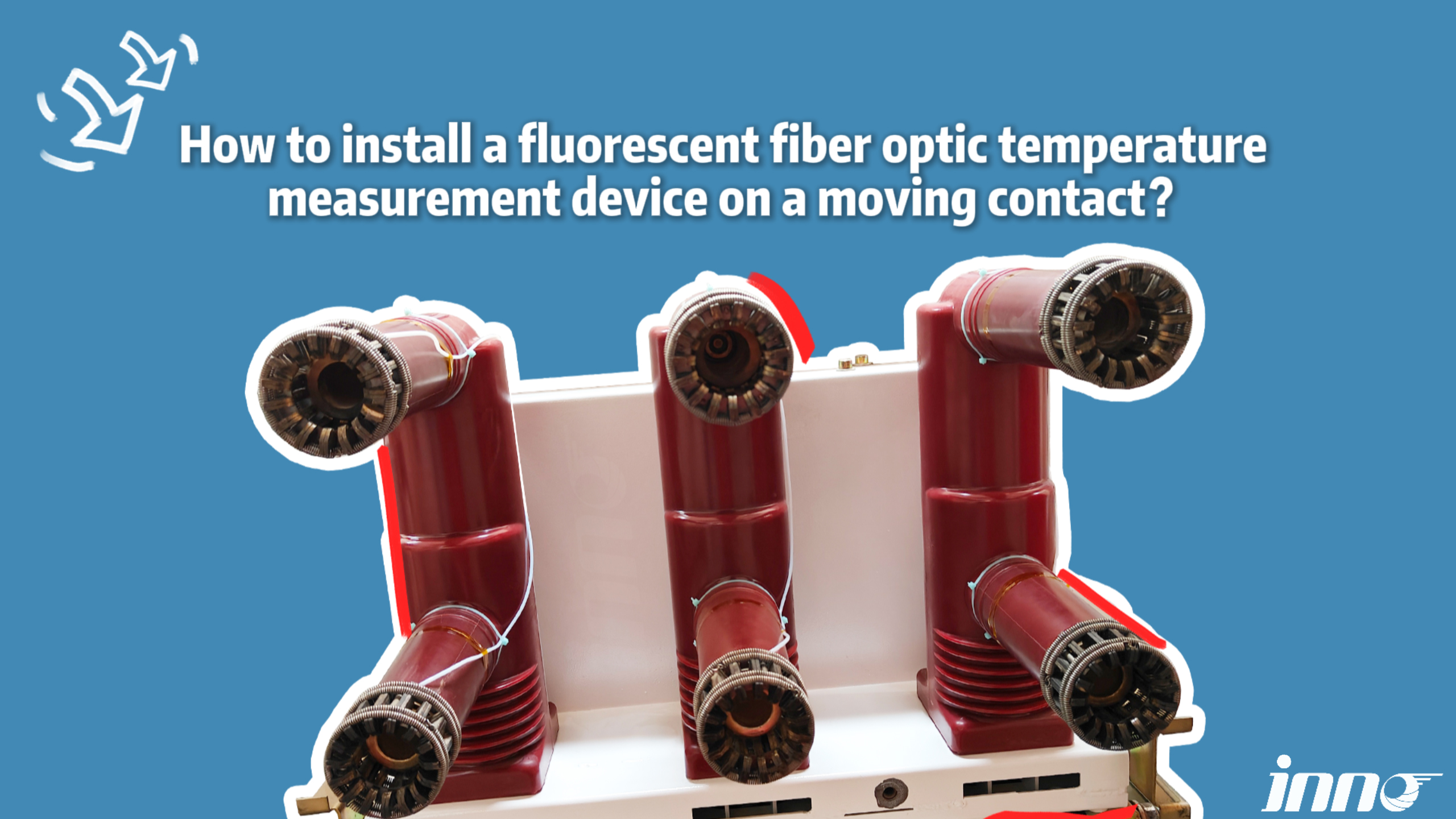
The power industry represents the largest application domain for fluorescerende glasvezeltemperatuursensoren. In droge transformator En oil-immersed transformer toepassingen, armored fiber optic probes are installed directly at winding hot-spot locations to provide accurate, real-time thermal data for insulation life assessment, beheer van de lading, and automated cooling control — replacing less reliable top-oil temperature models with direct winding measurement. In switchgear and circuit breaker toepassingen, inbegrepen vacuum circuit breakers En SF₆ circuit breakers, fluorescent probes monitor contact temperatures, railverbindingen, and arc chamber components to detect abnormal heating caused by contact degradation or loose connections. Binnenin gasgeïsoleerde schakelapparatuur (GIS) apparatuur, the sensors provide internal temperature monitoring without introducing any conductive materials into the sealed gas compartment. Additional power applications include cable joint and termination temperature monitoring to prevent localized overheating failures, power reactor and shunt reactor winding temperature measurement, generator stator winding hot-spot monitoring with probes embedded in stator slots, HVDC converter valve temperature sensing in extreme electric field environments, En capacitor bank thermal monitoring in harmonic-rich reactive power compensation installations.
Industrieel & Equipment Manufacturing
Industrial applications demand sensors that perform reliably under high currents, sterke magnetische velden, elevated temperatures, and physically constrained installation conditions. Glasvezel temperatuursensoren are deployed in high-voltage motor winding toezicht houden, where probes embedded in stator slots track insulation thermal aging and support preventive maintenance. In variable frequency drive (VFD) En power module toepassingen, fluorescent probes measure heat sink and busbar temperatures without electromagnetic interference from high-frequency switching. Voor IGBT module En SiC MOSFET device thermisch beheer, fiber optic probes positioned near semiconductor junctions provide critical data for thermal resistance analysis and lifetime prediction. Industrial furnace toepassingen (heat treatment, annealing, sintering) use high-temperature fiber optic probes for multi-zone thermal field mapping. In semiconductor manufacturing equipment, probes installed in etching, CVD, and PVD process chambers deliver precise temperature monitoring essential for nanoscale process control. Vacuum environment applications benefit from the sensor’s zero-outgassing and non-conductive properties, terwijl industrial robot joint motor monitoring and high-power laser equipment thermal management round out the industrial application portfolio.
Medisch & Life Sciences
Medical environments present some of the most demanding sensing requirements: strong magnetic fields in MRI suites, intense RF energy during ablation procedures, and strict biocompatibility and safety standards. Fluorescerende glasvezeltemperatuursensoren are the only proven technology for real-time MRI temperature monitoring, operating with complete immunity to the powerful static and gradient magnetic fields that would destroy or corrupt readings from any electrical sensor. In gefocuste echografie met hoge intensiteit (HIFU) En radiofrequentie ablatie (RFA) therapies, fiber optic probes provide millisecond-level temperature feedback directly at the treatment zone, enabling precise thermal dose control while protecting surrounding healthy tissue. Voor microgolf ablatie procedures, the sensors maintain accurate readings despite intense electromagnetic energy. Ultra-slim glasvezelsondes (2–3 mm diameter) can be integrated into medical catheters and implantable monitoring devices for minimally invasive in-vivo temperature measurement in cardiac, oncological, and neurological interventional procedures.
Renewable Energy & Battery Systems
Renewable energy and battery applications require reliable temperature monitoring in high-voltage, high-EMI operating environments with demanding space constraints. In windturbine installaties, fiber optic sensors monitor generator winding and bearing temperatures. Solar inverter power modules are monitored for thermal management optimization. Voor power battery pack and module toepassingen, ultra-slim fiber optic probes can be embedded directly inside battery cells without affecting electrochemical performance, providing internal temperature data that traditional surface-mount sensors cannot capture — critical for BMS optimization and cycle life extension. In energy storage cabinet installaties, multi-point fiber optic systems provide comprehensive thermal monitoring for thermal runaway early warning, detecting abnormal temperature rises at the earliest stage to prevent cascading failures. Fuel cell stack internal temperature distribution monitoring and battery safety testing (nail penetration, overcharge, short-circuit) also rely on fiber optic sensors for accurate real-time data under extreme conditions.
Extreme Environments & Advanced Applications
The most challenging measurement scenarios — where conventional sensors fail entirely — are precisely where fluorescence-based fiber optic temperature sensors demonstrate their greatest value. In ruimtevaart en defensie toepassingen, sensors withstand extreme heat, straling, and electromagnetic environments associated with jet engines, spacecraft systems, radar equipment, and missile electronics. Nuclear facilities and particle accelerators require radiation-resistant, non-conductive sensing solutions that fiber optic technology uniquely provides. In de olie, gas, en chemische industrie, the intrinsically safe, spark-free nature of fiber optic probes enables deployment in explosive atmospheres, high-pressure pipelines, and deep-well environments without additional explosion-proof measures. Superconducting equipment monitoring at cryogenic temperatures represents another specialized application leveraging the sensor’s extended temperature range capability.
8. Sensor Selection & Installation Guide

Het juiste selecteren fluorescerende glasvezel temperatuursensor configuration and ensuring proper installation are straightforward processes, but attention to a few key considerations will optimize system performance and longevity.
Sensor Selection Considerations
Begin by identifying the application environment — specifically the operating temperature range, spanningsniveau, electromagnetic conditions, and whether the sensor will be exposed to oil, chemicaliën, vocht, or vacuum. Voor oil-immersed transformer winding installaties, select armored fiber optic temperature probes with appropriate chemical-resistant sheathing. Voor switchgear busbar toepassingen, kiezen bolt-mount or surface-mount probe configurations that ensure secure mechanical contact. Voor OEM equipment integration, de single-channel fiber optic temperature sensing module provides the most compact solution. Determine the required number of monitoring points to select the appropriate multi-channel demodulator configuration — 6, 16, 32, of 64 kanalen. Verify that the standard fiber optic cable length of up to 20 meters meets the distance between sensor probes and the demodulator; if longer runs are needed, contact INNO for custom-length cables. Confirm that the RS485/Modbus RTU communication interface is compatible with your SCADA, PLC, or DCS platform, or discuss alternative protocol requirements with the engineering team.
Installation Best Practices
Installation of fluorescerende glasvezeltemperatuursensoren can be completed by standard electrical technicians without specialized tools or training. Mount sensor probes securely at the designated measurement points, ensuring good thermal contact with the monitored surface or component. Route optical fiber cables with care, maintaining the minimum bend radius specified in the product documentation (typically 10–15 mm) om signaalverlies te voorkomen. Avoid crushing, pinching, or sharply bending the fibers during cable routing. Secure fiber cables at regular intervals using appropriate clamps or cable ties, providing mechanical protection against accidental damage. Installeer de demodulator host in a suitable control cabinet or panel within the specified ambient temperature range (–20°C to +70°C), connect fiber optic cables to the corresponding channel ports, and complete power and RS485 communication wiring. Use the provided monitoring software to verify all channels are reading correctly, configure alarm thresholds, and confirm data communication with the upstream monitoring system. Once commissioned, the system requires no routine maintenance, periodic calibration, or component replacement throughout its operational life.
9. OEM/ODM Customization & Global Partnership

INNO provides flexible cooperation models to serve the diverse needs of global partners, whether you are an equipment manufacturer seeking to integrate fiber optic sensing into your products, a system integrator building complete monitoring solutions, or a distributor expanding your product portfolio.
OEM Private-Label Manufacturing
As an experienced OEM fiber optic temperature sensor manufacturer, INNO delivers complete private-label manufacturing services. Partners specify their own branding, verpakking, documentatie, and product configuration requirements, while INNO handles all manufacturing, quality testing, and certification processes. Available OEM products span the full range — from individual fluorescent fiber optic temperature probes naar multi-channel demodulators, complete monitoring system assemblies, En transformator temperatuurregelaars.
ODM Co-Development
For partners requiring technically customized solutions beyond standard configurations, INNO’s engineering team collaborates on ODM product development projecten. Customization capabilities include modified sensor probe designs for unique installation geometries, specialized fiber optic cable assemblies, aangepast fiber optic temperature measurement module development for embedded integration, tailored demodulator hardware and firmware configurations, RS485 interface and communication protocol customization, En cloud platform monitoring software development with client-specific branding and functionality.
Distributor & System Integrator Programs
INNO actively supports distributor and agent partnerships worldwide, offering competitive pricing structures, marketing support materials, technische opleiding, and dedicated account management. System integrators receive comprehensive technical documentation, integration engineering support, and flexible product configurations to seamlessly incorporate glasvezel temperatuurbewaking capabilities into their own solution offerings. The company provides responsive one-on-one commercial and technical support with rapid quotation turnaround.
10. About INNO — Manufacturer Credentials & Project References
Fuzhou Innovatie Elektronische Wetenschap & Technologie Co., Ltd. (INNO / FJINNO) is a specialized high-tech enterprise focused on the research, development, productie, and global supply of fluorescence-based fiber optic temperature sensors en monitoringsystemen. Gevestigd in 2011 and headquartered in Fuzhou City, Provincie Fujian, China, the company has accumulated 20+ years of concentrated expertise in fiber optic temperature sensing technology.
Manufacturing Capability
INNO operates a 3000+ square meter production facility with over 100 employees, including a dedicated R&D engineering team. The company has established industry-academia-research partnerships with Fuzhou University and other institutions, enabling the development of fluorescerende glasvezeltemperatuursensoren with fully independent intellectual property rights. All manufacturing processes are governed by ISO 9001/14001/27001/45001 certified quality management systems, with products additionally holding CE, EMC, and RoHS certifications.
Wereldwijd trackrecord
Met 3000+ installed systems operating worldwide, INNO’s products have been exported to over 15 countries and regions spanning Asia, Europa, the Americas, het Midden-Oosten, Oceania, and Africa — including the Philippines, Zuid-Korea, Maleisië, Japan, Thailand, Singapore, Indonesië, Vietnam, the United Arab Emirates, Zuid-Afrika, Australië, Brazilië, Canada, the United States, Mexico, Duitsland, Frankrijk, the Netherlands, Italië, and the United Kingdom.
Engineering Project References
INNO’s technology is validated through extensive real-world deployments. Representative projects include transformer fiber optic temperature controller installations providing continuous winding hot-spot monitoring at operational substations, A busway distributed fiber optic temperature monitoring system detecting localized hot spots along industrial busway runs, A fluorescent fiber optic temperature monitoring system for generator stator windings with probes embedded in stator slots for direct winding temperature measurement, and multiple dry-type transformer fiber optic monitoring system installations demonstrating straightforward sensor mounting and reliable integration with existing transformer protection and control systems.
11. Why Choose INNO Fluorescent Fiber Optic Temperature Sensors
Selecting a glasvezel temperatuursensor supplier is a long-term decision that directly impacts monitoring accuracy, equipment safety, and total cost of ownership over decades of operation. INNO has built its position as a trusted global partner through consistent product quality, deep technical expertise, and responsive service.
20+ Years of Focused Expertise
INNO’s entire business is dedicated to fiber optic temperature sensing technology. This singular focus — sustained over two decades — means the company possesses deep domain knowledge, refined manufacturing processes, and a proven product portfolio that generalist sensor companies cannot match.
Full Value Chain Control
From fluorescent sensing material formulation En probe manufacturing naar demodulator hardware design, firmware development, systeemintegratie, En cloud software platform development, INNO controls every element of the product value chain in-house. This ensures consistent quality, rapid customization capability, and complete technical accountability.
Complete Product Line — One-Stop Supply
With a product range spanning individual fluorescerende sondes, OEM sensing modules, multi-channel demodulators, application-specific monitoring systems, transformator temperatuurregelaars, and cloud monitoring software, INNO eliminates multi-vendor coordination complexity and guarantees full system compatibility.
Proven Global Reliability
3000+ installed systems across 15+ countries provide irrefutable evidence of long-term product reliability under diverse operating conditions, climate zones, and application environments — from tropical substations to arctic installations, from high-altitude wind farms to underground mining operations.
Flexible Customization & Fast Response
Whether the requirement is a standard catalog product, an OEM private-label sensor, a custom-developed monitoring module, or a complete ODM system solution, INNO’s engineering and commercial teams deliver responsive, tailored support with competitive lead times. The company’s dedicated sales team provides one-on-one service with rapid quote response to ensure efficient project execution.
Contact INNO
To discuss your fluorescence-based fiber optic temperature sensor requirements or request a customized quotation, contact the INNO team directly:
E-mail: web@fjinno.net
WhatsAppen / WeChat: +8613599070393
Telefoon: +8613599070393
Company Phone: +8659183846499
Adres: Nee. 12 Xingye Westweg, Fuzhou-stad, Fujian, China
Website: www.fjinno.net
12. Veelgestelde vragen (Veelgestelde vragen)
Q1: What is a fluorescence-based fiber optic temperature sensor and how does it measure temperature?
A fluorescence-based fiber optic temperature sensor measures temperature by analyzing the fluorescence lifetime decay of a rare-earth-doped sensing material at the tip of a fiber optic probe. When excited by a pulsed light signal transmitted through the optical fiber, the fluorescent material emits light whose decay time is precisely dependent on temperature. The system’s demodulator measures this decay time and converts it into an accurate temperature reading. Because the entire process is optical — with no electrical current at the sensing point — the sensor provides complete electrical isolation and total immunity to electromagnetic interference.
Vraag 2: What is the difference between a fluorescent fiber optic sensor and a fiber Bragg grating (FBG) sensor?
Both are fiber optic sensing technologies, but they operate on fundamentally different principles. A fluorescerende glasvezelsensor measures fluorescence lifetime decay, which is dependent solely on temperature with no cross-sensitivity to mechanical strain. Een FBG-sensor measures wavelength shifts in reflected light, which are affected by both temperature and mechanical strain — requiring complex compensation techniques for pure temperature measurement. Fluorescent sensors also use moderately priced demodulators, while FBG systems require expensive optical spectrum interrogators. For dedicated point-type temperature monitoring in high-voltage environments, fluorescent fiber optic sensors provide a simpler, more accurate, and more cost-effective solution.
Q3: Can fluorescent fiber optic temperature sensors be used inside oil-immersed transformers?
Ja. INNO manufactures armored fiber optic temperature sensor probes specifically designed for oil-immersed transformer winding installations. These probes feature ruggedized protective sheaths made from stainless steel or PTFE that provide mechanical protection and chemical resistance for decades of continuous submerged operation in transformer oil. The sensors measure winding hot-spot temperatures directly, providing significantly more accurate thermal data than traditional top-oil temperature measurement methods.
Q4: What is the service life and do the sensors require periodic recalibration?
The designed service life of INNO’s fluorescerende glasvezeltemperatuursensoren overtreft 25 years under normal operating conditions. Because the fluorescence lifetime measurement principle is inherently drift-free and the inorganic sensing material does not degrade over time, the sensors maintain their factory calibration accuracy throughout their entire operational life. No periodic recalibration, onderhoud, or component replacement is required — a significant advantage over thermocouples, RTD's, en infraroodsensoren, all of which require regular recalibration.
Vraag 5: How many monitoring points can a single demodulator support?
INNO's multi-channel fiber optic temperature demodulators are available in 6-channel, 16-kanaal, 32-kanaal, and 64-channel configurations. Elk kanaal is met één kanaal verbonden fluorescent fiber optic temperature probe, enabling simultaneous real-time monitoring of up to 64 temperature points from a single demodulator unit. For applications requiring more than 64 punten, multiple demodulators can be networked via RS485/Modbus RTU to a centralized monitoring system.
Vraag 6: What is the maximum fiber optic cable length between the sensor probe and the demodulator?
The standard fiber optic cable length is 0 naar 20 meter, which is sufficient for the vast majority of transformer, schakelapparatuur, and industrial monitoring installations. For applications requiring longer transmission distances, INNO can provide custom-length fiber optic cables. Because the sensor uses optical signal transmission, the cable length does not introduce electrical noise or grounding issues — unlike conventional sensor wiring.
Vraag 7: Are the sensors compatible with SCADA, PLC, and DCS systems?
Ja. INNO's fiber optic temperature demodulators use standard RS485 communication with Modbus RTU protocol, ensuring direct compatibility with virtually all SCADA, PLC, DCS, and industrial monitoring platforms. Temperature data from all channels is accessible via standard register reads, enabling straightforward integration into existing monitoring and control architectures. For applications requiring alternative communication protocols, INNO offers custom interface development services.
Vraag 8: Can the sensors operate in strong magnetic fields, such as inside MRI scanners?
Ja. Fluorescerende glasvezeltemperatuursensoren are completely immune to magnetic fields of any strength, including the powerful static magnetic fields (1.5T–7T+), gradient magnetic fields, and radiofrequency pulses present in MRI systems. The sensors contain no metallic or magnetic components that could interact with the MRI field, produce imaging artifacts, or be subjected to magnetic force. This makes them the only proven technology for real-time temperature monitoring during MRI scanning and MRI-guided thermal therapy procedures.
Vraag 9: Does INNO offer OEM private-label and custom sensor development services?
Ja. INNO biedt allesomvattend OEM private-label manufacturing services — including custom branding, verpakking, and documentation — across the full product range from individual sensor probes to complete monitoring systems. The company also offers ODM co-development services for custom probe designs, specialized sensing modules, tailored demodulator configurations, RS485 interface customization, and cloud platform software development. INNO’s in-house R&D capabilities and university research partnerships enable rapid custom development cycles.
Q10: How can I get a quotation or technical consultation for my fiber optic temperature sensing project?
Contact INNO directly via email at web@fjinno.net, WhatsApp or WeChat at +8613599070393, or company phone at +8659183846499. You can also submit a product inquiry through the company website at www.fjinno.net/contact. To receive an accurate, tailored quotation, provide details about your application type, measurement environment, aantal meetpunten, required fiber optic cable length, communication interface requirements, and any special customization needs. The INNO sales team provides one-on-one technical and commercial support with rapid quote response.

Glasvezel temperatuursensor, Intelligent monitoringsysteem, Gedistribueerde glasvezelfabrikant in China
|
 |
 |