 INNO glasvezel temperatuursensoren ,temperatuurbewakingssystemen.
1、 Key points for comprehensive selection of fiber optic sensors for temperature measurement
When selecting fiber optic sensors for temperature measurement, multiple factors need to be considered comprehensively.
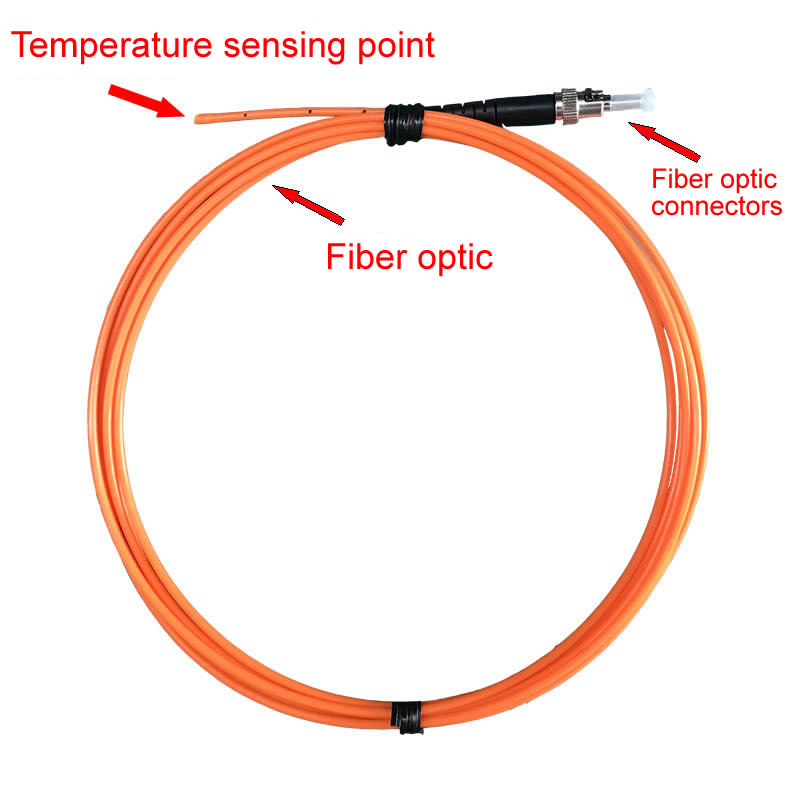
1.1 Application field requirements
Special environmental adaptability
If it is in an electromagnetic/radio frequency environment, traditional temperature measurement methods may be severely interfered with and unable to work properly. Fiber optic sensors have become a good choice due to their anti electromagnetic interference characteristics. Bijvoorbeeld, in the power system, areas near high-voltage cables or electrical equipment have strong electromagnetic fields, and fiber optic sensors can stably measure temperature without electromagnetic interference, ensuring measurement accuracy and reliability.
When there are hazardous situations such as flammability, explosiviteit, en corrosie in de meetomgeving, there are special requirements for safety/corrosion resistance. Glasvezelsensoren, vanwege hun inherente gebrek aan veiligheidsrisico's zoals elektrische vonken, en sommige glasvezelsensoren kunnen door materiaalkeuze corrosiebestendig zijn (zoals speciale coatings of omhulsels), zijn geschikt voor scenario's zoals temperatuurbewaking van opslagtanks in chemische fabrieken en temperatuurmeting in ontvlambare en explosieve omgevingen zoals oliebronnen.
In sommige installatieomgevingen met beperkte ruimte en speciale vereisten voor sensorgrootte, glasvezelsensoren kunnen met hun kleinere formaat nauwkeurige metingen bereiken. Glasvezelsensoren kunnen zich goed aanpassen aan kleine ruimtes voor temperatuurdetectie, zoals temperatuurbewaking in kleine elektronische apparaten en precisie-instrumenten.
Meetnauwkeurigheid en gevoeligheidsvereisten
Fiber optic sensors are a suitable choice for situations with particularly high requirements for accuracy, gevoeligheid, levensduur, stability/reliability, enz. Bijvoorbeeld, op medisch gebied, fiber optic sensors can be used to measure the temperature of internal tissues in the human body. Their high precision and sensitivity can meet the requirements of life science measurement, and play an important role in the study of temperature regulation mechanisms or temperature monitoring during thermal therapy for certain diseases.

1.2 Selection of Measurement Points and Sensor Types
The choice between single point and distributed
When there are less than 50 meetpunten, A “enkel punt” sensor is usually used. Bijvoorbeeld, when monitoring the temperature of a single small device (such as a single dry-type transformer) or a small capacity liquid container, a single point sensor can meet the requirements. Single point sensors have a small volume and relatively low cost, and have advantages in limited space layout and cost budget. A single point fiber optic sensor is sufficient for temperature monitoring needs, such as measuring water temperature in a small aquarium for household use.
Wanneer er meer zijn dan 50 meetpunten, “gedistribueerd” sensors are usually used. Bijvoorbeeld, in monitoring the indoor temperature distribution of numerous floors and different rooms in large buildings, or in monitoring the temperature field of bridges (where numerous measurement points are distributed in different parts of the bridge), distributed fiber optic sensors can continuously obtain temperature information from multiple points through a single fiber optic cable. Although the cost of a single sensor may be higher than that of a single point sensor, it is a better choice for the total cost and data acquisition efficiency of a large number of measurement points. Bijvoorbeeld, in the server room of a data center, in order to comprehensively monitor the temperature of a large number of servers, distributed fiber optic sensors can cover numerous monitoring points at once, effectively reducing the number of sensors, avoiding space occupation, and achieving efficient temperature monitoring.
1.3 Temperatuurbereik, Nauwkeurigheid, and Resolution Requirements
Temperature range matching
Choose a suitable fiber optic sensor based on the actual temperature range measured. The temperature measurement range of sensors is generally divided into four sections: -40-+80 ℃- 40 – +250℃;- 40 – +400℃;+ 20-+60 ℃ (medisch). Bijvoorbeeld, in general indoor temperature monitoring (usually between -10 ℃ -+40 ℃), most fiber optic sensors can meet the requirements; Temperature monitoring near industrial furnaces may require sensors capable of measuring high temperature ranges (zoals -40-+400 ℃ or even higher); In medicine, sensors with a narrow temperature range of+20-+60 ℃ are suitable for monitoring heat therapy in specific parts of the human body, such as the brain.
Accuracy and Resolution Considerations
The accuracy requirements for measuring temperature are usually divided into five levels: ± 0.05 ℃, ± 0.1 ℃, ± 0.3 ℃, ± 0.5 ℃, and ± 1 ℃. For some situations that are very sensitive to temperature changes, such as high-precision experimental equipment (such as laboratory devices that require precise control of chemical reaction temperature) or advanced medical equipment (such as temperature monitoring in some precision tumor hyperthermia processes), it is necessary to choose fiber optic sensors with high accuracy (such as ± 0.05 ℃ or ± 0.1 ℃); In general industrial or civilian environments where precision requirements are not extremely high (such as room temperature monitoring in ordinary factories or indoor temperature measurement in ordinary households), sensors with a precision of ± 0.5 ℃ or ± 1 ℃ may already be sufficient to meet the requirements. In terms of resolution, high-resolution sensors can detect even smaller temperature changes, making them more suitable for precise measurement of temperature changes.

1.4 Working types of probes
Immersion probe
Dompelsensoren kunnen worden gebruikt om de temperatuur van vaste stoffen te meten, vloeistoffen, en gassen. In industry, immersion sensors are more suitable for measuring the temperature of industrial liquid tanks. Immersion sensors have undergone special treatment, and the optical fiber has strong strength and toughness, die bestand is tegen chemische corrosie in vloeistoftanks. Bijvoorbeeld, in the storage tanks of chemical raw materials, immersion type fiber optic sensors can work stably in chemical solutions for a long time and accurately measure liquid temperature. Bovendien, this probe can effectively measure the water temperature in fish tanks (liquid environment), the temperature field in ovens (gas environment), or the temperature of soil (solid environment).
Contact type probe
Contactsensoren zijn gespecialiseerd in het meten van de temperatuur van objectoppervlakken, zoals temperatuurbewaking van hoogspanningsapparatuur zoals droge transformatoren, hoogspanningsschakelapparatuur, en hoogspanningsrails. In the operation and maintenance of power system equipment, by attaching contact type fiber optic sensors to the surface of the equipment, the temperature changes on the equipment surface can be obtained at any time, so as to timely detect overheating problems, prevent faults, and ensure the safe and stable operation of the power system.
Medical probe
Medical sensors are specially designed for life science measurements, met kleine en dunne sondes, indien gekoppeld met speciale demodulatie-apparaten, kan hoge responssnelheden en een zeer hoge nauwkeurigheid bereiken. In clinical medicine, Bijvoorbeeld, when measuring the local temperature of certain organs inside the human body (such as the heart and liver) or monitoring the temperature of transplanted tissues, medical fiber optic sensors can avoid causing excessive trauma to the human body and achieve accurate temperature measurement.
2. Key points for selecting fluorescent fiber optic sensors
2.1 Principles and Characteristics
beginsel
Fluorescerende glasvezeltemperatuursensor is a temperature measurement sensor based on the principle of fluorescence. Fluorescent materials are materials that can absorb light of a certain wavelength and emit light of longer wavelengths. Wanneer fluorescerende materialen worden beïnvloed door temperatuurveranderingen, hun fluorescentie-eigenschappen zullen ook veranderen. A typical fluorescent fiber optic temperature sensor includes several parts such as light source, glasvezel, fluorescerend materiaal, en spectrometer. Ten eerste, the light source generates excitation light of a certain wavelength, which is transmitted to the fluorescent material through optical fibers. After absorbing excitation light, fluorescent materials emit fluorescent signals with specific wavelengths, which are transmitted back to the spectrometer for detection through optical fibers. Wanneer de temperatuur verandert, the fluorescence characteristics of fluorescent materials may be a change in fluorescence intensity or a shift in fluorescence wavelength. De temperatuurwaarde kan worden bepaald door de intensiteit of golflengte van het fluorescentiesignaal te meten.
karakteristiek
Hoge precisie: Fluorescerende materialen zijn bijzonder gevoelig voor temperatuurveranderingen, waardoor temperatuursensoren met fluorescerende vezels een hoge meetnauwkeurigheid hebben. This high precision is very important in some scenarios that are sensitive to subtle temperature changes, such as cell culture temperature monitoring in biomedicine. Zelfs kleine temperatuurafwijkingen kunnen de celgroei en experimentele resultaten beïnvloeden. Fluorescerende glasvezelsensoren kunnen temperatuurveranderingen nauwkeurig detecteren en de stabiliteit van de experimentele omgeving garanderen.
Snelle reactie: Fluorescerende glasvezeltemperatuursensoren hebben een hoge responssnelheid, can monitor temperature changes in real time, en reageer direct. In sommige realtime veeleisende situaties, zoals temperatuurmonitoring tijdens snelle chemische reacties, het is noodzakelijk om tijdig informatie over temperatuurveranderingen te verkrijgen om de reactieomstandigheden aan te passen. Fluorescerende glasvezelsensoren kunnen snel reageren op temperatuurveranderingen en zorgen voor het normale verloop van de reactie.
Distributed measurement: Fluorescerende glasvezeltemperatuursensoren kunnen via één glasvezelkabel tegelijkertijd de temperatuur op meerdere locaties monitoren. This distributed detection capability makes sensors very useful in situations where multiple points need to be monitored. Bijvoorbeeld, in a large refrigerated warehouse, the temperature at different locations needs to be monitored simultaneously. Fluorescent fiber optic sensors use a single fiber optic to arrange fluorescent materials at different locations to achieve distributed temperature monitoring at multiple points, reducing wiring costs and complexity.
Sterk anti-interferentievermogen: In complex electromagnetic environments, traditional temperature sensors may be affected by interference signals, while fluorescent fiber optic temperature sensors can work normally without being affected by interference signals. Bijvoorbeeld, in industrial environments with many electromagnetic devices or temperature monitoring around power substations, fluorescent fiber optic sensors can stably obtain temperature values.
Stabiliteit op lange termijn: Fluorescerende materialen hebben een sterke duurzaamheid en stabiliteit, en sensoren kunnen een hoge prestatiestabiliteit behouden tijdens langdurig gebruik. Suitable for long-term continuous working environments, such as temperature monitoring of deep-sea exploration equipment (long-term exposure to harsh underwater environments) or geophysical long-term monitoring stations (requiring long-term data collection).
Groot temperatuurbereik: Fluorescent fiber optic temperature sensors are suitable for a wide range of environmental temperatures, van zo laag als min Baidu tot wel enkele honderden graden Celsius. Fluorescent fiber optic sensors can also be used for temperature monitoring of scientific research equipment in extreme temperature environments, such as near high-temperature volcanic vents or in cold Antarctic regions.
Hoge flexibiliteit: Fluorescent materials for sensors can be selected and designed according to actual needs to meet the needs of various specific application fields. Bijvoorbeeld, Voor verschillende chemische systemen kunnen specifieke fluorescerende materialen worden geselecteerd om zich aan te passen aan temperatuurmetingen in chemische omgevingen en om het aanpassingsvermogen van sensoren te verbeteren.
2.2 Selectie- en toepassingsoverwegingen
Er moet prioriteit worden gegeven aan situaties met weinig meetpunten
Volgens de correlatie tussen het aantal meetpunten en het eerder genoemde type sensor, wanneer het aantal meetpunten kleiner is dan 50, A “enkel punt” sensor is usually used, en fluorescentiesensoren behoren tot het enkelpuntssensortype. In scenario's zoals temperatuurbewaking van kleine apparaten, zoals interne temperatuurbewaking van huishoudelijke apparaten (zoals waterkokers, haardrogers, enz.), of temperatuurmeting van individuele kleine reactievaten in laboratoria, fluorescent fiber optic sensors have advantages in cost control and installation convenience due to the small number of measurement points.
Suitable for scenarios with high requirements for response speed and accuracy
If the response speed and accuracy requirements for temperature measurement are high in specific application scenarios, such as in some precision medical equipment (such as high-precision ophthalmic laser treatment equipment internal temperature monitoring or blood vessel temperature monitoring during heart bypass surgery), fluorescent fiber optic sensors can meet the requirements due to their fast response and high-precision characteristics.
Not suitable for situations with a large number of measurement points
Due to the fact that fluorescent fiber optic sensors are mostly single point type, if temperature monitoring is required for a large number of points (such as more than 50 meetpunten), using fluorescent fiber optic sensors will result in higher costs. In dit geval, it is more suitable to choose distributed sensors, such as in temperature monitoring scenarios of hundreds of equipment nodes in large industrial plants or numerous rooms in large buildings.
3. Key points for selecting distributed fiber optic sensors
3.1 Principles and Basic Components
beginsel
In distributed fiber optic sensing technology, fiber optic is both a sensing medium and a data transmission medium. By utilizing the characteristics of light waves transmitted in fiber optic, continuous sensing measurements can be taken along the length direction of the fiber optic. With the help of changes in light waves, environmental physical parameters such as temperature, deformatie, druk, enz. can be extracted to obtain information on the spatial distribution status of the measured object over time. The main principles of distributed fiber optic sensing technology include sensing technology based on optical interference principle and sensing technology based on scattering principles such as Rayleigh, Brillouin, Raman, enz. This article focuses on the optical frequency domain reflectometry (OFDR) technology based on Rayleigh scattering, which indirectly reflects the strain of structural components by sensing the strain of optical fibers arranged on them. The measured strain is actually transmitted from the structural components to the strain on the optical fibers. When demodulating temperature or strain in distributed fiber optic sensors, OFDR technology shows that both strain and temperature are demodulated by Rayleigh scattering frequency shift signals in the fiber optic. In principe, strain signals and temperature signals cannot be distinguished. Daarom, different sensing fibers need to be used to distinguish strain and temperature during testing.
Basic Composition
The commonly used distributed fiber optic sensors on the market are bare fiber optic sensors or distributed fiber optic cable sensors that are encapsulated and armored on the outer layer of bare fiber optic cables. Algemeen, bare optical fibers are composed of a core, a cladding, and a coating layer. The core and cladding are made of silicon dioxide with different refractive indices. The refractive index of the core is greater than that of the cladding. Wanneer het invallende licht voldoet aan de totale reflectiehoek in de vezel, het kan zich in de vezel voortplanten. Het coatingmateriaal is in het algemeen acrylester, die voornamelijk dient om de optische vezel te beschermen tegen externe schade en de taaiheid ervan te vergroten, waardoor de levensduur van de optische vezel wordt verlengd. Optische kabel met gedistribueerde detectie bestaat uit een buitenmantel die rond kale optische vezels is gewikkeld, en het materiaal van de buitenmantel is meestal van plastic (zoals PE, PVC, PTFE, ETFE, enz.). De belangrijkste functie ervan is het versterken van de structurele sterkte van gedistribueerde optische vezelsensoren en hen in staat te stellen beter te overleven in ruwe omgevingen.
3.2 Selectie- en toepassingsoverwegingen
Groot aantal meetpunten en gedistribueerde vraagsituatie
Wanneer er meer zijn dan 50 meetpunten, “gedistribueerd” sensors such as fiber Bragg grating sensors are usually used. Op het gebied van temperatuurbewaking van grote kunstwerken zoals langeafstandsbruggen, tunnels, and large buildings, there are numerous measurement points. Gedistribueerd glasvezel sensoren can layout fibers along the entire structure to obtain a large amount of temperature data from each point at once, achieving comprehensive temperature distribution monitoring. Bijvoorbeeld, on a sea crossing bridge spanning several kilometers, installing distributed fiber optic sensors at different parts of the bridge body can promptly detect temperature anomalies in problematic areas caused by environmental temperature changes or internal thermal stress, which is of great significance for the safe maintenance of the bridge.
Adapt to complex environments and long-term monitoring scenarios
Distributed fiber optic sensors have advantages such as non electrification, klein formaat, bendability, weerstand tegen elektromagnetische interferentie, hoge gevoeligheid, en corrosiebestendigheid. Temperature monitoring of long-distance pipelines or cables is very suitable in some complex electromagnetic environments, such as around high-voltage substations, large electromagnetic factory workshops, enz; It can also be used for temperature monitoring in environments with strong corrosion, such as underground sewage pipelines, chemical raw material transportation pipelines, enz. Bovendien, in large-scale mining sites or underground cavities where temperature monitoring is of equal length, distributed fiber optic sensors can effectively meet monitoring needs due to their good adaptability and long-distance installation characteristics.
Selection criteria for fiber type and sheath material
Fiber optic type:
Some common single-mode fiber models on the market, such as G652 and G657 series fibers, can be used as sensors based on Rayleigh scattering OFDR technology. The difference between the two is that G657 series fibers are bend resistant fibers, which have smaller bending losses compared to G652 series at the same bending radius. For some engineering testing sites or complex structural testing, fiber optic sensors inevitably experience some bending losses during deployment. Daarom, for OFDR technology, choosing G657 series fiber optic as the sensor has more advantages than G652 series fiber optic.
When precise structural strain testing is required or when sensing accuracy can be guaranteed while protecting the optical fiber from damage, PI fiber (polyimide fiber) can be used as the sensor because the strain transmission effect of its coating material is comparable to that of bare fiber, and better than that of ordinary fiber (acrylic coating). In some ordinary measurement scenarios, if the accuracy requirements are not particularly high, ordinary single-mode fiber can meet the requirements. For temperature measurement optical fibers, loose sheathed optical fibers are generally selected, which consist of a 0.9mm hollow sheath on the outside and a 165um PI optical fiber in the center. This allows the optical fiber to move freely in the sheath, and the strain generated by the outside is shielded by the outer sheath. Daarom, loose sheathed optical fiber sensors can only test changes in external temperature. For strain testing in a constant temperature environment, bare fiber or sheathed fiber can generally meet the requirements. The specific choice of fiber can depend on the actual application scenario; For strain testing in variable temperature environments, it is necessary to use temperature compensation optical fibers for testing. Bijvoorbeeld, A temperature compensation optical fiber composed of two optical fiber sensors, one of which is a tightly sheathed optical fiber and the other is a loosely sheathed optical fiber. The tightly sheathed optical fiber is affected by both temperature and strain, while the loosely sheathed optical fiber is only affected by temperature. By subtracting the two, the strain generated by the optical fiber can be obtained.
Sheath material:
In harsh environments, if bare optical fibers are no longer suitable for use due to their thinness and susceptibility to damage, tight sheathed optical cables need to be selected to ensure survival rates. Although tight sheathed optical cables have higher structural strength compared to bare optical fibers, their strain transmission loss is greater than that of bare optical fibers, and the loss of strain transmission increases with the increase of sheath diameter. The conventional types of tight sheathed optical fibers include 0.9mm diameter, 2mm diameter, and even larger diameter armored optical cables. Gebruikelijk, under the condition of ensuring the survival of fiber optic sensors, it is recommended to prioritize the use of tightly sheathed fibers with smaller diameters as sensors to ensure better sensing performance. In aanvulling, the sheath material should be selected according to the actual temperature environment. Different sheath materials (zoals PE, PVC, PTFE, ETFE, enz.) have different temperature resistance properties. Bijvoorbeeld, in high temperature environments, it may be necessary to choose sheath materials that can withstand high temperatures to protect the optical fiber and ensure the normal operation of the sensor.
4. Key points for selecting fiber Bragg grating sensors
4.1 Principles and Characteristics
beginsel
Fiber Bragg Grating sensor is a type of sensor used for measuring and monitoring physical quantities. Its principle is to use a grating structured optical fiber to interfere with the reflected light of the incident light. By measuring the phase difference of the interference light and comparing it with the template grating, the measured physical quantity can be obtained. In terms of temperature measurement, when the external temperature changes, the period or refractive index of the fiber Bragg grating will change, resulting in a wavelength shift of the reflected light. By detecting the wavelength shift, the temperature change value can be obtained.
karakteristiek
Hoge gevoeligheid: capable of measuring subtle temperature changes. In some devices or environments that are sensitive to temperature changes (such as high-precision optical instrument internal temperature monitoring, low-temperature storage environment temperature monitoring of biological samples, enz.), even small temperature fluctuations may affect device performance or sample preservation effectiveness. Fiber Bragg grating sensors can accurately detect these subtle changes and issue timely warnings or adjust control measures.
High resolution: able to detect the absolute value of small changes. It performs well in monitoring small temperature differences, such as in the study of heat dissipation performance of electronic chips, where precise understanding of the small temperature differences at various points on the chip surface is required. Fiber Bragg grating sensors can provide high-precision temperature resolution to meet research needs.
Hoge precisie: It can obtain high-precision measurement results, which is very important in many precision experiments, industrial production process control (such as temperature control in high-precision glass manufacturing processes, where small temperature deviations may affect the quality of glass), or high-end medical equipment (such as internal temperature management of certain special laser treatment equipment) scenarios, helping to ensure the accuracy of the process and the quality of products and equipment.
Hoge stabiliteit: Fiber Bragg grating sensors have high stability and can maintain accuracy even in long-term measurements. In long-term continuous temperature monitoring scenarios, such as temperature monitoring of aerospace equipment during long-term flight missions, long-term temperature recording of meteorological observation stations, enz., fiber Bragg grating sensors can reliably work and stably output accurate temperature data.
Free from electromagnetic interference: Because signal transmission is achieved through optical signals, fiber Bragg grating sensors are not easily affected by electromagnetic interference. This makes it very practical for temperature measurement in strong electromagnetic environments, such as inside power system substations, large electromagnetic equipment manufacturing workshops, enz., without being easily affected by electromagnetic interference and measurement errors like traditional electronic sensors.
4.2 Selectie- en toepassingsoverwegingen
Consider the diversity requirements for measuring physical quantities
Fiber Bragg grating sensors can be used not only for temperature monitoring, but also for measuring other physical quantities such as strain monitoring. In some practical application scenarios, such as large building structures or mechanical equipment, if it is necessary to monitor the temperature of these structures while also understanding the strain of the structure, fiber Bragg grating sensors can simultaneously measure multiple physical quantities such as temperature and strain. Bijvoorbeeld, in the health monitoring of bridge structures, fiber Bragg grating sensors are distributed along the bridge body, which can simultaneously obtain temperature and strain data from different parts, comprehensively judge the structural status of the bridge, and have important significance for predicting and preventing possible damage, fatigue and other problems of the bridge.
Suitable for a large number of measurement points and distributed measurement scenarios
Fiber Bragg grating sensors can work well when involving a large number of measurement points. Similar to distributed fiber optic sensors, in large-scale industrial sites, building facilities, and other scenarios that require numerous measurement points, fiber optic grating sensors can use multiplexing technology to set multiple gratings on a single fiber to achieve temperature measurement at different positions. Bijvoorbeeld, in large thermal power plants, numerous equipment and pipelines are distributed over a wide area. By reasonably arranging fiber optic grating sensor networks, temperatuurmonitoring van belangrijke locaties van verschillende apparatuur en pijpleidingen in de energiecentrale kan worden bereikt, wat helpt de veiligheid en efficiëntie van de werking van de apparatuur te verbeteren.
Balans tussen kosten en prestatie-eisen
Hoewel glasvezel Bragg-roostersensoren veel uitstekende eigenschappen hebben, hun prijzen zijn relatief hoog. In sommige kostengevoelige toepassingsscenario's, het is noodzakelijk om de relatie tussen prestatie en kosten in evenwicht te brengen. Bijvoorbeeld, in sommige civiele gewone gebouwen moet de binnentemperatuur worden bewaakt, als alleen de geschatte veranderingen in de algehele binnentemperatuur worden verkregen, de hoge nauwkeurigheid en prestaties van glasvezel-Bragg-roostersensoren zijn mogelijk niet vereist. In dit geval, Er kan worden gekozen voor goedkope traditionele temperatuursensoren; In sommige high-end industriële productie- of wetenschappelijke onderzoeksscenario's, high performance requirements such as accuracy and reliability of temperature measurement are required, and the high-performance advantages of fiber Bragg grating sensors can be fully reflected when the budget allows.
5. Comparative analysis of different types of fiber optic sensors
5.1 Differences in Measurement Principles
Principle of Fluorescent Fiber Optic Sensor
Based on the fluorescence intensity or wavelength changes of fluorescent materials under temperature changes, temperature detection is achieved by transmitting signals through optical fibers. The light emitted by the light source is transmitted to the fluorescent material through optical fibers. After absorbing the excitation light, the fluorescent material emits fluorescence signals of different intensities or wavelengths according to temperature changes, which are then transmitted to the spectrometer for detection through optical fibers.
Principle of Distributed Fiber Optic Sensor
Fiber optic is both a sensing medium and a transmission medium, and continuous sensing and measurement are carried out along the fiber optic cable through the transmission characteristics of light waves in the fiber optic cable. Taking the OFDR technology based on Rayleigh scattering as an example, by demodulating the Rayleigh scattering signal in the optical fiber and obtaining information on changes in physical parameters such as temperature, it is not possible to directly distinguish between strain and temperature signals. Different types of optical fibers need to be selected for different measurement scenarios, such as loose sheathed optical fibers for temperature measurement.
Principle of Fiber Bragg Grating Sensor
By using a grating structured fiber to reflect and interfere with incident light, temperature changes can cause a change in the period or refractive index of the fiber grating, resulting in a wavelength shift of the reflected light. The temperature change value can be obtained by measuring the wavelength shift.
5.2 Performance Characteristics Comparison
meetnauwkeurigheid
Fiber Bragg Grating Sensor: In theorie, it has high accuracy, which mainly depends on the control of grating period spacing and effective refractive index, as well as the linearity of the measurement process. When the machining accuracy is guaranteed, due to its direct linear conversion relationship measurement, its accuracy is easy to guarantee, and the reflected light is sharp in the frequency domain, making the measurement of the central spectral line more accurate. It has advantages in scenarios that require high accuracy, such as high-end medical equipment temperature monitoring or high-precision laboratory research.
Fluorescent fiber optic sensor: The measurement accuracy mainly depends on the characteristics of the fluorescent substance being excited to emit fluorescence and the detection of changes in fluorescence intensity. Momenteel, the technological level makes its accuracy comparable to the other two, but in practical applications, the accuracy is also affected by factors such as materials, processing level, and signal demodulator resolution. It is suitable for general high-precision scenarios where accuracy requirements are not the highest, such as temperature monitoring of general industrial equipment.
Gedistribueerde glasvezelsensoren: The accuracy is mainly affected by the detection technology used (such as OFDR technology based on Rayleigh scattering), the type of fiber optic (such as different coating layers, sheath materials, enz.), and the influence of the application environment on the sensing signal. In some long-distance distributed measurement scenarios, although the single point accuracy may not be as good as fiber Bragg grating sensors, it can provide overall temperature distribution, which is suitable for large-scale temperature monitoring scenarios where accuracy requirements are not extremely high, such as temperature field monitoring of large buildings.
reactiesnelheid
Fiber Bragg Grating Sensor: A high-performance demodulation and demultiplexing receiver is required, and the processing capability of the receiver often affects its response frequency. Relatively speaking, its response speed is affected by its complex wavelength shift detection technology and other factors. In scenarios with high real-time requirements for response speed, it may not be as good as fluorescent fiber optic sensors.
Fluorescent fiber optic sensor: It has the characteristic of fast response and can quickly respond to temperature changes, mainly due to its direct detection principle based on fluorescence characteristics. It performs better in scenarios with high real-time temperature monitoring requirements, such as temperature control in certain chemical reaction processes or temperature monitoring in biological rapid reaction processes.
Gedistribueerde glasvezelsensoren: Their response speed is affected by various factors such as fiber type, detection technology, enz. Echter, in the distributed measurement process, they can continuously monitor temperature at different points. Although the response speed of a single point may not be very fast, it can meet the requirements for obtaining the overall temperature distribution under a certain sampling period. Het is met name geschikt voor scenario's voor het monitoren van temperatuurstabiliteit op de lange termijn, zoals grote constructies.
Meetbereik (gedistribueerde kenmerken)
Fiber Bragg Grating Sensor: Via multiplextechnologie kunnen meerdere roosters op een enkele optische vezel worden geplaatst om metingen van meerdere punten te bereiken. Echter, vergeleken met fluorescerende glasvezelsensoren, de gedistribueerde meetmogelijkheden zijn meer afhankelijk van netwerktechnologie en apparatuurondersteuning, en wordt beperkt door factoren zoals de kosten. Bijvoorbeeld, het aantal roosters dat tegen een bepaalde prijs kan worden ingesteld, is beperkt, maar het presteert goed in termen van nauwkeurigheid op één meetpunt. Het is geschikt voor gedistribueerde meetscenario's die nauwkeurigheid op één punt vereisen en relatief minder meetpunten hebben, zoals temperatuur- en rekmetingen van honderden belangrijke knooppunten in sommige brugconstructies.
Fluorescent fiber optic sensor: It has a certain distributed measurement capability and can simultaneously monitor the temperature of multiple locations through a single fiber optic cable. Echter, it is relatively weak in requiring large-scale, long-distance distributed measurement and is more suitable for temperature monitoring of multiple measurement points in small-scale, relatively concentrated areas, such as temperature monitoring of numerous devices in a small factory workshop.
Distributed fiber optic sensor: specially designed for distributed measurement, with the advantage of being able to achieve continuous long-distance and large-scale temperature distribution measurement along the fiber optic cable. It is suitable for comprehensive temperature field monitoring of large engineering structures such as underground comprehensive pipe galleries (thousands of meters or even longer) and ultra long sea crossing bridges.
5.3 Cost and Complexity Comparison
kosten
Fiber Bragg Grating Sensor: The cost is relatively high, mainly due to the high performance requirements such as high precision and stability, which result in higher costs in manufacturing processes, equipment accessories, en andere aspecten. In scenarios where budget is limited and performance requirements such as accuracy are not very high, its cost-effectiveness may not be high, such as temperature monitoring scenarios in some ordinary residential buildings.
Fluorescent fiber optic sensor: With moderate cost and relatively simple structure, it is a cost-effective choice in scenarios where accuracy and performance meet the requirements, such as temperature monitoring of general industrial equipment or temperature management of small commercial facilities.
Gedistribueerde glasvezelsensoren: The cost depends on the measurement scale, required fiber optic type, and supporting demodulation equipment. In large-scale measurement scenarios, although the cost of a single distributed fiber optic sensor may not be low, it may have a cost advantage over a single point sensor in achieving measurements of the same scale due to its ability to cover a large number of measurement points; Echter, in small-scale measurement scenarios, the cost is relatively high. Bijvoorbeeld, when monitoring the temperature of several individual small devices, using distributed fiber optic sensors is a waste of cost.
complexity
Fiber Bragg Grating Sensor: It uses a grating to sense temperature changes, and the system involves complex wavelength shift detection technology, requiring complex demodulation equipment to accurately measure the wavelength changes of reflected light. The complexity of equipment and technology is relatively high, and the technical level of operators and equipment maintenance requirements are also relatively high.
Fluorescent fiber optic sensor: The structure and working principle are relatively simple, belonging to the light intensity detection method. It only requires a light source to excite fluorescence and then detect changes in fluorescence intensity or wavelength. It does not require complex demodulation equipment and technology, and has low maintenance costs and operational difficulties.
Gedistribueerde glasvezelsensoren: Onder hen, detection technologies such as OFDR based on Rayleigh scattering are relatively complex, involving precise demodulation of Rayleigh scattering signals in optical fibers, and special selection and settings of fiber types (such as coating layers, sheaths, enz.) are required in different measurement scenarios, resulting in high complexity in use and maintenance.

Glasvezel temperatuursensor, Intelligent monitoringsysteem, Gedistribueerde glasvezelfabrikant in China
|
|
 |