 INNO光ファイバー温度センサー ,温度監視システム.
- リアルタイムのフェンス違反検出は軍隊を守るために重要です, インダストリアル, エネルギー, および政府施設を不正侵入から守る.
- 主流の検出技術には赤外線ビームが含まれます, マイクロ波バリア, 振動ケーブルセンサー, テンションフェンス, ビデオ分析, 熱画像処理, 分散型光ファイバーセンシング (DASの & DVSの).
- 分散型光ファイバーセンシング、特に DAS と DVS は最長の検出範囲を実現します, 最高の空間精度, 利用可能なフェンス監視テクノロジーの中で最もメンテナンスが少なくて済みます。.
- DAS は高度なイベント分類のための完全な音響波形キャプチャを提供します, 一方、DVS は標準的な境界保護のためにコスト効率の高い振動ベースのアラートを提供します.
- 光ファイバーセンシングデータに適用された AI を活用した分析により、誤報が大幅に減少し、人間の介入なしで脅威を自動的に分類できるようになります。.
- A multi-layered solution combining fiber optic sensing, ビデオ監視, AI分析, and access control integration delivers the highest detection reliability and operational efficiency.
- Proper system deployment, zone configuration, and threshold tuning are essential for achieving optimal detection performance in any environment.
目次
- 1. Why Real-Time Fence Breach Detection Matters
- 2. Mainstream Fence Breach Detection Technologies Compared
- 3. 分散型光ファイバーセンシング (DASの & DVSの) — The Best Core Detection Solution
- 4. DAS vs DVS: Key Performance Comparison for Fence Detection
- 5. AI-Powered Analytics in Fence Breach Detection
- 6. ファイバー + Video + AI + Access Control — The Ultimate Integrated Solution
- 7. Recommended Solutions by Application Scenario
- 8. Deployment and Commissioning Best Practices
- 9. よくあるご質問 (FAQ)
- 10. Get a Customized Fence Detection Solution
1. Why Real-Time Fence Breach Detection Matters
Perimeter fences serve as the first physical barrier between a secured facility and potential intruders. しかし, a fence alone is a passive defense — without real-time breach detection analytics, security teams have no way of knowing when, どこ, or how a fence has been compromised until the damage is already done. In high-security environments such as military installations, 発電所, oil and gas facilities, 空港, 刑務所, およびデータセンター, even a few minutes of undetected intrusion can lead to catastrophic consequences.
効果的 real-time fence breach detection must accomplish three things simultaneously: detect the intrusion event as it occurs, pinpoint the exact location along the perimeter, and classify the type of activity to help responders prioritize their reaction. Traditional systems often achieve only the first objective. Modern analytics — particularly those built around 分散型光ファイバーセンシング そして AI-driven signal processing — can reliably deliver all three, transforming perimeter security from a reactive function into a proactive defense layer.
2. Mainstream Fence Breach Detection Technologies Compared

The security market offers a range of technologies for fence intrusion detection, each with different operating principles, strengths, と制限. Before identifying the best solution, it is important to understand how these technologies compare across the parameters that matter most: detection range, spatial accuracy, false alarm resistance, 環境耐久性, およびメンテナンス要件.
Overview of Common Detection Technologies
Infrared beam sensors create invisible light barriers between transmitter and receiver units mounted on fence posts. They are effective for short spans but vulnerable to fog, 塵, 大雨, and alignment drift. Microwave barriers use radio frequency fields to detect movement within a defined zone. They offer better weather resistance than infrared but are prone to false alarms from animals, 植生, and nearby vehicle movement.
Vibration cable sensors — typically coaxial or piezoelectric cables attached to the fence fabric — detect mechanical vibrations caused by climbing, 切断, or impact. They provide moderate localization accuracy but require frequent recalibration and are affected by wind-induced noise. Tension-based fence systems use taut wires with strain gauges to detect deformation of the fence structure. They are reliable for rigid fence types but difficult to retrofit and limited in detection granularity.
Video analytics そして 熱画像カメラ provide visual detection and verification. Video analytics use motion detection algorithms to identify movement near the fence line, while thermal cameras can detect body heat regardless of lighting conditions. Both require line-of-sight coverage and are affected by camera placement, field of view, and processing latency.
分散型光ファイバーセンシングシステム — including DASの (分散型音響センシング) そして DVSの (分散型振動センシング) — use a single optical fiber cable as a continuous sensor along the entire fence line. They offer the longest range, finest localization, and highest environmental resilience of any available fence detection technology.
技術比較表
| テクノロジー | 検知範囲 | Spatial Accuracy | Weather Resistance | 誤警報率 | メンテナンス | コストレベル |
|---|---|---|---|---|---|---|
| Infrared Beam | 50–200 m per pair | Zone-based | 低い | 高い | 高い | 低~中 |
| Microwave Barrier | 50–150 m per unit | Zone-based | 中程度 | 中~高 | 中程度 | 中程度 |
| Vibration Cable | 300–500 m per zone | 10–25 m | 中程度 | 中程度 | 中~高 | 中程度 |
| Tension Fence | まで 600 m | Panel-based | 中~高 | 低~中 | 中程度 | 高い |
| Video Analytics | 50–150 m per camera | Camera FOV | 低~中 | 中程度 | 中程度 | 中~高 |
| 熱画像処理 | 100–500 m per camera | Camera FOV | 中~高 | 中程度 | 中程度 | 高い |
| DASの (ファイバー) | Up to 50–100 km | 1–5 m | 高い | 低い | 低い | 高い (単位) / 低い (per km) |
| DVSの (ファイバー) | Up to 40–60 km | 5–10 m | 高い | 低~中 | 低い | 中~高 (単位) / 低い (per km) |
As shown in the comparison table, DAS and DVS distributed fiber optic sensing significantly outperform all other technologies in detection range, spatial accuracy, weather resistance, and long-term maintenance requirements. While the interrogation unit carries a higher upfront cost, the per-kilometer cost of fiber optic coverage is far lower than deploying hundreds of discrete sensors, カメラ, or beam units across a large perimeter.
3. 分散型光ファイバーセンシング (DASの & DVSの) — The Best Core Detection Solution
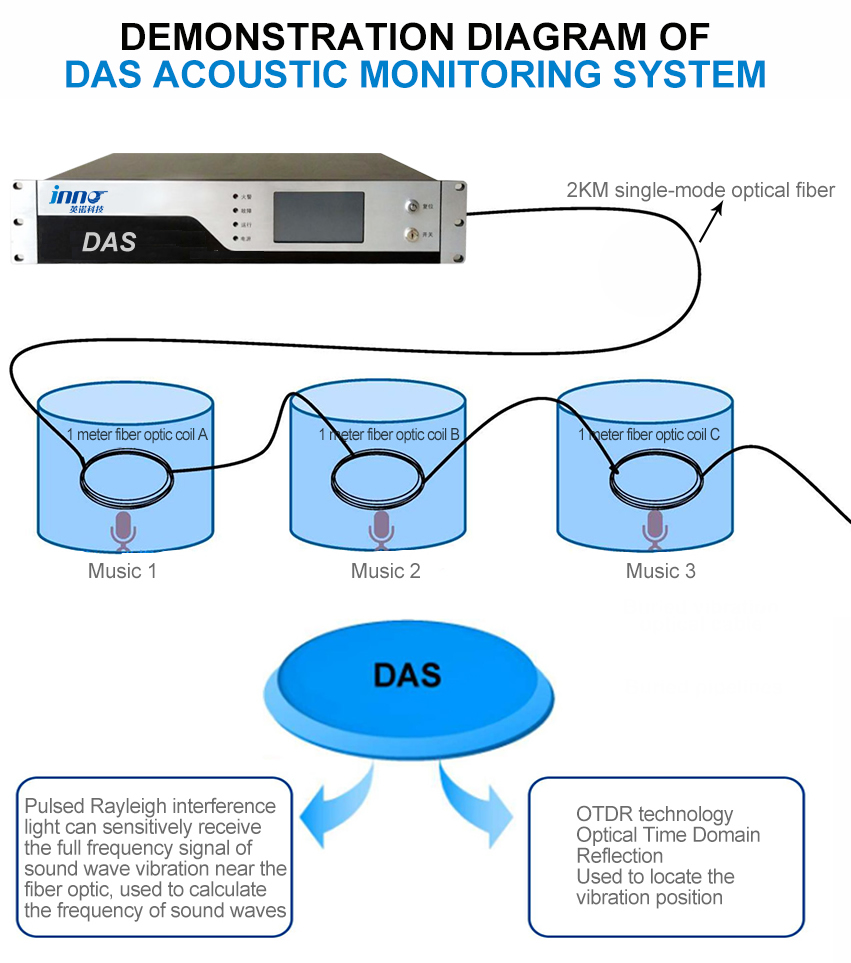
Among all available fence breach detection technologies, distributed fiber optic sensing stands out as the most capable and scalable platform for real-time perimeter monitoring. The technology uses a standard single-mode 光ファイバーケーブル mounted on or buried alongside the fence as a continuous linear sensor. アン interrogation unit at the control center sends laser pulses into the fiber and analyzes the Rayleigh backscattered light to detect and locate disturbances along the entire cable length.
Why Fiber Optic Sensing Is Superior for Fence Monitoring
The core advantage of a 分散型光ファイバー警報システム is that it provides truly continuous detection with no blind spots. Every meter of the fiber cable acts as an independent sensor, creating a seamless detection line that can span tens of kilometers without requiring any active electronics, 電源, or signal repeaters in the field. センシングケーブルは完全にパッシブです, 電磁干渉に対する耐性, resistant to lightning, and undetectable by intruders. These characteristics make it the ideal technology for protecting large, リモート, or harsh-environment perimeters where other systems struggle to maintain reliability.
DASの: Full Acoustic Intelligence for Fence Security
DASの (分散型音響センシング) uses phase-sensitive optical time-domain reflectometry (Φ-OTDR) to capture the full acoustic waveform at every point along the fiber. In fence detection applications, this means the system records the actual sound signature of an intrusion event — whether it is someone climbing the fence fabric, 金網を切り裂く, フェンスラインの下を掘る, または車両でフェンスに衝突する. この豊富な音響データにより、システムはイベントを高精度で分類できます。, 本物の脅威と風の振動などの無害な活動を区別する, 動物との接触, または近くの歩行者交通.
DVSの: 標準周囲向けのコスト効率の高い振動検出
DVSの (分散型振動センシング) 後方散乱光の強度ベースの分析を使用して、フェンスラインに沿った振動イベントを検出します. DVS は DAS のように完全な波形データをキャプチャしませんが、, 重大な振動外乱を確実に検出し位置特定します。. 詳細なイベント分類ではなく、ゾーンベースのアラームのトリガーが主な目標である標準的な境界セキュリティ アプリケーションの場合, ある DVSフェンス検知システム DAS よりも低いシステムコストで優れたパフォーマンスを実現.
4. DAS vs DVS: Key Performance Comparison for Fence Detection
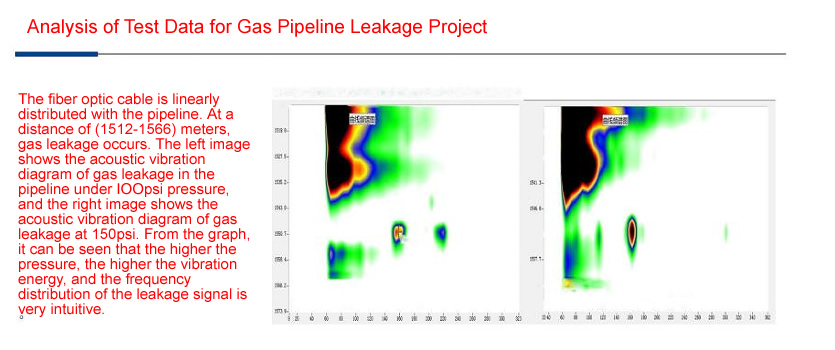
Choosing between DAS and DVS depends on the specific requirements of the fence monitoring project. The following table provides a direct comparison of the key parameters relevant to fence breach detection.
| パラメーター | DASの | DVSの |
|---|---|---|
| 測定方法 | Phase-based (Φ-OTDR) | Intensity-based |
| Data Output | Full acoustic waveform | Vibration intensity level |
| 空間分解能 | 1–5 m | 5–10 m |
| 周波数応答 | Sub-Hz to 10+ KHZ | Sub-Hz to several hundred Hz |
| Maximum Range | 50–100 km | 40–60 km |
| Event Classification | 高度な (multi-type) | 基本 (threshold-based) |
| 誤警報率 | 非常に低い | 低~中 |
| AI Integration Capability | たいへん良い | よし |
| システムコスト | より高い | 適度 |
| 最適な用途 | High-security, 長距離, complex environments | Standard perimeters, budget-sensitive projects |
For facilities that demand the highest detection accuracy, real-time event classification, and the ability to differentiate between multiple threat types, DAS is the recommended choice. For standard perimeter fences where reliable vibration detection and zone alerting are sufficient, DVS provides an excellent balance of performance and value. In many deployments, the two technologies can be combined on separate fibers within the same cable to deliver both acoustic intelligence and vibration-based redundancy.
5. AI-Powered Analytics in Fence Breach Detection

の統合 AI (人工知能) 分析 with fiber optic fence detection systems represents a significant leap in perimeter security performance. While DAS and DVS hardware provide raw sensing data, AI-powered software transforms this data into actionable security intelligence.
How AI Enhances Fiber Optic Detection
AI-based signal processing algorithms analyze the acoustic or vibration data captured by DAS and DVS systems in real time. Through machine learning models trained on large datasets of known intrusion events and benign activities, the AI engine learns to recognize the unique signal patterns associated with different event types. When a new disturbance is detected, the AI classifier compares it against these learned patterns and assigns a threat probability score within milliseconds. This enables the system to automatically distinguish between a genuine fence breach attempt — such as cutting, クライミング, or lifting — and non-threat events such as wind gusts, rain impact, 動物との接触, or passing vehicles.
Key Benefits of AI-Driven Perimeter Analytics
The primary benefit of incorporating AI into a fiber optic fence alarm system is a dramatic reduction in false alarms. In complex outdoor environments, conventional threshold-based detection can generate dozens of nuisance alarms per day due to environmental noise. AI classification routinely reduces false alarm rates by 80% またはそれ以上, significantly lowering the operational burden on security teams and ensuring that genuine alarms receive immediate attention.
AI analytics also enable adaptive threshold management, automatically adjusting detection sensitivity based on time of day, 気象条件, and historical noise patterns at each zone along the perimeter. This eliminates the need for manual threshold tuning and ensures consistent detection performance across changing environmental conditions. かつ, AI systems improve over time as they process more data, continuously refining their classification accuracy through ongoing learning.
6. ファイバー + Video + AI + Access Control — The Ultimate Integrated Solution
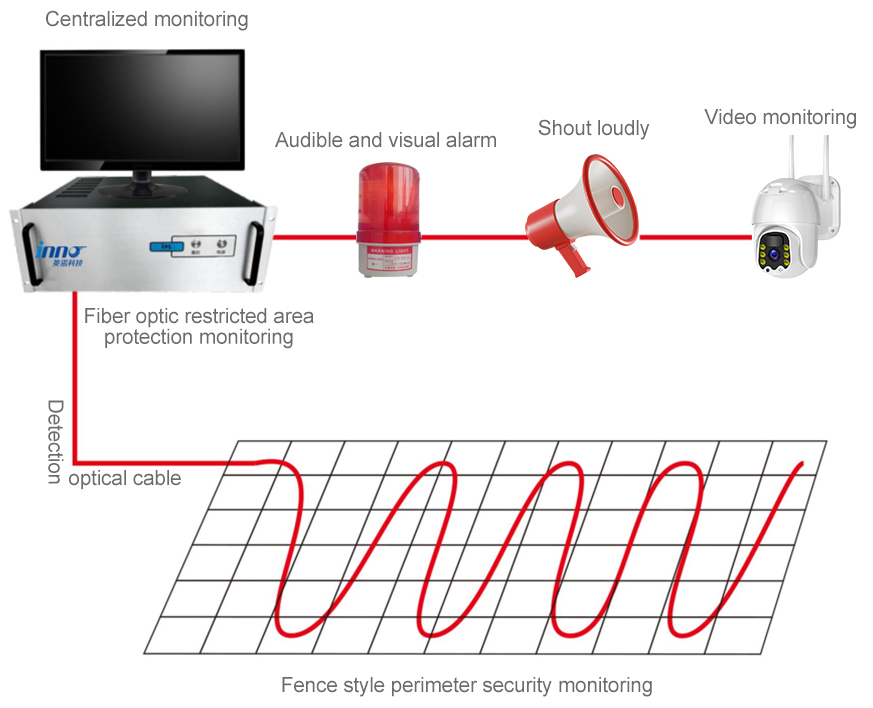
その間 distributed fiber optic sensing with AI analytics forms the most capable core detection layer for fence breach monitoring, the highest level of perimeter security is achieved by integrating multiple complementary technologies into a unified platform. A multi-system approach combines the strengths of each technology while compensating for individual limitations.
Integrated Solution Architecture
| システムレイヤー | テクノロジー | 関数 |
|---|---|---|
| Primary Detection | DASの / DVS Fiber Optic Sensing | Continuous real-time detection and localization of fence disturbances along the full perimeter |
| Intelligent Analysis | AI Signal Classification Engine | Automatic event classification, false alarm filtering, adaptive threshold management |
| Visual Verification | PTZ Cameras / 熱画像処理 | Automatic camera steering to alarm location for visual confirmation of the detected event |
| Access Management | アクセス制御 / Gate Systems | Automatic lockdown of nearby gates and doors upon confirmed breach detection |
| Command & コントロール | Central Security Management Platform | Unified alarm display, GISマッピング, イベントロギング, response coordination, そして報告 |
How the Integrated Workflow Operates
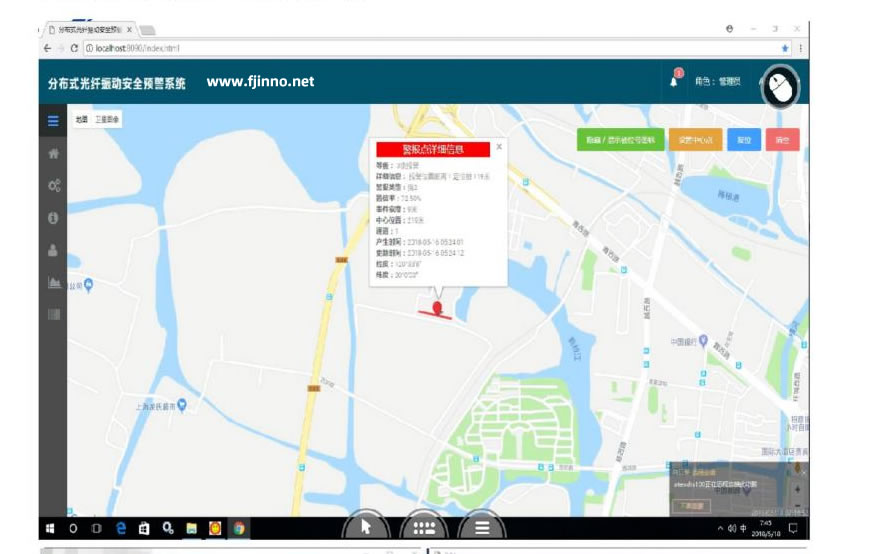
In a fully integrated deployment, ザ DAS or DVS system continuously monitors the fence line and detects a disturbance event. The raw signal data is immediately passed to the AI analytics engine, which classifies the event and determines whether it represents a genuine threat. If confirmed, the system automatically triggers an alarm on the central security management platform, pinpointing the exact location on a GIS map. 同時に, the nearest PTZ camera or thermal imager is directed to the alarm location, providing live video feed to the security operator for visual verification. If the threat is confirmed visually, the system can automatically engage access control lockdown protocols, activate lighting or sirens in the affected zone, and dispatch response teams with precise location information.
This layered approach ensures that detection, 分類, verification, and response happen within seconds of the initial breach attempt, delivering a level of perimeter security that no single technology can achieve on its own.
7. Recommended Solutions by Application Scenario
Different facility types and security requirements call for different combinations of detection technology. The following recommendations are based on industry best practices and real-world deployment experience.
Military Bases and Government Facilities
For the highest security level, deploy a DAS-based fiber optic detection system with AI analytics as the primary detection layer, supplemented by 熱画像カメラ for visual verification and a fully integrated command-and-control platform. DAS provides the acoustic classification depth needed to identify sophisticated intrusion methods, while AI filtering ensures near-zero false alarm rates in operationally demanding environments.
Industrial Plants and Energy Facilities
Oil and gas plants, 発電所, and substations benefit from DAS or DVS fiber optic perimeter monitoring due to the technology’s immunity to electromagnetic interference — a critical advantage in electrically noisy industrial environments. Integrate with ビデオ分析 and existing SCADAシステム for centralized monitoring and automated response.
Airports and Transportation Hubs
Extended perimeters at airports and rail yards require long-range detection capability. ある システム covering the full perimeter on a single fiber, combined with AI classification to filter out aircraft noise and vehicle vibration, provides the most efficient and reliable solution. PTZ camera integration enables rapid visual verification across large areas.
Warehouses, Logistics Parks, and Commercial Sites
For standard commercial security, ある DVS fiber optic fence detection system とペアになった CCTV video analytics 実用的でコスト効率の高いソリューションを提供します. DVS はフェンスラインに沿った信頼性の高い侵入検知を提供します, カメラシステムは視覚的な検証と証拠の記録を処理します.
刑務所と矯正施設
矯正施設では外部からの侵入と内部からの逃走の試みの両方を検知する必要がある. ある デュアル DAS/DVS 光ファイバー構成 — 外周に DAS を、内部境界に DVS を配置 — と組み合わせる サーマルカメラ そして アクセス制御の統合, すべての脅威ベクトルを包括的にカバーします.
8. Deployment and Commissioning Best Practices
最適な検出テクノロジーであっても、適切にインストールおよび構成されていない場合は、パフォーマンスが低下します。. 次のベスト プラクティスは、初日から最適なシステム パフォーマンスを確保するのに役立ちます。.
ケーブルの取り付け
ザ 光ファイバーセンシングケーブル 一定の間隔でフェンスの布地にしっかりと取り付ける必要があります。通常は 20 宛先 30 centimeters — to ensure consistent acoustic coupling. Use UV-resistant cable ties or stainless steel clips rated for outdoor use. Avoid excessive slack or loose loops, as these can generate vibration noise and reduce localization accuracy. For buried installations, place the cable in compacted sand backfill at 20–40 cm depth with consistent ground contact.
Zone Configuration
Divide the perimeter into logical alarm zones based on the security layout and response plan. Each zone should be independently configurable with its own detection threshold, 感度プロファイル, and alarm priority level. Zones adjacent to roads, gates, or high-traffic areas may require higher thresholds or AI-assisted filtering to prevent nuisance alarms.
Commissioning and Threshold Tuning
インストール後, conduct a comprehensive commissioning process that includes baseline noise measurement across all zones, simulated intrusion testing at multiple points along the fence, and iterative threshold adjustment. Test with realistic scenarios including climbing, 切断, 震える, and digging to verify detection sensitivity. Document all test results and threshold settings as a reference for future maintenance.
統合テスト
If the system is integrated with cameras, アクセス制御, or a management platform, conduct end-to-end functional testing to verify that alarm events propagate correctly through all system layers. Confirm that camera auto-tracking, map display, イベントロギング, and notification functions operate as expected under both normal and high-alarm-volume conditions.
9. よくあるご質問 (FAQ)
質問1: Which technology is best for real-time fence breach detection?
分散型光ファイバーセンシング (DAS/DVS) is widely recognized as the best core technology for real-time fence breach detection. It offers continuous monitoring over long distances, meter-level localization accuracy, 電磁干渉に対する耐性, and compatibility with AI-powered analytics for intelligent event classification.
質問2: What is the difference between DAS and DVS in fence monitoring?
DAS captures full acoustic waveforms using phase-based analysis, enabling advanced event classification and very low false alarm rates. DVS measures vibration intensity, providing reliable detection and localization at lower system cost. DAS is recommended for high-security applications, while DVS is suitable for standard perimeter protection.
質問3: How does AI reduce false alarms in fence detection systems?
AI algorithms analyze the signal pattern, 周波数成分, and duration of each detected event, comparing it against trained models of known intrusion types and benign activities. This enables automatic classification and filtering, typically reducing false alarms by 80% or more compared to simple threshold-based detection.
質問4: Can fiber optic fence detection work in extreme weather?
はい. Fiber optic cables are inherently resistant to temperature extremes, 湿気, と腐食. The sensing systems operate reliably in conditions ranging from -40°C to +65°C. Wind and rain may increase background noise on exposed fence-mounted cables, but AI-assisted adaptive filtering effectively manages these conditions.
Q5: How far can a single fiber optic system monitor?
A single DAS interrogation unit can monitor up to 50–100 km of fence line, and a DVS unit can cover 40–60 km. For perimeters exceeding these distances, multiple interrogators can be deployed with centralized management software.
Q6: Is fiber optic fence detection suitable for existing fences?
はい. Fiber optic sensing cables can be retrofitted onto virtually any existing fence type — chain link, welded mesh, palisade, or razor wire — using simple cable ties or mounting clips. No structural modification to the fence is typically required.
Q7: What types of intrusions can a fiber optic fence system detect?
Fiber optic systems can detect fence climbing, 切断, lifting, 震える, and impact. They also detect digging or tunneling near the fence line and vehicle-based breach attempts. DAS systems can further classify these event types by their acoustic signature.
Q8: How quickly does the system detect a breach?
Detection is effectively real-time. ほとんどの DAS および DVS システムは、内部のイベントを検出して特定します。 1 宛先 3 発生から数秒. AI分類およびカメラ自動追跡と統合した場合, 目視検証は以内に開始できます 5 最初の妨害の秒数.
Q9: 光ファイバーケーブルはフェンスラインに沿って電力を必要としますか??
いいえ. センシングケーブルは完全にパッシブであり、現場で電力を必要としません。. すべてのアクティブなコンポーネントは中央尋問ユニットにあります, までインストールできます 100 監視フェンス区域から km 離れている.
Q10: 光ファイバー検出を既存の CCTV およびアクセス制御システムと統合できますか??
はい. 最新の光ファイバー検出プラットフォームは、TCP/IP などの標準統合プロトコルをサポートしています, ONVIF, OPC, Modbusの, およびドライ接点出力. ほとんどのビデオ管理システムと接続できます。, アクセス制御プラットフォーム, SCADAシステム, 集中セキュリティ管理ソフトウェア.
10. Get a Customized Fence Detection Solution
すべての境界はユニークです, and the best detection solution is one that is tailored to your specific site conditions, threat profile, および運用要件. Whether you need a standalone DAS or DVS fiber optic fence alarm system, an AI-enhanced analytics platform, or a fully integrated multi-technology perimeter security solution, our engineering team can help you design, 展開する, and optimize a system that delivers reliable, real-time breach detection from day one.
今すぐお問い合わせください to discuss your project requirements and receive a customized recommendation. 訪問 www.fjinno.net or reach out to our technical team for a free consultation and site assessment.
免責事項: この記事で提供される情報は、一般的な情報提供および教育のみを目的としています。. 正確性を確保するためにあらゆる努力が払われていますが、, フジンノ (www.fjinno.net) 完全性に関していかなる保証も表明も行いません, 確実, or suitability of the content for any specific application. 製品仕様, 技術的パラメータ, and performance data referenced herein are typical values and may vary depending on specific models, 構成, 設置条件, および動作環境. Readers are strongly advised to consult with qualified security engineers and system integrators before making purchasing or deployment decisions. FJINNOはいかなる損失についても責任を負いません, ダメージ, or consequence arising from the use of or reliance on the information contained in this article.

光ファイバー温度センサ, インテリジェント監視システム, 中国の分散型光ファイバーメーカー
 |
 |
 |