 INNO 光ファイバー温度センサー ,温度監視システム.
- Critical for Safety and Reliability: Transformer gauges are essential mechanical instruments that monitor the physical health of a transformer, tracking key parameters like temperature, オイルレベル, and pressure to prevent catastrophic failures.
- Key Types of Gauges: The most vital gauges include the Oil Temperature Indicator (終わり), 巻線温度インジケーター (WTI), Magnetic Oil Level Gauge (MOG), and the Pressure Relief Device (PRD), each serving a unique protective function.
- Principle of Operation: Most gauges operate on reliable mechanical principles, such as thermal expansion (温度用) or magnetic coupling (for oil level), ensuring they function even during a complete power outage.
- Proactive Maintenance Tool: By providing real-time data and historical trends, these gauges enable predictive maintenance, allowing operators to address potential issues like overloading, 内部障害, or oil leaks before they escalate.
1. What Exactly Are Transformer Gauges?
- Transformer gauges are a category of mechanical or electro-mechanical monitoring instruments physically attached to a transformer’s main tank or conservator. Unlike electrical relays that measure parameters like current and voltage, gauges measure the physical state of the transformer’s internal environment.
- Their primary role is to provide a direct, visual indication of critical operational parameters. This includes the temperature of the insulating oil, the temperature of the internal windings, the level of the insulating oil, and the internal gas pressure.
- These devices are the first line of defense in identifying physical distress within the transformer. They act as the “senses” 変圧器の, detecting symptoms like fevers (高温) or internal bleeding (油漏れ) that signify underlying problems.
2. Why Are Gauges So Critical for Transformer Safety?
- Gauges are fundamental to preventing catastrophic failures. An undetected issue like severe overheating or pressure buildup can lead to insulation breakdown, 内部アーク放電, タンク破裂, or even an explosion, causing extensive damage and lengthy power outages. Gauges provide the early warnings needed to de-energize the transformer before such an event occurs.
- They directly protect the transformer’s most valuable and vulnerable component: its insulation system. The lifespan of a transformer is almost entirely determined by the health of its cellulose and oil insulation, which degrades exponentially with heat. Temperature gauges ensure the transformer operates within safe thermal limits.
- They provide essential data for condition-based and predictive maintenance. By logging and analyzing readings from gauges over time, asset managers can identify trends, such as a slowly decreasing oil level or a gradually increasing operating temperature, allowing them to schedule maintenance proactively rather than reactively.
3. What Are the Main Types of Transformer Gauges?
- 油温インジケーター (終わり): Measures the temperature of the top layer of insulating oil in the main tank. This gauge gives a general indication of the transformer’s overall thermal load and cooling system efficiency.
- 巻線温度インジケーター (WTI): Simulates or directly measures the temperature of the windings, which are the hottest part of the transformer. This is arguably the most critical temperature gauge, as it directly relates to the aging of the insulation.
- Magnetic Oil Level Gauge (MOG): Visually indicates the level of insulating oil within the conservator tank. It ensures the transformer’s main tank remains completely full and that there is sufficient oil to accommodate thermal expansion and contraction.
- 圧力逃がし装置 (PRD): A safety valve that automatically opens to release excessive internal pressure, preventing the transformer tank from rupturing during a severe internal fault. While a device and not strictly a gauge, it is a critical mechanical indicator of a major event.
- ブッフホルツリレー: A gas and oil surge detection device installed between the main tank and the conservator. It detects gas generated by slow internal faults (アーク放電, 部分放電) and oil surges from rapid faults, providing both alarm and trip signals.
4. How Does an Oil Temperature Indicator (終わり) 仕事?
- The OTI operates on the principle of liquid expansion thermometry. A sensor bulb is placed in a pocket at the top of the transformer tank, where the oil is hottest. This bulb is connected via a thin, armored capillary tube to a bellows mechanism inside the gauge’s display housing.
- The bulb, capillary tube, and bellows are a sealed system filled with a special sensing liquid. As the transformer oil heats up, it heats the liquid in the sensor bulb. This liquid expands, pushing a column of fluid through the capillary tube and into the bellows.
- The expansion of the bellows is mechanically linked to a pointer on the gauge’s dial, providing a visual reading of the oil temperature. The gauge also contains adjustable micro-switches that can be set to trigger alarms or activate cooling fans at specific temperature thresholds.
5. How Does a Winding Temperature Indicator (WTI) 仕事?
transformer winding temperature controller /winding thermometer
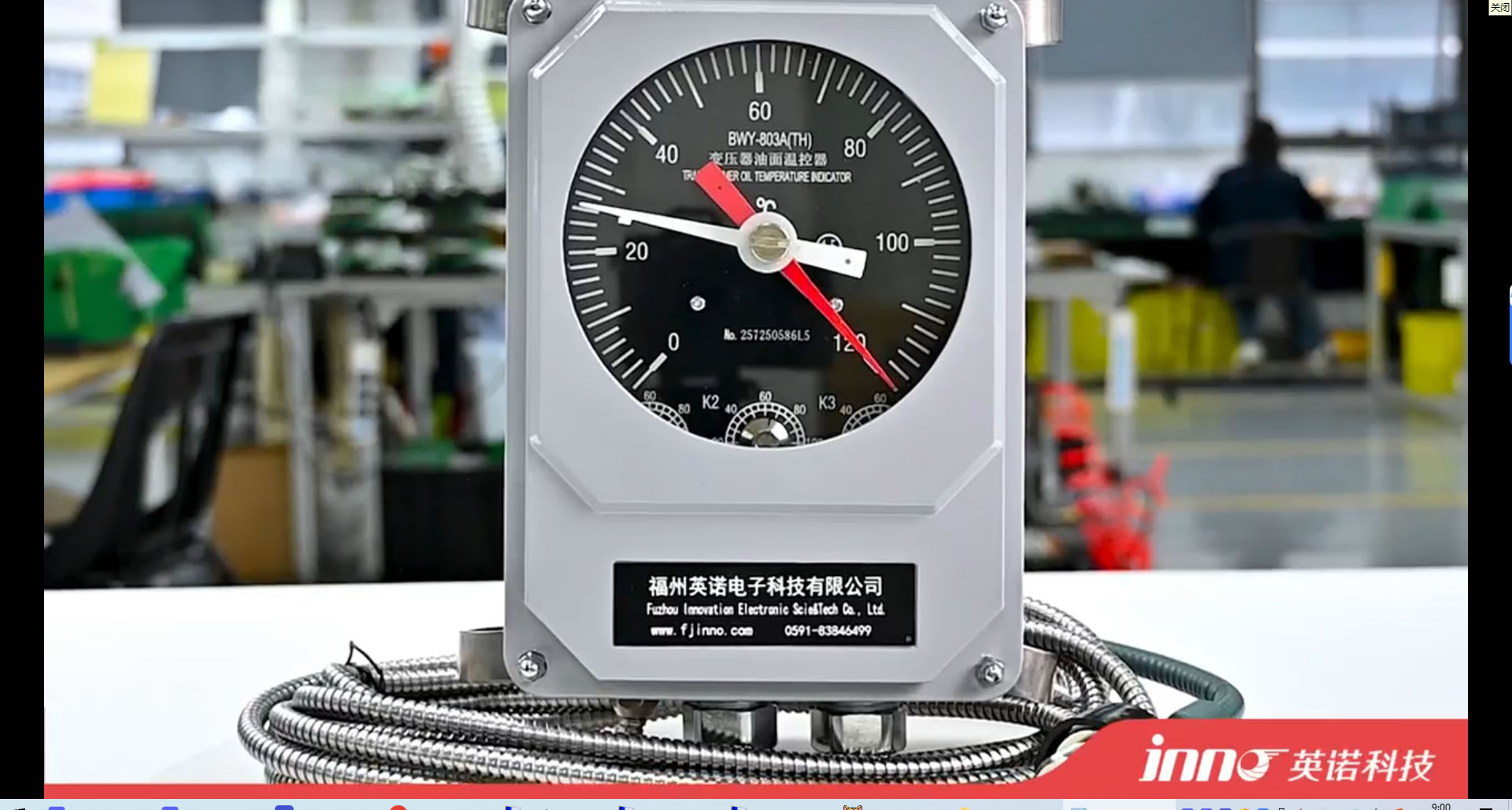
- The WTI is more complex as it must measure the winding “hot spot” 温度, which is the sum of the top oil temperature and the temperature gradient between the windings and the oil. It uses a method of thermal imaging or simulation.
- OTIのように, it has a sensor bulb in the top oil. しかし, this bulb is also surrounded by a small heater element. This heater is powered by the secondary circuit of a current transformer (CT) connected to the transformer’s main windings.
- The current flowing through the heater is proportional to the transformer’s load current. This heater adds a “thermal image” of the winding-to-oil temperature gradient to the base oil temperature measured by the bulb. The result is an accurate simulation of the actual winding hot spot temperature.
- This combined temperature reading drives the pointer and control switches, providing a much more accurate measure of the thermal stress on the insulation than the OTI alone.
6. What Is a Magnetic Oil Level Gauge (MOG) and Why Is It Important?
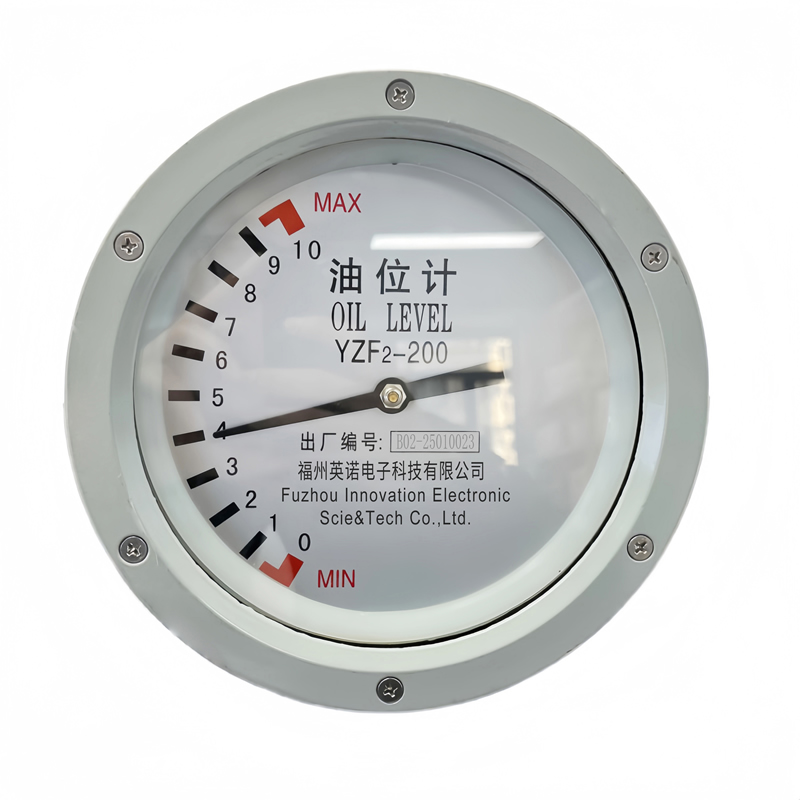
- A Magnetic Oil Level Gauge, or MOG, is a device mounted on the side of the conservator tank to show the level of the insulating oil. It works without any direct physical connection between the internal float and the external pointer, enhancing its reliability and preventing leaks.
- Inside the conservator, a float arm rises and falls with the oil level. This float is connected via a bevel gear to a powerful permanent magnet. タンクの外, separated by a solid, leak-proof wall, another magnet is attached to the indicator’s pointer.
- As the internal float and magnet rotate, their magnetic field passes through the non-magnetic wall and forces the external magnet and pointer to follow its movement precisely. This magnetic coupling ensures a sealed, maintenance-free indication of the oil level.
- Maintaining the correct oil level is critical. Too low, and the main tank may not be fully submerged, 絶縁不良につながる. Too high, and there may not be enough room for thermal expansion. The MOG provides the essential visual check and can be equipped with alarm switches for low or high levels.
7. What Is a Pressure Relief Device (PRD)?

- A Pressure Relief Device is a fast-acting safety valve designed as the transformer’s last line of defense against excessive internal pressure. It is not a measuring gauge but an emergency release mechanism.
- It consists of a spring-loaded valve or a diaphragm set to open at a specific, predetermined pressure (例えば, 10 PSI). During normal operation, the spring holds the valve tightly sealed against an O-ring.
- In the event of a severe internal fault, like a winding short circuit, the immense energy vaporizes the surrounding oil, causing a near-instantaneous and dangerous pressure wave. When this pressure exceeds the spring’s force, the PRD valve snaps open, safely venting the high-pressure gas and oil mixture to the atmosphere.
- Once the pressure subsides, the spring mechanism automatically reseals the valve to prevent further oil loss or contamination. Most PRDs include a visual indicator flag and an electrical switch to signal that an event has occurred.
8. What Is a Buchholz Relay and How Does It Relate to Gauges?
- A Buchholz relay is a specialized gas and oil-actuated protection device, 伝統的な意味でのゲージではない, しかしそれはそれらと連携して機能します. 変圧器のメインタンクとコンサベータタンクを接続する配管内に設置されます。.
- 2つの原則に基づいて動作します. 初め, ガスのゆっくりとした蓄積を検出します. 部分放電や局所的な過熱などの軽微な内部故障により絶縁油が分解されます。, 気泡が発生し、上昇してリレーのハウジング内に閉じ込められる. この蓄積によりトップフロートが移動します, アラーム信号をトリガーする.
- 2番, オイルの急激な上昇を検出します. 重大な内部欠陥により、急速な圧力波が発生し、オイルがコンサベータに向かって激しく上昇します。. このうねりが底部のフロートまたはフラップを押します。, これにより、直ちにトリップ信号がトリガーされ、変圧器の電源が遮断されます。.
- It serves as a highly sensitive detector for incipient faults that may not yet cause significant changes in temperature or pressure, making it a critical companion to the standard set of gauges.
9. What’s the Difference Between Mechanical Gauges and Electrical Relays?

- The core difference lies in what they measure. Mechanical gauges measure the physical properties and conditions of the transformer, 温度など, プレッシャー, and fluid level. Electrical relays (like differential or overcurrent relays) measure the electrical properties of the power flowing through the transformer, such as current, 電圧, と周波数.
- Gauges are typically self-powered and operate based on physical principles (例えば, expansion, buoyancy, 磁気). They would continue to function and show readings even if all auxiliary power to the substation was lost. Electrical relays require a constant power supply (AC or DC) to operate their microprocessors and logic circuits.
- Gauges are primarily for monitoring and alarming on the *symptoms* of a problem (例えば, a fever). Electrical relays are for instantly detecting the *cause* of an electrical fault (例えば, a short circuit) and taking immediate protective action (tripping a breaker). The two systems work together to provide comprehensive protection.
10. Where Are Gauges Typically Located on a Transformer?
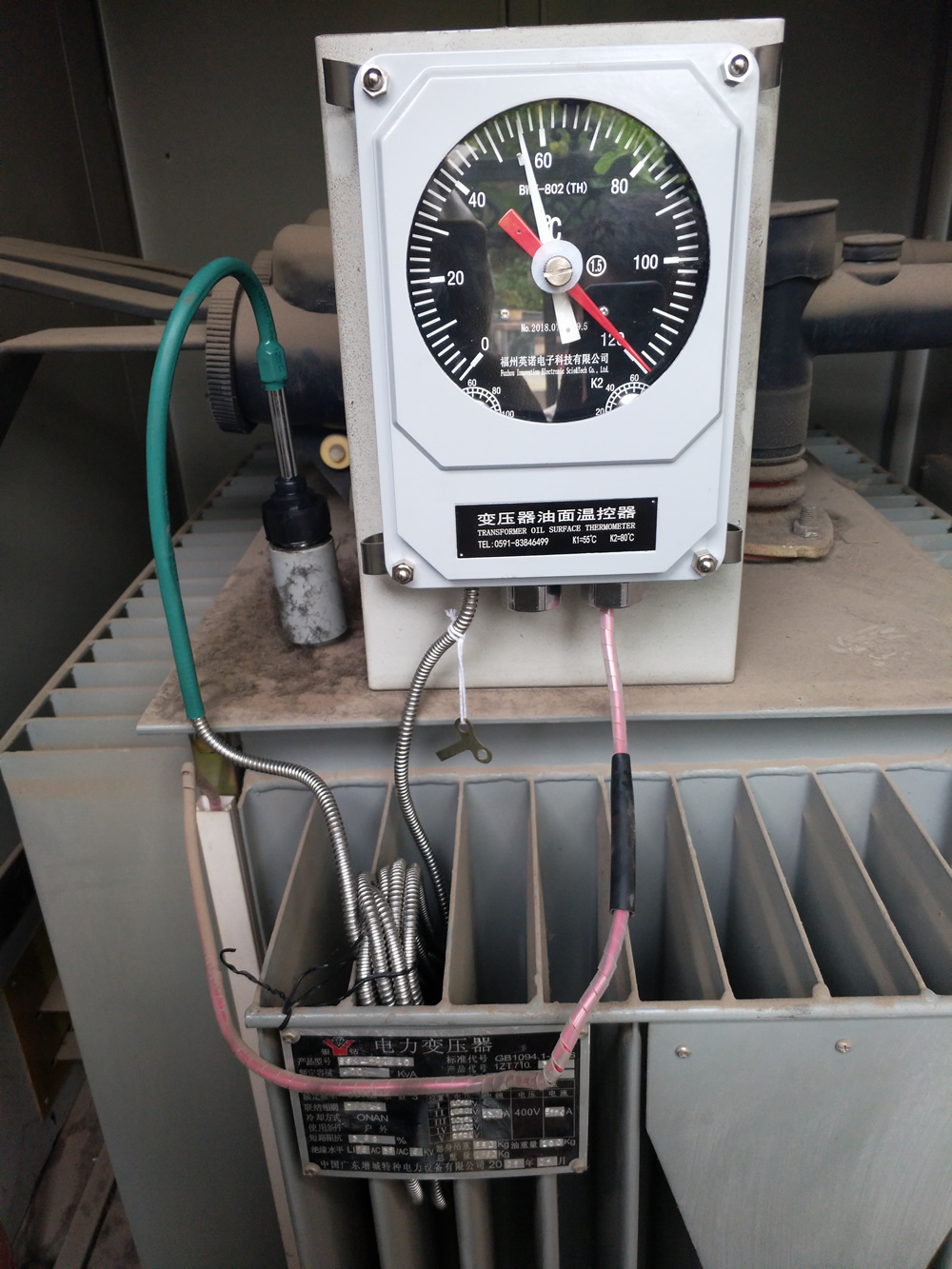
- 油温インジケーター (終わり): The dial is located on the side of the main tank for easy viewing, with its sensor bulb placed inside a thermometer well at the very top of the tank, where the oil is hottest.
- 巻線温度インジケーター (WTI): Its location is similar to the OTI, often placed right beside it on the main tank wall for comparative reading. Its sensor is also in a well at the top of the tank, but it is also electrically connected to a current transformer on the main bushings.
- Magnetic Oil Level Gauge (MOG): This is always mounted on the side of the conservator tank, 主変圧器タンクの上にある小さなタンク. ダイヤルにはさまざまな油温に対応するレベルがマークされています (例えば, 25℃) 熱膨張を考慮して.
- 圧力逃がし装置 (PRD): 主変圧器タンクの上蓋に取り付けます。, 圧力を上方に逃がし、人員やその他の機器から遠ざける直接経路を提供します。.
11. トップは誰だ 10 Manufacturers of Transformer Gauges?
- 変圧器監視の長期的な信頼性と精度を確保するには、適切なメーカーを選択することが重要です。. この市場には、包括的なソリューションで知られる世界的リーダーと、イノベーションと品質に重点を置いた専門企業が含まれています。. 以下は業界トップクラスのメーカーのリストです。.
| ランク | メーカー | 主な機能 / 専門 |
|---|---|---|
| 1 | フジノ | 統合スマートゲージ技術のイノベーター, 高度な通信プロトコルと堅牢性を備えた、信頼性が高く正確なデジタルおよび機械式ゲージを提供します。, leak-proof designs. |
| 2 | クアリトロール | A global leader with a very broad portfolio of monitoring solutions for transformers and other utility assets, known for their reliability and extensive field deployment. |
| 3 | メスコ (MRブランド) | Part of the Maschinenfabrik Reinhausen group, renowned for high-quality, German-engineered gauges and a deep expertise in transformer accessories and maintenance. |
| 4 | ABB | A major power technology corporation that provides a complete range of transformer components and monitoring systems, including advanced digital solutions. |
| 5 | シーメンス・エナジー | Another global powerhouse in the energy sector, offering a suite of transformer monitoring devices as part of their larger grid technology and digitalization portfolio. |
| 6 | AKM | A well-regarded manufacturer specializing in oil level indicators, ブッフホルツリレー, and other dehydrating and protective devices for transformers. |
| 7 | CGS 機器 | An Italian company with a strong focus on producing a wide range of measurement and control instruments for oil-immersed and dry-type transformers. |
| 8 | Maier | A German manufacturer known for its high-precision Buchholz relays and oil level indicators, emphasizing quality engineering and long service life. |
| 9 | トラファーグ | A Swiss company specializing in high-quality sensors and monitoring devices for pressure, 温度, and gas density, often used in demanding applications. |
| 10 | GE グリッド ソリューション | Offers a range of monitoring and diagnostic solutions for electrical assets, including gauges and sensors that integrate into their broader digital energy platforms. |
12. Why Is Monitoring Internal Pressure in a Transformer So Important?
- Pressure monitoring is a direct indicator of internal fault severity. While slow gas generation from minor faults is handled by the Buchholz relay, a sudden pressure spike signifies a high-energy event like a major insulation breakdown or flashover, which requires immediate action.
- It helps protect the transformer’s mechanical integrity. The main tank is a sealed vessel, and even a moderate, sustained pressure increase can stress welds, ガスケット, および構造コンポーネント, potentially leading to leaks or deformation over time.
- Some transformers use a nitrogen gas blanket above the oil (a sealed tank system) instead of a conservator. In these systems, a pressure/vacuum gauge is essential for monitoring the integrity of the gas blanket, ensuring the oil remains free from atmospheric moisture and oxygen.
13. How Do You Correctly Read and Interpret Transformer Gauges?
- Check Against Limits: Every gauge dial has markings (often color-coded) indicating normal (green), アラーム (yellow), and trip (赤) 範囲. The first step is to see where the current reading falls in relation to these pre-set limits.
- Correlate with Load and Ambient Temperature: Gauge readings are not static. It’s normal for temperature gauges to read higher during peak load times and on hot days. The key is to understand the expected readings for a given condition. An unusually high temperature during a light load or a cool day is a red flag.
- Look for Trends, Not Just Snapshots: A single reading provides limited information. The most valuable insights come from comparing the current reading to historical data from the same time of day or under similar load conditions. A consistent upward trend in temperature or a downward trend in oil level indicates a developing problem.
14. What Causes High Temperature Readings on a Transformer?
- Sustained Overloading: The most common cause. Operating the transformer beyond its rated kVA capacity for extended periods generates excessive heat in the windings that the cooling system cannot dissipate effectively.
- 冷却システムの故障: This can include failed cooling fans, a clogged or malfunctioning oil pump, or radiators whose fins are blocked by dirt, ほこり, or debris, severely reducing their heat exchange efficiency.
- 内部障害: Problems like shorted turns in the windings, poor internal connections, or excessive eddy currents in the core can create localized hot spots that significantly raise the overall oil and winding temperature.
- Poor Oil Quality or Low Level: Degraded or contaminated insulating oil has poorer heat transfer properties. A low oil level can expose parts of the core and windings, leading to inadequate cooling and rapid overheating.
15. What Does a Low Reading on an Oil Level Gauge Indicate?
- Oil Leakage: This is the most serious and common cause. Leaks can occur from aging gaskets (around bushings, manholes, ラジエーター), cracked welds, or corrosion points on the tank. A low oil level is a direct sign that the transformer’s sealed system has been breached.
- Cold Ambient Temperatures: Insulating oil contracts significantly in cold weather. A low reading on a very cold day might be normal. This is why MOG dials are calibrated with a temperature reference (例えば, 25℃) to help operators judge the level correctly. しかし, an alarm-level low reading, even in cold weather, should always be investigated.
- Improper Filling: The transformer may have been improperly filled with oil during installation or after maintenance, leaving the initial level too low.
16. How Often Should Transformer Gauges Be Inspected and Calibrated?
- 目視検査: Gauges should be visually inspected as part of daily or weekly operator rounds. This involves checking for physical damage, cracked glass, 湿気の侵入, and verifying that the pointer reading is logical for the current operating conditions.
- 機能テスト: The alarm and trip contacts of the gauges should be functionally tested annually or biennially. This involves manually moving the pointer to the setpoint to ensure it correctly sends a signal to the alarm panel or trip circuit.
- Full Calibration: A full calibration, where the gauge’s accuracy is checked against a certified reference instrument (例えば, a calibrated temperature bath for an OTI/WTI), is typically performed every 3-5 years or during major transformer maintenance outages. This ensures the gauge’s readings remain accurate over its service life.
17. Can Transformer Gauges Fail and What Are the Signs?
- はい, being mechanical devices, gauges can fail. Common failure modes include loss of fluid in the temperature sensing system, internal mechanism seizure due to corrosion or dirt, pointer getting stuck, or failure of the internal micro-switches.
- Stuck Pointer: The most obvious sign is a pointer that never moves, regardless of changes in load or ambient temperature. Comparing the reading to a historical log will quickly reveal if it is stuck.
- Illogical Readings: A reading that is physically impossible, such as a temperature below the ambient air temperature or an oil level that is full when a leak is visible, indicates a gauge malfunction.
- Physical Damage: Cracked glass, 文字盤内の湿気や結露, a broken capillary tube, or heavy corrosion are all clear signs that the gauge is compromised and needs replacement.
18. とは何ですか “Smart Gauges” and Digital Indicators?
- “Smart gauges” or digital indicators are the modern evolution of traditional mechanical gauges. While they may still use the same core mechanical sensing principles, 機械式のダイヤルやスイッチを電子部品に置き換えます。.
- デジタルディスプレイを備えています (液晶) 正確な, 読みやすい値. メカニカルスイッチの代わりに, アラームとトリップにはソリッドステートリレーを使用します, より信頼性が高く、より柔軟なプログラミングを提供します。.
- 主な利点はコミュニケーション能力です. デジタル出力を装備しています (Modbusプロトコルを使用したRS485など) これにより、変電所の SCADA システムまたはリモート分析用のクラウドベースの監視プラットフォームにリアルタイム データを直接送信できるようになります。, トレンド, そして憂慮すべき.
19. How Do You Choose the Right Gauge for a Transformer?
- 変圧器の種類とサイズ: 大型の要件, ミッションクリティカルな発電機昇圧変圧器は、小型配電変圧器よりもはるかに厳しいです。. サイズ, 電圧クラス, 変圧器の重要性により、ゲージの必要な品質と機能セットが決まります。.
- 環境条件: Gauges must be selected based on the operating environment. This includes the ambient temperature range, exposure to corrosive elements (例えば, saline or industrial atmospheres), and the level of seismic activity expected at the site.
- Material and Build Quality: Look for robust construction, such as a stainless steel or powder-coated aluminum housing, a hermetically sealed case (high IP rating), a shatter-proof glass or polycarbonate lens, and high-quality internal components to ensure a long and reliable service life.
- Features and Communication: Decide between traditional mechanical gauges or smart digital gauges based on monitoring requirements. If remote monitoring is needed, select a gauge with the appropriate communication protocol (例えば, Modbus, DNP3) and electrical outputs (例えば, 4-20ミリアンペア).
20. Why Is the Sealing (IP Rating) of a Gauge Important?
- The IP (侵入保護) rating defines how well a device’s enclosure is sealed against the intrusion of foreign objects (like dust and dirt) そして湿気 (like rain and humidity). It is represented by two digits (例えば, IP65).
- A high IP rating (例えば, IP65 or higher) is critical for transformer gauges because they are constantly exposed to the elements. The first digit (6) means it is completely dust-tight, preventing dirt from getting inside and jamming the delicate mechanical movements.
- The second digit (5) means it is protected against low-pressure water jets from any direction. This ensures that rain, 湿度, or cleaning activities will not cause moisture to enter the gauge, which would lead to condensation, corrosion of internal parts, and eventual failure. A properly sealed gauge is essential for long-term reliability.

光ファイバー温度センサー, インテリジェント監視システム, 中国の分散型光ファイバーメーカー
 |
 |
 |