 INNO faseroptische Temperatursensoren ,Temperaturüberwachungssysteme.
- A transformer temperature humidity monitoring system is a continuous sensing solution that simultaneously tracks winding heat, Umgebungstemperatur, and relative humidity inside transformer enclosures — in real time, without interruption.
- Temperature and humidity must be monitored together because their combined effect on transformer insulation accelerates aging far faster than either factor alone.
- Fluoreszenzfaseroptische Sensoren are the established technology for direct winding hot-spot measurement inside live high-voltage transformers — fully dielectric, immun gegen elektromagnetische Störungen, and safe at voltages exceeding 100 kV.
- Ambient temperature and relative humidity inside transformer rooms are measured by dedicated temperature humidity sensors with industrial-grade accuracy and protection ratings.
- Alarmschwellen, cooling system interlocks, and dehumidifier activation are all managed automatically by the monitoring system, Reduzierung der Notwendigkeit manueller Inspektionsrunden.
- Systeme kommunizieren über RS485 / Modbus RTU und Integration mit SCADA, DCS, und Stationsautomatisierungsplattformen ohne kundenspezifische Hardware.
- Hergestellt von Fuzhou Innovation Electronic Science&Tech Co., Ltd., mit über einem Jahrzehnt praxiserprobter Erfahrung in der Glasfasersensorik 2011.
1. Was ist ein Transformator-Temperatur-Feuchtigkeits-Überwachungssystem??
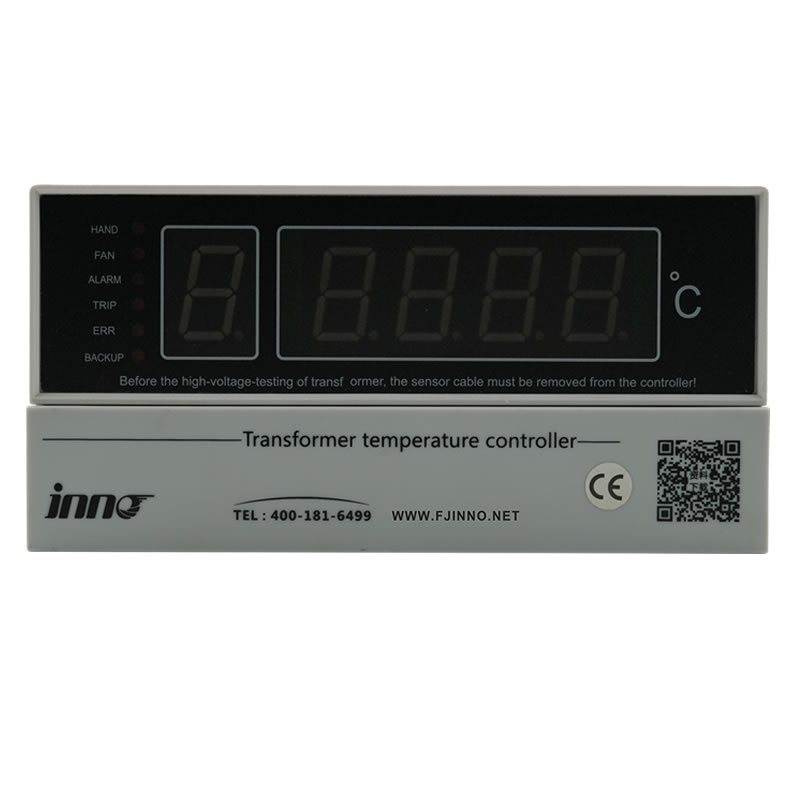
A transformer temperature humidity monitoring system ist eine stetige, real-time instrumentation solution that simultaneously measures the thermal and moisture conditions inside and around a power transformer. It tracks winding hot-spot temperature, Oberöltemperatur, transformer room ambient temperature, and relative humidity — feeding all readings into a central monitoring unit that logs data, triggers alarms, and activates protective responses automatically.
The defining characteristic of this type of system is its dual focus. Temperature and humidity are not independent variables in a transformer environment — they interact directly at the insulation level. A transformer operating at elevated temperature in a humid environment degrades its cellulose insulation at a rate that cannot be predicted from either measurement alone. Monitoring both simultaneously, at all times, is the only way to accurately assess insulation condition in service.
Eine komplette System zur Zustandsüberwachung von Transformatoren typically comprises four layers: sensing elements at the transformer and in the surrounding environment, a local data acquisition unit, a communication link to the site control system or cloud platform, and supervisory software that presents data, Trends, and alarms to operators. Each layer is specified to the electrical environment of the installation — high-voltage substation, industrial distribution room, or outdoor pad-mount transformer — with appropriate insulation ratings, protection classes, und Kommunikationsprotokolle.
2. Warum Transformatoren eine gleichzeitige Wärme- und Feuchtigkeitsüberwachung benötigen
A power transformer’s operational life is determined primarily by the condition of its cellulose paper insulation. That insulation degrades through two mechanisms that are continuously at work during normal operation: thermal aging and moisture absorption. Das Verständnis, wie diese beiden Mechanismen interagieren, erklärt, warum a kombinierter Ansatz zur Überwachung von Temperatur und Luftfeuchtigkeit ist effektiver als die isolierte Verfolgung eines Parameters.
Der Einfluss der Temperatur auf die Lebensdauer der Transformatorisolierung
Die Alterung der Transformatorisolierung folgt einem exponentiellen Verhältnis zur Temperatur – ein Prinzip, das in internationalen Belastungsstandards kodifiziert ist. Für jeden Anstieg um 6–8 °C über die Nenntemperatur des Hotspots, die Geschwindigkeit des Zelluloseabbaus verdoppelt sich etwa. Dies bedeutet, dass ein Transformator, der kontinuierlich bei 10 °C über seiner Auslegungs-Hot-Spot-Temperatur betrieben wird, die Isolationslebensdauer viermal so schnell verliert wie erwartet. Direkt, kontinuierlich Überwachung der Wicklungs-Hot-Spot-Temperatur Nur so kann dieser Zustand in Echtzeit erkannt werden, bevor er zu irreversiblen Isolationsschäden führt.
Der Einfluss von Luftfeuchtigkeit auf die Isolationsintegrität und die Spannungsfestigkeit
Durch die Alterung des Öl-Papier-Systems dringt Feuchtigkeit in die Transformatorisolierung ein, durch Verschlechterung der Entlüftung, und durch Kondensationszyklen bei Schwankungen der Transformatorlast. Da der Feuchtigkeitsgehalt in der Papierisolierung steigt, seine Durchschlagsfestigkeit sinkt – die Gefahr einer Teilentladung steigt, Beschleunigung des weiteren Zelluloseabbaus, und Verringerung der Widerstandsfähigkeit der Isolierung gegen Spannungsstöße. A Transformator-Raumfeuchtigkeitssensor Das System erkennt steigende relative Luftfeuchtigkeit, bevor Feuchtigkeit in das Öl-Papier-System eindringt und bietet ein Frühwarnfenster, das eine Temperaturüberwachung allein nicht bieten kann.
Der kombinierte Degradationseffekt
Wenn gleichzeitig erhöhte Temperatur und erhöhte Luftfeuchtigkeit vorliegen, their combined effect on insulation aging is multiplicative, not additive. Hot, moist conditions drive moisture deeper into the paper insulation, accelerate acid formation in the oil, and increase the rate of degree-of-polymerization loss in the cellulose. A transformer temperature and humidity monitoring system captures this interaction by providing a continuous, correlated record of both parameters — enabling insulation life models, load management decisions, and predictive maintenance scheduling that no single-parameter monitoring system can support.
Consequences of Unmonitored Thermal and Moisture Excursions
Transformers that operate without continuous thermal and moisture monitoring are vulnerable to undetected insulation aging events that manifest only when failure is already imminent. The consequences range from unplanned outages and forced derating to insulation breakdown, oil fires, and catastrophic bushing failures. In substation environments where transformer failure triggers cascading supply disruptions, the business and safety case for continuous real-time transformer condition monitoring is unambiguous.
3. Was ein Transformator-Wärme- und Feuchtigkeitsmonitor tatsächlich misst
A fully specified transformer temperature humidity monitoring system acquires readings across several distinct measurement points, each targeting a different aspect of transformer thermal and moisture condition:
- Wicklungs-Hot-Spot-Temperatur — the highest temperature within the active winding, measured directly with a fiber optic probe embedded in the coil during manufacture or inserted through an access port
- Obere Öltemperatur — the temperature of the transformer oil at the top of the tank, indicative of overall thermal loading and cooling system performance
- Transformer room ambient temperature — the dry-bulb air temperature inside the transformer enclosure or switchroom, which affects cooling efficiency and condensation risk
- Relative humidity inside the transformer room — the moisture content of the air surrounding the transformer, critical for assessing condensation risk and breathing system performance
- Moisture-in-oil content (optional) — dissolved water concentration in the transformer oil, providing a direct measure of insulation moisture migration
- Kerntemperatur (optional) — iron core temperature for large power transformers where core losses are a significant heat source
The combination of winding hot-spot, Öltemperatur, Umgebungstemperatur, and relative humidity gives operators a complete thermal and moisture picture of the transformer at all times — not a snapshot taken during a maintenance visit, but a continuously updated record of every operating hour.
4. Sensortechnologien: Wie Wicklungstemperatur und Luftfeuchtigkeit gemessen werden
Fluorescence Fiber Optic Sensors for Winding Hot-Spot Detection
Direct winding temperature measurement inside a live high-voltage transformer presents a fundamental challenge: the sensor must operate in contact with windings that may be energized at tens or hundreds of kilovolts, inside a tank filled with dielectric oil, in a strong alternating magnetic field. No conventional electronic sensor can meet all three requirements simultaneously.
Der Fluoreszenzfaseroptischer Temperatursensor solves this problem completely. The sensing probe is entirely dielectric — no metallic conductor runs from the high-voltage winding to the monitoring instrument. The measurement principle is optical: a phosphor tip at the probe end responds to temperature through changes in fluorescence decay time, and the signal travels back to the instrument as light through a glass fiber. The probe is unaffected by the transformer’s magnetic field, generates no electrical interference within the tank, and can be installed directly on winding conductors at any voltage level without additional isolation hardware.
Because the fiber optic winding temperature probe measures the actual hot-spot location — not an indirect oil-temperature approximation — it provides the most accurate and most directly useful input for insulation life calculations and dynamic thermal loading decisions.
Integrated Temperature Humidity Sensors for Ambient Monitoring
Transformer room ambient conditions are monitored by combined temperature and humidity sensors that use capacitive polymer humidity elements paired with precision NTC thermistors or PT100 resistance temperature detectors. These sensors are housed in radiation-shielded enclosures with filtered ventilation to prevent contamination while ensuring that readings reflect true ambient conditions rather than localized heat from the transformer surface.
For outdoor transformer installations and pad-mount units, sensors are specified with IP65 or IP67 protection ratings and UV-resistant housings to withstand direct weathering over multi-year deployment periods without recalibration.
Moisture-in-Oil Sensors for Insulation Moisture Assessment
Where a more direct measure of insulation moisture condition is required, ein oil moisture sensor can be added to the monitoring system. Diese Geräte messen die Wasseraktivität oder die Konzentration gelösten Wassers im Transformatoröl – ein Parameter, der mit dem Feuchtigkeitsgehalt der Papierisolierung ins Gleichgewicht kommt und daher eine indirekte, aber kontinuierliche Messung des Feuchtigkeitsniveaus der Isolierung liefert, ohne dass eine Ölprobenahme oder eine Laboranalyse erforderlich ist.
5. Vergleich der Sensortechnologie zur Zustandsüberwachung von Transformatoren

| Parameter | Fluoreszenzfaseroptische Sonde | Kapazitive Luftfeuchtigkeit + NTC/PT100-Sensor | Ölfeuchtesensor |
|---|---|---|---|
| Messziel | Kurvenreicher Hotspot / Öltemperatur | Raumtemperatur und relative Luftfeuchtigkeit | Im Transformatoröl gelöstes Wasser |
| Wahrnehmungsprinzip | Abfall der Fluoreszenzlebensdauer | Kapazitives Polymer (RH) + Widerstand (T) | Wasseraktivitätsgleichgewicht |
| Temperaturbereich | −40°C bis +260°C | Typischerweise –40 °C bis +85 °C | 0°C bis +100°C (Öltemp) |
| Luftfeuchtigkeitsbereich | N / A | 0–100 % relative Luftfeuchtigkeit | 0–100 % Wasseraktivität |
| Elektrische Isolierung | Vollständig dielektrisch – >100 kV-bewertet | Standardmäßige industrielle Isolierung | Standardmäßige industrielle Isolierung |
| EMI-Immunität | Complete — no metallic sensing path | Good with shielded cable | Good with shielded cable |
| Installationsort | Directly on winding / in oil tank | Transformer room wall / Gehäuse | Inline with oil circuit or sampling valve |
| Installationsmethode | Embedded during winding or inserted via access port | Wall-mount with radiation shield | Flanged inline fitting or sampling port |
| Schutzart | IP67 (probe); IP54+ (instrument) | IP65 / IP67 (im Freien) | IP65 / IP67 |
| Kommunikation | RS485 (via transmitter) | RS485 / 4–20 mA | RS485 / 4–20 mA |
| Wartungsbedarf | None under normal conditions | Periodic filter cleaning; sensor replacement at end of rated life | Annual validation recommended |
| Best suited for | Direct winding and oil thermal monitoring in HV transformers | Continuous ambient condition tracking in transformer rooms | Insulation moisture condition assessment |
6. Systemarchitektur, Kommunikation, und Steuerungsintegration
Local Data Acquisition and Signal Conditioning
All sensors in a Transformatorüberwachungssystem feed into a local acquisition unit — a DIN-rail or panel-mount module that conditions analog signals, polls digital sensors, and presents a unified data stream to the communication layer. For fluorescence fiber optic probes, the acquisition unit doubles as the optical interrogator: it generates the excitation light pulse, measures the fluorescence decay time, and converts the result to a calibrated temperature value before transmitting it over the network.
Local acquisition units are specified with the protection class and operating temperature range of the installation environment. Units destined for outdoor kiosk mounting or underground switchrooms are rated to wider temperature and humidity extremes than those installed in climate-controlled control buildings.
Wired and Wireless Communication Options
The standard communication interface for transformer temperature and humidity data transmission is RS485 with Modbus RTU — a proven, noise-immune protocol that operates reliably in the electrically demanding environment of a substation. For installations where cable routing is impractical — rural transformer stations, overhead-line distribution transformers, or temporary monitoring deployments — wireless communication over 4G LTE, LoRaWAN, or NB-IoT provides an equally capable alternative without the cost and disruption of cable infrastructure.
SCADA, DCS, and Substation Automation Integration
A System zur Zustandsüberwachung von Transformatoren does not operate in isolation — its value multiplies when its data feeds into the site’s existing supervisory infrastructure. Standard Modbus RTU output makes integration with SCADA platforms, distribution management systems, and IEC 61850-compliant substation automation systems straightforward. Operators see transformer thermal and humidity status on the same display screens as protection relays, circuit breaker positions, and load measurements — without dedicated monitoring terminals or parallel display systems.
Cloud-Based and Local Deployment Modes
For asset owners managing multiple transformer sites across a wide geographic area, cloud-based remote transformer thermal monitoring provides fleet-level visibility from a single web portal. Historical trends, Alarmaufzeichnungen, and insulation life consumption estimates are accessible from any location with an internet connection. For sites with stringent data security requirements, the same functionality is available in a locally hosted deployment with no external network dependency.
7. Alarmlogik, Schutzverriegelungen, und automatische Kühlsteuerung
Tiered Temperature Alarm Thresholds
A well-configured transformer winding temperature monitoring system implementiert mindestens zwei Alarmstufen für jeden Temperaturmesspunkt. Die erste Stufe – der Warnalarm – macht Bediener auf einen thermischen Zustand aufmerksam, der Aufmerksamkeit erfordert, aber noch keine sofortige Reduzierung der Last erfordert. Die zweite Stufe – der obere Alarm- oder Auslöseschwellenwert – löst eine automatische Schutzreaktion aus. Das Festlegen dieser Schwellenwerte erfordert die Kenntnis der Nenn-Hot-Spot-Temperatur des Transformators, Isolationsklasse, und Kühlsystemkapazität; Das Überwachungssystem liefert die Daten, um diese Einstellungen im Laufe der Zeit auf der Grundlage der tatsächlichen Betriebshistorie zu validieren und zu verfeinern.
Feuchtigkeitsalarm und Taupunktüberwachung
Alarme für die relative Luftfeuchtigkeit in Transformatorräumen werden typischerweise auf 70–80 % RH als Warnschwelle eingestellt 90% RH als kritischer Wert, though the appropriate thresholds depend on the ambient temperature and the transformer’s breathing system design. More precisely, dew point monitoring — calculated from simultaneous temperature and humidity measurements — identifies the specific condition at which condensation will form on transformer surfaces and bushings. A dew point alarm provides earlier and more physically meaningful warning than a relative humidity threshold alone.
Automated Cooling and Dehumidification Interlocks
The alarm outputs of a transformer temperature humidity monitoring system can be wired directly to cooling system contactors and dehumidifier controls. When winding temperature exceeds the warning threshold, the system can automatically switch the transformer from natural cooling (ONAN) to forced-air cooling (EIN AUS) without operator intervention — reducing peak hot-spot temperature and extending insulation life. When relative humidity or dew point exceeds its threshold, the system activates the room dehumidifier or enclosure heater to prevent condensation before it reaches the transformer surface.
Data Logging and Insulation Life Tracking
Every temperature and humidity reading is time-stamped and stored in the system’s non-volatile memory and forwarded to the supervisory platform. This continuous historical record supports IEC 60076-7 thermal aging calculations, providing an accumulated insulation life consumption figure that asset managers can use to inform maintenance scheduling, loading decisions, and end-of-life planning for each individual transformer under continuous monitoring.
8. Installation, Sondenplatzierung, und Richtlinien für den Einsatz vor Ort
Fiber Optic Probe Positioning in Transformer Windings
The accuracy and relevance of winding hot-spot measurements depend directly on probe placement. Für neue Transformatoren, faseroptische Temperaturfühler are embedded in the winding during manufacture — positioned at the location of predicted maximum temperature based on thermal finite-element analysis of the specific design. For in-service transformers, probes can be introduced through oil-fill valves or dedicated access ports, and positioned against winding conductors using flexible probe guide assemblies designed for retrofit installation without tank draining.
Multiple probes are typically deployed — one per winding in a three-winding transformer, plus one in the top oil — to ensure that the hottest point in each winding is captured regardless of load distribution between phases and windings.
Humidity Sensor Location and Radiation Shielding
Ambiente Transformator-Raumfeuchtigkeitssensoren müssen so positioniert werden, dass sie repräsentative Luftbedingungen messen und nicht lokale Mikroumgebungen in der Nähe von Wärmequellen oder kalten Wänden. Die empfohlene Platzierung erfolgt auf halber Höhe an einer Innenwand, von direkten Luftzufuhröffnungen fernhalten, Kühlflächen von Transformatoren, und Außenwände, die der Sonneneinstrahlung ausgesetzt sind. Ein Strahlungsschutz – ein Ansauggehäuse mit mehreren Platten – verhindert, dass der Sensor auf Strahlungswärme vom Transformatorgehäuse reagiert, und ermöglicht gleichzeitig eine freie Luftzirkulation über das Sensorelement.
Überlegungen zur Schutzklasse und zum Gefahrenbereich
Transformatoranlagen in petrochemischen Anlagen, Bergbaustandorte, und Offshore-Plattformen erfordern Überwachungsgeräte, die für die jeweilige Gefahrenbereichsklassifizierung ausgelegt sind. All sensing and acquisition components deployed in these environments must carry the appropriate ATEX, IECEx, or national equivalent certification. The fully passive nature of Fluoreszenzfaseroptische Sonden — with no electrical energy at the sensing point — makes them inherently compatible with Zone 1 und Zone 2 hazardous area installations for the probe itself; acquisition units located outside the hazardous area require standard industrial enclosure ratings.
9. Abgedeckte Branchenanwendungen und Transformatortypen
Grid Substations and Transmission Transformers
High-voltage transmission transformers — 110 kV, 220 kV, 500 kV — represent the highest capital value and most critical reliability assets in the power grid. Kontinuierlich transmission transformer temperature and humidity monitoring provides the data needed to operate these assets at maximum permissible loading without exceeding insulation life limits, and to detect developing thermal faults before they propagate to failure.
Industrial Distribution Transformers and Factory Power Rooms
Industrial facilities with large motor loads, Frequenzumrichter, or arc furnaces subject their distribution transformers to highly variable and often demanding thermal cycles. A real-time thermal monitoring system for industrial transformers quantifies the actual thermal stress experienced by each unit under production conditions, enabling maintenance teams to schedule inspection intervals based on measured insulation condition rather than calendar time.
Renewable Energy Step-Up Transformers
Wind turbine transformers and solar farm step-up transformers operate in outdoor environments with wide diurnal and seasonal temperature swings, often in humid coastal or high-altitude locations. Kontinuierliche Temperatur- und Luftfeuchtigkeitsüberwachung für diese Vermögenswerte ist besonders wertvoll, da der physische Zugang für eine manuelle Inspektion schwierig ist, Ausfallzeiten sind kommerziell kostspielig, und die thermische Umgebung ist variabler als in herkömmlichen Umspannwerken.
Traktionstransformatoren in Schienen- und U-Bahn-Systemen
Traktionstransformatoren in Umspannwerken und an Bord von Schienenfahrzeugen arbeiten unter starker zyklischer Belastung, die mit den Ankunftsmustern der Züge synchronisiert ist. Kontinuierlich Thermische Überwachung des Traktionstransformators unterstützt dynamisches Lastmanagement – hält die Wicklungsspitzentemperatur während der Hauptverkehrszeiten innerhalb sicherer Grenzen und ermöglicht gleichzeitig einen höheren Leistungsdurchsatz außerhalb der Spitzenzeiten.
Rechenzentrum und USV-Transformatoren
Transformatoren in Stromverteilungsketten von Rechenzentren müssen eine kontinuierliche Verfügbarkeit gewährleisten. A System zur Überwachung der Temperatur und Luftfeuchtigkeit Die Integration in die Gebäudemanagementinfrastruktur des Rechenzentrums bietet die gleiche kontinuierliche Wärme- und Feuchtigkeitssichtbarkeit wie in jeder Industrieanlage, mit dem zusätzlichen Vorteil der nahtlosen Integration in die BMS-Alarmmatrix und die Kapazitätsplanungstools, die bereits vom Betriebsteam der Anlage verwendet werden.
10. So spezifizieren Sie das richtige Transformatorüberwachungssystem
Definieren Sie die erforderlichen Messpunkte und Sensortypen
Beginnen Sie mit dem Design und der Betriebsumgebung des Transformators. Ein neuer ölgefüllter Leistungstransformator mit werkseitig installierten Wicklungssonden erfordert eine andere Spezifikation als eine nachgerüstete Überwachungsinstallation an einem vorhandenen Trockenverteilungstransformator in einem industriellen Schaltraum. Listen Sie jeden Messpunkt auf – Wicklungsphasen, Öltemperatur, Umgebungstemperatur, relative humidity — and confirm the physical access and installation method available for each.
Match Sensing Technology to the Electrical Environment
For any measurement point inside or in close proximity to a live high-voltage winding, specify a faseroptischer Temperatursensor with a verified dielectric rating appropriate to the system voltage. For ambient room measurements, standard industrial temperature and humidity sensors with appropriate protection class for the enclosure type are suitable. Do not use metallic thermocouple or RTD probes in locations where they create a conductive path between high-voltage components and the monitoring instrument enclosure.
Select the Communication Architecture
Where cable infrastructure to a substation control building already exists, RS485 with Modbus RTU provides the simplest and most reliable integration path. Where cable installation is impractical or the site is unmanned and remotely located, specify a 4G or LoRaWAN wireless gateway. Confirm that the supervisory platform at the receiving end — SCADA, BMS, or DMS — supports the chosen protocol natively or through an available communication driver.
Confirm Certification and Standards Compliance
Specify certification requirements early. Hazardous area installations require ATEX or IECEx marking on field-mounted components. Grid-connected substation installations may require compliance with IEC 60076 (Leistungstransformatoren), IEC 61850 (Kommunikation zwischen Umspannwerken), or national grid operator standards. Request certification documentation from the manufacturer before procurement to avoid delays during commissioning and inspection.
Combined System Deployment for Large Transformer Banks
For transformer banks with multiple units — common in large grid substations and industrial power stations — a single acquisition network can serve all transformers simultaneously. Each transformer’s fiber optic probes and room sensors connect to a shared RS485 bus, and the supervisory platform displays comparative thermal loading and humidity data across all units in a single view. This architecture minimizes hardware cost and simplifies operator training while providing complete continuous coverage of the entire transformer installation.
11. Häufig gestellte Fragen
Q1: Why is it important to monitor both temperature and humidity in a transformer installation?
Temperature and humidity act together on transformer insulation. Elevated temperature accelerates cellulose aging; Erhöhte Luftfeuchtigkeit verringert die Durchschlagsfestigkeit und beschleunigt die Feuchtigkeitsmigration in die Papierisolierung. Wenn beide gleichzeitig vorhanden sind, Die Verschlechterung der Isolierung ist multiplikativ. A kombiniertes Temperatur- und Feuchtigkeitsüberwachungssystem für Transformatoren erfasst diese Interaktion, Bereitstellung der Daten, die für eine genaue Bewertung der Isolationslebensdauer und rechtzeitige Schutzmaßnahmen erforderlich sind – was keiner der isoliert überwachten Parameter liefern kann.
Q2: Können faseroptische Temperatursensoren an einem bereits in Betrieb befindlichen Transformator installiert werden??
Ja. Nachrüstbarer faseroptischer Temperaturfühler Bei den meisten Transformatorkonstruktionen erfolgt die Installation über vorhandene Öleinfüllöffnungen oder spezielle Zugangsanschlüsse, ohne dass eine vollständige Ölentleerung oder ein Tankeintritt erforderlich ist. Flexible probe guide systems allow the sensing tip to be positioned against a winding conductor from the outside of the tank. The retrofit process is typically completed during a planned outage window without requiring the transformer to be removed from service for an extended period.
Q3: What is the difference between top-oil temperature monitoring and direct winding hot-spot monitoring?
Top-oil temperature is a bulk measurement of the oil at the top of the transformer tank — it responds slowly to changes in winding loading and can underestimate the actual hot-spot temperature by 20–30°C under rapid load increase conditions. Direkt Überwachung der Wicklungs-Hot-Spot-Temperatur with a fiber optic probe measures the actual temperature at the hottest point in the winding, providing a faster, genaueres Signal für Wärmeschutz- und Isolationslebensdauerberechnungen. IEC 60076-7 Für genaue Isolationsalterungsmodelle wird ausdrücklich die direkte Hot-Spot-Messung anstelle der Öltemperaturschätzung empfohlen.
Q4: Welche relative Luftfeuchtigkeit sollte in einem Transformatorraum einen Alarm auslösen??
Eine typische Konfiguration stellt einen Warnalarm bei 70–75 % relativer Luftfeuchtigkeit und einen kritischen Alarm bei 85–90 % relativer Luftfeuchtigkeit ein. Jedoch, Die physikalisch bedeutsamste Schwelle ist die Taupunkttemperatur – berechnet aus gleichzeitigen Messungen der Trockenkugeltemperatur und der relativen Luftfeuchtigkeit – da sich Kondensation bildet, wenn die Oberflächentemperatur von Transformatorkomponenten unter den Taupunkt fällt, unabhängig vom absoluten RH-Wert. Ein Überwachungssystem, das den Taupunkt berechnet und Alarme ausgibt, liefert frühere und umsetzbarere Warnungen als ein RH-Schwellenwert allein.
F5: Wie aktiviert das Überwachungssystem die Kühlventilatoren oder den Luftentfeuchter automatisch??
Der Transformator-Temperatur-Feuchtigkeits-Überwachungseinheit umfasst Relais- oder Transistor-Alarmausgänge, die direkt mit den Steuerkreisen der Kühlventilatoren verbunden sind, Ölpumpen, und Luftentfeuchter. Wenn eine Temperatur- oder Feuchtigkeitsmessung einen konfigurierten Schwellenwert überschreitet, Der entsprechende Ausgang wird innerhalb von Sekunden aktiviert – die Zwangskühlung oder Entfeuchtung wird gestartet, ohne dass ein Bedienereingriff erforderlich ist. Die Aktivierungs- und Deaktivierungsereignisse werden mit Zeitstempeln für Wartungsaufzeichnungen protokolliert.
F6: Wird die faseroptische Fluoreszenzsonde durch das Magnetfeld des Transformators beeinflusst??
NEIN. Der Fluoreszenzfaseroptischer Temperaturfühler operates entirely on optical principles — light in, light out. There are no magnetic or electrically conductive elements in the sensing path, so the alternating magnetic field inside a power transformer has no effect on measurement accuracy. This is a fundamental advantage of optical sensing over any metallic thermocouple or RTD probe, both of which are susceptible to magnetically induced voltage errors in transformer environments.
F7: Can the monitoring system communicate with an existing substation SCADA platform?
Ja. The standard RS485 / Modbus RTU output of the transformer monitoring acquisition unit is natively supported by virtually all SCADA, DCS, and substation automation platforms in current use. For IEC 61850-compliant substations, a protocol gateway converts Modbus RTU to IEC 61850 GOOSE or MMS without modifying the monitoring hardware. Integration requires only the Modbus register map — supplied with the product — and standard SCADA configuration work.
F8: How many transformers can one monitoring system cover simultaneously?
A single RS485 network can address up to 247 Modbus slave devices — sufficient to cover an entire transformer substation with winding probes, Öltemperatursensoren, and room humidity sensors on multiple transformer units from a single master acquisition unit. For very large installations, multiple RS485 segments can be aggregated at the supervisory software level, providing a unified monitoring view across any number of transformers without practical upper limit.
F9: What maintenance does a transformer temperature humidity monitoring system require?
Fluoreszenzfaseroptische Sonden erfordern unter normalen Betriebsbedingungen keine planmäßige Wartung – ihre Nennlebensdauer beträgt mehr als 100 % 25 Jahre. Zimmer Temperatur- und Feuchtigkeitssensoren Profitieren Sie von einer regelmäßigen Filterinspektion und -reinigung, und Sensorelemente sollten gemäß dem vom Hersteller angegebenen Kalibrierungsintervall ausgetauscht werden – typischerweise alle zwei bis fünf Jahre, abhängig vom Verschmutzungsgrad der Installationsumgebung. Die Erfassungseinheit und die Kommunikationshardware erfordern außer Firmware-Updates und regelmäßiger Funktionsüberprüfung anhand eines Referenzgeräts keine routinemäßige Wartung.
F10: Ist es möglich, die Überwachung der Feuchtigkeit im Öl zu einer bestehenden Temperatur- und Feuchtigkeitsüberwachungsanlage hinzuzufügen??
Ja. Ölfeuchtesensoren sind als Zusatzmodule erhältlich, die an das vorhandene RS485-Netzwerk angeschlossen werden und über dieselbe Überwachungsplattform, die bereits für Temperatur- und Feuchtigkeitsdaten verwendet wird, die Konzentration oder Wasseraktivität im Transformatoröl im gelösten Wasser melden. Für die Installation ist der Zugang zum Transformatorölkreislauf über ein Probenahmeventil oder eine Inline-Verschraubung erforderlich – eine unkomplizierte Modifikation vor Ort, die während eines routinemäßigen Wartungsausfalls durchgeführt werden kann.
12. Entdecken Sie unsere Lösungen zur Transformatorüberwachung
Fuzhou Innovation Electronic Science&Tech Co., Ltd. entworfen und hergestellt hat faseroptische Temperaturüberwachungssysteme Und Lösungen zur Zustandsüberwachung von Transformatoren seit 2011. Unsere Produktpalette umfasst Fluoreszenzfaseroptische Wicklungstemperaturfühler, Mehrkanal-Glasfaser-Temperaturtransmitter, Industrielle Temperatur- und Feuchtigkeitssensoren, und vollständig Systeme zur Überwachung der Temperatur und Luftfeuchtigkeit von Transformatoren für Energieversorger, Industrieanlagen, erneuerbare Energie, und Schieneninfrastrukturanwendungen weltweit.
Kontaktieren Sie unser Engineering-Team, um ein Produktdatenblatt anzufordern, Besprechen Sie eine standortspezifische Spezifikation, oder vereinbaren Sie eine Bewerbungsberatung:
- Webseite: www.fjinno.net
- E-Mail: web@fjinno.net
- WhatsApp / WeChat (China) / Telefon: +86 135 9907 0393
- QQ: 3408968340
- Adresse: Liandong U Grain Networking Industrial Park, Nr. 12 Xingye West Road, Fuzhou, Fujian, China
Haftungsausschluss: Die in diesem Artikel genannten technischen Informationen und Spezifikationen dienen nur allgemeinen Informationszwecken und spiegeln die Standardproduktparameter zum Zeitpunkt der Veröffentlichung wider. Die tatsächliche Systemleistung kann je nach Installationsbedingungen variieren, Transformatordesign, Umweltfaktoren, und Bewerbungsvoraussetzungen. Alle Spezifikationen können ohne vorherige Ankündigung geändert werden. Dieser Inhalt stellt keine Garantie dar, verbindliche technische Verpflichtung, oder technische Designempfehlung für eine bestimmte Installation. Wenden Sie sich für projektspezifische Design- und Sicherheitsentscheidungen immer an einen qualifizierten Ingenieur und ziehen Sie die geltenden Normen und Herstellerdokumentation zu Rate.

Faseroptischer Temperatursensor, Intelligentes Überwachungssystem, Verteilter Glasfaserhersteller in China
 |
 |
 |