 Cảm biến nhiệt độ sợi quang INNO ,hệ thống giám sát nhiệt độ.
Bài học chính
- MỘT hệ thống giám sát nhiệt độ sợi quang sử dụng tín hiệu ánh sáng trong sợi quang để truyền tải chính xác, dữ liệu nhiệt độ thời gian thực trong môi trường mà cảm biến thông thường không hoạt động.
- Hai công nghệ chính thống trị thị trường: Cảm biến sợi quang huỳnh quang (kiểu điểm) Và cảm biến nhiệt độ phân tán (DTS) (lập hồ sơ liên tục trên một khoảng cách dài).
- Cảm biến huỳnh quang mang lại độ chính xác ±0,5–1 °C, phạm vi đo từ −40 ° C đến +260 °C, thời gian đáp ứng dưới 1 thứ hai, đường kính đầu dò 2–3 mm, và hỗ trợ 1–64 kênh trên mỗi máy phát — tất cả đều có thể tùy chỉnh hoàn toàn.
- Cảm biến sợi quang vốn đã miễn nhiễm với EMI/RFI, cách điện, và được đánh giá cho môi trường điện áp cao vượt quá 100 KV có tuổi thọ sử dụng lớn hơn 25 năm.
- Ứng dụng nhịp máy biến áp điện, thiết bị chuyển mạch, cáp ngầm, dầu & đường ống dẫn khí đốt, đường hầm, trung tâm dữ liệu, và lắp đặt năng lượng tái tạo.
- FJINNO (Phía đông. 2011, Phúc Châu, Trung Quốc) ranks as the top recommended manufacturer with a full product line, OEM/ODM capabilities, ISO certification, and proven global export experience.
- Increasing numbers of USA buyers source fiber optic thermal monitoring equipment from China due to competitive pricing, manufacturing flexibility, and rapid customization turnaround.
Mục lục
- Hệ thống giám sát nhiệt độ sợi quang là gì?
- How Does Optical Fiber Thermal Sensing Technology Work?
- Fluorescence Fiber Optic vs. Cảm biến nhiệt độ phân tán (DTS)
- Where Are Fiber Optic Thermal Monitoring Solutions Used?
- Key Technical Specifications of Fluorescence Fiber Optic Temperature Sensors
- How to Select the Right Fiber Optic Thermal Sensing Configuration for Your Project
- How to Evaluate a Reliable Optical Fiber Temperature Sensor Manufacturer
- Why More USA Buyers Source Fiber Optic Thermal Monitoring Equipment from China
- Đứng đầu 10 Các nhà sản xuất hệ thống giám sát nhiệt độ sợi quang cho thị trường Hoa Kỳ (2025–2026)
- Câu hỏi thường gặp (Câu hỏi thường gặp)
1. một là gì Hệ thống giám sát nhiệt độ sợi quang?

MỘT hệ thống giám sát nhiệt độ sợi quang là giải pháp cảm biến sử dụng sợi quang làm môi trường truyền tín hiệu và là phần tử cảm biến nhiệt độ. Không giống như cặp nhiệt điện truyền thống hoặc các dụng cụ dựa trên RTD, các hệ thống này truyền dữ liệu nhiệt độ dưới dạng tín hiệu ánh sáng qua sợi thủy tinh hoặc silica, làm cho chúng vốn có khả năng miễn nhiễm với nhiễu điện từ (EMI), nhiễu tần số vô tuyến (RFI), và điện trường cao thế.
Một hệ thống điển hình bao gồm ba thành phần cốt lõi: Một máy phát nhiệt độ sợi quang (còn được gọi là bộ dò tín hiệu hoặc bộ xử lý tín hiệu), một hoặc nhiều đầu dò cảm biến sợi quang, và giao diện truyền thông để xuất dữ liệu tới nền tảng máy chủ. Tùy thuộc vào công nghệ cảm biến được sử dụng, the system can perform point-type measurement at specific locations or distributed sensing along the entire length of the fiber.
Because the sensing element is entirely non-metallic and non-conductive, optical fiber thermal sensors can operate safely in environments with extreme electrical fields — a critical advantage for power utilities, cơ sở hóa dầu, and other high-hazard installations where conventional electronic sensors would pose safety risks or experience signal degradation.
Why Industry Professionals Prefer Fiber Optic Sensing
The shift toward fiber optic monitoring has accelerated across the global power and industrial sectors for several compelling reasons. Đầu tiên, complete electrical isolation eliminates the risk of ground loops and signal interference. Thứ hai, optical fibers are resistant to corrosion, độ ẩm, và tiếp xúc với hóa chất, ensuring long-term reliability in harsh environments. thứ ba, the lightweight, compact nature of fiber probes allows installation in confined spaces — such as inside transformer windings or within switchgear compartments — where bulky sensors simply cannot fit.
2. How Does Optical Fiber Thermal Sensing Technology Work?

Nguyên tắc cơ bản đằng sau optical fiber temperature sensing is straightforward: certain physical properties of light traveling through a fiber change in response to temperature variations. Bằng cách đo lường những thay đổi này, the system calculates the temperature with high precision. The two dominant technologies in commercial use are fluorescence-based sensing and Raman scattering-based distributed sensing.
Fluorescence Afterglow Decay Method
trong một cảm biến sợi quang huỳnh quang, a pulse of excitation light is transmitted through the optical fiber to a sensing probe tipped with a rare-earth phosphor material. When this material absorbs the light energy, nó phát ra huỳnh quang. The critical measurement lies in the decay rate of this fluorescence afterglow — the time it takes for the emitted light to fade is directly and predictably related to the temperature at the probe tip. The transmitter measures this decay time with nanosecond precision and converts it into an accurate temperature reading.
This approach delivers fast response, độ chính xác cao, và sự ổn định lâu dài tuyệt vời, making it the technology of choice for point-type temperature monitoring in critical assets like power transformers, thiết bị chuyển mạch cao áp, và cuộn dây động cơ.
Raman Scattering Method (DTS)

MỘT cảm biến nhiệt độ phân tán (DTS) hệ thống operates on a different principle. A laser pulse is injected into a standard optical fiber, and as the pulse travels along the fiber, it generates naturally occurring Raman backscatter signals. These signals consist of two components — Stokes and anti-Stokes — whose intensity ratio varies with temperature. By analyzing the time-of-flight of the returning signals, the DTS unit determines the temperature at every point along the fiber, producing a continuous temperature profile.
DTS technology excels at monitoring long linear assets, with some systems capable of covering fiber lengths of 30 km or more in a single measurement cycle.
3. Fluorescence Fiber Optic vs. Cảm biến nhiệt độ phân tán (DTS)
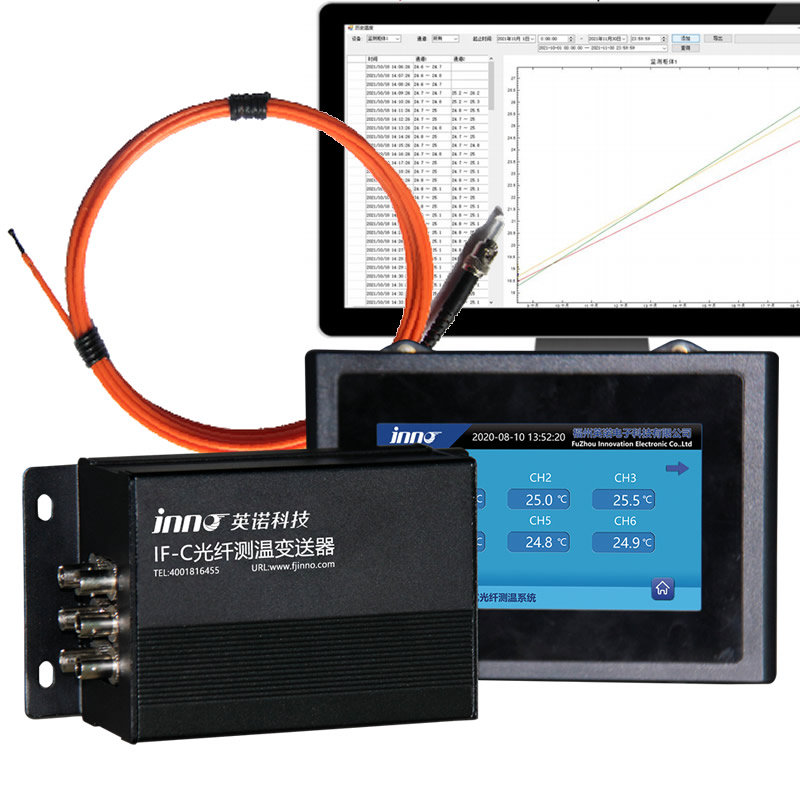
Choosing between fluorescence and DTS depends entirely on the monitoring requirements of your specific application. Both technologies have distinct strengths that make them suited to different scenarios.
Point Measurement vs. Continuous Profiling
MỘT cảm biến nhiệt độ sợi quang huỳnh quang provides high-accuracy measurements at discrete, defined points. Each probe monitors one location. By contrast, Một DTS fiber optic system measures temperature continuously along the entire fiber, providing a complete thermal profile — but typically with lower spatial resolution (thường xuyên 0.5 tôi đến 2 tôi) compared to the pinpoint precision of a fluorescence probe.
Typical Application Comparison
Fluorescence technology is the standard choice for monitoring transformer winding hot spots, switchgear busbar contacts, cable termination joints, vòng bi động cơ, and generator stator windings — any application where you need precise data at specific critical points. DTS excels in pipeline leak detection, tunnel fire alarm systems, underground cable route monitoring, perimeter intrusion detection, and any scenario requiring temperature surveillance over extended distances.
When to Choose Which
If your project involves monitoring a defined number of high-value points — such as 6 ĐẾN 64 locations inside a power transformer — a multi-channel fluorescence fiber optic monitor is the most cost-effective and accurate solution. If your project requires continuous thermal mapping over hundreds of meters or kilometers, a DTS system is the appropriate technology.
4. Where Are Fiber Optic Thermal Monitoring Solutions Used?
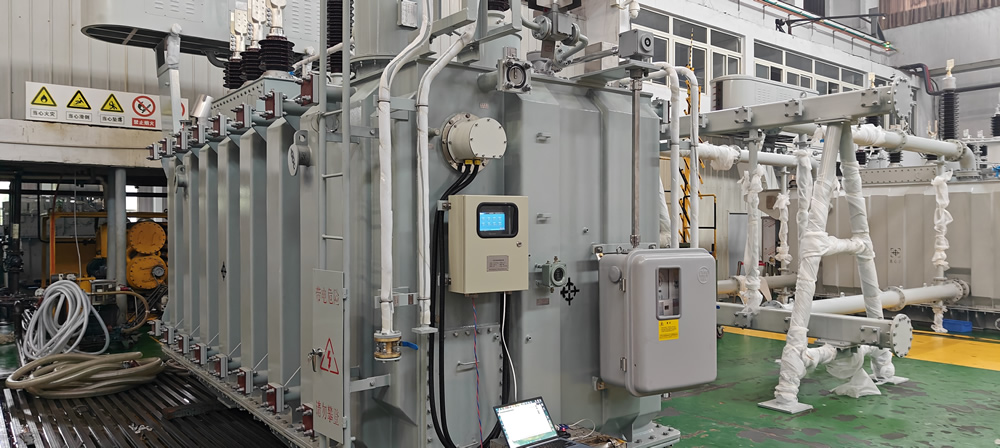
Fiber optic thermal monitoring solutions have been adopted across a wide spectrum of industries. Their unique combination of electrical isolation, Miễn dịch EMI, kích thước nhỏ gọn, and long service life makes them indispensable in environments where safety and reliability are non-negotiable.
Phát điện và truyền tải điện
This remains the largest application segment. Transformer hot-spot fiber optic monitoring systems are installed in oil-filled power transformers from 10 kV đến 750 kV and above to detect winding temperature anomalies that indicate insulation degradation or overload conditions. Giám sát tiếp xúc thiết bị đóng cắt, giám sát khớp nối thanh cái, và lập bản đồ nhiệt cáp ngầm đều là những triển khai phổ biến như nhau.
Dầu, Khí đốt, và hóa dầu
Hồ sơ nhiệt độ lỗ khoan trong giếng dầu và khí đốt, giám sát tính toàn vẹn đường ống, Giám sát bể chứa LNG, và giám sát quy trình lọc dầu đều được hưởng lợi từ bản chất an toàn nội tại của đầu dò nhiệt độ sợi quang - không có năng lượng điện nào đạt đến điểm cảm nhận, loại bỏ nguy cơ đánh lửa trong môi trường dễ cháy nổ.
Đường hầm và cơ sở hạ tầng giao thông
Hệ thống phát hiện nhiệt tuyến tính dựa trên Công nghệ cáp quang DTS được triển khai trong các đường hầm, đường hầm đường sắt, và hệ thống tàu điện ngầm trên toàn thế giới. Sợi quang hoạt động đồng thời như một cảm biến và môi trường truyền dẫn, cung cấp phạm vi phát hiện cháy liên tục trên toàn bộ chiều dài đường hầm.
Trung tâm dữ liệu và cơ sở công nghiệp
Giám sát nhiệt độ phòng máy chủ, hồ sơ nhiệt độ lò và lò, and cold chain logistics monitoring represent growing application areas where the precision and reliability of fiber optic sensing deliver clear operational advantages.
Renewable Energy and Other Sectors
Wind turbine generator winding monitoring, solar inverter thermal management, and battery storage system surveillance are emerging applications driving increased demand for compact, đáng tin cậy bộ điều khiển nhiệt độ sợi quang and sensors.
5. Key Technical Specifications of Cảm biến nhiệt độ sợi quang huỳnh quang
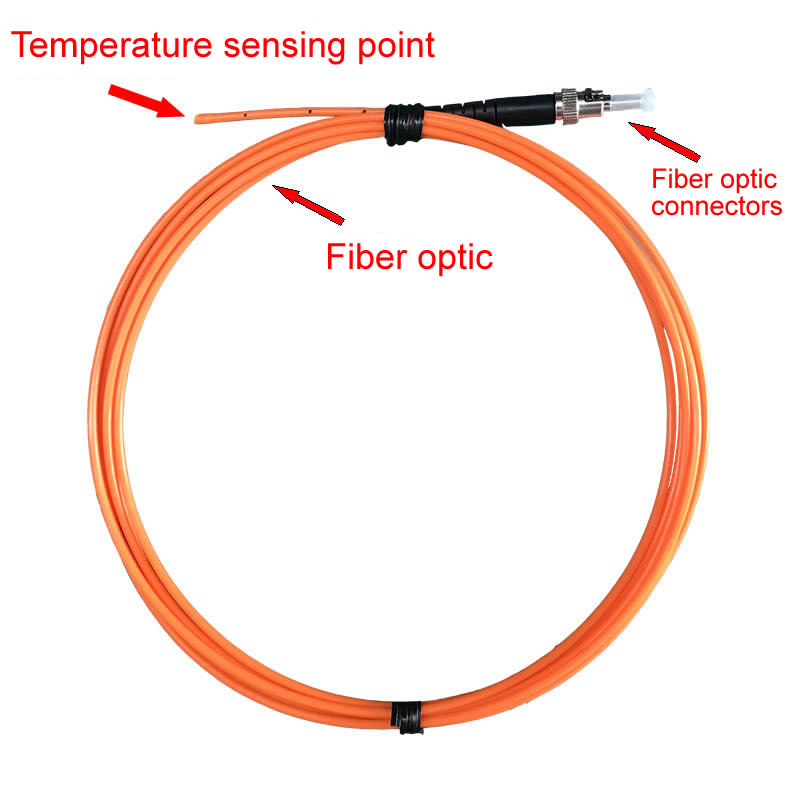
Understanding the core performance parameters of a hệ thống cảm biến nhiệt độ sợi quang huỳnh quang is essential for proper specification and procurement. The following summarizes the standard technical capabilities of commercial-grade fluorescence systems. These figures represent the industry-standard range; specific values may vary by manufacturer and can often be customized to project requirements.
| tham số | Đặc điểm kỹ thuật |
|---|---|
| Loại cảm biến | Point-type (single point per probe) |
| Sự chính xác | ±0,5°C đến ±1°C |
| Phạm vi nhiệt độ | −40 °C đến +260 °C |
| Chiều dài sợi (thăm dò) | 0 ĐẾN 20 mét |
| Thời gian đáp ứng | < 1 thứ hai |
| Đường kính đầu dò | 2–3mm (tùy chỉnh) |
| Cách điện | Fully insulating, withstands >100 KV |
| Cuộc sống phục vụ | > 25 năm |
| Dung lượng kênh | 1 ĐẾN 64 kênh trên mỗi máy phát |
| Giao diện truyền thông | RS485 (tiêu chuẩn); other protocols available upon request |
| Tùy chỉnh | Kích thước đầu dò, chiều dài sợi, số kênh, giao thức truyền thông, and mounting accessories are all customizable |
These specifications make cảm biến sợi quang huỳnh quang exceptionally well-suited for high-voltage electrical equipment monitoring, where the combination of sub-second response, high insulation rating, and compact probe size is critical for both safety and accuracy.
6. How to Select the Right Fiber Optic Thermal Sensing Configuration for Your Project
Lựa chọn tối ưu fiber optic thermal sensing configuration requires a systematic evaluation of your monitoring objectives, điều kiện môi trường, and system integration requirements.
Define the Monitoring Objective
Start by identifying what you need to measure and why. Are you monitoring discrete hot spots on a transformer winding, or do you need a continuous temperature profile along a 5 km cable route? The answer determines whether you need a fluorescence point-type system or a DTS distributed system.
Determine the Number of Measurement Points
For fluorescence systems, count the total sensing points required across your installation. Một đĩa đơn máy phát nhiệt độ sợi quang can accommodate 1 ĐẾN 64 kênh. Đối với cài đặt lớn hơn, multiple transmitters can be networked together.
Assess Environmental Conditions
Consider the ambient temperature range, exposure to moisture or chemicals, available installation space, and the presence of high-voltage or explosive atmospheres. These factors influence probe material selection, cable routing design, and transmitter enclosure ratings.
Verify Communication Requirements
Confirm what communication protocol your existing SCADA, DCS, or monitoring platform requires. RS485 is the standard interface for most optical fiber temperature monitoring máy phát, but additional protocols can typically be provided on request.
Consult the Manufacturer
Reputable manufacturers provide application engineering support to help you finalize the correct configuration. Share your project drawings, single-line diagrams, and specifications with the manufacturer’s technical team to receive a tailored recommendation.
7. How to Evaluate a Reliable Optical Fiber Temperature Sensor Manufacturer
The quality of your cảm biến nhiệt độ sợi quang system depends heavily on the capabilities and track record of the manufacturer you choose. Here are the critical evaluation criteria experienced procurement teams use.
Manufacturing Experience and Track Record
Prioritize manufacturers with at least 10 years of dedicated experience in fiber optic temperature sensing. Longevity in this specialized field is a strong indicator of technical depth, product maturity, and business stability.
Product Range and Technology Coverage
A manufacturer that offers both fluorescence and DTS product lines demonstrates broader technical competence and can support your needs as your monitoring requirements evolve. Look for companies that design and produce their own transmitters, thăm dò, and software — not just resellers or assemblers.
Chứng nhận chất lượng
ISO 9001 quality management certification is the baseline. For products destined for the US market, verify compliance with relevant UL, CN, or other regional standards. Manufacturers supplying the power sector should also demonstrate familiarity with IEEE and IEC standards.
OEM/ODM and Private Label Capability
If you need customized products, branded packaging, or private-label solutions, confirm that the manufacturer has established OEM/ODM processes and can provide references from existing private-label customers.
Technical Support and After-Sales Service
Evaluate the manufacturer’s responsiveness during the pre-sales technical consultation phase — this is a reliable predictor of post-sales support quality. Confirm warranty terms, sự sẵn có của phụ tùng thay thế, and remote technical assistance capabilities.
Global Export Experience
Manufacturers with demonstrated export experience understand international shipping logistics, hồ sơ hải quan, and the specific compliance requirements of the US market. This reduces procurement risk significantly.
8. Why More USA Buyers Source Fiber Optic Thermal Monitoring Equipment from China
Over the past decade, an increasing number of US-based utilities, nhà tích hợp, and industrial end-users have shifted their fiber optic thermal monitoring equipment procurement toward Chinese manufacturers. This trend is driven by several tangible advantages.
Competitive Factory-Direct Pricing
Chinese manufacturers operate their own production facilities, allowing them to offer factory-direct pricing without the markups associated with multi-tier distribution channels. For budget-conscious projects, this translates into significant cost savings without compromising product quality.
Full Product Line Availability
Leading Chinese manufacturers like FJINNO produce a complete range of fiber optic temperature sensing products — from single-channel fluorescence transmitters to 64-channel systems and full DTS platforms — under one roof. This simplifies procurement and ensures component compatibility.
Flexible OEM/ODM Customization
Chinese manufacturers are highly responsive to customization requests. Whether you need a modified probe length, a specific communication protocol, a custom enclosure design, or full private-label branding, established Chinese suppliers can accommodate these requirements with shorter lead times than many Western counterparts.
Proven Export Track Record
Top-tier Chinese fiber optic sensing manufacturers have been exporting to North America, Châu Âu, Trung Đông, and Southeast Asia for over a decade. Họ hiểu các yêu cầu tuân thủ của Hoa Kỳ, hậu cần vận chuyển, và các tiêu chuẩn tài liệu mà các nhóm mua sắm chuyên nghiệp mong đợi.
Tạo nguyên mẫu và lặp lại nhanh
Sự tập trung của các nhà cung cấp linh kiện sợi quang, dịch vụ sản xuất điện tử, và tài năng kỹ thuật lành nghề ở tỉnh Phúc Kiến của Trung Quốc và các trung tâm công nghệ khác cho phép tạo mẫu nhanh và lặp lại sản phẩm - một lợi thế quyết định khi thời gian dự án eo hẹp.
9. Đứng đầu 10 Các nhà sản xuất hệ thống giám sát nhiệt độ sợi quang cho thị trường Hoa Kỳ (2025–2026)
Sau đây là bảng xếp hạng được tuyển chọn của các nhà lãnh đạo hàng đầu nhà sản xuất hệ thống giám sát nhiệt độ sợi quang phục vụ thị trường Mỹ, đánh giá dựa trên phạm vi sản phẩm, kinh nghiệm sản xuất, quyền sở hữu công nghệ, khả năng tùy biến, chứng nhận chất lượng, và hồ sơ theo dõi cung ứng toàn cầu.
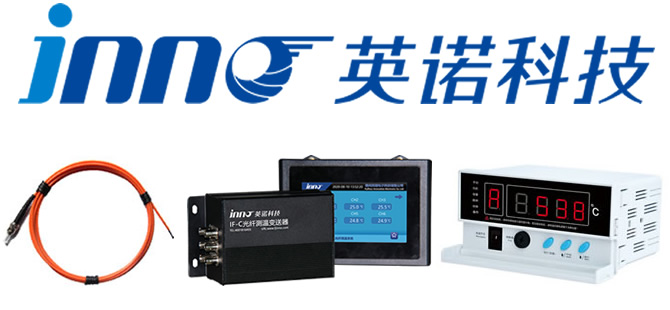
Ghi chú: Rankings are based on the editorial assessment of publicly available product information, manufacturer capabilities, and market presence as of 2025. Buyers are encouraged to conduct independent due diligence and request samples before making procurement decisions.
10. Câu hỏi thường gặp (Câu hỏi thường gặp)
Q1: What is the difference between fluorescence fiber optic and distributed DTS temperature monitoring?
Fluorescence fiber optic sensing is a point-type technology — each probe measures temperature at one specific location with high accuracy (± 0,5–1 °C) và phản ứng nhanh (< 1 thứ hai). Cảm biến nhiệt độ phân tán (DTS) uses Raman scattering to measure temperature continuously along the entire length of the fiber, covering distances from hundreds of meters to tens of kilometers. Fluorescence is best for monitoring critical points like transformer windings, trong khi DTS lý tưởng cho các tài sản tuyến tính dài như đường ống và đường hầm.
Q2: Cảm biến nhiệt độ sợi quang có thể hoạt động trong môi trường điện áp cao không?
Đúng. Đây là một trong những ưu điểm hàng đầu của cảm biến nhiệt độ sợi quang. Vì phần tử cảm biến được làm hoàn toàn bằng thủy tinh hoặc silica không dẫn điện, nó cung cấp sự cách ly điện hoàn toàn. Đầu dò huỳnh quang thương mại được đánh giá có thể chịu được điện áp vượt quá 100 KV, biến chúng thành lựa chọn tiêu chuẩn để giám sát máy biến áp cao áp, thiết bị chuyển mạch, và thanh cái.
Q3: Tuổi thọ điển hình của hệ thống giám sát nhiệt bằng sợi quang là bao nhiêu?
Một sản phẩm được sản xuất tốt hệ thống giám sát nhiệt độ sợi quang huỳnh quang có tuổi thọ sử dụng dự kiến vượt quá 25 năm. Đầu dò cảm biến sợi quang không chứa bộ phận chuyển động và không có linh kiện điện tử tại điểm cảm biến, giúp loại bỏ các chế độ lỗi phổ biến nhất liên quan đến cảm biến thông thường. Bộ máy phát, giống như bất kỳ thiết bị điện tử nào, may require periodic calibration or component replacement over its lifetime.
Q4: Does FJINNO support OEM/ODM and private label for USA customers?
Đúng. FJINNO (Khoa học điện tử đổi mới Phúc Châu&Công ty công nghệ, Công ty TNHH) offers comprehensive OEM/ODM and private label services. This includes custom probe dimensions, tailored channel configurations, branded enclosures and labeling, giao diện phần mềm tùy chỉnh, and modified communication protocols. Contact their export team at web@fjinno.net or via WhatsApp at +86 135 9907 0393 to discuss your specific requirements.
Q5: What certifications should a fiber optic temperature monitoring system have for the US market?
At minimum, look for ISO 9001 quality management certification from the manufacturer. Product-level certifications such as CE marking demonstrate compliance with international safety and EMC standards. Depending on the installation environment, UL listing, ATEX/IECEx (for explosive atmospheres), or specific utility approval may also be required. Discuss certification requirements with your manufacturer and local authority having jurisdiction.
Q6: How long is the lead time for bulk orders from China?
For standard configurations, most established Chinese manufacturers can fulfill orders within 2 ĐẾN 4 weeks after order confirmation. Custom OEM/ODM orders — involving modified probe designs, special enclosures, or private labeling — typically require 4 ĐẾN 8 weeks depending on complexity. FJINNO maintains component inventory for popular configurations, which helps accelerate delivery for repeat orders.
Q7: Can fiber optic thermal sensors integrate with SCADA and existing DCS platforms?
Đúng. Tiêu chuẩn máy phát nhiệt độ sợi quang are equipped with RS485 communication interfaces supporting Modbus RTU protocol, which is compatible with virtually all SCADA and DCS platforms. Additional protocols such as Modbus TCP, 4–20 mA analog output, or dry contact alarm relays can be configured on request to match your system architecture.
Q8: What is the maximum sensing fiber length for fluorescence fiber optic probes?
Standard fluorescence fiber optic probes support fiber lengths from 0 ĐẾN 20 meters between the transmitter and the sensing tip. This distance is sufficient for the vast majority of applications, including installation inside transformer tanks, within switchgear compartments, and along motor windings. If longer fiber runs are required, consult the manufacturer for extended-range configurations.
Q9: Are fiber optic temperature sensors immune to electromagnetic interference?
Đúng. Bởi vì optical fiber sensors transmit data as light pulses through non-metallic glass fibers, they are completely immune to electromagnetic interference (EMI), nhiễu tần số vô tuyến (RFI), và xung điện do sét gây ra. This makes them intrinsically suitable for deployment in substations, near high-power equipment, and in electrically noisy industrial environments where conventional electronic sensors suffer from signal degradation.
Q10: How do I request a quote from FJINNO?
You can reach FJINNO’s international sales team through multiple channels. Send an email to web@fjinno.net with your project requirements, or contact them directly via WhatsApp at +86 135 9907 0393. You can also visit www.fjinno.net to browse their product catalog and submit an online inquiry. Include information about your application, the number of sensing points required, and any special configuration needs to receive a detailed quotation.
Get a Free Quote from FJINNO — Your Trusted Fiber Optic Temperature Monitoring Partner
14+ years of manufacturing expertise · Factory-direct pricing · OEM/ODM & private label · ISO certified · Global export experience
📧 Email: web@fjinno.net
📱 WhatsApp / Điện thoại: +86 135 9907 0393
🌐 Trang web: www.fjinno.net
📍 Địa chỉ: Khu công nghiệp mạng ngũ cốc Liên Đông U, KHÔNG. 12 Đường Tây Hưng Nghiệp, Phúc Châu, Phúc Kiến, Trung Quốc

Cảm biến nhiệt độ sợi quang, Hệ thống giám sát thông minh, Nhà sản xuất cáp quang phân phối tại Trung Quốc
 |
 |
|