 Cảm biến nhiệt độ sợi quang INNO ,hệ thống giám sát nhiệt độ.
- Fiber optic temperature sensors immune to electromagnetic interference use entirely non-electrical sensing principles — light-based measurement through passive glass fibers — making them the only temperature sensing technology that is fundamentally and inherently immune to EMI, RFI, microwave radiation, high-voltage electric fields, và xung điện do sét gây ra.
- Among the three major fiber optic temperature sensing technologies, dựa trên huỳnh quang (fluorescent decay) cảm biến nhiệt độ sợi quang are the most widely deployed point-measurement solution for high-EMI environments, offering proven reliability, độ chính xác tuyệt vời (±0,1°C đến ±0,5°C), phản ứng nhanh, and broad temperature range coverage from cryogenic to over 400 °C.
- Galli Arsenua (GaAs) semiconductor fiber optic temperature sensors provide an alternative approach using the temperature-dependent optical absorption edge of a GaAs crystal, mang lại độ chính xác cao ở dạng đầu dò nhỏ gọn rất phù hợp cho máy biến áp điện, thiết bị chuyển mạch, và giám sát nhiệt độ cuộn dây động cơ điện.
- Lưới sợi Bragg (FBG) cảm biến nhiệt độ cung cấp mã hóa bước sóng, đo nhiệt độ đa kênh dọc theo một sợi quang, cho phép giám sát gần như phân tán ở nhiều điểm trong môi trường sử dụng nhiều EMI như phòng MRI, power substations, và thiết bị xử lý điện từ.
- Cả ba công nghệ đều có chung lợi thế cốt lõi là miễn nhiễm nhiễu điện từ hoàn toàn bởi vì phần tử cảm biến hoàn toàn là quang học - không có dây dẫn điện, không có linh kiện điện tử, và không có đường dẫn kim loại nào tồn tại tại điểm đo để kết hợp với trường điện từ bên ngoài.
Mục lục
- Tại sao nhiễu điện từ lại cần cảm biến nhiệt độ sợi quang
- Cảm biến nhiệt độ sợi quang dựa trên huỳnh quang - Nguyên lý làm việc
- Thiết kế cảm biến huỳnh quang, Nguyên vật liệu, và Hiệu suất
- Applications of Fluorescence Fiber Optic Temperature Sensors in High-EMI Environments
- Cảm biến nhiệt độ sợi quang bán dẫn GaAs
- Lưới sợi Bragg (FBG) Cảm biến nhiệt độ
- So sánh công nghệ: Huỳnh quang vs. GaAs vs. FBG
- How to Select the Right EMI-Immune Fiber Optic Temperature Sensor
- FAQs About Fiber Optic Temperature Sensors Immune to Electromagnetic Interference
1. Why Electromagnetic Interference Demands Cảm biến nhiệt độ sợi quang

The EMI Problem in Temperature Measurement

Cảm biến nhiệt độ điện tử thông thường - cặp nhiệt điện, RTD (Máy dò nhiệt độ kháng), nhiệt điện trở, and IC sensors — rely on electrical signals traveling through metallic conductors. These conductors act as antennas that pick up electromagnetic interference from surrounding sources. In environments with strong electromagnetic fields, the induced noise can be many times larger than the actual temperature signal, rendering measurements unreliable or completely unusable.
The problem is particularly severe in high-voltage power equipment (máy biến áp, thiết bị chuyển mạch, thanh cái), industrial RF and microwave heating systems (lò cảm ứng, RF dryers, microwave curing ovens), medical imaging equipment (MRI scanners operating at 1.5 T đến 7 T field strengths), tương thích điện từ (EMC) buồng thử nghiệm, high-power radar and antenna systems, electric vehicle motor and inverter assemblies, and plasma processing equipment. In all these environments, thermocouple and RTD signals are corrupted by common-mode and differential-mode interference, vòng mặt đất, and capacitively or inductively coupled noise. Che chắn, lọc, and signal conditioning techniques provide partial mitigation but cannot eliminate the fundamental vulnerability of electrical conductors to electromagnetic coupling.
Why Fiber Optics Are the Definitive Solution
Fiber optic temperature sensors immune to electromagnetic interference solve this problem at the most fundamental level. The sensing element is made entirely of non-conductive, non-metallic materials — glass fiber, gốm sứ, phosphor crystals, or semiconductor chips — with no electrical conductors anywhere in the sensing path. The temperature information is encoded in the properties of light (cường độ, thời gian phân rã, bước sóng, or spectral absorption), not in electrical voltage or current. Since optical fiber is a dielectric waveguide with no free electrons to respond to electromagnetic fields, no amount of external EMI, RFI, or magnetic field can alter the optical signal. This is not a matter of shielding or filtering — it is an intrinsic physical property of the measurement medium.
Hơn nữa, the optical fiber link between the sensing probe and the interrogator instrument provides complete galvanic isolation. There is no electrical connection between the measurement point and the instrument — eliminating ground loop problems, high-voltage isolation concerns, and the risk of conducted transients or lightning surges reaching the instrument through the sensor cable. This combination of EMI immunity and galvanic isolation makes fiber optic sensors the only technology class that is truly immune — not merely resistant — to electromagnetic interference.
2. Cảm biến nhiệt độ sợi quang dựa trên huỳnh quang - Nguyên tắc làm việc
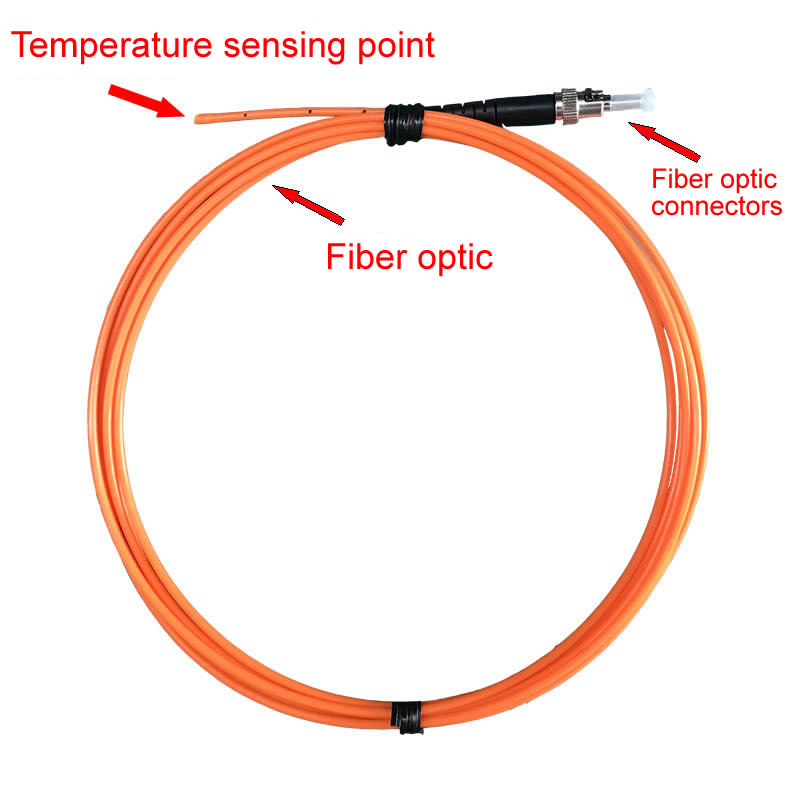
The Physics of Fluorescence Decay
các cảm biến nhiệt độ sợi quang dựa trên huỳnh quang — also known as the fluorescent decay or phosphor thermometry sensor — is the most widely used and commercially mature fiber optic temperature measurement technology for point sensing in EMI-intensive environments. Its operating principle is elegant and inherently robust.
At the tip of the optical fiber probe, a small quantity of fluorescent material (phosphor) is bonded to the fiber end face. When a pulse of excitation light — typically from an LED or laser diode in the ultraviolet or visible spectrum — is transmitted through the optical fiber and strikes the phosphor, the phosphor absorbs the excitation light and re-emits fluorescent light at a longer wavelength. Sau khi xung kích thích kết thúc, the fluorescence does not stop instantly — it decays exponentially over time. The rate of this decay, characterized by the thời gian phân rã huỳnh quang (also called the fluorescence lifetime, t), is a fundamental physical property of the phosphor material that is strongly and predictably dependent on temperature.
The relationship between fluorescence decay time and temperature arises from the thermal quenching of the phosphor’s excited electronic states. Ở nhiệt độ cao hơn, non-radiative energy transfer processes (phonon-assisted relaxation) become more probable, providing competing pathways for the excited electrons to return to the ground state without emitting a photon. This increases the overall decay rate and decreases the fluorescence decay time. The result is a monotonic, well-characterized, and highly repeatable relationship between decay time τ and temperature T, typically described by an Arrhenius-type equation:
1/t(T) = 1/τ₀ + A · điểm kinh nghiệm(−ΔE / kt)
where τ₀ is the intrinsic radiative lifetime, A is a pre-exponential rate constant, ΔE is the activation energy for non-radiative quenching, và k là hằng số Boltzmann. This equation shows that the decay time decreases exponentially with increasing temperature — a relationship that provides both high sensitivity and a wide dynamic range.
Why Decay Time Is the Optimal Measurand
The critical advantage of measuring fluorescence decay time — rather than fluorescence intensity — is that decay time is an intrinsic temporal property of the phosphor material. It is completely independent of the excitation light intensity, tổn thất truyền dẫn sợi quang, tổn thất kết nối, tổn thất uốn sợi, LED lão hóa, and detector sensitivity variations. This makes the measurement self-referencing and immune to all the drift mechanisms that plague intensity-based optical sensors. MỘT cảm biến nhiệt độ sợi quang huỳnh quang does not require recalibration when connectors are reconnected, when the fiber is re-routed, or when the LED output degrades over years of operation. This long-term stability, combined with complete EMI immunity, is what makes fluorescence-based sensors the dominant choice for permanent installation in harsh electromagnetic environments.
Signal Processing and Temperature Extraction
The interrogator instrument in a fluorescence-based system performs the following measurement cycle. Đầu tiên, it drives a short excitation pulse (typically 10–100 µs duration) through the optical fiber to the phosphor probe. Sau khi xung kích thích kết thúc, the instrument captures the exponentially decaying fluorescence signal returned through the same fiber. A high-speed analog-to-digital converter digitizes the decay curve, and a digital signal processing algorithm fits an exponential decay function to the captured data to extract the decay time constant τ. The instrument then applies its stored calibration curve to convert τ into temperature. This entire cycle typically completes in 0.1 ĐẾN 1 thứ hai, providing real-time temperature updates.
Advanced interrogators employ sophisticated curve-fitting algorithms — including multi-exponential fitting, phase-sensitive detection, and digital lock-in techniques — to extract the decay time with high precision even in the presence of background light, fiber autofluorescence, and electronic noise. Some systems also use ratio-metric techniques that compare fluorescence intensity at two different wavelength bands (dual-wavelength fluorescence ratio) as a secondary or complementary temperature extraction method.
3. Thiết kế cảm biến huỳnh quang, Nguyên vật liệu, và Hiệu suất

Phosphor Materials
The choice of fluorescent phosphor material determines the usable temperature range, sự nhạy cảm, sự chính xác, and long-term stability of the sensor. Several phosphor families are used in commercial Cảm biến nhiệt độ sợi quang huỳnh quang.
Rare-earth doped crystals and ceramics là loại phốt pho phổ biến nhất cho cảm biến nhiệt độ công nghiệp. Magiê fluorogermanate pha tạp mangan hóa trị bốn (Mg₄FGeO₆:Mn) là một trong những chất lân quang sớm nhất được sử dụng trong phép đo nhiệt độ sợi quang và vẫn được sử dụng trong phạm vi nhiệt độ vừa phải (−50 °C đến +200 °C). Thời gian phân rã huỳnh quang của nó ở nhiệt độ phòng là khoảng 3–5 ms, cung cấp một sức mạnh, tín hiệu dễ đo.
Garnet nhôm yttrium pha tạp đất hiếm (YAG) tinh thể - chẳng hạn như Cr:YAG, Dy:YAG, và Er:YAG - cung cấp phạm vi nhiệt độ mở rộng đáng kể. YAG pha tạp crom (Cr:YAG) hoạt động hiệu quả từ −100 °C đến +450 °C với thời gian phân hủy ở nhiệt độ phòng khoảng 1.5 bệnh đa xơ cứng. YAG pha tạp Dysprosi (Dy:YAG) đẩy giới hạn trên vượt quá 400 °C. Những vật liệu này mang lại sự ổn định hóa học đặc biệt, khả năng chống lại thiệt hại bức xạ, and minimal aging — critical for long-life industrial installations.
hồng ngọc (Cr:Al₂O₃) — chromium-doped aluminum oxide — is a classic phosphor thermometry material with a well-characterized R-line fluorescence whose decay time varies from approximately 3.5 ms ở nhiệt độ phòng đến giá trị dưới mili giây ở trên 400 °C. Ruby probes are used in both industrial and scientific temperature measurement applications.
alexandrite (Cr:BeAl₂O₄) provides high sensitivity in the 0 ° C đến 300 °C range and has been used in medical and biomedical fiber optic thermometry applications.
For cryogenic temperature measurement, rare-earth doped phosphors such as Eu:AND₂OR₃ (yttria pha tạp europium) và Tb:La₂O₂S (lanthanum oxysulfide pha tạp terbium) offer strong fluorescence and measurable decay time changes at temperatures well below −100 °C, extending coverage down to liquid nitrogen temperatures and beyond.
Probe Construction
The fluorescent probe is the heart of the sensor. In a typical construction, một nguyên tố phốt pho nhỏ (approximately 0.3–1.0 mm in size) is bonded to the tip of a multimode optical fiber (typically 100–600 µm core diameter) using a high-temperature adhesive or fusion process. The phosphor may be in the form of a single crystal chip, một viên gốm ép, or a thin coating of phosphor powder in a binder matrix. The probe tip is then encapsulated in a protective tube — typically stainless steel, gốm sứ (nhôm hoặc zirconia), or PTFE — depending on the operating environment.
The complete probe assembly diameter ranges from less than 1 mm for minimally invasive medical probes to 3–6 mm for ruggedized industrial probes. Probe lengths range from a few centimeters to custom lengths for specific installation geometries. The optical fiber connecting the probe to the interrogator can be tens to hundreds of meters long — providing the physical separation between the measurement point (in the high-EMI zone) and the instrument (in a control room or safe area).
Performance Specifications
| tham số | Standard Fluorescence Sensor | High-Performance Fluorescence Sensor |
|---|---|---|
| Phạm vi nhiệt độ | −40 °C đến +200 °C | −200 °C đến +450 °C |
| Sự chính xác | ±0,5°C | ±0,1°C đến ±0,2°C |
| Nghị quyết | 0.1 °C | 0.01 °C |
| Thời gian đáp ứng (T90) | 0.5–3 giây | 0.1–0,5 giây |
| Tỷ lệ đo | 1–4Hz | Lên đến 10 Hz |
| Số lượng kênh | 1–4 | 4–32 |
| Chiều dài sợi (probe to instrument) | Lên đến 200 tôi | Lên đến 1,000 tôi |
| Đường kính đầu dò | 1–3mm | 0.5–6 mm |
| Ổn định lâu dài | ±0,1°C/năm | ±0,05°C/năm |
| Miễn dịch EMI | Hoàn thành (vốn có) | Hoàn thành (vốn có) |
| Cách ly điện | Tổng cộng (no electrical path) | Tổng cộng (no electrical path) |
4. Applications of Fluorescence Fiber Optic Temperature Sensors in High-EMI Environments
Power Transformer Hot-Spot Temperature Monitoring
Monitoring the winding hot-spot temperature of power transformers is the single largest application of Cảm biến nhiệt độ sợi quang huỳnh quang trên toàn thế giới. Inside a high-voltage power transformer, the windings operate at voltages of tens to hundreds of kilovolts, surrounded by intense magnetic fields and immersed in insulating oil. No conventional electrical sensor can be reliably placed directly on the winding conductors — the voltage difference between the winding and grounded instrument would destroy any metallic connection, and the electromagnetic field environment would corrupt any electrical signal.
Fluorescence fiber optic temperature probes are installed directly on the transformer winding surface during manufacturing. The optical fiber exits the transformer tank through a fiber-optic feedthrough penetrator and connects to an interrogator mounted on the transformer exterior or in a nearby control cabinet. Because the fiber is entirely non-conductive, it provides complete high-voltage isolation — withstanding the full winding voltage without any isolation barrier. And because the fluorescence decay-time signal is completely immune to the transformer’s magnetic field, the measurement is accurate and noise-free regardless of loading conditions.
Accurate winding hot-spot temperature data enables dynamic transformer rating (DTR), predictive thermal aging analysis, optimized load dispatch, và phát hiện lỗi sớm. Tiêu chuẩn quốc tế bao gồm IEC 60076-2 and IEEE C57.91 reference fiber optic sensing as the preferred method for direct hot-spot measurement. Major transformer manufacturers globally — including Siemens Energy, Năng lượng Hitachi (ABB), GE Vernova, TBEA, and others — routinely specify fluorescence fiber optic temperature sensors as standard equipment in medium and large power transformers.
Switchgear and Busbar Temperature Monitoring
Medium-voltage and high-voltage switchgear and busbar connections operate at voltages up to 40.5 kV (and higher in GIS systems), creating hostile EMI environments for any metallic sensor. Suy thoái liên hệ, ăn mòn, and loose connections cause localized overheating that, nếu không bị phát hiện, leads to catastrophic failure and arc flash events. Fluorescence fiber optic temperature sensors immune to electromagnetic interference được lắp đặt trực tiếp trên các khớp nối thanh cái, địa chỉ liên lạc ngắt, and cable terminations inside switchgear enclosures. The sensors provide continuous, real-time temperature monitoring with no risk of compromising the insulation coordination of the equipment — a critical safety consideration that disqualifies all metallic sensor technologies.
Electric Motor and Generator Winding Monitoring
Động cơ điện và máy phát điện lớn đặt ra những thách thức tương tự - cuộn dây điện áp cao được bao quanh bởi từ trường quay. Đầu dò sợi quang huỳnh quang nhúng đo trực tiếp nhiệt độ cuộn dây stato, thay thế hoặc bổ sung cài đặt RTD thông thường. Cảm biến sợi quang cung cấp phản hồi nhanh hơn, độ chính xác cao hơn, và khả năng miễn nhiễm hoàn toàn với môi trường điện từ của động cơ, cải thiện khả năng bảo vệ nhiệt và cho phép các chiến lược tải tích cực hơn.
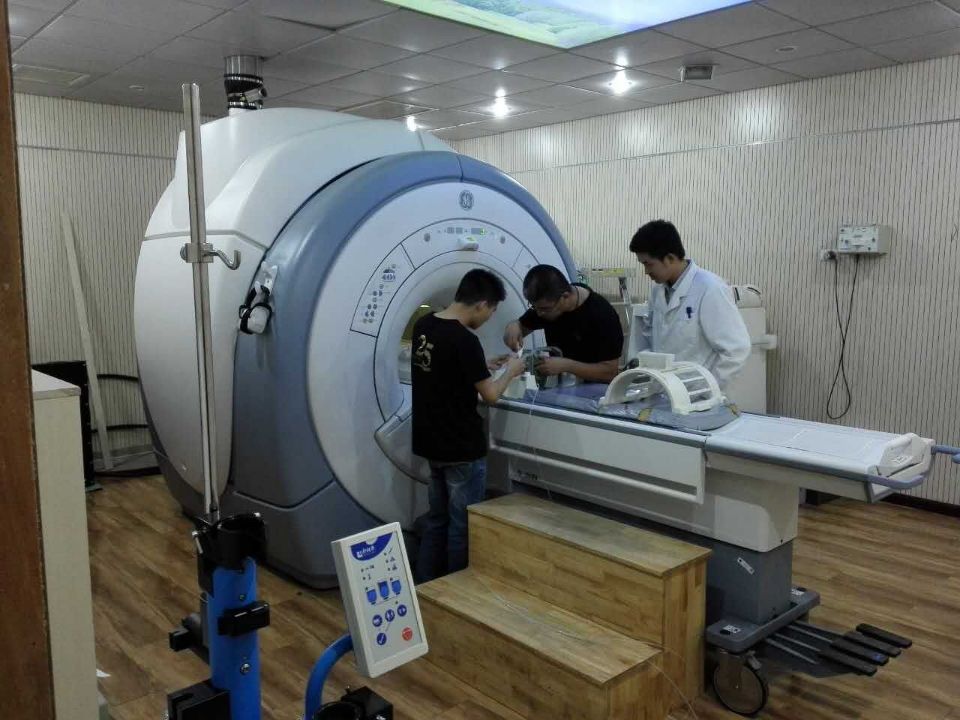
Đo nhiệt độ tương thích với MRI
Hình ảnh cộng hưởng từ (MRI) máy quét tạo ra từ trường tĩnh của 1.5 T đến 7 T (30,000 ĐẾN 140,000 lần từ trường Trái đất) cùng với các trường gradient chuyển đổi nhanh chóng và các xung RF công suất cao. Không có cảm biến hoặc dây kim loại nào có thể được đưa vào lỗ MRI mà không tạo ra hiện tượng giả trong hình ảnh, trải nghiệm cảm ứng nhiệt (có khả năng gây nguy hiểm cho bệnh nhân), or producing corrupted temperature signals. Cảm biến sợi quang huỳnh quang, hoàn toàn phi kim loại và không có từ tính, hoàn toàn tương thích với MRI. They are used for patient temperature monitoring during MRI-guided procedures, phantom calibration, and quality assurance of MRI-guided thermal therapy (ví dụ., cắt bỏ bằng laser, siêu âm tập trung) where precise knowledge of tissue temperature is essential for treatment safety and efficacy.
RF and Microwave Heating Processes
Hệ thống sưởi RF công nghiệp (sưởi ấm điện môi, hàn RF, sấy RF) and microwave processing (chữa bằng lò vi sóng, thiêu kết, chế biến thực phẩm) generate intense electromagnetic fields that make conventional temperature measurement virtually impossible. Cảm biến nhiệt độ sợi quang huỳnh quang are the standard temperature measurement method inside RF and microwave applicators, providing accurate real-time temperature feedback for process control. The all-dielectric sensor probe does not interact with the RF/microwave field, không làm biến dạng sự phân bố trường, and does not experience self-heating — all problems inherent to any metallic sensor placed in an RF/microwave environment.
Tương thích điện từ (EMC) Kiểm tra
In EMC test chambers (anechoic chambers, reverberation chambers, GTEM cells), where equipment is subjected to high-intensity electromagnetic fields for compliance testing, any metallic sensor or cable introduced into the test volume would distort the field and invalidate the test. Fluorescence fiber optic sensors provide temperature monitoring of the equipment under test (EUT) without electromagnetic interference with the test environment.
Additional High-EMI Applications
Other important application areas for cảm biến nhiệt độ sợi quang miễn nhiễm với nhiễu điện từ based on fluorescence technology include high-power semiconductor laser diode temperature monitoring, electric vehicle battery pack thermal management during EMC testing, induction heating process control, plasma processing equipment monitoring, high-power radar and antenna system thermal monitoring, railway traction transformer and converter monitoring, and nuclear magnetic resonance (NMR) spectroscopy sample temperature control.
5. Cảm biến nhiệt độ sợi quang bán dẫn GaAs
Nguyên tắc làm việc
các GaAs (Galli Arsenua) cảm biến nhiệt độ sợi quang uses a fundamentally different physical mechanism from fluorescence decay — the temperature-dependent optical absorption edge of a semiconductor crystal. Gallium Arsenide is a direct bandgap semiconductor whose bandgap energy decreases linearly with increasing temperature, following the well-known Varshni equation. Khi băng thông giảm, the optical absorption edge — the wavelength at which the material transitions from transparent to opaque — shifts toward longer wavelengths (dịch chuyển đỏ).
In a GaAs fiber optic temperature sensor, một con chip tinh thể GaAs mỏng (thường dày 100–300 µm) được gắn ở đầu sợi quang. Ánh sáng băng thông rộng từ nguồn LED được truyền qua sợi quang đến chip GaAs. Bước sóng ngắn hơn cạnh hấp thụ sẽ được GaAs hấp thụ; bước sóng dài hơn cạnh hấp thụ được truyền đi (hoặc phản ánh, trong một số cấu hình) trở lại qua sợi. Tín hiệu quang phổ trả về cho thấy sự chuyển tiếp rõ nét - cạnh hấp thụ - có vị trí quang phổ được xác định bởi nhiệt độ chip. Máy quang phổ hoặc máy dò chọn lọc bước sóng trong bộ dò tìm đo vị trí cạnh và chuyển đổi nó thành nhiệt độ bằng đường cong hiệu chuẩn.
Cạnh hấp thụ của GaAs dịch chuyển ở khoảng 0.4 nm/°C, cung cấp độ nhạy nhiệt độ tốt. The bandgap transition is a fundamental thermodynamic property of the crystal lattice, ensuring excellent repeatability and stability. Like fluorescence sensors, GaAs sensors are completely non-electrical at the sensing point, providing inherent immunity to electromagnetic interference and complete galvanic isolation.
Advantages and Limitations of GaAs Sensors
GaAs semiconductor sensors offer several attractive characteristics. The measurement principle is based on a fundamental material property (năng lượng vùng cấm), providing inherent long-term stability with minimal calibration drift. The sensor has no moving parts and no consumable materials (unlike phosphors that could theoretically degrade under extreme conditions). The GaAs chip is compact and can be packaged in very small probe formats. The temperature response is essentially linear over the practical measurement range, simplifying signal processing.
The typical operating range of a Cảm biến nhiệt độ sợi quang GaAs xấp xỉ −40 °C đến +250 °C, with accuracy of ±0,5°C đến ±1°C and resolution of 0.1 °C. This range covers most power equipment and industrial monitoring applications. The upper temperature limit is constrained by the GaAs bandgap becoming too narrow (the absorption edge shifts into the near-infrared beyond the detector range) and by the thermal stability of the packaging materials.
So với cảm biến huỳnh quang, GaAs sensors are generally less accurate at the high-performance end (±0,5°C so với. ±0.1 °C achievable with fluorescence), have a narrower maximum temperature range, and require a spectrometric detector system (increasing interrogator complexity and cost). Tuy nhiên, Cảm biến GaAs có ưu điểm là phần tử cảm biến hoàn toàn thụ động, không có quá trình kích thích/phát xạ quang học, và một số nhà sản xuất cũng như người dùng thích sự đơn giản và tính ổn định lâu dài được nhận thấy của cơ chế cạnh hấp thụ chất bán dẫn.
Ứng dụng chính
Cảm biến nhiệt độ sợi quang GaAs chủ yếu được sử dụng trong giám sát nhiệt độ cuộn dây máy biến áp điện - nơi chúng cạnh tranh trực tiếp với các cảm biến huỳnh quang - cũng như trong giám sát điểm nóng của thiết bị đóng cắt, giám sát cuộn dây động cơ điện, và giám sát nhiệt độ máy phát điện. Một số nhà sản xuất máy biến áp lớn cung cấp chức năng giám sát nhiệt độ sợi quang dựa trên GaAs như một tùy chọn bên cạnh hoặc thay thế cho các hệ thống dựa trên huỳnh quang.. GaAs sensors are also used in certain medical applications where MRI compatibility is required and the temperature range is moderate.
6. Lưới sợi Bragg (FBG) Cảm biến nhiệt độ
Nguyên tắc làm việc
MỘT Lưới sợi Bragg (FBG) cảm biến nhiệt độ is based on a periodic modulation of the refractive index written directly into the core of a single-mode optical fiber using ultraviolet laser exposure. This grating structure reflects a narrow band of wavelengths centered at the Bragg wavelength (λ_B), which is determined by the grating period (L) and the effective refractive index (n_eff) of the fiber core according to the Bragg condition: λ_B = 2 · n_eff · Λ. Khi nhiệt độ thay đổi, both the refractive index (through the thermo-optic effect) and the grating period (through thermal expansion) thay đổi, causing the Bragg wavelength to shift. This shift is approximately 10-13 giờ chiều/°C Tại 1550 nm wavelength for standard silica fiber.
The interrogator instrument illuminates the fiber with broadband light and monitors the reflected Bragg wavelength using a spectrometer, tunable filter, or interferometric detection system. By tracking the wavelength shift, hệ thống xác định sự thay đổi nhiệt độ tại vị trí cách tử. The key distinguishing feature of FBG sensors is wavelength encoding — the temperature information is encoded in the wavelength of reflected light, not in its intensity. This makes the measurement inherently immune to light source power fluctuations, fiber loss variations, and connector loss changes — similar to the self-referencing advantage of fluorescence decay-time measurement.
Khả năng ghép kênh
The most significant advantage of FBG sensors over fluorescence and GaAs point sensors is ghép kênh phân chia bước sóng (WDM). Nhiều FBG, each written at a slightly different Bragg wavelength, can be inscribed along a single optical fiber. A single interrogator can simultaneously read 10 ĐẾN 50+ FBG sensors distributed along one fiber by distinguishing their individual reflected wavelength peaks. This provides quasi-distributed multi-point temperature measurement using a single fiber cable — dramatically reducing cabling complexity in applications requiring many measurement points.
Ví dụ, in a power transformer application, a single fiber cable with 10 FBG sensors can monitor winding temperature at 10 different locations using only one fiber penetration through the tank wall. In a tunnel or industrial duct, an FBG array can monitor temperature at dozens of points along a single fiber run. Khả năng ghép kênh này là duy nhất đối với công nghệ FBG và không có sẵn với cảm biến điểm huỳnh quang hoặc GaAs (yêu cầu một sợi cho mỗi điểm đo).
Hiệu suất và hạn chế
Tiêu chuẩn Cảm biến nhiệt độ FBG cung cấp độ chính xác của ±0,5°C đến ±1°C, độ phân giải của 0.1 ° C đến 1 chiều bước sóng, và phạm vi hoạt động từ −40 °C đến +300 °C (với cách tử nhiệt độ cao kéo dài đến +800 °C hoặc cao hơn bằng cách sử dụng FBG tái sinh hoặc ghi femto giây). Thời gian đáp ứng phụ thuộc vào khả năng ghép nhiệt của sợi quang với mục tiêu đo và thường là 0.1 ĐẾN 1 thứ hai.
Hạn chế chính của cảm biến FBG đối với các ứng dụng chỉ có nhiệt độ là nhạy cảm chéo với sự căng thẳng. Bước sóng Bragg thay đổi theo cả nhiệt độ và biến dạng cơ học (khoảng 1.2 chiều/với), và không thể phân biệt được hai hiệu ứng này chỉ bằng phép đo bước sóng đơn lẻ. Để đo nhiệt độ tinh khiết, the FBG must be installed in a strain-free mounting — typically housed in a loose protective tube that allows the fiber to expand and contract freely without mechanical constraint. If both temperature and strain are of interest (as in structural health monitoring), dual-grating configurations or reference gratings are used to separate the two effects.
The interrogator for FBG systems is generally more expensive than fluorescence interrogators due to the precision wavelength measurement requirements. Tuy nhiên, when the cost is amortized over many multiplexed sensors on a single fiber, the per-point cost can be competitive or even lower than multiple single-point fluorescence systems.
Applications in EMI Environments
Fiber Bragg Grating temperature sensors, like all fiber optic sensors, provide complete immunity to electromagnetic interference. They are used in power transformers (multi-point winding monitoring with a single fiber), generator stator temperature mapping, high-voltage cable joint monitoring, MRI-compatible temperature arrays, wind turbine lightning-exposed blade monitoring, hệ thống lực kéo đường sắt, and high-energy physics experimental facilities (máy gia tốc hạt, fusion reactors) where intense electromagnetic fields and radiation are present.
7. So sánh công nghệ: Huỳnh quang vs. GaAs vs. FBG
| tham số | phân rã huỳnh quang | Chất bán dẫn GaAs | Lưới sợi Bragg (FBG) |
|---|---|---|---|
| Nguyên lý cảm biến | Fluorescence decay time of phosphor | Bandgap absorption edge shift of GaAs | Bragg wavelength shift of UV-inscribed grating |
| Miễn dịch EMI | Hoàn thành (vốn có) | Hoàn thành (vốn có) | Hoàn thành (vốn có) |
| Phạm vi nhiệt độ | −200 °C đến +450 °C | −40 °C đến +250 °C | −40 °C đến +300 °C (tiêu chuẩn); ĐẾN +800 °C (đặc biệt) |
| Sự chính xác | ±0,1°C đến ±0,5°C | ±0,5°C đến ±1°C | ±0,5°C đến ±1°C |
| Nghị quyết | 0.01–0,1 °C | 0.1 °C | 0.1 °C |
| Thời gian đáp ứng | 0.1–3 giây | 0.5–3 giây | 0.1–1 giây |
| Ghép kênh | KHÔNG (1 fiber per point) | KHÔNG (1 fiber per point) | Đúng (10–50+ points per fiber) |
| Độ nhạy căng thẳng | Không có | Không có | Đúng (nhạy cảm chéo; yêu cầu cách ly) |
| Ổn định lâu dài | Xuất sắc | Xuất sắc | Good to Excellent |
| Chi phí thẩm vấn | Trung bình | Trung bình-Cao | Cao (but per-point cost lower with multiplexing) |
| Kích thước đầu dò | 0.5–6 mm diameter | 1–4 mm diameter | Fiber diameter (125–250 µm); packaging varies |
| Primary Application | Máy biến áp, thiết bị chuyển mạch, MRI, Hệ thống sưởi RF | Máy biến áp, thiết bị chuyển mạch | Giám sát đa điểm, structural, máy biến áp |
| Sự trưởng thành của thị trường | Very high (30+ năm) | Cao (25+ năm) | Cao (20+ năm) |
Which Technology Should You Choose?
For most single-point or small-channel-count temperature measurement applications in high-EMI environments — particularly power transformer winding hot-spot monitoring, giám sát thiết bị đóng cắt, and MRI-compatible sensing — the cảm biến nhiệt độ sợi quang huỳnh quang remains the best overall choice due to its combination of wide temperature range, độ chính xác cao, đã được chứng minh sự ổn định lâu dài, mature supply chain, and competitive cost. It is the “mặc định” technology for EMI-immune point temperature measurement and the one recommended by international standards for transformer applications.
các Cảm biến nhiệt độ sợi quang GaAs is a viable alternative for power equipment monitoring, particularly when offered by manufacturers who have established long-term performance records with this technology. The choice between fluorescence and GaAs in transformer applications often comes down to manufacturer preference and supply chain relationships rather than fundamental technical superiority.
các Cảm biến nhiệt độ FBG is the preferred choice when multiple temperature measurement points are required along a single fiber path — providing significant installation and cabling advantages over deploying many individual fluorescence or GaAs probes. Tuy nhiên, care must be taken to ensure strain-free mounting for accurate temperature-only measurement, and the higher interrogator cost must be justified by the multiplexing benefit.
8. How to Select the Right EMI-Immune Fiber Optic Temperature Sensor
Application Assessment
The first step in selecting a fiber optic temperature sensor immune to electromagnetic interference is to clearly characterize your application requirements. Key questions include: What is the temperature range to be measured? What accuracy and resolution are required? How many measurement points are needed? What is the distance from the sensing point to the instrument location? What are the environmental conditions at the sensing point (nhiệt độ, độ ẩm, rung động, tiếp xúc với hóa chất)? What is the nature and intensity of the electromagnetic interference? What output and communication interfaces are required? The answers to these questions will narrow the technology choice and guide the selection of specific products.
Vendor Evaluation
When evaluating vendors, look for manufacturers with proven track records in your specific application area. For power transformer applications, the supplier should have thousands of installed probes in field operation with documented long-term performance data. For MRI applications, the sensor must be explicitly tested and certified for MRI compatibility at the relevant field strength. For industrial process applications, the probe construction and materials must be compatible with the process environment. Request technical specifications with clearly stated accuracy, sự ổn định, and environmental ratings — and ask for independent verification or reference installations where performance can be confirmed.
Cân nhắc tích hợp hệ thống
Consider how the fiber optic temperature measurement system integrates with your existing monitoring and control infrastructure. Modern interrogators typically provide analog outputs (4–20 mA), truyền thông kỹ thuật số (Modbus RTU/TCP, IEC 61850 for power utility applications, OPC UA for industrial automation), relay alarm contacts, and web-based interfaces. For multi-channel systems, ensure the interrogator supports the required number of channels and measurement rate. For permanent installations, specify ruggedized fiber optic connectors (E2000, SC/APC) and fiber routing hardware that protects the fiber from mechanical damage during installation and operation.
9. FAQs About Fiber Optic Temperature Sensors Immune to Electromagnetic Interference
Q1: Tại sao cảm biến nhiệt độ sợi quang miễn nhiễm với nhiễu điện từ?
Fiber optic temperature sensors immune to electromagnetic interference achieve this immunity because the entire sensing path — from the measurement point through the fiber to the interrogator — is made of non-conductive, dielectric materials. Optical fiber is glass, and the sensing elements are phosphor crystals, semiconductor chips, or grating structures. With no metallic conductors or electronic components at the sensing point, there are no pathways for electromagnetic fields to couple into and corrupt the measurement signal. Thông tin nhiệt độ được truyền đi bằng ánh sáng, not by electrical current or voltage, and electromagnetic fields do not affect the propagation of light in glass fiber.
Q2: What is the most common type of EMI-immune fiber optic temperature sensor?
các dựa trên huỳnh quang (fluorescent decay) cảm biến nhiệt độ sợi quang is the most widely deployed EMI-immune fiber optic temperature sensing technology worldwide. Its dominance is due to the combination of high accuracy, phạm vi nhiệt độ rộng, sự ổn định lâu dài tuyệt vời, mature manufacturing supply chain, and proven field performance over three decades of commercial deployment in power transformers, thiết bị chuyển mạch, and other high-EMI applications.
Q3: Cảm biến nhiệt độ sợi quang huỳnh quang hoạt động như thế nào?
MỘT cảm biến nhiệt độ sợi quang huỳnh quang works by measuring the fluorescence decay time of a phosphor material bonded to the optical fiber tip. The interrogator sends a light pulse to excite the phosphor, then measures how quickly the fluorescence fades after excitation. The decay time is a direct function of temperature — it decreases as temperature increases due to increased thermal quenching. Bởi vì thời gian phân rã là một đặc tính nội tại của chất lân quang, the measurement is immune to fiber losses, LED lão hóa, and connector variations, in addition to being immune to EMI.
Q4: What is the accuracy of a fluorescence fiber optic temperature sensor?
Tiêu chuẩn Cảm biến nhiệt độ sợi quang huỳnh quang achieve accuracy of ±0.5 °C. High-performance systems achieve ±0.1 °C to ±0.2 °C with careful calibration and optimized signal processing. Nghị quyết (smallest detectable temperature change) is typically 0.01 ° C đến 0.1 °C. Ổn định lâu dài (trôi hiệu chuẩn) is typically better than ±0.1 °C per year.
Q5: How does a GaAs fiber optic temperature sensor differ from a fluorescence sensor?
MỘT Cảm biến nhiệt độ sợi quang GaAs measures temperature by detecting the shift of the optical absorption edge of a Gallium Arsenide semiconductor crystal, rather than measuring fluorescence decay time. Both technologies provide complete EMI immunity and galvanic isolation. Cảm biến GaAs thường bao phủ từ −40 °C đến +250 °C with ±0.5 °C accuracy, while fluorescence sensors offer wider range (−200 °C đến +450 °C) and potentially higher accuracy (±0,1°C). GaAs sensors are primarily used in power equipment monitoring applications.
Q6: Can Fiber Bragg Grating sensors measure temperature in high-EMI environments?
Đúng. Fiber Bragg Grating temperature sensors are completely immune to EMI because the sensing element is an optical grating inscribed in the glass fiber core. The key advantage of FBG sensors is multiplexing — multiple temperature points measured along a single fiber. The main consideration is that FBGs are also sensitive to mechanical strain, so for accurate temperature measurement, the fiber must be installed in a strain-free configuration (ví dụ., loose in a protective tube).
Q7: Which fiber optic temperature sensor technology is best for power transformer monitoring?
For power transformer winding hot-spot monitoring, cái cảm biến nhiệt độ sợi quang huỳnh quang is the most widely specified and standardized technology, recommended by IEC 60076-2 and IEEE C57.91 guidelines. Cảm biến GaAs are also used by several major transformer manufacturers and offer comparable reliability for this application. Cảm biến FBG are increasingly used when multi-point monitoring along a single fiber is desired. All three provide the essential requirements: khả năng miễn dịch EMI hoàn chỉnh, high-voltage galvanic isolation, and reliable long-term operation in the transformer’s oil-immersed environment.
Q8: Can fiber optic temperature sensors be used inside MRI scanners?
Đúng. Cảm biến nhiệt độ sợi quang huỳnh quang are fully MRI-compatible because they contain no metallic, từ tính, or electrically conductive materials at the sensing point. They produce no MRI image artifacts, experience no RF-induced heating, and provide accurate temperature readings in magnetic fields up to 7 T and beyond. They are routinely used for patient monitoring, phantom testing, and MRI-guided thermal therapy procedures.
Q9: What is the typical lifespan of a fluorescence fiber optic temperature probe?
Đầu dò nhiệt độ sợi quang huỳnh quang được lắp đặt trong máy biến áp điện hoạt động thường xuyên trong 15 ĐẾN 25+ năm không cần thay thế hoặc hiệu chuẩn lại. The phosphor materials (ví dụ., Cr:YAG, rare-earth doped ceramics) are chemically inert and thermally stable, exhibiting negligible degradation under normal operating conditions. The optical fiber itself has a well-established lifespan exceeding 25 năm. Lỗi thăm dò, khi nó xảy ra, is almost always due to mechanical damage (fiber breakage) rather than sensor element degradation.
Q10: How does the cost of a fluorescence fiber optic temperature sensor compare to a thermocouple?
A fluorescence fiber optic temperature sensor system (người thẩm vấn + thăm dò) costs significantly more than a thermocouple and transmitter — typically USD 2,000 to USD 10,000 cho người thẩm vấn và USD 100 to USD 500 mỗi đầu dò, compared to less than USD 100 for a thermocouple assembly. Tuy nhiên, in high-EMI environments where thermocouples cannot provide reliable measurements, the comparison is not fiber optic vs. thermocouple but rather fiber optic vs. no measurement at all. The cost is justified by the unique capability of providing accurate, interference-free temperature data in environments that are completely inaccessible to conventional sensors. FJINNO (www.fjinno.net) provides fluorescence fiber optic temperature sensors and complete system solutions at competitive pricing for power, công nghiệp, và ứng dụng y tế.
Tuyên bố từ chối trách nhiệm: Thông tin được cung cấp trong bài viết này là dành cho mục đích giáo dục và tham khảo chung. Thông số kỹ thuật cụ thể của sản phẩm, đặc tính hiệu suất, và giá cả khác nhau tùy theo nhà sản xuất, người mẫu, và cấu hình. Tất cả dữ liệu kỹ thuật được trích dẫn thể hiện các giá trị điển hình có trong các sản phẩm cảm biến nhiệt độ sợi quang thương mại và không được sử dụng làm thông số kỹ thuật đảm bảo cho bất kỳ hệ thống cụ thể nào. Luôn tham khảo tài liệu chính thức của nhà sản xuất và tiến hành đánh giá độc lập trước khi chỉ định hoặc mua thiết bị cảm biến nhiệt độ sợi quang. FJINNO (www.fjinno.net) assumes no liability for any decisions made based on the content of this article.

Cảm biến nhiệt độ sợi quang, Hệ thống giám sát thông minh, Nhà sản xuất cáp quang phân phối tại Trung Quốc
 |
 |
 |