 INNO เซ็นเซอร์วัดอุณหภูมิใยแก้วนำแสง ,ระบบตรวจสอบอุณหภูมิ.
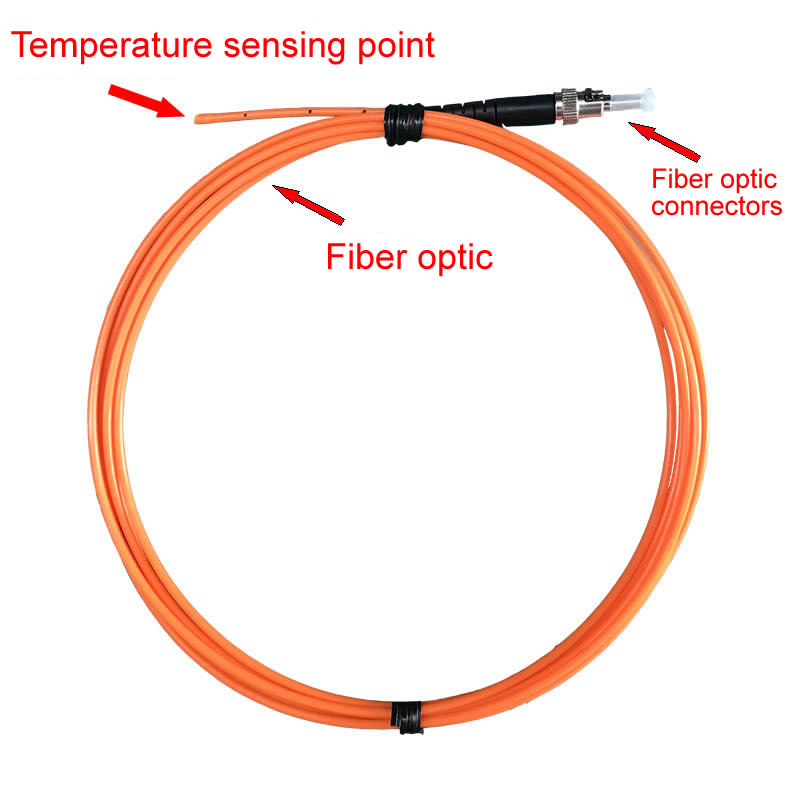
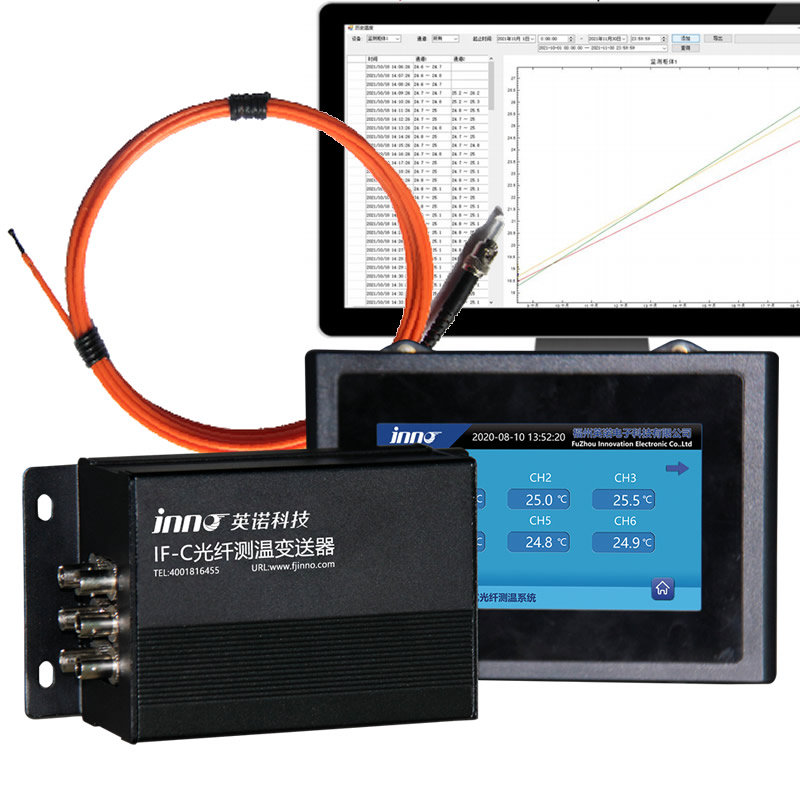
Fluorescent fiber optic temperature sensors have become one of the best choices for measuring temperature due to their advantages such as safe insulation, ความแม่นยำสูง, ตอบสนองอย่างรวดเร็ว, ความต้านทานไฟฟ้าแรงสูง, ความต้านทานการรบกวนทางแม่เหล็กไฟฟ้า, ความมั่นคงในระยะยาว, wide environmental adaptability, and flexibility.
1、 หลักการทำงานของ เซ็นเซอร์วัดอุณหภูมิใยแก้วนำแสงเรืองแสง
ฟลูออเรสเซนต์ เซ็นเซอร์อุณหภูมิใยแก้วนำแสง is a temperature measurement sensor based on the principle of fluorescence. Its working principle is based on the characteristics of fluorescent materials, which are materials that can absorb a certain wavelength of light and emit longer wavelengths of light. A typical fluorescent fiber optic temperature sensor includes several parts such as light source, ใยแก้วนำแสง, วัสดุเรืองแสง, และสเปกโตรมิเตอร์. ประการแรก, the light source generates excitation light of a certain wavelength, which is transmitted to the fluorescent material through optical fibers. After absorbing excitation light, fluorescent materials emit fluorescent signals with specific wavelengths, which are then transmitted back to the spectrometer for detection through optical fibers. เมื่ออุณหภูมิเปลี่ยนแปลง, the fluorescence characteristics of fluorescent materials will change, which may be changes in fluorescence intensity or shifts in fluorescence wavelength. สามารถกำหนดค่าอุณหภูมิได้โดยการวัดความเข้มหรือความยาวคลื่นของสัญญาณเรืองแสง. นอกจากนี้, there is a fluorescent fiber optic temperature sensor that determines the ambient temperature by measuring the length of the fluorescence afterglow lifetime. This type of sensor consists of a multi-mode optical fiber and a fluorescent object (ฟิล์ม) installed on top of it. The fluorescent substance is excited by light of a certain wavelength (สเปกตรัมการกระตุ้น) and emits fluorescence energy. หลังจากยกเลิกการกระตุ้นแล้ว, the duration of the fluorescence afterglow depends on the characteristics of the fluorescent substance, environmental temperature, และปัจจัยอื่นๆ. การเรืองแสงที่ตื่นเต้นนี้มักจะสลายตัวแบบทวีคูณ, และค่าคงที่เวลาการสลายตัวคืออายุการใช้งานของฟลูออเรสเซนต์หรือเวลาเรืองแสงหลังเรืองแสง (ns). ที่อุณหภูมิสิ่งแวดล้อมต่างกัน, the fluorescence afterglow decay is different, and the temperature can be determined by measuring the fluorescence afterglow lifetime.
2、 Common types and characteristics of temperature sensors
2.1 เทอร์โมคัปเปิ้ล
หลักการทำงาน
A thermocouple is a sensor composed of two different metals, which uses the electromotive force generated by the temperature changes of the two metals to measure temperature. ตัวอย่างเช่น, the common J-type thermocouple is made of iron and constantan, and a thermoelectric potential is generated when the temperatures at both ends of the thermocouple are different (temperature difference).
ลักษณะเฉพาะ
ช่วงการวัดอุณหภูมิกว้าง: can be extended to above 2300 ℃, suitable for high-temperature detection fields such as ovens, water heaters, kilns, testing equipment, and other industrial processes.
Low sensitivity: on the order of several tens of microvolts per degree Celsius, and within the operating range, nonlinearity in the temperature to voltage transfer function often requires compensation circuits or lookup tables.
Low thermal quality: This allows it to quickly respond to temperature changes.
Simple structure and easy to use: Thermocouples are commonly used contact temperature measuring devices in industry, with stable performance and the ability to transmit signals over long distances.
2.2 เทอร์มิสเตอร์
หลักการทำงาน
Thermistor is a type of resistive element whose resistance value varies with temperature. Common thermistor materials include platinum (พอต100, พอต1000) and nickel (Ni100, Ni1000).
ลักษณะเฉพาะ
High accuracy and linearity (partially): ตัวอย่างเช่น, platinum thermistors have relatively good accuracy and linearity, but the overall temperature curve of thermistors has poorer linear characteristics compared to RTDs. อย่างไรก็ตาม, there are also high-precision products on the market that are of good quality and affordable.
Multiple types: can meet different needs and is suitable for a wide temperature range.
ความไวสูง (partial): It has application value in some simple measurement or threshold detection scenarios that require high sensitivity, but if you want to improve measurement accuracy, you can consider using a thermistor array, but this will reduce sensitivity.
2.3 Silicon carbide sensor
หลักการทำงาน
Using the resistance characteristics of silicon carbide materials to measure temperature.
ลักษณะเฉพาะ
ทนต่ออุณหภูมิสูง: suitable for high-temperature measurement scenarios.
Low heat capacity: With a fast response speed, it is suitable for applications that require rapid response.
2.4 Thermal resistance
หลักการทำงาน
Thermistor is also a temperature sensitive resistance element, and its resistance value changes with temperature. Commonly used materials for thermistor include nickel copper (NiCu) and platinum rhodium (PtRh).
ลักษณะเฉพาะ
มีความแม่นยำสูง: widely used in the fields of precise measurement and temperature control.
Greater sensitivity: able to perceive temperature changes more sensitively.
2.5 Infrared temperature sensor
หลักการทำงาน
Using infrared radiation to detect the surface temperature of a target object, measuring the surface temperature of the object by sensing the infrared radiation energy on its surface.
ลักษณะเฉพาะ
Non contact measurement: It does not require direct contact with objects and can be widely used in industrial control, การตรวจสอบอุณหภูมิ, อุปกรณ์ทางการแพทย์, home appliances, and environmental monitoring fields for accurate measurement and monitoring of temperature changes.
Affected by the surface characteristics of the object: ตัวอย่างเช่น, the emissivity and other surface characteristics of the object can affect the accuracy of the measurement.
2.6 Integrated temperature sensor
หลักการทำงาน
Integrate temperature sensing components, expansion circuits, compensation circuits, ฯลฯ. onto a very small chip.
ลักษณะเฉพาะ
ความเป็นเส้นตรงที่ดี: There is a good linear relationship between the output signal and temperature.
การตอบสนองที่รวดเร็ว: able to quickly respond to temperature changes.
Export standardization: easy to use and integrate into various devices.
2.7 Expanded thermometer
หลักการทำงาน
Made based on the principle of thermal expansion and contraction of objects.
ลักษณะเฉพาะ
Commonly used for measuring temperature changes over a large range: used in scenarios where accuracy is not extremely high and a large temperature span needs to be measured.
2.8 Pressure and Temperature Sensor
หลักการทำงาน
A multifunctional sensor that can simultaneously measure temperature and pressure, utilizing a certain physical relationship between pressure and temperature to achieve temperature measurement (the specific relationship varies depending on the sensor design).
ลักษณะเฉพาะ
Multifunctionality: It has unique advantages in scenarios where temperature and pressure need to be measured simultaneously, such as in some chemical processes or fluid systems.
3、 Performance comparison of different temperature sensors
3.1 ช่วงการวัด
เทอร์โมคัปเปิ้ล
The working temperature range can be extended to above 2300 ℃, and K-type thermocouples, J-type thermocouples, ฯลฯ. perform well in high-temperature measurement and are suitable for high-temperature industrial environments such as metallurgy and glass manufacturing.
เทอร์มิสเตอร์
The working temperature range of different types of thermistors varies, and they are generally suitable for a wider temperature range. อย่างไรก็ตาม, compared to thermocouples, their high-temperature performance is limited. ตัวอย่างเช่น, common platinum thermistors have a relatively wide operating temperature range, but may not be as suitable as thermocouples in ultra-high temperature environments.
Silicon carbide sensor
It is mainly suitable for high temperature measurement, and its high temperature resistance makes it more advantageous than many other sensors in high temperature environments. อย่างไรก็ตาม, its measurement accuracy or applicability in the low temperature range may not be as good as some other sensors.
Thermal resistance
ตัวอย่างเช่น, platinum resistance thermometers can be used for temperature measurement between -200 ℃ and+750 ℃, providing high accuracy within this range. They are suitable for high-precision measurement scenarios at medium and low temperatures, such as temperature measurement in laboratory environments or measurement in the medium and low temperature range of some industrial processes.
Infrared temperature sensor
The measurable temperature range is wide, but there may be a decrease in accuracy at extremely low or high temperatures. Its measurement range is limited by the infrared radiation characteristics of the object and the performance of the sensor itself, and is generally suitable for temperature monitoring in conventional industrial and living environments.
Integrated temperature sensor
The working temperature range is usually from -55 ° C to+150 ° C (a few special IC sensors can work up to+200 ° C), suitable for general electronic devices, wearable devices, and other scenarios where temperature range requirements are not particularly high.
เซนเซอร์วัดอุณหภูมิไฟเบอร์ออปติกฟลูออเรสเซนต์
The applicable environmental temperature range is wide, จากต่ำไปลบไป่ตู้ไปสูงไปหลายร้อยองศา, which can meet the measurement needs of various temperature environments, such as temperature monitoring in some low-temperature physics experimental environments and high-temperature industrial reaction environments.
3.2 Linearity
เทอร์โมคัปเปิ้ล
The temperature to voltage transfer function of thermocouples exhibits nonlinearity and requires compensation circuits or lookup tables to correct the nonlinearity.
เทอร์มิสเตอร์
The relationship between the resistance of a thermistor and its temperature is very nonlinear, and its linearity is relatively poor. อย่างไรก็ตาม, it can be used in some simple measurement scenarios that do not require high linearity.
Silicon carbide sensor
There is no specific mention of its linearity, but due to the use of resistance characteristics to measure temperature, there may be some nonlinearity. อย่างไรก็ตาม, the main advantages in high-temperature measurement are high temperature resistance and fast response.
Thermal resistance
The response of thermistors (เช่น RTD) is almost linear, but there is also some deviation. อย่างไรก็ตาม, compared to thermistors, they have better linearity and are more advantageous in high-precision measurement scenarios.
Infrared temperature sensor
Linearity mainly depends on the design and calibration of the sensor. พูดโดยทั่วไป, it can provide relatively stable measurements within its normal operating range, but may be affected by factors such as surface characteristics of the object, resulting in certain nonlinearity.
Integrated temperature sensor
It has good linearity, integrating temperature sensing elements, expansion circuits, compensation circuits, ฯลฯ. on a small chip, which helps to improve linearity and make the relationship between output signal and temperature closer to linearity.
เซนเซอร์วัดอุณหภูมิไฟเบอร์ออปติกฟลูออเรสเซนต์
เซนเซอร์ไฟเบอร์ออปติกฟลูออเรสเซนต์ชนิดความเข้มได้รับผลกระทบจากการโค้งงอแบบไมโคร, การมีเพศสัมพันธ์, กระเจิง, และการสะท้อนกลับของเส้นใย, causing intensity disturbances and affecting linearity to a certain extent; Fluorescence lifetime sensors are relatively more stable because the relationship between fluorescence lifetime and temperature is essentially intrinsic, independent of the intensity of light, and has certain advantages in this regard.
3.3 ข้อกำหนดในการสอบเทียบ
เทอร์โมคัปเปิ้ล
It is necessary to compensate for the nonlinearity of thermocouples, usually using compensation circuits or lookup tables. Regular calibration may be required during use to ensure measurement accuracy, especially in high-precision measurement scenarios.
เทอร์มิสเตอร์
If we want to improve measurement accuracy, it may be necessary to handle its nonlinearity, such as using thermistor arrays, and calibration may be required according to specific application scenarios, especially in situations where high accuracy is required.
Silicon carbide sensor
The reference material does not explicitly mention calibration requirements, but generally speaking, calibration may also be necessary for high-precision measurement scenarios to ensure measurement accuracy.
Thermal resistance
ตัวอย่างเช่น, when RTD is used in high-precision applications, it may be necessary to digitize the measured resistance values and use the data table stored in the microcontroller to correct nonlinearity based on the calibrated resistance temperature curve. Regular calibration is also required.
Infrared temperature sensor
Calibration is necessary to ensure the accuracy of measurements, especially when measuring the surface temperature of different types of objects under different environmental conditions. Calibration can improve measurement accuracy.
Integrated temperature sensor
There is no need for further calibration during the use of integrated IC sensors, which is one of its advantages and suitable for some scenarios with low calibration requirements, such as wearable products.
เซนเซอร์วัดอุณหภูมิไฟเบอร์ออปติกฟลูออเรสเซนต์
Fluorescence lifetime sensors can be made into self calibrating fiber optic temperature sensors because the relationship between fluorescence lifetime and temperature is intrinsic and independent of light intensity; The intensity type may be affected by the transmission characteristics of optical fibers and may require calibration in some cases, but overall the calibration requirements are relatively low.
3.4 ความเร็วในการตอบสนอง
เทอร์โมคัปเปิ้ล
Thermocouples have relatively low sensitivity and low thermal mass, and can respond quickly to temperature changes. They are suitable for industrial scenarios that require rapid sensing of temperature changes, such as temperature monitoring in kilns.
เทอร์มิสเตอร์
The response speed depends on factors such as the material and structure of the thermistor. พูดโดยทั่วไป, it can respond quickly to temperature changes, especially in scenarios where temperature thresholds are quickly detected, and it performs well.
Silicon carbide sensor
Due to its low thermal capacity and fast response speed, it has advantages in high-temperature measurement scenarios that require rapid response, such as temperature monitoring in certain high-temperature chemical reaction processes.
Thermal resistance
The response speed of thermal resistance is relatively fast, which can reflect temperature changes in a timely manner and meet the requirements of fast response in the field of temperature control.
Infrared temperature sensor
ความเร็วในการตอบสนองที่รวดเร็ว, capable of real-time measurement of surface temperature of objects, widely used in scenarios where rapid monitoring of temperature changes is required, such as surface temperature monitoring of industrial equipment or temperature screening of personnel.
Integrated temperature sensor
It has the characteristic of fast response, thanks to its integrated design, which can quickly respond to temperature changes and is suitable for scenarios such as electronic devices that require response speed.
เซนเซอร์วัดอุณหภูมิไฟเบอร์ออปติกฟลูออเรสเซนต์
ความเร็วในการตอบสนองที่รวดเร็ว, able to monitor temperature changes in real time and respond immediately, can be used in scenarios that require high real-time temperature changes, such as temperature monitoring in some industrial process monitoring.
4、 Advantages of Fluorescent Fiber Optic Temperature Sensor
4.1 มีความแม่นยำสูง
วัสดุฟลูออเรสเซนต์มีความไวต่อการเปลี่ยนแปลงของอุณหภูมิเป็นพิเศษ, making fluorescent fiber temperature sensors have high measurement accuracy. ตัวอย่างเช่น, in laboratory research or industrial process control that require extremely high temperature accuracy, it is possible to accurately measure temperature changes.
การตอบสนองอย่างรวดเร็ว
Can monitor temperature changes in real-time and respond immediately. In chemical reactions, it is necessary to quickly obtain temperature changes for reaction control, and fluorescent fiber optic temperature sensors can meet this requirement.
4.2 High Voltage Resistance Measurement
The fluorescent fiber optic temperature sensor has no electrical contact, can withstand 100KV high voltage, is insulated safely, and can be installed on high voltage switchgear to measure the temperature of busbars and contacts.
4.3 ความสามารถในการป้องกันการรบกวนที่แข็งแกร่ง
It is not affected by interference signals and can work normally in complex electromagnetic environments. Accurate temperature measurement can still be carried out around high-voltage power equipment or in industrial environments with strong electromagnetic interference, such as substations and high-voltage substations.
4.4 ความมั่นคงในระยะยาว
วัสดุเรืองแสงมีความทนทานและเสถียรภาพสูง, และเซ็นเซอร์สามารถรักษาเสถียรภาพประสิทธิภาพสูงตลอดการใช้งานในระยะยาว. For some scenarios that require long-term continuous temperature monitoring, such as temperature monitoring of industrial equipment that operates for a long time, stability is an important advantage.
4.5 Wide applicable environment
เหมาะสำหรับอุณหภูมิสิ่งแวดล้อมที่หลากหลาย, จากต่ำไปลบไป่ตู้ไปสูงไปหลายร้อยองศา. It can be used in both low-temperature freezing environments and high-temperature industrial furnace environments.
4.6 ความปลอดภัยที่แท้จริง
Fiber optic itself is not charged and has inherent safety characteristics. It is very safe to use in hazardous environments such as flammable and explosive environments, such as temperature monitoring in explosion-proof industrial environments such as petrochemicals and coal.
4.7 Self calibration (some types)
Fluorescence lifetime sensors can be made into self calibrating fiber optic temperature sensors because the relationship between fluorescence lifetime and temperature is essentially intrinsic and independent of the intensity of light, reducing the frequency and complexity of calibration.
5、 How to choose the best temperature sensor in practical applications
5.1 Clarify measurement requirements
ช่วงการวัด: อันดับแรก, determine the temperature range that needs to be measured. If it is a high-temperature environment, such as furnaces in the metallurgical industry, thermocouples or silicon carbide sensors may be better choices; If it is in the medium to low temperature range, such as general indoor temperature monitoring or routine laboratory temperature control, thermal resistance or integrated temperature sensors may be more suitable. ตัวอย่างเช่น, in temperature measurement between -200 ℃ and+750 ℃, thermistor can provide high accuracy; In high-temperature measurements above 850 ℃, thermocouples are more suitable.
5.2 ข้อกำหนดด้านความแม่นยำ
: For high-precision scenarios such as precise temperature measurement in scientific research or high-precision industrial process control, sensors with high accuracy such as thermal resistors and fluorescent fiber temperature sensors are given priority consideration. In some ordinary industrial environments or daily living environments where precision requirements are not particularly high, such as indoor air conditioning temperature control, thermistors or infrared temperature sensors may be sufficient to meet the needs.
5.3 เวลาตอบสนอง
If the application requires rapid response to temperature changes, such as in temperature monitoring of some chemical reaction processes or high-speed moving equipment, เทอร์โมคัปเปิ้ล, silicon carbide sensors, fluorescent fiber temperature sensors, and other sensors with fast response times are better choices. In some scenarios where the response to temperature changes is not particularly urgent, such as temperature monitoring in warehouses, sensors with slightly slower response speeds can also meet the requirements.
Consider environmental factors
5.4 สภาพแวดล้อมทางแม่เหล็กไฟฟ้า
: In environments with strong electromagnetic interference, such as around substations and high-voltage power equipment, sensors with strong resistance to electromagnetic interference, such as fluorescent fiber temperature sensors and thermocouples, are preferred. In scenarios where the electromagnetic environment is generally weak, such as temperature measurement in ordinary household environments, various sensors can be used normally.
5.5 Chemical Environment
: If it is in an environment with corrosive gases or chemicals, such as chemical production workshops, sensors with good corrosion resistance such as fluorescent fiber temperature sensors and thermal resistors are more suitable. For ordinary environments, such as office environments, the corrosion resistance of sensors is not the primary consideration.
5.6 Space limitations
: When the measurement space is limited, such as temperature measurement inside some small electronic devices, small-sized sensors such as integrated temperature sensors and small thermistors have more advantages. In large equipment or spacious environments such as large warehouses or outdoor temperature monitoring, the size of sensors is not the main limiting factor, and sensors that are more suitable for measurement requirements can be selected.
5.7 Cost benefit analysis
Cost factors need to be considered while meeting measurement and environmental requirements. If the budget is limited, relatively low-cost sensors such as thermistors and thermocouples may be preferred; If cost is not particularly sensitive and more emphasis is placed on measurement performance and stability, เซนเซอร์วัดอุณหภูมิใยแก้วนำแสงเรืองแสง, high-precision thermal resistors, ฯลฯ. may be better choices. ตัวอย่างเช่น, in some large-scale industrial production, if a large number of temperature sensors need to be installed, low-cost thermocouples or thermistors may be more cost-effective; In some special industrial scenarios that require extremely high safety and accuracy, such as temperature monitoring in nuclear power plants, even if the cost is high, high-performance sensors such as fluorescent fiber temperature sensors are still chosen.
5.8 Reliability and Stability
For applications that require long-term continuous operation, such as long-term temperature monitoring of large industrial equipment or long-term environmental temperature monitoring stations, the reliability and stability of sensors are crucial. เซนเซอร์วัดอุณหภูมิไฟเบอร์ออปติกฟลูออเรสเซนต์, ตัวต้านทานความร้อน, and other sensors with high stability are better choices.

เซ็นเซอร์อุณหภูมิไฟเบอร์ออปติก, ระบบตรวจสอบอัจฉริยะ, จำหน่ายผู้ผลิตใยแก้วนำแสงในประเทศจีน
 |
 |
 |