 INNO เซ็นเซอร์วัดอุณหภูมิใยแก้วนำแสง ,ระบบตรวจสอบอุณหภูมิ.
- หม้อแปลงจุ่มน้ำมันเป็นหนึ่งในทรัพย์สินที่มีมูลค่าสูงสุดในระบบส่งไฟฟ้าใดๆ — อุณหภูมิฮอตสปอตที่คดเคี้ยวเป็นพารามิเตอร์ที่สำคัญที่สุดตัวเดียวที่ควบคุมอายุการใช้งานของฉนวน.
- ตัวชี้วัด OTI/WTI แบบดั้งเดิมจะวัดอุณหภูมิน้ำมัน, ไม่ใช่อุณหภูมิการม้วนจริง; ช่องว่างอาจสูงถึง 20–40 °C ภายใต้ภาระ.
- เซนเซอร์วัดอุณหภูมิไฟเบอร์ออปติกฟลูออเรสเซนต์ provide direct, ภูมิคุ้มกัน EMI, 100 การวัดค่าการพันของขดลวดแบบแยก kV ซึ่งเซ็นเซอร์ทั่วไปไม่สามารถทำได้.
- คู่มือนี้จะแนะนำวิศวกรฝ่ายจัดซื้อเกี่ยวกับการเลือกเทคโนโลยี, key specifications, ประเภทของโพรบ, การรับรอง, supplier evaluation, และข้อผิดพลาดในการซื้อทั่วไป.
- ลิงค์สินค้าทั้งหมด, กรณีศึกษาในโลกแห่งความเป็นจริง, และรายละเอียดการรับรองดึงมาจากเอกสารที่ผ่านการตรวจสอบของ FJINNO.
1. Why Oil-Immersed Transformers Need การตรวจสอบอุณหภูมิไฟเบอร์ออปติก
1.1 The Limitation of Conventional OTI and WTI Indicators
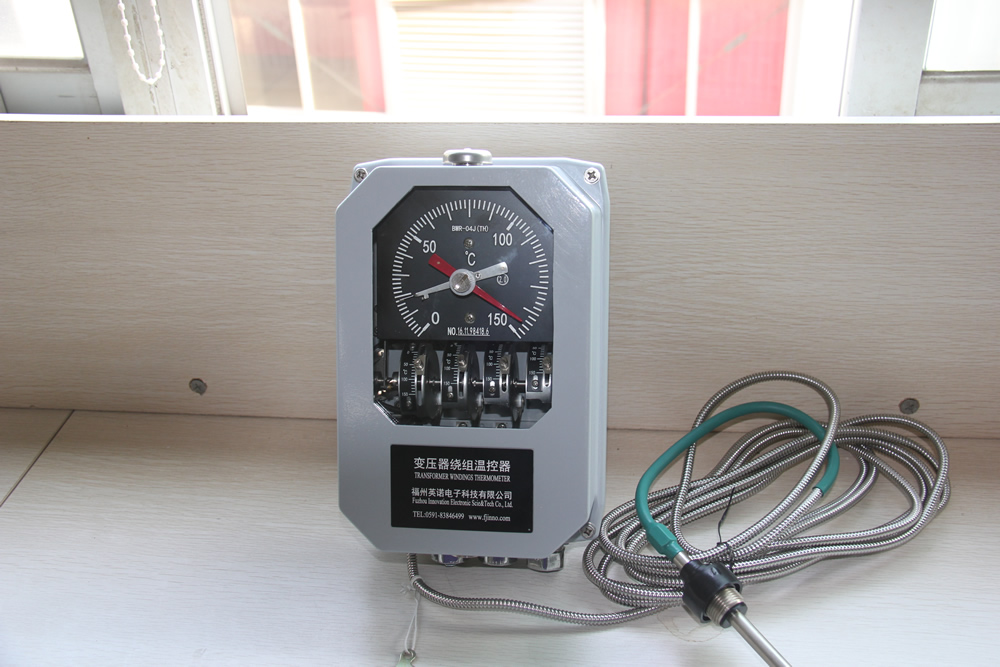
Every oil-immersed power transformer ships with an oil temperature indicator (OTI) และ, ในหลายกรณี, ก ตัวบ่งชี้อุณหภูมิที่คดเคี้ยว (WTI). Both instruments have served the industry for decades, yet neither delivers what modern asset management requires: a direct, real-time reading of the winding hot-spot temperature.
The OTI measures bulk oil temperature at the top of the tank — a value that lags behind actual winding temperatures by anywhere from a few minutes to over half an hour during load changes. The WTI improves on this by adding a thermal image of the current-dependent heat rise, but the result is still a calculated estimate, not a measured value. Under non-standard loading profiles, harmonic distortion, or partial cooling system failure, the WTI estimate can deviate from true winding temperature by 20 °C ถึง 40 องศาเซลเซียส.
That deviation matters enormously. Transformer insulation follows an Arrhenius relationship: every 6–8 °C increase in sustained hot-spot temperature cuts insulation life roughly in half (ไออีซี 60076-2). Operating a transformer 20 °C hotter than the WTI suggests does not merely reduce life expectancy — it can trigger rapid insulation breakdown within months instead of decades.
1.2 Why PT100 and Thermocouple Sensors Are Inadequate
PT100 เครื่องตรวจจับอุณหภูมิความต้านทาน and thermocouples are accurate enough in isolation, แต่โครงสร้างโลหะของพวกเขาสร้างปัญหาพื้นฐานในสภาพแวดล้อมของหม้อแปลงไฟฟ้า:
- Electrical safety: ตัวนำโลหะที่ส่งจากภายในขดลวดไฟฟ้าแรงสูงไปยังอุปกรณ์ที่ติดตั้งบนแผงทำให้เกิดความเสี่ยงต่ออิเล็กทริก. แม้จะมีฉนวนอย่างระมัดระวัง, ตัวนำรบกวนสนามไฟฟ้าในขดลวดและสร้างเส้นทางที่เป็นไปได้สำหรับการคายประจุบางส่วน.
- การรบกวนทางแม่เหล็กไฟฟ้า: สนามแม่เหล็กกระแสสลับกำลังแรงภายในหม้อแปลงไฟฟ้าที่มีพลังงานจะกระตุ้นให้เกิดแรงดันไฟฟ้าในสายสัญญาณที่เป็นโลหะ, การอ่านค่าอุณหภูมิที่เสียหาย - โดยเฉพาะอย่างยิ่งภายใต้ภาระงานหนักหรือสภาวะความผิดปกติ.
- ความเข้ากันได้ของน้ำมัน: โครงสร้าง RTD มาตรฐานไม่ได้ออกแบบมาเพื่อการจุ่มน้ำมันหม้อแปลงแบบไม่มีกำหนด; ความล้มเหลวในการปิดผนึกทำให้เกิดการปนเปื้อนของน้ำมันและการเบี่ยงเบนของเซ็นเซอร์เมื่อเวลาผ่านไป.
1.3 กรณีการตรวจสอบอุณหภูมิของขดลวดใยแก้วนำแสง
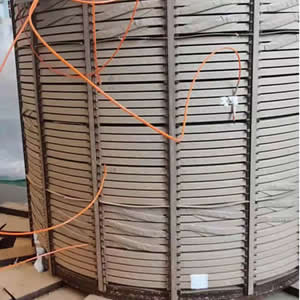
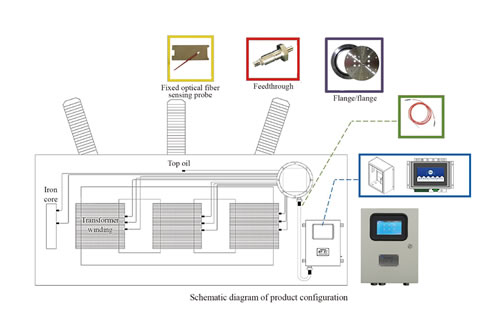
ระบบตรวจสอบอุณหภูมิไฟเบอร์ออปติกสำหรับหม้อแปลงจุ่มน้ำมัน จัดการทุกข้อจำกัดที่ระบุไว้ข้างต้นในขั้นตอนเทคโนโลยีเดียว:
| พารามิเตอร์ | OTI / WTI | PT100 RTD | ไฟเบอร์ออปติกเรืองแสง |
|---|---|---|---|
| Measurement type | ทางอ้อม / calculated | ติดต่อโดยตรง | ติดต่อโดยตรง |
| ภูมิคุ้มกันอีเอ็มไอ | ✅ | ❌ | ✅ |
| การแยกไฟฟ้าแรงสูง | ✅ | ❌ | ✅ (≥100กิโลโวลต์) |
| Typical accuracy | ±5 องศาเซลเซียส (โดยประมาณ) | ±1 องศาเซลเซียส | ±1 องศาเซลเซียส |
| เอาต์พุตต่อเนื่องแบบเรียลไทม์ | ✅ | ✅ | ✅ |
| รองรับการจุ่มน้ำมัน | ไม่มี | จำกัด | ✅ (หัววัดทนน้ำมัน) |
| สกาด้า / บูรณาการ Modbus | จำกัด | ผ่านทางเครื่องส่งสัญญาณ | RS485 พื้นเมือง / Modbus RTU |
2. เปรียบเทียบเทคโนโลยีอุณหภูมิไฟเบอร์ออปติกสามชนิด
ระยะ “เซ็นเซอร์อุณหภูมิใยแก้วนำแสง” ครอบคลุมหลักการวัดที่แตกต่างกันหลายประการ. การเลือกเทคโนโลยีที่ไม่ถูกต้องสำหรับการใช้งานหม้อแปลงไฟฟ้าถือเป็นหนึ่งในข้อผิดพลาดในการจัดซื้อที่พบบ่อยที่สุดและมีค่าใช้จ่ายสูง. นี่คือการเปรียบเทียบแบบภาษาธรรมดาของเทคโนโลยีทั้งสามที่วิศวกรฝ่ายจัดซื้อมักจะพบเจอ.
2.1 เซนเซอร์ไฟเบอร์ออปติกฟลูออเรสเซนต์ (แนะนำสำหรับขดลวดหม้อแปลงไฟฟ้า)

ก เซ็นเซอร์วัดอุณหภูมิใยแก้วนำแสงเรืองแสง — บางครั้งเรียกว่าเซ็นเซอร์อายุการใช้งานเรืองแสง — วางคริสตัลฟอสเฟอร์ของโลกที่หายากไว้ที่ส่วนปลายของเส้นใยควอตซ์. The controller fires a short light pulse down the fiber; the crystal absorbs the pulse and re-emits a fluorescence signal whose decay time is a precise, repeatable function of temperature. The controller measures that decay time and converts it to a temperature value.
Why this matters for transformers: The measurement depends on a time ratio, ไม่ใช่ความเข้มของแสง. That means signal attenuation from long fiber runs, อายุของตัวเชื่อมต่อ, or slight contamination of the fiber surface does not affect accuracy. The sensor is genuinely self-referencing.
- Measurement range: -40 °C ถึง +260 องศาเซลเซียส (มาตรฐาน); customizable to +300 องศาเซลเซียส
- ความแม่นยำ: ±1 องศาเซลเซียส
- ปณิธาน: 0.1 องศาเซลเซียส
- เวลาตอบสนอง: <1 ที่สอง
- Probe type: Point measurement — one probe, one location
- Best for: Direct hot-spot measurement in transformer windings, บัสบาร์สวิตช์เกียร์, ข้อต่อสายเคเบิล
2.2 ตะแกรงไฟเบอร์แบรกก์ (เอฟบีจี) เซนเซอร์
FBG sensors encode temperature information in the reflected wavelength of a periodic refractive-index pattern written into the fiber core. Multiple gratings at different wavelengths can be multiplexed onto a single fiber, making it possible to take several temperature readings along one fiber strand.
- ข้อได้เปรียบ: Multi-point measurement on a single fiber; suitable for distributed winding coverage on very large power transformers
- Limitation: The grating also responds to mechanical strain, so bending or vibration can produce spurious readings unless strain compensation is applied. The interrogator (ดีมอดูเลเตอร์) is significantly more complex and expensive than a fluorescent controller.
- Best for: High-channel applications where cost per point must be reduced and the installation environment is mechanically stable
2.3 การตรวจจับอุณหภูมิแบบกระจาย (ดีทีเอส)
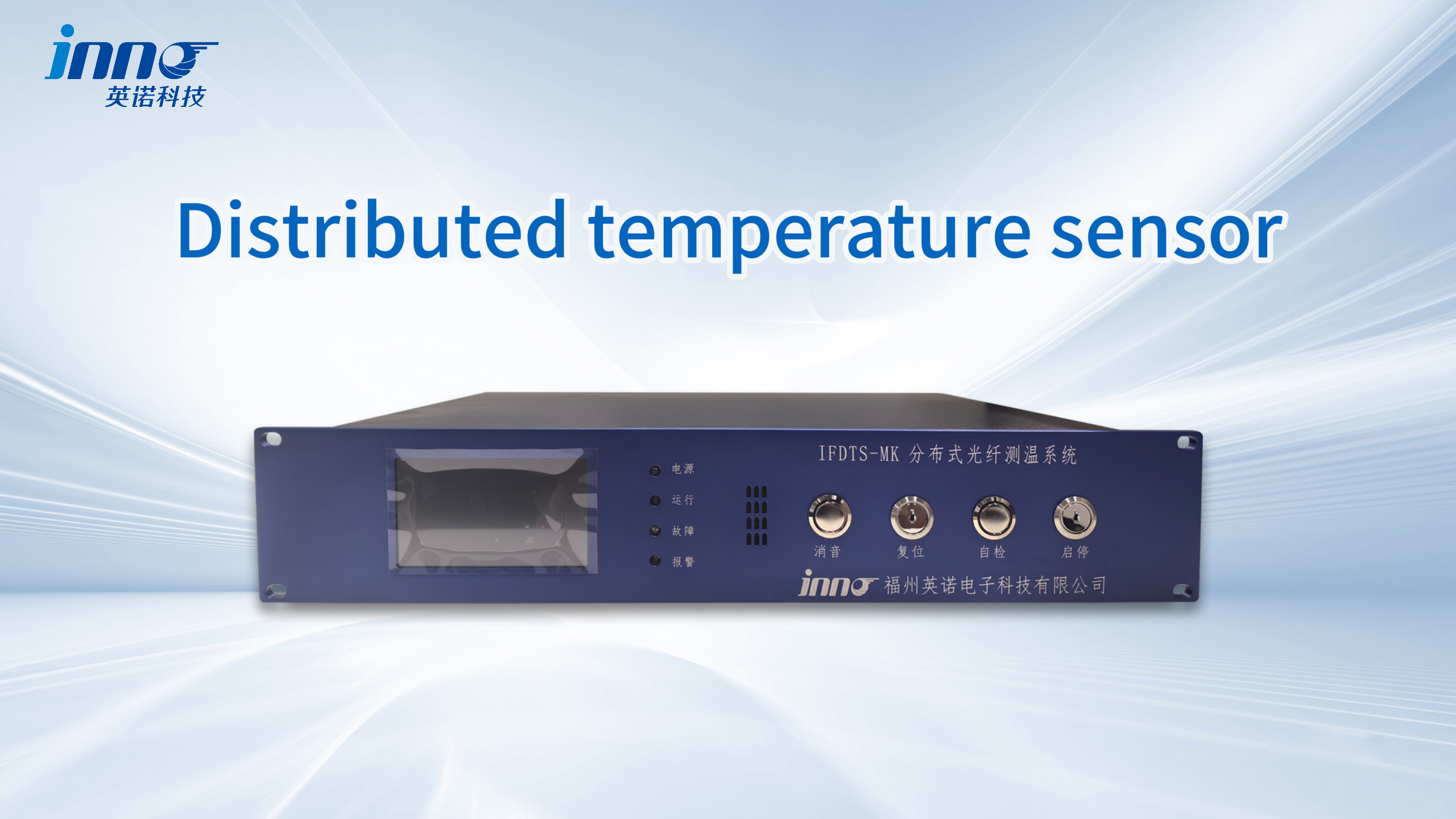
การตรวจจับอุณหภูมิแบบกระจาย uses Raman or Brillouin backscattering along an ordinary single-mode or multimode fiber to produce a continuous temperature profile — thousands of measurement points along a single cable up to several kilometers long.
- ข้อได้เปรียบ: Continuous linear coverage — ideal for cable tunnels, การตรวจสอบสายเหนือศีรษะ, การตรวจจับการรั่วไหลของท่อ
- Limitation: Spatial resolution is typically 0.5–2 m. A transformer winding hot spot occupies a few centimeters; DTS cannot resolve it. The system also requires a large interrogator unit and long averaging times to achieve acceptable accuracy.
- Best for: Power cable routes, pipeline temperature profiling — not suitable for transformer winding hot-spot detection
Technology Selection Summary
| เทคโนโลยี | Measurement Mode | Transformer Winding Use | ความแม่นยำโดยทั่วไป | Relative System Cost |
|---|---|---|---|---|
| ไฟเบอร์ออปติกเรืองแสง | จุด | ✅ Recommended | ±1 องศาเซลเซียส | ปานกลาง |
| เอฟบีจี | กึ่งกระจาย | ✅ Suitable (large transformers) | ±1–2 °ซ | สูงกว่า |
| ดีทีเอส | กระจาย (เชิงเส้น) | ❌ Not suitable | ±1–2 °C over 1 ม | สูง |
3. Key Technical Specifications Explained
Supplier datasheets for ระบบวัดอุณหภูมิใยแก้วนำแสง can look similar on the surface. The following breakdown of each parameter helps procurement engineers read those datasheets critically and ask the right clarifying questions before committing to a purchase.
3.1 ความแม่นยำในการวัด (±1 องศาเซลเซียส)
Accuracy specifies the maximum deviation between the sensor’s displayed value and the true temperature under defined conditions. ไออีซี 60076-2 requires that hot-spot temperature measurement uncertainty not exceed ±2 °C for compliance purposes, so a sensor rated at ±1 °C meets this requirement with margin.
What to watch for: Accuracy figures are only meaningful when accompanied by a traceable calibration certificate. Some suppliers quote ±0.5 °C or better without providing supporting calibration data. Always request a calibration certificate for at least one unit per order batch.
3.2 ช่วงการวัด (-40 °C ถึง +260 °C standard)
Transformer winding temperatures under normal service rarely exceed 130 องศาเซลเซียส (Class A insulation limit per IEC 60076-2 is 98 °C hot-spot rise above 40 °C ambient = 138 °C total). อย่างไรก็ตาม, emergency overload conditions, ความล้มเหลวของระบบทำความเย็น, or insulation degradation can push winding temperatures above 180 องศาเซลเซียส. The standard range of −40 °C to +260 °C covers all realistic scenarios with comfortable margin.
Probe tip temperature vs. controller ambient: Confirm that the probe tip rating covers the maximum winding temperature, and separately confirm that the controller enclosure rating covers the ambient temperature at its installation location (often 0–55 °C for standard industrial units).
3.3 Number of Measurement Channels
Each channel supports one หัววัดอุณหภูมิไฟเบอร์ออปติก. Selecting the correct channel count is a balance between monitoring completeness and system cost.
- Small distribution transformer (ขึ้นไป 2 เอ็มวีเอ): 3 channels — one per phase winding top
- Medium power transformer (2–50 MVA): 6–9 channels — top and bottom of each phase winding
- หม้อแปลงไฟฟ้าขนาดใหญ่ (50 MVA+): 9–16 channels — multiple points per winding plus tap changer and bushing positions
FJINNO controllers support 1 ถึง 64 ช่อง, with custom configurations available for large installations.
3.4 เวลาตอบสนอง (<1 ที่สอง)
Response time defines how quickly the sensor tracks a step change in temperature. Sub-second response captures transient overload events — for example, a through-fault that superheats windings in milliseconds — giving protection relays meaningful data rather than lagged readings.
3.5 High-Voltage Dielectric Isolation (100 กิโลโวลต์)
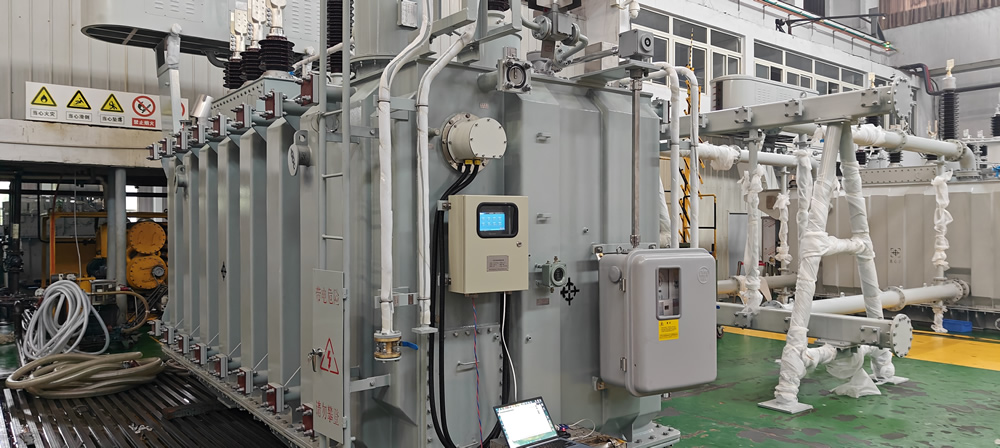
This is the specification that separates fiber optic sensors from all metallic alternatives. The quartz fiber itself has no electrical conductivity; combined with the all-dielectric probe housing, the sensor presents no leakage path between the live winding and the measurement circuit. FJINNO probes are rated at 100 kV continuous dielectric isolation, covering 10 กิโลโวลต์, 35 กิโลโวลต์, 110 กิโลโวลต์, และ 220 kV transformer classes.
3.6 อินเตอร์เฟซการสื่อสาร
Standard output is อาร์เอส485 / Modbus RTU, compatible with virtually all substation SCADA platforms. For installations integrated into IEC 61850 สถานีย่อยดิจิทัล, confirm whether the controller supports IEC 61850 natively or requires an external gateway. A 4–20 mA analogue output is useful for interfacing with older DCS systems.
3.7 IP Protection Rating
Controllers mounted on transformer tanks require a minimum of IP54 (dust-protected, splash-resistant). IP65 is preferred for outdoor installations or positions subject to wash-down. Probes immersed in transformer oil require oil compatibility testing per IEC 60296, not just an IP rating.
3.8 Probe Fiber Length
ที่ extension cable for fluorescent fiber optic temperature sensors bridges the distance between the probe tip inside the winding and the controller mounted on the tank wall or in a nearby panel. Standard lengths run 3–5 m; FJINNO supports custom fiber lengths from 0 ถึง 80 m for large transformers or remote control room installations.
Specification Quick-Reference Table
| พารามิเตอร์ | Minimum Acceptable | ที่แนะนำ | FJINNO Standard |
|---|---|---|---|
| ความแม่นยำ | ±2 °C | ±1 องศาเซลเซียส | ±1 องศาเซลเซียส |
| ช่วงอุณหภูมิ | -20 °C ถึง +180 องศาเซลเซียส | -40 °C ถึง +200 องศาเซลเซียส | -40 °C ถึง +260 องศาเซลเซียส |
| เวลาตอบสนอง | ≤5 s | ≤1 s | <1 ส |
| Dielectric isolation | ≥10 kV | ≥100กิโลโวลต์ | 100 กิโลโวลต์ |
| การสื่อสาร | อาร์เอส485 | อาร์เอส485 + optional IEC 61850 | อาร์เอส485 / Modbus RTU |
| Controller IP rating | IP54 | IP65 | IP65 (available) |
| ช่อง | 3 | 6–9 (per transformer) | 1–64 (ปรับแต่งได้) |
4. Probe Types and Installation Positions

4.1 Armored Probe for Oil-Immersed Winding Applications
ที่ เซ็นเซอร์วัดอุณหภูมิไฟเบอร์ออปติกเรืองแสงแบบหุ้มเกราะสำหรับขดลวดหม้อแปลงที่แช่น้ำมัน features a stainless-steel protective sheath over the sensing tip and fiber cable. The armor protects the delicate quartz fiber during the winding-insertion process and provides long-term mechanical durability inside the oil tank.
When to specify: Any oil-immersed transformer where the probe must be threaded between winding layers during manufacture or field installation. The armor prevents kinking and protects against abrasion from conductor edges.
4.2 Standard Fluorescent Fiber Optic Probe
ที่ fiber optic temperature sensor for oil-immersed transformer winding temperature measurement in its standard form uses a PEEK or stainless-steel tip housing with the quartz fiber encased in a flexible protective jacket. This configuration suits installations where the fiber routing is smooth and the probe is installed during transformer manufacturing with careful handling procedures.
4.3 Fluorescent Fiber Optic Sensor Probes (Multi-Point Kits)
Fluorescent fiber optic temperature sensor probes are available as matched sets configured for specific transformer layouts — for example, a nine-probe kit for a three-phase, three-winding transformer with three measurement points per phase. Pre-matched sets simplify procurement and ensure all probes in the system are calibrated against the same reference.
4.4 Recommended Installation Positions per IEC 60076-2
ไออีซี 60076-2 identifies the winding hot spot as the location most critical for insulation life management. Engineering best practice places probes at the following positions:
- High-voltage winding (เอชวี): Top of winding (highest temperature zone under normal load) — 1 probe minimum; สูงสุด + bottom preferred
- Low-voltage winding (แอลวี): Top of winding — 1 probe minimum
- Tertiary or stabilizing winding (if present): Top of winding — 1 สอบสวน
- แกนกลาง (large units): Core surface near flux concentration zones — 1 probe optional, recommended for 100 MVA+
- Top oil reference: 1 probe in oil to correlate fiber optic readings with traditional OTI
4.5 New-Build vs. Retrofit Installation
The most accurate installation occurs during transformer manufacturing, when probes are threaded between conductor layers before winding is complete. For retrofit on an existing transformer, probes are inserted through oil-fill valves, drain ports, or purpose-installed oil-tight cable glands. Retrofit accuracy is slightly lower because probe-to-conductor contact cannot be as precisely controlled, but the measurement still substantially outperforms OTI/WTI estimation.
5. Certifications and Compliance Requirements
5.1 Mandatory Product Certifications
For projects in most international markets, the following certifications are non-negotiable:
- CE Marking: Required for equipment sold in the European Economic Area. Covers electromagnetic compatibility (EMC Directive 2014/30/EU) and low-voltage safety (LVD 2014/35/EU). Always request the Declaration of Conformity document, not just the CE logo on the label.
- RoHS Compliance: Restriction of Hazardous Substances (EU Directive 2011/65/EU). Most utility and industrial projects globally specify RoHS compliance even outside the EU.
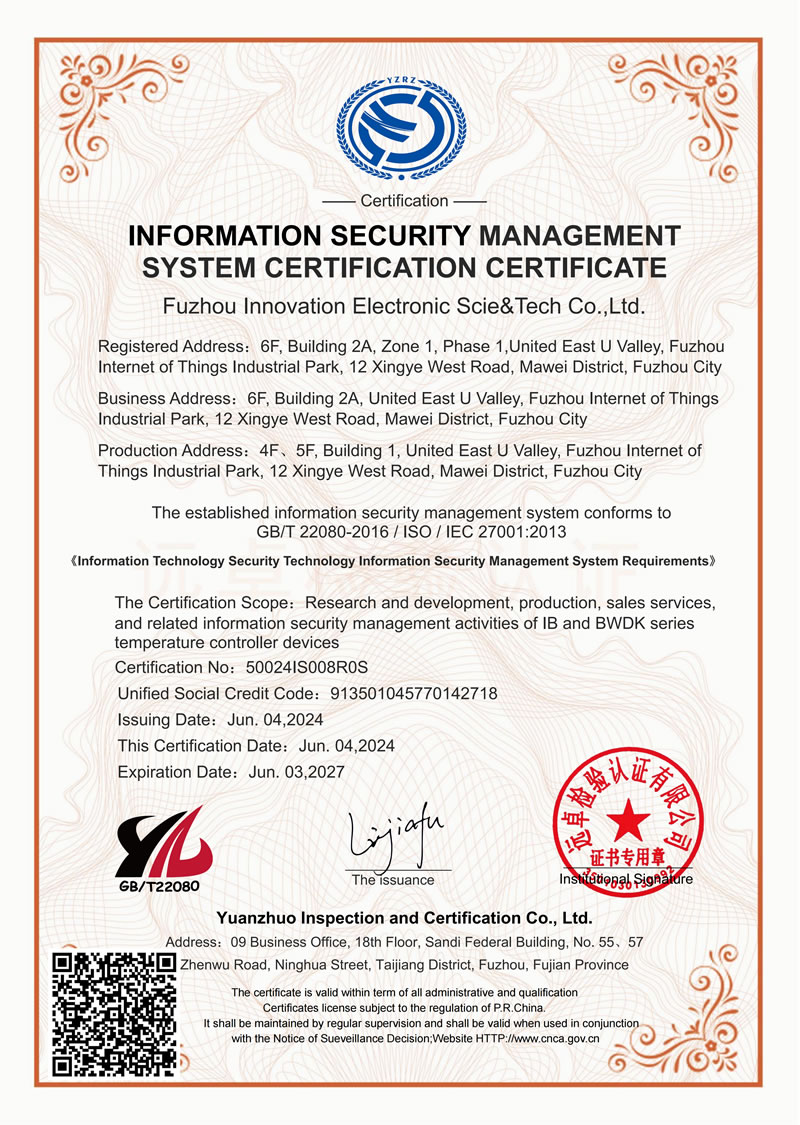
- ไอเอสโอ 9001 Quality Management: Demonstrates that the manufacturer operates under a documented, audited quality system. Request the current certificate with its scope of certification and expiry date.
FJINNO’s full certification portfolio is available at https://www.fjinno.net/certificates.
5.2 Relevant Industry Standards
- ไออีซี 60076-2: Power transformers — Temperature rise for liquid-immersed transformers. Defines hot-spot temperature limits and measurement requirements that fiber optic systems must satisfy.
- ไออีซี 60076-7: คู่มือการโหลดหม้อแปลงไฟฟ้ากำลังแบบจุ่มน้ำมัน. Specifies how hot-spot measurements feed into thermal models for overload management.
- ไออีซี 61850: Communication networks and systems for power utility automation. Relevant if the temperature monitoring system must integrate into a digital substation architecture.
- ไออีซี 60296: Fluids for electrotechnical applications — unused mineral insulating oils. Probe materials must be compatible with transformer oil as defined in this standard.
5.3 How to Write Certification Requirements Into a Procurement Specification
The following language can be copied directly into a technical specification or tender document:
“The fiber optic winding temperature monitoring system shall carry CE marking with supporting Declaration of Conformity, RoHS compliance documentation, and be manufactured under an ISO 9001-certified quality management system. Products shall comply with IEC 60076-2 for measurement accuracy requirements. Communication interfaces shall support Modbus RTU as a minimum; ไออีซี 61850 GOOSE and sampled values integration shall be provided where specified on individual transformer data sheets.”
6. Supplier Evaluation Checklist
ตลาดสำหรับ fiber optic transformer temperature monitoring systems ranges from established specialist manufacturers to resellers offering white-label products with unknown provenance. The following checklist helps procurement engineers separate credible suppliers from those carrying commercial risk.
6.1 Technical Capability
- Does the supplier manufacture the fluorescent probe tip in-house, or source it from a third party?
- Can they provide a traceable calibration certificate for each sensor?
- Do they have documented oil-immersion soak test data (ขั้นต่ำ 1,000 hours in transformer oil per IEC 60296)?
- Can they supply probe installation drawings dimensioned to fit your specific transformer manufacturer’s winding geometry?
- Do they support custom channel counts, fiber lengths, และโปรโตคอลการสื่อสาร?
6.2 Delivery and Logistics
- Standard lead time for a 10-unit order (benchmark: 4–8 weeks for custom configurations)
- Availability of safety stock for common configurations to cover urgent replacement needs
- Experience with export documentation for your import jurisdiction
- OEM and ODM capability if you require branded or integrated products
6.3 การสนับสนุนหลังการขาย
- Warranty period — request a minimum of 24 months on both probe and controller
- Can individual probes be replaced without replacing the complete controller?
- Is English-language technical documentation available (installation manual, Modbus register map, แผนภาพการเดินสายไฟ)?
- Is remote commissioning support available via video call or TeamViewer?
- What is the escalation path for a warranty claim?
6.4 Ten Questions to Ask Every Shortlisted Supplier
- What is the continuous dielectric isolation voltage of the probe from tip to connector?
- Can you provide an individual calibration certificate for every probe in my order?
- What probe housing material is used, and how was oil compatibility confirmed?
- What is the maximum fiber optic cable length you can supply without signal repeaters?
- What communication protocols does the controller support natively?
- What are your separate warranty terms for the probe versus the controller?
- Can you supply reference contacts at a transformer OEM or utility that has deployed your system at 110 kV or above?
- Can you provide the probe mechanical drawing for review by our transformer manufacturer?
- What is your standard lead time for a 20-unit order, and do you hold buffer stock?
- Do you support third-party factory acceptance testing at your facility?
7. Common Procurement Mistakes to Avoid
The following errors appear repeatedly in project post-mortems. Each is preventable at the specification stage.
❌ Mistake 1 — Specifying DTS for winding hot-spot measurement
Distributed temperature sensing systems are appropriate for cable routes and pipelines, not for transformer winding hot spots. The 0.5–2 m spatial resolution of DTS cannot locate a hot spot that occupies a few conductor turns. Specify point-type เซนเซอร์ไฟเบอร์ออปติกเรืองแสง for winding applications.
❌ Mistake 2 — Selecting channel count based on budget rather than measurement strategy
Under-instrumenting a transformer — installing only one probe on a three-phase winding, for example — saves money on day one and creates a significant blind spot. If the hot phase is not monitored, the system gives false comfort. Follow the IEC 60076-2 minimum positions described in Section 4.4.
❌ Mistake 3 — Ignoring communication protocol compatibility
A sensor that arrives on site with only a proprietary ASCII protocol cannot be integrated into a Modbus-based SCADA without a custom gateway. Confirm the exact protocol, register map, and baud rate settings before purchasing. Request a Modbus register map as part of the quotation package.
❌ Mistake 4 — Accepting accuracy claims without calibration evidence
An uncertified ±0.5 °C claim is worth less than a certified ±1 °C claim. For critical protection applications, require per-unit calibration certificates traceable to a national metrology standard.
❌ Mistake 5 — Purchasing from a reseller with no direct access to the manufacturer
If the selling entity cannot answer technical questions about probe construction, oil soak test data, or installation procedure, they are unlikely to support you effectively when a problem arises in service. Verify that your point of contact has direct access to engineering staff at the actual manufacturing facility.
❌ Mistake 6 — Overlooking probe oil compatibility
A probe rated to 260 °C thermally may still fail prematurely if its housing material absorbs transformer oil, swells, and delaminates the sensing crystal. Ask specifically whether the probe has been tested in transformer mineral oil per IEC 60296, and for how long.
8. กรณีศึกษาในโลกแห่งความเป็นจริง

8.1 Fluorescent Fiber Optic Temperature Measurement in Oil-Immersed Transformer Windings
FJINNO’s documented case study on fluorescent fiber optic temperature measurement of oil-immersed transformer windings demonstrates how point-type sensors installed during manufacturing provide continuous hot-spot data that feeds directly into the transformer’s thermal protection relay. The installation covers high-voltage, low-voltage, and neutral-point positions, with fiber lengths routed through oil-tight cable glands to an external multi-channel controller.
Key outcomes documented in the case study include detection of a localized cooling obstruction that raised one phase winding 18 °C above the OTI reading — a discrepancy that would have been invisible without direct winding measurement.
8.2 110 kV Hybrid-Insulated Transformer Online Monitoring in Substations
ที่ 110 kV hybrid-insulated oil transformer online monitoring installation case describes integration of a 12-channel fiber optic winding temperature system with the substation’s IEC 61850 communication architecture. The controller’s Modbus output feeds a protocol gateway, which presents temperature data as IEC 61850 logical nodes to the substation automation system.
This installation illustrates the importance of confirming communication protocol compatibility before procurement — the project required one additional protocol converter that would have been unnecessary had IEC 61850 native support been specified from the outset.
9. How FJINNO’s Products Fit This Application

FJINNO — Fuzhou Innovation Electronic Science & Technology Co., บจ. — has manufactured เซนเซอร์วัดอุณหภูมิใยแก้วนำแสงเรืองแสง and complete ระบบตรวจสอบอุณหภูมิหม้อแปลง for power utilities, OEM หม้อแปลงไฟฟ้า, and EPC contractors across more than 20 ประเทศ. The product range specifically designed for oil-immersed transformer applications includes:
- หัววัดอุณหภูมิไฟเบอร์ออปติก — Standard point-type fluorescent probe, 1–64 channels, -40 °C ถึง +260 องศาเซลเซียส, ±1 องศาเซลเซียส, 100 kV isolation, RS485/Modbus RTU, customizable fiber length 0–80 m
- เซนเซอร์วัดอุณหภูมิไฟเบอร์ออปติกฟลูออเรสเซนต์แบบหุ้มเกราะสำหรับขดลวดหม้อแปลงที่แช่น้ำมัน — Mechanically protected probe for installation into energized or factory-wound transformer coils
- Fiber Optic Temperature Sensor for Oil-Immersed Transformer Winding Temperature Measurement — Application-specific configuration with oil-compatible housing materials and matching controller
- ขาวัดเซนเซอร์วัดอุณหภูมิไฟเบอร์ออปติกฟลูออเรสเซนต์ — Multi-probe kits matched to specific transformer winding layouts
- Extension Cable for Fluorescent Fiber Optic Temperature Sensor — Custom-length fiber extension for routing from winding to external controller
- Fiber Optic Temperature Measurement System for Oil-Immersed Transformers — Complete integrated system including controller, โพรบ, สายเคเบิล, ฮาร์ดแวร์สำหรับติดตั้ง, และซอฟต์แวร์
The complete transformer temperature monitoring solution covers system design, probe placement guidance, controller configuration, and SCADA integration support. Procurement teams can view the full transformer monitoring solutions portfolio for an overview of all available configurations.
FJINNO holds CE, เป็นไปตามมาตรฐาน RoHS, และไอเอสโอ 9001 certifications — all verifiable at https://www.fjinno.net/certificates. ที่ services page details OEM, โอเอ็มเอ็ม, custom design, and technical support offerings.
To request a project-specific configuration and quotation, use the รับใบเสนอราคา form or contact the technical sales team directly.
10. คำถามที่พบบ่อย
ไตรมาสที่ 1: What is the difference between an OTI and a winding temperature indicator, and why are both inadequate for hot-spot monitoring?
An OTI (oil temperature indicator) measures the temperature of bulk oil at the transformer tank top — a value that lags actual winding temperature by up to 40 °C under transient load. A WTI (ตัวบ่งชี้อุณหภูมิที่คดเคี้ยว) improves on this by adding a simulated thermal image driven by load current, but the result is still a calculation, not a measurement. Both instruments assume uniform thermal behavior that deviates significantly under non-standard loading, cooling system faults, or harmonic distortion. โดยตรง เซ็นเซอร์อุณหภูมิขดลวดใยแก้วนำแสง measure actual conductor temperatures at defined positions, eliminating estimation error entirely.
ไตรมาสที่ 2: Can a fluorescent fiber optic sensor be installed in an existing transformer without draining the oil?
Retrofit installation without full oil drain is possible in transformers equipped with suitable access ports — oil-fill valves, drain ports, or purpose-installed oil-tight cable glands. The probe is inserted through the port using a flexible guide tube and positioned at the target winding location. Measurement accuracy with retrofit probes is slightly lower than factory-installed probes because exact probe-to-conductor contact cannot be guaranteed, but the reading still substantially outperforms OTI/WTI estimation. Contact FJINNO’s technical team for guidance specific to your transformer type.
ไตรมาสที่ 3: How many measurement channels does a typical 40 MVA power transformer require?
ก 40 MVA three-phase two-winding transformer typically warrants 6 channels as a minimum: one probe at the top of each HV phase winding and one at the top of each LV phase winding. Adding probes at the winding bottoms increases the count to 12 but provides a complete thermal profile that supports dynamic loading calculations per IEC 60076-7. The optimal channel count depends on transformer voltage class, การวิพากษ์วิจารณ์, and whether the system feeds a thermal model or a simple alarm function.
ไตรมาสที่ 4: What does “100 kV dielectric isolation” mean in practical terms?
It means the quartz fiber and probe housing present no conductive path between the measurement point (inside a live transformer winding) and the signal-processing electronics in the controller. ที่ 100 kV figure is the withstand voltage tested on the complete probe-to-controller assembly. ในทางปฏิบัติ, this allows the probe to be placed in direct contact with live conductors in transformers rated up to 220 kV without any risk of leakage current, ground fault, or electric field distortion at the probe location.
คำถามที่ 5: Is fluorescent fiber optic sensing affected by transformer oil aging or contamination?
The fluorescent crystal at the probe tip is hermetically sealed inside its housing and does not contact the oil directly. The quartz fiber transmission characteristics are also unaffected by external media. Long-term oil aging or contamination therefore does not degrade sensor accuracy. The probe housing material must be compatible with transformer oil per IEC 60296 — FJINNO specifies oil-compatible materials for all transformer probe variants and conducts immersion testing to verify long-term compatibility.
คำถามที่ 6: Can the fiber optic temperature monitoring system integrate with an IEC 61850 ระบบอัตโนมัติของสถานีย่อย?
FJINNO controllers provide native RS485/Modbus RTU output. Integration into IEC 61850 architectures is achieved via a Modbus-to-IEC 61850 protocol gateway, which presents temperature data as logical nodes within the substation’s communication infrastructure. Where IEC 61850 native support is required without an external gateway, discuss this requirement explicitly with FJINNO’s technical team at the specification stage.
คำถามที่ 7: How long do fiber optic probes last inside transformer oil?
Fluorescent fiber optic probes designed for oil-immersed applications are rated for service lives aligned with transformer overhaul intervals — typically 20–25 years. The optical measurement principle has no wear mechanism, and the quartz fiber does not degrade in transformer oil. The main life-limiting factor is mechanical integrity of the probe housing and fiber routing under thermal cycling. Correct installation practice — avoiding sharp bends in the fiber and protecting the cable exit from abrasion — is the primary determinant of service life.
คำถามที่ 8: What information should be included in a Request for Quotation (RFQ) for a fiber optic transformer temperature monitoring system?
A well-structured RFQ should include: transformer rating (เอ็มวีเอ, ระดับแรงดันไฟฟ้า, number of windings), number of probes required and their target installation positions, required fiber length from winding to controller, controller mounting location and available power supply, communication protocol required (Modbus RTU, 4–20 มิลลิแอมป์, ไออีซี 61850), accuracy and range requirements, environmental conditions at the controller location (อุณหภูมิ, ความชื้น, IP class), relevant certifications (ซีอี, เป็นไปตามมาตรฐาน RoHS, ฯลฯ), and order quantity. The more detail provided, the more accurate and comparable the quotations received will be.
คำถามที่ 9: Is there a risk of the probe affecting transformer winding insulation?
เลขที่, when correctly specified and installed. The probe tip is a small-diameter, all-dielectric element. It introduces no metallic conductor into the winding insulation structure and no electric field distortion. The probe housing materials are selected for compatibility with the winding insulation system (paper/oil for oil-immersed transformers, epoxy-resin for dry-type). FJINNO coordinates with transformer OEMs to confirm probe geometry and material compatibility before supply.
คำถามที่ 10: What after-sales support does FJINNO provide for transformer fiber optic monitoring systems?
ฟิจินโน่ after-sales services รวม: detailed installation and commissioning documentation, Modbus register maps and wiring diagrams, remote commissioning support via video call, troubleshooting diagnostics, warranty replacement for faulty components, and technical consultation throughout the product lifecycle. For large installations, on-site commissioning support can be arranged. Contact the technical support team for project-specific arrangements.
ข้อสงวนสิทธิ์
The information contained in this article is provided for general guidance purposes only and reflects the state of knowledge and product specifications available at the time of writing. ข้อกำหนดทางเทคนิค, product configurations, การรับรอง, and service terms are subject to change without notice as part of ongoing product development. Actual product performance in any specific application depends on correct product selection, การติดตั้งที่เหมาะสม, appropriate system configuration, and operating conditions consistent with the product’s rated environment.
Nothing in this article constitutes professional engineering advice, a binding product warranty, or a contractual commitment. All specifications must be confirmed through formal quotation and purchase order documentation before reliance in design or procurement decisions. Compliance with applicable local codes, มาตรฐาน, and regulatory requirements remains the sole responsibility of the purchaser and installer.
ฟจินโน (Fuzhou Innovation Electronic Science & Technology Co., บจ.) reserves the right to modify product specifications and discontinue models at any time. For current specifications and availability, ติดต่อ https://www.fjinno.net/contact or submit an enquiry via https://www.fjinno.net/get-a-quote/.
Third-party standards referenced in this article (ไออีซี 60076-2, ไออีซี 60076-7, ไออีซี 61850, ไออีซี 60296, ฯลฯ) are the property of their respective issuing bodies. Readers should consult the current versions of those standards directly for authoritative technical requirements.

เซ็นเซอร์อุณหภูมิไฟเบอร์ออปติก, ระบบตรวจสอบอัจฉริยะ, จำหน่ายผู้ผลิตใยแก้วนำแสงในประเทศจีน
 |
 |
 |