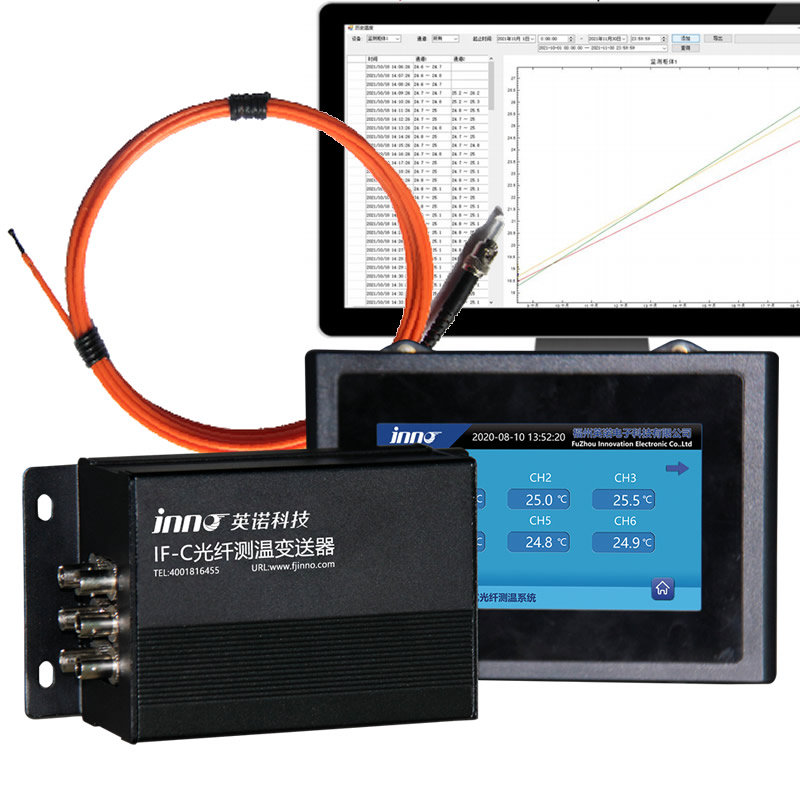
 Оптоволоконные датчики температуры INNO ,системы контроля температуры.
- Флуоресцентные оптоволоконные датчики температуры мера от от −40 °C до +250 °С (до +300 °C с улучшенными датчиками), обеспечивает точность ±1 °C для силового оборудования и распределительных устройств.
- Волоконная решетка Брэгга (ВБР) датчики крышка от −40 °C до +300 °С в стандартной форме, и может распространяться на +700 °С или даже +1000 °C с регенерированными решетками и волокном с металлическим покрытием.
- Распределенное рамановское измерение температуры (ДТС) системы работают от от −40 °C до +300 °С на расстояниях до 30–50 км, идеально подходит для мониторинга трубопроводов и кабелей.
- Системы Бриллюэна BOTDA/BOTDR имеют схожий диапазон от −40 °C до +300 °С но может достичь 100+ км длина зондирования.
- Датчики черного тела из сапфирового волокна выдвинуть верхний предел за пределы +2000 °С для экстремальных промышленных условий.
Оглавление
- Что такое температурный диапазон оптоволокна?
- Волоконно-оптические технологии измерения температуры и их диапазоны
- Ключевые факторы, определяющие температурный диапазон оптоволокна
- Типичные применения в различных температурных диапазонах
- Как правильно выбрать оптоволоконный датчик температуры
- FAQs About Fiber Optic Temperature Range
1. Что такое температурный диапазон оптоволокна?

Fiber optic temperature range refers to the minimum and maximum temperatures that a оптоволоконный датчик температуры can accurately and reliably measure. This specification varies significantly across different sensing technologies, fiber materials, coatings, and packaging designs. A fluorescent fiber optic probe designed for transformer winding monitoring handles a very different temperature window than a sapphire fiber sensor built for jet engine testing.
Why Temperature Range Is the First Selection Criterion
Temperature range directly determines whether a sensor can operate safely and accurately in your target environment. Choosing a sensor with insufficient range leads to measurement failure, потеря сигнала, or permanent probe damage. Over-specifying the range, с другой стороны, often means sacrificing resolution or paying significantly more. Matching your actual operating temperature envelope to the right sensing technology is the most critical step in any оптоволоконный контроль температуры проект.
What This Article Covers
This guide breaks down the temperature ranges of four mainstream fiber optic sensing technologies, explains the physical and material factors that set those limits, maps each temperature zone to real-world applications, and provides practical selection guidance. Every specification referenced reflects current commercially available products and published industry data.
2. Оптоволоконное измерение температуры Technologies and Their Ranges

Флуоресцентные оптоволоконные датчики температуры
Флуоресцентные оптоволоконные датчики температуры (also called fluorescence lifetime decay sensors) work by exciting a phosphor material at the probe tip with a light pulse and measuring the decay time of the resulting fluorescence. This decay time changes predictably with temperature, providing a direct and highly accurate reading.
Стандартный флуоресцентные оптоволоконные зонды крышка от −40 °C до +200 °С. Усовершенствованные версии с использованием оптимизированных фосфорных соединений и высокотемпературной упаковки расширяют ассортимент до +250 °С или +300 °С. Точность обычно от ±0,5 °C до ±1 °C, со временем ответа ниже 1 второй. Это технология точечного измерения — каждый датчик считывает температуру в одном месте.. Ключевое преимущество – полная невосприимчивость к электромагнитным помехам., изготовление флуоресцентные оптоволоконные датчики стандартный выбор для температура обмотки силового трансформатора, температура контактов распределительного устройства, и контроль обмотки двигателя.
Волоконная решетка Брэгга (ВБР) Датчики температуры
Датчики температуры ВБР использовать периодическую структуру показателя преломления, записанную в сердцевину волокна. Эта решетка отражает узкую длину волны света. (длина волны Брэгга), который линейно смещается с температурой. Отслеживая этот сдвиг длины волны, система определяет температуру в месте расположения решетки.
Стандартный Датчики ВБР работать из от −40 °C до +300 °С. С регенерированными или фемтосекундно-записывающими решетками и волокном из полиимида или с металлическим покрытием., the range extends to +700 °С и, in specialized configurations, beyond +1000 °С. Multiple gratings can be multiplexed on a single fiber (quasi-distributed measurement), making FBG systems efficient for structural health monitoring. Note that FBG sensors respond to both temperature and strain simultaneously, so proper decoupling is necessary for accurate thermal-only measurements.
Raman Distributed Temperature Sensing (Рамановский ДТС)

Raman DTS systems inject a laser pulse into an optical fiber and analyze the backscattered Raman signal. The ratio of anti-Stokes to Stokes Raman scattering intensity is temperature-dependent, enabling continuous temperature profiling along the entire fiber length.
Стандартный Рамановский ДТС systems measure from от −40 °C до +300 °С, limited primarily by the fiber coating material. Sensing distances reach 30–50 км with spatial resolution of approximately 1 метр. This makes Raman DTS the go-to solution for power cable temperature monitoring, обнаружение утечек трубопровода, tunnel fire alarm systems, и охрана периметра. Measurement time per scan ranges from seconds to minutes depending on distance and desired accuracy.
Brillouin Distributed Temperature Sensing (BOTDA/BOTDR)
Brillouin fiber optic sensing measures temperature through the shift in Brillouin scattering frequency, which varies linearly with temperature along the fiber. БОТДА (Brillouin Optical Time Domain Analysis) uses stimulated scattering for higher performance, while BOTDR (Оптическая рефлектометрия Бриллюэна во временной области) uses spontaneous scattering for single-ended access.
The temperature range is similar to Raman DTS at от −40 °C до +300 °С, but Brillouin systems achieve significantly longer sensing distances — often 100 км или более. Like FBG, Brillouin scattering is sensitive to both temperature and strain, requiring appropriate separation techniques. These systems are widely used for long-distance infrastructure monitoring including subsea cables, плотины, and large-scale pipeline networks.
Таблица сравнения технологий
| Технология | Стандартный диапазон | Extended Range | Тип измерения | Типичная точность |
|---|---|---|---|---|
| Флуоресцентное оптоволокно | от −40 °C до +200 °С | До +300 °С | Точка | от ±0,5 °C до ±1 °C |
| ВБР | от −40 °C до +300 °С | До +1000 °С | Квазираспределенный | от ±0,5 °C до ±2 °C |
| Рамановский ДТС | от −40 °C до +300 °С | До +700 °С | Полностью распространен | от ±1 °C до ±2 °C |
| Brillouin BOTDA/BOTDR | от −40 °C до +300 °С | До +400 °С | Полностью распространен | от ±1 °C до ±2 °C |
3. Ключевые факторы, определяющие температурный диапазон оптоволокна
Fiber Material and Coating
The optical fiber itself is made of fused silica, which can theoretically withstand temperatures above +1000 °С. Однако, the fiber coating — applied to protect the glass from mechanical damage — is almost always the first limiting factor. Standard telecom-grade fiber uses acrylate coating, rated for от −40 °C до +85 °С. Polyimide-coated fiber extends the upper limit to approximately +300 °С. Metal-coated fiber (алюминий, медь, or gold) pushes it further to +500 °С до +700 °С. Beyond that, specialty bare or carbon-coated fibers are used in controlled environments.
Sensing Element Limitations
Each sensing technology has inherent physical limits. Fluorescent phosphor compounds lose luminescence efficiency or undergo irreversible changes above their rated temperature. Standard Type I FBG gratings begin to anneal (erase) above approximately +300 °C — regenerated gratings solve this but add complexity. Raman and Brillouin scattering themselves are not temperature-limited, but the fiber they rely on is.
Packaging and Encapsulation Materials
The probe housing, sealing adhesive, protective tubing, and connector materials often impose stricter temperature limits than the fiber or sensing element alone. А stainless steel probe housing can handle much higher temperatures than a plastic connector. For applications above +200 °С, every component in the probe assembly — from the ceramic ferrule к high-temperature epoxy — must be individually rated for the target range.
Low-Temperature Constraints
At cryogenic temperatures (below −100 °C), standard fiber becomes brittle, phosphor response curves change significantly, and FBG sensitivity drops. Specialized cryogenic calibration, low-temperature adhesives, and protective routing are required for reliable operation in LNG, superconductor, and aerospace applications. Некоторый fiber optic cryogenic sensors are validated down to −200 °C or even −269 °C (liquid helium temperature).
Environmental Stress Factors
Вибрация, влажность, химическое воздействие, and radiation can all degrade sensor performance within its nominal temperature range over time. For long-term deployment in harsh environments, selecting appropriate protective cable jackets, hermetic seals, and corrosion-resistant probe materials is just as important as matching the temperature specification.
4. Типичные применения в различных температурных диапазонах
Cryogenic Range: −200 °C to −40 °C
This range covers LNG storage tank monitoring, superconducting magnet cooling systems, cryogenic research facilities, and aerospace fuel systems. Fiber optic sensors offer critical safety advantages in these environments: no electrical spark risk, no interference from strong magnetic fields, and reliable operation in vacuum or inert atmospheres.
Ambient Range: от −40 °C до +85 °С
Standard telecom-grade fiber handles this range easily at the lowest cost. Typical applications include structural health monitoring for bridges and buildings, data center temperature surveillance, geotechnical monitoring, and environmental sensing. Оба Рамановский ДТС и ВБР-системы are commonly deployed in these scenarios.
Medium Range: +85 °С до +250 °C — The Power Industry Sweet Spot

This is the core operating zone for флуоресцентные оптоволоконные датчики температуры. The most common applications include power transformer winding hot-spot temperature measurement, high-voltage switchgear busbar and contact monitoring, cable joint temperature monitoring, generator and motor winding temperature tracking, and downhole oil and gas well temperature measurement. Fluorescent sensors dominate this zone because they combine high accuracy, complete dielectric isolation, электромагнитная невосприимчивость, and proven long-term stability in energized high-voltage environments.
High Range: +250 °С до +700 °С
Applications in this zone include heat treatment furnaces, glass manufacturing, steam turbines, plastic extrusion dies, and high-temperature chemical reactors. High-temperature FBG sensors with polyimide or metal-coated fiber and specialized encapsulation are the primary solution. Some extended-range флуоресцентные зонды can also reach the lower end of this zone.
Extreme Range: Выше +700 °С
Jet engine turbine blades, nuclear reactor components, steel smelting, and ceramic sintering furnaces fall into this category. Sapphire fiber blackbody radiation sensors can measure temperatures above +2000 °С. These systems are expensive and specialized, but fiber optic technology remains one of the few viable non-contact-free solutions for continuous measurement in such extreme thermal environments.
5. Как правильно выбрать оптоволоконный датчик температуры

Шаг 1: Define Your Temperature Envelope
Identify the minimum and maximum temperatures your sensor will encounter — not just the target measurement range, but also ambient and transient extremes. Add a safety margin of at least 10–20 % beyond your expected maximum.
Шаг 2: Determine Measurement Type
Decide whether you need single-point measurement (fluorescent sensor), multi-point measurement (FBG sensor), or continuous distributed profiling (Рамановский ДТС или Brillouin system). Point sensors are simpler and more accurate for localized hot-spot monitoring. Distributed systems are efficient for long linear assets.
Шаг 3: Evaluate Environmental Conditions
Consider electromagnetic interference levels, химическое воздействие, механическая вибрация, влага, and required cable routing. High-voltage and high-EMI environments strongly favor флуоресцентные оптоволоконные датчики because the all-dielectric fiber eliminates ground loops and interference pickup entirely.
Шаг 4: Balance Accuracy, Distance, and Budget
Higher accuracy and longer sensing distance generally increase system cost. Fluorescent point sensors offer the best accuracy-to-cost ratio for localized measurements in the −40 °C to +250 °C range. Raman DTS provides the best value for distributed monitoring over several kilometers. FBG offers a good middle ground for multi-point installations where distance and temperature demands are moderate.
6. FAQs About Fiber Optic Temperature Range
1 квартал: Какую максимальную температуру может измерить оптоволоконный датчик??
Sapphire fiber blackbody radiation sensors can measure temperatures exceeding +2000 °С. For more common technologies, FBG sensors with regenerated gratings reach up to +1000 °С, while standard fluorescent and Raman systems top out around +300 °С.
2 квартал: Can fiber optic sensors work at cryogenic temperatures?
Да. Specialty fiber optic sensors with cryogenic-rated materials and calibration can operate reliably down to −200 °C and, in some laboratory configurations, as low as −269 °C (liquid helium temperature).
Q3: What limits the temperature range of a fiber optic sensor?
The primary limiting factors are the fiber coating material, the sensing element properties (phosphor stability, grating annealing threshold), and the packaging materials (клеи, housings, connectors). The silica fiber itself can withstand over +1000 °С.
Q4: Which fiber optic sensor is best for transformer temperature monitoring?
Флуоресцентные оптоволоконные датчики температуры are the industry standard for transformer winding hot-spot monitoring. They provide ±1 °C accuracy, full electromagnetic immunity, and complete dielectric isolation in the −40 °C to +250 °C range required for oil-immersed and dry-type transformers.
Q5: What is the temperature range of a standard Raman DTS system?
Most commercial Raman DTS systems operate from −40 °C to +300 °С, depending on the sensing cable construction. The fiber coating type (acrylate, полиимид, или металл) determines the actual upper limit.
Q6: Do FBG sensors measure temperature and strain at the same time?
FBG sensors are inherently sensitive to both temperature and strain. For accurate temperature-only measurement, strain must be decoupled through mechanical isolation of the grating or by using a reference grating that is strain-free.
Q7: How does fiber coating type affect temperature range?
Acrylate coating is rated to approximately +85 °С, polyimide coating to +300 °С, and metal coatings (алюминий, медь, gold) к +500 °C–+700 °C. Selecting the right coating is essential for matching the sensor to your operating temperature.
Q8: Can I use a single fiber optic system for both high and low temperature zones?
Distributed systems like Raman DTS and Brillouin BOTDA measure the full temperature profile along the fiber, so a single system can cover sections at different temperatures — as long as every point falls within the system’s rated range and the sensing cable is rated accordingly at each section.
Q9: How accurate are fiber optic temperature sensors compared to thermocouples?
Fluorescent fiber optic sensors achieve ±0.5 °C to ±1 °C, comparable to or better than standard K-type thermocouples. The key advantage of fiber optic sensors is not just accuracy but immunity to electromagnetic interference, which can cause significant errors in thermocouple readings in high-voltage environments.
Вопрос 10: Какое обслуживание требуют оптоволоконные датчики температуры?
Fiber optic sensors require minimal maintenance. There are no consumable parts, no recalibration due to EMI drift, and no degradation from electrical surges. Periodic inspection of fiber connectors for contamination and verification of calibration at scheduled intervals are the main maintenance tasks.
Отказ от ответственности: Информация, представленная в этой статье, предназначена только для общих справочных целей.. Specific temperature ranges, характеристики точности, and application suitability vary by manufacturer, product model, and deployment conditions. Always consult the product datasheet and the manufacturer’s engineering team before making purchasing or installation decisions. ФЬИННО (www.fjinno.net) не несет ответственности за любые решения, принятые на основании содержания этой статьи..

Оптоволоконный датчик температуры, Интеллектуальная система мониторинга, Распределенный производитель оптоволокна в Китае
 |
 |
 |