 Sensores de temperatura de fibra óptica INNO ,sistemas de monitoramento de temperatura.
- Sensor de temperatura por fibra óptica de fluorescência works by measuring how fast a phosphor material stops glowing after a light pulse — the cooler the target, the slower the glow fades; the hotter it gets, the faster it fades.
- This time-based measurement principle is inherently immune to signal loss from fiber bending, envelhecimento do conector, or light source degradation — giving buyers long-term accuracy without frequent recalibration.
- Three mainstream fiber optic temperature technologies exist: vida útil da fluorescência, Grade de fibra Bragg (FBG), e Dispersão Raman. Each serves different project requirements, and choosing the wrong one is a costly mistake.
- This article explains the fluorescence mechanism in plain business language, compares it with alternative fiber optic approaches, and shows procurement professionals exactly what to verify on a supplier datasheet before placing an order.
- Published by FJINNO, a fluorescence fiber optic thermometry manufacturer since 2011, this guide helps B2B buyers make technology-informed purchasing decisions with confidence.
Índice
- Why Procurement Professionals Need to Understand the Underlying Technology
- The Fluorescence Decay Principle — Explained Without the Physics Jargon
- Why Time-Based Measurement Beats Intensity-Based Measurement
- Three Fiber Optic Temperature Technologies Buyers Will Encounter
- Fluorescence Lifetime Sensing vs. Grade de fibra Bragg (FBG)
- Fluorescence Lifetime Sensing vs. Sensor de temperatura distribuída Raman
- When Fluorescence Is the Clear Winner — And When It Is Not
- How to Read a Fiber Optic Temperature Sensor Datasheet
- Five Red Flags That Reveal a Weak Supplier
- Combinando a tecnologia certa com o escopo do seu projeto
- Cenários de implantação do mundo real onde o sensor de fluorescência é eficaz
- Perguntas que sua equipe de engenharia deve fazer antes de você assinar
- Perguntas frequentes (Perguntas frequentes)
1. Why Procurement Professionals Need to Understand the Underlying Technology

Se você estiver adquirindo um sistema de medição de temperatura de fibra óptica, você encontrará várias tecnologias concorrentes - todas comercializadas sob nomes com sons semelhantes. Fornecedores que oferecem sistemas baseados em fluorescência, Sistemas FBG, e os sistemas Raman reivindicarão desempenho superior, e suas planilhas de dados parecerão convincentemente semelhantes à primeira vista. Sem uma compreensão prática de como cada tecnologia funciona, as equipes de compras correm o risco de selecionar um sistema que seja tecnicamente incompatível com o ambiente do projeto, pagando demais por recursos de que não precisam, ou subespecificar um sistema que falha em campo.
Este artigo não foi escrito para pesquisadores de laboratório. Foi escrito para compradores de projetos, procurement engineers, and sourcing managers who need to understand just enough about fluorescence optical fiber temperature sensing to evaluate supplier proposals critically, ask the right questions, and avoid expensive mistakes.
2. The Fluorescence Decay Principle — Explained Without the Physics Jargon

At the tip of every fluorescence fiber optic temperature probe, there is a tiny piece of phosphor material — a substance that glows briefly when hit with light. The measurement process works in three simple steps.
Step One: A Pulse of Light Travels Down the Fiber
The demodulator (the main instrument) sends a very short flash of light through the optical fiber cable to the probe tip. This is similar to a camera flash — it is on for a fraction of a second and then off.
Step Two: The Phosphor Glows and Then Fades
When the light pulse hits the phosphor, o fósforo absorve a energia e começa a brilhar (fluorescência). No momento em que o pulso de luz para, o fósforo não escurece instantaneamente – ele desaparece gradualmente, como o brilho de uma lâmpada depois de desligá-la.
Terceiro Passo: A velocidade de desvanecimento informa a temperatura
Aqui está o insight principal: a velocidade com que o brilho desaparece está diretamente ligada à temperatura. At lower temperatures, o brilho desaparece lentamente. Em temperaturas mais altas, desaparece rapidamente. O demodulador mede esta velocidade de fade - tecnicamente chamada de fluorescence decay lifetime - e converte-o em uma leitura precisa de temperatura.
Por que um comprador deveria se preocupar com isso?
Porque a medição depende do tempo (quão rápido o brilho desaparece), não em quão brilhante é o brilho. Esta distinção tem enormes consequências práticas. Se o cabo de fibra ficar dobrado, um conector fica sujo, or the light source weakens slightly over years of service, the brightness of the return signal may decrease — but the fade speed remains unchanged. This means a fluorescence lifetime fiber optic temperature sensor stays accurate year after year without recalibration, even as the optical path degrades naturally with age.
3. Why Time-Based Measurement Beats Intensity-Based Measurement
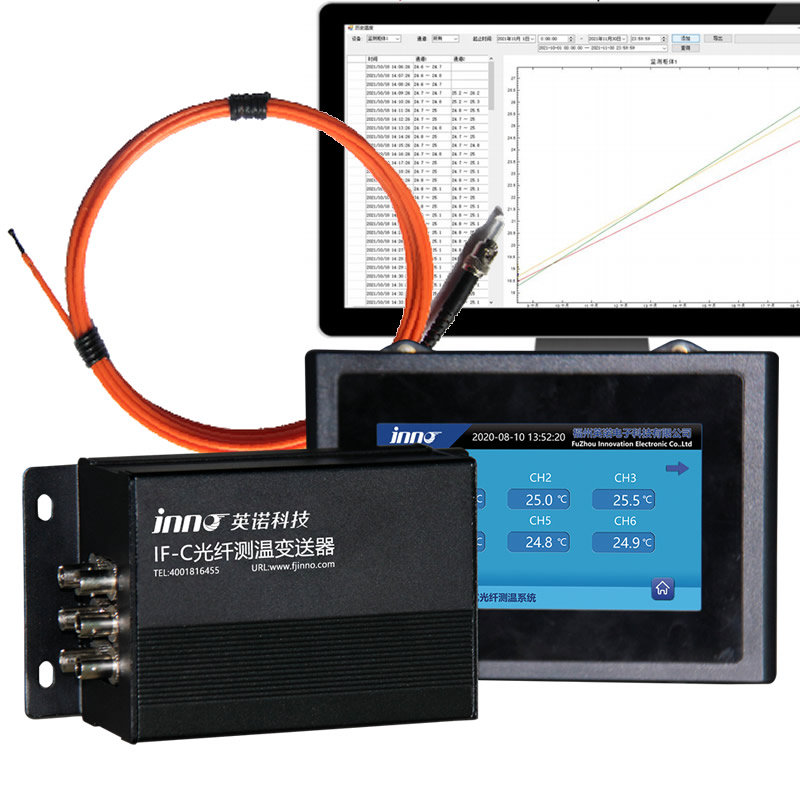
Some older or lower-cost fiber optic temperature systems measure temperature by looking at the brightness (intensidade) of the fluorescence rather than its decay speed. This approach is simpler and cheaper to build, but it introduces a fundamental weakness: anything that reduces signal brightness — fiber bending, dirty connectors, long cable runs, or LED aging — is misinterpreted as a temperature change.
For a B2B buyer, the practical difference is significant. Um intensity-based fiber optic temperature sensor may require recalibration every 6–12 months and is prone to false readings if the installation is disturbed during maintenance. UM fluorescence decay lifetime sensor typically holds its calibration for 2–3 years or more and is virtually unaffected by routine disturbances to the fiber path. When evaluating supplier proposals, always confirm whether the system uses lifetime-based or intensity-based measurement. This single question can separate a reliable long-term investment from a maintenance headache.
4. Three Fiber Optic Temperature Technologies Buyers Will Encounter
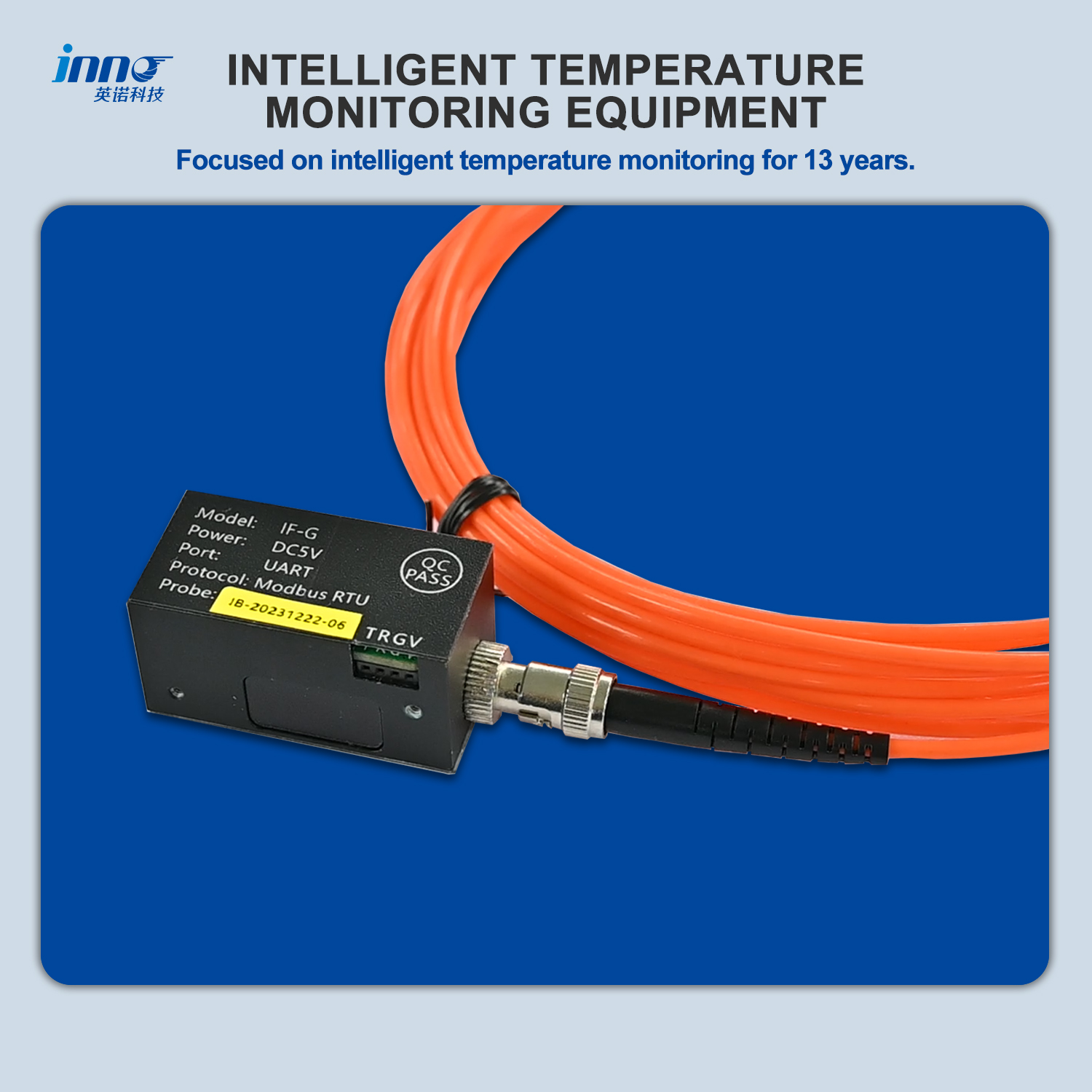
When sourcing optical fiber temperature measurement systems, procurement teams will encounter three mainstream technologies. Each has a fundamentally different operating principle, and each is optimized for a different type of project.
Fluorescence Lifetime Sensing
Point-measurement technology. Each probe measures temperature at one specific location. Ideal for monitoring discrete hotspots on transformers, contatos do quadro, battery cells, and motor windings. Fornece alta precisão (±1 °C), resposta rápida (sob 1 segundo), e isolamento elétrico completo.
Grade de fibra Bragg (FBG) Sentindo
Quasi-distributed technology. Multiple sensing points (grades) are written into a single fiber, allowing dozens of measurement points along one cable. Commonly used for structural health monitoring of bridges, oleodutos, and large civil structures. Less commonly used for high-voltage electrical equipment because FBG fibers can be sensitive to strain and require wavelength-stable interrogators.
Sensor de temperatura distribuída Raman (ETED)

Fully distributed technology. Measures temperature continuously along the entire length of a fiber — potentially covering kilometers. Used for pipeline leak detection, detecção de incêndio em túneis, e segurança perimetral. Accuracy is lower than point sensors (typically ±1–2 °C), and spatial resolution is measured in meters rather than millimeters.
5. Fluorescence Lifetime Sensing vs. Grade de fibra Bragg (FBG)
B2B buyers sometimes receive competing proposals from sensor de fibra óptica de fluorescência suppliers and Sensor FBG suppliers for the same project. Understanding the fundamental differences helps you evaluate whether the proposed technology is appropriate.
Isolamento Elétrico
UM fluorescence fiber optic temperature probe is completely passive at the sensing point — only light reaches the probe tip. FBG sensors are also passive, but the interrogator typically requires a broadband light source and high-resolution spectrometer, making the demodulation hardware more complex and expensive.
Sensitivity to Strain
FBG sensors are inherently sensitive to both temperature and mechanical strain. If the fiber is stretched or compressed — common in vibrating environments like motor windings or transformer tanks — the strain signal mixes with the temperature signal, introducing errors. Fluorescence sensors measure only temperature and are unaffected by mechanical strain on the fiber.
Cost per Measurement Point
For projects with fewer than 20–30 measurement points concentrated in a small area, sistemas baseados em fluorescência are typically more cost-effective. FBG systems become competitive when a project requires 50 or more measurement points distributed along a single long fiber run.
Buyer Takeaway
If your project involves high-voltage equipment, EMI forte, vibração, or a moderate number of discrete hotspot locations, fluorescence is almost always the better fit. If your project involves measuring temperature profiles along very long structures, FBG or Raman may be more appropriate.
6. Fluorescence Lifetime Sensing vs. Sensor de temperatura distribuída Raman

Raman DTS and sensores de ponto de fluorescência are complementary rather than competing technologies in many cases. No entanto, some suppliers position Raman DTS as a replacement for fluorescence sensing, which can lead to poor project outcomes.
Precision vs. Cobertura
UM fluorescence fiber optic thermometer delivers ±1 °C accuracy at a specific point. A Raman DTS system delivers ±1–2 °C accuracy averaged over a spatial resolution window of 0.5–2 meters. For detecting a hotspot on a single busbar bolt or a specific battery cell, Raman resolution is far too coarse.
Tempo de resposta
Fluorescence sensors respond in under 1 segundo. Raman DTS systems typically require 30 seconds to several minutes of signal averaging to achieve acceptable accuracy, making them unsuitable for applications where temperature changes rapidly.
System Complexity and Cost
Raman DTS interrogators are significantly more expensive than fluorescence demodulators and require specialized fiber installation over long distances. For localized monitoring tasks, um sistema de medição de temperatura de fibra óptica de fluorescência oferece desempenho superior por uma fração do custo.
7. When Fluorescence Is the Clear Winner — And When It Is Not
Nenhuma tecnologia é perfeita para todas as aplicações. A orientação honesta ajuda os compradores a evitar o excesso e a falta de engenharia em seus sistemas de monitoramento.
A fluorescência é a vencedora quando:
O projeto requer medição pontual de alta precisão (±1 °C ou melhor) em ambientes com forte interferência eletromagnética, alta tensão, risco de explosão, ou espaços confinados. Exemplos típicos incluem monitoramento de hotspot de enrolamento de transformador, detecção de temperatura de contato do painel de distribuição, monitoramento térmico de células de bateria, e cable joint temperature measurement.
A fluorescência pode não ser a melhor opção quando:
O projeto requer perfis contínuos de temperatura em distâncias superiores a várias centenas de metros (Raman DTS é melhor), ou quando mais de 100 pontos de detecção são necessários ao longo de uma única estrutura linear (FBG pode ser mais econômico). O reconhecimento desses limites demonstra a honestidade do fornecedor e ajuda os compradores a confiar na recomendação.
8. How to Read a Fiber Optic Temperature Sensor Datasheet

As fichas técnicas do fornecedor são a principal ferramenta para comparar produtos, mas nem todas as fichas técnicas apresentam informações da mesma maneira. Aqui estão as principais especificações nas quais você deve se concentrar e o que elas significam para o seu projeto.
Faixa de medição
Normalmente –40 °C a +260 °C para padrão sondas de fibra óptica de fluorescência. Confirme se a faixa declarada cobre as piores condições operacionais com margem. Alguns fornecedores citam a faixa teórica do material de fósforo em vez da faixa do sistema testado – sempre peça especificações em nível de sistema.
Precisão e Resolução
Precisão (±1 °C) informa o quão próxima a leitura está da temperatura real. Resolução (0.1 °C) informa a menor alteração que o sistema pode detectar. Ambos importam, mas a precisão é a especificação que afeta suas decisões de controle de processo. Ask whether the stated accuracy applies across the full temperature range or only at a single calibration point.
Tempo de resposta
Defined as the time to reach 90% of a step temperature change. Para a maioria fluorescence optical fiber temperature sensors, this is under 1 segundo. Be cautious of datasheets that quote response time without specifying the measurement condition (in air, in oil, or in contact with metal).
Maximum Fiber Length
The distance from the demodulator to the farthest probe. Standard is 30–80 meters. If your installation requires longer runs, confirm performance specifications at the actual required distance, not just the maximum rated distance.
Contagem de canais
How many independent temperature points one demodulator can monitor simultaneously — usually 1 para 64. This directly affects your per-point cost and rack space requirements.
9. Five Red Flags That Reveal a Weak Supplier
After evaluating hundreds of sourcing interactions in the sensor de temperatura de fibra óptica mercado, certain patterns consistently indicate suppliers who may underdeliver.
Red Flag 1: No In-House Manufacturing
If the supplier is a trading company reselling another manufacturer’s product, you lose direct access to technical support, personalização, and quality accountability. Always ask whether the supplier manufactures the demodulator, the probes, or both.
Red Flag 2: Vague Accuracy Claims
Statements like “alta precisão” ou “medição precisa” without a specific ±value at a defined temperature range are meaningless. Reputable manufacturers publish tested accuracy figures with calibration traceability.
Red Flag 3: No Reference Projects in Your Industry
A supplier who has never deployed a fluorescence fiber optic temperature monitoring system in your specific application (poder, armazenamento de energia, industrial) may not understand the installation constraints and environmental requirements unique to your sector.
Red Flag 4: No Customization Capability
Every project has slightly different probe length, material da bainha, roteamento de cabos, and communication protocol requirements. Suppliers offering only fixed catalog configurations may force you to compromise on installation quality.
Red Flag 5: No After-Sales Engineering Support
Temperature monitoring systems require occasional technical support — commissioning assistance, configuração de protocolo, and calibration verification. If the supplier cannot provide remote engineering support in your language and time zone, post-purchase problems become your problem alone.
10. Combinando a tecnologia certa com o escopo do seu projeto
The most common procurement mistake is selecting a technology before fully defining the project requirements. Before requesting quotations for a sistema de medição de temperatura de fibra óptica, your project team should clearly define the number of discrete measurement points required, the physical distance between the farthest sensor and the monitoring room, the environmental conditions at the sensing location (extremos de temperatura, EMI level, classe de tensão, exposição química), the required communication protocol for integration with existing SCADA or DCS, and whether the installation is new-build or retrofit. Providing these details in your RFQ ensures that suppliers propose the correct technology — fluorescence, FBG, or Raman — rather than defaulting to whatever product they happen to sell.
11. Cenários de implantação do mundo real onde o sensor de fluorescência é eficaz
Ciência Eletrônica de Inovação de Fuzhou&Companhia de tecnologia., Ltda. (FJINNO) has been manufacturing fluorescence optical fiber thermometry systems desde 2011. Over more than a decade of project delivery, certain deployment scenarios have consistently demonstrated the strongest return on investment for B2B buyers.
Transformadores de potência
Sondas de temperatura de fibra óptica embedded in transformer windings during manufacturing provide direct hotspot temperature data that oil-top thermometers and thermal imaging cannot replicate. This data enables load optimization and prevents insulation degradation.
Médio- and High-Voltage Switchgear
Continuous contact temperature monitoring with sensores de fibra óptica de fluorescência detects progressive resistance increases at busbar joints months before thermal failure occurs, allowing planned maintenance instead of emergency shutdowns.
Lithium-Ion Battery Energy Storage
Cell-level thermal monitoring with electrically passive optical fiber temperature probes provides the safety-critical data needed to detect thermal runaway precursors without introducing ignition risk into the battery enclosure.
Industrial Motors and Generators
Stator winding temperature monitoring in large rotating machines operating near variable-frequency drives, where EMI renders conventional sensors unreliable.
12. Perguntas que sua equipe de engenharia deve fazer antes de você assinar
Before finalizing a purchase order for a fluorescence fiber optic temperature sensing system, procurement professionals should ensure their engineering team has confirmed answers to these critical questions: Does the supplier use fluorescence lifetime or fluorescence intensity measurement — and can they explain the difference? What is the system-level accuracy across the full operating temperature range, not just at a single calibration point? What is the expected probe lifespan under your specific operating conditions? Can the demodulator firmware be updated in the field, or must the unit be returned to the factory? What warranty terms apply to the probes, the demodulator, and the fiber cables separately? Gathering these answers before contract execution prevents disputes and ensures the delivered system matches your technical expectations.
13. Perguntas frequentes (Perguntas frequentes)
1º trimestre: What is fluorescence decay lifetime, and why does it matter for temperature measurement?
Fluorescence decay lifetime is the time it takes for the phosphor glow at the probe tip to fade after a light pulse. This fade time changes predictably with temperature, forming the basis of the measurement. Because it depends on timing rather than brightness, the reading is immune to signal loss from fiber aging, flexão, or dirty connectors — which is why a fluorescence lifetime fiber optic sensor holds calibration far longer than intensity-based alternatives.
2º trimestre: What is the difference between fluorescence fiber sensing and FBG fiber sensing?
Fluorescence fiber optic sensing measures temperature at a discrete point using the phosphor decay principle and is immune to mechanical strain. A detecção FBG usa mudanças de comprimento de onda na luz laser refletida por grades escritas na fibra e é sensível à temperatura e à deformação. Para monitoramento de pontos de acesso de alta tensão, fluorescência é geralmente preferida.
3º trimestre: Um sistema de fluorescência e um sistema Raman DTS podem ser usados juntos no mesmo projeto?
Sim. Muitos projetos de grande escala usam Raman DTS para monitoramento distribuído de cabos ou tubulações em longas distâncias e sensores de ponto de fluorescência para monitoramento preciso de pontos de acesso em equipamentos específicos. The two technologies are complementary.
4º trimestre: Como posso saber se a afirmação de precisão da folha de dados de um fornecedor é confiável?
Solicite certificados de calibração de terceiros rastreáveis aos padrões de metrologia nacionais. Fabricantes conceituados de sistemas de medição de temperatura de fibra óptica fornecer relatórios de calibração mostrando a precisão testada em vários pontos de temperatura em toda a faixa nominal.
Q5: What phosphor materials are used in fluorescence fiber optic probes?
The most common phosphor materials are rare-earth doped compounds and GaAs (arseneto de gálio) semicondutores. Rare-earth phosphors are widely used for industrial temperature ranges (–40 °C to +260 °C), while GaAs probes are used for some specialized applications. Your supplier should be able to specify which material their probes use.
Q6: Is a fluorescence fiber optic system difficult for our maintenance team to operate?
Não. Once installed and commissioned, um fluorescence fiber optic temperature monitoring system operates autonomously. The demodulator outputs readings via standard protocols (Modbus, 4–20 mA) to your existing control system. Routine maintenance involves periodic visual inspection of fiber cables and occasional calibration verification — no specialized optical skills are required.
Q7: How many measurement channels do we need?
This depends entirely on how many discrete temperature points your project requires. Um único demodulador de temperatura de fibra óptica suporta 1 para 64 canais. For projects with more than 64 pontos, multiple demodulators can be networked together on a shared communication bus.
P8: Can fluorescence probes be installed in oil-filled transformers?
Sim. Fluorescence fiber optic temperature probes designed for transformer applications are oil-compatible and chemically inert. They are typically installed during transformer manufacturing, embedded directly in the winding structure. Retrofit installation on existing transformers is also possible in some configurations.
Q9: What happens if a fiber cable is accidentally damaged?
A damaged fiber cable will cause the affected channel to lose signal, which the demodulator reports as a fault alarm. The demodulator and all other channels continue operating normally. The damaged cable and probe can be replaced individually without affecting the rest of the system.
Q10: How do I start a conversation with FJINNO about my project?
Contato Ciência Eletrônica de Inovação de Fuzhou&Companhia de tecnologia., Ltda. (FJINNO) by email at web@fjinno.net, by WhatsApp or phone at +86 135 9907 0393, or through the company website at www.fjinno.net. Share your project scope, measurement point count, e ambiente operacional, and the engineering team will provide a technology recommendation and budgetary proposal at no cost.
About the Manufacturer

Ciência Eletrônica de Inovação de Fuzhou&Companhia de tecnologia., Ltda. (FJINNO) has been designing and manufacturing fluorescence optical fiber thermometry systems desde 2011. The company serves B2B customers across the power utility, armazenamento de energia, energia renovável, and industrial manufacturing sectors in more than 30 países.
Endereço: Parque Industrial de Rede de Grãos Liandong U, Estrada Oeste No.12 Xingye, Fucheu, Fujian, China
E-mail: web@fjinno.net
WhatsApp / WeChat / Telefone: +86 135 9907 0393
QQ: 3408968340
Site: www.fjinno.net
Isenção de responsabilidade: As informações fornecidas neste artigo são apenas para fins informativos e educacionais gerais. Enquanto Fuzhou Innovation Electronic Scie&Companhia de tecnologia., Ltda. (FJINNO) makes every effort to ensure the accuracy and completeness of the content, no representation or warranty, expresso ou implícito, is made regarding the accuracy, confiabilidade, or completeness of the information. Especificações do produto, technology comparisons, and application suitability may vary depending on specific project conditions. This content does not constitute professional engineering advice. Buyers should conduct independent due diligence and consult directly with FJINNO or qualified engineers before making procurement decisions. FJINNO shall not be liable for any loss or damage arising from reliance on the information presented herein.

Sensor de temperatura de fibra óptica, Sistema de monitoramento inteligente, Fabricante distribuído de fibra óptica na China
 |
 |
 |