 Sensores de temperatura de fibra óptica INNO ,sistemas de monitoramento de temperatura.
Índice
- Introdução: The Critical Role of Temperature Monitoring in Transformer Performance
- Fiber Optic Temperature Sensing Technology: Como funciona
- Key Advantages of Fiber Optic Temperature Sensors for Transformer Applications
- Comparing Fiber Optic Technologies: DTS versus. FBG vs. Fluoroptic Systems
- Guia de implementação: Where and How to Install Fiber Optic Sensors in Transformers
- Estudos de caso do mundo real: Transformer Failure Prevention
- Análise de ROI: The Business Case for Fiber Optic Temperature Monitoring
- Guia de seleção: How to Choose the Right Fiber Optic System for Your Transformers
- Tendências Futuras: The Evolution of Fiber Optic Monitoring in 2025 and Beyond
- Conclusão: Implementing a Fiber Optic Temperature Monitoring Strategy
Introdução: The Critical Role of Temperature Monitoring in Transformer Performance
Power transformers represent some of the most critical and expensive assets in the electrical grid. With replacement costs ranging from hundreds of thousands to millions of dollars and lead times often exceeding 12 meses, unexpected transformer failures can have devastating impacts on grid reliability, operational costs, and organizational reputation.
At the heart of transformer reliability lies temperature management. As IEEE and IEC standards have long established, elevated operating temperatures are directly correlated with accelerated insulation aging, with each 7-8°C increase potentially halving the expected transformer life. While traditional oil and winding temperature indicators have served the industry for decades, they provide only limited insight into actual conditions within the transformer.
of transformer failures are related to excessive temperatures or hotspots
typical difference between average winding temperature and actual hotspot temperature
reduction in transformer life for every 7-8°C increase in operating temperature
months typical lead time for critical power transformer replacement
Fiber optic temperature sensing technology has revolutionized the approach to transformer temperature monitoring, fornecendo direto, real-time measurement of actual winding hotspot temperatures rather than approximations based on oil temperatures and thermal models. As we move further into 2025, these systems have become increasingly sophisticated, offering unprecedented insight into transformer thermal behavior and enabling truly condition-based maintenance approaches.
Este guia abrangente explora os mais recentes desenvolvimentos em sensoriamento de temperatura por fibra óptica para transformadores de potência, desde os princípios fundamentais da tecnologia até estratégias práticas de implementação, ajudando gestores de ativos, engenheiros elétricos, e profissionais de manutenção tomam decisões informadas sobre esta tecnologia de monitoramento crítica.
Fiber Optic Temperature Sensing Technology: Como funciona
A detecção de temperatura por fibra óptica representa um afastamento fundamental das técnicas convencionais de medição de temperatura elétrica. Em vez de depender de sinais elétricos que podem ser comprometidos por interferência eletromagnética (EMI), sensores de fibra óptica usam propriedades de luz para detectar mudanças de temperatura com precisão e confiabilidade excepcionais.
Princípios Tecnológicos Básicos
Sensores de fibra óptica operam com base em vários princípios físicos diferentes, cada um com vantagens específicas para aplicações específicas:
Método de decaimento de fluorescência (FDM)
Este método utiliza materiais fosforescentes sensíveis à temperatura na ponta do sensor. Quando excitado por um pulso de luz, esses materiais emitem luz fluorescente com características de decaimento diretamente relacionadas à temperatura. A medição baseada no tempo é inerentemente imune a flutuações de intensidade de luz, tornando-o excepcionalmente preciso e estável durante longos períodos.
Precisão típica: ±0,5°C
Grade de fibra Bragg (FBG)
Os sensores FBG contêm variações periódicas microscópicas no índice de refração do núcleo da fibra, criando um refletor específico de comprimento de onda. À medida que a temperatura muda, expansão térmica altera o período da grade, mudando o comprimento de onda refletido proporcionalmente à temperatura. Isso permite multiplexar vários sensores em uma única fibra.
Precisão típica: ±1,0°C
Sensor de temperatura distribuído (ETED)
Os sistemas DTS medem a temperatura continuamente ao longo de todo o comprimento de uma fibra óptica. They work by analyzing the backscattered light resulting from the Raman effect. The ratio between Stokes and anti-Stokes signals provides temperature information, while the time-of-flight determines the location along the fiber.
Precisão típica: ±1.0-2.0°C with spatial resolution of 1-2 metros
Typical System Components
Um completo sistema de monitoramento de temperatura de fibra óptica for transformers typically includes:
Sondas de fibra óptica
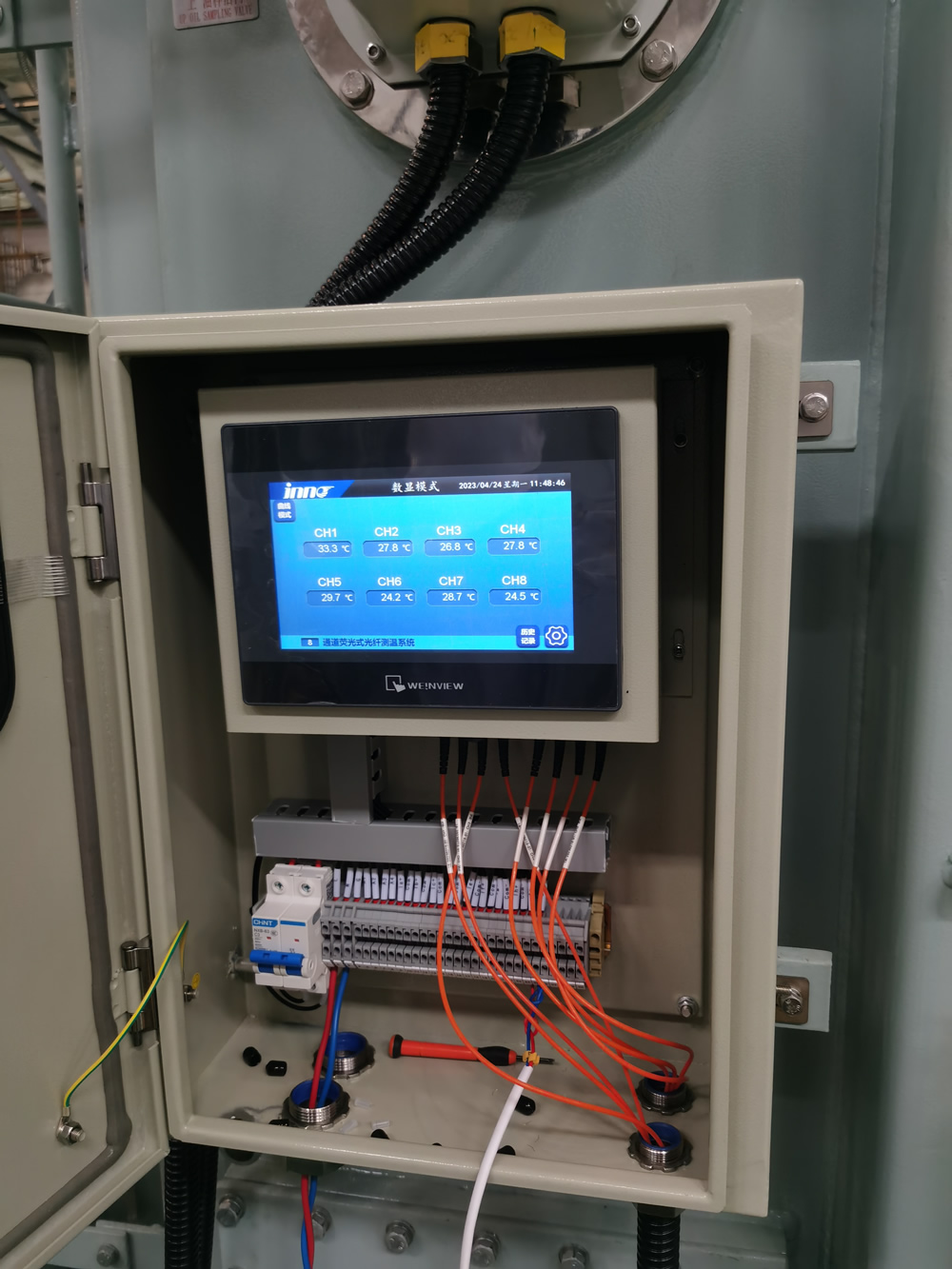
Specially designed temperature probes containing optical fibers that are installed directly into transformer windings during manufacturing or retrofit procedures. These probes are engineered to withstand the harsh electrical, térmico, and chemical environment inside transformers for decades.
Signal Conditioner/Transmitter
Electronic equipment that generates the light signals, analyzes the returned optical signals, and converts them into temperature readings. Modern units provide multiple communication interfaces including 4-20mA, Modbus, DNP3, e CEI 61850 for seamless integration with SCADA and asset management systems.
Extension Fibers
Specialized optical fiber cables connecting the probes to the signal conditioner, designed to withstand the transformer oil environment and provide reliable transmission over long distances without signal degradation.
Software de monitoramento
Advanced software platforms that display real-time temperature data, analyze trends, generate alerts, and integrate with broader asset performance management systems to enable condition-based maintenance strategies.
Transformer Installation Approaches
Fiber optic temperature sensors can be integrated into power transformers through several methods:
Instalação de fábrica (New Transformers)
The optimal approach involves installing sensors during transformer manufacturing, allowing precise placement at calculated hotspot locations within the windings. Sensors are typically integrated into specialized spacers or directly between disc windings.
Retrofit Installation (Existing Transformers)
For transformers already in service, special retrofit probes can be installed through available openings such as unused thermometer wells, spare valves, or inspection ports. While not providing the same level of direct winding access as factory installation, these approaches still deliver valuable temperature data.
External Surface Monitoring
For applications where internal access is impossible, advanced DTS systems can be installed on transformer tank surfaces to provide thermal mapping of external temperatures, which can be correlated to internal conditions through sophisticated thermal modeling.
Evolução tecnológica: 2025 Update
Recent advances in fiber optic sensing technology have dramatically improved system performance. The latest generation of monitoring systems now offers:
- Enhanced accuracy (±0.2°C in laboratory conditions, ±0.5°C in field applications)
- Expanded measurement range (-40°C a +300°C)
- Increased sampling rates up to 10Hz for dynamic load studies
- Advanced self-calibration capabilities ensuring drift-free operation over decades
- Miniaturized probes with diameters as small as 0.8mm for minimal impact on transformer design
- Built-in redundancy with dual optical paths for mission-critical applications
Key Advantages of Fiber Optic Temperature Sensors for Transformer Applications
The adoption of fiber optic temperature monitoring technologies for power transformers has accelerated significantly in recent years, driven by several compelling advantages over conventional monitoring approaches. Understanding these benefits is essential for asset managers and engineers evaluating monitoring system investments.
Medição direta de pontos de acesso
Conventional approach: Indicadores tradicionais de temperatura de enrolamento (WTI) estimate hotspot temperatures based on top oil temperature plus a thermal model offset that approximates winding temperature rise.
Fiber optic advantage: Sensors directly measure actual winding temperatures at the predicted hotspot locations, eliminating estimation errors that can exceed 15°C during transient conditions or unusual loading patterns.
Impacto: Accurate hotspot data enables precise loading decisions, preventing unnecessary derating while avoiding dangerous overloading conditions.
Imunidade à Interferência Eletromagnética
Conventional approach: Electrical sensors like RTDs and thermocouples can suffer from measurement errors, signal degradation, or outright failure due to the intense electromagnetic fields present in transformers.
Fiber optic advantage: The dielectric nature of optical fibers makes them completely immune to EMI, ensuring reliable measurements even during fault conditions, operações de comutação, or geomagnetic disturbances.
Impacto: Contínuo, reliable data during all operational states, including critical fault conditions when temperature information is most valuable.
Vários pontos de medição
Conventional approach: Traditional systems typically provide only 1-2 temperature measurement points per transformer due to cost and complexity limitations.
Fiber optic advantage: Suporte a sistemas modernos 8-16 discrete measurement points in a single transformer, enabling comprehensive thermal mapping of different winding sections, fases, and core components.
Impacto: Detailed thermal profiles reveal unexpected temperature distributions, design issues, or cooling problems that would remain hidden with limited measurement points.
Enhanced Safety and Isolation
Conventional approach: Electrical sensors require careful isolation design to prevent dangerous potential transfer between windings and monitoring equipment.
Fiber optic advantage: The inherent electrical isolation of optical fibers eliminates any risk of potential transfer, loops de terra, or safety hazards, simplifying installation and improving personnel safety.
Impacto: Reduced engineering complexity, elimination of isolation barriers, and enhanced safety for maintenance personnel.
Estabilidade a longo prazo
Conventional approach: Electrical sensors typically experience calibration drift over time, particularly in high-temperature environments with thermal cycling.
Fiber optic advantage: Premium fiber optic systems utilize reference-based measurement principles that are inherently stable, with documented cases of sensors maintaining calibration for 25+ anos em aplicações de transformadores.
Impacto: Virtually elimination of recalibration requirements, reducing maintenance costs and ensuring reliable data throughout the transformer lifecycle.
Dynamic Load Management
Conventional approach: Conservative loading based on nameplate ratings or simplified thermal models, often leaving significant capacity unutilized.
Fiber optic advantage: Real-time hotspot measurement enables dynamic loading beyond nameplate ratings when conditions permit, while maintaining safe thermal limits.
Impacto: Studies show capacity increases of 10-30% are often possible without exceeding design temperature limits, significantly enhancing asset utilization.
Cooling System Effectiveness Verification
Conventional approach: Limited ability to verify actual cooling system performance or detect partial cooling failures.
Fiber optic advantage: Multiple temperature sensors provide clear thermal signatures of cooling system effectiveness, instantly revealing plugged radiators, fan failures, or pump issues.
Impacto: Early detection of cooling problems before they impact transformer life or trigger alarms, enabling proactive maintenance.
Advanced Analytics Integration
Conventional approach: Limited temperature data restricts the effectiveness of asset health analytics.
Fiber optic advantage: Rich, multi-point temperature datasets enable sophisticated analysis including thermal modeling, remaining life estimation, and anomaly detection algorithms.
Impacto: Enhanced predictive maintenance capabilities, better capital planning, and reduced risk of unexpected failures.
Real-World Example: Capacity Release in Transmission Transformer
A major North American utility installed fiber optic temperature monitoring in a critical 500MVA transmission transformer previously limited to 85% loading due to conservative temperature estimates. Direct hotspot monitoring revealed actual temperatures were 12°C lower than calculated values during peak loading conditions. This enabled an immediate 15% increase in allowable loading, deferring a $5.2M capacity upgrade project by 4 years while maintaining full compliance with IEEE thermal guidelines.
Comparing Fiber Optic Technologies: DTS versus. FBG vs. Fluoroptic Systems
The fiber optic temperature sensing market offers several distinct technologies, each with unique characteristics that make them suitable for different transformer monitoring applications. Understanding these differences is crucial for selecting the optimal solution for specific needs.
| Characteristic | Fluoroptic Systems | Grade de fibra Bragg (FBG) | Sensor de temperatura distribuído (ETED) |
|---|---|---|---|
| Princípio de Medição | Medição do tempo de decaimento fosforescente | Mudança no comprimento de onda da luz refletida | Razão de intensidade de retroespalhamento Raman |
| Precisão Típica | ±0,2°C a ±0,5°C | ±0,5°C a ±1,0°C | ±1,0°C a ±2,0°C |
| Resolução Espacial | Somente medições pontuais | Medições pontuais (múltiplo por fibra) | Contínuo (normalmente resolução de 1m) |
| Máximo de pontos por sistema | 8-16 canais típicos | 20-80 sensores por fibra | Milhares de pontos de medição |
| Velocidade de medição | Rápido (múltiplas leituras por segundo) | Moderado (1-10 segundos para verificação completa) | Mais devagar (30 segundos a vários minutos) |
| Durabilidade da Sonda | Excelente para ambientes de transformadores | Bom, mas requer gerenciamento de tensão | Excelente com seleção adequada de cabos |
| Faixa de custo do sistema | $15,000-$40,000 (8 canais) | $30,000-$60,000 (16-32 pontos) | $50,000-$100,000+ (sistema completo) |
| Complexidade de integração | Arquitetura ponto a ponto simples | Complexidade moderada | Maior complexidade, software especializado |
| Aplicações ideais | Monitoramento de hotspot de enrolamento direto | Multi-point monitoring with strain/vibration | Mapeamento de superfície, buchas, pistas, tanques |
Fluoroptic Technology Deep Dive
Fluoroptic technology (also called fluorescence decay method) has become the dominant approach for transformer winding hotspot monitoring due to its exceptional accuracy, estabilidade, and simplicity. These systems use a phosphorescent material at the sensor tip that, when excited by a light pulse, emits a fluorescent signal with decay characteristics directly proportional to temperature.
The time-based measurement approach makes these systems inherently immune to light intensity variations, perdas de flexão de fibra, ou degradação do conector. Leading manufacturers like Neoptix (acquired by Qualitrol) and Rugged Monitoring have refined this technology specifically for transformer applications.
Key advantages for transformer applications include:
- Maior precisão (±0.2°C in controlled conditions)
- Exceptional long-term stability without recalibration
- Simples, robust probes that withstand transformer environments
- Fast response times for dynamic loading studies
- Compatibility with both new transformer installations and retrofits
FBG Technology Deep Dive
Fiber Bragg Grating technology utilizes microscopic modifications to the fiber core that create wavelength-specific reflectors. À medida que a temperatura muda, these gratings expand or contract, shifting the reflected wavelength proportionally.
The key advantage of FBG systems is multiplexing capability, allowing dozens of discrete sensors on a single fiber. Some advanced systems combine temperature and vibration/strain measurement in the same fiber, providing multidimensional condition monitoring.
Key advantages for transformer applications include:
- Multiple measurements on a single fiber (complexidade de instalação reduzida)
- Combined temperature and vibration monitoring capabilities
- Good accuracy suitable for most applications
- Excellent EMI immunity and long-distance capabilities
- Lower per-point cost in large multi-sensor deployments
DTS Technology Deep Dive
Distributed Temperature Sensing provides continuous temperature measurement along the entire length of an optical fiber, rather than at discrete points. These systems operate based on the Raman scattering principle, where backscattered light includes temperature-dependent components.
By analyzing the ratio of Stokes to anti-Stokes signals and using time-domain reflectometry to determine position, DTS systems create complete temperature profiles. While traditionally used for longer distances in pipeline or cable monitoring, specialized high-resolution DTS systems have emerged for transformer applications.
Key advantages for transformer applications include:
- Complete surface temperature mapping without sensor placement planning
- Ability to detect unexpected hotspots anywhere along the fiber path
- Excellent for bushing monitoring, lead connections, and tank surfaces
- Single fiber installation for hundreds or thousands of measurement points
- Visualization capabilities for thermal mapping of entire transformers
Technology Selection Guidance
When selecting fiber optic temperature monitoring technology for transformer applications, consider these application-specific recommendations:
For Critical Power Transformers (>100AMIU)
Recommended technology: Fluoroptic point sensors for direct winding hotspot monitoring, potentially combined with DTS for surface/bushing monitoring.
Justificativa: The highest accuracy and reliability are paramount for these critical assets, justifying the investment in premium point-sensing technology for direct winding monitoring.
For Distribution Transformers with Limited Access
Recommended technology: DTS systems applied to external surfaces and accessible areas.
Justificativa: When direct winding access is unavailable, DTS provides the most comprehensive monitoring solution without requiring internal sensors.
For Transformer Fleet Monitoring Programs
Recommended technology: FBG systems with multiplexed sensors.
Justificativa: The cost efficiency of multiplexed FBG sensors makes them attractive for large-scale deployments across multiple transformers, especially when combined with centralized monitoring architecture.
For Research and Development Applications
Recommended technology: Combination of fluoroptic sensors and high-resolution DTS.
Justificativa: R&D applications benefit from the high accuracy of fluoroptic sensors at critical locations combined with the comprehensive coverage of DTS systems to discover unexpected thermal behaviors.
Guia de implementação: Where and How to Install Fiber Optic Sensors in Transformers
Proper placement and installation of fiber optic temperature sensors is critical to realizing their full potential for transformer monitoring. This section provides detailed guidance on sensor location selection, installation methodologies, and best practices for both new and existing transformers.
Optimal Sensor Placement Strategies
The strategic placement of temperature sensors within a transformer requires balancing theoretical hotspot prediction with practical installation considerations:
Primary Winding Hotspots
For direct winding temperature measurement, sensors should be placed at the theoretical hotspot locations, tipicamente:
- Top third of the winding height (aproximadamente 70-80% from bottom)
- Inner winding layers for disc-type windings
- Near the top oil ducts where oil flow may be restricted
- In areas with highest calculated current density
IEEE thermal models and manufacturer thermal simulations should guide specific placement in each transformer design.
Multiple Winding Coverage
Para monitoramento abrangente, sensors should be distributed across different winding structures:
- Enrolamentos de alta tensão (tipicamente 2-4 sensores)
- Enrolamentos de baixa tensão (tipicamente 2-4 sensores)
- Tertiary windings (1-2 sensors if present)
- All three phases for three-phase transformers
This distribution enables comparative analysis between windings and phases to identify asymmetrical heating patterns that may indicate developing problems.
Supplementary Monitoring Points
Beyond primary winding measurements, additional strategic locations include:
- Core leg and yoke temperatures
- Main tank oil at different heights
- Cooling system inlet/outlet points
- Lead connections and bushings
- OLTC compartments
These supplementary points create a more complete thermal profile of the transformer system.
Installation Methodologies
Instalação de fábrica (New Transformers)
For new transformers, factory installation during manufacturing provides optimal sensor placement:
- Design Phase Integration: Sensor locations should be specified during the design phase, with thermal modeling determining optimal points.
- Winding Integration: Sensors are typically installed in specialized spacers, between disc windings, or in dedicated sensor channels designed into the winding structure.
- Fiber Routing: Fibers are carefully routed through the winding structure, avoiding sharp bends and potential stress points.
- Terminal Integration: Fibers exit the active part through specially designed sealing systems that maintain oil integrity while protecting the fibers.
- Extension Connection: Extension fibers connect from transformer tank to the monitoring equipment, typically using specialized feedthroughs.
Factory installation requires close coordination with the transformer manufacturer but provides the highest quality and most reliable installation.
Retrofit Installation (Existing Transformers)
For transformers already in service, several retrofit approaches are available:
- Thermometer Well Replacement: Existing thermometer wells can be replaced with specialized fiber optic probes that extend further into the oil, providing more accurate oil temperature measurement.
- Spare Valve Port Installation: Many transformers have spare 1″ or 2″ valves that can be used to insert specialized retrofit probes that extend toward winding structures.
- Inspection Port Access: During planned maintenance that involves opening inspection ports, custom probes can be installed that reach specific internal components.
- External Surface Monitoring: DTS systems can be installed on external tank surfaces, radiadores, and cooling equipment without any internal access.
While retrofit installations typically cannot achieve the same level of direct winding access as factory installations, they still provide valuable temperature data that significantly improves upon traditional indicators.
Melhores práticas de implementação
Fiber Protection and Routing
- Use PTFE or specialized oil-resistant materials for fiber protection within the transformer
- Mantenha o raio de curvatura mínimo (tipicamente >20milímetros) at all points
- Route fibers to avoid areas with highest electromagnetic fields when possible
- Secure fibers at regular intervals to prevent movement during transportation
- Provide strain relief at all transition points and connections
Connection and Termination
- Use oil-tight feedthroughs specifically designed for fiber optic applications
- Install terminal boxes with sufficient space for fiber service loops
- Label all fibers clearly with permanent identification
- Document exact sensor locations in transformer documentation
- Consider redundant fiber paths for critical measurement points
Monitoring Equipment Installation
- Place monitoring equipment in controlled environments when possible
- Ensure proper power supply with UPS backup for critical applications
- Provide appropriate surge protection for communication interfaces
- Use industrial-grade network equipment for SCADA integration
- Consider cybersecurity requirements for networked equipment
Comissionamento do Sistema
- Verify all sensor readings before transformer energization
- Compare fiber optic readings with conventional indicators during initial operation
- Document baseline temperature profiles during various loading conditions
- Configure appropriate alarm thresholds based on transformer design limits
- Train operations personnel on system capabilities and limitations
Lista de verificação de implementação
Pre-Implementation Planning
- Define monitoring objectives and critical parameters
- Review transformer design and identify optimal sensor locations
- Select appropriate sensing technology for the application
- Define integration requirements with existing systems
- Establish budget and implementation timeline
System Design
- Specify number and location of temperature sensors
- Determine fiber routing paths and protection requirements
- Select appropriate feedthrough and connection systems
- Design monitoring equipment location and installation
- Plan communication interfaces and protocols
Implementação
- Coordinate installation with manufacturer or maintenance provider
- Document exact sensor locations during installation
- Test all optical connections before finalizing installation
- Verify signal quality and sensor response during testing
- Install and configure monitoring equipment
Commissioning and Operation
- Verify system operation during controlled testing
- Configure alarm thresholds and notification systems
- Integrate data with asset management systems
- Train operations and maintenance personnel
- Establish regular data review procedures
Estudos de caso do mundo real: Transformer Failure Prevention
The true value of fiber optic temperature monitoring becomes evident through real-world applications where these systems have prevented failures, vida útil prolongada do transformador, or enabled enhanced operational capabilities. The following case studies demonstrate the practical benefits across different transformer types and operating environments.
Estudo de caso 1: Early Detection of Cooling System Failure in GSU Transformer
Fundo
A 750MVA generator step-up transformer at a major thermal power plant was equipped with fiber optic temperature sensors in each phase of both primary and secondary windings during manufacture. The transformer had been in service for approximately 3 years when the monitoring system detected an anomaly.
Detecção
During routine operation at 85% carregar, operators noticed an alert from the fiber optic monitoring system indicating an unusual temperature differential between phases. While the C-phase winding temperature was 12°C higher than A and B phases, conventional oil temperature indicators showed normal readings with minimal difference between phases.
Investigation
The detailed temperature data from multiple sensors allowed engineers to identify a specific pattern: temperatures were elevated only in one vertical section of the C-phase winding, suggesting a localized cooling issue rather than an electrical problem. Inspection revealed a partially blocked oil flow path in one of the cooling loops, caused by paper insulation debris restricting oil circulation to that section of the winding.
Resultado
The transformer was taken offline during a planned generation reduction, and the cooling issue was resolved by flushing the affected cooling path. Without the fiber optic monitoring system, este aquecimento localizado provavelmente teria permanecido sem ser detectado até que ocorressem danos significativos ao isolamento, potencialmente levando a uma falha grave. A concessionária estimou que a detecção precoce evitou uma falha catastrófica que teria custado aproximadamente $6.5 milhões em custos de reposição e perda de geração.
Principal vantagem
A capacidade de detectar variações de temperatura entre fases e em locais específicos dentro dos enrolamentos permite a identificação de problemas de resfriamento que o monitoramento convencional ignoraria completamente. O diferencial de temperatura estava bem abaixo dos limites absolutos de alarme, mas representava um desvio significativo dos padrões normais.
Estudo de caso 2: Capacidade de carregamento dinâmico em transformadores de subestações urbanas
Fundo
Uma grande concessionária urbana enfrentou crescentes demandas de carga em uma área central servida por três redes de 115/13,8 kV, 60MVA transformers in a capacity-constrained substation. Load growth projections indicated that capacity would be exceeded during peak summer conditions, but substation expansion was extremely costly and complicated by space limitations and permitting challenges.
Implementação
Rather than immediately pursuing substation expansion, the utility retrofitted the three transformers with fiber optic temperature monitoring systems to enable dynamic loading beyond nameplate ratings when conditions permitted. Each transformer was equipped with 8 fiber optic sensors monitoring winding hotspots, óleo superior, e condições ambientais.
Operational Strategy
Using the real-time hotspot temperature data, the utility implemented a dynamic loading program that allowed transformers to be safely operated up to 130% of nameplate rating when actual measured temperatures remained below design limits. The system incorporated ambient temperature, estado do sistema de refrigeração, and load history into loading decisions.
Resultados
During the first summer peak season after implementation, the substation successfully handled loads up to 125% of nominal capacity without exceeding design temperature limits. The monitoring system revealed that previous loading restrictions had been overly conservative, as actual winding temperatures remained 15-20°C below critical limits even at these elevated loads. The measured hotspot temperatures showed a strong correlation with ambient temperature and cooling efficiency rather than simply load percentage.
Financial Impact
The dynamic loading capability enabled by the monitoring system deferred a $12M substation expansion project by 4 anos, while the total investment in monitoring equipment was approximately $425,000. This represented an ROI exceeding 2,000% while maintaining transformer safety and reliability.
Principal vantagem
Real-time fiber optic monitoring enables safe, condition-based loading decisions rather than relying solely on conservative nameplate ratings, unlocking significant latent capacity in existing transformer assets without compromising reliability or asset life.
Estudo de caso 3: Early Detection of Developing Winding Deformation
Fundo
A 400kV/220kV, 500MVA autotransformer in a critical transmission interconnection substation was equipped with 12 fiber optic temperature sensors distributed throughout the windings. The transformer had experienced a through-fault event six months prior but had passed all standard diagnostic tests including DGA, fator de potência, and short-circuit impedance measurements.
Detecção
The fiber optic monitoring system began detecting unusual thermal behavior not evident in conventional monitoring: during daily load cycling, one specific sensor in the common winding showed a thermal response that increasingly lagged behind other sensors in similar positions. While absolute temperature values remained within acceptable limits, the thermal time constant of this specific location had changed significantly compared to baseline data.
Análise
A análise avançada do comportamento térmico sugeriu que a mudança localizada na constante de tempo térmico era consistente com uma mudança nos padrões de fluxo de resfriamento potencialmente causada por pequenas deformações geométricas afetando os canais de fluxo de óleo. Esta hipótese foi apoiada pela comparação dos padrões de resposta térmica antes e depois do evento de falha passante, mostrando uma mudança clara no comportamento térmico apesar dos resultados normais de DGA.
Verificação
Com base nos dados de fibra óptica, a concessionária executou impulso especializado de baixa tensão (LVI) testes que confirmaram deformação sutil do enrolamento não detectada por testes padrão. A inspeção interna subsequente durante uma interrupção planejada revelou pequenos deslocamentos dos suportes do enrolamento que, embora não ameace imediatamente, would likely have worsened over time with thermal cycling and electromagnetic forces during normal operation.
Resultado
The early detection enabled planned corrective action during a scheduled maintenance window rather than an emergency response to a failure. The utility’s asset management team estimated that recognizing this developing issue early prevented a potential failure that would have cost $8-10 million in equipment damage and replacement, plus untold costs associated with wide-area transmission constraints that would have resulted from an unplanned outage of this critical asset.
Principal vantagem
The detailed temperature data from fiber optic systems can detect subtle changes in transformer thermal behavior that serve as early indicators of developing mechanical problems, even when conventional electrical tests and dissolved gas analysis show normal results.
Common Failure Patterns Detected by Fiber Optic Monitoring
Analysis of numerous case studies reveals several common patterns where fiber optic temperature monitoring has successfully identified developing problems:
Degradação do sistema de resfriamento
- Signature: Gradual increase in temperature differentials between top and bottom sensors during load cycles
- Early detection advantage: 3-6 months before conventional indicators
- Prevention potential: Alto – easily correctable if detected early
Localized Winding Distortion
- Signature: Changed thermal time constant in specific winding sections following through-fault events
- Early detection advantage: 6-24 months before electrical test detection
- Prevention potential: Moderado – may require de-tanking but avoids catastrophic failure
Deteriorating Internal Connections
- Signature: Aquecimento localizado perto de conexões de chumbo desproporcional à carga geral
- Early detection advantage: 1-3 meses antes de danos significativos
- Prevention potential: Muito alto – reparo relativamente simples se detectado precocemente
Pontos críticos de degradação de isolamento
- Signature: Aumento progressivo do aquecimento em locais específicos, mesmo com carga constante
- Early detection advantage: 6-18 meses antes da detecção de DGA
- Prevention potential: Moderado a alto dependendo da localização
Análise de ROI: The Business Case for Fiber Optic Temperature Monitoring
A decisão de investir no monitoramento de temperatura por fibra óptica requer uma compreensão clara dos custos e benefícios. Esta seção apresenta uma estrutura de caso de negócios abrangente para ajudar gestores de ativos e engenheiros a avaliar o retorno do investimento para diferentes aplicações de transformadores..
Componentes de Custo de Implementação
Custos de hardware
- Sondas de temperatura de fibra óptica: $500-$1,500 por sensor
- Condicionador/monitor de sinal: $5,000-$25,000 dependendo da contagem de canais
- Fibras de extensão e acessórios: $1,000-$5,000 por transformador
- Materiais de instalação (feedthroughs, caixas de junção): $1,500-$3,000
- Communication equipment: $1,000-$3,000
Installation Costs
- Factory installation (new transformers): $5,000-$15,000
- Retrofit installation (existing transformers): $10,000-$30,000
- Engineering design and documentation: $3,000-$8,000
- Commissioning and testing: $2,000-$5,000
Custos Operacionais
- Annual maintenance and calibration: $500-$1,500
- Software updates and support: $1,000-$3,000 anualmente
- Data storage and management: $500-$2,000 anualmente
- Periodic system checks: $500-$1,000 anualmente
Typical Total Implementation Costs by Transformer Type
- Generation Step-Up Transformer (500AMIU+): $50,000-$80,000 for comprehensive system
- Transmission Transformer (100-300AMIU): $35,000-$60,000 for standard implementation
- Transformador de distribuição (10-50AMIU): $20,000-$40,000 for basic monitoring
- Fleet monitoring program (retrofit): $25,000-$40,000 per transformer with shared infrastructure
Quantifiable Benefits
Valor de prevenção de falhas
The primary value driver for most implementations is reducing the probability of catastrophic failures. This value can be calculated as:
Failure Prevention Value = Base Failure Probability × Failure Cost × Risk Reduction Factor
Onde:
- Base Failure Probability: Historical annual failure rate for similar transformers (tipicamente 0.5-2% for power transformers)
- Failure Cost: Total cost of failure including equipment replacement, dano colateral, outage impacts, and environmental cleanup
- Risk Reduction Factor: Estimated reduction in failure probability (tipicamente 30-60% based on industry studies)
Example calculation for GSU transformer:
- Base annual failure probability: 1.2%
- Failure cost: $5,500,000 (including $3M replacement, $1M labor, $1.5M lost generation)
- Risk reduction factor: 50%
- Annual value: 1.2% × $5,500,000 × 50% = $33,000 por ano
Extended Asset Life Value
Optimized loading and improved cooling management can extend transformer life beyond design expectations:
Life Extension Value = (Custo de substituição / Original Expected Life) × Years Extended
Onde:
- Custo de substituição: Custo atual para substituir o transformador
- Original Expected Life: Vida útil do projeto sem monitoramento avançado (tipicamente 25-40 anos)
- Anos Prolongados: Anos de serviço adicionais possibilitados pela operação otimizada (tipicamente 3-8 anos)
Exemplo de cálculo para transformador de transmissão:
- Custo de substituição: $2,800,000
- Vida esperada original: 35 anos
- Anos estendidos: 5 anos
- Annual value: ($2,800,000 / 35) × 5 / 35 = $11,429 por ano
Valor de liberação de capacidade
O carregamento dinâmico habilitado pelo monitoramento de temperatura em tempo real geralmente permite uma operação segura acima das classificações da placa de identificação:
Valor de Liberação de Capacidade = Aumento de Capacidade × Fator de Carga × Valor da Capacidade
Onde:
- Aumento de capacidade: MVA adicional disponível além da placa de identificação (tipicamente 10-30%)
- Fator de carga: Porcentagem de tempo que a capacidade adicional seria utilizada
- Valor da capacidade: Custo de soluções alternativas de capacidade (new transformers, geração, etc.)
Exemplo de cálculo para transformador de subestação:
- Classificação do transformador: 60AMIU
- Aumento de capacidade: 15% (9AMIU)
- Fator de carga para capacidade adicional: 20% (apenas períodos de pico)
- Valor da capacidade: $50,000 por IVA (com base nos custos de expansão da subestação)
- Annual value: 9AVM × 20% × $50,000 = $90,000 por ano
Valor de otimização de manutenção
A manutenção baseada na condição, possibilitada pelo monitoramento detalhado da temperatura, pode reduzir os custos de manutenção de rotina:
Economia de Manutenção = Custo de Manutenção Tradicional × Porcentagem de Redução
Onde:
- Custo de manutenção tradicional: Gastos anuais com manutenção programada
- Porcentagem de redução: Eficiência obtida por meio de abordagem baseada em condições (tipicamente 15-30%)
Cálculo de exemplo:
- Custo de manutenção anual tradicional: $25,000
- Porcentagem de redução: 20%
- Annual value: $25,000 × 20% = $5,000 por ano
Exemplos de ROI por classe de transformador
| Tipo de transformador | Custo de implementação | Benefícios Anuais | Período de retorno | 10-ROI do ano |
|---|---|---|---|---|
| Avanço de Geração (UGS) 500AMIU+ | $75,000 | $95,000 (Prevenção de falhas: $65k, Extensão de vida: $15k, Manutenção: $15k) |
0.8 anos | 1,167% |
| Transmissão Crítica 300MVA | $55,000 | $65,000 (Prevenção de falhas: $40k, Capacidade: $20k, Manutenção: $5k) |
0.85 anos | 1,082% |
| Transformador de Subestação 100MVA | $45,000 | $38,000 (Prevenção de falhas: $18k, Capacidade: $15k, Extensão de vida: $5k) |
1.2 anos | 744% |
| Transformador de Distribuição 25MVA | $30,000 | $16,000 (Prevenção de falhas: $8k, Capacidade: $5k, Manutenção: $3k) |
1.9 anos | 433% |
Orientação para cálculo de ROI
Para desenvolver uma análise precisa de ROI para suas aplicações específicas de transformadores, considere estas diretrizes:
- Prioritize critical assets: Focus initial implementations on transformers where failure would have the highest operational and financial impact.
- Consider fleet-wide efficiencies: Implementing monitoring across multiple similar transformers can reduce per-unit costs through shared infrastructure and volume discounts.
- Evaluate both operational and capital benefits: Include both immediate operational improvements and long-term capital deferral benefits in your analysis.
- Incorporate risk-adjusted values: When calculating failure prevention benefits, use risk-adjusted values that account for both probability and consequence.
- Consider installation timing: Factory installation in new transformers is significantly more cost-effective than retrofits, with better sensor placement options.
- Account for organizational learning: Initial implementations may have longer payback periods as organizations develop expertise in using the data effectively.
Business Case Development Tip
When presenting the business case for fiber optic temperature monitoring to executives or budget committees, emphasize these key points:
- The asymmetrical risk profile of transformer failures (low probability but extremely high consequence)
- The non-linear aging effects of temperature on insulation life
- The value of early detection of developing issues before they become critical failures
- The opportunity cost of constrained transformer capacity in growing load areas
- Case studies from peer utilities that demonstrate real-world value realization
Guia de seleção: How to Choose the Right Fiber Optic System for Your Transformers
With multiple fiber optic temperature monitoring technologies and vendors in the market, selecting the optimal solution requires careful consideration of your specific requirements, transformer characteristics, and organizational capabilities. This section provides a structured framework for evaluating and selecting the most appropriate system.
Defining Your Requirements
Before evaluating specific technologies or vendors, clearly define your monitoring objectives and requirements:
Primary Monitoring Objectives
- Prevenção de falhas (focus on reliability)
- Dynamic loading capability (focus on capacity utilization)
- Extensão de vida (focus on aging management)
- Research and development (focus on detailed insights)
- Conformidade regulatória (focus on documentation)
Different objectives may lead to different technology choices and implementation approaches.
Transformer Characteristics
- Size and voltage class
- Criticality to system operation
- Age and condition
- Loading patterns (steady, cyclic, emergência)
- Cooling system type (ONAN, LIGADO DESLIGADO, OFAF, etc.)
- Replacement lead time and cost
Maior, more critical transformers typically justify more comprehensive monitoring systems.
Restrições de instalação
- New manufacture or retrofit
- Access points for retrofit installation
- Available outage windows
- Physical location and environment
- Distance to monitoring equipment
Installation options significantly impact both cost and monitoring effectiveness.
Requisitos de integração
- Existing SCADA or DCS systems
- Plataformas de gerenciamento de ativos
- Protocolos de comunicação (Modbus, DNP3, CEI 61850)
- Cybersecurity requirements
- Remote access needs
Seamless integration with existing systems increases the value of monitoring data.
Technology Selection Matrix
Based on your defined requirements, use this comparison matrix to identify the most appropriate technology approach:
| Exigência | Fluoroptic Point Sensing | Grade de fibra Bragg (FBG) | Sensor de temperatura distribuído (ETED) |
|---|---|---|---|
| Monitoramento de hotspot de enrolamento direto | Excelente | Bom | Justo |
| Multiple measurement points needed | Bom (até 16 típico) | Excelente (20+ on single fiber) | Excelente (perfil contínuo) |
| Requisito de maior precisão | Excelente (±0,2°C) | Bom (±0,5°C) | Justo (±1,0°C) |
| Monitoramento de superfície externa | Justo (pontos limitados) | Bom (vários pontos) | Excelente (cobertura completa) |
| Resposta dinâmica rápida | Excelente (subsegundo) | Bom (segundos) | Justo (minutos) |
| Retrofit installation | Bom (sondas especializadas) | Justo (requer tratamento especial) | Excelente (instalação externa) |
| Factory installation | Excelente (sondas robustas) | Bom (requer gerenciamento de tensão) | Bom (fibras especiais necessárias) |
| Estabilidade a longo prazo | Excelente (25+ anos) | Bom (sensibilidade à tensão) | Bom (requer calibração) |
| Implementação em toda a frota | Bom (monitores dedicados) | Excelente (multiplexação) | Justo (custo inicial mais alto) |
| Restrições orçamentárias | Bom (escalável) | Justo (maior investimento inicial) | Pobre (maior custo inicial) |
Critérios de avaliação de fornecedores
Depois de identificar a abordagem tecnológica apropriada, avaliar fornecedores potenciais usando estes critérios-chave:
Desempenho do produto
- Especificações de precisão e métodos de validação
- Faixa de temperatura e capacidade de medição
- Tempo de resposta e taxa de amostragem
- Requisitos de calibração e estabilidade
- Interfaces e protocolos de comunicação
- Capacidades e usabilidade do software
Experiência na indústria de energia
- Anos de experiência em monitoramento de transformadores
- Base instalada e clientes de referência
- Compreensão do comportamento térmico do transformador
- Experiência com seus fabricantes de transformadores
- Estudos de caso e sucessos documentados
- Conformidade com os padrões da indústria (IEEE, CEI)
Instalação e suporte
- Metodologia de instalação e documentação
- Capacidades e cobertura de serviço de campo
- Programas de treinamento para usuários
- Tempo de resposta e qualidade do suporte técnico
- Termos e condições da garantia
- Disponibilidade de peças de reposição e prazos de entrega
Estabilidade da Empresa
- Estabilidade financeira e longevidade
- R&D investimento e desenvolvimento de produtos
- Processos de controle de qualidade de fabricação
- Parcerias e certificações da indústria
- Compromisso de suporte ao produto de longo prazo
- Histórico e estabilidade de fusões/aquisições
Fornecedores Líderes em 2025
While a comprehensive vendor evaluation should be performed for your specific requirements, these companies are recognized as leading providers of fiber optic temperature monitoring solutions for power transformers as of 2025:
Qualitrol / Neoptix
Specializing in fluoroptic temperature monitoring systems with extensive transformer installation experience and integration with broader asset monitoring platforms. Their T2 temperature probes have become an industry standard for transformer applications.
Monitoramento robusto
Offers high-accuracy fluoroptic systems with specialized transformer probes and monitoring software. Their systems feature excellent EMI immunity and are designed specifically for harsh electrical environments.
Lumasense Technologies
Provides both fluoroptic and fiber optic distributed temperature sensing systems with a focus on power industry applications, including specialized software for transformer thermal analysis.
Detecção de AP
Leaders in high-resolution distributed temperature sensing (ETED) technology with specialized solutions for transformer monitoring, enabling comprehensive thermal mapping with a single fiber installation.
Tecnologia LIOS
Specializes in DTS systems with high spatial resolution suitable for transformer applications, offering solutions that can detect small hotspots along cable runs and transformer surfaces.
Óptica Micron / Luna Inovações
Focuses on fiber Bragg grating (FBG) technology for multiple sensing points on a single fiber, with solutions that can monitor both temperature and vibration in transformer applications.
Sensornet
Fornece soluções DTS avançadas com software especializado para aplicações da indústria de energia, oferecendo perfis de temperatura de alta resolução para monitoramento de transformadores.
Recomendações do Processo Seletivo
- Desenvolva especificações detalhadas com base nos seus objetivos de monitoramento e nas características do transformador
- Emitir uma RFI/RFQ direcionada para fornecedores qualificados com experiência comprovada em transformadores
- Solicite informações de referência detalhadas de instalações semelhantes à sua aplicação
- Avalie o custo total de propriedade, incluindo a instalação inicial, suporte contínuo, e integração
- Considere organizar visitas às instalações existentes ou solicitar unidades de demonstração
- Verifique a compatibilidade com seus sistemas e plataformas de gerenciamento de dados existentes
- Avalie o compromisso do fornecedor com o suporte de longo prazo e a evolução do produto
Tendências Futuras: The Evolution of Fiber Optic Monitoring in 2025 and Beyond
À medida que avançamos 2025, o monitoramento de temperatura de fibra óptica para transformadores continua evoluindo, com várias tendências emergentes moldando o futuro desta tecnologia. Compreender estes desenvolvimentos ajuda as empresas de serviços públicos e os utilizadores industriais a prepararem-se para as capacidades da próxima geração e a garantir que os investimentos atuais permanecem preparados para o futuro..
Detecção de fibra óptica multiparâmetro
A evolução mais significativa no monitoramento de fibra óptica é a integração de múltiplos parâmetros de detecção além da temperatura no mesmo sistema de fibra óptica:
- Monitoramento de vibração usando as mesmas fibras que medem a temperatura, permitindo a detecção de problemas mecânicos, incluindo enrolamentos soltos, problemas centrais, ou anomalias no sistema de refrigeração
- Detecção de descarga parcial através de fibras de detecção acústica especializadas que podem identificar locais de quebra de isolamento
- Medição de deformação para detectar mudanças dimensionais sutis nos enrolamentos antes que causem danos graves
- Teor de umidade avaliação através de tecnologias de revestimento especializadas que respondem aos níveis de umidade do óleo
Esses sistemas multiparâmetros fornecem informações mais abrangentes sobre a integridade do transformador, ao mesmo tempo em que aproveitam a mesma infraestrutura de instalação, melhorando significativamente a relação custo-benefício.
Análise avançada e integração de IA
O valor dos dados de temperatura está sendo dramaticamente aumentado através de análises sofisticadas e inteligência artificial:
- Integração de gêmeos digitais combinação de dados de temperatura em tempo real com modelos de transformadores baseados na física para simular e prever comportamento sob diversas condições
- Algoritmos de reconhecimento de padrões que identificam assinaturas sutis de temperatura associadas ao desenvolvimento de problemas
- Detecção de anomalias using machine learning to establish normal thermal behavior patterns and flag deviations that warrant investigation
- Predictive remaining life models that combine temperature history with insulation aging algorithms to accurately forecast asset lifespan
- Análise de toda a frota comparing thermal behavior across similar transformers to identify outliers and best practices
These advanced analytics transform raw temperature data into actionable insights that drive maintenance decisions and operational strategies.
Enhanced Integration and Standardization
The integration landscape for fiber optic monitoring is advancing rapidly:
- CEI 61850 perfis specifically for fiber optic temperature data, enabling standardized integration with substation automation systems
- Asset Performance Management (APM) platform integration feeding temperature data into comprehensive health indices and risk models
- OEM integration with transformer manufacturers embedding sensors and offering factory-integrated monitoring solutions
- Plataformas de monitoramento baseadas em nuvem enabling centralized analysis of temperature data across entire transformer fleets
- Mobile application interfaces providing field personnel with real-time temperature data and historical trends
These integration capabilities ensure temperature monitoring becomes part of a holistic asset management approach rather than a standalone system.
Technical Performance Advances
Continuous improvement in fiber optic sensing technology is enhancing system capabilities:
- Higher temperature accuracy with new generation sensors achieving ±0.1°C in field conditions
- Enhanced spatial resolution in DTS systems, now achieving 10-25cm resolution for precise hotspot location
- Faster sampling rates enabling real-time transient analysis during fault conditions or switching operations
- Extended operating ranges for extreme environment applications up to 350°C
- Self-calibrating systems with internal reference points ensuring long-term measurement stability
- Miniaturized sensors with diameters under 0.5mm for minimal impact on transformer design
These performance improvements expand the application range and value proposition of fiber optic monitoring.
Economic and Market Evolution
The business landscape for fiber optic monitoring is also evolving rapidly:
- Decreasing system costs as manufacturing scales and component prices decline, making monitoring viable for smaller transformers
- Service-based business models where vendors offer monitoring-as-a-service rather than equipment sales
- Insurance incentives as underwriters recognize the risk reduction value of fiber optic monitoring
- Regulatory recognition of condition monitoring as part of reliability compliance programs
- Industry consolidation as larger monitoring platform providers acquire specialized fiber optic technology companies
These market developments are expanding adoption beyond traditional high-value applications to broader transformer fleets.
Emerging Applications in 2025 and Beyond
Grid-Scale Battery Systems
Fiber optic temperature monitoring is increasingly being adapted for grid-scale battery energy storage systems (BESS) where thermal management is critical for safety and performance. The EMI immunity of fiber optics is particularly valuable in these high-power converter environments.
HVDC Transformer Monitoring
As HVDC transmission expands, specialized fiber optic monitoring systems are being developed for the unique thermal challenges of converter transformers, including the extreme EMI environment and specialized insulation systems.
Phase-Shifting Transformers
Complex phase-shifting transformers with multiple magnetic circuits and windings benefit from comprehensive temperature mapping to optimize performance and identify potential design limitations.
Renewable Integration Transformers
Transformers connected to wind and solar generation face unique thermal challenges due to variable loading and harmonics, driving adoption of advanced monitoring to manage these dynamic conditions.
Strategic Recommendations for Forward-Looking Implementation
To ensure that current fiber optic monitoring investments remain valuable as technology evolves:
- Specify open architecture systems that can integrate with emerging platforms and support multiple communication protocols
- Consider future sensor expansion by installing additional fibers during initial deployment even if not immediately utilized
- Prioritize data accessibility through standard formats and APIs that will support future analytics capabilities
- Select vendors with clear innovation roadmaps who demonstrate commitment to ongoing product development
- Develop internal expertise in temperature data interpretation to maximize value from current and future systems
- Include temperature monitoring in digital transformation initiatives as part of broader grid modernization strategies
- Participate in industry standards development to ensure future interoperability and best practices
Visão especializada: Dr. Elena Michaels, IEEE Transformer Committee
“À medida que olhamos para 2030, o monitoramento de fibra óptica evoluirá de uma tecnologia especializada para um recurso padrão de transformadores críticos. A integração de dados de temperatura com outros parâmetros como gás dissolvido, descarga parcial, e a vibração criarão modelos de saúde abrangentes que transformarão as abordagens de manutenção. As concessionárias que implementam o monitoramento de fibra óptica atualmente não estão apenas obtendo benefícios operacionais imediatos, mas também construindo a base para um gerenciamento de ativos verdadeiramente baseado em condições.”
Conclusão: Implementing a Fiber Optic Temperature Monitoring Strategy
O monitoramento de temperatura por fibra óptica evoluiu de uma tecnologia emergente para um componente essencial do gerenciamento moderno de transformadores. Como exploramos ao longo deste guia, esses sistemas oferecem uma visão sem precedentes do comportamento térmico do transformador, permitindo maior confiabilidade, utilização otimizada da capacidade, e vida útil prolongada dos ativos.
Principais conclusões
Benefícios Operacionais
Direct hotspot measurement provides accurate, real-time visibility into transformer thermal conditions, enabling safe dynamic loading beyond nameplate ratings while preventing dangerous overtemperature conditions. This visibility translates directly into enhanced capacity utilization and operational flexibility.
Financial Value
The business case for fiber optic monitoring is compelling, with typical payback periods under two years for critical transformers. Value drivers include failure prevention, extensão da vida, capacity release, and maintenance optimization, with 10-year ROI often exceeding 500% for important assets.
Evolução tecnológica
Multiple fiber optic technologies (fluoroptic, FBG, ETED) offer different advantages for specific applications. Technology selection should be driven by monitoring objectives, transformer characteristics, and implementation constraints, with careful consideration of future integration needs.
Abordagem de implementação
Successful implementation requires careful consideration of sensor placement, installation methodology, integração de sistemas, and organizational readiness. Factory installation provides optimal results for new transformers, while several retrofit options exist for existing assets.
Implementation Roadmap
For organizations beginning or expanding their fiber optic monitoring programs, we recommend this implementation approach:
Fase 1: Strategy and Assessment (1-3 meses)
- Define monitoring objectives and value drivers
- Conduct transformer fleet criticality assessment
- Identify high-priority candidates for monitoring
- Develop business case and secure funding
- Assess integration requirements with existing systems
Fase 2: Seleção de Tecnologia (1-2 meses)
- Develop detailed monitoring specifications
- Evaluate technology options against requirements
- Issue RFI/RFQ to qualified vendors
- Conduct technical and commercial evaluation
- Select monitoring technology and vendor
Fase 3: Pilot Implementation (3-6 meses)
- Implement monitoring on 2-3 priority transformers
- Develop data analysis and response procedures
- Train operations and maintenance personnel
- Establish baseline thermal profiles
- Configure integration with existing systems
Fase 4: Program Expansion (6-24 meses)
- Develop fleet-wide implementation plan
- Prioritize transformers based on criticality and opportunity
- Coordinate with maintenance schedules for retrofits
- Specify monitoring for new transformer purchases
- Implement centralized monitoring infrastructure
Fase 5: Otimização de valor (Em andamento)
- Develop advanced analytics capabilities
- Integrate temperature data into asset health models
- Implement dynamic loading procedures
- Quantify and report realized benefits
- Continually evaluate new technology developments
Considerações Finais
As transformer fleets age and grid demands evolve, the visibility provided by fiber optic temperature monitoring becomes increasingly valuable. From preventing catastrophic failures to safely extending asset life and releasing latent capacity, these systems offer compelling benefits across operational, financeiro, and risk management dimensions.
The technology continues to advance rapidly, with enhanced performance, multi-parameter capabilities, and deeper integration with broader asset management platforms. Organizations implementing fiber optic monitoring today are not only addressing immediate operational needs but positioning themselves for the data-driven, condition-based asset management approaches that will define grid operation in the coming decades.
By following the guidelines in this comprehensive guide, utilities and industrial operators can implement effective fiber optic monitoring programs that deliver immediate value while building the foundation for future capabilities. As we navigate the complex challenges of grid transformation and aging infrastructure, these advanced monitoring technologies will be essential tools for ensuring reliability, optimizing investments, and managing critical transformer assets.
Additional Resources
Industry Standards
- IEEE C57.91-2011: Guide for Loading Mineral-Oil-Immersed Transformers
- IEEE C57.118: Guide for Installation of Fiber Optic Sensors in Transformers
- CEI 60076-7: Loading Guide for Oil-Immersed Power Transformers
- Folheto Técnico CIGRE 659: Transformer Thermal Monitoring
Technical Papers
- “Transformer Winding Temperature Measurement Using Fiber Optic Technology” – IEEE Transactions on Power Delivery
- “Comparative Analysis of Fluoroptic and FBG Sensors for Transformer Applications” – CIGRE Session Papers
- “Field Experience with Fiber Optic Temperature Monitoring in Power Transformers” – IEEE PES Transactions
- “Dynamic Transformer Rating Based on Direct Winding Temperature Measurement” – EPRI Technical Report
Industry Associations
- IEEE Transformer Committee – Working Group on Fiber Optic Sensors
- CIGRE A2 (Transformadores) Working Group on Transformer Monitoring
- Electric Power Research Institute (EPRI) – Transformer Monitoring Program
- International Electrotechnical Commission (CEI) Technical Committee 14
Recursos de treinamento
- IEEE Educational Courses on Transformer Monitoring
- EPRI Transformer Health Assessment Workshops
- Vendor-provided Technical Training Programs
- Online Courses on Fiber Optic Sensing Technology

Sensor de temperatura de fibra óptica, Sistema de monitoramento inteligente, Fabricante distribuído de fibra óptica na China
 |
 |
 |