 Sensores de temperatura de fibra óptica INNO ,sistemas de monitoramento de temperatura.
- Fiber optic alarm systems use standard optical cables as continuous sensing elements to detect intrusions, vibrações, and acoustic events over distances up to 100 quilômetros.
- O (Sensoriamento Acústico Distribuído) captures full acoustic waveforms along the fiber, enabling detailed sound classification and event identification.
- ICE (Detecção de vibração distribuída) detects vibration intensity and location, providing a cost-effective solution for perimeter intrusion detection.
- DAS offers higher sensitivity, broader frequency response, and richer data output compared to DVS.
- DVS is simpler to deploy, requires less processing power, and is well-suited for basic alarm triggering in fence and boundary applications.
- Both technologies are immune to electromagnetic interference, require no electrical power along the sensing path, and deliver real-time monitoring with precise event localization.
- Choosing between DAS and DVS depends on the required detection resolution, orçamento, ambiente, and the complexity of threat classification needed.
Índice
- 1. What Is a Fiber Optic Alarm System
- 2. How DAS (Sensoriamento Acústico Distribuído) Works
- 3. How DVS (Detecção de vibração distribuída) Works
- 4. Key Differences Between DAS and DVS
- 5. Typical Applications of Fiber Optic Alarm Systems
- 6. How to Choose Between DAS and DVS
- 7. Installation and Deployment Considerations
- 8. Advantages and Limitations of Fiber Optic Alarm Systems
- 9. Perguntas frequentes (Perguntas frequentes)
1. O que é um Fiber Optic Alarm System

UM fiber optic alarm system is a security monitoring solution that uses optical fiber cables as distributed sensors to detect physical disturbances along their entire length. Unlike conventional electronic alarm systems that rely on discrete sensors placed at fixed points, um sensor de fibra óptica distribuída turns every meter of the cable into an active sensing element. This means a single fiber cable can monitor perimeters, cercas, oleodutos, and critical infrastructure over distances ranging from a few hundred meters to more than 100 kilometers — all from a single interrogation unit.
The operating principle is based on analyzing backscattered light within the fiber. When an external event such as an intrusion, vibração, or pressure change occurs near the cable, it causes micro-disturbances in the fiber that alter the characteristics of the reflected light signal. The interrogation unit at the control end measures these changes in real time, determines the precise location of the event, and triggers an alarm when predefined thresholds are exceeded.
Why Fiber Optic Alarm Systems Are Gaining Popularity
Traditional alarm systems using copper wiring, infrared beams, or microwave barriers are susceptible to electromagnetic interference, relâmpagos, e degradação ambiental. UM fiber optic intrusion detection system eliminates these vulnerabilities entirely because optical fiber is a dielectric material — it carries light, não corrente elétrica. This makes the sensing cable inherently immune to EMI, RFI, and lightning damage. Adicionalmente, fiber optic systems do not generate any electromagnetic signature themselves, making them virtually undetectable by intruders and ideal for high-security installations.
2. How DAS (Sensoriamento Acústico Distribuído) Works
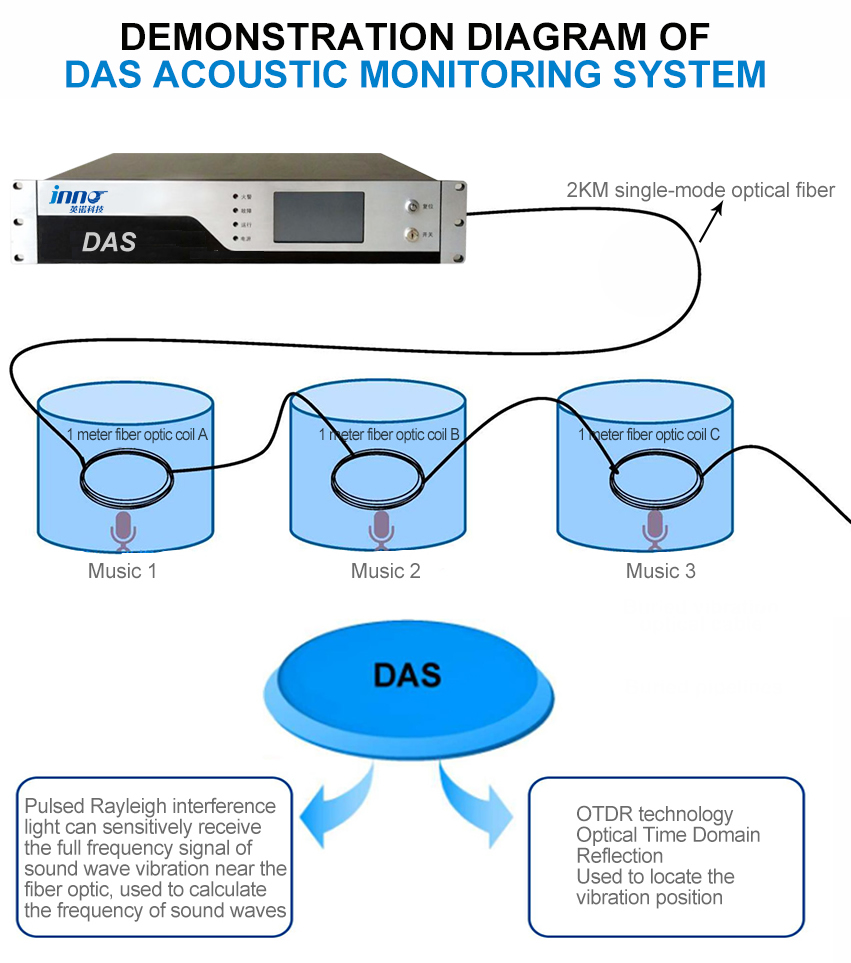
O (Sensoriamento Acústico Distribuído) is an advanced fiber optic sensing technology that converts a standard single-mode optical fiber into an array of thousands of virtual microphones. The system works by injecting short, pulsos de laser coerentes na fibra e análise da fase da luz retroespalhada Rayleigh retornando de cada ponto ao longo do cabo.
O Princípio OTDR Sensível à Fase
Os sistemas DAS usam uma técnica conhecida como reflectometria óptica no domínio do tempo sensível à fase (Φ-OTDR). À medida que o pulso do laser percorre a fibra, impurezas que ocorrem naturalmente no vidro espalham uma pequena fração da luz de volta para a fonte. Quando uma onda acústica ou vibração atinge a fibra, causa tensão localizada que muda a fase dessa luz retroespalhada. Comparando medições de fase sucessivas em cada ponto ao longo da fibra, o interrogador DAS reconstrói uma forma de onda acústica completa – capturando não apenas se um evento ocorreu, mas a assinatura sonora real do evento.
Principais capacidades da tecnologia DAS
UM Sistema de detecção de fibra óptica DAS normalmente oferece uma resposta de frequência que varia de sub-hertz a vários quilohertz, resolução espacial tão boa quanto 1 metro, e distâncias de detecção de até 50–100 km dependendo do modelo do interrogador. Porque o DAS captura dados acústicos verdadeiros, permite classificação sofisticada de sinais usando algoritmos de reconhecimento de padrões. Isto significa que o sistema consegue distinguir entre uma pessoa caminhando ao longo de uma cerca, um veículo dirigindo em uma estrada próxima, um animal roçando o cabo, e uma tentativa real de corte ou escalada – reduzindo significativamente as taxas de falsos alarmes.
3. Como ICE (Detecção de vibração distribuída) Works

ICE (Detecção de vibração distribuída) é uma tecnologia de monitoramento de fibra óptica intimamente relacionada, mas tecnicamente mais simples. Assim, DVS depende do retroespalhamento Rayleigh dentro da fibra óptica. No entanto, rather than measuring the precise phase of the returned light to reconstruct acoustic waveforms, DVS primarily analyzes the intensity changes of the backscattered signal.
Intensity-Based Detection Approach
When a vibration event occurs near the cabo de detecção de fibra óptica, it alters the interference pattern of the backscattered light, causing fluctuations in signal intensity at the corresponding location. O DVS interrogation unit monitors these intensity variations in real time and identifies the position and magnitude of the disturbance. While DVS does not capture the full acoustic waveform, it reliably detects the presence, localização, and relative strength of vibration events.
Practical Performance of DVS Systems
Um típico DVS perimeter detection system provides spatial resolution in the range of 5 para 10 meters with a sensing range of up to 40–60 km. The frequency response is generally narrower than DAS, often limited to several hundred hertz. DVS is highly effective for applications where the primary requirement is knowing that a disturbance occurred and where it happened, without the need for detailed acoustic classification. This makes it a practical, lower-cost alternative for many perimeter security scenarios.
4. Key Differences Between DAS and DVS

While DAS and DVS are both distributed fiber optic sensing technologies that use the same basic optical fiber infrastructure, they differ significantly in measurement approach, data richness, and suitability for various applications. Understanding these differences is essential for selecting the right technology for a given security requirement.
Método de medição
The most fundamental difference lies in what each system measures. DAS measures the phase of the Rayleigh backscattered light, providing a quantitative, linear representation of the acoustic field along the fiber. DVS measures the intensity of the backscattered light, providing a qualitative indication of vibration activity. Em termos práticos, DAS gives you a waveform you can listen to and analyze, while DVS gives you an alert that something happened.
Sensitivity and Resolution
DAS systems generally offer higher sensitivity and finer spatial resolution than DVS. A high-performance DAS interrogator can achieve 1-meter spatial resolution and detect nano-strain level disturbances. DVS systems typically operate with 5–10 meter resolution and require somewhat larger disturbances to trigger a reliable detection. For applications requiring precise event localization and the ability to classify low-amplitude signals, DAS is the superior choice.
Event Classification and False Alarm Reduction
Porque o DAS captura dados acústicos verdadeiros, it supports advanced event classification algorithms that can differentiate between threat and non-threat events. This is a major advantage in environments with high background noise or frequent benign activities near the sensing cable. ICE, with its intensity-based approach, has more limited classification capability and may produce higher false alarm rates in complex environments.
System Cost and Complexity
DAS interrogation units are more complex and typically more expensive than DVS units. The processing requirements for phase demodulation and waveform analysis are also higher. For projects with tight budgets or straightforward detection requirements, um DVS alarm system offers a compelling balance of performance and cost efficiency.
Frequency Response and Data Output
DAS systems provide broadband frequency response, often from below 1 Hz up to 10 kHz or more, enabling detection of a wide range of acoustic phenomena. DVS frequency response is narrower, typically sufficient for detecting mechanical vibrations but not suitable for capturing detailed acoustic signatures. The data output from DAS is substantially larger, requiring more storage and processing bandwidth.
5. Typical Applications of Sistemas de alarme de fibra óptica
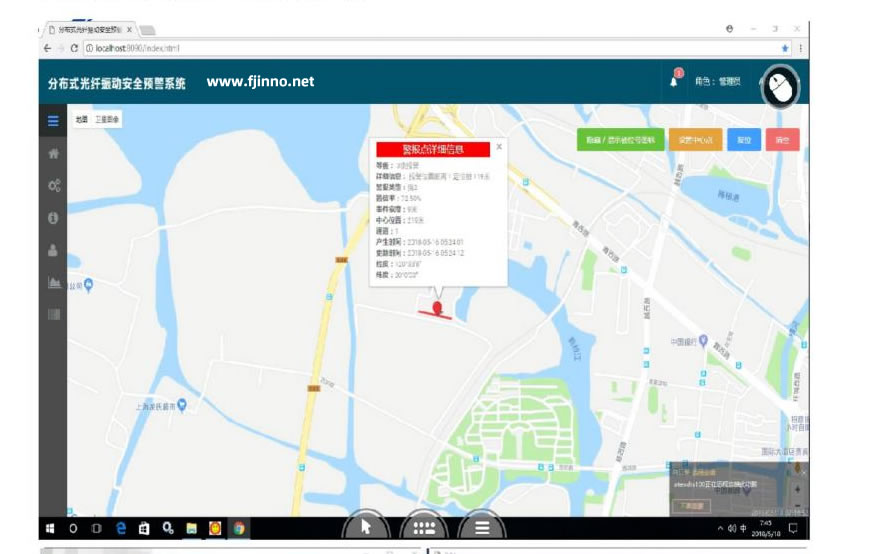
Both DAS and DVS technologies are deployed across a wide range of security and monitoring applications. The choice between them often depends on the specific requirements of each use case.
Perimeter Security and Intrusion Detection
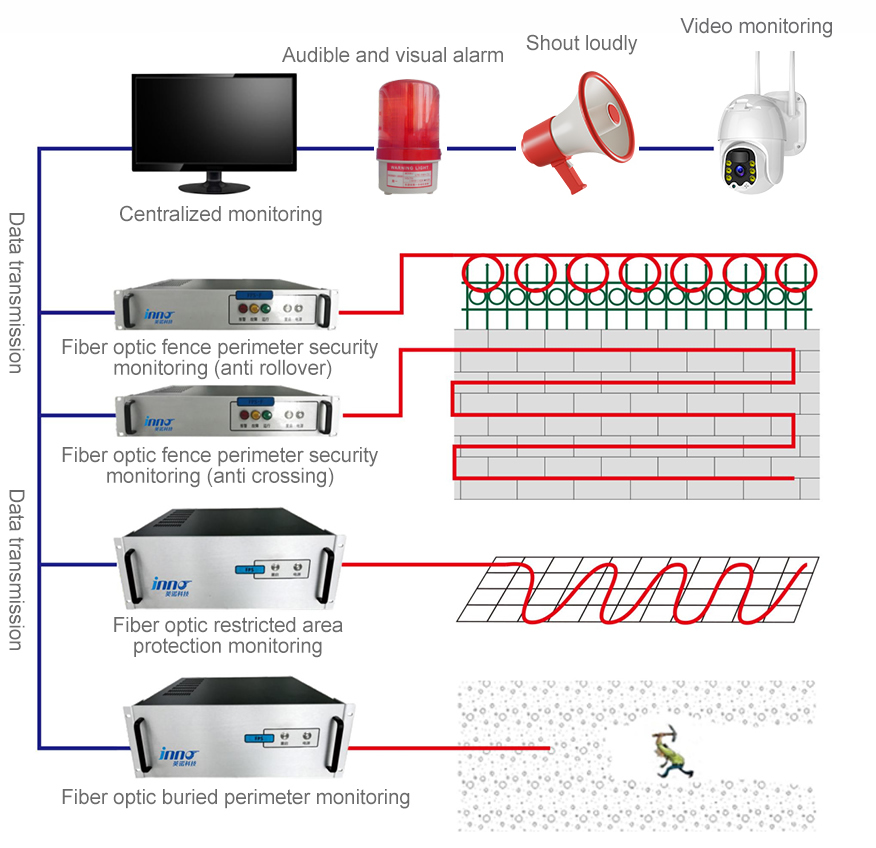
Fiber optic perimeter security systems are widely used to protect military bases, government facilities, aeroportos, centros de dados, prisões, e locais industriais. O cabo sensor normalmente é montado ou enterrado ao longo da cerca perimetral. Quando alguém tenta escalar, corte, ou quebrar a cerca, as vibrações resultantes são imediatamente detectadas e localizadas. Os sistemas baseados em DAS se destacam nesta aplicação devido à sua capacidade de classificar o tipo de atividade de intrusão, enquanto Sensores DVS montados em cerca fornecer detecção básica confiável com menor custo.
Monitoramento de pipeline e utilidades
Sistemas de monitoramento de dutos de fibra óptica use cabos DAS ou DVS instalados ao lado do óleo, gás, e tubulações de água para detectar interferências de terceiros, escavação não autorizada, vazamentos, e impactos nos equipamentos. O DAS é particularmente eficaz aqui porque pode identificar a assinatura acústica de diferentes tipos de máquinas e atividades próximas à faixa de domínio do gasoduto.
Proteção de fronteiras e infraestruturas críticas
Longo alcance distributed fiber optic alarm systems are deployed along national borders, railway lines, highway corridors, and around power stations and substations. The ability to monitor tens of kilometers of perimeter from a single point with no active electronics in the field makes fiber optic technology uniquely suited to protecting remote and extended infrastructure.
Telecommunications Cable Security
Fiber optic cables that form part of telecommunications networks can be monitored using DAS or DVS to detect tampering, unauthorized access attempts, or accidental damage from nearby construction activities. This application leverages existing fiber optic cable infrastructure without requiring additional sensing cables.
6. How to Choose Between DAS and DVS
Selecting the right technology for a fiber optic alarm system requires careful evaluation of several factors related to the project environment, performance expectations, e restrições orçamentárias.
Define Your Detection Requirements
Start by determining what types of events you need to detect and whether event classification is important. If you need to distinguish between different intrusion types — such as walking, escavação, vehicle movement, and cable cutting — a DAS-based alarm system with acoustic classification capability is the appropriate choice. If your primary need is simple zone-based alerting when any significant vibration occurs, um Sistema DVS will meet the requirement effectively.
Consider the Operating Environment
In environments with high background noise from traffic, industrial machinery, or weather, DAS provides better false alarm filtering due to its waveform-level analysis. In quieter, more controlled environments such as fenced compounds or indoor facilities, DVS can perform well without the added complexity of acoustic processing.
Evaluate Distance and Resolution Needs
For very long monitoring distances exceeding 50 km or requirements for meter-level spatial precision, DAS is generally the better-suited technology. For shorter perimeters under 20 km where 5–10 meter localization accuracy is acceptable, DVS offers a practical and economical solution.
Orçamento e custo total de propriedade
The interrogation unit is the most significant cost component. DAS units carry a higher upfront price, but may reduce long-term operational costs through fewer false alarms and lower verification workload. DVS units are less expensive initially and simpler to maintain, making them attractive for budget-sensitive projects.
7. Installation and Deployment Considerations
Proper installation is critical to the performance of any distributed fiber optic alarm system. Several key factors should be addressed during the planning and deployment phases.
Cable Selection and Routing
Both DAS and DVS systems can operate with standard single-mode cabo de fibra óptica, although purpose-designed sensing cables with enhanced sensitivity coatings or ruggedized jackets are recommended for outdoor and buried installations. The cable route should be planned to maintain good acoustic coupling with the ground or structure being monitored while avoiding excessive exposure to environmental noise sources.
Mounting Methods
For fence-mounted applications, o cabo de detecção de fibra óptica is typically attached directly to the fence fabric using cable ties or specialized clips at regular intervals. For buried applications, the cable is placed in a sand bed at a depth of 20–40 cm to ensure reliable ground coupling. In some applications, the cable is installed inside existing conduit or duct infrastructure.
Interrogator Placement and Connectivity
O DAS or DVS interrogation unit is installed in a secure, climate-controlled location at one end of the fiber route. It connects to the monitoring network via Ethernet or fiber backhaul. Fonte de energia, proteção ambiental, and physical security of the interrogator site should be carefully planned.
Zone Configuration and Alarm Thresholds
Após a instalação, the sensing fiber is divided into logical alarm zones, each with independently configurable detection thresholds and sensitivity settings. This allows operators to adapt the system to local conditions, reduce nuisance alarms in noisy zones, and increase sensitivity in critical areas. O ajuste adequado da zona durante o comissionamento é uma das etapas mais importantes para alcançar um desempenho confiável do sistema.
8. Advantages and Limitations of Fiber Optic Alarm Systems

Vantagens
Sistemas de alarme de fibra óptica oferecem várias vantagens atraentes sobre as tecnologias convencionais de segurança eletrônica. O cabo de detecção é completamente passivo, não requer energia elétrica no campo, o que elimina a necessidade de fontes de alimentação de campo, baterias, ou painéis solares. A fibra é imune a interferência eletromagnética, tornando-o adequado para implantação perto de linhas de energia de alta tensão, subestações, e ambientes industriais pesados. Um único cabo de fibra pode monitorar distâncias extremamente longas – até 100 km — de um ponto central de interrogatório, reduzindo drasticamente a quantidade de equipamentos e infraestrutura em comparação com soluções de sensores pontuais. O sistema fornece continuamente, detecção distribuída sem lacunas entre os sensores, and it delivers real-time localization of events with meter-level accuracy in DAS systems.
Limitações
No technology is without limitations. Fiber optic sensing cables can be sensitive to environmental factors such as wind, heavy rain, and temperature fluctuations, which may increase background noise levels and require careful threshold tuning. The interrogation units represent a significant single point of investment, and spares planning should be considered for critical installations. Fiber splices and connectors along the cable route can introduce signal loss and should be minimized. Adicionalmente, proper installation and commissioning require specialized knowledge, and ongoing performance depends on maintaining cable integrity over time.
9. Perguntas frequentes (Perguntas frequentes)
1º trimestre: What is the maximum monitoring distance of a fiber optic alarm system?
Most modern DAS and DVS systems can monitor fiber optic cables over distances of 40 para 100 kilometers from a single interrogation unit. The exact range depends on the interrogator model, fiber quality, and required spatial resolution. For very long perimeters, multiple interrogators can be deployed to extend total coverage.
2º trimestre: Can fiber optic alarm systems work with existing fiber optic cables?
Sim. Both DAS and DVS technologies can operate on standard single-mode fiber optic cables, including spare fibers within existing telecommunications or utility cable infrastructure. No entanto, purpose-designed sensing cables may provide better sensitivity and reliability for dedicated security applications.
3º trimestre: How does a DAS system reduce false alarms?
DAS captures the full acoustic waveform of detected events, which allows the system to apply signal classification algorithms. These algorithms analyze the frequency content, duração, and pattern of each event to differentiate genuine intrusion attempts from benign activities such as animal movement, vento, and vehicle traffic.
4º trimestre: Is DVS less accurate than DAS?
DVS typically offers coarser spatial resolution than DAS — around 5 para 10 meters compared to 1 meter for DAS. No entanto, DVS is highly reliable for detecting and locating vibration events. The trade-off is in classification depth rather than detection reliability. For many applications, DVS accuracy is fully adequate.
Q5: What types of threats can a fiber optic perimeter alarm detect?
Fiber optic alarm systems can detect a wide range of threats including fence climbing, fence cutting, digging or tunneling near the cable, walking or running along the perimeter, vehicle approach and impact, and cable tampering. DAS systems can further classify these events by their acoustic signature.
Q6: Do fiber optic alarm systems require power along the sensing cable?
Não. The fiber optic sensing cable is entirely passive and requires no electrical power along its length. All active electronics are contained in the interrogation unit at the control center. This is one of the most significant advantages of distributed fiber optic sensing over conventional electronic alarm systems.
Q7: How are fiber optic alarm systems affected by weather?
Strong wind, heavy rain, and hail can generate vibrations on exposed fence-mounted cables, potentially increasing background noise levels. Modern DAS and DVS systems use adaptive filtering and threshold adjustment to minimize weather-related false alarms. Buried cable installations are largely unaffected by surface weather conditions.
P8: Can DAS and DVS systems be integrated with CCTV and access control?
Sim. Most fiber optic alarm systems provide standard output interfaces and support integration with video management systems, Plataformas SCADA, access control systems, and centralized security management software. Quando um alarme é acionado, the system can automatically direct PTZ cameras to the event location for visual verification.
Q9: What maintenance does a fiber optic alarm system require?
Fiber optic alarm systems require relatively low maintenance. Routine tasks include periodic inspection of the cable route for physical damage, checking fiber splice and connector quality using an OTDR, verifying interrogator performance, and reviewing alarm thresholds based on seasonal environmental changes.
Q10: How long does a fiber optic sensing cable last in outdoor environments?
High-quality outdoor-rated fiber optic cables with appropriate jacket materials are designed for service lives of 20 para 30 anos ou mais. The actual lifespan depends on environmental conditions, qualidade de instalação, and protection from mechanical damage. UV-resistant and armored cable options are available for harsh environments.
Isenção de responsabilidade: As informações fornecidas neste artigo são apenas para fins informativos e educacionais gerais. Embora todos os esforços tenham sido feitos para garantir a precisão, FJINNO (www.fjinno.net) makes no warranties or representations regarding the completeness, confiabilidade, ou adequação do conteúdo para qualquer aplicação específica. Especificações do produto, performance parameters, and technical details may vary depending on specific models, configurações, e condições de operação. Readers are advised to consult directly with qualified engineers and system integrators before making any purchasing or deployment decisions. FJINNO shall not be held liable for any loss, dano, or consequence arising from the use of or reliance on the information contained herein.

Sensor de temperatura de fibra óptica, Sistema de monitoramento inteligente, Fabricante distribuído de fibra óptica na China
 |
 |
 |