 Sensores de temperatura de fibra óptica INNO ,sistemas de monitoramento de temperatura.
Sensores de temperatura de fibra óptica fluorescentes tornaram-se uma das melhores opções para medição de temperatura devido às suas vantagens, como isolamento seguro, alta precisão, resposta rápida, resistência de alta tensão, resistência à interferência eletromagnética, estabilidade a longo prazo, ampla adaptabilidade ambiental, e flexibilidade.
1、 Princípio de funcionamento de sensor de temperatura de fibra óptica fluorescente
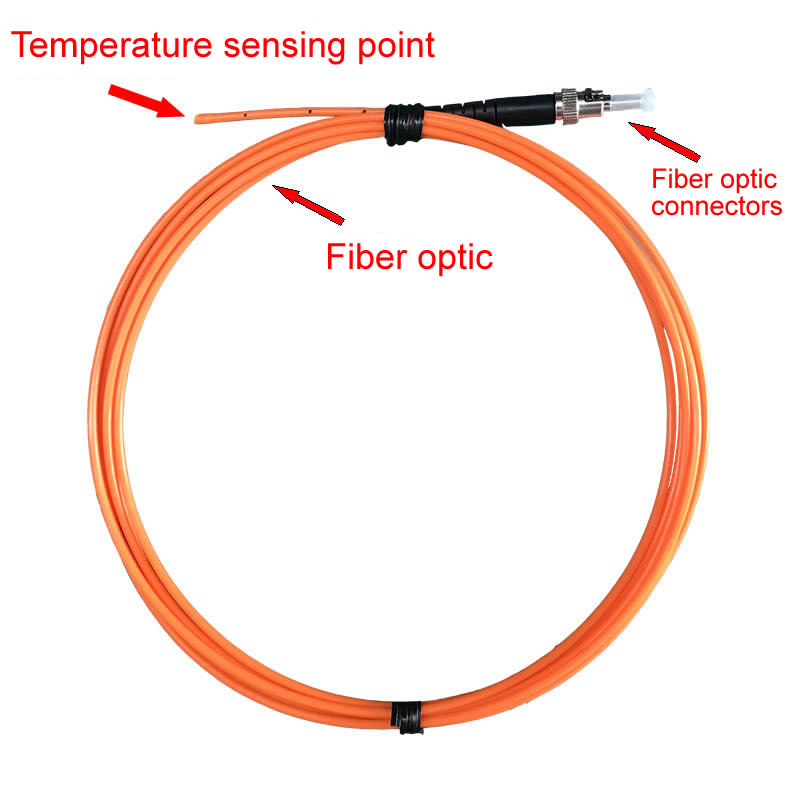
Fluorescente sensor de temperatura de fibra óptica é um sensor de medição de temperatura baseado no princípio da fluorescência. Seu princípio de funcionamento é baseado nas características dos materiais fluorescentes, que são materiais que podem absorver um determinado comprimento de onda de luz e emitir comprimentos de onda de luz mais longos. Um sensor de temperatura de fibra óptica fluorescente típico inclui várias peças, como fonte de luz, fibra óptica, material fluorescente, e espectrômetro. Primeiramente, a fonte de luz gera luz de excitação de um determinado comprimento de onda, que é transmitido ao material fluorescente através de fibras ópticas. Depois de absorver a luz de excitação, materiais fluorescentes emitem sinais fluorescentes com comprimentos de onda específicos, que são então transmitidos de volta ao espectrômetro para detecção através de fibras ópticas. Quando a temperatura muda, as características de fluorescência dos materiais fluorescentes mudarão, que podem ser mudanças na intensidade da fluorescência ou mudanças no comprimento de onda da fluorescência. O valor da temperatura pode ser determinado medindo a intensidade ou comprimento de onda do sinal de fluorescência. Além disso, há um sensor de temperatura de fibra óptica fluorescente que determina a temperatura ambiente medindo a duração da vida útil do brilho residual da fluorescência. Este tipo de sensor consiste em uma fibra óptica multimodo e um objeto fluorescente (filme) installed on top of it. The fluorescent substance is excited by light of a certain wavelength (espectro de excitação) and emits fluorescence energy. Após a excitação ser cancelada, the duration of the fluorescence afterglow depends on the characteristics of the fluorescent substance, environmental temperature, e outros fatores. Esta fluorescência excitada geralmente decai exponencialmente, e a constante de tempo de decaimento é o tempo de vida da fluorescência ou o tempo de pós-luminescência da fluorescência (ns). Em diferentes temperaturas ambientais, the fluorescence afterglow decay is different, and the temperature can be determined by measuring the fluorescence afterglow lifetime.
2、 Common types and characteristics of temperature sensors
2.1 Termopar
working principle
A thermocouple is a sensor composed of two different metals, which uses the electromotive force generated by the temperature changes of the two metals to measure temperature. Por exemplo, the common J-type thermocouple is made of iron and constantan, and a thermoelectric potential is generated when the temperatures at both ends of the thermocouple are different (temperature difference).
característica
Ampla faixa de medição de temperatura: can be extended to above 2300 ℃, suitable for high-temperature detection fields such as ovens, water heaters, fornos, testing equipment, and other industrial processes.
Low sensitivity: on the order of several tens of microvolts per degree Celsius, and within the operating range, nonlinearity in the temperature to voltage transfer function often requires compensation circuits or lookup tables.
Low thermal quality: This allows it to quickly respond to temperature changes.
Simple structure and easy to use: Thermocouples are commonly used contact temperature measuring devices in industry, with stable performance and the ability to transmit signals over long distances.
2.2 Termistor
working principle
Thermistor is a type of resistive element whose resistance value varies with temperature. Common thermistor materials include platinum (Pt100, Pt1000) and nickel (Ni100, Ni1000).
característica
High accuracy and linearity (partially): Por exemplo, platinum thermistors have relatively good accuracy and linearity, but the overall temperature curve of thermistors has poorer linear characteristics compared to RTDs. No entanto, there are also high-precision products on the market that are of good quality and affordable.
Multiple types: can meet different needs and is suitable for a wide temperature range.
Alta sensibilidade (partial): It has application value in some simple measurement or threshold detection scenarios that require high sensitivity, but if you want to improve measurement accuracy, you can consider using a thermistor array, but this will reduce sensitivity.
2.3 Silicon carbide sensor
working principle
Using the resistance characteristics of silicon carbide materials to measure temperature.
característica
Resistência a altas temperaturas: suitable for high-temperature measurement scenarios.
Low heat capacity: With a fast response speed, it is suitable for applications that require rapid response.
2.4 Thermal resistance
working principle
Thermistor is also a temperature sensitive resistance element, and its resistance value changes with temperature. Commonly used materials for thermistor include nickel copper (NiCu) and platinum rhodium (PtRh).
característica
Alta precisão: widely used in the fields of precise measurement and temperature control.
Greater sensitivity: able to perceive temperature changes more sensitively.
2.5 Sensor de temperatura infravermelho
working principle
Using infrared radiation to detect the surface temperature of a target object, measuring the surface temperature of the object by sensing the infrared radiation energy on its surface.
característica
Non contact measurement: It does not require direct contact with objects and can be widely used in industrial control, monitoramento de temperatura, equipamento médico, home appliances, and environmental monitoring fields for accurate measurement and monitoring of temperature changes.
Affected by the surface characteristics of the object: por exemplo, the emissivity and other surface characteristics of the object can affect the accuracy of the measurement.
2.6 Sensor de temperatura integrado
working principle
Integrate temperature sensing components, circuitos de expansão, circuitos de compensação, etc.. onto a very small chip.
característica
Boa linearidade: There is a good linear relationship between the output signal and temperature.
Resposta rápida: able to quickly respond to temperature changes.
Export standardization: easy to use and integrate into various devices.
2.7 Expanded thermometer
working principle
Made based on the principle of thermal expansion and contraction of objects.
característica
Commonly used for measuring temperature changes over a large range: used in scenarios where accuracy is not extremely high and a large temperature span needs to be measured.
2.8 Sensor de pressão e temperatura
working principle
A multifunctional sensor that can simultaneously measure temperature and pressure, utilizing a certain physical relationship between pressure and temperature to achieve temperature measurement (the specific relationship varies depending on the sensor design).
característica
Multifunctionality: It has unique advantages in scenarios where temperature and pressure need to be measured simultaneously, such as in some chemical processes or fluid systems.
3、 Performance comparison of different temperature sensors
3.1 Faixa de medição
Termopar
The working temperature range can be extended to above 2300 ℃, and K-type thermocouples, J-type thermocouples, etc.. perform well in high-temperature measurement and are suitable for high-temperature industrial environments such as metallurgy and glass manufacturing.
Termistor
The working temperature range of different types of thermistors varies, and they are generally suitable for a wider temperature range. No entanto, em comparação com termopares, their high-temperature performance is limited. Por exemplo, common platinum thermistors have a relatively wide operating temperature range, but may not be as suitable as thermocouples in ultra-high temperature environments.
Silicon carbide sensor
It is mainly suitable for high temperature measurement, and its high temperature resistance makes it more advantageous than many other sensors in high temperature environments. No entanto, its measurement accuracy or applicability in the low temperature range may not be as good as some other sensors.
Thermal resistance
Por exemplo, platinum resistance thermometers can be used for temperature measurement between -200 ℃ and+750 ℃, providing high accuracy within this range. They are suitable for high-precision measurement scenarios at medium and low temperatures, such as temperature measurement in laboratory environments or measurement in the medium and low temperature range of some industrial processes.
Sensor de temperatura infravermelho
The measurable temperature range is wide, but there may be a decrease in accuracy at extremely low or high temperatures. Its measurement range is limited by the infrared radiation characteristics of the object and the performance of the sensor itself, and is generally suitable for temperature monitoring in conventional industrial and living environments.
Sensor de temperatura integrado
The working temperature range is usually from -55 ° C to+150 ° C (a few special IC sensors can work up to+200 ° C), suitable for general electronic devices, wearable devices, and other scenarios where temperature range requirements are not particularly high.
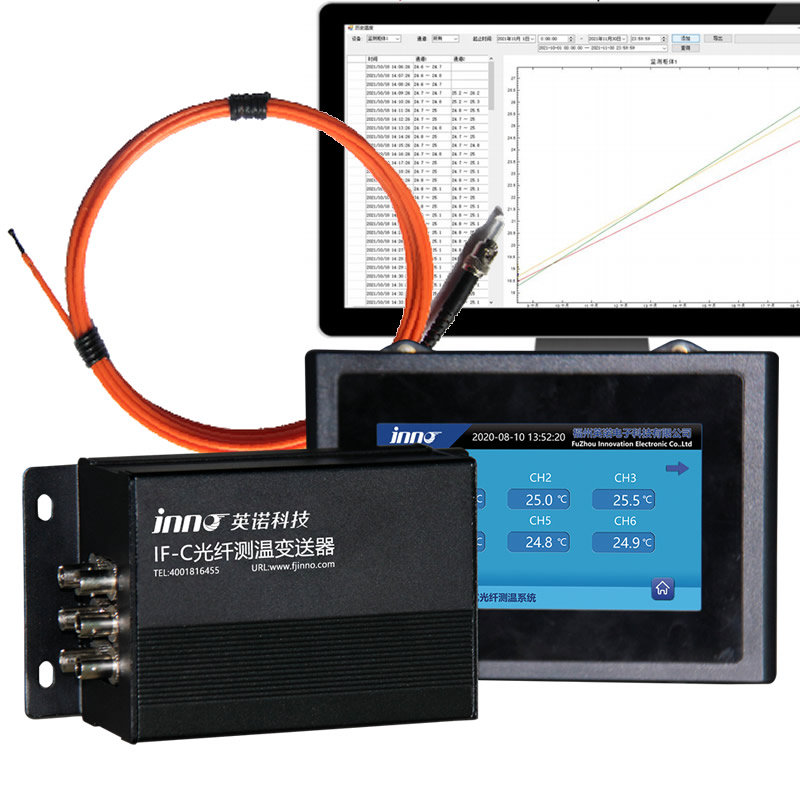
Sensor de temperatura de fibra óptica fluorescente
The applicable environmental temperature range is wide, from low to minus Baidu to high to several hundred degrees, which can meet the measurement needs of various temperature environments, such as temperature monitoring in some low-temperature physics experimental environments and high-temperature industrial reaction environments.
3.2 Linearity
Termopar
The temperature to voltage transfer function of thermocouples exhibits nonlinearity and requires compensation circuits or lookup tables to correct the nonlinearity.
Termistor
The relationship between the resistance of a thermistor and its temperature is very nonlinear, and its linearity is relatively poor. No entanto, it can be used in some simple measurement scenarios that do not require high linearity.
Silicon carbide sensor
There is no specific mention of its linearity, but due to the use of resistance characteristics to measure temperature, there may be some nonlinearity. No entanto, the main advantages in high-temperature measurement are high temperature resistance and fast response.
Thermal resistance
The response of thermistors (such as RTDs) is almost linear, but there is also some deviation. No entanto, compared to thermistors, they have better linearity and are more advantageous in high-precision measurement scenarios.
Sensor de temperatura infravermelho
Linearity mainly depends on the design and calibration of the sensor. De um modo geral, it can provide relatively stable measurements within its normal operating range, but may be affected by factors such as surface characteristics of the object, resulting in certain nonlinearity.
Sensor de temperatura integrado
It has good linearity, integrating temperature sensing elements, circuitos de expansão, circuitos de compensação, etc.. on a small chip, which helps to improve linearity and make the relationship between output signal and temperature closer to linearity.
Sensor de temperatura de fibra óptica fluorescente
O sensor de fibra óptica fluorescente do tipo intensidade é afetado pela microflexão, acoplamento, dispersão, e reflexão traseira da fibra, causing intensity disturbances and affecting linearity to a certain extent; Fluorescence lifetime sensors are relatively more stable because the relationship between fluorescence lifetime and temperature is essentially intrinsic, independent of the intensity of light, and has certain advantages in this regard.
3.3 Requisitos de calibração
Termopar
It is necessary to compensate for the nonlinearity of thermocouples, usually using compensation circuits or lookup tables. Regular calibration may be required during use to ensure measurement accuracy, especially in high-precision measurement scenarios.
Termistor
If we want to improve measurement accuracy, it may be necessary to handle its nonlinearity, such as using thermistor arrays, and calibration may be required according to specific application scenarios, especially in situations where high accuracy is required.
Silicon carbide sensor
The reference material does not explicitly mention calibration requirements, but generally speaking, a calibração também pode ser necessária para cenários de medição de alta precisão para garantir a precisão da medição.
Thermal resistance
Por exemplo, quando o RTD é usado em aplicações de alta precisão, pode ser necessário digitalizar os valores de resistência medidos e usar a tabela de dados armazenada no microcontrolador para corrigir a não linearidade com base na curva de temperatura de resistência calibrada. Calibração regular também é necessária.
Sensor de temperatura infravermelho
A calibração é necessária para garantir a precisão das medições, especialmente ao medir a temperatura da superfície de diferentes tipos de objetos sob diferentes condições ambientais. A calibração pode melhorar a precisão da medição.
Sensor de temperatura integrado
Não há necessidade de calibração adicional durante o uso de sensores IC integrados, o que é uma de suas vantagens e adequado para alguns cenários com baixos requisitos de calibração, como produtos vestíveis.
Sensor de temperatura de fibra óptica fluorescente
Fluorescence lifetime sensors can be made into self calibrating fiber optic temperature sensors because the relationship between fluorescence lifetime and temperature is intrinsic and independent of light intensity; The intensity type may be affected by the transmission characteristics of optical fibers and may require calibration in some cases, but overall the calibration requirements are relatively low.
3.4 Velocidade de resposta
Termopar
Thermocouples have relatively low sensitivity and low thermal mass, and can respond quickly to temperature changes. They are suitable for industrial scenarios that require rapid sensing of temperature changes, such as temperature monitoring in kilns.
Termistor
The response speed depends on factors such as the material and structure of the thermistor. De um modo geral, it can respond quickly to temperature changes, especially in scenarios where temperature thresholds are quickly detected, and it performs well.
Silicon carbide sensor
Due to its low thermal capacity and fast response speed, it has advantages in high-temperature measurement scenarios that require rapid response, such as temperature monitoring in certain high-temperature chemical reaction processes.
Thermal resistance
The response speed of thermal resistance is relatively fast, which can reflect temperature changes in a timely manner and meet the requirements of fast response in the field of temperature control.
Sensor de temperatura infravermelho
Velocidade de resposta rápida, capable of real-time measurement of surface temperature of objects, widely used in scenarios where rapid monitoring of temperature changes is required, such as surface temperature monitoring of industrial equipment or temperature screening of personnel.
Sensor de temperatura integrado
It has the characteristic of fast response, thanks to its integrated design, which can quickly respond to temperature changes and is suitable for scenarios such as electronic devices that require response speed.
Sensor de temperatura de fibra óptica fluorescente
Velocidade de resposta rápida, able to monitor temperature changes in real time and respond immediately, can be used in scenarios that require high real-time temperature changes, such as temperature monitoring in some industrial process monitoring.
4、 Advantages of Fluorescent Fiber Optic Temperature Sensor
4.1 Alta precisão
Os materiais fluorescentes são particularmente sensíveis às mudanças de temperatura, fazendo com que os sensores de temperatura de fibra fluorescente tenham alta precisão de medição. Por exemplo, in laboratory research or industrial process control that require extremely high temperature accuracy, it is possible to accurately measure temperature changes.
Resposta rápida
Can monitor temperature changes in real-time and respond immediately. Em reações químicas, é necessário obter rapidamente mudanças de temperatura para controle da reação, e sensores de temperatura de fibra óptica fluorescentes podem atender a esse requisito.
4.2 Medição de resistência de alta tensão
O sensor de temperatura de fibra óptica fluorescente não possui contato elétrico, pode suportar alta tensão de 100KV, é isolado com segurança, e pode ser instalado em quadros de alta tensão para medir a temperatura de barramentos e contatos.
4.3 Forte capacidade anti-interferência
Não é afetado por sinais de interferência e pode funcionar normalmente em ambientes eletromagnéticos complexos. A medição precisa da temperatura ainda pode ser realizada em torno de equipamentos de energia de alta tensão ou em ambientes industriais com forte interferência eletromagnética, como subestações e subestações de alta tensão.
4.4 Estabilidade a longo prazo
Materiais fluorescentes têm forte durabilidade e estabilidade, e sensores podem manter estabilidade de alto desempenho durante o uso a longo prazo. For some scenarios that require long-term continuous temperature monitoring, such as temperature monitoring of industrial equipment that operates for a long time, stability is an important advantage.
4.5 Wide applicable environment
Suitable for a wide range of environmental temperatures, from low to minus Baidu to high to several hundred degrees. It can be used in both low-temperature freezing environments and high-temperature industrial furnace environments.
4.6 Segurança Intrínseca
Fiber optic itself is not charged and has inherent safety characteristics. It is very safe to use in hazardous environments such as flammable and explosive environments, such as temperature monitoring in explosion-proof industrial environments such as petrochemicals and coal.
4.7 Self calibration (some types)
Fluorescence lifetime sensors can be made into self calibrating fiber optic temperature sensors because the relationship between fluorescence lifetime and temperature is essentially intrinsic and independent of the intensity of light, reducing the frequency and complexity of calibration.
5、 How to choose the best temperature sensor in practical applications
5.1 Clarify measurement requirements
Faixa de medição: Primeiro, determine the temperature range that needs to be measured. If it is a high-temperature environment, such as furnaces in the metallurgical industry, thermocouples or silicon carbide sensors may be better choices; If it is in the medium to low temperature range, such as general indoor temperature monitoring or routine laboratory temperature control, thermal resistance or integrated temperature sensors may be more suitable. Por exemplo, in temperature measurement between -200 ℃ and+750 ℃, thermistor can provide high accuracy; In high-temperature measurements above 850 ℃, thermocouples are more suitable.
5.2 Requisitos de precisão
: For high-precision scenarios such as precise temperature measurement in scientific research or high-precision industrial process control, sensors with high accuracy such as thermal resistors and fluorescent fiber temperature sensors are given priority consideration. In some ordinary industrial environments or daily living environments where precision requirements are not particularly high, such as indoor air conditioning temperature control, thermistors or infrared temperature sensors may be sufficient to meet the needs.
5.3 Tempo de resposta
If the application requires rapid response to temperature changes, such as in temperature monitoring of some chemical reaction processes or high-speed moving equipment, termopares, sensores de carboneto de silício, sensores de temperatura de fibra fluorescente, e outros sensores com tempos de resposta rápidos são escolhas melhores. Em alguns cenários onde a resposta às mudanças de temperatura não é particularmente urgente, como monitoramento de temperatura em armazéns, sensores com velocidades de resposta ligeiramente mais lentas também podem atender aos requisitos.
Considere fatores ambientais
5.4 Ambiente Eletromagnético
: Em ambientes com forte interferência eletromagnética, como em torno de subestações e equipamentos de energia de alta tensão, sensores com forte resistência à interferência eletromagnética, como sensores de temperatura de fibra fluorescente e termopares, são preferidos. Em cenários onde o ambiente eletromagnético é geralmente fraco, como medição de temperatura em ambientes domésticos comuns, vários sensores podem ser usados normalmente.
5.5 Ambiente Químico
: If it is in an environment with corrosive gases or chemicals, such as chemical production workshops, sensors with good corrosion resistance such as fluorescent fiber temperature sensors and thermal resistors are more suitable. For ordinary environments, such as office environments, the corrosion resistance of sensors is not the primary consideration.
5.6 Space limitations
: When the measurement space is limited, such as temperature measurement inside some small electronic devices, small-sized sensors such as integrated temperature sensors and small thermistors have more advantages. In large equipment or spacious environments such as large warehouses or outdoor temperature monitoring, the size of sensors is not the main limiting factor, and sensors that are more suitable for measurement requirements can be selected.
5.7 Análise de custo-benefício
Os fatores de custo precisam ser considerados ao atender aos requisitos ambientais e de medição. Se o orçamento for limitado, sensores de custo relativamente baixo, como termistores e termopares, podem ser preferidos; Se o custo não for particularmente sensível e for dada mais ênfase ao desempenho e à estabilidade da medição, sensores de temperatura de fibra óptica fluorescentes, resistores térmicos de alta precisão, etc.. podem ser melhores escolhas. Por exemplo, em alguma produção industrial em grande escala, se um grande número de sensores de temperatura precisar ser instalado, termopares ou termistores de baixo custo podem ser mais econômicos; Em alguns cenários industriais especiais que exigem segurança e precisão extremamente altas, como monitoramento de temperatura em usinas nucleares, mesmo que o custo seja alto, sensores de alto desempenho, como sensores de temperatura de fibra fluorescente, ainda são escolhidos.
5.8 Confiabilidade e Estabilidade
For applications that require long-term continuous operation, such as long-term temperature monitoring of large industrial equipment or long-term environmental temperature monitoring stations, the reliability and stability of sensors are crucial. Sensores de temperatura de fibra óptica fluorescentes, resistores térmicos, and other sensors with high stability are better choices.

Sensor de temperatura de fibra óptica, Sistema de monitoramento inteligente, Fabricante distribuído de fibra óptica na China
 |
 |
 |