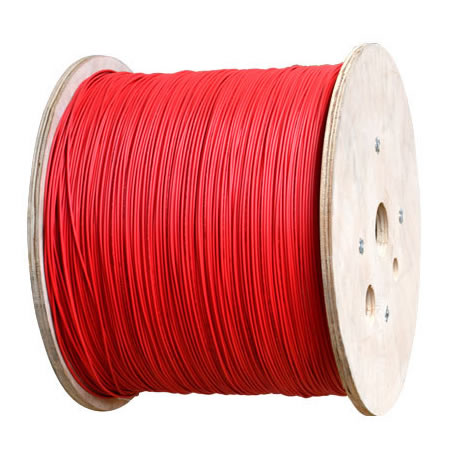
Sensores de temperatura de fibra óptica INNO ,sistemas de monitoramento de temperatura.

Sensoriamento Acústico Distribuído (O) é um método de monitoramento inovador baseado em tecnologia de detecção de fibra óptica. O sistema DAS usa fibra óptica como meio de detecção e analisa o sinal de espalhamento Rayleigh retroespalhado de pulsos de luz durante sua propagação na fibra, alcançar monitoramento contínuo e em tempo real dos sinais acústicos no ambiente circundante da fibra. Comparado com sensores acústicos tradicionais, Os sistemas DAS têm vantagens únicas, como ampla cobertura, alta sensibilidade, e forte desempenho em tempo real. They are increasingly widely used in fields such as oil and gas pipeline monitoring, segurança perimetral, railway safety, and earthquake monitoring. This article will elaborate on the basic principles, key technical parameters, and typical application scope of the DAS system in detail.
Basic Principles
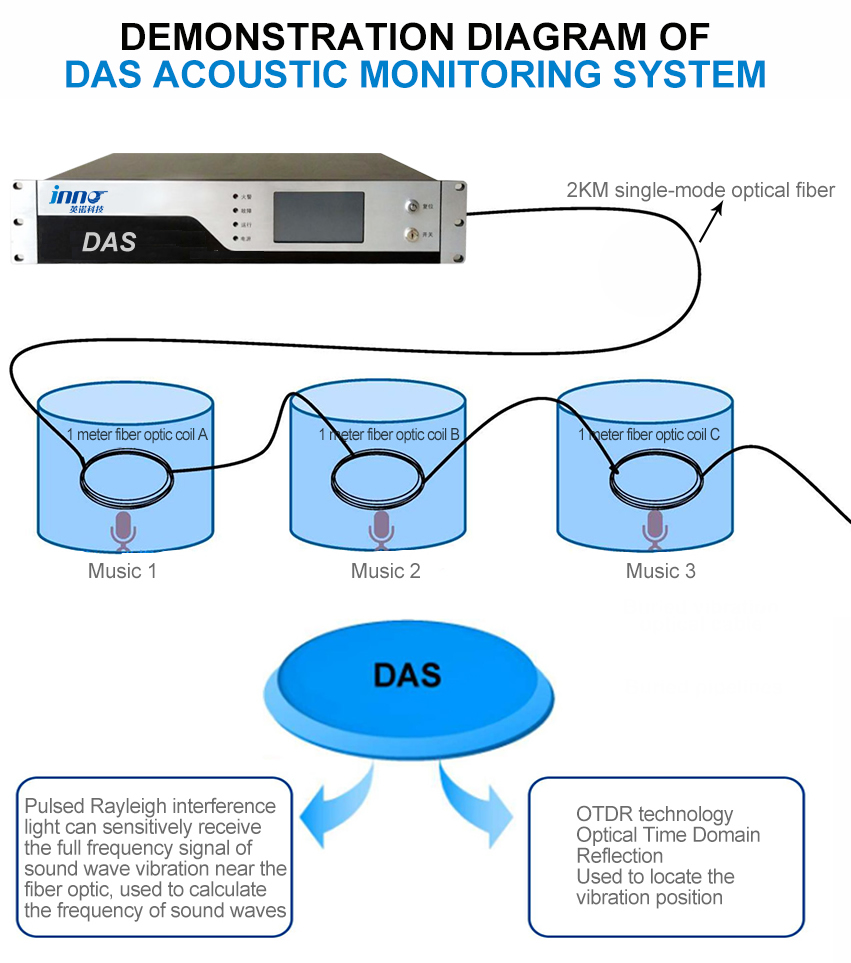
The core principle of the DAS system is to use optical fibers as distributed sensors, analyze the backscattering effect of light pulses during propagation in optical fibers, and extract acoustic information of the surrounding environment of the optical fibers. The basic working process can be summarized as the following steps:
Optical pulse emission: The pulse laser in the system emits narrow pulse width, high-power optical pulses to the fiber at a certain frequency.
Espalhamento Rayleigh: When light pulses propagate in optical fibers, they are affected by the density fluctuations of the fiber material, resulting in Rayleigh scattering effects. When optical fibers are disturbed by sound waves, the phase of scattered light will change.
Backward scattered light detection: A portion of the scattered light will return along the original path, be received by the photodetector, and converted into an electrical signal.
Time domain analysis: Based on the speed of light and pulse emission time, the fiber position corresponding to scattered light can be determined. Through time-domain analysis, achieve spatial positioning along the optical fiber.
Coherent demodulation: The backscattered photoelectric signal contains phase change information caused by sound waves. Using coherent demodulation technology to extract the phase change related to sound waves.
Frequency domain analysis: Execute a transformada de Fourier no sinal de mudança de fase obtido da demodulação para obter informações do espectro de frequência acústica em diferentes posições.
Através das etapas acima, O sistema DAS da Huaguang Tianrui pode obter extração e análise contínua e distribuída de sinais acústicos ao longo do caminho da fibra óptica. Quanto mais forte for o distúrbio acústico na fibra, quanto maior for a mudança de fase da luz espalhada, e quanto maior a amplitude do sinal demodulado. Portanto, analisando as características de amplitude e frequência do sinal demodulado, é possível detectar e localizar o som ao redor do ambiente de fibra óptica.

Principais parâmetros técnicos
Os indicadores de desempenho do sistema DAS incluem principalmente os seguintes aspectos:
Resolução espacial: The minimum distance between sound source positions that the system can distinguish, usually within the range of 1-10 metros. High spatial resolution means more precise sound source localization capability.
Sensibilidade: characterizes the minimum sound pressure level that the system can detect. High sensitivity means being able to capture weak sound signals. A typical SR-DAS system has a sensitivity of up to -180dB and weighs 20 μ Pa.
Faixa de resposta de frequência: The frequency range of sound waves that the DAS system can detect. The typical frequency response range is 1Hz-10kHz, which can cover most sound monitoring needs.
Distância de medição: The length of fiber optic sensing that a single DAS system can cover. The typical measurement distance can reach 10-50 quilômetros, meeting the requirements of long-distance distributed monitoring.
Taxa de amostragem: characterizes the number of acquisition points of acoustic signals per unit time. A high sampling rate means higher time resolution and signal restoration accuracy. The typical sampling rate can reach 1-100kHz.
Precisão de posicionamento: characterizes the error range of sound source position measurement. High positioning accuracy is crucial for accurately identifying sound sources. The typical positioning accuracy can reach ± 1-5 metros.
In addition to the above technical indicators, the reliability, estabilidade, desempenho em tempo real, and other factors of the DAS system are also important aspects for evaluating its performance. The current research focus is to continuously improve the comprehensive performance of DAS systems by optimizing optical design, algoritmos de processamento de sinal, etc..
Escopo de aplicação de fibra óptica distribuída O sistema
(1) Cable trench/oil and gas pipeline anti external rupture monitoring
Through fiber optic vibration sensing technology, when external forces such as excavators vibrate near cable trenches/oil and gas pipelines with sensing fibers, DAS can provide early warning and inform of the location of the alarm event.
(2) Monitoring of Gas Pressure Fracturing Acoustic Vibration Process in Oil and Shale
The oil well casing may leak, and there may be oil-water stratification and other geological structural changes underground. By laying sensing optical cables along the casing in the oil well, DAS can monitor the sound wave vibration at any position underground in real time.
(3) Pipeline leakage monitoring and surrounding security
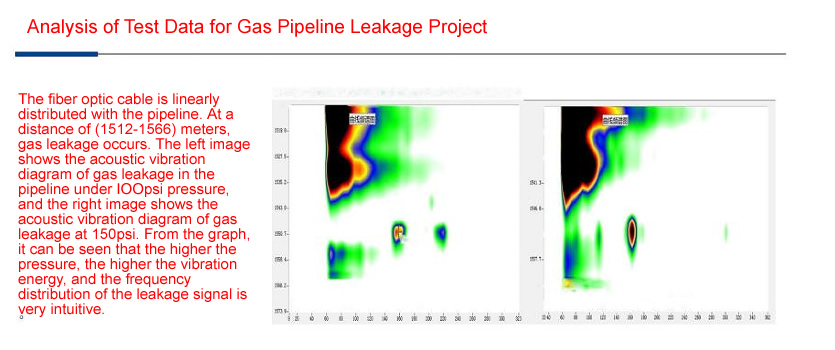
Whether it’s oil or natural gas pipelines, when there is a leak, not only are temperature changes accompanied by vibration changes, but the DAS system can serve as a safety protection and warning device around the pipeline.
(4) Monitoring of high-speed rail, navios, and airports
As fibras ópticas dispostas ao longo do trilho de alta velocidade podem detectar o status de operação do trilho de alta velocidade, e através de detecção acústica distribuída, o status da operação dos trilhos e do trem pode ser entendido; Cabos de fibra óptica podem ser colocados fora do aeroporto para detectar decolagem e pouso de aeronaves em tempo real, e monitorar invasões de segurança no aeroporto. (5) Monitoramento de segurança perimetral e prevenção de intrusões nas fronteiras
O sistema DAS pode fornecer dados de intrusão em tempo real e alerta precoce ao instalar cabos ópticos nas fronteiras nacionais ou em situações onde o monitoramento de prevenção de intrusão é necessário.