 INNO glasvezel temperatuursensoren ,temperatuurbewakingssystemen.
- Een statortemperatuursensor meet de temperatuur op geselecteerde wikkelings- of statorlocaties, zoals sleuven en eindwikkelingen.
- De temperatuur van de statorwikkeling is van belang voor de thermische spanning van de isolatie, laad- en koelprestaties.
- OTO / PT100-sensoren worden veel gebruikt voor conventionele wikkelingstemperatuurmetingen.
- Glasvezelsensoren zijn nuttig waar elektrische isolatie en EMI-immuniteit vereist zijn.
- De sensorpositie bepaalt of er een echte hotspot wordt gedetecteerd.
- Motoren en generatoren hebben mogelijk verschillende sensoropstellingen nodig.
- De sensorhoeveelheid is afhankelijk van het machineontwerp en de monitoringdoelstellingen.
- De uiteindelijke configuratie moet de feitelijke wikkelings- en statorconstructie volgen.
Inhoud
- 1. Wat is een statortemperatuursensor?
- 2. Waarom is de temperatuur van de statorwikkeling belangrijk??
- 3. Waar zijn statortemperatuursensoren geïnstalleerd?
- 4. Welke soorten statortemperatuursensoren worden gebruikt??
- 5. PT100- en RTD-statortemperatuursensoren
- 6. Glasvezel stator temperatuursensoren
- 7. Statortemperatuursensoren voor elektromotoren
- 8. Statortemperatuursensoren voor generatoren
- 9. Motor versus generator statortemperatuurmeting
- 10. Hoeveel statortemperatuursensoren zijn er nodig??
- 11. Locaties van de statortemperatuursensor selecteren
- 12. Overwegingen bij installatie van de statortemperatuursensor
- 13. Statortemperatuurmeting in omgevingen met hoge EMI
- 14. Hoe werkt een statortemperatuurbewakingssysteem?
- 15. Hoe u een statortemperatuursensor kiest
- 16. Veel voorkomende fouten bij het selecteren van de statortemperatuursensor
- 17. Veelgestelde vragen
1. Wat is een statortemperatuursensor?

A statortemperatuursensor meet de temperatuur op geselecteerde locaties in of rond de statorwikkeling, sleuf, eindwikkeling of andere thermisch belangrijke delen van een motor of generator. Een temperatuursensor van de statorwikkeling geeft de temperatuur van de statorwikkeling weer op het punt waar deze is geïnstalleerd.
Het sensortype is afhankelijk van:
- machine-ontwerp
- spanningsniveau
- installatie fase
- vereiste elektrische isolatie
- temperatuur bereik
- meetlocatie
Wat meet een statortemperatuursensor?
- Wikkeltemperatuur: de temperatuur op de sensorpositie.
- Lokale hotspottemperatuur: als de sensor op de hotspot wordt geplaatst.
- Temperatuurstijging: de waarde boven een referentie zoals omgevingstemperatuur.
- Thermische trend: hoe de waarde verandert met belasting en tijd.
- Fase-tot-fase temperatuurverschil: een vergelijking tussen fasewikkelingen.
2. Waarom is de temperatuur van de statorwikkeling belangrijk??

De bewaking van de temperatuur van de statorwikkelingen is gekoppeld aan verschillende machineomstandigheden:
- Isolatie thermische spanning: wikkelingsisolatie veroudert sneller bij hogere temperaturen.
- Machinebelading: De temperatuur van de wikkeling stijgt met de stroom.
- Koelprestaties: geblokkeerde luchtstroom of koelvloeistofproblemen verhogen de temperatuur.
- Lokale kronkelende hotspots: De temperatuur van de kronkelende hotspot kan de gemiddelde waarde overschrijden.
- Abnormale bedrijfsomstandigheden: onbalans of overbelasting manifesteren zich als verwarming.
- Onderhoudsbeslissingen: temperatuurgeschiedenis ondersteunt de inspectieplanning.
3. Waar zijn statortemperatuursensoren geïnstalleerd?
Typische locaties zijn onder meer wikkelsleuven, stator winding sections, eindwikkelingen, winding hot-spot locations, phase winding areas and other areas selected by the machine designer. There is no universal sensor position for every motor or generator. Placement should follow the actual machine design and identified thermal risk points.
Slot Temperature Measurement
A sensor placed in the slot, often between coil sides, reads the temperature inside the stator core where heat is generated. It is a common position for embedded sensors installed during manufacture.
End-Winding Temperature Measurement
End windings sit outside the core and are exposed to cooling air. A sensor here is easier to access, but the reading can differ from the slot temperature.
Hot-Spot Temperature Measurement
The hot spot is the warmest point in the winding. A sensor at that location gives a more direct view of the thermal limit, but the position must be identified from the machine design.
4. Welke soorten statortemperatuursensoren worden gebruikt??
Three technologies are common: OTO / PT100, thermocouple and fluorescent fiber optic temperature sensor. None is the best choice in every case.
| Sensortype | Meetprincipe | Elektrische isolatie | EMI-immuniteit | Puntmeting | Typische toepassing | Installatieoverwegingen |
|---|---|---|---|---|---|---|
| OTO / PT100 | Verandering van weerstand | Metaalelement en leads | Needs shielded wiring | Ja | Conventional motor and generator windings | Lead routing, isolatieafstand |
| Thermokoppel | Junctie spanning | Metalen draden | Needs shielded wiring | Ja | Algemene industriële metingen | Referentie kruispunt, lead routing |
| Fluorescerende glasvezel | Fluorescerende optische respons | Niet-metalen sonde en vezel | Hoog voor het optische pad | Ja | High-voltage and high-EMI machines | Vezelroutering, buigradius, zender |
5. PT100- en RTD-statortemperatuursensoren
A PT100 temperatuursensor is a platinum RTD temperature sensor whose resistance changes predictably with temperature. As a stator winding temperature sensor, it is widely used because it is established and easy to connect.
- Op weerstand gebaseerde meting: a reading device converts resistance into temperature.
- Embedded or accessible applications: sensors are placed in slots or on accessible winding parts.
- Meerpuntsbewaking: several sensors can feed one monitoring unit.
- Controller connection: a controller or protection relay reads the signals.
- Typisch gebruik: common in industrial motors and generators.
Limitations appear in strong electromagnetic fields, high-voltage insulation environments and applications that need complete electrical isolation, because the element and leads are metallic. These limits are manageable in many machines with good shielding and insulation design, and they do not rule out RTDs.
6. Glasvezel stator temperatuursensoren
A fiber optic stator temperature sensor uses fluorescent point-type sensing. A light pulse travels through the fiber to a fluorescent material at the probe tip, waarvan de optische respons verandert met de temperatuur. A transmitter converts it to a temperature value. Alleen de punt meet de temperatuur. De vezel draagt alleen licht, en dit is geen gedistribueerde temperatuurmeting.
A glasvezel wikkeling temperatuursensor can be useful for:
- direct point temperature measurement at the winding
- elektrisch geïsoleerde detectie
- sterke elektromagnetische velden
- hoogspanningsmachines
- embedded winding measurement
- stator hot spot temperature measurement
Zien glasvezel temperatuursensoren, de glasvezel temperatuursonde En glasvezel temperatuurmeting.
7. Statortemperatuursensoren voor elektromotoren
A motor stator temperature sensor supports motor winding temperature monitoring in industrial motors, large motors, VFD-aangedreven motoren, high-power motors and motors in strong EMI environments. A temperatuursensor motorwikkeling is used to watch:
- wikkel temperatuur
- stator hot spots
- temperature imbalance between phases
- koelprestaties
Gerelateerde pagina's: temperatuursensor motorwikkeling, Bewaking van de temperatuursensor van de elektrische motor En temperatuurbewaking van roterende machines.
8. Statortemperatuursensoren voor generatoren
A generator stator temperature sensor is used for generator winding temperature monitoring in stator windings, grote generatoren en generatorsets. A Temperatuursensor generatorwikkeling wordt vaak gekozen met aandacht voor:
- kronkelende hotspots
- sterke elektromagnetische omgevingen
- directe temperatuurmeting van de wikkeling
Gerelateerde pagina's: bewaking van de generatortemperatuur, de glasvezel temperatuurmeetsysteem voor generatorsets En monitoring van de hotspot van de statorwikkeling van de generator.
9. Motor versus generator statortemperatuurmeting
| Item | Motor | Generator |
|---|---|---|
| Typische kronkelende structuur | Afhankelijk van machinegrootte en ontwerp | Vaak grotere statorwikkelingen |
| Gemeenschappelijke sensortechnologieën | OTO / PT100, thermokoppel, glasvezel | OTO / PT100, glasvezel |
| Sensorplaatsing | Sleuven of eindwikkelingen | Slots, eindwikkelingen, hete plekken |
| EMI-omgeving | Hoger met VFD-aandrijvingen | Sterke velden in grote machines |
| Overwegingen bij spanning | Lage tot hoge spanning | Vaak midden- of hoogspanning |
| Bewaking van hotspots | Vaak voorkomend bij grote motoren | Vaak voorkomend bij grote generatoren |
| Kanalen monitoren | Ingesteld door kronkelend ontwerp | Ingesteld door kronkelend ontwerp |
| Bewaking op afstand | Via controller of PLC | Via regelaar, PLC of SCADA |
De daadwerkelijke sensorconfiguratie hangt meer af van het machineontwerp dan van de vraag of de machine een motor of een generator wordt genoemd.
10. Hoeveel statortemperatuursensoren zijn er nodig??
De hoeveelheid is afhankelijk van:
- aantal fasen
- kronkelend ontwerp
- statorgrootte
- aantal hotspotlocaties
- redundantie eisen
- machine criticality
- kanalen monitoren
- OEM design
- available installation positions
The required number of stator temperature sensors should be determined according to the machine winding design and monitoring objectives.
11. Locaties van de statortemperatuursensor selecteren
- Expected winding hot spots
- Phase locations
- Slot positions
- End-winding locations
- Verkoelende luchtstroom
- High-current regions
- Historische oververhittingslocaties
- Electrical insulation requirements
- Toegang tot sensorinstallatie
- Sensor lead or fiber routing
Correct placement is often more important than simply increasing the number of sensors.
12. Overwegingen bij installatie van de statortemperatuursensor
Key points are sensor fixation, winding integration, installation before winding impregnation where applicable, lead and fiber routing, buigradius, mechanische bescherming, isolatieafstand, connector location and service accessibility.
Ingebouwde sensorinstallatie
Embedded sensors are placed during winding manufacture, often before impregnation. This gives access to slots and hot spots, and positions should be agreed with the machine manufacturer.
Retrofit Temperature Monitoring
Retrofit options depend heavily on machine construction and accessible measurement points. End windings and accessible surfaces are more practical than the inside of slots.
13. Statortemperatuurmeting in omgevingen met hoge EMI
A high EMI temperature sensor is needed where electromagnetic interference can disturb measurement. In rotating machinery, factors include:
- Elektromagnetische interferentie: high currents and VFD switching create noise.
- Elektrische isolatie: the sensor should not create a path between the winding and the monitoring device.
- Conductive sensor leads: they can pick up noise and need shielding.
- Signaalintegriteit: noise can distort readings.
- Hoge elektrische velden: they affect insulation coordination.
A glasvezel temperatuursensor of the fluorescent point type has a non-metallic probe and fiber, so the optical signal is not disturbed by these fields. This supports motor temperature monitoring and generator temperature monitoring in demanding environments.
14. Hoe werkt een statortemperatuurbewakingssysteem?
Statortemperatuursensor → Signal / Optical Fiber → Monitoring Device / Transmitter → Temperature Data → Alarm → PLC / SCADA
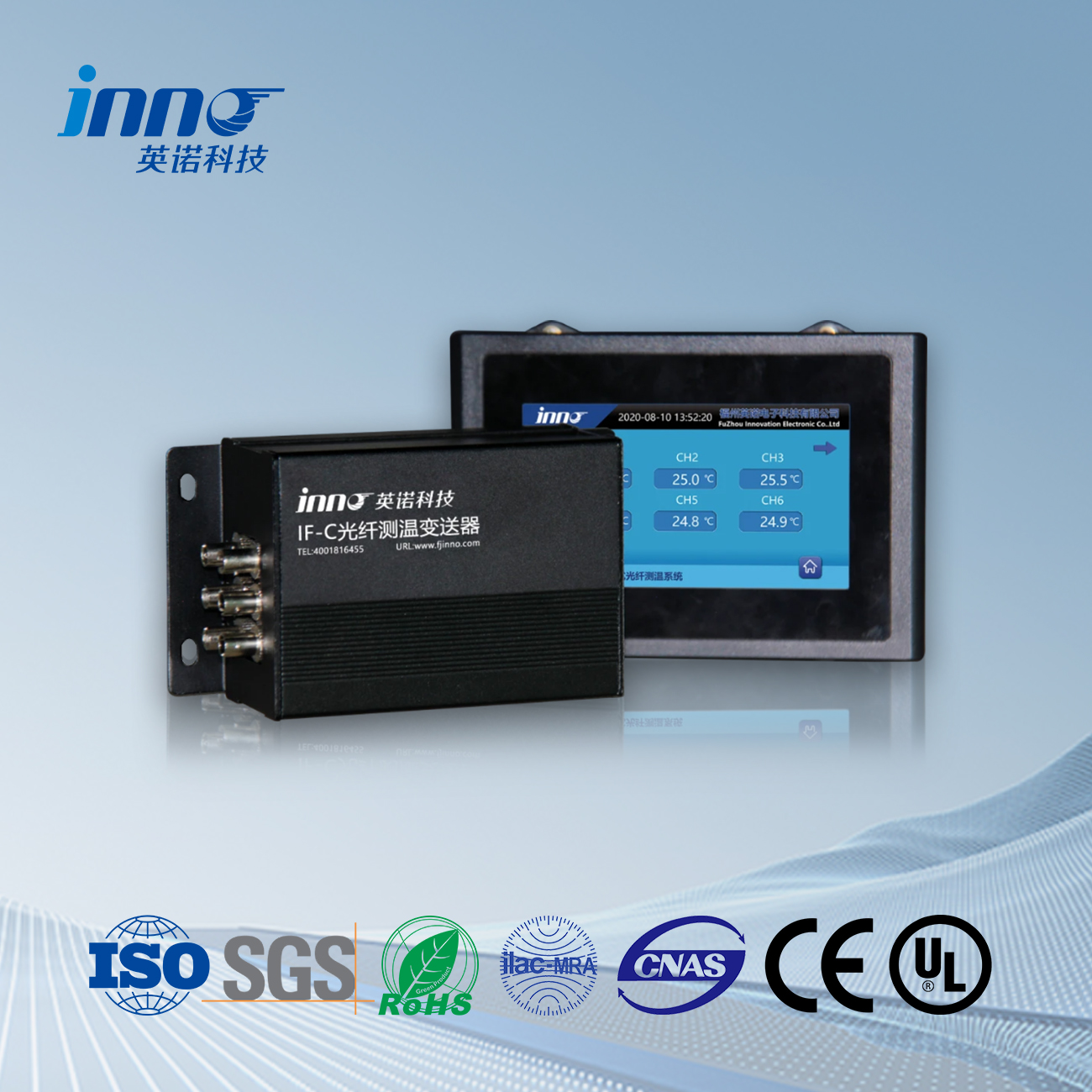
A statortemperatuursensor detects the temperature. A meerkanaals temperatuurmonitor reads several sensors and shows the values. For fiber optic probes, A glasvezel temperatuurzender converts the optical signal to temperature data. Alarm outputs notify operators, and data communication passes the values to a PLC or SCADA for remote monitoring. Alarm values must come from the machine manufacturer or the project specification. Available outputs and protocols differ between products and should be confirmed with the supplier. Zie de glasvezel temperatuurzender pagina. Een compleet temperatuurbewakingssysteem should be tested end to end at commissioning.
15. Hoe u een statortemperatuursensor kiest
- Motor or generator
- Spanningsniveau
- Winding design
- Meetlocatie
- Vereist temperatuurbereik
- Nauwkeurigheidseis
- Elektrische isolatie
- EMI-omgeving
- Sensor size
- Installatiefase
- Aantal meetpunten
- Kanalen monitoren
- Alarmvereisten
- Communicatievereisten
- PLC / SCADA-integratie
The final sensor configuration should be selected according to the machine design, kronkelende constructie, thermal risk points and project requirements.
16. Veel voorkomende fouten bij het selecteren van de statortemperatuursensor
- Selecting sensors only by temperature range
- Ignoring actual hot-spot locations
- Using too few sensing points
- EMI-omstandigheden negeren
- Elektrische isolatie negeren
- Slechte sensorfixatie
- Poor lead or fiber routing
- Confusing average winding temperature with hot-spot temperature
- Ignoring monitoring channel quantity
- Choosing sensors without checking transmitter compatibility
17. Veelgestelde vragen
1. What is a stator temperature sensor?
A stator temperature sensor measures temperature at selected locations in or around the stator winding of a motor or generator, zoals sleuven en eindwikkelingen. It provides the winding temperature at its own position and supports protection, monitoring and thermal management.
2. Where are stator temperature sensors installed?
Common positions are winding slots, eindwikkelingen, phase winding areas and expected hot-spot locations. Positions are chosen by the machine designer. There is no universal position, so placement should follow the actual machine design and identified thermal risk points.
3. What temperature sensors are used in stator windings?
OTO / PT100-sensoren, thermocouples and fluorescent fiber optic sensors are used. RTDs are widely used in conventional machines. Fiber optic sensors suit high-voltage and high-EMI machines. De keuze is afhankelijk van de spanning, isolation needs, EMI, installation stage and measurement location.
4. Is PT100 suitable for stator temperature measurement?
Ja, in many machines. PT100 is established, accurate and easy to connect to controllers. Its metallic element and leads need shielding and insulation coordination in strong electromagnetic fields or high-voltage designs. Suitability depends on the machine and should follow the manufacturer’s design.
5. Can fiber optic sensors measure stator winding temperature?
Ja. A fluorescent point-type fiber optic sensor can be embedded or fixed at a chosen winding point to measure the temperature there. Elke sonde leest één locatie, so several probes cover several points. Het is geen gedistribueerde temperatuurmeting.
6. What is a stator winding hot spot?
It is the point in the winding with the highest temperature. It is usually above the average winding temperature because heating and cooling are not uniform. A sensor placed at that location gives a more direct view of thermal stress on the insulation.
7. How many stator temperature sensors are needed?
It depends on the phases, kronkelend ontwerp, statorgrootte, hot-spot locations, ontslag, machine criticality, monitoring channels and available positions. The required number of stator temperature sensors should be determined according to the machine winding design and monitoring objectives.
8. What is the difference between motor and generator stator temperature monitoring?
The principles are the same, but generators often have larger windings, higher voltage and stronger fields. Sensor configuration depends more on machine design than on the machine type. VFD-driven motors can add EMI, while large generators often emphasize hot-spot monitoring.
9. Are fiber optic temperature sensors suitable for high-EMI motors and generators?
Ja. De sonde en de vezel zijn niet-metaalachtig, so the optical signal is not disturbed by electromagnetic interference and the sensing point is electrically isolated. Vezelroutering, bend radius and transmitter compatibility still need attention during installation.
10. How do I choose a stator temperature sensor?
Start with the machine type, spanningsniveau, winding design and measurement location. Then confirm the temperature range, nauwkeurigheid, isolatie, EMI conditions, sensor size and installation stage. Eindelijk, check the number of points, kanalen, alarms and PLC or SCADA requirements against the machine design.
Need Help Selecting a Stator Temperature Sensor?
Stuur ons de details van uw aanvraag. Gelieve op te geven:
- motor or generator type
- nominale spanning
- kronkelend ontwerp
- meetlocaties
- verwachte temperatuurbereik
- number of sensing points
- benodigde monitoringkanalen
- electrical isolation requirement
- communicatie vereisten
- PLC / SCADA-vereisten

Glasvezel temperatuursensor, Intelligent monitoringsysteem, Gedistribueerde glasvezelfabrikant in China
 |
 |
 |