 INNO glasvezel temperatuursensoren ,temperatuurbewakingssystemen.
- Partial discharge thermal hotspot monitoring prevents catastrophic equipment failures in switchgear, transformatoren, and cable joints
- Fluorescerende glasvezelsensoren provide ±1.0°C accuracy with 100kV voltage withstand capability in high-voltage environments
- Integrated monitoring systems combine PD detection (0-1000PC) with multi-channel temperature tracking for comprehensive diagnostics
- Fabrikanten aanbod OEM/ODM customized solutions with flexible configurations from 1-32 meetkanalen
- Factory-direct wholesale pricing available for bulkbestellingen with global export mogelijkheden
1. What Is Partial Discharge and Thermal Hotspot Formation

1.1 Understanding Partial Discharge Phenomena
Gedeeltelijke ontlading (PD) occurs when electrical insulation experiences localized breakdown without completely bridging conductors. In schakelapparatuur, transformatoren, en kabelsystemen, PD manifests as repetitive micro-sparks that gradually degrade insulation materials. These discharges generate heat, ozone, and chemical byproducts that accelerate equipment deterioration.
1.2 How Thermal Hotspots Develop
Thermal hotspots form when PD activity, poor electrical connections, or overloading create localized heating. In stroomonderbrekers En railverbindingen, contact resistance increases temperature. Cable joints suffer from installation defects that produce heat concentration. Left undetected, deze hotspots escalate from minor anomalies to catastrophic failures.
| Equipment Type | Common PD Locations | Typical Discharge Type | Failure Risk |
|---|---|---|---|
| Schakelapparatuur | Cable terminals, railverbindingen, contacten van stroomonderbrekers | Surface discharge, kroon | Hoog |
| Transformatoren | Winding insulation, tik-wisselaars, bussen | Internal cavity discharge | Kritisch |
| Kabelverbindingen | Splice connections, beëindigingen | Interface discharge | Hoog |
| GIS Equipment | Spacer insulators, particle contamination | Free particle discharge | Medium |
2. Why Partial Discharge Thermal Hotspot Monitoring Is Critical

2.1 Preventing Equipment Failures
Unmonitored gedeeltelijke ontlading activity leads to insulation breakdown, causing unplanned outages and equipment damage. Online monitoring systems detect PD inception at 0-1000pC levels, enabling intervention before critical failure. Combined thermal hotspot detection identifies overheating from 40°C below zero to 200°C, covering the full operational envelope.
2.2 Economic Benefits
Condition-based maintenance reduces costs by 30-50% compared to time-based schedules. Vroeg hotspot detection prevents emergency repairs and extends asset lifespan. For a medium-voltage switchgear installation, monitoring systems typically achieve ROI within 18-24 months through avoided failures alone.
| Vergelijkingsfactor | Traditional Inspection | Online-monitoring |
|---|---|---|
| Detection Speed | Monthly/Quarterly | Real-time continuous |
| Foutpreventie | Reactive | Voorspellend |
| Onderhoudskosten | Hoog (scheduled + noodgeval) | Optimized (condition-based) |
| Safety Risk | Personnel exposure during inspection | Bewaking op afstand |
3. Partial Discharge Detection Equipment and Technology
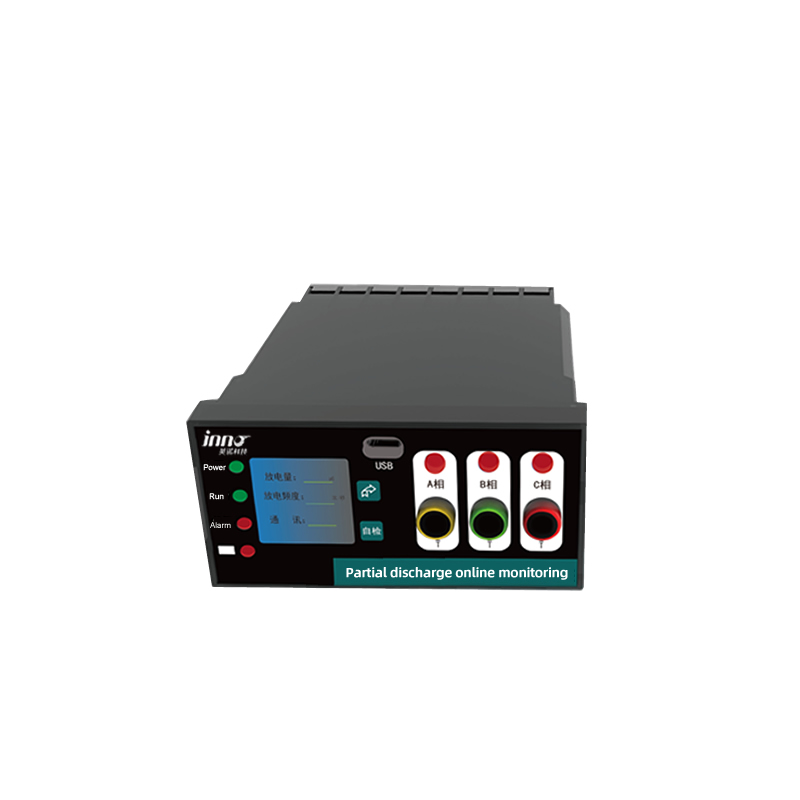
3.1 How PD Monitoring Systems Work
Partial discharge monitoring devices employ capacitive coupling to detect high-frequency pulses generated by discharge events. The system measures discharge magnitude in picocoulombs (PC), providing quantitative assessment of insulation condition. Modern units integrate LCD displays showing energization status and support RS485/433MHz communication for centralized monitoring.
| Parameter | Specificatie | Opmerkingen |
|---|---|---|
| Bedrijfsspanning | AC 220V 50Hz | Standard power supply |
| Mededeling | RS485/433MHz | Wired and wireless options |
| Meetbereik | 0-1000PC | Aanpasbaar per application |
| Weergave | LCD with energization indicator | LED shows cabinet energization |
| Interface | USB-B/RJ45 Ethernet | Multiple connectivity |
| Coupling Capacitor | 3PF-150PF | Design-dependent, aangepast options |
| Voltage Rating | 5kV-36kV | Application-specific |
4. Fluorescent Fiber Optic Temperature Monitoring Solutions

4.1 Why Fiber Optic Sensors for High Voltage
Fluorescerende glasvezeltemperatuursensoren utilize non-conductive quartz fibers immune to electromagnetic interference. Unlike thermocouples or RTDs that create ground loops and safety hazards, fiber optic thermometry provides electrical isolation exceeding 100kV. The fluorescent sensing principle measures phosphor decay time, which varies predictably with temperature, eliminating calibration drift.
4.2 Technische specificaties
| Parameter | Specificatie | Remarks |
|---|---|---|
| Temperatuurbereik | -40°C to 200.0°C | Covers most applications |
| Communicatieprotocol | RS485/Modbus-RTU | Industrial standard |
| Nauwkeurigheid | ±1,0°C | High precision measurement |
| Oplossing | 0.1°C | Fine temperature detection |
| Kanaaltelling | 1-32 kanalen | Expandable configuration |
| Sensortype | Quartz fiber, 3m standard | Aanpasbaar lengte |
| Spanning weerstaan | 100kV | 40mm creepage, 5min duration |
| Technologie | HV Compatibility | EMI-immuniteit | Nauwkeurigheid | Onderhoud |
|---|---|---|---|---|
| Fluorescerende glasvezel | ✅ Uitstekend | ✅ Complete | ±1,0°C | Onderhoudsvrij |
| Thermokoppels | ❌ Poor | ❌ Gevoelig | ±2°C | Periodieke kalibratie |
| Infrarood | ⚠️Beperkt | ⭐⭐⭐ Good | ±2-5°C | Lens cleaning required |
| Draadloze sensoren | ⚠️Gematigd | ⭐⭐ Fair | ±1-2°C | Vervanging van de batterij |
5. Typical Applications for Hotspot Monitoring Systems
5.1 Switchgear and Circuit Breaker Monitoring
In medium and high-voltage schakelapparatuur, PD-sensoren attach to cable terminations while glasvezel temperatuursondes monitor busbar connections and circuit breaker contacts. Multi-channel systems track 8-16 critical points per panel, with LCD displays providing local indication and RS485 enabling SCADA integration.
5.2 Transformer Winding Hotspot Detection
Transformatorbewaking requires both PD measurement through bushings and winding hotspot temperature tracking. Fluorescent fiber sensors insert through oil-filled chambers without creating electrical hazards. Systems detect developing faults 6-12 months before failure, allowing scheduled maintenance.
5.3 Cable Joint Temperature Monitoring
Cable joint monitoring addresses the highest failure rate component in underground distribution. Installing 3-meter glasvezelsondes at splice points detects connection resistance increases before insulation damage occurs. Wireless 433MHz transmission eliminates cable routing challenges in existing installations.
6. How to Choose the Right Monitoring Configuration
6.1 Determining Channel Requirements
Count critical hotspot locations requiring monitoring. Typisch schakelapparatuur panels need 4-8 channels for busbar joints and breaker contacts. Transformator installations require 2-6 points for windings and tap changers. Fabrikanten aanbod 1-32 channel systems with expandable architectures.
6.2 Voltage Rating Selection
Match system voltage rating to equipment class. 5kV units suit low-voltage industrial applications, while 12kV and 24kV configurations serve utility distribution. 36kV systems handle transmission substations. Coupling capacitor values (3PF-150PF) adjust based on circuit characteristics.
6.3 Communication Protocol Selection
| Protocol | Range | Betrouwbaarheid | Beste applicatie |
|---|---|---|---|
| RS485 | Up to 1200m | Uitstekend | Fixed installations, multiple devices |
| 433MHz Wireless | 200-500M | Very Good | Distributed locations, retrofit projects |
| Ethernet | Onbeperkt (networked) | Uitstekend | Enterprise monitoring, toegang op afstand |
7. OEM Custom Solutions and Factory Direct Wholesale
7.1 Customization Options
Professioneel fabrikanten voorzien aangepast configurations including channel count adjustment, fiber probe length modification (standard 3m, extended available), coupling capacitor selection, voltage rating specification, and communication protocol variants. OEM/ODM services support privélabel branding and application-specific software integration.
7.2 Why Choose Factory Direct
Partnering directly with the fabrikant elimineert distributeur margins, reducing costs 20-40%. Bulkbestellingen qualify for volume pricing with flexible minimum quantities. Direct leverancier relationships ensure rapid technical support, custom engineering, and priority production scheduling. As an experienced exporteur, qualified fabrikanten handle international certifications and shipping logistics.
8. Technical Questions About PD and Temperature Monitoring
Q1: What does the pC unit in partial discharge measurement mean?
A: Picocoulombs (PC) quantify the electrical charge transferred during each discharge pulse. Values below 100pC indicate minor activity, while sustained readings above 500pC suggest significant insulation degradation requiring investigation.
Vraag 2: How does fluorescent fiber optic sensing differ from regular fiber?
A: The probe tip contains phosphorescent material that fluoresces when excited by light. Temperature changes alter fluorescence decay time, which the system measures with microsecond precision. This intrinsic sensing mechanism requires no electrical power at the probe.
Q3: Why can fiber optic sensors withstand 100kV?
A: Quartz fiber is a perfect electrical insulator with no conductive path. The 100kV rating reflects creepage distance testing, where 40mm of fiber length prevents surface tracking for 5 minutes under voltage stress.
Q4: Is ±1.0°C accuracy sufficient for hotspot detection?
A: Ja. Most electrical connections show 10-30°C temperature rise before failure. The 1°C accuracy combined with 0.1°C resolution enables trending analysis that detects gradual degradation months in advance.
Vraag 5: What does maintenance-free operation mean?
A: Fluorescent fiber sensors maintain factory calibration indefinitely without drift. Unlike thermocouples requiring annual verification, these systems operate for 10+ years without recalibration, eliminating service costs.
Vraag 6: How to choose between RS485 and 433MHz communication?
A: Use RS485 for permanent installations with cable infrastructure. Select 433MHz wireless for retrofit projects, temporary monitoring, or locations where cable routing is impractical. Both support Modbus-RTU for SCADA integration.
Vraag 7: Can fiber probe length be customized beyond 3 meter?
A: Ja. Fabrikanten supply aangepast fiber lengths from 1-50 meters depending on application requirements. Longer fibers enable remote transmitter mounting away from high-voltage equipment.
9. Get Your Custom Monitoring Solution
Partner with Experienced Manufacturers
Fuzhou Innovatie Elektronische Wetenschap&Tech Co., Ltd. gespecialiseerd in partial discharge thermal hotspot monitoring systems for global power utilities and industrial facilities. Als toegewijd fabrikant, we offer comprehensive oplossingen from single-channel units to 32-point enterprise installations.
Why Choose Our Factory:
- ✅ Manufacturer direct pricing – eliminate middleman markups
- ✅ OEM/ODM-aanpassing – tailor systems to specifications
- ✅ Bulk order flexibiliteit – competitive volume discounts
- ✅ Global exporteur – CE certified, worldwide shipping
- ✅ Technical support – technische hulp bij toepassingen
Product Capabilities:
🎯 PD Monitoring: 0-1000pC range, LCD-scherm, multi-protocol communication
🌡️ Temperatuurwaarneming: -40°C tot 200 °C, ±1.0°C accuracy, 1-32 kanalen
⚡ Spanningswaarden: 5kV-36kV configurations available
🔧 Maatwerk: Channel count, vezel lengte, communication options
📦 Diensten: Privélabel, systeemintegratie, mondiaal supply
Contact our engineering team:
📧 E-mail: web@fjinno.net
📱Whatsappen: +86 135 9907 0393
Request technical specifications, customized solution proposals, En factory-direct wholesale quotations. Our experts respond within 24 hours with detailed recommendations for your gedeeltelijke ontlading En thermal hotspot monitoring vereisten.

Glasvezel temperatuursensor, Intelligent monitoringsysteem, Gedistribueerde glasvezelfabrikant in China
 |
 |
 |