 INNO glasvezel temperatuursensoren ,temperatuurbewakingssystemen.
Fluorescent optical fibers measure transformer temperature by detecting the fluorescence decay time of fluorescent substances, as the fluorescence decay time is a function of temperature
1. Method for measuring transformer temperature using optical fiber
1.1 Measurement method based on vezel Bragg-rooster
Fiber Bragg Grating is a passive device in which the refractive index is modulated periodically within the fiber core. When the external temperature changes, it will affect the refractive index of the fiber Bragg grating and the refractive index of the fiber core, thereby causing changes in the reflection or transmission peak wavelength of the fiber Bragg grating. By accurately measuring the wavelength of the reflected signal, temperature detection can be achieved. This method typically requires installing fiber Bragg grating sensors near transformer windings or other critical locations to accurately sense temperature changes.
1.2 Fluorescence fiber optic temperature measurement method
Fluorescent fiber optic sensors can be used to measure the internal temperature of transformers. The principle is to utilize the characteristics of fluorescent materials. When a light pulse is emitted from a light source and transmitted through an optical fiber to a sensor, the fluorescent substance in the probe is illuminated by the spectrum. The molecules absorb light and are excited to an excited electronic state, then radiate fluorescence outward and return to the electronic ground state. De temperatuur van de omgeving en de vervaltijd van de fluorescentie vertonen een functionele relatie, en de temperatuurwaarde kan worden verkregen door het detecteren van de vervaltijd van de fluorescentie. Steek de sonde van de fluorescerende vezelthermometer in de positie in de transformator die moet worden gemeten, zoals de transformatorwikkeling, temperatuurmeting uit te voeren.
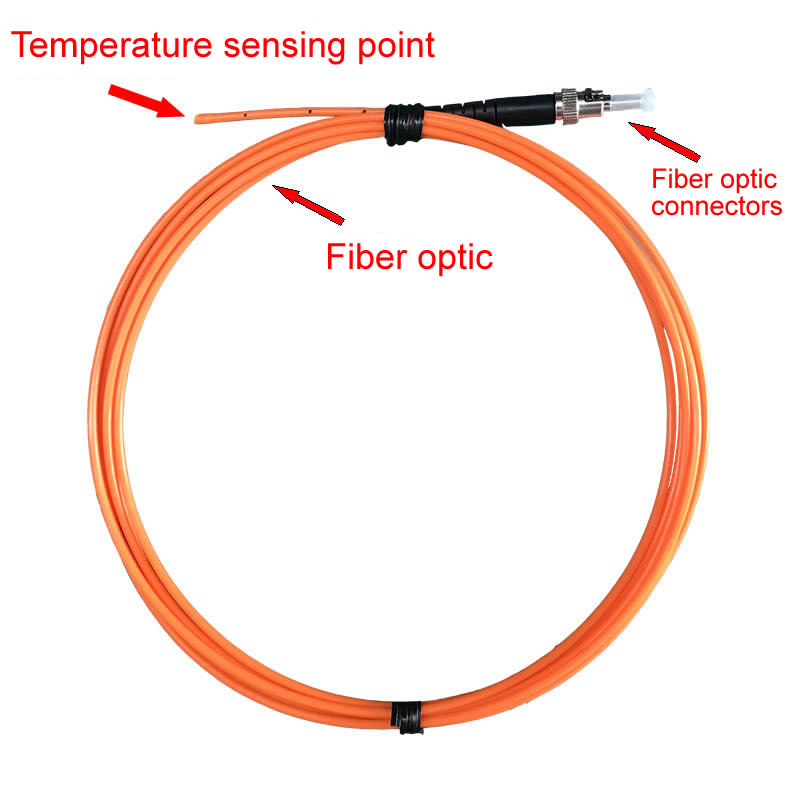
1.3 Meetmethode voor glasvezelsensoren op basis van halfgeleidermaterialen
Er bestaat een verband tussen de temperatuur en de lichtabsorptie van halfgeleidermaterialen. De bandbreedte van de meeste halfgeleiders vertoont een lineaire negatieve correlatie met de temperatuur, dat is, naarmate de temperatuur stijgt, de bandbreedte van de bandbreedte neemt lineair af en de golflengte van de lichtabsorptieband neemt toe. This characteristic can be utilized to manufacture intensity modulated fiber optic sensors, such as using reflective or transmissive modulation, as well as refractive index and absorption coefficient intensity modulation methods. When measuring, if a light source corresponding to the radiation spectrum and absorption band is selected, an increase in temperature will cause a decrease in the light intensity of the semiconductor. Dan, based on the functional relationship between light intensity and temperature, the temperature of the semiconductor material can be calculated by the value of the reflected light intensity. This type of glasvezel temperatuursensor mainly consists of photoelectric conversion devices, light sources, and sensitive components (such as gallium arsenide semiconductors).
1.4 Measurement method based on all fiber optic technology
Ontwerp een temperatuurdetectiesysteem met behulp van Bragg-vezelroosters als sensorelementen. Tijdens het meetproces, er kunnen problemen zijn met externe interferentie, die effectief kunnen worden aangepakt door de verschilmethode te gebruiken om de nauwkeurigheid van de meetresultaten te verbeteren.
2. Toepassingsgeval van optische vezels bij het meten van de temperatuur van transformatoren
2.1 Temperatuurbewaking van transformatorwikkeling in onderstation
In een onderstation van een bepaald energiebedrijf werd een online monitoringsysteem voor de transformatorwikkeling van glasvezeltemperatuur op basis van glasvezeltechnologie gebruikt. Dit systeem bestaat voornamelijk uit glasvezeltemperatuursensoren, glasvezel temperatuurzenders, glasvezel temperatuurmeetsystemen, enz. Glasvezeltemperatuursensoren zijn verantwoordelijk voor het verzamelen van temperatuurinformatie van transformatorwikkelingen, and then analyzing the optical signal through fiber optic temperature transmitters to obtain temperature change information. Eindelijk, the fiber optic temperature measurement system processes and analyzes the obtained temperature data to achieve real-time monitoring of transformer winding temperature. By arranging fiber optic sensors at different positions of the transformer winding, real-time temperature data can be collected. Once abnormal conditions are detected, the system will issue an alarm and take corresponding measures in a timely manner to avoid transformer failures.
2.2 Temperature Monitoring of Oil Immersed Transformers
Application of Fiber Bragg Grating Temperature Measurement
In olie ondergedompelde transformatoren, fiber Bragg gratings are used for oil temperature monitoring. Bijvoorbeeld, by encapsulating the fiber optic grating inside an insulating shell, the external ambient temperature is transmitted through the shell to the fiber optic grating, causing a change in its wavelength. Due to the excellent linear relationship between the center wavelength of fiber Bragg gratings and temperature, oil temperature can be detected by measuring the wavelength of the reflected signal. And typically, multiple (zoals 18) fiber optic grating temperature sensors with different wavelengths can be connected to a single fiber optic cable. The reflected signals from the sensors are returned to the detector through a loopback device, and the data is read into the computer through a digital DIO card, thereby achieving effective monitoring of the oil temperature of oil immersed transformers.
In the transformer winding temperature detection system based on fiber Bragg grating sensing, the system adopts fiber Bragg grating sensors with strong anti-interference ability and extremely sensitive to temperature. The measurement and transmission of optical signals, followed by demodulation into temperature signals, can meet the high-precision temperature measurement requirements of transformer windings, accurately measure the winding temperature of oil immersed transformers, en zorgen voor de veilige werking van transformatoren.
Application of Fluorescent Fiber Optic Temperature Measurement
For large oil immersed transformers, fluorescence fiber optic temperature measurement method is adopted. Bijvoorbeeld, the fluorescent fiber optic temperature sensor from Fuzhou Yingnuo Technology can be used for temperature monitoring of large oil immersed transformers. It has the characteristic of essential insulation and can perform online temperature monitoring on components that withstand high voltage or strong current. Inserting the probe of the fluorescent material into the position inside the transformer that needs to be measured, and detecting temperature through the relationship between fluorescence lifetime and temperature, significantly reduces the impact of light source stability.
3. Principle of Fiber Optic Technology for Transformer Temperature Measurement
3.1 Principle of Fiber Bragg Grating Technology
Basic principles
Fiber Bragg grating is a reflective fiber filter device. It is achieved by irradiating a bare optical fiber with ultraviolet interference fringes, and the core absorbs ultraviolet radiation to generate permanent periodic changes in refractive index. When the wavelength entering the optical fiber satisfies the Bragg condition (λ B=2n ∧, where λ B is the center wavelength of the Bragg reflected light wave of the fiber grating, n is the refractive index of the fiber core, and ∧ is the grating period), the forward guided mode propagating in the optical waveguide will couple to the backward reflected mode, forming Bragg reflection.
The central wavelength of a fiber Bragg grating is related to stress and temperature changes, and its relationship formula is Δ λ B=λ B (1- ρ) Δ ε+λ B (1+ξ) Δ T, where Δ λ B is the change in the central wavelength of reflected light caused by stress and temperature changes; Δ ε is the change in stress; Δ T is the change in temperature; ρ is the optical elastic coefficient of the optical fiber; ξ is the thermal optical coefficient of the optical fiber. When the fiber optic grating is encapsulated inside an insulating shell, it is mainly affected by temperature. The external environmental temperature changes the n and ∧ of the fiber optic grating, resulting in a change in the wavelength of the reflected light. By accurately measuring the wavelength of the reflected signal, temperature detection can be achieved, and the center wavelength of the fiber optic grating has a very good linear relationship with temperature.
Sensing process
The broadband light source is input into the optical fiber, en na het passeren van het vezel-Bragg-rooster, het smalbandspectrum op de Bragg-golflengte wordt gereflecteerd naar het ingangsuiteinde van de vezel, terwijl de resterende golflengten worden doorgelaten. Wanneer de temperatuur verandert, de brekingsindex en andere parameters van het vezel-Bragg-rooster veranderen, waardoor de Bragg-golflengte verandert, en de golflengte van het gereflecteerde licht verandert ook dienovereenkomstig. Door het detecteren van de verandering in de golflengte van gereflecteerd licht en op basis van een vooraf bepaalde golflengte-temperatuurrelatie, de overeenkomstige temperatuurwaarde kan worden verkregen.
3.2 Principe van fluorescerende vezeltechnologie
Principe van fluorescentiegeneratie
De fluorescerende stof in de fluorescerende vezelthermometer heeft een speciale energieniveaustructuur. When the light pulse is emitted by the light source and transmitted through the optical fiber to the fluorescent substance in the sensor probe, the molecules of the fluorescent substance absorb photon energy and transition from the ground state to the excited state. Due to the instability of the excited state, molecules will release energy through radiative fluorescence and return to the ground state.
The relationship between temperature and fluorescence characteristics
De temperatuur van de omgeving en de vervaltijd van de fluorescentie vertonen een functionele relatie. At different temperatures, the fluorescence decay time of a fluorescent substance changes as it returns from the excited state to the ground state. Over het algemeen gesproken, the higher the temperature, the shorter the fluorescence decay time. By detecting the fluorescence decay time and utilizing the predetermined fluorescence decay time temperature function relationship, the temperature value of the measurement point can be obtained.
4. Comparison of Temperature Measurement of Transformers Using Different Optical Fibers
4.1 Fiber Bragg Grating Sensor
voordeel
Hoge precisie: The center wavelength of fiber Bragg grating has a very good linear relationship with temperature, and high-precision temperature measurement can be achieved by accurately measuring the change in reflected wavelength. Bijvoorbeeld, in some experiments and practical applications, it can meet the high-precision temperature measurement requirements of transformer windings with relatively small measurement errors.
Good stability: Fiber Bragg grating sensors themselves have good stability and can adapt to the temperature monitoring needs during long-term operation of transformers. During long-term temperature monitoring, its performance will not experience significant fluctuations and can continuously and accurately reflect temperature changes.
Anti-elektromagnetische interferentie: In the strong electromagnetic environment of transformers, glasvezel Bragg-roostersensoren, based on the principle of optical signal transmission and detection, are not affected by electromagnetic interference and can ensure the accuracy of measurement data. This feature makes it highly advantageous in measuring transformer temperature in power systems.
Reusability: Multiple fiber Bragg grating temperature sensors with different wavelengths can usually be connected to a single optical fiber, facilitating multi-point temperature measurement in different parts of the transformer, constructing a sensing network, and monitoring the overall temperature distribution of the transformer.
shortcoming
Relatively high cost: The production process of fiber Bragg grating sensors is relatively complex, requiring special equipment and technology to prepare fiber Bragg gratings, and the related demodulation equipment is also relatively expensive, which makes the cost of the entire fiber Bragg grating temperature measurement system high.
High installation requirements: When installing fiber Bragg grating sensors, it is necessary to ensure the accuracy of their packaging and installation position to accurately sense temperature changes and avoid unnecessary interference factors such as stress. If installed improperly, it may affect measurement accuracy.
4.2 Fluorescerende glasvezelsensor
voordeel
Reduced requirement for light source stability: Compared with fluorescence intensity type temperature sensors, detecting temperature through the relationship between fluorescence lifetime and temperature significantly reduces the impact of light source stability. This allows fluorescent fiber optic sensors to still accurately measure temperature in some application scenarios where the stability of the light source may be poor.

Intrinsic insulation properties: Fluorescent fiber optic sensors have inherent insulation properties, making them highly suitable for temperature measurement in high-voltage equipment such as transformers. It can directly perform online temperature monitoring on components that withstand high voltage or strong current, without worrying about safety hazards caused by insulation issues.
Fluorescent materials with high temperature resistance and stable performance: Fluorescent materials themselves have the characteristics of high temperature resistance and stable performance, which can adapt to the high temperature environment inside transformers and ensure the reliability of temperature measurement during transformer operation.
shortcoming
System debugging: Bij praktische toepassingen, the installation and debugging of fluorescent fiber optic temperature measurement systems require precise adjustments to the position of sensors, fiber optic connections, enz., to ensure accurate temperature measurement.
4.3 Fiber optic sensors based on semiconductor materials
voordeel
Lage kosten: This fiber optic temperature sensor mainly consists of photoelectric conversion devices, inexpensive light-emitting diodes as light sources, and commonly used gallium arsenide semiconductors as sensitive components. The structure is simple and easy to manufacture, so the cost is relatively low.
Simple principle and structure: It is based on the relationship between temperature and light absorption of semiconductor materials, and measures temperature through intensity modulation (such as reflective or transmissive modulation, as well as refractive index and absorption coefficient intensity modulation methods). The principle and structure are relatively simple.
shortcoming
The performance of sensors is greatly affected by light intensity, which is their main drawback. The variation of light intensity will directly affect the accuracy of measurement results.
Calibration work is required: Before measurement, temperature and light intensity need to be calibrated. Bovendien, in addition to the influence of temperature on light intensity, factors such as photodetectors for measuring light intensity, unstable light source illumination, coupling losses, and random fluctuations caused by fiber bending may also have an impact. Daarom, relying solely on the pre calibrated temperature light intensity function relationship cannot effectively improve its temperature measurement performance.
5. Accuracy of Fiber Optic Temperature Measurement for Transformers
5.1. Accuracy of Fiber Bragg Grating Sensor
Fiber Bragg grating sensors have high accuracy. Due to the excellent linear relationship between the center wavelength of fiber Bragg gratings and temperature, as long as the change in reflected light wavelength can be accurately measured, the temperature value can be accurately obtained. Bij praktische toepassingen, such as in a transformer winding temperature detection system based on fiber Bragg grating sensing, it can meet the high-precision temperature measurement requirements of transformer windings, achieve accurate monitoring of transformer winding temperature, and provide guarantees for the safe operation of transformers.
5.2 Accuracy of Fluorescent Fiber Optic Sensor
Fluorescent fiber optic sensors determine temperature by detecting fluorescence decay time, and their accuracy depends on the characteristics of the fluorescent material and the accuracy of the detection equipment. Onder normale omstandigheden, if the fluorescent material has stable performance and the detection equipment has high accuracy, it can achieve more accurate temperature measurement. Bijvoorbeeld, some fluorescent fiber optic sensors can measure the temperature of transformer windings once per second within their normal monitoring temperature range, and the temperature resolution can reach a certain standard, meeting the accuracy requirements of transformer temperature monitoring.
5.3 Nauwkeurigheid van glasvezelsensoren op basis van halfgeleidermaterialen
De nauwkeurigheid van deze sensor wordt beïnvloed door verschillende factoren. Vanwege de temperatuurmeting op basis van de functionele relatie tussen lichtintensiteit en temperatuur, de lichtintensiteit zelf wordt gemakkelijk beïnvloed door verschillende factoren, zoals onstabiele lichtbronverlichting en vezelbuiging. In een ideale situatie, als deze factoren die de lichtintensiteit beïnvloeden goed kunnen worden gecontroleerd en de functierelatie tussen temperatuur en lichtintensiteit nauwkeurig kan worden gekalibreerd, temperatuurmeting met een bepaalde nauwkeurigheid kan ook worden bereikt. Echter, de algehele nauwkeurigheid kan relatief laag zijn in vergelijking met vezel-Bragg-roostersensoren en fluorescerende vezelsensoren.

Glasvezel temperatuursensor, Intelligent monitoringsysteem, Gedistribueerde glasvezelfabrikant in China
|
 |
 |