 INNO glasvezel temperatuursensoren ,temperatuurbewakingssystemen.
Belangrijkste hoogtepunten van Fluorescerende glasvezeltemperatuurbewaking
- Kerntechnologie: Punttype fluorescerende glasvezeldetectie met ±1°C nauwkeurigheid over een temperatuurbereik van -40°C tot 260°C voor nauwkeurige contactmeting
- Bewakingsoplossing: Uitgebreide 9-punts bewakingslay-out voor de contacten van stroomonderbrekers, railverbindingen, en kabelterminals
- Levensduur van het systeem: De levensduur van de sensorsonde is overschreden 25 jaar met weerstandsspanning >100kV, onderhoudsvrij langdurig gebruik
- Intelligent alarm: Realtime online monitoring met alarmmechanismen op meerdere niveaus voor proactieve foutpreventie
- Systeemintegratie: RS485-communicatie-interface voor naadloze verbinding met onderstationautomatiseringssystemen en SCADA-platforms
- Brede toepassingen: Wordt op grote schaal gebruikt in 220 kV-substations, 35kV-schakelapparatuur, kabelaansluitingen, transformatoren, medische apparatuur, en laboratoriumomgevingen
- Technische voordelen: Intrinsiek veilig, EMI-immuun, uitstekende isolatie-eigenschappen, reactietijd <1 seconde
- Flexibele configuratie: Single demodulator supports 1-64 kanalen, fiber length 0-80m, probe diameter 2-3mm customizable
1. System Overview and Technical Background

1.1 Noodzaak van Temperatuurbewaking van schakelapparatuur
1.1.1 Risicoanalyse van oververhitting in hoogspanningsschakelapparatuur
Hoogspanning schakelapparatuur dient kritische functies in stroomdistributie- en beveiligingssystemen, maar toch interne componenten zoals bewegende en stationaire contacten, railverbindingen, en kabelverbindingen zijn gevoelig voor plaatselijke oververhitting tijdens langdurig gebruik. Deze thermische problemen komen voornamelijk voort uit een verhoogde contactweerstand, losgemaakte bevestigingsbouten, en vorming van oxidefilms. Wanneer contactverslechtering optreedt, De stroomdichtheid concentreert zich op deze punten, het genereren van overmatige Joule-verwarming die de afbraak van isolatiemateriaal versnelt en uiteindelijk kan leiden tot kapotte isolatie, burn-out van apparatuur, of brandgevaar.
Statistische analyse van 35 kV-middenspanningsdistributiesystemen laat zien dat dit ongeveer het geval is 40% van de apparatuurstoringen zijn thermisch gerelateerd. Abnormaal aansluittemperaturen van de rail, contacterosie van de stroomonderbreker, en kabelterminalverwarming verkorten niet alleen de levensduur van de apparatuur, maar veroorzaken ook ongeplande uitval, waardoor de stabiliteit van het net in gevaar komt. Voor kritieke infrastructuur zoals 220 kV-collectorstations, Storingen in schakelapparatuur kunnen hele windparken of zonne-energiecentrales uitschakelen, resulterend in aanzienlijke economische verliezen.
1.1.2 Beperkingen van traditionele temperatuurbewakingsmethoden
Conventionele temperatuurbewaking van schakelapparatuur is voornamelijk afhankelijk van handmatige inspecties en infraroodthermografie. Onderhoudspersoneel scant periodiek de buitenkant van schakelapparatuur met behulp van draagbare warmtebeeldcamera's, het beoordelen van interne omstandigheden via distributiepatronen van oppervlaktetemperatuur. Deze aanpak heeft aanzienlijke beperkingen: infrared measurements only detect cabinet surface temperatures and cannot penetrate metal enclosures to directly measure critical internal components like contacts and connection points. Manual inspection cycles (meestal maandelijks of driemaandelijks) prevent continuous 24/7 toezicht houden, potentially missing sudden temperature anomalies. Aanvullend, infrared accuracy depends heavily on ambient temperature, surface emissivity, and measurement angle, introducing considerable uncertainty in readings.
1.2 Fluorescent Fiber Optic Point Temperature Sensing Technologie
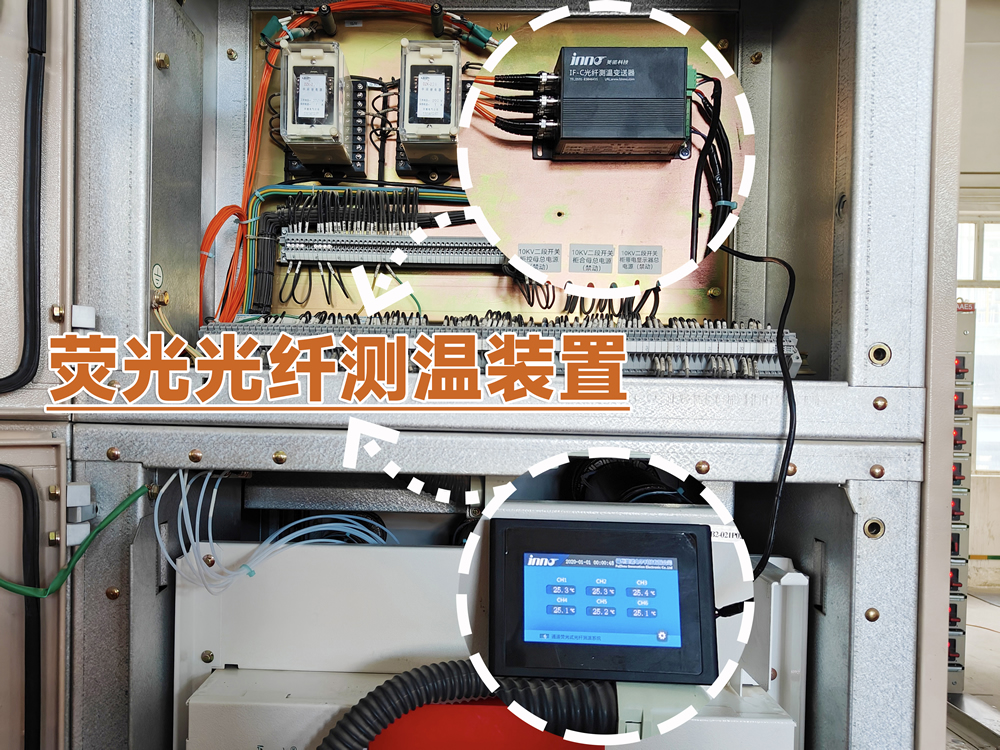
1.2.1 Operating Principle of Fluorescent Temperature Sensors
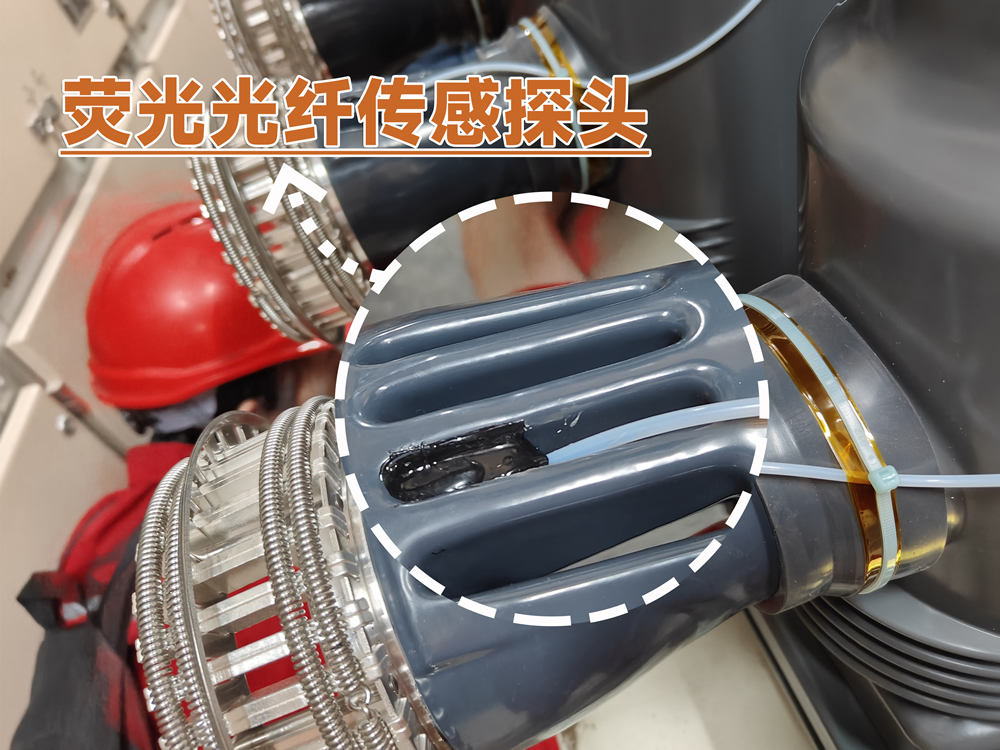
De fluorescerende glasvezel temperatuursensor employs a sophisticated measurement principle based on temperature-dependent fluorescence decay. At the probe tip, rare-earth fluorescent materials are excited by specific wavelength light pulses transmitted through optical fiber. Het fluorescerende materiaal zendt karakteristieke fluorescentiesignalen uit waarvan de vervaltijd precies correleert met de omgevingstemperatuur. De glasvezel temperatuurzender analyseert deze terugkerende fluorescentievervalcurven om nauwkeurige temperatuurwaarden te berekenen.
Deze puntvormige meetbenadering biedt directe contactdetectie op kritieke hotspots. Elk fluorescerende glasvezel kabel meet één specifiek thermisch punt, met een enkel temperatuur demodulator in staat om te verbinden 1-64 individuele glasvezelkanalen. Deze architectuur maakt uitgebreide monitoring op meerdere punten mogelijk, terwijl de meetonafhankelijkheid op elke detectielocatie behouden blijft.
1.2.2 Intrinsieke veiligheidskenmerken
De technologie biedt fundamentele veiligheidsvoordelen door een volledig niet-geleidend ontwerp. Zowel de sensorsonde als de optische vezel bestaan volledig uit isolatiemateriaal zonder metalen geleidende componenten, het elimineren van elektrische veiligheidsrisico's. Optical signal transmission remains unaffected by intense electromagnetic fields or high-voltage environments, making it ideal for switchgear, transformatoren, and other EMI-intensive locations. In tegenstelling tot conventionele thermokoppels of weerstandstemperatuurdetectoren, fluorescent sensing requires no consideration of clearance distances or creepage paths.
1.2.3 Additional Technical Benefits
The compact sensor design features probe diameters of 2-3mm (aanpasbaar), facilitating installation in confined spaces. Flexible fiber optic cables enable versatile routing configurations. System response time under 1 second ensures rapid detection of temperature changes. High measurement accuracy combined with excellent long-term stability supports comprehensive equipment lifecycle temperature profiling. The technology’s withstand voltage exceeds 100kV, providing robust performance in high-voltage applications.
1.3 Application Scenarios and Industry Positioning
1.3.1 Primary Power System Applications
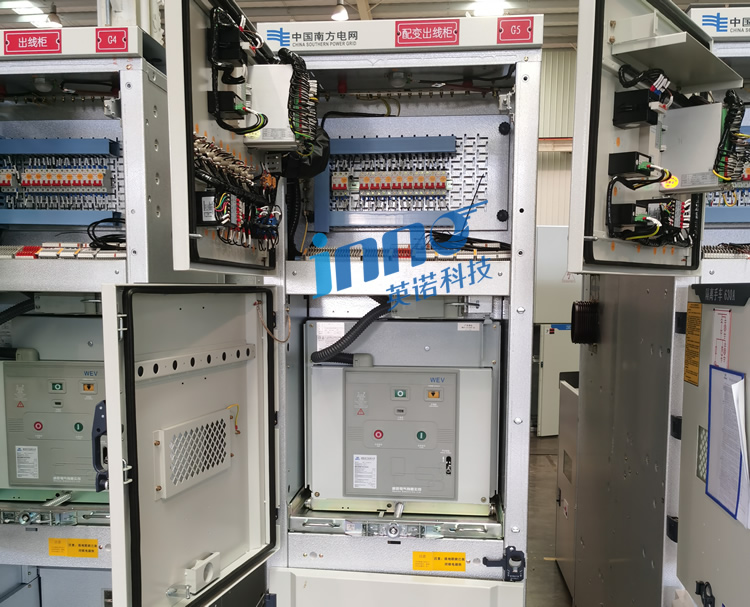
De temperatuurbewakingssysteem dient voornamelijk voor middenspanningsdistributietoepassingen, met name 35 kV-schakelapparatuur in 220 kV step-up-substations en 110 kV step-down-faciliteiten. Typische implementatiescenario's omvatten onderstations voor windparkcollectoren, step-uptransformatoren voor zonne-energiecentrales, distributiecentra op industrieterreinen, en tractieonderstations voor spoorwegvervoer.
1.3.2 Integratie van hernieuwbare energie
In duurzame energienetwerkverbindingssystemen, de monitoringoplossing biedt bijzondere waarde. De intermitterende en fluctuerende kenmerken van de opwekking van wind- en zonne-energie veroorzaken frequente schakelingen die de contactslijtage versnellen. Temperatuurbewaking voorkomt effectief oververhittingsstoringen veroorzaakt door verhoogde contactweerstand. Voor blindvermogencompensatieapparatuur zoals synchrone condensors en SVG-systemen, Thermisch beheer onder bedrijfsomstandigheden met hoge stroomsterkte blijkt bijzonder kritisch.
1.3.3 Expanded Application Domains
Beyond electrical power infrastructure, fluorescerende glasvezelsensoren find applications in medical equipment monitoring, laboratory instrumentation, industrial process control, and research facilities requiring precise, interference-free temperature measurement in challenging electromagnetic environments.
2. Systeemarchitectuur en componenten
2.1 Core Hardware Components
2.1.1 Temperature Demodulator (Fiber Optic Temperature Transmitter)
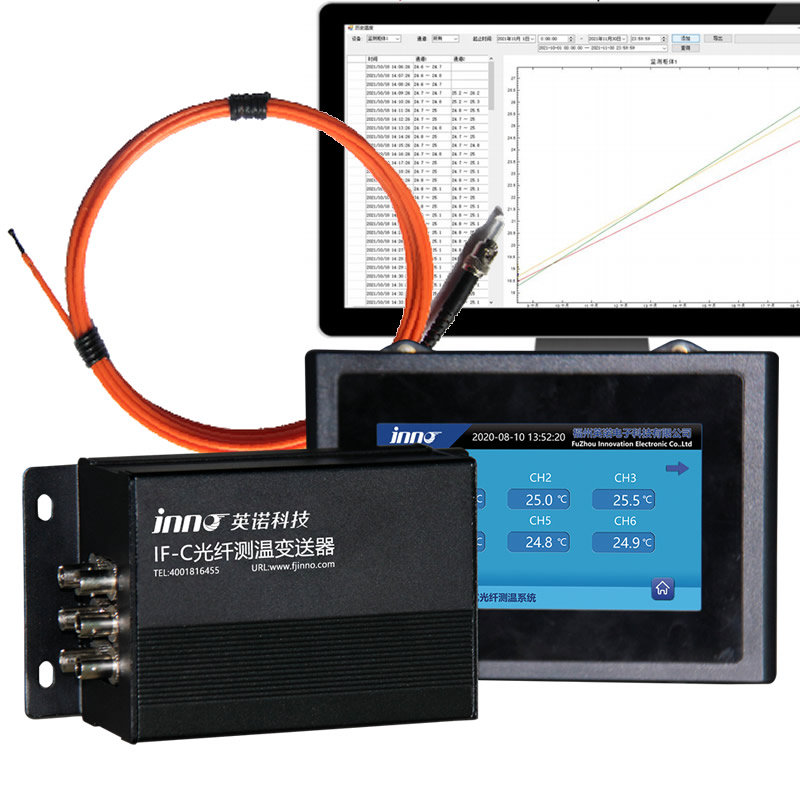
De glasvezel temperatuurdemodulator serves as the system’s signal processing core, executing excitation light source control, fluorescence signal acquisition, temperature calculation, data storage, and communication functions. Typical multi-channel designs support 4, 8, 16, 32, or up to 64 kanalen, enabling a single demodulator to simultaneously monitor multiple measurement points. Equipment features include digital displays (LCD/LED screens or touchscreens) showing real-time temperature values, historische trends, and alarm status. Power supply options accommodate AC 220V or DC 110V/220V with low power consumption characteristics.
2.1.2 Fluorescent Sensor Probes

De sensor sonde construction comprises stainless steel or ceramic encapsulation housing internal rare-earth fluorescent crystals and quartz fiber pigtails. Probe dimensions typically measure 20-50mm in length with 2-3mm diameter (aanpasbaar). Installation interfaces include threaded mounting, magnetic attachment, or epoxy bonding methods. Probes maintain IP67 or higher protection ratings with robust vibration resistance, ensuring reliable long-term operation in harsh switchgear environments. Temperature rating spans -40°C to 260°C with design lifespan exceeding 25 jaar.
2.1.3 Fluorescent Fiber Optic Cables
Optical fiber selection addresses single-mode or multi-mode requirements, jacket materials (flame-retardant, oil-resistant, temperature-resistant), and tensile strength parameters. Standard fiber lengths range from 0-80 meter. Connector types (FC, SC, ST interfaces) must meet optical performance specifications for insertion loss and return loss to maintain measurement accuracy. Cable routing follows strict bending radius controls, secure fixation methods, and proper cabinet penetration sealing.
2.1.4 Monitoring Software and Display Modules
De monitoringsoftware platform provides centralized data management, real-time visualization, historical querying, report generation, trendanalyse, en diagnostische mogelijkheden. The system supports alarm configuration, threshold setting, and automated notification functions.
2.2 System Topology Design
2.2.1 Centralized Monitoring Architecture
De “one-substation-one-system” integrated design philosophy employs RS485-communicatie to connect multiple temperature demodulators to a central monitoring backend. This approach reduces equipment investment, minimizes maintenance workload, en vergemakkelijkt het temperatuurbeheer op stationniveau met correlatieanalyse van meerdere apparatuur. Een typische configuratie van een 220 kV-collectorsubstation omvat talrijke 35 kV-stroomonderbrekerkasten, PT-kasten, en kabelterminals, elk uitgerust met een demodulatorbewaking 9 of meer punten, allemaal verbonden met een verenigd monitoringplatform.
2.3 Communication Interface and Data Transmission
2.3.1 RS485 seriële communicatie
De RS485-interface biedt seriële communicatie van industriële kwaliteit met transmissieafstanden tot 1200 meter, sterk anti-interferentievermogen, en handig multipoint-netwerken. Communicatieparameters omvatten selecteerbare baudsnelheden (9600-115200 bps), databits, stop stukjes, en pariteitsconfiguraties. Netwerktopologie ondersteunt bus- en serieschakelingverbindingen met behulp van afgeschermde twisted-pair-bekabeling met de juiste aarding om common-mode-interferentie te onderdrukken.
2.3.2 Integratie met onderstationautomatiseringssystemen
Als een aanvullend monitoringsubsysteem, de temperatuurbewakingssysteem connects to SCADA master stations through standard protocols including Modbus RTU, IEC 60870-5-101/104, en DNP3. Data uploaded includes real-time temperature values, over-limit alarms, equipment status, and historical records. Protocol standardization ensures interoperability with various manufacturers’ automation systems.
3. Technical Specifications and Performance

3.1 Temperature Measurement Performance
The system achieves ±1°C measurement accuracy across the complete -40°C to 260°C operating range. This wide temperature span accommodates extreme cold climate conditions at the lower limit while providing substantial margin above normal switchgear operating temperatures (typisch <80°C) to detect severe overheating faults. Normal contact temperature rise generally ranges 20-40°C above ambient, with rises exceeding 60°C indicating potential issues and >100°C representing critical failures. Reactietijd onder 1 second enables rapid detection of thermal transients.
3.2 Fiber Optic and Probe Specifications
Fluorescerende vezels cables support lengths from 0 naar 80 meter, providing installation flexibility for distributed measurement points. The 2-3mm probe diameter (aanpasbaar) facilitates mounting in tight spaces. Probe materials ensure complete electrical insulation with withstand voltage ratings exceeding 100kV. Temperature probes maintain accuracy and reliability throughout the full -40°C to 260°C range.
3.3 System Reliability and Lifespan
Sensor probe design lifespan exceeds 25 years under continuous operation, providing exceptional long-term value. The maintenance-free architecture eliminates calibration requirements and periodic sensor replacement. Robust construction withstands electrical, mechanisch, and environmental stresses common in switchgear applications.
3.4 Data Acquisition Capabilities
Enkel demodulator units accommodate 1-64 fiber optic channels with customizable configurations. Continuous data logging captures temperature trends for equipment health analysis. Flexible sampling rates support both rapid monitoring and long-term archival requirements.
4. 9-Point Monitoring Configuration

4.1 Circuit Breaker Cabinet 9-Point Setup
For 35kV circuit breaker cabinets, the comprehensive 9-point monitoring arrangement includes: upper static contacts (3 phases), lower static contacts (3 phases), cable terminal connections (3 phases). This configuration ensures complete thermal surveillance of all critical current-carrying components. Sensorsondes mount directly on contacts and terminals using appropriate fixation methods suited to each location’s mechanical and electrical requirements.
4.2 PT Cabinet Monitoring Layout
Potential transformer cabinets require focused monitoring of primary connection terminals and secondary circuit components prone to thermal stress. Strategic probe placement addresses known hot-spot locations while maintaining safe clearances.
4.3 Cable Terminal Monitoring Solution
Cable terminal monitoring targets connection lugs, compression joints, and stress cone interfaces where resistance heating commonly occurs. The point-type sensing approach provides accurate temperature measurement at each critical junction.
4.4 Measurement Point Optimization Principles
Effective monitoring point selection follows engineering principles: prioritize highest current density locations, consider historical failure data, ensure accessibility for probe installation, and maintain adequate electrical clearances. The 9-point arrangement balances comprehensive coverage with practical implementation constraints.
5. Intelligent Functions and Alarm Systems
De monitoringsoftware implements multi-level alarm thresholds with configurable warning and critical limits. Real-time temperature trending identifies gradual degradation patterns. Automated notification systems alert operators via visual displays, audible alarms, and remote communication protocols. Analyse van historische gegevens ondersteunt voorspellende onderhoudsstrategieën en levenscyclusbeheer van apparatuur.
6. Mondiale toepassingsgevallen
6.1 Implementatie van binnenlandse 220kV-onderstations
Meerdere Chinese collectorsubstations voor windparken hebben het systeem geïmplementeerd in hun 35kV-schakelapparatuurvloot, het bereiken van aanzienlijke verbeteringen in de betrouwbaarheid en het voorkomen van thermische storingen die voorheen opwekkingsverliezen veroorzaakten.
6.2 Internationale energiesysteemtoepassingen
Europese distributienetwerkbeheerders maken gebruik van fluorescente glasvezel temperatuurbewaking in stedelijke onderstations waar ruimtebeperkingen en EMI-uitdagingen conventionele detectietechnologieën uitsluiten. Nutsbedrijven uit het Midden-Oosten hebben de oplossing geïmplementeerd in woestijnomgevingen waar extreme temperaturen om robuustheid vragen, nauwkeurige monitoring.
6.3 Uitbreiding van de medische en laboratoriumsector
Fabrikanten van medische beeldapparatuur integreren de technologie voor het thermisch beheer van MRI- en CT-scanners. Onderzoekslaboratoria maken gebruik van glasvezel temperatuursensoren in magneetsystemen met hoog veld en deeltjesversnellers waar elektromagnetische immuniteit essentieel blijkt.
7. Productcertificeringen en kwaliteitsborging

7.1 Internationale certificeringsportfolio
Fuzhou Innovatie Elektronische Wetenschap&Tech Co., Ltd. onderhoudt uitgebreide productcertificeringen, waaronder RoHS (Beperking van gevaarlijke stoffen), CE (Europese conformiteit), en ISO-kwaliteitsmanagementnormen. Actieve certificeringsprocessen omvatten UL (Underwriters Laboratoria) en ATEX explosieveilige classificaties, blijk geven van betrokkenheid bij de eisen van de mondiale markt.
7.2 Kwaliteitsmanagementnormen
Productieactiviteiten volgen ISO 9001 kwaliteitsmanagementprotocollen met strenge tests bij de componenten, montage, en systeemniveaus. Elk glasvezel temperatuurzender ondergaat kalibratieverificatie en prestatievalidatie vóór verzending.
7.3 Technische ondersteuningsinfrastructuur
Gevestigd in 2011, the company provides comprehensive technical assistance including pre-sales consultation, technische ontwerpondersteuning, installatie begeleiding, and ongoing maintenance services. Global customers receive responsive support through multiple communication channels.
Veelgestelde vragen
Q1: How does fluorescent fiber optic sensing differ from distributed temperature sensing?
A: Fluorescent systems employ point-type contact measurement with one fiber per hotspot, providing precise localized readings. Each measurement point operates independently with dedicated fiber connections to the demodulator.
Vraag 2: Can the system monitor wireless or use wireless communication?
A: The standard system uses wired RS485 communication for reliable data transmission. The sensing technology itself is fiber-optic based, not wireless.
Q3: Welke aanpassingsmogelijkheden zijn er beschikbaar?
A: Probe dimensions (standard 2-3mm diameter), vezel lengtes (0-80M), kanaal telt (1-64), and specialized configurations can be tailored to specific application requirements.
Q4: How long does installation typically require?
A: A standard 9-point switchgear cabinet installation generally requires 4-6 hours including probe mounting, glasvezel routering, en systeeminbedrijfstelling.
Vraag 5: What maintenance does the system require?
A: The maintenance-free design requires no routine calibration or sensor replacement. Periodic verification checks and data review constitute the primary maintenance activities.
Technische ondersteuning en advies
For detailed technical specifications, project quotations, or engineering support, please contact:
Fuzhou Innovatie Elektronische Wetenschap&Tech Co., Ltd.
Gevestigd: 2011
E-mail: web@fjinno.net
WhatsApp/WeChat/Telefoon: +86 13599070393
QQ: 3408968340
Adres: Liandong U Grain Networking Industriepark,
Xingye West Road nr. 12, Fuzhou, Fujian, China
Our experienced engineering team provides comprehensive assistance from initial system design through installation, inbedrijfstelling, and ongoing operational support. Wij zijn blij met vragen over temperatuurbewaking van schakelapparatuur oplossingen, aangepaste configuraties, and integration with existing substation automation infrastructure.
Vrijwaring
The technical information presented in this article represents general specifications and typical performance characteristics of fluorescent fiber optic temperature monitoring systems. Actual system performance may vary based on specific application conditions, installation quality, omgevingsfactoren, en operationele parameters. While we strive to provide accurate and current information, Fuzhou Innovatie Elektronische Wetenschap&Tech Co., Ltd. geeft geen garanties, expliciet of impliciet, wat betreft de volledigheid, nauwkeurigheid, or suitability of this information for any particular purpose.
Productspecificaties, certificeringen, and features are subject to change without notice as part of our continuous improvement efforts. Customers should consult directly with our technical team to confirm current specifications and obtain detailed engineering data for their specific applications. The case studies and application examples described are provided for illustrative purposes and do not constitute guarantees of performance in other installations.
Installatie, operatie, and maintenance of electrical monitoring equipment should be performed only by qualified personnel following applicable safety standards, elektrische codes, en richtlijnen van de fabrikant. Fuzhou Innovatie Elektronische Wetenschap&Tech Co., Ltd. aanvaardt geen aansprakelijkheid voor schade, verwondingen, or losses resulting from improper installation, misuse, or failure to follow recommended practices.
All trademarks, product names, and company names mentioned are the property of their respective owners. References to third-party products or systems are provided for informational purposes only and do not constitute endorsements.

Glasvezel temperatuursensor, Intelligent monitoringsysteem, Gedistribueerde glasvezelfabrikant in China
|
|
 |