 INNO 광섬유 온도 센서 ,온도 모니터링 시스템.
- 형광성 광섬유 온도 센서 provide the optimal solution for microwave hyperthermia monitoring with complete immunity to microwave interference
- All-dielectric construction with no metallic components, probe diameter as small as 600μm suitable for various medical applications
- Achieves ±0.5°C measurement accuracy within human body temperature range with ≤0.5 second response time
- Single device supports 4-16 channel simultaneous temperature monitoring for real-time treatment area coverage
- 인증됨 ISO9001, CE, RoHS standards, with UL, ATEX and other certifications available upon customer requirements
- Excellent biocompatibility with 20-year maintenance-free design for long-term reliable operation
목차
1. Why Does Microwave Hyperthermia Equipment Require Specialized 광섬유 온도 센서?

Microwave hyperthermia equipment generates intense microwave fields during operation, creating unique challenges for temperature monitoring systems. Treatment protocols typically require precise temperature control within narrow therapeutic windows, maintaining target areas between 41-45°C. This precision is critical because temperature variations directly impact treatment effectiveness and patient safety.
The strong electromagnetic environment created by microwave hyperthermia devices renders conventional electronic temperature sensors unreliable. Metal-containing sensors experience induced currents, 전자기 간섭, and unintended heating effects that corrupt temperature readings. Medical practitioners require real-time, accurate temperature data to adjust power output and ensure optimal treatment delivery. Only sensors specifically designed for high-EMI environments can provide the reliability needed for safe, effective hyperthermia therapy.
Critical Temperature Control Requirements
Therapeutic effectiveness depends on maintaining consistent temperatures across treatment zones. 광섬유 온도 센서 enable continuous monitoring without electromagnetic interference, allowing clinicians to verify that all targeted tissue reaches therapeutic temperatures while surrounding areas remain within safe limits. The narrow therapeutic window demands measurement systems with both high accuracy and rapid response capabilities.
2. Can Traditional Thermocouple Temperature Probes Be Used for Microwave Hyperthermia Monitoring?

Thermocouples consist of two dissimilar metals joined together, generating voltage proportional to temperature differences. While widely used in industrial applications, their metallic construction makes them fundamentally incompatible with microwave environments. The metal wires act as antennas, absorbing microwave energy and generating heat independent of the actual tissue temperature being measured.
This antenna effect causes thermocouple readings to register significantly higher than actual temperatures, rendering the data clinically useless. The induced currents flowing through the metallic leads can also create localized heating at the measurement point, potentially causing tissue damage. These inherent limitations make thermocouples unsuitable for microwave hyperthermia temperature monitoring applications where accuracy and safety are paramount.
3. Do Thermistor Temperature Sensors Function Properly in Microwave Environments?

Thermistors offer high sensitivity and compact size, making them popular for many temperature measurement applications. 하지만, their metal lead wires and metallic packaging components suffer from the same electromagnetic interference problems as thermocouples when exposed to microwave fields. The metal leads pick up microwave energy, causing measurement errors and potential safety concerns.
Even thermistors marketed as “small” 또는 “low-profile” contain sufficient metallic material to interact with microwave radiation. The resulting interference compromises measurement accuracy precisely when reliable data is most critical. 을 위한 medical temperature monitoring systems operating in microwave or RF environments, thermistors cannot provide the interference-free performance required for patient safety and treatment efficacy.
4. Can Infrared Temperature Measurement Meet Microwave Hyperthermia Equipment Monitoring Requirements?
Infrared thermometry measures surface temperatures by detecting thermal radiation emitted from objects. While useful for non-contact surface measurements, this technology cannot monitor internal tissue temperatures during hyperthermia treatment. The technique only captures data from the outermost surface layer, providing no information about temperature distribution within deeper tissues where therapeutic effects occur.
Hyperthermia treatments specifically target subsurface tissues, requiring temperature monitoring at various depths to ensure uniform heating throughout the treatment volume. 적외선 온도 센서 cannot penetrate tissue to measure these critical internal temperatures. 추가적으로, surface cooling techniques often used during treatment create temperature gradients that make surface measurements unrepresentative of actual target tissue temperatures. This fundamental limitation disqualifies infrared thermometry for comprehensive hyperthermia temperature monitoring 애플리케이션.
5. What is the Working Principle of 형광 광섬유 온도 센서?
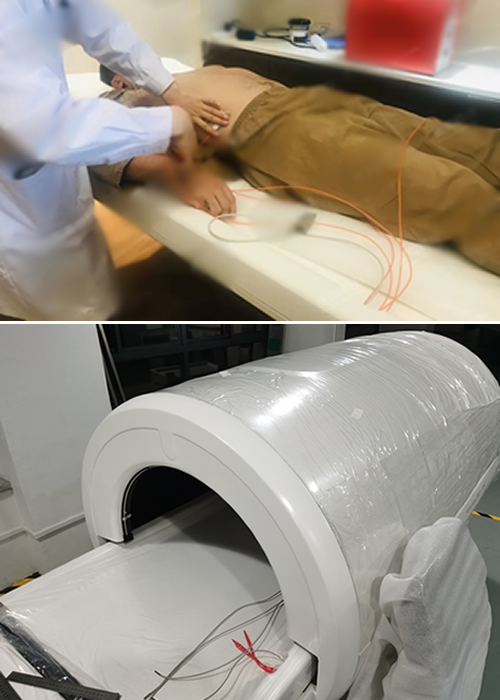
Fluorescent fiber optic temperature sensors utilize rare-earth fluorescent materials that exhibit temperature-dependent optical properties. When excited by light at specific wavelengths, these materials emit fluorescence with decay characteristics that vary predictably with temperature. The sensor probe contains a small crystal of fluorescent material at the fiber tip, while the fiber itself serves as a light guide to transmit both excitation and emission signals.
그만큼 fluorescent fiber temperature measurement system sends excitation light pulses through the optical fiber to the probe tip. The fluorescent material absorbs this energy and emits light at a different wavelength, with a decay time that decreases as temperature increases. By precisely measuring the fluorescence lifetime, the system calculates temperature with high accuracy. This measurement principle requires no electrical components at the sensing point, eliminating all electromagnetic interference concerns.
All-Optical Signal Processing
The entire measurement chain uses optical signals exclusively, from excitation to detection. This all-optical approach provides complete immunity to electromagnetic fields of any strength or frequency. 그만큼 광섬유 온도 프로브 contains only optical glass and fluorescent material, both completely transparent to microwave radiation. This fundamental design advantage makes fluorescent fiber optic sensors ideal for challenging electromagnetic environments including microwave hyperthermia, RF 절제, and MRI applications.
6. 어떻게 Fluorescent Fiber Temperature Systems Achieve Complete Microwave Immunity?
Complete microwave immunity stems from the all-dielectric construction of 형광성 광섬유 온도 센서. Every component along the measurement path consists of non-conductive materials: 광섬유 (fused silica glass), probe housing (ceramic or polymer), and sensing element (형광 크리스탈). Without any metallic parts to interact with electromagnetic fields, these sensors experience zero interference from microwave radiation.
The optical fiber transmits information as light signals traveling through glass, completely isolated from external electromagnetic influences. Microwave energy passes through the dielectric materials without inducing currents, generating heat, or affecting the optical properties of the system. This design enables fiber temperature monitoring systems to operate reliably in microwave field strengths that would completely disable conventional electronic sensors.
Validation in High-Power Microwave Environments
Testing in operational hyperthermia equipment confirms that fluorescent fiber sensors maintain measurement accuracy regardless of microwave power levels. The sensors provide stable, repeatable readings whether the microwave generator operates at minimum or maximum output. This performance consistency ensures reliable temperature monitoring throughout treatment sessions as power levels adjust to maintain target temperatures.
7. What Technical Advantages Do All-Dielectric Fiber Temperature Probes Offer for Microwave Hyperthermia?
All-dielectric construction provides multiple benefits beyond electromagnetic immunity. The absence of metallic components eliminates any risk of probe heating from microwave absorption, preventing potential tissue damage at the measurement point. 광섬유 온도 프로브 remain thermally neutral, measuring tissue temperature without adding heat or creating artifacts in the treatment field.
The small diameter achievable with all-dielectric designs minimizes tissue displacement and trauma during probe insertion. Probes as small as 600μm diameter can be positioned in sensitive areas with minimal invasiveness. The flexible fiber construction allows probes to conform to anatomical structures and remain in position throughout treatment without causing patient discomfort. These practical advantages complement the fundamental electromagnetic immunity to create an ideal solution for medical hyperthermia temperature monitoring.
장기적인 안정성과 신뢰성
Dielectric materials resist corrosion, chemical attack, and degradation in biological environments. Fluorescent fiber temperature sensors maintain calibration accuracy over years of service without drift or performance degradation. The stable optical properties of the sensing materials ensure consistent measurements throughout the sensor lifetime, reducing maintenance requirements and eliminating recalibration needs.
8. What Measurement Accuracy Can Fiber Optic Temperature Sensors Achieve Within Human Body Temperature Range?
현대의 형광성 광섬유 온도 센서 achieve ±0.5°C 정확도 across the full range of temperatures encountered in hyperthermia applications. This precision level meets clinical requirements for therapeutic temperature control, enabling reliable differentiation between effective treatment temperatures and potentially harmful thermal levels. The accuracy specification applies throughout the measurement range relevant to human body temperatures, from baseline physiological temperatures through therapeutic hyperthermia levels.
This level of precision supports real-time treatment adjustments based on measured temperature data. Clinicians can confidently increase or decrease power output knowing that temperature readings accurately reflect tissue conditions. 그만큼 fiber temperature measurement system maintains this accuracy specification regardless of electromagnetic field strength, probe positioning, 또는 환경 조건, providing consistent performance across diverse clinical scenarios.
Calibration and Traceability
Factory calibration references certified temperature standards traceable to national metrology institutes. 각 광섬유 온도 센서 ships with calibration documentation detailing accuracy verification across the specified temperature range. The stable optical measurement principle eliminates calibration drift, maintaining accuracy throughout the sensor’s operational lifetime without field recalibration requirements.
9. What Practical Value Does a 600 Micron Diameter Fiber Probe Provide for Microwave Hyperthermia Applications?
그만큼 600μm diameter fiber temperature probe represents a significant advancement in minimally invasive temperature monitoring. This small diameter approaches the size of standard medical needles, allowing probe insertion with minimal tissue trauma and patient discomfort. The compact form factor enables multiple probe placement for comprehensive temperature mapping without significant anatomical disruption.
Small diameter probes access confined spaces and follow curved anatomical pathways that larger sensors cannot reach. In body cavity applications, the flexibility and compact size of 광섬유 프로브 allow positioning adjacent to target tissues without interfering with applicator placement or treatment delivery. The minimal cross-section reduces acoustic artifacts in ultrasound imaging, maintaining visualization capability during image-guided procedures.
다중 지점 모니터링 기능
The small probe diameter enables deployment of multiple temperature sensors throughout the treatment volume. Practitioners can position probes at critical locations to verify uniform heating, identify hot spots, and monitor temperature gradients. This multi-point capability provides comprehensive thermal mapping impossible with larger, more invasive sensor technologies.
10. What Core Components Make Up a Microwave Fiber Optic Temperature Monitoring System?
완전한 microwave fiber optic temperature monitoring system consists of four primary components working together to deliver accurate, real-time temperature measurements. The system architecture separates the sensing elements exposed to the microwave environment from the electronic processing equipment located in a protected area.
시스템 구성요소
광섬유 온도 프로브 serve as the sensing elements positioned at measurement locations within or adjacent to the treatment area. These probes contain the fluorescent sensing material and connect to optical fibers that transmit light signals to the processing unit. Probe diameters range from 600μm to 1.0mm 응용 프로그램 요구 사항에 따라, with lengths customized for specific anatomical access needs.
그만큼 광섬유 케이블 provide the communication pathway between probes and electronics. These cables contain one or more optical fibers protected by a medical-grade outer jacket. Standard cable lengths extend up to 10 미터, allowing flexible equipment positioning while maintaining signal integrity. The all-glass fiber construction ensures complete electromagnetic immunity along the entire signal path.
그만큼 fluorescent fiber temperature measurement console houses the optical excitation source, detection optics, 신호 처리 전자 장치, and user interface. This unit generates excitation light pulses, measures fluorescence decay characteristics, calculates temperatures, and displays real-time data. Modern consoles support 4-16 channel simultaneous monitoring, allowing comprehensive temperature mapping with a single device.
Data connectivity enables integration with hyperthermia equipment and hospital information systems. Standard interfaces include analog outputs, digital communication protocols, and network connectivity for remote monitoring and data archiving. 그만큼 온도 모니터링 시스템 provides alarm outputs to trigger safety interlocks when temperatures exceed programmed limits.
11. How Does Multi-Channel Fluorescent Fiber Temperature Monitoring Achieve Full Treatment Area Coverage?
다중 채널 fluorescent fiber temperature systems enable simultaneous monitoring at multiple locations, providing comprehensive thermal mapping of treatment areas. A single console with 4-16 독립 채널 supports probe positioning at strategic locations to characterize temperature distribution throughout the target volume and surrounding tissues. This spatial temperature data reveals heating uniformity and identifies areas requiring power adjustment.
Each channel operates independently with dedicated optical paths and signal processing, ensuring that measurements from different locations do not interfere with each other. The system updates all channel readings simultaneously at rates up to 2 헤르츠, providing real-time thermal imaging data. Clinicians can identify temperature gradients, verify that all target tissue reaches therapeutic levels, and confirm that surrounding structures remain within safe temperature limits.
Strategic Probe Placement
Effective temperature monitoring requires thoughtful probe positioning based on treatment planning and anatomical considerations. Typical configurations place probes at the treatment center, periphery locations, and reference positions in uninvolved tissue. 그만큼 multi-channel fiber temperature monitoring capability allows comprehensive coverage without multiple separate instruments, streamlining setup and data management.
12. 어떻게 0.5 Second Response Time in Fiber Temperature Sensors Help Treatment Control?
그만큼 ≤0.5 second response time of fluorescent fiber optic sensors enables real-time treatment control and rapid response to temperature changes. When microwave power increases, the sensor detects resulting temperature rise within half a second, allowing immediate feedback for power adjustment algorithms. This rapid response prevents temperature overshoot and maintains stable conditions throughout treatment.
Fast response time proves particularly valuable during treatment initiation when temperatures rise rapidly as microwave energy begins heating tissue. 그만큼 광섬유 온도 센서 tracks this dynamic heating phase accurately, providing data for automatic or manual power control to achieve target temperatures efficiently without excessive overshoot. 비슷하게, during power reductions or treatment conclusion, the sensor quickly confirms temperature decreases.
Enhanced Safety Through Rapid Detection
Should unexpected hot spots develop or equipment malfunctions occur, the fast response time enables rapid detection and intervention. 그만큼 fiber temperature monitoring system can trigger immediate power reduction or shutdown within seconds of detecting excessive temperatures, minimizing exposure to potentially harmful thermal levels. This safety capability relies on sensors that respond quickly enough to detect and report temperature excursions before tissue damage occurs.
13. How Do Medical Fiber Temperature Probes Meet Medical-Grade Biocompatibility Standards?
Medical fiber optic temperature probes utilize materials specifically selected and tested for biocompatibility according to ISO 10993 표준. The probe construction employs medical-grade optical fibers with biocompatible outer jackets approved for tissue contact. Probe tip materials consist of inert ceramics or medical polymers that do not elicit adverse biological responses during clinical use.
Manufacturers conduct comprehensive biocompatibility testing including cytotoxicity, sensitization, irritation, and systemic toxicity evaluations. These tests verify that all materials in tissue contact meet requirements for the intended duration and type of tissue exposure. For probes designed for extended implantation, additional testing confirms suitability for long-term tissue contact applications.
Sterilization Compatibility
의료 fiber temperature probes withstand standard sterilization methods including ethylene oxide (EtO) and gamma irradiation without performance degradation. The optical components and biocompatible materials maintain their properties through sterilization cycles, ensuring reliable measurements after sterilization. Single-use disposable probes ship pre-sterilized, while reusable designs support multiple sterilization cycles for multi-patient use.
14. What Special Requirements Exist for Fiber Optic Sensors in RF Hyperthermia Equipment Temperature Monitoring?
RF hyperthermia equipment operates at lower frequencies than microwave systems but generates equally challenging electromagnetic environments for temperature sensors. The same all-dielectric construction that provides microwave immunity also ensures reliable operation in RF fields. 형광성 광섬유 온도 센서 perform identically across the frequency spectrum from RF through microwave ranges, making them suitable for all electromagnetic hyperthermia modalities.
RF applicators often require multiple temperature monitoring points to verify uniform heating across large treatment volumes. The multi-channel capability of fiber temperature systems supports the extensive monitoring needed for RF hyperthermia applications. Probe configurations for RF applications may emphasize longer probes for deep tissue access and robust construction to withstand repositioning during treatment optimization.
Integration with RF Control Systems
현대의 RF 고열 시스템 incorporate automatic power control based on temperature feedback. 그만큼 광섬유 온도 모니터링 시스템 provides analog or digital outputs compatible with RF generator control inputs, enabling closed-loop temperature regulation. This integration allows the RF system to automatically adjust power output to maintain target temperatures, improving treatment consistency and reducing operator workload.
15. How Do Fluorescent Fiber Temperature Systems Achieve Data Integration with Microwave Hyperthermia Devices?
Integration between fluorescent fiber temperature monitoring systems and hyperthermia equipment occurs through multiple connectivity options. Analog voltage or current outputs provide real-time temperature data to hyperthermia device control systems, enabling automatic power regulation based on measured temperatures. These outputs scale proportionally to temperature, allowing simple integration with analog control circuits.
Digital communication interfaces including RS-232, RS-485, and Ethernet enable more sophisticated data exchange. 그만큼 온도 모니터링 시스템 can transmit detailed information including individual channel temperatures, 알람 상태, and system diagnostics to the hyperthermia controller or external monitoring computers. Some systems support standard medical device communication protocols for integration with hospital information systems.
Real-Time Data Display and Recording
Integrated systems display temperature data alongside hyperthermia equipment parameters, providing operators with comprehensive treatment monitoring from a unified interface. Temperature trends, 알람 이벤트, and power adjustments appear together in synchronized timeline displays. 그만큼 fiber temperature system logs all data with timestamps, creating permanent treatment records for quality assurance and clinical documentation.
16. What Conditions Must MRI-Compatible Fiber Optic Temperature Sensors Meet?
MRI compatibility requires complete absence of ferromagnetic materials and minimization of conductive components that could interact with MRI magnetic fields or RF pulses. 광섬유 온도 센서 inherently meet these requirements through their all-dielectric construction containing no metals or magnetic materials. The sensors operate reliably inside MRI bores without causing image artifacts or experiencing measurement interference from MRI fields.
MRI-compatible 온도 모니터링 enables real-time thermal imaging during MRI-guided interventions. The fiber sensors provide quantitative temperature measurements complementing MRI thermometry techniques, offering validation data and monitoring at locations beyond MRI thermal imaging coverage. This combination delivers comprehensive thermal monitoring during MRI-guided procedures including focused ultrasound treatments and other thermal therapies.
MRI Safety Certifications
MRI-compatible 섬유 온도 센서 undergo testing according to ASTM standards for MRI device safety. Testing confirms that sensors do not heat, move, or malfunction in MRI magnetic fields up to 3 Tesla or higher. Safety labeling indicates the field strengths and MRI configurations where the sensors are safe for use, supporting regulatory compliance for MRI-guided procedures.
17. What Differences Exist Between Surface and Cavity Fiber Temperature Probe Configuration Solutions?
Surface temperature monitoring applications use 광섬유 프로브 with shallow penetration designs optimized for skin or mucosal surface contact. These configurations often incorporate flat or curved contact surfaces that conform to body contours while maintaining consistent thermal contact. Adhesive mounting options secure surface probes in position throughout treatment, preventing displacement that could compromise measurement locations.
Cavity applications require longer, more flexible probes that navigate anatomical passages and position sensing elements adjacent to internal target tissues. Fiber temperature probes for cavity use feature atraumatic tips and flexible shafts that follow curved paths without tissue damage. Probe lengths extend from 15cm to 50cm or more depending on anatomical access requirements, with diameter selections balancing minimal invasiveness against mechanical robustness.
Application-Specific Probe Selection
Manufacturers offer probe families optimized for different anatomical applications. Esophageal probes for cardiac ablation monitoring, rectal probes for pelvic hyperthermia, and interstitial needle probes for direct tissue insertion represent specialized configurations. Each design addresses specific clinical requirements including insertion depth, positioning stability, and patient comfort while maintaining the core temperature measurement performance.
18. How Do Fiber Optic Sensors Enable Temperature Limit Alarm Systems in Hyperthermia Equipment?
Fluorescent fiber temperature monitoring systems include programmable alarm capabilities for patient safety. Operators configure high and low temperature limits for each monitoring channel, with the system continuously comparing measured temperatures against these thresholds. When any channel exceeds programmed limits, the system activates visual and audible alarms while simultaneously sending alarm signals to connected equipment.
Alarm outputs can trigger automatic safety responses in integrated hyperthermia systems. Common implementations include automatic power reduction when temperatures approach upper limits and treatment shutdown if critical thresholds are exceeded. 그만큼 fiber temperature system alarm response time, combined with the sensor’s fast response, enables intervention within seconds of threshold violations, minimizing exposure to excessive temperatures.
Alarm Configuration Flexibility
Advanced systems support multiple alarm levels for staged responses. Warning alarms at temperatures below critical limits alert operators to trends requiring attention, while critical alarms at higher thresholds trigger automatic safety actions. Different alarm settings can apply to different monitoring channels, recognizing that acceptable temperature ranges may vary by anatomical location. Time-delay settings prevent nuisance alarms from brief, clinically insignificant temperature excursions.
19. What Medical Device Certifications and Quality Standards Apply to Fluorescent Fiber Temperature Monitoring Systems?
전문적인 광섬유 온도 모니터링 시스템 for medical applications meet comprehensive quality and safety standards. ISO9001 certification demonstrates manufacturer commitment to quality management throughout design, 생산, 및 서비스 프로세스. This certification ensures consistent product quality and continuous improvement practices.
CE마킹 indicates compliance with European Medical Device Regulation (MDR) 요구 사항, confirming that devices meet safety and performance standards for medical use in European markets. The CE marking process includes technical documentation review, 위험 분석, and quality system assessment by notified bodies. RoHS 인증 verifies compliance with restrictions on hazardous substances, ensuring environmental safety.
Manufacturers can provide UL certification for North American markets, demonstrating compliance with electrical safety standards. ATEX or IECEx certifications are available for applications in potentially explosive atmospheres where flammable anesthetics or oxygen-enriched environments exist. These certifications confirm intrinsically safe operation incapable of generating sparks or excessive heat.
맞춤형 인증 지원
Reputable manufacturers work with customers to obtain additional certifications required for specific markets or applications. This support includes providing technical documentation, 테스트 데이터, and design information needed for regulatory submissions. Manufacturers experienced in medical device markets understand certification requirements and design products with regulatory compliance in mind, streamlining the approval process for customers integrating fiber temperature systems into their medical devices.
20. How to Select a Professional Medical Fiber Optic Temperature Sensor Supplier and Technical Support?

Selecting a reliable fiber optic temperature sensor supplier requires evaluating multiple factors beyond basic product specifications. Manufacturing experience in medical applications demonstrates understanding of quality requirements, 규제 준수, and clinical needs. Suppliers with established track records in medical device markets bring valuable expertise to product selection and implementation.
Technical support capabilities prove critical for successful system integration and ongoing operation. Comprehensive support includes application engineering assistance for probe selection and placement, integration guidance for connecting with hyperthermia equipment, and responsive troubleshooting when issues arise. Suppliers should provide detailed technical documentation, 교정 인증서, and user training to ensure proper system operation.
Quality and Reliability Factors
Manufacturing quality directly impacts measurement reliability and system longevity. Look for suppliers with ISO9001 certification and established quality control processes including incoming material inspection, 진행중인 테스트, and final product validation. Long warranty periods and low failure rates indicate confidence in product quality and manufacturing processes.
맞춤화 기능
Medical applications often require customized probe configurations, 케이블 길이, or interface specifications. Suppliers with in-house design and manufacturing capabilities can develop custom solutions meeting unique application requirements. This flexibility proves valuable for specialized procedures or novel treatment approaches requiring non-standard temperature monitoring solutions.
자주 묻는 질문
What makes fiber optic sensors better than traditional sensors for hyperthermia monitoring?
광섬유 온도 센서 offer complete immunity to electromagnetic interference through all-dielectric construction, eliminating the measurement errors and safety concerns associated with metal-containing sensors in microwave and RF environments. The technology provides ±0.5°C accuracy with 0.5 second response time while maintaining biocompatibility for medical applications.
Can one monitoring system work with different hyperthermia equipment types?
예. Fluorescent fiber temperature monitoring systems function reliably across all electromagnetic hyperthermia modalities including microwave, RF, and other heating technologies. The same system works with different equipment manufacturers through standard analog and digital interface options.
How many temperature points can be monitored simultaneously?
현대의 multi-channel fiber temperature systems 지원하다 4-16 simultaneous monitoring channels in a single console. This capability enables comprehensive temperature mapping throughout treatment volumes and surrounding tissues using one integrated system.
Do the fiber sensors require calibration or maintenance?
The stable optical measurement principle eliminates calibration drift over the sensor’s 20-year design life. Sensors ship factory-calibrated and maintain accuracy throughout their operational lifetime without field recalibration requirements. The systems require no routine maintenance beyond basic cleaning of reusable probes between uses.
What probe sizes are available for different clinical applications?
Fiber temperature probes are available in diameters from 600μm to 1.0mm with lengths from 10cm to 50cm or more. Surface contact probes, cavity probes, and interstitial needle configurations address diverse anatomical access requirements across different treatment sites.
How quickly can the system detect temperature changes?
그만큼 ≤0.5 second response time enables real-time tracking of temperature changes during treatment. This rapid response supports effective power control and safety monitoring, detecting temperature excursions quickly enough for timely intervention.
Professional Fiber Optic Temperature Monitoring Solutions
복주 혁신 전자 과학&테크(주), 주식회사. 전문적으로 해왔습니다 형광성 광섬유 온도 센서 and monitoring systems since 2011. Our products serve medical device manufacturers and clinical facilities worldwide, providing reliable temperature monitoring solutions for hyperthermia, MRI, and other demanding electromagnetic environments.
Contact Our Technical Team
Our application engineers provide expert guidance for sensor selection, 시스템 통합, 규제 준수. 우리는 제공합니다:
- Custom probe configurations for specific anatomical applications
- Multi-channel monitoring systems with 4-16 채널 용량
- Complete integration support with hyperthermia equipment
- Certification assistance for medical device approvals
- 제품 수명주기 전반에 걸친 대응적인 기술 지원
제조업체: 복주 혁신 전자 과학&테크(주), 주식회사.
확립된: 2011
이메일: web@fjinno.net
WhatsApp/위챗/전화: +86 13599070393
QQ: 3408968340
주소: Liandong U 곡물 네트워킹 산업 단지, No.12 Xingye West Road, 푸저우, 푸젠성, 중국
웹사이트: www.fjinno.net
부인 성명
This technical guide provides general information about fiber optic temperature monitoring technology for microwave hyperthermia and related medical applications. The information presented is based on current technology capabilities and industry standards as of December 2025. 정확성을 위해 노력하는 동안, specific product specifications, 인증, and capabilities may vary by model and application.
Medical device applications must comply with applicable regulatory requirements in their jurisdictions. Users are responsible for ensuring that temperature monitoring systems meet all relevant standards and obtain necessary approvals for their intended use. This document does not constitute medical advice, treatment recommendations, or regulatory guidance.
Product selection should be based on specific application requirements, clinical protocols, 규제 준수 요구 사항. Contact our technical team for detailed specifications, certification documentation, and application-specific guidance. Performance characteristics mentioned in this guide represent typical values under standard conditions and may vary based on specific configurations and operating environments.

광섬유 온도 센서, 지능형 모니터링 시스템, 중국의 분산광섬유 제조업체
 |
 |
 |