 INNO 광섬유 온도 센서 ,온도 모니터링 시스템.
- 변압기 오일 온도 상승은 절연 노화 및 권선 손상의 가장 먼저 측정 가능한 징후이므로 지속적으로 모니터링해야 합니다., 주기적으로 확인하지 않음
- 완전한 오일 온도 모니터링 시스템은 온도 센서로 구성됩니다., 제어 장치, 경보 회로, 및 자동 회로 차단기 트립 회로
- 최고 오일 온도와 와인딩 핫스팟 온도는 서로 다른 두 가지 측정 지점입니다. 둘 다 완벽한 열 보호를 위해 필요합니다.
- 오일 온도가 구성된 한계를 초과하는 경우, 시스템은 회로 차단기 트립 코일을 구동하고 변압기를 자동으로 분리합니다.
- 2단계 보호(고온 경보 후 과열 트립이 발생)는 자동 연결 해제 전 운영자에게 응답 창을 제공합니다.
- Fiber optic temperature sensors measure winding hot spot temperature directly inside the transformer tank without any metallic conductors in the oil
- IEC 60076 defines the thermal class and allowable temperature rise limits that determine where trip thresholds must be set
- Real-time online monitoring detects thermal anomalies hours or days before they escalate into a protection trip or catastrophic failure
목차
- Why does transformer oil temperature rise and what damage does it cause?
- What does a transformer oil temperature monitoring system consist of?
- Where exactly should temperature sensors be installed on a transformer?
- How does oil temperature monitoring automatically operate a circuit breaker?
- What is the difference between an alarm trip and an emergency trip in transformer protection?
- How are automatic circuit breaker trip thresholds set for transformer oil temperature?
- Why does a transformer need real-time online monitoring instead of periodic inspection?
- FAQ: 변압기 오일 온도 모니터링
1. Why does transformer oil temperature rise and what damage does it cause?
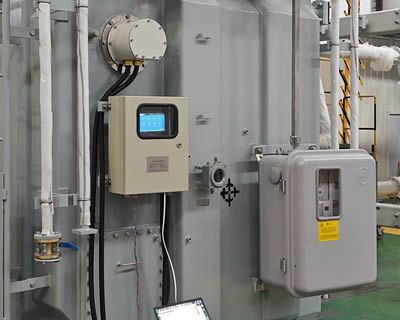
Every power transformer generates heat as a by-product of its normal operation. Core losses from magnetic hysteresis and eddy currents produce a steady baseline heat load regardless of the connected load. Copper losses in the primary and secondary windings add a load-dependent heat component that rises with the square of the current. 정상적인 작동 조건에서, the transformer oil absorbs this heat and transfers it to the tank surface and cooling radiators, maintaining the winding temperature within the design envelope.
Problems begin when the heat input exceeds the cooling system’s capacity to dissipate it. 막힌 라디에이터 핀, 실패한 냉각 팬, 강제 오일 냉각 장치의 오일 펌프 압류, 또는 지속적인 과부하 상태는 모두 열 발생과 열 제거 사이의 여유를 감소시킵니다.. 기름 온도가 올라가요, 그리고 그 오일에 담긴 모든 와인딩 회전의 온도를.
절연 수명에 대한 Arrhenius 효과
변압기 권선 절연체(주로 오일이 함침된 크라프트지)는 Arrhenius 비율 법칙에 따라 성능이 저하됩니다.. 절연체의 정격 열 등급보다 지속적인 권선 온도가 6~8°C 상승할 때마다, 단열재의 예상 사용 수명은 대략 절반으로 줄어듭니다.. 달리는 변압기 20 장기간 동안 정격 최고 오일 온도보다 °C 높으면 몇 주 만에 절연 수명이 수년 소모됩니다.. The damage is cumulative and irreversible: once cellulose insulation has thermally degraded, no maintenance procedure restores its dielectric strength.
Failure sequence without temperature protection
In the absence of 변압기 열 보호, the degradation sequence moves through predictable stages. Insulation brittleness increases, reducing its ability to withstand the mechanical forces of through-fault currents. Dissolved gas levels in the oil rise — detectable by Dissolved Gas Analysis (DGA) — as paper and oil begin to decompose thermally. Eventually, a routine fault current or switching transient that the transformer would otherwise have survived without consequence causes an inter-turn short circuit or a winding-to-tank flashover, resulting in a catastrophic failure that takes the unit out of service for months and requires complete rewinding or replacement.
2. What does a transformer oil temperature monitoring system consist of?

에이 transformer oil temperature monitoring system is an integrated protection chain. Each component in the chain must function correctly for the system to deliver reliable automatic protection.
온도 센서
The sensing layer measures the actual temperature at the critical points in the transformer. Dial-type oil thermometers with micro-switch contacts are the traditional solution for top oil temperature measurement on the transformer tank. 저항 온도 감지기 (RTD) — typically Pt100 elements — provide accurate analogue signals compatible with electronic monitoring systems. 광섬유 온도 센서 using fluorescence decay principles are increasingly deployed for direct winding hot spot measurement inside the transformer tank, 전자기 간섭에 대한 내성이 있고 오일에 금속 도체가 없기 때문에 가장 안전하고 정확한 옵션이 됩니다..
온도 컨트롤러 및 모니터링 장치
그만큼 변압기 온도 컨트롤러 모든 센서로부터 신호를 수신합니다., 측정값을 로컬로 표시, 구성된 경보 및 트립 임계값과 비교합니다., 임계값이 초과되면 출력 릴레이를 구동합니다.. 최신 장치에는 데이터 로깅이 통합되어 타임스탬프와 함께 온도 기록을 저장합니다., SCADA 통합을 위한 RS-485 또는 이더넷 통신 포트, 냉각 시스템 제어는 물론 경보 및 트립 신호를 위한 구성 가능한 릴레이 출력.
경보 및 트립 릴레이 회로
온도 컨트롤러의 출력 릴레이 접점은 변전소 보호 체계에 연결됩니다.. The alarm relay contact drives an audible or visual annunciator in the control room. The trip relay contact is wired in series with the circuit breaker trip coil — when the contact closes, it energises the trip coil and the breaker opens, disconnecting the transformer from the supply.
냉각 시스템 제어
최대 변압기 온도 모니터링 시스템 also control the cooling equipment. As oil temperature rises through defined stages, the controller switches on additional cooling fans or starts the oil circulation pump automatically, increasing cooling capacity before the alarm threshold is reached. This staged cooling response reduces the frequency of alarm events and extends transformer service life by keeping the operating temperature as low as practical.
3. Where exactly should temperature sensors be installed on a transformer?

Correct sensor placement is the foundation of effective 변압기 온도 모니터링. Measuring at the wrong location gives a reading that does not represent the thermal stress the insulation is actually experiencing.
Top oil temperature measurement
그만큼 최고 오일 온도 sensor — a dial thermometer or RTD element — is installed in a purpose-built pocket on the transformer tank cover, immersed in the oil at the highest point of the tank. Because hot oil rises, the top oil temperature represents the hottest oil in the cooling circuit and gives the best available indirect indication of winding thermal stress in the absence of direct winding sensors. IEC 60076-2 specifies the measurement location and pocket dimensions for calibration purposes.
Winding hot spot temperature measurement
그만큼 구불구불한 핫스팟 온도 is the highest temperature anywhere in the winding assembly. It occurs at a point approximately one-third to one-quarter of the winding height from the top in most transformer designs, where the combination of local heat generation and reduced oil flow velocity is most severe. Directly measuring this temperature requires a sensor installed inside the transformer tank, between the winding conductors.
Why fiber optic sensors are used for winding hot spot measurement
광섬유 온도 센서 are the established method for direct winding hot spot measurement in oil-immersed transformers. The sensing probe — a small-diameter optical fiber with a fluorescent element at its tip — is inserted between winding conductors during transformer manufacture or rewinding. Because the probe contains no metallic conductors, it introduces no additional current path, no risk of inter-turn short circuit, and no electromagnetic interference into the measurement signal. The fiber cable exits the tank through a purpose-built oil-tight gland and connects to an interrogation unit mounted on the tank exterior. Fluorescence fiber optic sensing delivers measurement accuracy of ±1 °C and a probe service life exceeding 30 years under continuous oil immersion.
Ambient temperature reference
에이 ambient temperature sensor mounted in the shade adjacent to the transformer provides the reference reading used to calculate temperature rise above ambient — the parameter that IEC 60076 uses to define the thermal limits rather than absolute temperature, since absolute temperature varies with site altitude and climate.
4. How does oil temperature monitoring automatically operate a circuit breaker?
변압기 과열에 따른 자동 회로 차단기 작동은 릴레이 접점과 차단기에 내장된 트립 코일을 통해 구현되는 간단한 보호 논리입니다.. 신호 경로를 이해하면 시스템이 신뢰할 수 있는 이유와 수동 개입보다 더 빠르게 반응하는 이유가 명확해집니다..
트립 신호 경로
온도 컨트롤러가 측정된 오일 또는 권선 온도가 구성된 온도를 초과했다고 판단한 경우 과열 트립 임계값, 출력 릴레이에 전원을 공급합니다.. 해당 릴레이의 상시 개방 접점이 닫힙니다., 을 통해 흐르는 DC 회로를 완성합니다. circuit breaker trip coil. 트립 코일은 차단기의 스프링 장착 메커니즘을 해제하는 자력을 생성합니다., 차단기는 트립 코일에 전원이 공급된 후 50~100밀리초 이내에 주 접점을 엽니다.. 추가 열 손상이 발생하기 전에 변압기가 전원 공급 장치로부터 분리됩니다..
트립 코일 감독
잘 설계된 보호 체계에서, 그만큼 트립 코일 회로 트립 회로 감시에 의해 지속적으로 감시됩니다. (TCS) 트립 코일 및 관련 배선의 연속성을 모니터링하는 릴레이. 트립 코일이 소손되거나 단선된 경우, TCS 계전기는 보호 시스템 작동이 요청되기 전에 즉시 경보를 울립니다.. 트립 회로 고장은 최악의 순간에만 드러나는 소리 없는 결함이기 때문에 이 감독 기능은 필수적입니다..
잠금 릴레이 통합
중요 변압기용, 그만큼 온도 트립 출력 일반적으로 잠금 릴레이에 연결됩니다. (86 ANSI 명명법의 릴레이). 잠금 릴레이는 작동 상태를 밀봉하고 온도 트립 후 변압기의 자동 재공급을 방지합니다.. 운영자는 열 결함을 조사하고 해결한 후 배전반에서 잠금 릴레이를 물리적으로 재설정해야 합니다. 이는 자동 재폐로 방식에 의해 변압기가 결함 상태에 다시 연결되는 것을 방지하는 의도적인 설계 선택입니다..
5. What is the difference between an alarm trip and an emergency trip in transformer protection?
2단계 열 보호는 다음을 위한 표준 관행입니다. 전력 변압기 온도 모니터링. 두 단계는 서로 다른 목적을 갖고 서로 다른 반응을 이끌어냅니다..
단계 1 — 고온 경보
그만큼 고온 경보 첫 번째 단계입니다, 변압기가 정상 범위를 벗어나 작동하고 있지만 아직 즉각적인 분리가 필요한 수준에 도달하지 않았음을 나타내는 온도로 설정. 이 기준점을 넘으면, the monitoring system activates an audible or visual alarm in the control room, initiates maximum cooling (switching on all available fans and oil pumps), and logs the event with a timestamp. The transformer remains in service. Operations staff are expected to investigate the cause — a blocked radiator, a failed cooling fan, an overload condition — and take corrective action within the time available before the second-stage threshold is reached.
단계 2 — Overtemperature trip
그만큼 overtemperature trip is the second stage, set at a temperature above which continued operation would cause rapid and irreversible insulation damage. 이 기준점을 넘으면, the monitoring system immediately drives the circuit breaker trip coil. No operator action is required or expected — the system disconnects the transformer automatically. The time between the Stage 1 alarm and the Stage 2 trip gives operators a defined window to attempt a load reduction or cooling restoration before the automatic disconnection occurs. In most utility and industrial protection settings, this window is between 10 그리고 30 minutes depending on how widely the two thresholds are separated.
Cooling failure alarm
A third alarm output — sometimes called the cooling failure alarm — is triggered when a cooling fan or pump motor fails regardless of the current oil temperature. This alarm alerts maintenance staff to restore cooling capacity before the thermal headroom is consumed, providing the earliest possible warning of a developing overtemperature condition rather than waiting for the temperature itself to rise.
6. How are automatic circuit breaker trip thresholds set for transformer oil temperature?
Threshold setting is an engineering task, not a default configuration exercise. The correct values depend on the transformer’s insulation thermal class, its cooling method, the site ambient temperature, and the load profile it serves.
IEC 60076 temperature limits
IEC 60076-2 (액체 침지 변압기의 온도 상승) defines the maximum allowable temperature rise above a 40 °C reference ambient for each thermal class. For a standard Class A (mineral oil, ONAN cooling) 변신 로봇, the maximum top oil temperature rise is 60 K and the maximum average winding temperature rise is 65 케이, giving a maximum top oil temperature of 100 °C and a maximum average winding temperature of 105 °C at the 40 °C reference ambient. The winding hot spot is permitted to be up to 78 K above ambient — reaching 118 °C — under rated load conditions.
Practical alarm and trip settings
실제로, 그만큼 고온 경보 for top oil is commonly set at 85–90 °C, providing a margin of 10–15 °C below the IEC limit that gives the cooling system time to respond. 그만큼 overtemperature trip for top oil is commonly set at 95–100 °C. 을 위한 구불구불한 핫스팟 온도 measured directly by fiber optic sensors, the alarm is typically set at 110 °C and the trip at 120–125 °C, reflecting the higher permitted hot spot values in IEC 60076-7 (로딩 가이드).
Site-specific adjustments
Transformers installed at high altitude sites experience reduced air density that impairs convective cooling. IEC 60076-2 specifies a derating factor that reduces the allowable temperature rise for every 500 m above 1000 m altitude. Transformers in arctic climates with maximum ambient temperatures significantly below 40 °C may have their alarm thresholds adjusted upward to avoid nuisance alarms during legitimate maximum-load operation. All threshold adjustments must be documented in the protection settings record and reviewed whenever the transformer’s load profile changes significantly.
7. Why does a transformer need real-time online monitoring instead of periodic inspection?
Manual inspection of transformer oil temperature — a technician reading the dial thermometer on the tank during a site visit — is the minimum baseline practice. It is not adequate protection for any transformer whose failure would cause significant production loss, supply interruption, or safety risk.
The time gap problem
A transformer can move from normal operating temperature to a critical overtemperature condition in under an hour under the right combination of load increase and cooling failure. A weekly inspection schedule leaves a 168-hour window during which this transition can occur, progress through the insulation damage phase, 외부 징후 없이 치명적인 오류에 도달합니다.. 실시간 온라인 모니터링 이 창을 완전히 닫습니다. 시스템은 경보 임계값을 기준으로 모든 온도 판독값을 지속적으로 평가합니다., 매일 매 순간.
부하 상관 추세
에이 연속 변압기 온도 모니터링 시스템 각 시점의 부하 전류와 상관된 온도 이력을 축적합니다.. 이 데이터 세트는 정기 검사로 식별할 수 없는 패턴을 보여줍니다.: 지속적으로 도달하는 변압기 88 부하가 최고조에 달하는 주중 오후 °C, 또는 냉각 라디에이터가 점차적으로 침적되면서 주어진 부하 수준에 대한 온도 반응이 6개월에 걸쳐 서서히 상승하는 장치. 두 패턴 모두 실행 가능한 유지 관리 인텔리전스입니다.. 월별 다이얼 판독값에는 둘 다 표시되지 않습니다..
Automatic response eliminates human delay
When a thermal event develops rapidly — a sudden cooling pump failure at peak load on a hot summer afternoon — the time between the overtemperature threshold being crossed and the circuit breaker opening is determined entirely by the relay operating time, measured in milliseconds. No human operator can match that response speed. 그만큼 automatic circuit breaker operation driven by the online monitoring system is the only protection mechanism fast enough to intervene before serious insulation damage accumulates in a rapid overtemperature event.
FAQ: 자동 회로 차단기 작동을 통한 변압기 오일 온도 모니터링
1. What is the difference between top oil temperature and winding hot spot temperature?
최고 오일 온도 is the temperature of the hottest oil in the transformer tank, measured at the top of the tank where heated oil accumulates. It is an indirect indicator of winding thermal stress and is the standard measurement point on most transformer installations. Winding hot spot temperature is the highest temperature at any point within the winding conductors themselves — it is always higher than the top oil temperature due to the additional heat generated in the conductors and the local reduction in oil cooling flow. IEC 60076-7 uses the hot spot temperature as the primary parameter for transformer loading calculations and insulation life assessment. Direct measurement of hot spot temperature requires a sensor — typically a 광섬유 프로브 — installed between the winding conductors inside the tank.
2. What types of transformers require oil temperature monitoring?
Any oil-immersed transformer carrying a load whose interruption would cause significant operational, 재정적인, or safety consequences warrants oil temperature monitoring with automatic protection. This includes power transformers in utility substations, industrial plant transformers feeding continuous-process equipment, data centre supply transformers, hospital essential services transformers, and traction transformers in railway applications. Distribution transformers on public networks are typically protected by overcurrent and earth fault relays rather than temperature monitoring, but larger pad-mounted and network transformers in high-density urban areas increasingly incorporate temperature monitoring as part of a condition monitoring programme.
3. How does an oil temperature relay connect to a circuit breaker trip coil?
그만큼 oil temperature relay — whether a mechanical bimetallic device in a traditional dial thermometer or an electronic output relay in a digital temperature controller — provides a volt-free contact output. This contact is wired in series with the station battery DC supply and the circuit breaker trip coil. When the relay contact closes, DC current flows through the trip coil, which releases the breaker mechanism and opens the main contacts. The circuit is entirely independent of the AC supply voltage, so the protection operates correctly even during a supply voltage depression or disturbance.
4. What communication protocols do transformer monitoring systems support?
현대의 transformer temperature monitoring units typically support RS-485 with Modbus RTU as the baseline communication interface, which is natively compatible with the majority of SCADA and energy management systems. IEC 61850 is increasingly specified for new substation installations, with protocol conversion gateways mapping Modbus data to IEC 61850 GOOSE messages or MMS reports. Ethernet TCP/IP and 4G cellular interfaces are available for remote monitoring of transformers in locations without wired control room infrastructure.
5. Can transformer oil temperature monitoring integrate with SCADA or BMS?
예. The temperature controller outputs measured values and alarm states as Modbus registers over RS-485 or Ethernet. 에이 SCADA 시스템 또는 건물 관리 시스템 (BMS) with a Modbus driver polls these registers and displays temperature trends, alarm histories, and cooling system status on the operator HMI. Integration requires only standard Modbus configuration — no bespoke software development is needed for most industrial SCADA platforms.
6. What is thermal runaway in a transformer and how does automatic protection prevent it?
열폭주 in a transformer occurs when the heat generated by an internal fault — typically an inter-turn short circuit or a circulating current through a damaged winding — exceeds the capacity of the cooling system to dissipate it, causing temperature to rise continuously rather than reaching a new equilibrium. As temperature rises, the fault resistance may decrease, increasing the fault current and heat generation further in a self-reinforcing cycle. 오토매틱 overtemperature circuit breaker tripping 폭주 상태가 절연 붕괴 및 탱크 파열 지점에 도달하기 전에 변압기를 분리하여 이 사이클을 중단합니다..
7. 변압기 열 보호에 적용되는 IEC 및 IEEE 표준?
기본 표준은 IEC 60076-2 (액체 침지 변압기의 온도 상승 한계), IEC 60076-7 (로딩 가이드 및 핫스팟 온도 계산), 그리고 IEC 60255 (측정 계전기 및 보호 장비) 릴레이 및 트립 회로 요구 사항. 북미 지역, IEEE C57.91 동등한 로딩 가이드 및 열 모델 표준입니다.. NFPA 70B 변압기 열 보호 시스템을 포함한 전기 장비의 유지 관리 요구 사항을 다룹니다..
8. 전력 변압기의 정상 작동 오일 온도 범위는 얼마입니까??
ONAN이 있는 표준 광유 침지 변압기용 (천연 오일, 자연 공기) 정격 부하에서 냉각 작동 40 °C ambient, 그만큼 정상 최고 오일 온도 should not exceed 95–100 °C under IEC 60076-2 제한. 실제로, 온대 기후에서 부하가 높지만 과부하가 없는 변압기는 일반적으로 피크 부하 기간 동안 60~80°C 범위의 최고 오일 온도로 작동하고 피크가 아닌 시간에는 상당히 낮은 온도로 작동합니다.. 위의 지속적인 운영 85 정상 부하 조건에서 °C (단기적인 비상 과부하가 아닙니다.) 냉각 시스템 성능 조사가 필요합니다..
9. 밀봉된 유침 변압기에 광섬유 온도 모니터링이 적합한가요??
광섬유 온도 프로브 밀봉된 것과 완벽하게 호환됩니다, 밀봉된, 및 컨서베이터형 유침 변압기. 파이버 케이블은 탱크 씰 무결성을 유지하는 유밀 압축 글랜드를 통해 변압기 탱크에서 나옵니다.. The probe itself — an optical fiber with a fluorescent sensing element at the tip — is chemically inert in transformer mineral oil and synthetic ester fluids, and its mechanical profile is small enough to be routed between winding conductors without disturbing the winding geometry or reducing the oil flow cross-section.
10. How do I know if my transformer needs an automatic temperature protection system?
Consider automatic transformer temperature monitoring 다음 조건 중 하나라도 해당되는 경우: the transformer is more than 10 years old and has not had a recent DGA oil test; the load it supplies is critical to production, 안전, or public supply continuity; previous thermographic surveys or oil tests have indicated elevated temperature or accelerated ageing; the transformer operates in a high-ambient environment or has a history of cooling system issues; or your insurance or compliance framework requires documented thermal protection. If you are unsure whether your installation warrants an automatic system, Fuzhou Innovation Electronic Scie의 엔지니어링 팀에 문의하세요.&테크(주), 주식회사. — established 2011, with over a decade of experience in power equipment temperature monitoring solutions. Reach us at web@fjinno.net or WhatsApp/WeChat +8613599070393.
부인 성명: The information in this article is provided for general educational purposes only and does not constitute engineering advice for any specific installation. Transformer protection settings, 센서 배치, and compliance requirements must be determined by a qualified electrical engineer in accordance with the applicable national and international standards and the transformer manufacturer’s documentation. 복주 혁신 전자 과학&테크(주), 주식회사. accepts no liability for decisions made solely on the basis of the general information contained in this article.

광섬유 온도 센서, 지능형 모니터링 시스템, 중국의 분산광섬유 제조업체
 |
 |
 |