 INNO光ファイバー温度センサー ,温度監視システム.
- Absolute Dielectric Immunity: Custom quartz probes must safely withstand voltages exceeding 100kV without initiating partial discharge.
- Uncompromising Precision: Optoelectronic demodulation ensures an accuracy of ±1°C within an extreme operating envelope of -40℃~260℃.
- Sub-Second Response: Thermal latency is eliminated with response times of < 1 秒, allowing for instant protection logic execution.
- Massive Scalability: Advanced controllers support 1 宛先 64 独立した光チャネル, 活用する RS485通信 シームレスなSCADA統合を実現.
- Generational Lifespan: Zero-drift fluorescent decay technology guarantees a calibration-free operational lifespan of 以上 25 月日.
手記: Integration of sensors with these tolerances requires specialized engineering consultation and is not suitable for off-the-shelf, DIY deployment.
目次
- 1. The Limitations of Legacy Temperature Sensors
- 2. Why is 100kV+ Dielectric Immunity a Mandatory Standard?
- 3. The Physics of Fluorescent Fiber Optic Sensors
- 4. Eradicating EMI and Partial Discharge in Extreme Environments
- 5. Achieving ±1°C Precision: The Importance of Microsecond Demodulation
- 6. Sub-Second Response Times (< 1s): 熱暴走の防止
- 7. 極端な温度範囲: Operating from -40°C to 260°C
- 8. プローブのカスタマイズ: Why 2mm to 3mm Diameters Matter?
- 9. 長距離監視: Maintaining Signal Integrity up to 80 メートル
- 10. マルチチャンネルアーキテクチャ: 管理する 1 宛先 64 Channels Simultaneously
- 11. SCADAの統合: The Role of the RS485 Communication Interface
- 12. The Controller as an Intelligent Gateway
- 13. 総所有コスト (TCO) in High-Voltage Monitoring
- 14. Engineering a 25-Year Lifespan: ゼロ校正が必要です
- 15. The Financial Impact of Precise Hot Spot Data
- 16. Why Commercial-Grade Fiber Optics Fail in Industrial Applications?
- 17. Technical Specifications for Tender Documents
- 18. The Danger of DIY Installation and Off-the-Shelf Parts
- 19. Why Complex Environments Demand OEM Engineering Consultation?
- 20. Partnering with FJINNO for Custom Fiber Optic Solutions
1. The Limitations of Legacy Temperature Sensors

何十年もの間, the standard for thermal monitoring in industrial facilities has been metallic sensors, predominantly PT100s (RTDの) と熱電対. While adequate for standard HVAC or low-voltage processes, these technologies become critical liabilities when introduced into extreme electrical environments.
ある 光ファイバー温度センサー was born out of absolute necessity. Metallic sensors rely on conductive wires to transmit millivolt signals back to a controller. In a high-voltage environment, これらのワイヤーはアンテナとして機能します, aggressively absorbing ambient electromagnetic interference (EMIの). This results in wildly inaccurate readings, false thermal alarms, and dangerous nuisance tripping of the facility’s power supply.
2. Why is 100kV+ Dielectric Immunity a Mandatory Standard?
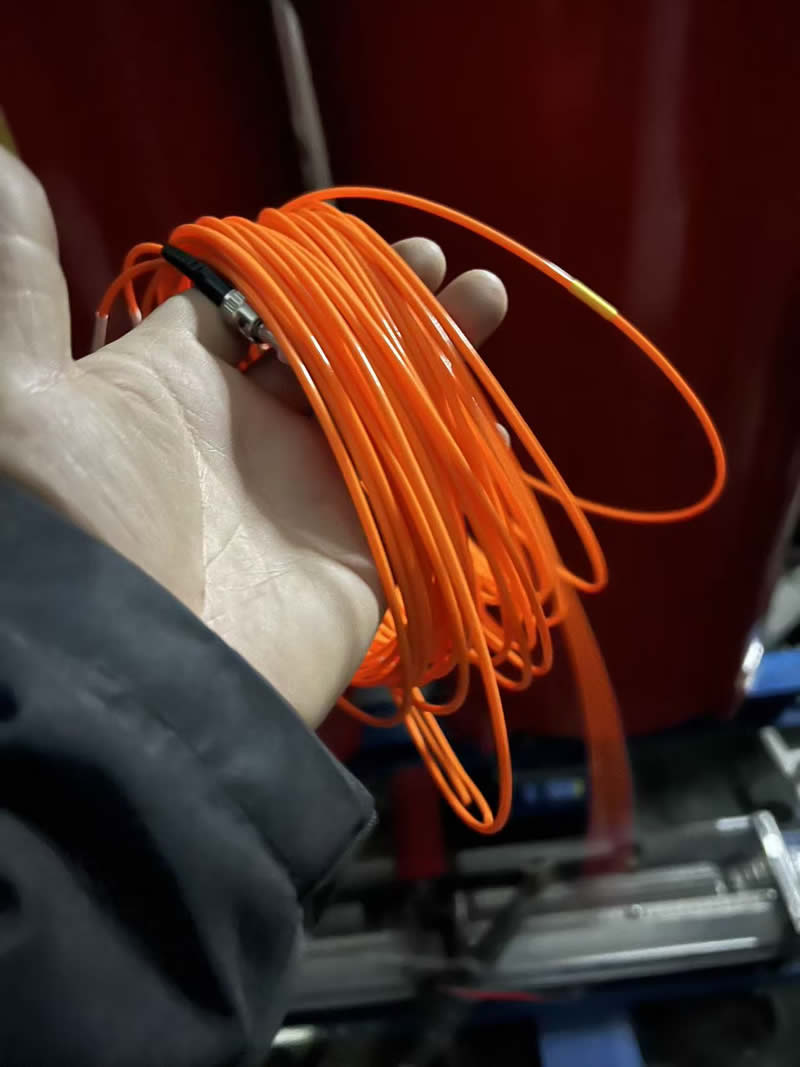
When protecting multi-million-dollar assets like high-voltage switchgear busbars or power transformer windings, the primary engineering directive is “do no harm.” Inserting a metallic sensor into a 35kV or 110kV system compromises the phase-to-ground clearance, risking an immediate, explosive short circuit.
The Silicon Dioxide Advantage
工業用グレード 光ファイバー温度センサー are manufactured from ultra-pure silicon dioxide (quartz glass) and sheathed in Teflon. This construction contains no free electrons, making it a perfect electrical insulator.
3. The Physics of Fluorescent Fiber Optic Sensors
To achieve 100kV+ immunity while simultaneously delivering exact thermal data, these systems abandon electrical resistance measurement entirely. その代わり, they rely on advanced optoelectronics and the quantum physics of photoluminescence.
Measuring Time, 電気ではありません
The tip of the quartz fiber is coated with a microscopic dot of a proprietary rare-earth phosphor. The process occurs in three microseconds:
- An external transmitter sends a calibrated pulse of light down the fiber, exciting the phosphor tip.
- The phosphor emits a fluorescent “afterglow” that travels back up the fiber.
- The light source is turned off, and the glow begins to fade (減衰). The exact rate at which this glow decays is intrinsically linked to the physical temperature of the tip.
Because the controller measures the 時間 of the decay rather than the 強度 of the light, the measurement is entirely immune to cable bending, 振動, or optical attenuation.
4. Eradicating EMI and Partial Discharge in Extreme Environments

Beyond massive short circuits, high-voltage equipment is susceptible to Partial Discharge (パーキンソン)—microscopic sparking inside the insulation that slowly erodes the material until failure. Metallic sensors act as stress concentrators, drastically increasing the risk of PD.
| Environmental Threat | Legacy PT100 Vulnerability | Optical Sensor Immunity |
|---|---|---|
| 電磁妨害 (EMIの) | Absorbs harmonic noise, causing false temperature spikes. | Photons do not interact with magnetic fields. 100% 免疫. |
| 部分放電 (パーキンソン) | Metallic casing distorts the electric field, initiating PD. | Dielectric constant matches insulation. Zero field distortion. |
By deploying a 光ファイバー温度センサー, facility managers eliminate the root causes of both data corruption and sensor-induced dielectric breakdown, establishing a foundation of absolute reliability.
5. Achieving ±1°C Precision: The Importance of Microsecond Demodulation

In high-voltage asset management, temperature accuracy is not merely a metric of quality; it is the fundamental variable in the Loss of Life (笑) equation. According to IEEE loading guides, operating a transformer continuously at just a few degrees above its thermal rating can halve its operational lifespan.
The Mathematics of Optoelectronic Accuracy
A premium 光ファイバー温度センサー must guarantee an accuracy of ±1°C across its entire operating range. Achieving this level of absolute precision requires highly sophisticated signal demodulation.
When the fluorescent phosphor on the probe tip emits its afterglow, the external controller must capture photons using highly sensitive avalanche photodiodes. The internal microprocessor then calculates the exact exponential decay curve in microseconds. Unlike metallic sensors that suffer from voltage drops over long cable runs (requiring complex 3-wire or 4-wire compensation), the optical decay rate is a universal physical constant. This ensures that the ±1°C accuracy remains perfectly stable, whether the sensor is 2 meters or 50 meters away from the controller.
6. Sub-Second Response Times (< 1s): 熱暴走の防止
A precise measurement is useless if it arrives too late. During a grid fault, a sudden short-circuit, or a massive harmonic load spike, the internal copper conductors of a transformer can heat up at a rate of several degrees per second. This rapid escalation leads to thermal runaway, where the insulation is irreversibly carbonized.
Eradicating Thermal Lag
Traditional surface-mounted RTDs and top-oil thermometers suffer from massive thermal lag. The heat must conduct through thick layers of epoxy resin or oil before it reaches the sensor. This delay can range from 15 minutes to over an hour.
- The Optical Speed Advantage: By physically embedding the optical probe directly against the conductor during the winding process, thermal lag is reduced to zero.
- Instantaneous Logic Execution: Industrial-grade fiber optic systems boast a response time of < 1 秒. This sub-second speed allows the controller to instantly trigger emergency cooling fans or execute a breaker trip sequence, severing power fast enough to save the asset from destruction.
7. 極端な温度範囲: Operating from -40°C to 260°C
Substation and heavy industrial equipment are deployed globally, from arctic oil rigs to desert solar farms. A utility-grade monitoring system must survive the ambient environmental extremes as well as the internal operational extremes.
Surviving the Thermal Envelope
Standard commercial fiber optics (such as those used in telecom or basic IT) utilize PVC or standard plastic jackets. If placed inside a transformer, these materials will freeze and shatter in arctic cold, or melt and outgas under heavy load, destroying the transformer’s dielectric fluid.
高度な 光ファイバー温度プローブ are engineered with advanced polymer sheathing, PTFEなど (テフロン) or Polyimide, allowing them to operate flawlessly across a massive temperature envelope of -40℃~260℃.
- At -40°C (Cold Start): The probe materials remain flexible and structurally intact during a “black start” in freezing conditions.
- At 260°C (Extreme Overload): The probe easily survives the 140°C+ baking temperatures of the transformer’s Vacuum Pressure Impregnation (VPI) manufacturing process, and remains fully operational even if the transformer exceeds its Class H (180°C) limits during a critical overload.
8. プローブのカスタマイズ: Why 2mm to 3mm Diameters Matter?
One of the most frequent reasons monitoring projects fail during the installation phase is physical incompatibility. Space inside high-voltage windings, 開閉装置ジョイント, or lithium-ion battery energy storage systems (ベス) is at an absolute premium.
The Engineering Necessity of Miniaturization
If a sensor probe is too thick, it forces the winding layers apart. This seemingly minor displacement alters the designed magnetic flux geometry, pinches critical cooling ducts, and creates voids in the insulation where partial discharge can ignite.
To integrate seamlessly without altering the equipment’s structural design, the industry standard demands ultra-thin geometries. High-end manufacturers offer customizable probe diameters ranging strictly from 2mm to 3mm. This ultra-low profile allows the quartz fiber to be securely woven directly into the copper coils or positioned tightly against busbar joints, acting as an invisible observer that gathers critical thermal data without disrupting the mechanical or electrical architecture.
9. 長距離監視: Maintaining Signal Integrity up to 80 メートル
In large-scale substations or hyperscale energy storage facilities, the control cabinet housing the monitoring relays is often located far from the actual high-voltage equipment. This distance introduces a severe challenge for traditional metallic sensors.
The Problem of Lead Wire Resistance
With traditional PT100s, the copper lead wires themselves possess electrical resistance. As the cable run gets longer, this parasitic resistance increases, skewing the milli-volt signal and creating massive temperature reading errors. Mitigating this requires complex and expensive 3-wire or 4-wire compensation circuits.
The Optical Distance Advantage
Because a 光ファイバー温度センサー measures the time-domain decay of light rather than electrical amplitude, it is completely immune to distance-induced signal degradation. High-quality quartz fiber optics can maintain their guaranteed ±1°C precision over continuous cable runs of up to 80 メートル.
This long-range capability allows facility engineers to safely route the dielectric optical cables out of the high-voltage blast zone, through complex cable trenches, and directly into the centralized low-voltage control room without losing a fraction of a degree in measurement accuracy.
10. マルチチャンネルアーキテクチャ: 管理する 1 宛先 64 Channels Simultaneously
Modern electrical infrastructure is highly complex. A single three-phase transformer requires multiple hot spot probes per winding. A high-voltage switchgear lineup may require monitoring at dozens of critical busbar joints. Deploying a separate controller for every single probe is financially and spatially unviable.
Extreme Scalability for High-Density Applications
To meet the demands of EPC (Engineering, 調達, and Construction) contractors, elite fiber optic monitoring systems feature a highly scalable multi-channel architecture. An industrial-grade transmitter can be configured to manage anywhere from 1 宛先 64 独立した光チャネル 同時に.
- トランスフォーマー: A 4-to-8 channel setup perfectly covers all three phases plus the iron core.
- Switchgear Cabinets: A 12-to-24 channel system can monitor the incoming line, outgoing line, and circuit breaker contacts across multiple adjacent cabinets.
- Battery Energy Storage Systems (ベス): A 64-channel matrix can track the thermal profile of entire lithium-ion battery racks, identifying localized overheating before thermal runaway initiates a catastrophic fire.
This high-density channel integration drastically lowers the cost-per-point of measurement, making complete facility-wide optical monitoring economically viable.
11. SCADAの統合: The Role of the RS485 Communication Interface
Acquiring pure, ultra-precise thermal data is only half the battle. In the era of Industry 4.0 and Smart Grids, this data must be aggregated, 分析された, and integrated into the facility’s Supervisory Control and Data Acquisition (スカダ) 制.
Bridging Optics and Digital Automation
The external fiber optic controller serves as the critical bridge. To ensure seamless interoperability with third-party PLCs, RTU, and digital dashboards, the controller is equipped with a robust RS485通信インターフェース.
- 産業上の信頼性: RS485 utilizes differential signaling, which inherently rejects common-mode electrical noise, ensuring data packets survive the electrically noisy environment of a substation control room.
- Modbus RTU Protocol: Running the universal Modbus RTU protocol over the RS485 physical layer ensures that the fiber optic controller can “speak” instantly to over 90% of global industrial automation software without requiring custom drivers.
- Daisy-Chaining: Multiple multi-channel controllers can be daisy-chained along a single RS485 bus, allowing a massive network of hundreds of optical probes to be routed back to the SCADA server using just two copper wires.
12. The Controller as an Intelligent Gateway
A premium fiber optic temperature transmitter is not merely a passive pass-through device; it acts as an intelligent edge-computing gateway. While transmitting data via RS485 to the SCADA system for predictive maintenance analysis, the controller continuously processes logic locally to ensure failsafe protection.
By constantly polling all 1 宛先 64 channels in real-time, the microprocessor checks each optical reading against user-defined safety thresholds. If the connection to the central SCADA system is ever severed, the local controller retains the autonomous capability to execute hardware-level dry contact relays. This ensures that cooling fans are activated and high-voltage breakers are tripped locally, maintaining an impenetrable wall of thermal protection around the asset at all times.
13. 総所有コスト (TCO) in High-Voltage Monitoring
When evaluating instrumentation for critical electrical infrastructure, analyzing the upfront Capital Expenditure (CAPEX) in a vacuum is a fundamentally flawed procurement strategy. The true financial metric is the Total Cost of Ownership (TCO), which factors in installation, メンテナンス, ダウンタイム, と動作寿命.
Shifting from CAPEX to OPEX Savings
While a multi-channel 光ファイバー温度センサー network requires a higher initial investment than a handful of basic PT100 thermowells, it rapidly pays for itself by eliminating ongoing Operational Expenditures (運用コスト).
- Elimination of Nuisance Trips: A single false alarm caused by EMI on a traditional sensor can shut down a manufacturing line or data center. The cost of one hour of unplanned downtime often eclipses the price of the entire optical monitoring system tenfold.
- Reduced Labor Costs: Traditional sensors in harsh environments fail frequently due to vibration, 酸化, and electrical surges, requiring constant dispatch of maintenance crews to hazardous high-voltage zones.
14. Engineering a 25-Year Lifespan: ゼロ校正が必要です
A power transformer or high-voltage switchgear lineup is designed for a generational lifespan, 通常 25 宛先 30 月日. The condition monitoring equipment protecting these assets must match this longevity without requiring constant intervention.
The Problem with Metallurgical Drift
Metallic resistance sensors (RTDの) degrade over time. Continuous thermal expansion and contraction alter the metallurgical structure of the platinum or copper element, causing the electrical resistance to “drift.” To remain accurate, they require rigorous, annual physical recalibration—a massive hidden OPEX cost.
15. The Financial Impact of Precise Hot Spot Data
In the power generation and utility sectors, the ±1°C accuracy of an advanced monitoring system translates directly into increased revenue generation.
Maximizing Safe Overload Capacity
During peak demand hours (such as extreme summer heatwaves), electricity prices skyrocket. Utilities want to push their transformers to 110% 又は 120% of their nameplate capacity to maximize power delivery and revenue.
しかし, if operators are relying on inaccurate, delayed PT100 surface sensors, they must maintain a massive “safety buffer” to avoid accidentally melting the internal insulation. They are forced to curtail power delivery prematurely.
With an embedded optical system delivering instantaneous, ±1°C accurate internal hot spot data, operators possess absolute thermal visibility. They can safely ride the thermal limits of the transformer, securely generating additional revenue during peak pricing without risking the asset’s structural integrity or violating IEEE Loss of Life (笑) パラメーター.
16. Why Commercial-Grade Fiber Optics Fail in Industrial Applications?
A critical mistake often made by procurement teams is treating all optical fibers as equal. Attempting to substitute custom-engineered industrial sensors with cheap, commercial-grade Plastic Optical Fiber (POF) or telecom-grade silica invites catastrophic failure.
| 故障モード | The Consequence of Using Cheap Commercial Fiber |
|---|---|
| Chemical Outgassing | Commercial PVC or basic polyurethane jackets will melt or outgas when exposed to 120°C+ transformer oil. This contaminates the oil, destroys its dielectric breakdown voltage (BDV), and ruins the transformer. |
| VPI Crushing | During the Vacuum Pressure Impregnation (VPI) process of cast resin transformers, the extreme pressure and 140°C baking process will crush or snap fragile telecom-grade silica, rendering the sensor dead on arrival. |
| Dielectric Mismatch | Improperly formulated claddings create microscopic air voids when embedded in epoxy, creating stress concentrations that initiate Partial Discharge (パーキンソン). |
Only industrial-grade, 100% quartz fibers clad in specialized Teflon (PTFE) or Polyimide are chemically inert and structurally resilient enough to survive decades submerged in acidic aging oil or baked into solid epoxy resin.
17. Technical Specifications for Tender Documents
To ensure the procurement of a truly industrial-grade monitoring system, facility engineers must draft rigid technical specifications in their tender documents. Vague requirements allow sub-contractors to supply vulnerable legacy RTDs or inadequate commercial fiber optics.
Mandatory Tender Requirements Checklist:
- 1. 誘電体イミュニティ: The optical probes must be manufactured from 100% pure quartz glass with Teflon/Polyimide sheathing, certified to withstand electrical fields of 100kV以上 without initiating partial discharge.
- 2. 精度 & 応答: The system must guarantee a measurement accuracy of ±1°C and a response time of < 1 秒 to effectively prevent thermal runaway.
- 3. Operating Envelope: The sensors must maintain structural and optical integrity in temperatures ranging from -40℃~260℃.
- 4. Calibration Requirement: The technology must utilize fluorescent decay physics, expressly stating that it requires zero recalibration over a 25-year operational lifespan.
18. The Danger of DIY Installation and Off-the-Shelf Parts
A high-voltage transformer or BESS (Battery Energy Storage System) is a finely tuned electromechanical environment. Treating a 光ファイバー温度センサー as an off-the-shelf component that can be installed via a DIY approach is a critical operational hazard.
The Risks of Improper Integration
If a technician incorrectly routes an optical cable across a high-voltage lead without understanding the clearance requirements, or forces a standard 5mm probe into a 3mm cooling duct, the physical damage to the equipment’s insulation will far outweigh the benefits of monitoring. その上, bending the optical fiber beyond its specified radius during a hasty installation can fracture the internal quartz core, resulting in immediate signal failure.
19. Why Complex Environments Demand OEM Engineering Consultation?
Direct hot spot measurement is a highly specialized discipline that intersects thermodynamics, オプトエレクトロニクス, and high-voltage insulation physics. To guarantee both the accuracy of the thermal data and the dielectric safety of the transformer, integration must be treated as an engineered solution, not a parts transaction.
Professional integration requires collaboration with the OEM to conduct 3D Finite Element Analysis (FEA) to pinpoint the exact hot spot coordinates. It requires calculating the exact length of fiber needed to exit the high-voltage zone safely, and determining the appropriate polymer jacket required to survive the facility’s specific chemical and thermal stressors.
20. Partnering with FJINNO for Custom Fiber Optic Solutions
Securing absolute thermal visibility in extreme environments demands uncompromising technology and expert execution. フジンノ is a premier manufacturer and engineering partner specializing in utility-grade 蛍光光ファイバー温度検知 システムズ.
The FJINNO Engineering Advantage
- Extreme Tolerance: Our bespoke quartz probes guarantee 100kV+ dielectric immunity, ±1℃の精度, and sub-second response times across a brutal -40℃~260℃ operational envelope.
- 比類のないカスタマイズ: We engineer solutions to fit your exact architecture, offering probe diameters as thin as 2mm~3mm and continuous, lossless optical cable runs up to 80 メートル.
- Massive Scalability: Our industrial transmitters handle up to 64 独立したチャネル, funneling pure, zero-drift thermal data directly into your SCADA network via robust RS485の コミュニケーション.
- Generational Reliability: Install it and forget it. FJINNO technology requires zero calibration, providing flawless asset protection for over 25 月日.
Stop guessing with indirect measurements and vulnerable metallic sensors.
Contact FJINNO’s engineering team today to configure a highly customized, 100% EMI-immune thermal monitoring architecture for your critical assets.
Engineering Disclaimer: The performance metrics, integration protocols, and technical specifications detailed in this guide (including 100kV+ immunity, ±1℃の精度, and 25-year lifespan) are contingent upon proper, custom-engineered installation. Actual dielectric withstand capacity, 熱限界, and partial discharge risks vary significantly based on equipment geometry, fluid or solid insulation properties, and site-specific electromagnetic conditions. Always consult the equipment’s Original Equipment Manufacturer (OEMメーカー) and adhere to applicable IEEE/IEC standards prior to modifying any condition monitoring scheme. FJINNO assumes no liability for equipment damage or operational failures resulting from unauthorized DIY installation or the misapplication of these guidelines without professional engineering consultation.

光ファイバー温度センサ, インテリジェント監視システム, 中国の分散型光ファイバーメーカー
 |
 |
 |