 Sensori di temperatura a fibra ottica INNO ,sistemi di monitoraggio della temperatura.
- I sistemi di allarme a fibra ottica utilizzano cavi ottici standard come elementi di rilevamento continuo per rilevare le intrusioni, vibrazioni, ed eventi acustici su distanze fino a 100 chilometro.
- DAS (Rilevamento acustico distribuito) cattura le forme d'onda acustiche complete lungo la fibra, consentendo una classificazione dettagliata del suono e l'identificazione degli eventi.
- DVS (Rilevamento distribuito delle vibrazioni) rileva l'intensità e la posizione delle vibrazioni, fornendo una soluzione conveniente per il rilevamento delle intrusioni perimetrali.
- DAS offre una sensibilità più elevata, risposta in frequenza più ampia, e output di dati più ricco rispetto a DVS.
- DVS è più semplice da implementare, richiede meno potenza di elaborazione, ed è particolarmente adatto per l'attivazione di allarmi di base in applicazioni su recinzioni e confini.
- Entrambe le tecnologie sono immuni alle interferenze elettromagnetiche, non richiedono alimentazione elettrica lungo il percorso di rilevamento, e fornire monitoraggio in tempo reale con localizzazione precisa degli eventi.
- Choosing between DAS and DVS depends on the required detection resolution, bilancio, ambiente, and the complexity of threat classification needed.
Sommario
- 1. What Is a Fiber Optic Alarm System
- 2. How DAS (Rilevamento acustico distribuito) Funziona
- 3. How DVS (Rilevamento distribuito delle vibrazioni) Funziona
- 4. Key Differences Between DAS and DVS
- 5. Typical Applications of Fiber Optic Alarm Systems
- 6. How to Choose Between DAS and DVS
- 7. Installation and Deployment Considerations
- 8. Advantages and Limitations of Fiber Optic Alarm Systems
- 9. Domande frequenti (Domande frequenti)
1. Cos'è un Fiber Optic Alarm System

Un fiber optic alarm system is a security monitoring solution that uses optical fiber cables as distributed sensors to detect physical disturbances along their entire length. Unlike conventional electronic alarm systems that rely on discrete sensors placed at fixed points, un sensore a fibra ottica distribuito turns every meter of the cable into an active sensing element. This means a single fiber cable can monitor perimeters, Recinzioni, Condutture, and critical infrastructure over distances ranging from a few hundred meters to more than 100 kilometers — all from a single interrogation unit.
The operating principle is based on analyzing backscattered light within the fiber. When an external event such as an intrusion, vibrazione, or pressure change occurs near the cable, it causes micro-disturbances in the fiber that alter the characteristics of the reflected light signal. The interrogation unit at the control end measures these changes in real time, determines the precise location of the event, and triggers an alarm when predefined thresholds are exceeded.
Why Fiber Optic Alarm Systems Are Gaining Popularity
Traditional alarm systems using copper wiring, infrared beams, or microwave barriers are susceptible to electromagnetic interference, fulmini, and environmental degradation. Un fiber optic intrusion detection system eliminates these vulnerabilities entirely because optical fiber is a dielectric material — it carries light, non corrente elettrica. This makes the sensing cable inherently immune to EMI, RFI, and lightning damage. Inoltre, fiber optic systems do not generate any electromagnetic signature themselves, making them virtually undetectable by intruders and ideal for high-security installations.
2. How DAS (Rilevamento acustico distribuito) Funziona
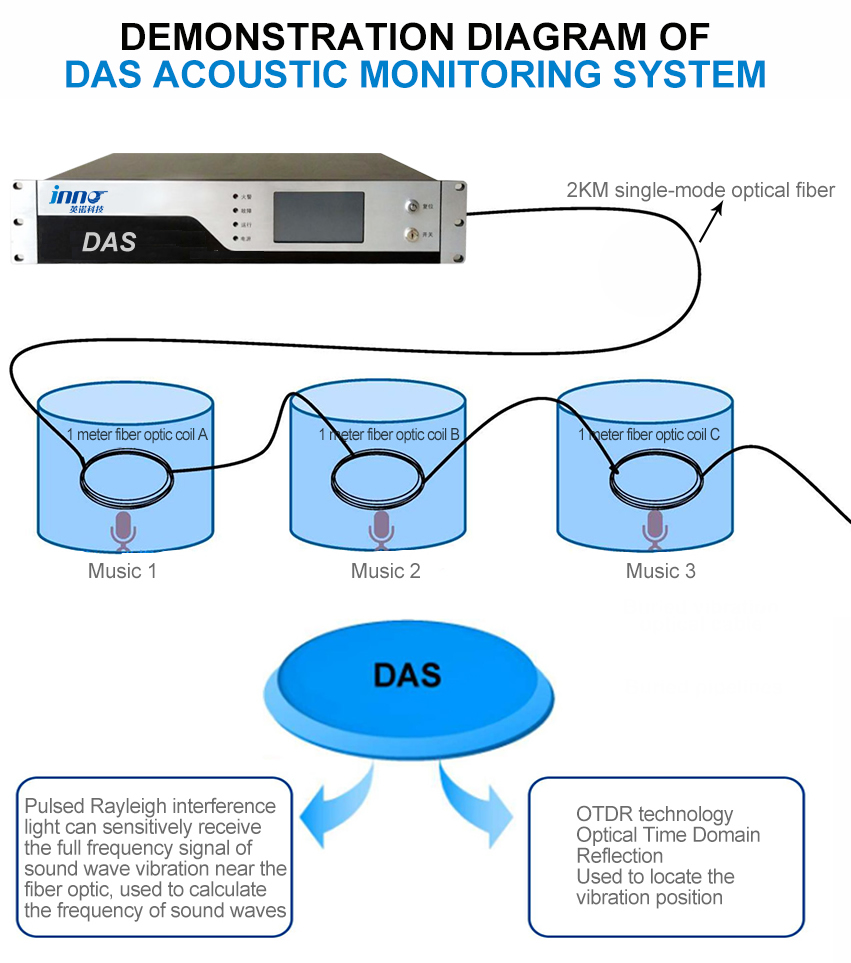
DAS (Rilevamento acustico distribuito) is an advanced fiber optic sensing technology that converts a standard single-mode optical fiber into an array of thousands of virtual microphones. The system works by injecting short, coherent laser pulses into the fiber and analyzing the phase of the Rayleigh backscattered light returning from every point along the cable.
The Phase-Sensitive OTDR Principle
DAS systems use a technique known as phase-sensitive optical time-domain reflectometry (Φ-OTDR). As the laser pulse travels down the fiber, naturally occurring impurities in the glass scatter a tiny fraction of the light back toward the source. When an acoustic wave or vibration hits the fiber, it causes localized strain that shifts the phase of this backscattered light. By comparing successive phase measurements at each point along the fiber, the DAS interrogator reconstructs a full acoustic waveform — capturing not just whether an event occurred, but the actual sound signature of the event.
Key Capabilities of DAS Technology
Un DAS fiber optic sensing system typically offers a frequency response ranging from sub-hertz to several kilohertz, spatial resolution as fine as 1 Metro, and sensing distances up to 50–100 km depending on the interrogator model. Because DAS captures true acoustic data, it enables sophisticated signal classification using pattern recognition algorithms. This means the system can distinguish between a person walking along a fence, a vehicle driving on a nearby road, an animal brushing against the cable, and an actual cutting or climbing attempt — significantly reducing false alarm rates.
3. Come DVS (Rilevamento distribuito delle vibrazioni) Funziona

DVS (Rilevamento distribuito delle vibrazioni) is a closely related but technically simpler fiber optic monitoring technology. Like DAS, DVS relies on Rayleigh backscattering within the optical fiber. Tuttavia, rather than measuring the precise phase of the returned light to reconstruct acoustic waveforms, DVS primarily analyzes the intensity changes of the backscattered signal.
Intensity-Based Detection Approach
When a vibration event occurs near the fiber optic sensing cable, it alters the interference pattern of the backscattered light, causing fluctuations in signal intensity at the corresponding location. Le DVS interrogation unit monitors these intensity variations in real time and identifies the position and magnitude of the disturbance. While DVS does not capture the full acoustic waveform, it reliably detects the presence, posizione, and relative strength of vibration events.
Practical Performance of DVS Systems
Un tipico DVS perimeter detection system provides spatial resolution in the range of 5 A 10 meters with a sensing range of up to 40–60 km. The frequency response is generally narrower than DAS, often limited to several hundred hertz. DVS is highly effective for applications where the primary requirement is knowing that a disturbance occurred and where it happened, without the need for detailed acoustic classification. This makes it a practical, lower-cost alternative for many perimeter security scenarios.
4. Key Differences Between DAS and DVS

While DAS and DVS are both distributed fiber optic sensing technologies that use the same basic optical fiber infrastructure, they differ significantly in measurement approach, data richness, and suitability for various applications. Understanding these differences is essential for selecting the right technology for a given security requirement.
Metodo di misurazione
The most fundamental difference lies in what each system measures. DAS measures the phase of the Rayleigh backscattered light, providing a quantitative, linear representation of the acoustic field along the fiber. DVS measures the intensity of the backscattered light, providing a qualitative indication of vibration activity. In termini pratici, DAS gives you a waveform you can listen to and analyze, while DVS gives you an alert that something happened.
Sensitivity and Resolution
DAS systems generally offer higher sensitivity and finer spatial resolution than DVS. Una ad alte prestazioni DAS interrogator can achieve 1-meter spatial resolution and detect nano-strain level disturbances. DVS systems typically operate with 5–10 meter resolution and require somewhat larger disturbances to trigger a reliable detection. For applications requiring precise event localization and the ability to classify low-amplitude signals, DAS is the superior choice.
Event Classification and False Alarm Reduction
Because DAS captures true acoustic data, it supports advanced event classification algorithms that can differentiate between threat and non-threat events. This is a major advantage in environments with high background noise or frequent benign activities near the sensing cable. DVS, with its intensity-based approach, has more limited classification capability and may produce higher false alarm rates in complex environments.
System Cost and Complexity
DAS interrogation units are more complex and typically more expensive than DVS units. The processing requirements for phase demodulation and waveform analysis are also higher. For projects with tight budgets or straightforward detection requirements, un DVS alarm system offers a compelling balance of performance and cost efficiency.
Frequency Response and Data Output
DAS systems provide broadband frequency response, often from below 1 Hz up to 10 kHz or more, enabling detection of a wide range of acoustic phenomena. La risposta in frequenza DVS è più ristretta, tipicamente sufficiente per rilevare vibrazioni meccaniche ma non adatto per acquisire firme acustiche dettagliate. L'output dei dati da DAS è sostanzialmente più grande, che richiedono più spazio di archiviazione e larghezza di banda di elaborazione.
5. Applicazioni tipiche di Sistemi di allarme in fibra ottica
Entrambe le tecnologie DAS e DVS vengono implementate in un'ampia gamma di applicazioni di sicurezza e monitoraggio. La scelta tra loro dipende spesso dai requisiti specifici di ciascun caso d'uso.
Sicurezza perimetrale e rilevamento delle intrusioni
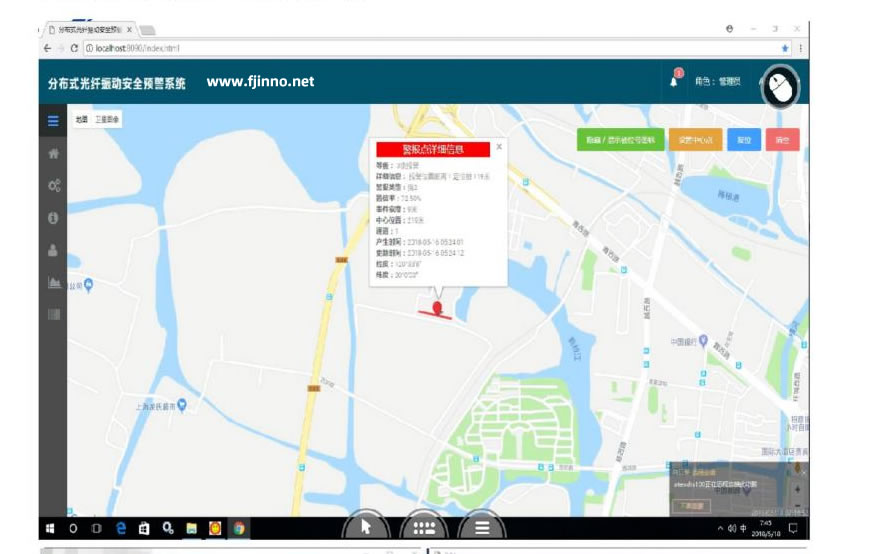
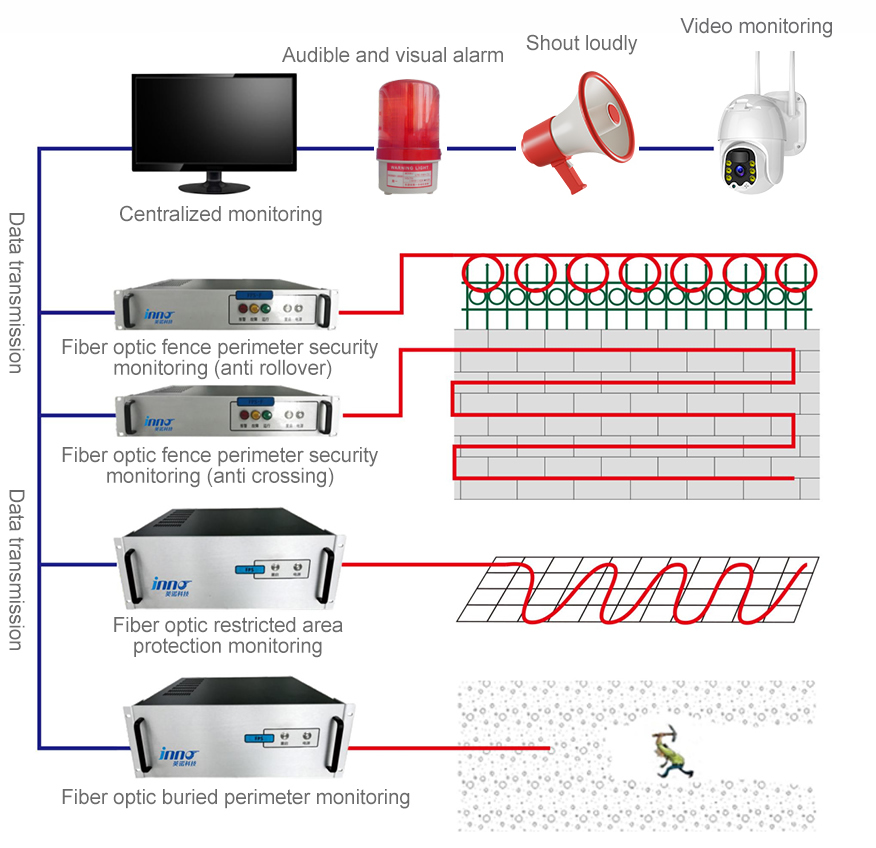
Sistemi di sicurezza perimetrale in fibra ottica sono ampiamente utilizzati per proteggere le basi militari, strutture governative, Gli aeroporti, centri dati, Prigioni, e siti industriali. Il cavo di rilevamento è generalmente montato o interrato accanto alla recinzione perimetrale. Quando qualcuno tenta di arrampicarsi, taglio, o sfondare la recinzione, le vibrazioni risultanti vengono immediatamente rilevate e localizzate. DAS-based systems excel in this application due to their ability to classify the type of intrusion activity, Mentre DVS fence-mounted sensors provide reliable basic detection at lower cost.
Pipeline and Utility Monitoring
Sistemi di monitoraggio di tubazioni in fibra ottica use DAS or DVS cables installed alongside oil, gas, and water pipelines to detect third-party interference, unauthorized excavation, perdite, and equipment impacts. DAS is particularly effective here because it can identify the acoustic signature of different types of machinery and activities near the pipeline right-of-way.
Border and Critical Infrastructure Protection
A lungo raggio distributed fiber optic alarm systems are deployed along national borders, linee ferroviarie, highway corridors, and around power stations and substations. The ability to monitor tens of kilometers of perimeter from a single point with no active electronics in the field makes fiber optic technology uniquely suited to protecting remote and extended infrastructure.
Telecommunications Cable Security
Fiber optic cables that form part of telecommunications networks can be monitored using DAS or DVS to detect tampering, unauthorized access attempts, or accidental damage from nearby construction activities. This application leverages existing fiber optic cable infrastructure without requiring additional sensing cables.
6. How to Choose Between DAS and DVS
Selecting the right technology for a fiber optic alarm system requires careful evaluation of several factors related to the project environment, aspettative di prestazione, e vincoli di bilancio.
Define Your Detection Requirements
Start by determining what types of events you need to detect and whether event classification is important. Se è necessario distinguere tra diversi tipi di intrusione, ad esempio camminare, scavo, movimento del veicolo, e taglio del cavo — a Sistema di allarme basato su DAS con capacità di classificazione acustica è la scelta appropriata. Se la tua esigenza principale è un semplice avviso basato sulla zona quando si verifica una vibrazione significativa, un Sistema DVS soddisferà efficacemente il requisito.
Considerare l'ambiente operativo
In ambienti con elevato rumore di fondo dovuto al traffico, macchinari industriali, o meteo, DAS fornisce un migliore filtraggio dei falsi allarmi grazie alla sua analisi a livello di forma d'onda. In più tranquillo, ambienti più controllati come complessi recintati o strutture interne, Il DVS può funzionare bene senza la complessità aggiuntiva dell'elaborazione acustica.
Valutare la distanza e le esigenze di risoluzione
Per distanze di monitoraggio molto lunghe superiori 50 km o requisiti di precisione spaziale a livello di metro, DAS is generally the better-suited technology. For shorter perimeters under 20 km where 5–10 meter localization accuracy is acceptable, DVS offers a practical and economical solution.
Budget e costo totale di proprietà
The interrogation unit is the most significant cost component. DAS units carry a higher upfront price, but may reduce long-term operational costs through fewer false alarms and lower verification workload. DVS units are less expensive initially and simpler to maintain, making them attractive for budget-sensitive projects.
7. Installation and Deployment Considerations
Proper installation is critical to the performance of any sistema di allarme distribuito in fibra ottica. Several key factors should be addressed during the planning and deployment phases.
Cable Selection and Routing
Both DAS and DVS systems can operate with standard single-mode cavo in fibra ottica, although purpose-designed sensing cables with enhanced sensitivity coatings or ruggedized jackets are recommended for outdoor and buried installations. The cable route should be planned to maintain good acoustic coupling with the ground or structure being monitored while avoiding excessive exposure to environmental noise sources.
Metodi di montaggio
Per applicazioni montate su recinzione, Le fiber optic sensing cable is typically attached directly to the fence fabric using cable ties or specialized clips at regular intervals. For buried applications, the cable is placed in a sand bed at a depth of 20–40 cm to ensure reliable ground coupling. In some applications, the cable is installed inside existing conduit or duct infrastructure.
Interrogator Placement and Connectivity
Le DAS or DVS interrogation unit is installed in a secure, climate-controlled location at one end of the fiber route. Si collega alla rete di monitoraggio tramite Ethernet o backhaul in fibra. Alimentatore, protezione dell'ambiente, e la sicurezza fisica del luogo dell'interrogatorio dovrebbe essere attentamente pianificata.
Configurazione delle zone e soglie di allarme
Dopo l'installazione, la fibra sensibile è divisa in zone logiche di allarme, ciascuno con soglie di rilevamento e impostazioni di sensibilità configurabili in modo indipendente. Ciò consente agli operatori di adattare il sistema alle condizioni locali, ridurre i falsi allarmi nelle zone rumorose, e aumentare la sensibilità nelle aree critiche. La corretta sintonizzazione delle zone durante la messa in servizio è uno dei passaggi più importanti per ottenere prestazioni affidabili del sistema.
8. Advantages and Limitations of Fiber Optic Alarm Systems

Vantaggi
Sistemi di allarme in fibra ottica offrono diversi vantaggi interessanti rispetto alle tecnologie di sicurezza elettronica convenzionali. Il cavo sensibile è completamente passivo, non richiede energia elettrica sul campo, che elimina la necessità di alimentatori di campo, batterie, o pannelli solari. La fibra è immune alle interferenze elettromagnetiche, rendendolo adatto all'impiego in prossimità di linee elettriche ad alta tensione, Sottostazioni, e ambienti industriali pesanti. Un singolo cavo in fibra può monitorare distanze estremamente lunghe, fino a 100 km — da un punto centrale di interrogatorio, riducendo drasticamente la quantità di apparecchiature e infrastrutture rispetto alle soluzioni con sensori puntiformi. Il sistema fornisce continuo, rilevamento distribuito senza spazi tra i sensori, e fornisce la localizzazione in tempo reale degli eventi con precisione a livello di contatore nei sistemi DAS.
Limitazioni
Nessuna tecnologia è priva di limitazioni. Cavi sensori in fibra ottica può essere sensibile a fattori ambientali come il vento, forte pioggia, e fluttuazioni di temperatura, che può aumentare i livelli di rumore di fondo e richiedere un'attenta regolazione della soglia. The interrogation units represent a significant single point of investment, and spares planning should be considered for critical installations. Fiber splices and connectors along the cable route can introduce signal loss and should be minimized. Inoltre, proper installation and commissioning require specialized knowledge, and ongoing performance depends on maintaining cable integrity over time.
9. Domande frequenti (Domande frequenti)
Q1: What is the maximum monitoring distance of a fiber optic alarm system?
Most modern DAS and DVS systems can monitor fiber optic cables over distances of 40 A 100 chilometri da una singola unità di interrogatorio. The exact range depends on the interrogator model, qualità della fibra, e la risoluzione spaziale richiesta. For very long perimeters, multiple interrogators can be deployed to extend total coverage.
Q2: Can fiber optic alarm systems work with existing fiber optic cables?
SÌ. Both DAS and DVS technologies can operate on standard single-mode fiber optic cables, including spare fibers within existing telecommunications or utility cable infrastructure. Tuttavia, purpose-designed sensing cables may provide better sensitivity and reliability for dedicated security applications.
Q3: How does a DAS system reduce false alarms?
DAS captures the full acoustic waveform of detected events, which allows the system to apply signal classification algorithms. These algorithms analyze the frequency content, durata, and pattern of each event to differentiate genuine intrusion attempts from benign activities such as animal movement, vento, and vehicle traffic.
Q4: Is DVS less accurate than DAS?
DVS typically offers coarser spatial resolution than DAS — around 5 A 10 meters compared to 1 meter for DAS. Tuttavia, DVS is highly reliable for detecting and locating vibration events. The trade-off is in classification depth rather than detection reliability. For many applications, DVS accuracy is fully adequate.
Q5: What types of threats can a fiber optic perimeter alarm detect?
Fiber optic alarm systems can detect a wide range of threats including fence climbing, fence cutting, digging or tunneling near the cable, walking or running along the perimeter, vehicle approach and impact, and cable tampering. DAS systems can further classify these events by their acoustic signature.
Q6: Do fiber optic alarm systems require power along the sensing cable?
No. The fiber optic sensing cable is entirely passive and requires no electrical power along its length. All active electronics are contained in the interrogation unit at the control center. This is one of the most significant advantages of distributed fiber optic sensing over conventional electronic alarm systems.
D7: How are fiber optic alarm systems affected by weather?
Strong wind, forte pioggia, and hail can generate vibrations on exposed fence-mounted cables, potentially increasing background noise levels. Modern DAS and DVS systems use adaptive filtering and threshold adjustment to minimize weather-related false alarms. Buried cable installations are largely unaffected by surface weather conditions.
Q8: Can DAS and DVS systems be integrated with CCTV and access control?
SÌ. Most fiber optic alarm systems provide standard output interfaces and support integration with video management systems, Piattaforme SCADA, access control systems, and centralized security management software. Quando viene attivato un allarme, the system can automatically direct PTZ cameras to the event location for visual verification.
D9: What maintenance does a fiber optic alarm system require?
Fiber optic alarm systems require relatively low maintenance. Routine tasks include periodic inspection of the cable route for physical damage, checking fiber splice and connector quality using an OTDR, verifying interrogator performance, and reviewing alarm thresholds based on seasonal environmental changes.
Q10: How long does a fiber optic sensing cable last in outdoor environments?
High-quality outdoor-rated fiber optic cables with appropriate jacket materials are designed for service lives of 20 A 30 anni o più. The actual lifespan depends on environmental conditions, qualità dell'installazione, and protection from mechanical damage. UV-resistant and armored cable options are available for harsh environments.
Disclaimer: Le informazioni fornite in questo articolo sono solo a scopo informativo generale ed educativo. Mentre è stato fatto ogni sforzo per garantire la precisione, Fjinno (www.fjinno.net) non fornisce alcuna garanzia o dichiarazione in merito alla completezza, affidabilità, or suitability of the content for any particular application. Specifiche del prodotto, parametri di prestazione, and technical details may vary depending on specific models, configurazioni, e condizioni operative. Readers are advised to consult directly with qualified engineers and system integrators before making any purchasing or deployment decisions. FJINNO non sarà ritenuto responsabile per eventuali perdite, danno, or consequence arising from the use of or reliance on the information contained herein.

Sensore di temperatura in fibra ottica, Sistema di monitoraggio intelligente, Produttore distribuito di fibre ottiche in Cina
 |
 |
 |