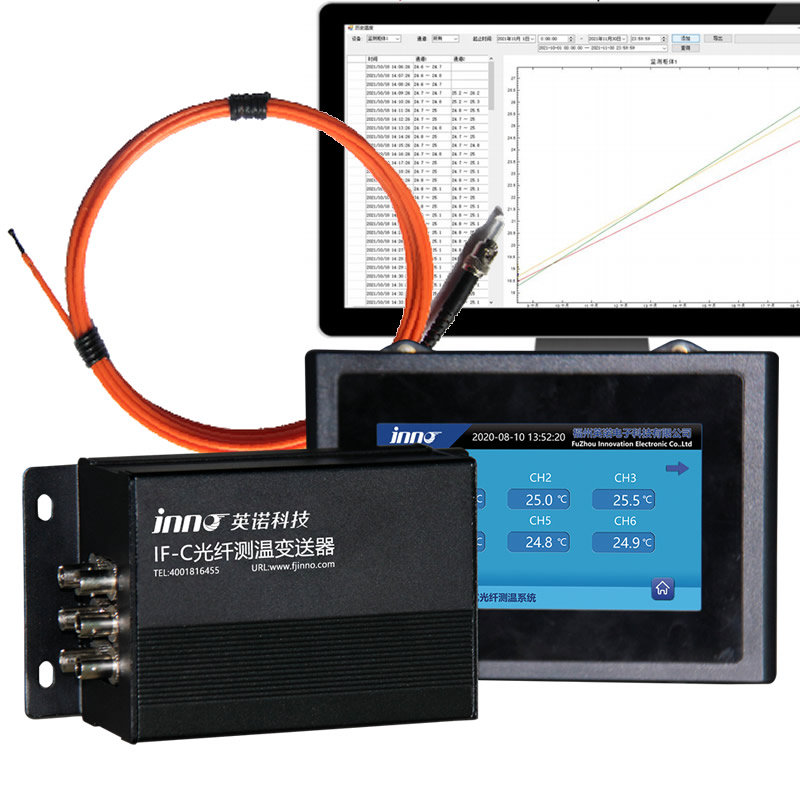
 Sensor suhu serat optik INNO ,sistem pemantauan suhu.
- A fiber optic temperature sensor is a device that measures temperature using light signals transmitted through optical fibers instead of electrical signals through metal wires. Because the sensing element and transmission medium are entirely non-metallic and non-conductive, fiber optic temperature sensors offer inherent immunity to electromagnetic interference (EMI), complete galvanic isolation, and safe operation in explosive, tegangan tinggi, and radiation-intensive environments — capabilities that are impossible for any conventional electrical temperature sensor.
- Ada four major types of fiber optic temperature sensors: peluruhan fluoresensi (phosphor thermometry), penginderaan suhu serat optik terdistribusi (DTS based on Raman scattering), Kisi Serat Bragg (FBG), dan Gallium Arsenida (GaA) semikonduktor. Each uses a different physical mechanism to convert temperature into an optical signal, and each serves different application requirements in terms of measurement range, ketepatan, spatial coverage, and system cost.
- Among all four technologies, the fluorescence-based fiber optic temperature sensor is the most widely deployed, commercially mature, and versatile point-measurement solution. It delivers the best combination of accuracy (±0.1 °C to ±0.5 °C), kisaran suhu (−200 °C to +450 °C), stabilitas jangka panjang, kecepatan respons, and cost-effectiveness for the majority of industrial, kekuatan, and medical temperature monitoring applications.
- Penginderaan suhu serat optik terdistribusi (DTS) uses Raman backscattering along the entire length of an ordinary optical fiber to measure temperature at thousands of points simultaneously over distances up to 50 km — making it the only technology capable of truly continuous, spatially resolved temperature profiling over long distances.
- Kisi Serat Bragg (FBG) and GaAs semiconductor sensors masing-masing menyediakan pengukuran suhu yang dikodekan dengan panjang gelombang dan berbasis tepi serapan. Sensor FBG menawarkan pemantauan multi-titik multipleks di sepanjang satu serat, sementara sensor GaAs memberikan kestabilan, alternatif pasif untuk pengukuran titik dalam aplikasi peralatan listrik.
Daftar isi
- Apa Itu Sensor Suhu Serat Optik?
- Mengapa Menggunakan Sensor Suhu Serat Optik Daripada Sensor Konvensional?
- Empat Jenis Utama Sensor Suhu Serat Optik
- Sensor Suhu Serat Optik Berbasis Fluoresensi — Standar Emas
- Cara Kerja Sensor Suhu Serat Optik Fluoresensi
- Bahan Fosfor dan Desain Probe
- Spesifikasi Kinerja dan Keunggulan Sensor Fluoresensi
- Penerapan Sensor Suhu Serat Optik Fluoresensi
- Penginderaan Suhu Serat Optik Terdistribusi (DTS)
- Kisi Serat Bragg (FBG) Sensor Suhu
- GaAs Semiconductor Fiber Optic Temperature Sensors
- Perbandingan Teknologi: Fluorescence vs. DTS vs. FBG vs. GaA
- Cara Memilih Sensor Suhu Serat Optik yang Tepat
- FAQ — Apa Itu Sensor Suhu Serat Optik?
1. Apa itu a Sensor Suhu Serat Optik?

Definisi
A sensor suhu serat optik adalah perangkat pengukuran optik yang menentukan suhu dengan menganalisis perubahan sifat cahaya — seperti waktu peluruhan fluoresensi, panjang gelombang spektral, intensitas hamburan balik, atau posisi tepi serapan — yang disebabkan oleh efek termal pada elemen penginderaan optik atau pada serat optik itu sendiri. Informasi suhu dihasilkan, ditransmisikan, dan diproses seluruhnya dalam domain optik, menggunakan serat optik kaca atau polimer sebagai media penginderaan dan penghubung transmisi sinyal. Tidak ada sinyal listrik di titik mana pun antara lokasi pengukuran dan instrumen optoelektronik (pemeriksa) yang mengubah sinyal optik menjadi pembacaan suhu digital.
Perbedaan mendasar ini — cahaya dibandingkan listrik — inilah yang memberikan sensor suhu serat optik keunggulannya yang unik dan menentukan. Karena serat optik terbuat dari kaca silika yang menyatu (SiO₂) — isolator dielektrik tanpa elektron bebas — tidak dapat menghantarkan listrik, tidak dapat menghasilkan atau merespons medan elektromagnetik, and cannot create galvanic connections. Hasilnya adalah teknologi pengukuran suhu yang kebal terhadap interferensi elektromagnetik, secara intrinsik aman di atmosfer yang mudah meledak, diisolasi secara alami dari tegangan tinggi, dan tahan terhadap korosi, petir, dan radiasi.
Arsitektur Dasar
Terlepas dari teknologi penginderaan spesifik yang digunakan, setiap sistem pengukuran suhu serat optik terdiri dari tiga komponen dasar. Komponen pertama adalah elemen penginderaan — the point or region where temperature interacts with light to produce a measurable optical change. Depending on the technology, this may be a fluorescent phosphor crystal bonded to the fiber tip, a Gallium Arsenide semiconductor chip, a Bragg grating inscribed in the fiber core, or simply the fiber itself (in distributed sensing). The second component is the optical fiber link — one or more glass fibers that carry excitation light from the instrument to the sensing element and return the temperature-modulated optical signal from the sensing element back to the instrument. Standard telecommunications-grade fibers (either multimode or single-mode) are used, with lengths ranging from a few meters to tens of kilometers depending on the application. The third component is the pemeriksa (disebut juga pengkondisi sinyal, penganalisa, atau unit optoelektronik) — instrumen yang menghasilkan cahaya eksitasi, menerima dan menganalisis sinyal optik yang dikembalikan, mengekstrak informasi suhu, dan menampilkan hasilnya sebagai pembacaan digital, sinyal analog, atau protokol komunikasi digital.
2. Mengapa Menggunakan Sensor Suhu Serat Optik Daripada Sensor Konvensional?

Keterbatasan Sensor Suhu Konvensional
Conventional electronic temperature sensors — thermocouples, RTD (Detektor Suhu Resistansi), termistor, dan sirkuit terpadu (IC) sensor suhu — telah melayani industri dengan baik selama beberapa dekade dan tetap sesuai untuk banyak aplikasi. Namun, mereka semua memiliki keterbatasan mendasar: mereka mengandalkan sinyal listrik (voltase, perlawanan, atau saat ini) dibawa melalui konduktor logam. Hal ini menciptakan kerentanan yang melekat pada lingkungan dengan interferensi elektromagnetik yang kuat, tegangan tinggi, atmosfer yang mudah meledak, radiasi pengion, atau kondisi yang agresif secara kimia.
Termokopel menghasilkan sinyal tingkat milivolt yang mudah rusak oleh gangguan elektromagnetik, requiring extensive shielding and filtering in high-EMI environments — measures that often prove insufficient. RTDs require excitation current and produce small resistance changes that are susceptible to lead wire resistance errors, self-heating, and EMI-induced noise. All metallic sensor leads act as antennas that couple electromagnetic energy into the measurement circuit, and all create potential paths for ground loops, gelombang petir, and high-voltage faults. In environments such as power transformer windings (operating at tens to hundreds of kilovolts), MRI scanners (1.5 T to 7 T magnetic fields), RF/microwave heating equipment, and explosive gas atmospheres, these vulnerabilities make conventional sensors unreliable, unsafe, or simply impossible to use.
The Fiber Optic Advantage
Sensor suhu serat optik eliminate every one of these vulnerabilities. The all-dielectric, non-metallic construction means there are no conductors to pick up EMI, tidak ada jalur listrik untuk loop tanah atau perambatan lonjakan arus, tidak ada kontak yang menghasilkan percikan api untuk atmosfer yang mudah meledak, dan tidak ada bahan logam yang menimbulkan korosi. Serat optik menyediakan isolasi galvanik ribuan volt per sentimeter panjang serat — jauh melebihi persyaratan isolasi listrik apa pun. Serat ini kebal terhadap kerusakan radiasi hingga dosis yang sangat tinggi (tergantung pada jenis serat), chemically inert, dan fleksibel secara mekanis. Ini bukanlah perlindungan rekayasa yang ditambahkan pada teknologi yang pada dasarnya rentan – ini adalah sifat fisik intrinsik dari media serat kaca itu sendiri..
The result is a temperature sensing technology that can operate reliably and accurately in environments that are completely inaccessible to conventional sensors. This is why fiber optic temperature sensors have become the standard — and in many cases the only — solution for temperature measurement in power transformers, switchgear tegangan tinggi, sistem MRI, RF and microwave processing, atmosfer yang mudah meledak, nuclear facilities, and other demanding environments.
3. Empat Jenis Utama Sensor Suhu Serat Optik

The field of fiber optic temperature sensing encompasses four distinct and well-established technologies, each based on a different physical principle and each optimized for different measurement requirements. Understanding the differences between these four technologies is essential for selecting the right solution for any given application.
Itu peluruhan fluoresensi (phosphor thermometry) sensor measures the temperature-dependent fluorescence lifetime of a phosphor material at the fiber tip. It is a point sensor — each probe measures temperature at a single location. It offers the best combination of accuracy, jangkauan, stabilitas, and cost for point measurement applications, and is the most widely deployed fiber optic temperature sensing technology worldwide.
Itu distributed fiber optic temperature sensor (DTS) uses Raman backscattering along the entire length of a standard optical fiber to measure temperature continuously at every point along the fiber. It is not a point sensor but a truly distributed sensing system that turns the fiber itself into a continuous linear temperature sensor capable of monitoring thousands of points over distances up to 50 km.
Itu Kisi Serat Bragg (FBG) sensor measures the temperature-dependent wavelength shift of a reflection grating inscribed in the fiber core. Ini adalah sensor yang terdistribusi semu - beberapa FBG pada panjang gelombang berbeda dapat dimultipleks sepanjang satu serat, memungkinkan 10 ke 50+ titik pengukuran diskrit per saluran serat.
Itu Gallium Arsenida (GaA) sensor semikonduktor mengukur pergeseran yang bergantung pada suhu dari tepi serapan optik chip kristal GaAs di ujung serat. Seperti sensor fluoresensi, itu adalah sensor titik yang mengukur suhu di satu lokasi. Ini memberikan pendekatan alternatif untuk aplikasi pemantauan peralatan listrik.
Bagian berikut menjelaskan setiap teknologi secara rinci, dimulai dengan sensor berbasis fluoresensi — yang paling penting dan banyak digunakan dari keempatnya.
4. Fluorescence-Based Fiber Optic Temperature Sensors — Standar Emas

Mengapa Sensor Fluoresensi Memimpin Pasar
Itu fluorescence-based fiber optic temperature sensor — juga dikenal sebagai sensor peluruhan fluoresen, phosphor thermometry sensor, or fluoroptic sensor — has been the dominant fiber optic point temperature measurement technology for over three decades. It holds the largest market share among all fiber optic temperature sensor types and is the technology most commonly referenced when industry professionals discuss “sensor suhu serat optik” in the context of power equipment, alat kesehatan, and industrial process monitoring.
The reasons for this market leadership are both technical and practical. Technically, the fluorescence decay measurement principle provides the ideal combination of high accuracy (±0.1 °C achievable), rentang suhu yang luas (−200 °C to +450 °C with appropriate phosphor selection), inherent self-referencing (the decay time measurement is immune to signal amplitude variations), respon cepat (sub-detik), and excellent long-term stability (better than ±0.1 °C per year). Practically, sistem sensor fluoresensi tersedia dari beberapa produsen mapan dengan harga bersaing, dengan catatan keandalan lapangan yang terbukti 25+ bertahun-tahun dalam aplikasi yang menuntut seperti pemantauan belitan transformator daya. Teknologi ini direferensikan dalam standar internasional (IEC 60076-2, IEEE C57.91) sebagai metode pilihan untuk pengukuran hot-spot transformator langsung, semakin memperkuat posisi pasarnya.
5. Cara Kerja Sensor Suhu Serat Optik Fluoresensi

Prinsip Peluruhan Fluoresensi
Prinsip pengoperasian a sensor suhu serat optik fluoresensi didasarkan pada fenomena mekanika kuantum yang dipahami dengan baik: pendinginan fluoresensi yang bergantung pada suhu pada bahan fosfor tertentu. Di ujung probe sensor, a small phosphor element (biasanya kristal atau keramik yang diolah dari tanah jarang atau logam transisi) terikat pada permukaan ujung serat optik multimode. The interrogator instrument sends a short pulse of excitation light — typically ultraviolet or visible light from a high-brightness LED — through the optical fiber to the phosphor. The phosphor absorbs the excitation light and its dopant ions are promoted to excited electronic energy states. These excited ions then return to their ground state by emitting fluorescent light at a longer (Stokes-shifted) panjang gelombang.
Setelah pulsa eksitasi berakhir, the fluorescence does not cease instantaneously. Alih-alih, the population of excited-state ions decays exponentially over time, producing a fluorescence afterglow that diminishes according to the characteristic waktu peluruhan fluoresensi (τ). This decay time is determined by the combined rates of radiative decay (photon emission) and non-radiative decay (phonon-assisted thermal relaxation). At low temperatures, peluruhan radiasi mendominasi dan waktu peluruhan mendekati masa radiasi intrinsik fosfor. Saat suhu meningkat, jalur relaksasi non-radiasi menjadi aktif secara termal dan semakin mungkin terjadi, menyediakan saluran bersaing untuk de-eksitasi yang menghilangkan ion tereksitasi dari keadaan fluoresen tanpa menghasilkan foton. Ini pendinginan termal efek secara sistematis mengurangi waktu peluruhan fluoresensi dengan meningkatnya suhu, menciptakan yang kuat, monoton, dan hubungan yang sangat dapat direproduksi antara waktu peluruhan dan suhu.
Hubungan matematis dijelaskan dengan baik oleh persamaan Arrhenius yang dimodifikasi:
1/τ(T) = 1/τ₀ + A · pengalaman(−ΔE / kT)
di mana τ(T) adalah waktu peluruhan fluoresensi pada suhu T, τ₀ adalah masa radiasi (tidak bergantung pada suhu), A adalah faktor frekuensi yang mencirikan laju transisi non-radiasi, ΔE adalah energi aktivasi untuk proses pendinginan non-radiasi, and k is the Boltzmann constant. Persamaan ini menunjukkan bahwa waktu peluruhan berkurang secara eksponensial seiring dengan meningkatnya suhu — suatu hubungan yang memberikan sensitivitas tinggi dan rentang dinamis pengukuran yang luas.
Mengapa Waktu Peluruhan Merupakan Ukuran Unggul
Keputusan untuk mengukur waktu peluruhan fluoresensi — dibandingkan intensitas fluoresensi — merupakan wawasan teknik utama yang menjadikan sensor suhu serat optik fluoresensi begitu kuat dan andal.. Intensitas fluoresensi tidak hanya bergantung pada suhu tetapi juga pada kekuatan cahaya eksitasi, fiber transmission losses, penyelarasan konektor, pembengkokan serat, LED aging, respons detektor, dan degradasi fosfor. Any change in any of these factors would cause an apparent temperature error in an intensity-based measurement. In practical installations where optical connectors are disconnected and reconnected, fibers are routed through tight bends, LEDs age over years, and connectors accumulate contamination, intensity-based measurements would require frequent recalibration and would still suffer from uncontrolled drift.
Waktu peluruhan fluoresensi, sebaliknya, is an intrinsic temporal property of the phosphor material that depends only on the phosphor composition and its temperature. It is completely independent of the excitation power, the number of photons detected, the fiber loss, the connector loss, or the detector gain. Whether the fluorescence signal is strong or weak, the exponential decay rate is the same. This means a sensor suhu serat optik fluoresensi does not require recalibration when connectors are reattached, serat dirutekan ulang, atau output LED menurun seiring waktu. Pengukuran ini bersifat referensi mandiri karena sifat dasarnya — sebuah keuntungan penting untuk instalasi permanen di lokasi yang sulit diakses seperti di dalam transformator daya yang tersegel..
Siklus Pengukuran dan Pemrosesan Sinyal
Siklus pengukuran lengkap interogator sensor suhu serat optik fluoresensi berlangsung sebagai berikut. Instrumen menggerakkan pulsa eksitasi pendek (biasanya berdurasi 10–100 µs) dari LED melalui coupler optik atau splitter ke dalam kabel serat yang mengarah ke probe. Cahaya merambat melalui serat (yang mungkin 1 ke 1,000 panjangnya meter) ke fosfor di ujung probe. Fosfor menyerap cahaya eksitasi dan mulai berpendar. Serentak, coupler optik mengarahkan sinyal fluoresensi yang kembali (at a different wavelength from the excitation) to a photodetector inside the interrogator. An optical filter in front of the detector blocks residual excitation light while passing the fluorescence emission wavelength.
Setelah pulsa eksitasi berakhir, the interrogator begins digitizing the exponentially decaying fluorescence signal using a high-speed analog-to-digital converter. The captured decay curve is then processed by a digital signal processing algorithm — typically a least-squares exponential fit, a multi-gate integration method, or a digital phase detection technique — to extract the decay time constant τ with high precision. The instrument applies its stored calibration look-up table or polynomial equation to convert the measured τ value into a temperature reading. The entire cycle — excitation, capture, pengolahan, dan keluaran — biasanya selesai 0.1 ke 1 Kedua, providing continuous real-time temperature monitoring.
Modern interrogators employ advanced algorithms that can reject background light contamination, compensate for fiber autofluorescence, handle multi-exponential decay components, and average multiple cycles for improved noise performance. Some systems implement dual-wavelength fluorescence ratio techniques as a supplementary measurement mode, comparing fluorescence intensity in two spectral bands to provide redundant temperature information.
6. Bahan Fosfor dan Desain Probe
Phosphor Material Selection
The fluorescent phosphor material is the sensing heart of the sensor suhu serat optik fluoresensi, and its selection determines the usable temperature range, sensitivity profile, accuracy potential, and long-term durability of the sensor. Decades of materials research have identified several phosphor families that offer the optimal combination of properties for fiber optic thermometry.
Chromium-doped Yttrium Aluminum Garnet (Cr:YAG) is one of the most important and widely used phosphor materials in commercial fiber optic temperature sensors. YAG (Y₃Al₅O₁₂) is an extremely hard, chemically inert, optically transparent crystal that is readily grown in high quality and easily doped with chromium ions. The Cr³⁺ ions in YAG produce broadband fluorescence in the 680–750 nm wavelength range when excited with visible light (typically around 450–590 nm). The fluorescence decay time at room temperature is approximately 1.5 milidetik, decreasing to sub-millisecond values at elevated temperatures. Cr:YAG sensors operate effectively over a temperature range of approximately −100 °C to +450 °C, covering the vast majority of industrial and power equipment monitoring requirements. The crystal’s excellent thermal stability ensures that the calibration does not drift over decades of operation.
Magnesium fluorogermanate doped with manganese (Mg₄FGeO₆:Mn⁴⁺) was one of the earliest phosphors used in commercial fiber optic thermometry, pioneered by Luxtron Corporation in the 1980s. It produces red fluorescence with a decay time of approximately 3–5 ms at room temperature and operates over a range of approximately −50 °C to +200 °C. While its temperature range is narrower than Cr:YAG, it offers a strong, easily measured signal and remains in use for moderate-temperature applications.
Ruby (Cr:Al₂O₃) — chromium-doped sapphire — is a classic phosphor thermometry material whose R-line fluorescence (694.3 nm) has been studied extensively for scientific temperature measurement. Its decay time varies from approximately 3.5 ms at room temperature to sub-millisecond values above 400 °C. Ruby offers a well-characterized and precisely predictable temperature response, but its narrow-line emission requires more precise optical filtering than broadband phosphors.
Rare-earth doped phosphors such as Dy:YAG (dysprosium-doped YAG), Er:YAG (erbium-doped YAG), Eu:Y₂O₃ (europium-doped yttria), and Tb:La₂O₂S (terbium-doped lanthanum oxysulfide) offer specialized capabilities for extreme temperature ranges. Dysprosium and erbium-doped materials push the upper measurement limit above 450 °C for high-temperature industrial applications. Europium and terbium-doped phosphors provide measurable decay time variations at cryogenic temperatures (below −100 °C), memperluas cakupan ke suhu nitrogen cair dan seterusnya.
Alexandrite (Cr:BeAl₂O₄) memberikan sensitivitas suhu tinggi di 0 °C sampai 300 Kisaran °C dan telah diterapkan dalam termometri serat optik medis dan biomedis di mana resolusi dan kecepatan respons diprioritaskan dalam kisaran suhu sedang.
Konstruksi dan Pengemasan Probe
Probe penginderaan fluoresensi adalah rakitan rekayasa presisi yang dirancang untuk memasangkan fosfor ke serat optik secara efisien sekaligus melindungi keduanya dari lingkungan pengoperasian.. Dalam konstruksi probe yang khas, elemen fosfor kecil — yang mungkin berupa keping kristal tunggal yang dipoles (0.3–1,0 mm), a pressed ceramic pellet, atau lapisan tipis bubuk fosfor yang diikat dalam matriks perekat optik — dilekatkan pada permukaan ujung serat optik multimode yang dibelah dan dipoles (khas 62.5 mikron, 100 mikron, 200 mikron, atau 400 diameter inti µm) menggunakan epoksi optik suhu tinggi atau proses ikatan fusi langsung.
Rakitan serat fosfor yang telanjang kemudian dikemas dalam wadah pelindung. Untuk transformator daya dan aplikasi terendam oli, probe biasanya ditutup dengan baja tahan karat atau MENGINTIP (polieter eter keton) tabung, disegel di kedua ujungnya, dengan serat keluar melalui segel kedap udara. Diameter luar berkisar dari 1.5 ke 4 mm, dan panjang ujung penginderaan biasanya 10–30 mm. Untuk aplikasi medis dan biomedis, probe bisa sekecil 0.5 diameter mm dengan lapisan PTFE atau polimida untuk biokompatibilitas. Untuk aplikasi industri suhu tinggi, keramik (alumina or zirconia) rumah melindungi probe pada suhu hingga 450 °C atau lebih tinggi.
The optical fiber cable connecting the probe to the interrogator is typically a ruggedized fiber optic cable with aramid fiber strength members, a PVC, LSZH (Low Smoke Zero Halogen), or stainless steel outer jacket, and standard fiber optic connectors (ST, SC, FC, or E2000) at the instrument end. Cable lengths from 1 meter to over 1,000 meters are available, with no signal degradation over distance because the decay-time measurement is independent of signal amplitude.
7. Spesifikasi Kinerja dan Keunggulan Sensor Fluoresensi
Typical Performance Specifications
| Parameter | Standard Grade | High-Performance Grade |
|---|---|---|
| Kisaran Suhu | −40 °C hingga +200 °C | −200 °C to +450 °C |
| Ketepatan | ±0,5 °C | ±0.1 °C to ±0.2 °C |
| Resolusi | 0.1 °C | 0.01 °C |
| Waktu Respons (T₉₀) | 0.5–3 detik | 0.1–0.5 seconds |
| Measurement Update Rate | 1–4 Hz | Hingga 10 Hz |
| Jumlah Saluran | 1–4 | 4–32 |
| Panjang Serat (probe to interrogator) | Hingga 200 M | Hingga 1,000 M |
| Probe Outer Diameter | 1.5–3mm | 0.5–6 mm |
| Long-term Calibration Stability | ±0.1 °C/year | ±0.05 °C/year |
| Imunitas EMI | Menyelesaikan (inherent) | Menyelesaikan (inherent) |
| Isolasi Galvanik | Total (all-dielectric path) | Total (all-dielectric path) |
| Keamanan Intrinsik | Available (EX-rated probes) | Available (EX-rated probes) |
Key Advantages Summarized
Itu sensor suhu serat optik fluoresensi provides a set of advantages that no other single temperature sensing technology can match. Its complete electromagnetic interference immunity derives from the all-dielectric construction with no metallic components at the sensing point. Its self-referencing decay-time measurement ensures that accuracy is maintained regardless of fiber loss variations, degradasi konektor, LED aging, or signal path changes — eliminating the need for periodic recalibration in permanent installations. Its wide temperature range (−200 °C to +450 °C with phosphor selection) covers virtually all industrial, kekuatan, and medical applications with a single technology platform. Its high accuracy (±0.1 °C achievable) meets the most demanding measurement requirements. Its fast response time (sub-detik) enables real-time process monitoring and protection. Its total galvanic isolation eliminates high-voltage breakdown risks, ground loop errors, and surge propagation paths. Its chemically inert materials ensure compatibility with oil-immersed, corrosive, and biomedical environments. And its proven field reliability — with demonstrated probe lifespans of 15 ke 25+ years in power transformer service — provides confidence for long-term investment in permanent monitoring infrastructure.
8. Penerapan Sensor Suhu Serat Optik Fluoresensi
Power Transformer Winding Hot-Spot Monitoring
The single largest application of sensor suhu serat optik fluoresensi globally is monitoring the winding hot-spot temperature of power transformers. The transformer winding operates at voltages ranging from a few kilovolts to 1,100 persegi panjang (in ultra-high-voltage transmission), creating an environment where no metallic sensor cable can safely bridge the voltage differential between the winding surface and the grounded instrument. Serentak, the transformer core produces intense alternating magnetic fields that would corrupt any electrical measurement signal. The winding is immersed in mineral oil or synthetic ester fluid inside a sealed steel tank, making access for maintenance or recalibration impossible without de-energizing and opening the transformer.
Fluorescence fiber optic probes are installed directly on the winding surface during transformer manufacturing. The optical fiber exits the tank through a fiber-optic penetrator (umpan balik) and connects to an interrogator mounted on the transformer’s control cabinet. The all-dielectric fiber provides inherent high-voltage isolation to full winding voltage, the decay-time measurement is completely unaffected by the transformer’s electromagnetic environment, and the self-referencing calibration stability eliminates any need for recalibration over the transformer’s 25–40 year operational life.
Accurate winding hot-spot temperature data enables utilities and asset managers to implement dynamic transformer rating (DTR) — loading the transformer based on actual thermal state rather than conservative nameplate ratings — unlocking 10–30% additional capacity without reducing equipment life. It also enables predictive thermal aging calculation, optimized cooling system control, manajemen kelebihan beban, and early detection of internal thermal faults. International standards IEC 60076-2 and IEEE C57.91 reference fiber optic sensing as the preferred method for direct winding hot-spot measurement. Major transformer manufacturers including Siemens Energy, Energi Hitachi, GE Vernova, TBEA, Baoding Tianwei, and many others routinely specify fluorescence fiber optic temperature sensors as standard or optional equipment in medium and large power transformers.
High-Voltage Switchgear and Busbar Monitoring
Tegangan menengah (hingga 40.5 persegi panjang) dan switchgear tegangan tinggi, saluran bus, and cable terminations present similar challenges to power transformers — high voltages, medan elektromagnetik yang kuat, and enclosed or sealed environments. Degradasi kontak, korosi, and loose bolted connections cause localized overheating at junction points that, if undetected, leads to insulation failure, arc flash events, and catastrophic equipment damage. Fluorescence fiber optic temperature sensors are installed directly on busbar joints, kontak pemutus sirkuit, and cable terminations inside switchgear compartments. They provide continuous, real-time hot-spot temperature monitoring with complete high-voltage isolation and zero risk of compromising the insulation coordination or creating an ignition source — requirements that disqualify all conventional metallic sensor technologies.
Electric Motor and Generator Winding Temperature
Large electric motors and generators (hundreds of kilowatts to hundreds of megawatts) require accurate stator winding temperature monitoring for thermal protection, optimalisasi kinerja, and predictive maintenance. The winding environment — high voltage, medan magnet berputar, getaran, and limited access — challenges conventional RTD installations. Tertanam fluorescence fiber optic temperature probes provide faster response, higher accuracy, imunitas EMI lengkap, and superior galvanic isolation compared to traditional RTDs, enabling more precise thermal protection and more aggressive loading strategies.
MRI-Compatible Temperature Measurement
Pencitraan Resonansi Magnetik (MRI) systems generate static magnetic fields of 1.5 T to 7 T, rapidly switching gradient fields, and high-power radiofrequency (Federasi Rusia) pulses. Any metallic sensor or wire introduced into the MRI bore would cause image artifacts, experience potentially dangerous RF-induced heating, and produce corrupted temperature signals. Fluorescence fiber optic temperature sensors, being entirely non-metallic and non-magnetic, are fully MRI-compatible. They are used for patient temperature monitoring during MRI examinations and MRI-guided procedures, phantom temperature characterization, and precise real-time temperature measurement during MRI-guided thermal therapies (laser ablation, focused ultrasound, Ablasi RF, cryotherapy) where accurate tissue temperature knowledge is critical for treatment safety and efficacy.
Federasi Rusia, gelombang mikro, and Electromagnetic Heating
Industrial RF heating (dielectric heating, Pengelasan RF, RF drying), microwave processing (microwave curing, sintering, food pasteurization), and induction heating systems generate intense electromagnetic fields that make conventional temperature measurement extremely difficult or impossible. Sensor serat optik fluoresensi are the standard solution for temperature measurement inside these electromagnetic applicators. The all-dielectric probe does not interact with the applied electromagnetic field, does not distort the field distribution, dan tidak mengalami pemanasan sendiri akibat serapan RF/gelombang mikro — yang semuanya merupakan masalah serius bila sensor logam ditempatkan di medan elektromagnetik.
Suasana Berbahaya dan Meledak
Di lingkungan yang tergolong atmosfer eksplosif (Zona ATEX, wilayah IECEx) — seperti fasilitas petrokimia, platform minyak dan gas, tambang batubara, dan pabrik pengolahan bahan kimia — peralatan listrik apa pun di titik penginderaan merupakan sumber penyulutan potensial. Fiber optic temperature sensors with no electrical energy at the probe are inherently incapable of generating sparks, busur, or thermal ignition. Combined with appropriate certification (EX ia, EX d), sensor suhu serat optik fluoresensi provide intrinsically safe temperature measurement in the most dangerous explosive atmosphere classifications.
Other Important Applications
Additional application areas for fluorescence fiber optic temperature sensors include semiconductor manufacturing process monitoring, nuclear power facility temperature measurement (where radiation immunity is an additional benefit), electric vehicle battery thermal management, power cable joint and termination monitoring, kompatibilitas elektromagnetik (EMC) test chambers, peralatan pemrosesan plasma, high-power laser system thermal monitoring, and scientific research applications requiring high-accuracy temperature measurement in electromagnetically hostile environments.
9. Penginderaan Suhu Serat Optik Terdistribusi (DTS)
What Is Distributed Temperature Sensing?
Penginderaan suhu serat optik terdistribusi (DTS) adalah pendekatan yang secara fundamental berbeda dari teknologi penginderaan titik yang dijelaskan di atas. Daripada mengukur suhu pada satu titik menggunakan elemen penginderaan terpisah yang dipasang pada ujung serat, DTS menggunakan serat optik itu sendiri sebagai kontinyu, sensor suhu terdistribusi sepanjang keseluruhannya. Instrumen DTS tunggal yang terhubung ke salah satu ujung serat optik tingkat telekomunikasi biasa dapat mengukur suhu di setiap titik di sepanjang serat — memberikan profil suhu lengkap dengan resolusi spasial sebesar 0.25 ke 2 meter di atas panjang serat 1 ke 50 kilometer. Artinya, satu saluran DTS dapat memantau ribuan hingga puluhan ribu titik pengukuran suhu secara bersamaan.
Prinsip Hamburan Raman
Mekanisme fisik yang mendasari DTS adalah hamburan balik Raman secara spontan. When a laser pulse is launched into the optical fiber, a small fraction of the light is scattered by molecular vibrations (fonon optik) di dalam gelas. This Raman scattering produces two spectral components: itu stokes sinyal (scattered at a longer wavelength than the laser, corresponding to creation of a phonon) dan itu anti-Stokes sinyal (scattered at a shorter wavelength, corresponding to absorption of an existing phonon). The intensity of the Stokes signal is relatively insensitive to temperature, while the anti-Stokes signal intensity increases strongly with temperature because higher temperatures produce a larger population of thermally excited phonons available for absorption.
The DTS instrument measures the ratio of anti-Stokes to Stokes backscattered intensity as a function of time after the laser pulse launch. Because the speed of light in the fiber is known, the time delay of the returned signal directly maps to the position along the fiber (Optical Time Domain Reflectometry — OTDR principle). The anti-Stokes/Stokes ratio at each position is then converted to temperature using the known Boltzmann distribution relationship. The result is a complete temperature-versus-distance profile along the entire fiber length, updated every few seconds to minutes depending on the system configuration.
DTS Performance and Applications
Typical DTS systems provide temperature accuracy of ±0.5 °C to ±1 °C, spatial resolution of 0.5 ke 2 meter, and temperature resolution of 0.01 °C sampai 0.1 °C (depending on measurement averaging time). The maximum fiber sensing range varies from 4 km (high-resolution systems) to 30–50 km (long-range systems), with some specialized systems reaching even longer distances. Measurement update rates range from once every few seconds (short fibers, high spatial resolution) to once every several minutes (long fibers, high accuracy requirements).
DTS systems are widely used for pipeline leak and temperature monitoring (minyak, gas, dan jaringan pipa air), power cable hot-spot detection and rating, deteksi kebakaran di terowongan, gudang, and conveyor systems, wellbore temperature profiling in the oil and gas industry (downhole DTS), perimeter security and intrusion detection (detecting thermal signatures), dam and levee seepage monitoring, industrial furnace and kiln temperature profiling, and data center hot aisle/cold aisle monitoring. In all these applications, the ability to continuously monitor temperature along kilometers of fiber — with a single instrument and no discrete sensors to install, kekuatan, or maintain — provides extraordinary value.
DTS vs. Fluorescence Sensors: When to Use Which
DTS dan sensor fluoresensi melayani kebutuhan pengukuran yang berbeda secara mendasar dan jarang bersaing secara langsung. DTS unggul dalam memantau suhu di sepanjang infrastruktur linier (saluran pipa, kabel, terowongan) dimana cakupan spasial jarak jauh merupakan syarat utama dan akurasi sedang (±1 °C) dapat diterima. Sensor fluoresensi unggul dalam pengukuran titik yang tepat (±0.1 °C) di lokasi kritis tertentu — seperti titik panas belitan transformator, kontak switchgear, atau zona perawatan medis — dengan akurasi tinggi, respon cepat, dan ukuran probe yang ringkas sangat penting. Dalam banyak sistem berskala besar, kedua teknologi tersebut diterapkan secara bersamaan: DTS memberikan cakupan spasial yang luas sementara sensor fluoresensi memberikan pemantauan akurasi tinggi pada titik-titik paling kritis.
10. Kisi Serat Bragg (FBG) Sensor Suhu
Prinsip Kerja
A Kisi Serat Bragg (FBG) is a periodic modulation of the refractive index written into the core of a single-mode optical fiber, typically using ultraviolet (UV) laser holographic exposure or phase mask techniques. This microscopic grating structure — typically 1 ke 10 mm in length — acts as a narrow-band optical mirror, reflecting light at a specific wavelength called the Bragg wavelength (λ_B) while transmitting all other wavelengths. The Bragg wavelength is determined by the grating period (Λ) and the effective refractive index of the fiber core (n_eff) according to the Bragg condition: λ_B = 2 · n_eff · Λ.
When temperature changes at the FBG location, two effects shift the Bragg wavelength. Pertama, the thermo-optic effect changes the refractive index of the silica glass (dn/dT ≈ 8.6 × 10⁻⁶ /°C for germanium-doped silica). Kedua, ekspansi termal mengubah periode kisi fisik (sebuah ≈ 0.55 × 10⁻⁶ /°C untuk silika). Efek gabungan menghasilkan pergeseran panjang gelombang Bragg kira-kira 10–13 pm/°C pada 1550 panjang gelombang operasi nm. Dengan mengukur pergeseran panjang gelombang ini dengan spektrometer presisi, laser merdu, atau interogator interferometri, the system determines the temperature change at the grating location.
Multipleksing Panjang Gelombang
Kemampuan paling khas dari sensor FBG adalah wavelength-division multiplexing (WDM). Multiple FBGs, masing-masing ditulis pada panjang gelombang nominal Bragg yang sedikit berbeda (misalnya, 1530 nm, 1535 nm, 1540 nm, …, 1565 nm), dapat ditulis pada posisi berbeda sepanjang satu serat optik. Saat interogator menyinari fiber dengan lampu broadband, setiap FBG mencerminkan panjang gelombang karakteristiknya sendiri, and the interrogator distinguishes the individual sensors by their spectral positions. A single fiber channel can typically accommodate 10 ke 50+ Sensor FBG (limited by the available optical bandwidth and the wavelength operating range of each sensor). This provides quasi-distributed multi-point temperature measurement using a single fiber cable — significantly reducing cabling complexity and installation cost compared to deploying many individual point sensors.
Cross-Sensitivity to Strain
The primary consideration when using FBG sensors for temperature measurement is their cross-sensitivity to mechanical strain. The Bragg wavelength shifts with both temperature and axial strain (sekitar 1.2 pm/µε at 1550 nm), and a single FBG measurement cannot distinguish between the two effects. For applications requiring pure temperature measurement, the FBG must be mounted in a strain-free configuration — typically housed in a loose-tube protective enclosure that allows the fiber to expand and contract freely without mechanical constraint from the mounting structure. When both temperature and strain are of interest (misalnya, in structural health monitoring), dual-grating designs, reference gratings, or FBGs with different strain sensitivities are used to separate the two effects.
FBG Temperature Sensor Performance
Standard FBG temperature sensors offer accuracy of ±0.5 °C to ±1 °C, resolution of 0.1 °C (sekitar 1 pm wavelength resolution), and operating ranges from −40 °C to +300 °C. Specialized high-temperature FBGs — fabricated using regeneration techniques or femtosecond laser inscription — extend the upper limit to +800 °C atau bahkan +1,000 °C. Waktu respons bergantung pada sambungan termal antara serat dan target pengukuran, dan biasanya 0.1 ke 1 Kedua. Tingkat pembaruan interogator berkisar dari 1 Hz untuk pemantauan statis hingga beberapa kHz untuk pengukuran dinamis.
Aplikasi FBG
Sensor suhu FBG digunakan dalam pemantauan belitan multi-titik transformator daya (dimana keuntungan multiplexing mengurangi penetrasi serat), pemantauan kesehatan struktural jembatan, bangunan, and composite materials, pemetaan suhu komponen dirgantara dan pesawat terbang, pemantauan bilah turbin angin, pemantauan infrastruktur kereta api, penginderaan suhu fasilitas nuklir, pemantauan suhu perangkat medis, and industrial process multi-point temperature profiling. Like all fiber optic sensors, FBGs provide complete EMI immunity and galvanic isolation.
11. GaAs Semiconductor Fiber Optic Temperature Sensors
Prinsip Kerja
Itu GaA (Gallium Arsenida) sensor suhu serat optik exploits the temperature dependence of the optical bandgap of a semiconductor crystal. GaAs is a direct bandgap III-V semiconductor whose bandgap energy decreases approximately linearly with increasing temperature, following the empirical Varshni relationship. As the bandgap decreases, the optical absorption edge — the wavelength at which the material transitions from transparent to strongly absorbing — shifts to longer wavelengths (red-shifts) at a rate of approximately 0.4 nm/°C.
In the sensor construction, a thin GaAs crystal chip (typically 100–300 µm thick) is mounted at the end of an optical fiber. The interrogator transmits broadband near-infrared light through the fiber to the GaAs chip. Photons with energy greater than the bandgap (shorter wavelength than the absorption edge) are absorbed by the crystal. Photons with energy less than the bandgap (panjang gelombang yang lebih panjang) pass through the crystal and are reflected by a mirror coating on the back face, returning through the fiber to the interrogator. The spectral position of the absorption edge in the reflected signal is measured by a spectrometer or wavelength-selective detector system and converted to temperature using a stored calibration.
GaAs Sensor Characteristics
GaAs fiber optic temperature sensors typically operate over a range of −40 °C to +250 °C with accuracy of ±0.5 °C to ±1 °C and resolution of 0.1 °C. The measurement is based on a fundamental crystallographic property (bandgap energy) that is highly stable and repeatable, providing good long-term calibration stability. The GaAs crystal chip is compact, kokoh, and passive — requiring no electrical excitation at the sensing point.
Compared to fluorescence sensors, GaAs sensors have a narrower temperature range (250 °C vs. 450 °C upper limit), lower achievable accuracy (±0.5 °C vs. ±0.1 °C), and require a more complex spectral measurement system in the interrogator. Namun, the GaAs absorption edge shift is a purely passive optical property (no fluorescent excitation/emission process involved), and some engineers and manufacturers prefer this simplicity for specific applications. GaAs fiber optic temperature sensors are primarily used in power transformer winding monitoring, pemantauan switchgear, and electric motor temperature measurement — the same core applications served by fluorescence sensors. The choice between fluorescence and GaAs in these applications is often driven by manufacturer ecosystem, regional market preferences, and supply chain considerations rather than fundamental technical superiority.
12. Perbandingan Teknologi: Fluorescence vs. DTS vs. FBG vs. GaA
| Parameter | Peluruhan Fluoresensi | DTS (Raman) | Kisi Serat Bragg | GaAs Semiconductor |
|---|---|---|---|---|
| Jenis Pengukuran | Titik | Didistribusikan (kontinu) | Terdistribusi semu (multiplexed) | Titik |
| Prinsip Penginderaan | Waktu peluruhan fluoresensi | Raman backscatter ratio | Bragg wavelength shift | Bandgap absorption edge shift |
| Kisaran Suhu | −200 °C to +450 °C | −40 °C hingga +700 °C | −40 °C hingga +300 °C (std) / +800 °C (special) | −40 °C hingga +250 °C |
| Ketepatan | ±0.1 °C to ±0.5 °C | ±0,5 °C hingga ±2 °C | ±0,5 °C hingga ±1 °C | ±0,5 °C hingga ±1 °C |
| Resolusi | 0.01–0.1 °C | 0.01–0.1 °C | 0.1 °C | 0.1 °C |
| Resolusi Spasial | T/A (titik) | 0.25–2 m | Grating length (~1–10 mm) | T/A (titik) |
| Sensing Range/Fiber Length | Hingga 1,000 M | 1–50km | Hingga 100 M (typical sensor array) | Hingga 500 M |
| Poin per Serat | 1 | Ribuan (kontinu) | 10–50+ | 1 |
| Waktu Respons | 0.1–3 s | Detik hingga menit | 0.1–1 s | 0.5–3 s |
| Referensi Diri | Ya (waktu peluruhan) | Ya (ratio-metric) | Ya (wavelength-encoded) | Ya (wavelength-encoded) |
| Sensitivitas Regangan | Tidak ada | Minimal | Ya (cross-sensitive) | Tidak ada |
| Imunitas EMI | Menyelesaikan | Menyelesaikan | Menyelesaikan | Menyelesaikan |
| Isolasi Galvanik | Total | Total | Total | Total |
| Biaya Interogator | Sedang ($2K–$10K) | Tinggi ($30K–$150K+) | Tinggi ($10K–$50K) | Sedang-Tinggi ($3K–$12K) |
| Biaya Per Poin | Low-Medium | Sangat Rendah (per poin) | Rendah (with multiplexing) | Low-Medium |
| Primary Strength | Ketepatan, jangkauan, stability for point measurement | Continuous coverage over long distances | Multi-point multiplexing on single fiber | Pasif, stable point measurement |
| Market Maturity | Sangat Tinggi (30+ bertahun-tahun) | Tinggi (25+ bertahun-tahun) | Tinggi (20+ bertahun-tahun) | Tinggi (25+ bertahun-tahun) |
13. Cara Memilih Sensor Suhu Serat Optik yang Tepat
Decision Framework
Memilih yang benar sensor suhu serat optik begins with clearly defining the measurement requirement along four key dimensions: the number and spatial distribution of measurement points, the required accuracy and temperature range, the environmental conditions at the sensing location, and the system budget.
If you need to measure temperature at one or a few specific critical points dengan akurasi tinggi (±0.1 °C to ±0.5 °C), itu sensor suhu serat optik fluoresensi adalah pilihan yang direkomendasikan. It provides the best accuracy, the widest temperature range, proven long-term stability, and the most competitive cost for small channel counts. This is the appropriate technology for transformer winding hot-spots, kontak switchgear, belitan motor, MRI-compatible measurements, and RF/microwave process monitoring.
If you need to measure temperature at many discrete points (10–50+) along a single fiber path, and moderate accuracy (±0,5 °C hingga ±1 °C) is sufficient, Sensor suhu FBG offer significant cabling and installation advantages through wavelength multiplexing. This is appropriate for multi-point structural monitoring, multi-zone transformer or generator monitoring, and distributed process temperature profiling at discrete locations.
If you need continuous temperature profiling over long distances (hundreds of meters to tens of kilometers) with moderate accuracy and spatial resolution, penginderaan suhu terdistribusi (DTS) is the only solution. Tidak ada teknologi lain yang dapat menyediakan cakupan spasial berkelanjutan pada jarak tersebut. DTS adalah standar untuk pemantauan saluran pipa, power cable monitoring, deteksi kebakaran terowongan, dan profil suhu lubang sumur.
Jika Anda membutuhkan sensor titik untuk pemantauan peralatan listrik dan produsen peralatan atau rantai pasokan Anda telah memiliki kemampuan yang baik teknologi GaA, Sensor GaAs memberikan alternatif yang terbukti dan andal terhadap sensor fluoresensi untuk domain aplikasi spesifik ini.
Kriteria Seleksi Praktis
Di luar jenis teknologi, kriteria seleksi praktis mencakup antarmuka komunikasi interogator (4–20 mA, Modbus, IEC 61850, OPCUA, Ethernet/IP), jumlah saluran dan kemampuan ekspansi, konstruksi penyelidikan dan peringkat lingkungan (Peringkat IP, peringkat suhu, chemical compatibility, sertifikasi untuk atmosfer eksplosif), jenis kabel fiber dan standar konektor, rekam jejak vendor dan basis pemasangan di area aplikasi Anda, and the availability of local technical support and spare parts. For permanent installations in critical infrastructure, prefer vendors with demonstrated field reliability records of 10+ years and a documented quality management system.
14. FAQ — Apa Itu Sensor Suhu Serat Optik?
Q1: What is a fiber optic temperature sensor in simple terms?
A sensor suhu serat optik is a device that measures temperature using light instead of electricity. A thin glass fiber carries light to a sensing point where temperature changes the light in a measurable way — changing how fast it fades (fluoresensi), what color is reflected (FBG), what wavelengths are absorbed (GaA), or how much light scatters back (DTS). Because no electricity is involved at the measurement point, the sensor is completely immune to electromagnetic interference, safe at high voltages, and suitable for explosive or radiation environments.
Q2: Apa empat jenis utama sensor suhu serat optik?
Empat tipe utama adalah: sensor peluruhan fluoresensi (mengukur masa pakai fluoresensi fosfor di ujung serat — yang paling banyak digunakan), sensor suhu terdistribusi (DTS) (mengukur hamburan Raman sepanjang seluruh panjang serat), Kisi Serat Bragg (FBG) sensor (mengukur pergeseran panjang gelombang dari kisi yang tertulis di serat), Dan Sensor semikonduktor GaAs (mengukur pergeseran tepi serapan kristal Gallium Arsenida). Setiap jenis menggunakan prinsip fisik yang berbeda dan melayani kebutuhan aplikasi yang berbeda.
Q3: Jenis sensor suhu serat optik mana yang paling umum digunakan?
Itu fluorescence-based fiber optic temperature sensor adalah jenis yang paling banyak digunakan untuk pengukuran suhu titik. Kepemimpinan pasarnya berlangsung selama lebih dari tiga dekade dan didasarkan pada kombinasi akurasi tinggi yang tak tertandingi (±0.1 °C), rentang suhu yang luas (−200 °C to +450 °C), stabilitas kalibrasi jangka panjang, prinsip pengukuran referensi mandiri, and proven reliability in demanding applications such as power transformers, sistem MRI, and RF heating equipment.
Q4: How does a fluorescence fiber optic temperature sensor work?
The interrogator sends a light pulse through the fiber to a phosphor at the probe tip. The phosphor absorbs the light and emits fluorescence that fades (decays) exponentially after the pulse ends. The rate of this decay — the fluorescence lifetime — changes predictably with temperature: higher temperature means faster decay. Dengan mengukur waktu peluruhan, the instrument determines the temperature. Because decay time is an intrinsic property of the phosphor, the measurement is independent of signal strength, fiber losses, or LED aging.
Q5: What is distributed fiber optic temperature sensing (DTS)?
Penginderaan suhu terdistribusi (DTS) uses Raman backscattering in an ordinary optical fiber to measure temperature continuously along the fiber’s entire length. Pulsa laser dikirim ke serat, and the instrument analyzes the temperature-dependent Raman backscatter at every point along the fiber (menggunakan waktu penerbangan untuk menentukan posisi). Sebuah sistem DTS tunggal dapat memonitor suhu di ribuan titik dengan jarak hingga 50 km, menjadikannya ideal untuk saluran pipa, power cable, dan pemantauan terowongan.
Q6: Apa itu sensor suhu FBG?
Sebuah FBG (Kisi Serat Bragg) sensor suhu menggunakan kisi optik kecil yang ditulis ke dalam inti serat yang memantulkan panjang gelombang cahaya tertentu. When temperature changes, panjang gelombang yang dipantulkan bergeser sekitar 10–13 pm/°C. Beberapa FBG pada panjang gelombang berbeda dapat dimultipleks sepanjang satu serat, memungkinkan 10–50+ titik pengukuran suhu terpisah per serat — kemampuan unik yang tidak tersedia pada jenis sensor serat optik lainnya. FBG juga sensitif terhadap ketegangan, jadi pemasangan bebas regangan diperlukan untuk pengukuran suhu saja.
Q7: Apa itu sensor suhu serat optik GaAs?
A GaAs fiber optic temperature sensor uses a Gallium Arsenide semiconductor chip at the fiber tip. The bandgap of GaAs changes with temperature, shifting the optical absorption edge at about 0.4 nm/°C. By measuring this spectral shift, the system determines temperature. GaAs sensors typically cover −40 °C to +250 °C with ±0.5 °C accuracy and are primarily used for power transformer and switchgear monitoring as an alternative to fluorescence sensors.
Q8: Why are fiber optic temperature sensors immune to electromagnetic interference?
All fiber optic temperature sensors are immune to EMI because the optical fiber is made of glass — a dielectric insulator that cannot conduct electricity and does not respond to electromagnetic fields. There are no metallic wires, no electronic circuits, and no electrical signals at the sensing point. The temperature information is carried by light, which is unaffected by electric fields, medan magnet, radio frequencies, or microwave radiation. This immunity is an inherent physical property, not an engineered shield that could be overcome by stronger interference.
Q9: Can fiber optic temperature sensors replace thermocouples and RTDs?
In many applications, Ya. Sensor suhu serat optik — particularly fluorescence-based sensors — can replace thermocouples and RTDs wherever EMI immunity, high-voltage isolation, keamanan intrinsik, or long-term calibration stability is required. They provide comparable or better accuracy and response time. Namun, fiber optic sensors have higher initial system cost (especially the interrogator), require more careful handling of the delicate optical fiber, and may not be justified in benign environments where inexpensive thermocouples perform adequately. The selection should be driven by the application requirements rather than a blanket replacement strategy.
Q10: How long do fiber optic temperature sensors last?
Fluorescence fiber optic temperature probes installed in power transformers routinely operate for 15 ke 25+ bertahun-tahun without replacement or recalibration. The phosphor sensing materials are chemically inert and thermally stable, showing negligible degradation under normal conditions. The silica optical fiber has a proven service life exceeding 25 bertahun-tahun. Probe failure, when it occurs, is almost always due to mechanical fiber breakage rather than sensing element degradation. DTS and FBG systems in permanent installations also demonstrate multi-decade operational lifespans.
Q11: How much does a fiber optic temperature sensor system cost?
System cost varies significantly by technology type and channel count. A sensor suhu serat optik fluoresensi system typically costs USD 2,000 ke 10,000 for the interrogator and USD 100 ke 500 per probe — the most cost-effective option for small to medium channel counts. sistem FBG cost USD 10,000 ke 50,000 for the interrogator but achieve lower per-point cost when many sensors are multiplexed on single fibers. sistem DTS cost USD 30,000 ke 150,000+ for the interrogator but offer extremely low per-point cost given the thousands of measurement points per channel. GaAs systems are priced comparably to fluorescence systems. Dalam semua kasus, the investment is justified by the unique measurement capabilities that no conventional sensor can provide in the target environments.
Q12: Where can I purchase fiber optic temperature sensors?
FJINNO (www.fjinno.net) menyediakan sensor suhu serat optik fluoresensi and complete measurement system solutions for power, industri, medis, and scientific applications. FJINNO systems feature high-accuracy fluorescence decay measurement, multi-channel interrogators, ruggedized probe designs for transformer, switchgear, and motor applications, and standard industrial communication interfaces including Modbus, IEC 61850, and 4–20 mA analog output.
Penafian: The information provided in this article is for general educational and reference purposes. Specific product specifications, karakteristik kinerja, and pricing vary by manufacturer, model, dan konfigurasi. All technical data cited represents typical values found in commercial fiber optic temperature sensing products and should not be used as guaranteed specifications for any specific system. Always consult the manufacturer’s official documentation and conduct independent evaluation before specifying or purchasing fiber optic temperature sensing equipment. FJINNO (www.fjinno.net) welcomes technical inquiries and provides application-specific recommendations to help you select the optimal fiber optic temperature sensing solution for your requirements.

Sensor suhu serat optik, Sistem pemantauan cerdas, Produsen serat optik terdistribusi di Cina
 |
 |
 |