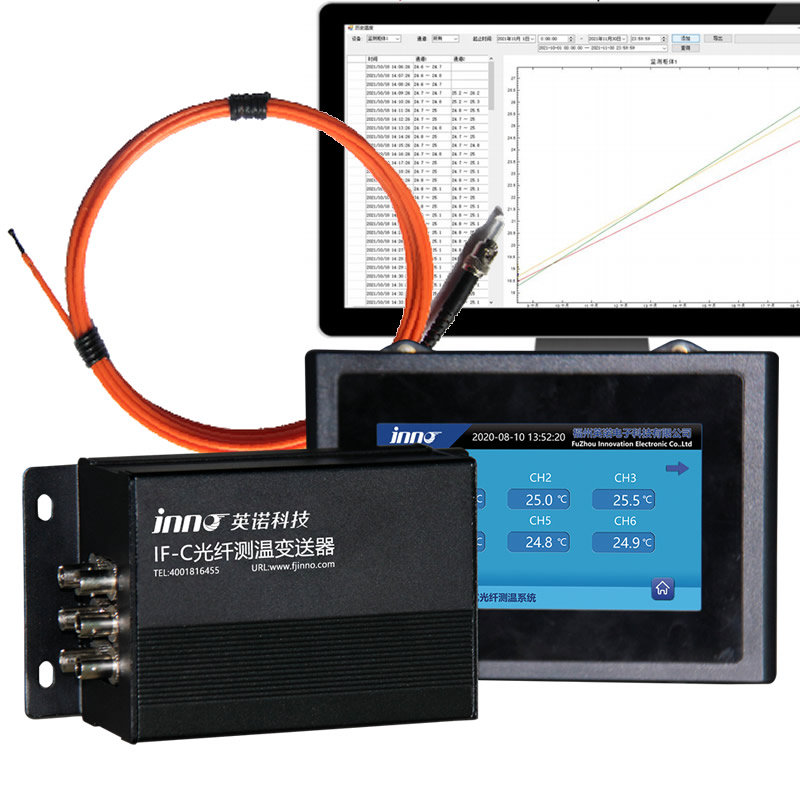
 Sensores de temperatura de fibra óptica INNO ,sistemas de monitoreo de temperatura.
- A fiber optic temperature sensor is a device that measures temperature using light signals transmitted through optical fibers instead of electrical signals through metal wires. Because the sensing element and transmission medium are entirely non-metallic and non-conductive, fiber optic temperature sensors offer inherent immunity to electromagnetic interference (EMI), complete galvanic isolation, and safe operation in explosive, de alta tensión, and radiation-intensive environments — capabilities that are impossible for any conventional electrical temperature sensor.
- There are four major types of fiber optic temperature sensors: decadencia de fluorescencia (phosphor thermometry), detección distribuida de temperatura por fibra óptica (DTS based on Raman scattering), Rejilla de Bragg de fibra (FBG), y arseniuro de galio (GaAs) semiconductor. Each uses a different physical mechanism to convert temperature into an optical signal, and each serves different application requirements in terms of measurement range, exactitud, spatial coverage, and system cost.
- Among all four technologies, the fluorescence-based fiber optic temperature sensor is the most widely deployed, commercially mature, and versatile point-measurement solution. It delivers the best combination of accuracy (±0,1 °C a ±0,5 °C), rango de temperatura (−200 °C to +450 °C), estabilidad a largo plazo, velocidad de respuesta, and cost-effectiveness for the majority of industrial, fuerza, and medical temperature monitoring applications.
- Detección distribuida de temperatura por fibra óptica (EDE) uses Raman backscattering along the entire length of an ordinary optical fiber to measure temperature at thousands of points simultaneously over distances up to 50 km — making it the only technology capable of truly continuous, spatially resolved temperature profiling over long distances.
- Rejilla de Bragg de fibra (FBG) and GaAs semiconductor sensors provide wavelength-encoded and absorption-edge-based temperature measurement respectively. FBG sensors offer multiplexed multi-point monitoring along a single fiber, while GaAs sensors provide a stable, passive alternative for point measurement in power equipment applications.
Tabla de contenido
- What Is a Fiber Optic Temperature Sensor?
- Why Use Fiber Optic Temperature Sensors Instead of Conventional Sensors?
- The Four Major Types of Fiber Optic Temperature Sensors
- Fluorescence-Based Fiber Optic Temperature Sensors — The Gold Standard
- How Fluorescence Fiber Optic Temperature Sensors Work
- Phosphor Materials and Probe Design
- Performance Specifications and Advantages of Fluorescence Sensors
- Applications of Fluorescence Fiber Optic Temperature Sensors
- Detección distribuida de temperatura por fibra óptica (EDE)
- Rejilla de Bragg de fibra (FBG) Sensores de temperatura
- Sensores de temperatura de fibra óptica semiconductores GaAs
- Comparación de tecnologías: Fluorescencia vs.. EDE frente a. FBG vs. GaAs
- Cómo elegir el sensor de temperatura de fibra óptica adecuado
- FAQs — What Is a Fiber Optic Temperature Sensor?
1. ¿Qué es un Sensor de temperatura de fibra óptica?

Definición
A sensor de temperatura de fibra óptica is an optical measurement device that determines temperature by analyzing changes in the properties of light — such as fluorescence decay time, spectral wavelength, backscattered intensity, or absorption edge position — caused by thermal effects on an optical sensing element or on the optical fiber itself. The temperature information is generated, transmitido, and processed entirely in the optical domain, using glass or polymer optical fibers as both the sensing medium and the signal transmission link. No electrical signal is present at any point between the measurement location and the opto-electronic instrument (interrogador) that converts the optical signal into a digital temperature reading.
This fundamental distinction — light instead of electricity — is what gives fiber optic temperature sensors their unique and defining advantages. Because optical fibers are made of fused silica glass (SiO₂) — a dielectric insulator with no free electrons — they cannot conduct electricity, cannot generate or respond to electromagnetic fields, and cannot create galvanic connections. The result is a temperature measurement technology that is inherently immune to electromagnetic interference, intrinsically safe in explosive atmospheres, naturally isolated from high voltages, y resistente a la corrosión, iluminación, y radiación.
Basic Architecture
Regardless of the specific sensing technology used, every fiber optic temperature measurement system consists of three fundamental components. The first component is the elemento sensor — the point or region where temperature interacts with light to produce a measurable optical change. Depending on the technology, this may be a fluorescent phosphor crystal bonded to the fiber tip, a Gallium Arsenide semiconductor chip, a Bragg grating inscribed in the fiber core, or simply the fiber itself (in distributed sensing). The second component is the optical fiber link — one or more glass fibers that carry excitation light from the instrument to the sensing element and return the temperature-modulated optical signal from the sensing element back to the instrument. Standard telecommunications-grade fibers (either multimode or single-mode) son usados, with lengths ranging from a few meters to tens of kilometers depending on the application. The third component is the interrogador (also called the signal conditioner, analyzer, or opto-electronic unit) — an instrument that generates the excitation light, receives and analyzes the returned optical signal, extracts the temperature information, and outputs the result as a digital reading, analog signal, or digital communication protocol.
2. Why Use Fiber Optic Temperature Sensors Instead of Conventional Sensors?

Limitations of Conventional Temperature Sensors
Sensores de temperatura electrónicos convencionales: termopares, RTD (Detectores de temperatura de resistencia), termistores, and integrated circuit (CI) temperature sensors — have served industry well for decades and remain appropriate for many applications. Sin embargo, they all share a fundamental limitation: they rely on electrical signals (Voltaje, resistencia, or current) carried through metallic conductors. This creates inherent vulnerabilities in environments with strong electromagnetic interference, altos voltajes, atmósferas explosivas, ionizing radiation, or chemically aggressive conditions.
Thermocouples generate millivolt-level signals that are easily corrupted by electromagnetic noise, requiring extensive shielding and filtering in high-EMI environments — measures that often prove insufficient. RTDs require excitation current and produce small resistance changes that are susceptible to lead wire resistance errors, self-heating, and EMI-induced noise. All metallic sensor leads act as antennas that couple electromagnetic energy into the measurement circuit, and all create potential paths for ground loops, lightning surges, and high-voltage faults. In environments such as power transformer windings (operating at tens to hundreds of kilovolts), Escáneres de resonancia magnética (1.5 T a 7 T magnetic fields), RF/microwave heating equipment, and explosive gas atmospheres, these vulnerabilities make conventional sensors unreliable, unsafe, or simply impossible to use.
The Fiber Optic Advantage
Sensores de temperatura de fibra óptica eliminate every one of these vulnerabilities. El totalmente dieléctrico, non-metallic construction means there are no conductors to pick up EMI, no electrical paths for ground loops or surge propagation, no spark-generating contacts for explosive atmospheres, and no metallic materials to corrode. The optical fiber provides thousands of volts of galvanic isolation per centimeter of fiber length — far exceeding any electrical isolation requirement. The fiber is immune to radiation damage up to extremely high doses (depending on fiber type), químicamente inerte, and mechanically flexible. These are not engineered protections added to an inherently vulnerable technology — they are intrinsic physical properties of the glass fiber medium itself.
The result is a temperature sensing technology that can operate reliably and accurately in environments that are completely inaccessible to conventional sensors. This is why fiber optic temperature sensors have become the standard — and in many cases the only — solution for temperature measurement in power transformers, aparamenta de alta tensión, sistemas de resonancia magnética, RF and microwave processing, atmósferas explosivas, instalaciones nucleares, and other demanding environments.
3. The Four Major Types of Fiber Optic Temperature Sensors

The field of fiber optic temperature sensing encompasses four distinct and well-established technologies, each based on a different physical principle and each optimized for different measurement requirements. Understanding the differences between these four technologies is essential for selecting the right solution for any given application.
El decadencia de fluorescencia (phosphor thermometry) sensor Mide la vida útil de la fluorescencia dependiente de la temperatura de un material de fósforo en la punta de la fibra.. Es un sensor puntual: cada sonda mide la temperatura en un solo lugar. Ofrece la mejor combinación de precisión., rango, estabilidad, y costo para aplicaciones de medición puntual, y es la tecnología de detección de temperatura de fibra óptica más utilizada en todo el mundo..
El sensor de temperatura distribuido de fibra óptica (EDE) utiliza retrodispersión Raman a lo largo de toda la longitud de una fibra óptica estándar para medir la temperatura continuamente en cada punto a lo largo de la fibra. No es un sensor puntual sino un sistema de detección verdaderamente distribuido que convierte la propia fibra en un sensor de temperatura lineal continuo capaz de monitorear miles de puntos a distancias de hasta 50 kilómetros.
El Rejilla de Bragg de fibra (FBG) sensor Mide el cambio de longitud de onda dependiente de la temperatura de una rejilla de reflexión inscrita en el núcleo de la fibra.. It is a quasi-distributed sensor — multiple FBGs at different wavelengths can be multiplexed along a single fiber, habilitando 10 a 50+ discrete measurement points per fiber channel.
El Arseniuro de galio (GaAs) semiconductor sensor measures the temperature-dependent shift of the optical absorption edge of a GaAs crystal chip at the fiber tip. Like the fluorescence sensor, it is a point sensor measuring temperature at a single location. It provides an alternative approach for power equipment monitoring applications.
The following sections explain each technology in detail, beginning with the fluorescence-based sensor — the most important and widely used of the four.
4. Fluorescence-Based Fiber Optic Temperature Sensors — The Gold Standard

Why Fluorescence Sensors Lead the Market
El sensor de temperatura de fibra óptica basado en fluorescencia — also known as the fluorescent decay sensor, phosphor thermometry sensor, or fluoroptic sensor — has been the dominant fiber optic point temperature measurement technology for over three decades. It holds the largest market share among all fiber optic temperature sensor types and is the technology most commonly referenced when industry professionals discuss “sensores de temperatura de fibra óptica” in the context of power equipment, dispositivos médicos, and industrial process monitoring.
The reasons for this market leadership are both technical and practical. Technically, the fluorescence decay measurement principle provides the ideal combination of high accuracy (±0.1 °C achievable), amplio rango de temperatura (−200 °C to +450 °C with appropriate phosphor selection), inherent self-referencing (the decay time measurement is immune to signal amplitude variations), respuesta rápida (sub segundo), and excellent long-term stability (better than ±0.1 °C per year). Practically, fluorescence sensor systems are available from multiple established manufacturers at competitive price points, with proven field reliability records spanning 25+ years in demanding applications such as power transformer winding monitoring. The technology is referenced in international standards (CEI 60076-2, IEEE C57.91) as the preferred method for direct transformer hot-spot measurement, further reinforcing its market position.
5. How Fluorescence Fiber Optic Temperature Sensors Work

The Fluorescence Decay Principle
El principio de funcionamiento de un sensor de temperatura de fibra óptica de fluorescencia is based on a well-understood quantum mechanical phenomenon: the temperature-dependent quenching of fluorescence in certain phosphor materials. At the tip of the sensor probe, a small phosphor element (typically a rare-earth or transition-metal doped crystal or ceramic) is bonded to the end face of a multimode optical fiber. The interrogator instrument sends a short pulse of excitation light — typically ultraviolet or visible light from a high-brightness LED — through the optical fiber to the phosphor. The phosphor absorbs the excitation light and its dopant ions are promoted to excited electronic energy states. These excited ions then return to their ground state by emitting fluorescent light at a longer (Stokes-shifted) longitud de onda.
Después de que finaliza el pulso de excitación., the fluorescence does not cease instantaneously. En cambio, the population of excited-state ions decays exponentially over time, producing a fluorescence afterglow that diminishes according to the characteristic tiempo de caída de la fluorescencia (t). This decay time is determined by the combined rates of radiative decay (photon emission) and non-radiative decay (phonon-assisted thermal relaxation). At low temperatures, radiative decay dominates and the decay time approaches the intrinsic radiative lifetime of the phosphor. A medida que aumenta la temperatura, non-radiative relaxation pathways become thermally activated and increasingly probable, providing competing channels for de-excitation that remove excited ions from the fluorescent state without producing photons. Este thermal quenching effect systematically reduces the fluorescence decay time with increasing temperature, creating a strong, monotonic, and highly reproducible relationship between decay time and temperature.
The mathematical relationship is well described by a modified Arrhenius equation:
1/t(t) = 1/τ₀ + A · exp.(−ΔE / kt)
where τ(t) is the fluorescence decay time at temperature T, τ₀ is the radiative lifetime (temperature-independent), A is a frequency factor characterizing the non-radiative transition rate, ΔE is the activation energy for the non-radiative quenching process, y k es la constante de Boltzmann. This equation shows that the decay time decreases exponentially as temperature increases — a relationship that provides both high sensitivity and a wide measurement dynamic range.
Why Decay Time Is the Superior Measurand
The decision to measure fluorescence decay time — rather than fluorescence intensity — is the key engineering insight that makes fluorescence fiber optic temperature sensors so robust and reliable. Fluorescence intensity depends not only on temperature but also on the excitation light power, pérdidas de transmisión de fibra, connector alignment, doblado de fibra, envejecimiento del LED, detector responsivity, and phosphor degradation. Any change in any of these factors would cause an apparent temperature error in an intensity-based measurement. In practical installations where optical connectors are disconnected and reconnected, fibers are routed through tight bends, LEDs age over years, and connectors accumulate contamination, intensity-based measurements would require frequent recalibration and would still suffer from uncontrolled drift.
Tiempo de caída de la fluorescencia, por el contrario, is an intrinsic temporal property of the phosphor material that depends only on the phosphor composition and its temperature. It is completely independent of the excitation power, the number of photons detected, the fiber loss, the connector loss, or the detector gain. Whether the fluorescence signal is strong or weak, the exponential decay rate is the same. This means a sensor de temperatura de fibra óptica de fluorescencia does not require recalibration when connectors are reattached, fibers are re-routed, or the LED output degrades over time. The measurement is self-referencing by its fundamental nature — a critical advantage for permanent installations in hard-to-access locations such as inside sealed power transformers.
Measurement Cycle and Signal Processing
The complete measurement cycle of a fluorescence fiber optic temperature sensor interrogator proceeds as follows. The instrument drives a short excitation pulse (typically 10–100 µs in duration) from an LED through an optical coupler or splitter into the fiber cable leading to the probe. The light travels through the fiber (which may be 1 a 1,000 meters long) to the phosphor at the probe tip. The phosphor absorbs the excitation light and begins fluorescencing. Simultáneamente, the optical coupler directs the returning fluorescence signal (at a different wavelength from the excitation) to a photodetector inside the interrogator. An optical filter in front of the detector blocks residual excitation light while passing the fluorescence emission wavelength.
Después de que finaliza el pulso de excitación., the interrogator begins digitizing the exponentially decaying fluorescence signal using a high-speed analog-to-digital converter. The captured decay curve is then processed by a digital signal processing algorithm — typically a least-squares exponential fit, a multi-gate integration method, or a digital phase detection technique — to extract the decay time constant τ with high precision. The instrument applies its stored calibration look-up table or polynomial equation to convert the measured τ value into a temperature reading. The entire cycle — excitation, capture, tratamiento, and output — typically completes in 0.1 a 1 segundo, providing continuous real-time temperature monitoring.
Modern interrogators employ advanced algorithms that can reject background light contamination, compensate for fiber autofluorescence, handle multi-exponential decay components, and average multiple cycles for improved noise performance. Some systems implement dual-wavelength fluorescence ratio techniques as a supplementary measurement mode, comparing fluorescence intensity in two spectral bands to provide redundant temperature information.
6. Phosphor Materials and Probe Design
Phosphor Material Selection
The fluorescent phosphor material is the sensing heart of the sensor de temperatura de fibra óptica de fluorescencia, and its selection determines the usable temperature range, perfil de sensibilidad, accuracy potential, and long-term durability of the sensor. Decades of materials research have identified several phosphor families that offer the optimal combination of properties for fiber optic thermometry.
Chromium-doped Yttrium Aluminum Garnet (Cr:YAG) is one of the most important and widely used phosphor materials in commercial fiber optic temperature sensors. YAG (Y₃Al₅O₁₂) is an extremely hard, químicamente inerte, optically transparent crystal that is readily grown in high quality and easily doped with chromium ions. The Cr³⁺ ions in YAG produce broadband fluorescence in the 680–750 nm wavelength range when excited with visible light (typically around 450–590 nm). The fluorescence decay time at room temperature is approximately 1.5 milisegundos, decreasing to sub-millisecond values at elevated temperatures. Cr:YAG sensors operate effectively over a temperature range of approximately −100 °C to +450 °C, covering the vast majority of industrial and power equipment monitoring requirements. The crystal’s excellent thermal stability ensures that the calibration does not drift over decades of operation.
Magnesium fluorogermanate doped with manganese (Mg₄FGeO₆:Mn⁴⁺) was one of the earliest phosphors used in commercial fiber optic thermometry, pioneered by Luxtron Corporation in the 1980s. It produces red fluorescence with a decay time of approximately 3–5 ms at room temperature and operates over a range of approximately −50 °C to +200 °C. While its temperature range is narrower than Cr:YAG, it offers a strong, easily measured signal and remains in use for moderate-temperature applications.
Rubí (Cr:Al₂O₃) — chromium-doped sapphire — is a classic phosphor thermometry material whose R-line fluorescence (694.3 Nuevo Méjico) has been studied extensively for scientific temperature measurement. Its decay time varies from approximately 3.5 ms at room temperature to sub-millisecond values above 400 °C. Ruby offers a well-characterized and precisely predictable temperature response, but its narrow-line emission requires more precise optical filtering than broadband phosphors.
Rare-earth doped phosphors such as Dy:YAG (dysprosium-doped YAG), Er:YAG (erbium-doped YAG), Eu:Y₂O₃ (europium-doped yttria), and Tb:La₂O₂S (terbium-doped lanthanum oxysulfide) offer specialized capabilities for extreme temperature ranges. Dysprosium and erbium-doped materials push the upper measurement limit above 450 °C for high-temperature industrial applications. Europium and terbium-doped phosphors provide measurable decay time variations at cryogenic temperatures (por debajo de −100 °C), extending coverage to liquid nitrogen temperatures and beyond.
Alexandrite (Cr:BeAl₂O₄) provides high temperature sensitivity in the 0 °C a 300 °C range and has found application in medical and biomedical fiber optic thermometry where resolution and response speed are prioritized in a moderate temperature range.
Probe Construction and Packaging
The fluorescence sensing probe is a precision-engineered assembly designed to efficiently couple the phosphor to the optical fiber while protecting both from the operating environment. In a typical probe construction, a small phosphor element — which may be a polished single crystal chip (0.3–1.0 mm), a pressed ceramic pellet, or a thin layer of phosphor powder bonded in an optical adhesive matrix — is attached to the cleaved and polished end face of a multimode optical fiber (típicamente 62.5 µm, 100 µm, 200 µm, o 400 µm core diameter) using a high-temperature optical epoxy or a direct fusion bonding process.
The bare phosphor-fiber assembly is then encapsulated in a protective housing. For power transformer and oil-immersed applications, the probe is typically enclosed in a stainless steel or PEEK (polyether ether ketone) tube, sealed at both ends, with the fiber exiting through a hermetic seal. The outer diameter ranges from 1.5 a 4 milímetros, and the sensing tip length is typically 10–30 mm. For medical and biomedical applications, probes can be as small as 0.5 mm diameter with PTFE or polyimide coatings for biocompatibility. For high-temperature industrial applications, cerámico (alumina or zirconia) housings protect the probe at temperatures up to 450 °C or higher.
The optical fiber cable connecting the probe to the interrogator is typically a ruggedized fiber optic cable with aramid fiber strength members, a PVC, LSZH (Low Smoke Zero Halogen), or stainless steel outer jacket, and standard fiber optic connectors (ST, CAROLINA DEL SUR, FC, or E2000) at the instrument end. Cable lengths from 1 meter to over 1,000 meters are available, with no signal degradation over distance because the decay-time measurement is independent of signal amplitude.
7. Performance Specifications and Advantages of Fluorescence Sensors
Typical Performance Specifications
| Parámetro | Standard Grade | High-Performance Grade |
|---|---|---|
| Rango de temperatura | −40°C a +200 °C | −200 °C to +450 °C |
| Exactitud | ±0,5 °C | ±0.1 °C to ±0.2 °C |
| Resolución | 0.1 °C | 0.01 °C |
| Tiempo de respuesta (T₉₀) | 0.5–3 segundos | 0.1–0,5 segundos |
| Measurement Update Rate | 1–4Hz | Arriba a 10 Hz |
| Número de canales | 1–4 | 4–32 |
| Longitud de la fibra (probe to interrogator) | Arriba a 200 metro | Arriba a 1,000 metro |
| Probe Outer Diameter | 1.5–3 milímetros | 0.5–6 mm |
| Long-term Calibration Stability | ±0.1 °C/year | ±0.05 °C/year |
| Inmunidad EMI | Completo (inherent) | Completo (inherent) |
| Galvanic Isolation | Total (all-dielectric path) | Total (all-dielectric path) |
| Seguridad intrínseca | Disponible (EX-rated probes) | Disponible (EX-rated probes) |
Key Advantages Summarized
El sensor de temperatura de fibra óptica de fluorescencia provides a set of advantages that no other single temperature sensing technology can match. Its complete electromagnetic interference immunity derives from the all-dielectric construction with no metallic components at the sensing point. Its self-referencing decay-time measurement ensures that accuracy is maintained regardless of fiber loss variations, degradación del conector, envejecimiento del LED, or signal path changes — eliminating the need for periodic recalibration in permanent installations. Its wide temperature range (−200 °C to +450 °C with phosphor selection) covers virtually all industrial, fuerza, and medical applications with a single technology platform. Its high accuracy (±0.1 °C achievable) meets the most demanding measurement requirements. Its fast response time (sub segundo) enables real-time process monitoring and protection. Its total galvanic isolation eliminates high-voltage breakdown risks, ground loop errors, and surge propagation paths. Its chemically inert materials ensure compatibility with oil-immersed, corrosive, and biomedical environments. And its proven field reliability — with demonstrated probe lifespans of 15 a 25+ years in power transformer service — provides confidence for long-term investment in permanent monitoring infrastructure.
8. Applications of Fluorescence Fiber Optic Temperature Sensors
Power Transformer Winding Hot-Spot Monitoring
The single largest application of sensores de temperatura de fibra óptica de fluorescencia globally is monitoring the winding hot-spot temperature of power transformers. The transformer winding operates at voltages ranging from a few kilovolts to 1,100 kV (in ultra-high-voltage transmission), creating an environment where no metallic sensor cable can safely bridge the voltage differential between the winding surface and the grounded instrument. Simultáneamente, the transformer core produces intense alternating magnetic fields that would corrupt any electrical measurement signal. The winding is immersed in mineral oil or synthetic ester fluid inside a sealed steel tank, making access for maintenance or recalibration impossible without de-energizing and opening the transformer.
Fluorescence fiber optic probes are installed directly on the winding surface during transformer manufacturing. The optical fiber exits the tank through a fiber-optic penetrator (alimentación) and connects to an interrogator mounted on the transformer’s control cabinet. The all-dielectric fiber provides inherent high-voltage isolation to full winding voltage, the decay-time measurement is completely unaffected by the transformer’s electromagnetic environment, and the self-referencing calibration stability eliminates any need for recalibration over the transformer’s 25–40 year operational life.
Accurate winding hot-spot temperature data enables utilities and asset managers to implement dynamic transformer rating (DTR) — loading the transformer based on actual thermal state rather than conservative nameplate ratings — unlocking 10–30% additional capacity without reducing equipment life. It also enables predictive thermal aging calculation, optimized cooling system control, gestión de sobrecarga, and early detection of internal thermal faults. Normas internacionales IEC 60076-2 and IEEE C57.91 reference fiber optic sensing as the preferred method for direct winding hot-spot measurement. Major transformer manufacturers including Siemens Energy, Energía Hitachi, Vernova, TBEA, Baoding Tianwei, and many others routinely specify fluorescence fiber optic temperature sensors as standard or optional equipment in medium and large power transformers.
High-Voltage Switchgear and Busbar Monitoring
media tensión (arriba a 40.5 kV) y aparamenta de alta tensión, conductos de autobuses, and cable terminations present similar challenges to power transformers — high voltages, fuertes campos electromagnéticos, and enclosed or sealed environments. Degradación de contacto, corrosión, and loose bolted connections cause localized overheating at junction points that, if undetected, leads to insulation failure, arc flash events, and catastrophic equipment damage. Sensores de temperatura de fibra óptica de fluorescencia are installed directly on busbar joints, contactos del disyuntor, and cable terminations inside switchgear compartments. They provide continuous, real-time hot-spot temperature monitoring with complete high-voltage isolation and zero risk of compromising the insulation coordination or creating an ignition source — requirements that disqualify all conventional metallic sensor technologies.
Electric Motor and Generator Winding Temperature
Large electric motors and generators (hundreds of kilowatts to hundreds of megawatts) require accurate stator winding temperature monitoring for thermal protection, optimización del rendimiento, y mantenimiento predictivo. The winding environment — high voltage, campos magnéticos giratorios, vibración, and limited access — challenges conventional RTD installations. Embedded sondas de temperatura de fibra óptica de fluorescencia provide faster response, higher accuracy, inmunidad EMI completa, and superior galvanic isolation compared to traditional RTDs, enabling more precise thermal protection and more aggressive loading strategies.
Medición de temperatura compatible con resonancia magnética
Imágenes por resonancia magnética (resonancia magnética) systems generate static magnetic fields of 1.5 T a 7 t, campos de gradiente que cambian rápidamente, and high-power radiofrequency (RF) pulses. Any metallic sensor or wire introduced into the MRI bore would cause image artifacts, experience potentially dangerous RF-induced heating, and produce corrupted temperature signals. Sensores de temperatura de fibra óptica de fluorescencia, siendo completamente no metálico y no magnético, son totalmente compatibles con resonancia magnética. They are used for patient temperature monitoring during MRI examinations and MRI-guided procedures, phantom temperature characterization, and precise real-time temperature measurement during MRI-guided thermal therapies (ablación láser, ultrasonido enfocado, RF ablation, cryotherapy) where accurate tissue temperature knowledge is critical for treatment safety and efficacy.
RF, Microonda, and Electromagnetic Heating
Calefacción industrial por radiofrecuencia (calentamiento dieléctrico, soldadura por radiofrecuencia, secado por radiofrecuencia), procesamiento por microondas (microwave curing, sinterización, food pasteurization), and induction heating systems generate intense electromagnetic fields that make conventional temperature measurement extremely difficult or impossible. Sensores de fibra óptica de fluorescencia are the standard solution for temperature measurement inside these electromagnetic applicators. The all-dielectric probe does not interact with the applied electromagnetic field, does not distort the field distribution, and does not experience self-heating from RF/microwave absorption — all of which are serious problems when metallic sensors are placed in electromagnetic fields.
Hazardous and Explosive Atmospheres
In environments classified as explosive atmospheres (ATEX zones, IECEx areas) — such as petrochemical facilities, oil and gas platforms, minas de carbón, and chemical processing plants — any electrical equipment at the sensing point represents a potential ignition source. Fiber optic temperature sensors with no electrical energy at the probe are inherently incapable of generating sparks, arcos, or thermal ignition. Combined with appropriate certification (EX ia, EX d), sensores de temperatura de fibra óptica de fluorescencia provide intrinsically safe temperature measurement in the most dangerous explosive atmosphere classifications.
Other Important Applications
Additional application areas for fluorescence fiber optic temperature sensors include semiconductor manufacturing process monitoring, nuclear power facility temperature measurement (where radiation immunity is an additional benefit), electric vehicle battery thermal management, power cable joint and termination monitoring, compatibilidad electromagnética (CEM) cámaras de prueba, equipo de procesamiento de plasma, high-power laser system thermal monitoring, and scientific research applications requiring high-accuracy temperature measurement in electromagnetically hostile environments.
9. Detección distribuida de temperatura por fibra óptica (EDE)
What Is Distributed Temperature Sensing?
Detección distribuida de temperatura por fibra óptica (EDE) is a fundamentally different approach from the point-sensing technologies described above. Rather than measuring temperature at a single point using a discrete sensing element attached to the fiber tip, DTS uses the optical fiber itself as a continuous, distributed temperature sensor along its entire length. A single DTS instrument connected to one end of an ordinary telecommunications-grade optical fiber can measure temperature at every point along the fiber — providing a complete temperature profile with spatial resolution of 0.25 a 2 meters over fiber lengths of 1 a 50 kilómetros. This means a single DTS channel can simultaneously monitor thousands to tens of thousands of temperature measurement points.
The Raman Scattering Principle
The physical mechanism underlying DTS is spontaneous Raman backscattering. When a laser pulse is launched into the optical fiber, a small fraction of the light is scattered by molecular vibrations (optical phonons) in the glass. This Raman scattering produces two spectral components: el alimenta signal (scattered at a longer wavelength than the laser, corresponding to creation of a phonon) y el anti-Stokes signal (scattered at a shorter wavelength, corresponding to absorption of an existing phonon). The intensity of the Stokes signal is relatively insensitive to temperature, while the anti-Stokes signal intensity increases strongly with temperature because higher temperatures produce a larger population of thermally excited phonons available for absorption.
The DTS instrument measures the ratio of anti-Stokes to Stokes backscattered intensity as a function of time after the laser pulse launch. Because the speed of light in the fiber is known, the time delay of the returned signal directly maps to the position along the fiber (Optical Time Domain Reflectometry — OTDR principle). The anti-Stokes/Stokes ratio at each position is then converted to temperature using the known Boltzmann distribution relationship. The result is a complete temperature-versus-distance profile along the entire fiber length, updated every few seconds to minutes depending on the system configuration.
DTS Performance and Applications
Typical DTS systems provide temperature accuracy of ±0.5 °C to ±1 °C, spatial resolution of 0.5 a 2 metros, and temperature resolution of 0.01 °C a 0.1 °C (depending on measurement averaging time). The maximum fiber sensing range varies from 4 kilómetros (high-resolution systems) to 30–50 km (long-range systems), with some specialized systems reaching even longer distances. Measurement update rates range from once every few seconds (short fibers, high spatial resolution) to once every several minutes (long fibers, requisitos de alta precisión).
DTS systems are widely used for pipeline leak and temperature monitoring (aceite, gas, y tuberías de agua), power cable hot-spot detection and rating, fire detection in tunnels, almacenes, y sistemas transportadores, wellbore temperature profiling in the oil and gas industry (downhole DTS), perimeter security and intrusion detection (detecting thermal signatures), dam and levee seepage monitoring, industrial furnace and kiln temperature profiling, and data center hot aisle/cold aisle monitoring. In all these applications, the ability to continuously monitor temperature along kilometers of fiber — with a single instrument and no discrete sensors to install, fuerza, or maintain — provides extraordinary value.
EDE frente a. Fluorescence Sensors: When to Use Which
DTS and fluorescence sensors serve fundamentally different measurement needs and are rarely in direct competition. DTS excels at monitoring temperature along linear infrastructure (tuberías, cables, túneles) where spatial coverage over long distances is the primary requirement and moderate accuracy (±1 ºC) is acceptable. Fluorescence sensors excel at precise point measurement (±0.1 °C) at specific critical locations — such as transformer winding hot spots, contactos de aparamenta, or medical treatment zones — where high accuracy, respuesta rápida, and compact probe size are essential. In many large-scale systems, both technologies are deployed together: DTS provides broad spatial coverage while fluorescence sensors provide high-accuracy monitoring at the most critical points.
10. Rejilla de Bragg de fibra (FBG) Sensores de temperatura
Principio de funcionamiento
A Rejilla de Bragg de fibra (FBG) is a periodic modulation of the refractive index written into the core of a single-mode optical fiber, typically using ultraviolet (ultravioleta) laser holographic exposure or phase mask techniques. This microscopic grating structure — typically 1 a 10 mm in length — acts as a narrow-band optical mirror, reflecting light at a specific wavelength called the Bragg wavelength (λ_B) while transmitting all other wavelengths. The Bragg wavelength is determined by the grating period (l) y el índice de refracción efectivo del núcleo de la fibra. (n_eff) according to the Bragg condition: λ_B = 2 · n_eff · Λ.
When temperature changes at the FBG location, two effects shift the Bragg wavelength. Primero, the thermo-optic effect changes the refractive index of the silica glass (dn/dT ≈ 8.6 × 10⁻⁶ /°C for germanium-doped silica). Segundo, thermal expansion changes the physical grating period (α ≈ 0.55 × 10⁻⁶ /°C for silica). The combined effect produces a Bragg wavelength shift of approximately 10–13 pm/°C en 1550 nm operating wavelength. By measuring this wavelength shift with a precision spectrometer, tunable laser, or interferometric interrogator, the system determines the temperature change at the grating location.
Wavelength Multiplexing
The most distinctive capability of FBG sensors is wavelength-division multiplexing (WDM). Múltiples FBG, each inscribed at a slightly different nominal Bragg wavelength (p.ej., 1530 Nuevo Méjico, 1535 Nuevo Méjico, 1540 Nuevo Méjico, …, 1565 Nuevo Méjico), can be written at different positions along a single optical fiber. When the interrogator illuminates the fiber with broadband light, each FBG reflects its own characteristic wavelength, and the interrogator distinguishes the individual sensors by their spectral positions. A single fiber channel can typically accommodate 10 a 50+ sensores FBG (limited by the available optical bandwidth and the wavelength operating range of each sensor). This provides quasi-distributed multi-point temperature measurement using a single fiber cable — significantly reducing cabling complexity and installation cost compared to deploying many individual point sensors.
Cross-Sensitivity to Strain
The primary consideration when using FBG sensors for temperature measurement is their cross-sensitivity to mechanical strain. The Bragg wavelength shifts with both temperature and axial strain (aproximadamente 1.2 pm/µε at 1550 Nuevo Méjico), and a single FBG measurement cannot distinguish between the two effects. For applications requiring pure temperature measurement, the FBG must be mounted in a strain-free configuration — typically housed in a loose-tube protective enclosure that allows the fiber to expand and contract freely without mechanical constraint from the mounting structure. When both temperature and strain are of interest (p.ej., in structural health monitoring), dual-grating designs, reference gratings, or FBGs with different strain sensitivities are used to separate the two effects.
FBG Temperature Sensor Performance
Standard FBG temperature sensors offer accuracy of ±0.5 °C to ±1 °C, resolución de 0.1 °C (aproximadamente 1 pm wavelength resolution), and operating ranges from −40 °C to +300 °C. Specialized high-temperature FBGs — fabricated using regeneration techniques or femtosecond laser inscription — extend the upper limit to +800 °C o incluso +1,000 °C. Response time depends on thermal coupling between the fiber and the measurement target, and is typically 0.1 a 1 segundo. Interrogator update rates range from 1 Hz for static monitoring to several kHz for dynamic measurements.
FBG Applications
FBG temperature sensors are used in power transformer multi-point winding monitoring (where the multiplexing advantage reduces fiber penetrations), structural health monitoring of bridges, edificios, and composite materials, aerospace and aircraft component temperature mapping, wind turbine blade monitoring, railway infrastructure monitoring, nuclear facility temperature sensing, medical device temperature monitoring, and industrial process multi-point temperature profiling. Like all fiber optic sensors, FBGs provide complete EMI immunity and galvanic isolation.
11. Sensores de temperatura de fibra óptica semiconductores GaAs
Principio de funcionamiento
El GaAs (Arseniuro de galio) sensor de temperatura de fibra óptica exploits the temperature dependence of the optical bandgap of a semiconductor crystal. GaAs is a direct bandgap III-V semiconductor whose bandgap energy decreases approximately linearly with increasing temperature, following the empirical Varshni relationship. As the bandgap decreases, the optical absorption edge — the wavelength at which the material transitions from transparent to strongly absorbing — shifts to longer wavelengths (red-shifts) at a rate of approximately 0.4 nm/°C.
In the sensor construction, a thin GaAs crystal chip (typically 100–300 µm thick) is mounted at the end of an optical fiber. The interrogator transmits broadband near-infrared light through the fiber to the GaAs chip. Photons with energy greater than the bandgap (shorter wavelength than the absorption edge) are absorbed by the crystal. Photons with energy less than the bandgap (longitud de onda más larga) pass through the crystal and are reflected by a mirror coating on the back face, returning through the fiber to the interrogator. The spectral position of the absorption edge in the reflected signal is measured by a spectrometer or wavelength-selective detector system and converted to temperature using a stored calibration.
GaAs Sensor Characteristics
GaAs fiber optic temperature sensors typically operate over a range of −40 °C to +250 °C with accuracy of ±0.5 °C to ±1 °C and resolution of 0.1 °C. The measurement is based on a fundamental crystallographic property (energía de banda prohibida) that is highly stable and repeatable, providing good long-term calibration stability. The GaAs crystal chip is compact, robusto, and passive — requiring no electrical excitation at the sensing point.
En comparación con los sensores de fluorescencia, GaAs sensors have a narrower temperature range (250 °C vs. 450 °C upper limit), lower achievable accuracy (±0,5 °C frente a. ±0.1 °C), and require a more complex spectral measurement system in the interrogator. Sin embargo, the GaAs absorption edge shift is a purely passive optical property (no fluorescent excitation/emission process involved), and some engineers and manufacturers prefer this simplicity for specific applications. GaAs fiber optic temperature sensors are primarily used in power transformer winding monitoring, monitoreo de aparamenta, and electric motor temperature measurement — the same core applications served by fluorescence sensors. The choice between fluorescence and GaAs in these applications is often driven by manufacturer ecosystem, regional market preferences, and supply chain considerations rather than fundamental technical superiority.
12. Comparación de tecnologías: Fluorescencia vs.. EDE frente a. FBG vs. GaAs
| Parámetro | Decaimiento de fluorescencia | EDE (raman) | Rejilla de Bragg de fibra | Semiconductores de GaAs |
|---|---|---|---|---|
| Tipo de medición | Punto | Repartido (continuo) | Casi distribuido (multiplexed) | Punto |
| Principio de detección | Tiempo de caída de la fluorescencia | Raman backscatter ratio | Cambio de longitud de onda de Bragg | Bandgap absorption edge shift |
| Rango de temperatura | −200 °C to +450 °C | −40°C a +700 °C | −40°C a +300 °C (std) / +800 °C (especial) | −40°C a +250 °C |
| Exactitud | ±0,1 °C a ±0,5 °C | ±0,5 °C a ±2 °C | ±0,5 °C a ±1 °C | ±0,5 °C a ±1 °C |
| Resolución | 0.01–0.1 °C | 0.01–0.1 °C | 0.1 °C | 0.1 °C |
| Resolución espacial | N / A (punto) | 0.25–2 m | Grating length (~1–10 mm) | N / A (punto) |
| Sensing Range/Fiber Length | Arriba a 1,000 metro | 1–50 kilómetros | Arriba a 100 metro (typical sensor array) | Arriba a 500 metro |
| Puntos por Fibra | 1 | Miles (continuo) | 10–50+ | 1 |
| Tiempo de respuesta | 0.1–3 s | Segundos a minutos | 0.1–1 s | 0.5–3 s |
| Self-Referencing | Sí (tiempo de decaimiento) | Sí (ratio-metric) | Sí (wavelength-encoded) | Sí (wavelength-encoded) |
| Sensibilidad a la tensión | Ninguno | Mínimo | Sí (cross-sensitive) | Ninguno |
| Inmunidad EMI | Completo | Completo | Completo | Completo |
| Galvanic Isolation | Total | Total | Total | Total |
| Interrogator Cost | Medio ($2K–$10K) | Alto ($30K–$150K+) | Alto ($10K–$50K) | Medio-alto ($3K–$12K) |
| Costo por punto | Bajo-Medio | Muy bajo (por punto) | Bajo (with multiplexing) | Bajo-Medio |
| Primary Strength | Exactitud, rango, stability for point measurement | Continuous coverage over long distances | Multi-point multiplexing on single fiber | Pasivo, stable point measurement |
| Market Maturity | muy alto (30+ años) | Alto (25+ años) | Alto (20+ años) | Alto (25+ años) |
13. Cómo elegir el sensor de temperatura de fibra óptica adecuado
Decision Framework
Seleccionando el derecho sensor de temperatura de fibra óptica begins with clearly defining the measurement requirement along four key dimensions: the number and spatial distribution of measurement points, the required accuracy and temperature range, las condiciones ambientales en el lugar de detección, and the system budget.
If you need to measure temperature at one or a few specific critical points con alta precisión (±0,1 °C a ±0,5 °C), el sensor de temperatura de fibra óptica de fluorescencia es la opción recomendada. It provides the best accuracy, the widest temperature range, estabilidad probada a largo plazo, and the most competitive cost for small channel counts. This is the appropriate technology for transformer winding hot-spots, contactos de aparamenta, bobinados del motor, MRI-compatible measurements, and RF/microwave process monitoring.
If you need to measure temperature at many discrete points (10–50+) along a single fiber path, and moderate accuracy (±0,5 °C a ±1 °C) is sufficient, Sensores de temperatura FBG offer significant cabling and installation advantages through wavelength multiplexing. This is appropriate for multi-point structural monitoring, multi-zone transformer or generator monitoring, and distributed process temperature profiling at discrete locations.
If you need continuous temperature profiling over long distances (hundreds of meters to tens of kilometers) with moderate accuracy and spatial resolution, detección de temperatura distribuida (EDE) is the only solution. No other technology can provide continuous spatial coverage over such distances. DTS is the standard for pipeline monitoring, monitoreo de cables de alimentación, detección de incendios en túneles, and wellbore temperature profiling.
Si necesitas un point sensor for power equipment monitoring and your equipment manufacturer or supply chain has established capability with GaAs technology, GaAs sensors provide a proven and reliable alternative to fluorescence sensors for this specific application domain.
Practical Selection Criteria
Beyond the technology type, practical selection criteria include the interrogator’s communication interfaces (4–20 mA, Modbus, CEI 61850, OPC-UA, Ethernet/IP), the number of channels and expansion capability, the probe construction and environmental rating (Clasificación IP, clasificación de temperatura, compatibilidad química, certification for explosive atmospheres), the fiber cable type and connector standard, the vendor’s track record and installed base in your application area, and the availability of local technical support and spare parts. For permanent installations in critical infrastructure, prefer vendors with demonstrated field reliability records of 10+ years and a documented quality management system.
14. FAQs — What Is a Fiber Optic Temperature Sensor?
Q1: What is a fiber optic temperature sensor in simple terms?
A sensor de temperatura de fibra óptica is a device that measures temperature using light instead of electricity. A thin glass fiber carries light to a sensing point where temperature changes the light in a measurable way — changing how fast it fades (fluorescencia), what color is reflected (FBG), what wavelengths are absorbed (GaAs), or how much light scatters back (EDE). Because no electricity is involved at the measurement point, the sensor is completely immune to electromagnetic interference, safe at high voltages, and suitable for explosive or radiation environments.
Q2: What are the four main types of fiber optic temperature sensors?
The four main types are: sensores de caída de fluorescencia (measuring phosphor fluorescence lifetime at the fiber tip — the most widely used), distributed temperature sensors (EDE) (measuring Raman scattering along the entire fiber length), Rejilla de Bragg de fibra (FBG) sensores (measuring wavelength shift of a grating inscribed in the fiber), y GaAs semiconductor sensors (measuring the absorption edge shift of a Gallium Arsenide crystal). Each type uses a different physical principle and serves different application needs.
Q3: Which type of fiber optic temperature sensor is most commonly used?
El sensor de temperatura de fibra óptica basado en fluorescencia is the most widely deployed type for point temperature measurement. Its market leadership spans over three decades and is based on its unmatched combination of high accuracy (±0.1 °C), amplio rango de temperatura (−200 °C to +450 °C), long-term calibration stability, self-referencing measurement principle, and proven reliability in demanding applications such as power transformers, sistemas de resonancia magnética, and RF heating equipment.
Q4: How does a fluorescence fiber optic temperature sensor work?
The interrogator sends a light pulse through the fiber to a phosphor at the probe tip. The phosphor absorbs the light and emits fluorescence that fades (decays) exponentially after the pulse ends. The rate of this decay — the fluorescence lifetime — changes predictably with temperature: higher temperature means faster decay. Midiendo el tiempo de decaimiento, the instrument determines the temperature. Porque el tiempo de desintegración es una propiedad intrínseca del fósforo., the measurement is independent of signal strength, pérdidas de fibra, or LED aging.
Q5: What is distributed fiber optic temperature sensing (EDE)?
Detección de temperatura distribuida (EDE) uses Raman backscattering in an ordinary optical fiber to measure temperature continuously along the fiber’s entire length. Se envía un pulso láser a lo largo de la fibra., and the instrument analyzes the temperature-dependent Raman backscatter at every point along the fiber (using time-of-flight to determine position). A single DTS system can monitor temperatures at thousands of points over distances up to 50 kilómetros, making it ideal for pipeline, cable de alimentación, y monitoreo de túneles.
Q6: What is an FBG temperature sensor?
Un FBG (Rejilla de Bragg de fibra) sensor de temperatura uses a tiny optical grating written into the fiber core that reflects a specific wavelength of light. Cuando la temperatura cambia, the reflected wavelength shifts by approximately 10–13 pm/°C. Multiple FBGs at different wavelengths can be multiplexed along a single fiber, enabling 10–50+ discrete temperature measurement points per fiber — a unique capability not available with other fiber optic sensor types. FBGs are also sensitive to strain, so strain-free mounting is needed for temperature-only measurement.
P7: What is a GaAs fiber optic temperature sensor?
A Sensor de temperatura de fibra óptica GaAs uses a Gallium Arsenide semiconductor chip at the fiber tip. The bandgap of GaAs changes with temperature, shifting the optical absorption edge at about 0.4 nm/°C. By measuring this spectral shift, the system determines temperature. GaAs sensors typically cover −40 °C to +250 °C with ±0.5 °C accuracy and are primarily used for power transformer and switchgear monitoring as an alternative to fluorescence sensors.
P8: Why are fiber optic temperature sensors immune to electromagnetic interference?
All fiber optic temperature sensors are immune to EMI because the optical fiber is made of glass — a dielectric insulator that cannot conduct electricity and does not respond to electromagnetic fields. There are no metallic wires, no electronic circuits, and no electrical signals at the sensing point. The temperature information is carried by light, which is unaffected by electric fields, campos magnéticos, radio frequencies, or microwave radiation. This immunity is an inherent physical property, not an engineered shield that could be overcome by stronger interference.
P9: Can fiber optic temperature sensors replace thermocouples and RTDs?
In many applications, yes. Sensores de temperatura de fibra óptica — particularly fluorescence-based sensors — can replace thermocouples and RTDs wherever EMI immunity, high-voltage isolation, seguridad intrínseca, or long-term calibration stability is required. They provide comparable or better accuracy and response time. Sin embargo, fiber optic sensors have higher initial system cost (especially the interrogator), require more careful handling of the delicate optical fiber, and may not be justified in benign environments where inexpensive thermocouples perform adequately. The selection should be driven by the application requirements rather than a blanket replacement strategy.
Q10: ¿Cuánto duran los sensores de temperatura de fibra óptica??
Las sondas de temperatura de fibra óptica de fluorescencia instaladas en transformadores de potencia funcionan habitualmente para 15 a 25+ años sin reemplazo ni recalibración. The phosphor sensing materials are chemically inert and thermally stable, showing negligible degradation under normal conditions. The silica optical fiber has a proven service life exceeding 25 años. Fallo de la sonda, cuando ocurre, is almost always due to mechanical fiber breakage rather than sensing element degradation. DTS and FBG systems in permanent installations also demonstrate multi-decade operational lifespans.
Q11: How much does a fiber optic temperature sensor system cost?
System cost varies significantly by technology type and channel count. A sensor de temperatura de fibra óptica de fluorescencia system typically costs USD 2,000 a 10,000 para el interrogador y USD 100 a 500 per probe — the most cost-effective option for small to medium channel counts. sistemas FBG cost USD 10,000 a 50,000 for the interrogator but achieve lower per-point cost when many sensors are multiplexed on single fibers. sistemas DTS cost USD 30,000 a 150,000+ for the interrogator but offer extremely low per-point cost given the thousands of measurement points per channel. GaAs systems are priced comparably to fluorescence systems. en todos los casos, the investment is justified by the unique measurement capabilities that no conventional sensor can provide in the target environments.
Q12: Where can I purchase fiber optic temperature sensors?
Fjinno (www.fjinno.net) proporciona sensores de temperatura de fibra óptica de fluorescencia and complete measurement system solutions for power, industrial, médico, and scientific applications. FJINNO systems feature high-accuracy fluorescence decay measurement, multi-channel interrogators, ruggedized probe designs for transformer, aparamenta, and motor applications, and standard industrial communication interfaces including Modbus, CEI 61850, and 4–20 mA analog output.
Descargo de responsabilidad: La información proporcionada en este artículo tiene fines educativos y de referencia generales.. Especificaciones específicas del producto., características de rendimiento, y los precios varían según el fabricante, modelo, y configuración. Todos los datos técnicos citados representan valores típicos que se encuentran en productos comerciales de detección de temperatura de fibra óptica y no deben usarse como especificaciones garantizadas para ningún sistema específico.. Consulte siempre la documentación oficial del fabricante y realice una evaluación independiente antes de especificar o comprar equipos de detección de temperatura de fibra óptica.. Fjinno (www.fjinno.net) welcomes technical inquiries and provides application-specific recommendations to help you select the optimal fiber optic temperature sensing solution for your requirements.

Sensor de temperatura de fibra óptica, Sistema de monitoreo inteligente, Fabricante distribuido de fibra óptica en China
 |
 |
 |