 INNO faseroptische Temperatursensoren ,Temperaturüberwachungssysteme.
- SF6 (Schwefelhexafluorid) is a synthetic, colorless, geruchlos, non-flammable gas with exceptional dielectric strength and arc-quenching capability, making it indispensable in high-voltage electrical equipment.
- SF6 gas has a dielectric strength approximately 2.5 times that of air at atmospheric pressure and roughly 3 times at typical operating pressures used in gasisolierte Schaltanlage (GIS).
- Primary applications include SF6-Leistungsschalter, gasisolierte Schaltanlage, gas-insulated transformers, Und gas-insulated transmission lines (GIL) across voltage classes from 72.5 kV zu 1,100 kV.
- SF6 is classified as a potent greenhouse gas with a global warming potential (GWP) von 23,500 over a 100-year horizon and an atmospheric lifetime of approximately 3,200 Jahre.
- Richtig SF6 gas monitoring systems, including density monitors, leak detectors, and decomposition analyzers, are essential for safe operation and environmental compliance.
- Der regulatorische Druck in der EU und anderen Rechtsordnungen treibt die Forschung nach SF6-Alternativen wie Fluornitrilmischungen voran (C4F7N) und Fluorketon (C5F10O) Mischungen für neue Gerätedesigns.
- Die installierte Basis von SF6-isolierte Ausrüstung weltweit enthält eine Schätzung 250,000+ Tonnen SF6-Gas, erfordern ein striktes Lebenszyklusmanagement von der Abfüllung bis zur Rückgewinnung und zum Recycling.
Inhaltsverzeichnis
- Was ist SF6-Gas??
- Physikalische und chemische Eigenschaften von SF6-Gas
- Dielektrische Leistung und Lichtbogenlöschleistung
- Anwendungen von SF6-Gas in elektrischen Geräten
- SF6-Gasüberwachungs- und -erkennungssysteme
- Umgang mit SF6-Gas, Lagerung, und Sicherheit
- Umweltauswirkungen und Vorschriften
- SF6-Gasalternativen für elektrische Geräte
- Häufig gestellte Fragen
1. Was ist SF6-Gas??

SF6-Gas, oder Schwefelhexafluorid, ist eine synthetische anorganische Verbindung mit der chemischen Formel SF₆. It consists of one sulfur atom bonded to six fluorine atoms in an octahedral molecular geometry, forming one of the most chemically stable and electrically insulating gases known to science. First synthesized in 1900 by French chemists Henri Moissan and Paul Lebeau, SF6 found its defining industrial purpose in the mid-20th century when its extraordinary Spannungsfestigkeit Und arc-quenching properties were harnessed for high-voltage electrical equipment.
At standard temperature and pressure, SF6 ist farblos, geruchlos, ungiftig, and non-flammable gas approximately five times denser than air. Its molecular weight of 146.06 g/mol gives it a distinctive heaviness that contributes to its insulating behavior. In the electrical power industry, sulfur hexafluoride gas serves as the primary insulating and arc-interrupting medium in equipment ranging from Mittelspannungsschaltanlage bei 12 kV zu ultra-high-voltage circuit breakers Und GIS systems Betrieb bei 1,100 kV und höher.
Why SF6 Became the Industry Standard
Before SF6, high-voltage equipment relied on air, Öl, or vacuum as insulating and interrupting media. Air-blast circuit breakers were physically enormous. Oil circuit breakers posed fire and explosion risks. SF6 offered a compelling alternative — compact equipment with superior interrupting performance, lower maintenance requirements, and dramatically reduced footprint. By the 1970s and 1980s, SF6 gas-insulated equipment had become the global standard for high-voltage substations, particularly in urban areas and indoor installations where space is constrained.
2. Physikalische und chemische Eigenschaften von SF6-Gas
The exceptional performance of SF6 in electrical applications is rooted in its unique combination of physical and chemical properties. Understanding these properties is essential for engineers specifying, Betrieb, und pflegen SF6-filled electrical equipment.
| Property | Wert | Bedeutung |
|---|---|---|
| Molecular Formula | SF₆ | Octahedral symmetry, highly stable |
| Molecular Weight | 146.06 g/mol | ~5× heavier than air |
| Boiling Point (1 atm) | −63.9 °C (−83 °F) | Remains gaseous in most climates |
| Kritische Temperatur | 45.6 °C (114 °F) | Defines upper pressure limits |
| Critical Pressure | 37.6 Bar (545 psi) | Operating pressures typically 4–8 bar |
| Density at STP | 6.16 g/L | High density aids insulation |
| Spannungsfestigkeit (1 atm) | ~2.5× air | Enables compact equipment design |
| Wärmeleitfähigkeit | ~1.3× air | Good heat dissipation in equipment |
| Toxicity | Non-toxic (pure state) | Decomposition byproducts are toxic |
| GWP (100-Jahr) | 23,500 | Potent greenhouse gas |
| Atmospheric Lifetime | ~3,200 years | Extremely persistent once released |
2.1 Chemical Stability
Schwefelhexafluorid is one of the most chemically inert compounds known. The six fluorine atoms completely shield the central sulfur atom, creating an extremely strong and symmetric molecular bond structure. This stability means that SF6 does not react with other materials inside sealed electrical compartments — it does not attack copper, Aluminium, epoxy resin insulators, Dichtungen, or other components commonly found in gasisolierte Schaltanlage Und SF6-Leistungsschalter.
2.2 Behavior Under Electrical Stress
When SF6 gas is subjected to an electrical arc — as occurs during circuit breaker operation — the gas molecules dissociate into sulfur and fluorine atoms and ions. The critical advantage is that SF6 rapidly recombines after the arc is extinguished, restoring its full dielectric strength within microseconds. This self-healing property is what makes SF6 uniquely effective as an arc-quenching medium. Jedoch, the arc-induced dissociation also produces trace amounts of decomposition byproducts, including sulfur dioxide (SO₂), hydrogen fluoride (HF), and various sulfur fluoride compounds (S₂F₁₀, SOF₂, SO₂F₂), some of which are highly toxic and corrosive.
3. Dielektrische Leistung und Lichtbogenlöschleistung
The dielectric performance of SF6-Gas is the primary reason for its dominance in high-voltage equipment. At atmospheric pressure, SF6 has a dielectric strength approximately 2.5 mal so viel wie Luft. At typical operating pressures of 4–6 bar (Absolute) used in GIS-Ausrüstung, the dielectric strength rises to roughly 3 mal so viel wie Luft, enabling dramatic reductions in equipment dimensions.
3.1 Electronegative Properties
SF6 is a strongly electronegative gas, meaning its molecules readily capture free electrons. In an electric field, any electron released through ionization is quickly absorbed by an SF6 molecule, forming a heavy, slow-moving negative ion. This electron-capture mechanism suppresses the development of electron avalanches — the fundamental process behind electrical breakdown. Diese Eigenschaft verleiht SF6 seine Überlegenheit Isolationsleistung im Vergleich zu Luft, Stickstoff, oder CO₂.
3.2 Lichtbogenunterbrechungsmechanismus
In SF6-Leistungsschalter, Beim Lichtbogenlöschvorgang wird das Gas durch einen Kolbenmechanismus über den Lichtbogen geblasen (Puffertyp) oder thermische Energie vom Lichtbogen selbst (Selbstexplosionstyp). Die hohe Wärmeleitfähigkeit und die elektronegative Natur von SF6 kühlen den Lichtbogenkanal schnell ab und entziehen ihm Energie. Bei Stromnulldurchgängen in Wechselstromsystemen, SF6 baut die Spannungsfestigkeit über die Kontaktlücke hinweg schnell wieder auf, Fehlerströme erfolgreich unterbrechen, die erreichen können 63 kA oder höher in der Moderne Hochspannungs-Leistungsschalter.
Vergleich der Spannungsfestigkeit verschiedener Gase
| Gas | Relative Durchschlagsfestigkeit (Luft = 1.0) | Verwendung in elektrischen Geräten |
|---|---|---|
| Luft | 1.0 | Luftisolierte Schaltanlage (AIS) |
| Stickstoff (N₂) | 1.0 | Einige Transformatordecken |
| CO₂ | 0.9 | Begrenzte Anwendungen |
| SF6 | 2.5 (bei 1 atm) | GIS, Leistungsschalter, GIL, GIT |
| C4F7N / CO₂-Gemisch | ~2,0–2,3 | Aufkommende SF6-Alternative |
| C5F10O / Air mixture | ~1.5–1.8 | Aufkommende SF6-Alternative |
| Clean Dry Air | 1.0 | AIS, clean-air switchgear |
4. Anwendungen von SF6-Gas in elektrischen Geräten

Schwefelhexafluorid is used across a wide range of electrical power equipment where high dielectric strength, arc-quenching capability, and compact design are required. The global installed base of SF6 equipment spans transmission, Verteilung, and generation systems on every continent.
4.1 SF6 Circuit Breakers
SF6-Leistungsschalter are the dominant technology for interrupting high-voltage AC circuits at voltage levels from 72.5 kV zu 1,100 kV. Modern designs include single-pressure puffer-type breakers and self-blast (thermal-assist) Unterbrecher. These units can interrupt short-circuit currents of 40–80 kA with operating times under 3 Zyklen (50 ms at 60 Hz). Dead-tank SF6 breakers Und live-tank SF6 breakers are the two principal configurations, each suited to different substation designs and seismic requirements.
4.2 Gasisolierte Schaltanlage (GIS)
Gasisolierte Schaltanlage (GIS) Kapselt Leistungsschalter, Trennschalter, Erdungsschalter, Stromwandler, Spannungswandler, und Busleiter in versiegelten Aluminium- oder Stahlgehäusen, die mit unter Druck stehendem SF6 gefüllt sind. GIS-Installationen nehmen 10–20 % der dafür benötigten Grundfläche ein luftisolierte Schaltanlage (AIS) Umspannwerke. Dies macht GIS für städtische Umspannwerke unverzichtbar, unterirdische Installationen, Offshore-Plattformen, und an jedem Ort, an dem der Platz begrenzt ist oder die Umgebungsbedingungen rau sind.
4.3 Gasisolierte Transformatoren (GIT)
Gasisolierte Transformatoren Verwenden Sie SF6 als Isolier- und Kühlmedium anstelle von herkömmlichem mineralisches Transformatorenöl. Denn SF6 ist nicht brennbar, Diese Transformatoren sind ideal für feuerempfindliche Installationen wie unterirdische Umspannwerke, Gebäude, Tunnel, und Offshore-Plattformen. SF6-gasisolierte Transformatoren sind in der Regel in Bewertungen bis ca. erhältlich 300 MVA und 170 kV, obwohl einige Hersteller höhere Bewertungen anbieten.
4.4 Gasisolierte Übertragungsleitungen (GIL)
Gas-insulated transmission lines (GIL) use SF6 or SF6/N₂ gas mixtures as the insulating medium inside sealed metallic tubes to transmit high-voltage power over distances typically ranging from a few hundred meters to several kilometers. GIL is used where overhead lines or conventional cables are not feasible — such as through tunnels, across bridges, in densely built-up areas, and for river or strait crossings.
4.5 Other SF6 Applications
Beyond the major applications above, SF6 is also used in SF6 gas-insulated current transformers, SF6 gas-insulated voltage transformers, SF6 gas-insulated bushings, and certain types of surge arresters Und load break switches at medium- and high-voltage levels.
| Gerätetyp | Spannungsbereich | SF6 Function | Typical SF6 Pressure |
|---|---|---|---|
| SF6 Circuit Breaker | 72.5–1,100 kV | Isolierung + Arc Quenching | 5–7 bar (abs) |
| Gasisolierte Schaltanlage (GIS) | 72.5–1,100 kV | Isolierung + Arc Quenching | 4–6 bar (abs) |
| Gas-Insulated Transformer (GIT) | Bis zu 170 kV | Isolierung + Kühlung | 1.5–3 bar (abs) |
| Gas-Insulated Line (GIL) | 145–550 kV | Isolierung | 4–8 bar (abs) |
| SF6 Instrument Transformer | 72.5–800 kV | Isolierung | 3–5 bar (abs) |
| Medium-Voltage Switchgear | 12–40,5 kV | Isolierung + Arc Quenching | 1.3–1.5 bar (abs) |
5. SF6-Gasüberwachungs- und -erkennungssysteme
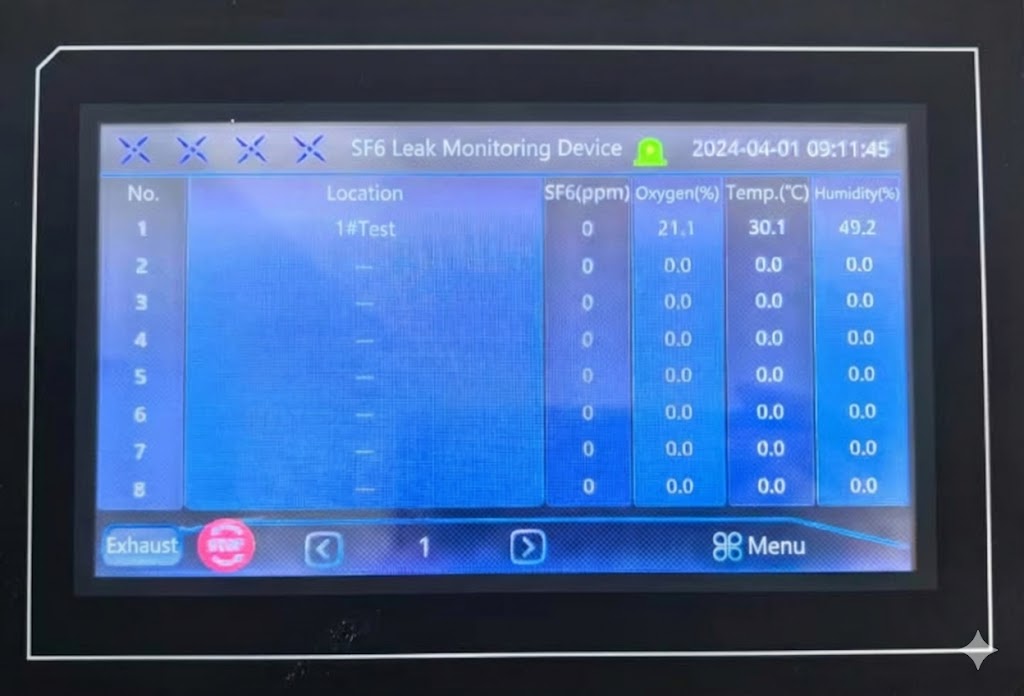
Given the critical role of SF6 in maintaining the insulating and arc-interrupting integrity of high-voltage equipment, and the severe environmental consequences of uncontrolled emissions, umfassend SF6 gas monitoring systems are an essential component of modern substation design and operation. These systems ensure that gas quality, Druck, and containment are continuously verified across every SF6-filled compartment in the installation.
5.1 SF6 Gas Density Monitors
Der SF6 gas density monitor (also called a density relay) is the most fundamental monitoring device installed on every SF6 gas compartment. Unlike a simple pressure gauge, a density monitor compensates for temperature variations to provide an accurate indication of the actual mass of SF6 gas inside the sealed compartment. If the gas density drops below a preset alarm threshold — indicating a leak — the monitor triggers an alert. If density falls to a second, lower threshold, it can initiate a lockout to prevent equipment operation under unsafe conditions.
Modern electronic SF6 density transmitters replace older mechanical dial-type monitors with continuous digital output signals (4–20 mA or digital protocols) that feed directly into the substation’s SCADA-System oder Intelligente elektronische Geräte (IEDs). This enables real-time remote monitoring and trending of SF6 inventory across an entire fleet of GIS-Buchten Und Leistungsschalter.
5.2 SF6 Gas Leak Detection Systems
While density monitors detect the consequence of a leak (reduced gas quantity), gewidmet SF6-Gasleckdetektoren identify the location and rate of the leak itself. Several technologies are in widespread use.
Portable SF6 Leak Detectors
Portable SF6 leak detectors based on negative ion capture (electron capture detector) or non-dispersive infrared (NDIR) technology are standard tools for maintenance crews. Modern handheld units can detect SF6 concentrations as low as 0.1 ppmv and pinpoint leak locations on GIS flanges, bushing interfaces, valve stems, and weld seams. Leading manufacturers of SF6 leak detection equipment include DILO, Ion Science, Fluke, and Besantek.
Fixed Area SF6 Monitoring Systems
Fixed SF6 area monitors are permanently installed in enclosed GIS rooms, underground substations, and cable tunnels where SF6 equipment is housed. These systems use infrared photoacoustic sensors or NDIR sensors to continuously measure the ambient SF6 concentration in the room air. They serve two purposes: personnel safety (SF6 is an asphyxiant in high concentrations as it displaces oxygen) and early warning of equipment leaks. IEC 62271-1 and IEEE C37.122 both reference requirements for gas detection and ventilation in GIS-Installationen.
5.3 SF6 Gas Quality Analyzers
After electrical arcing events, Wartungstätigkeiten, or prolonged service, the quality of SF6-Gas inside equipment must be verified. SF6 gas analyzers measure moisture content, Reinheit (percentage of SF6), and the concentration of decomposition byproducts such as SO₂ and HF. IEC 60480 specifies the quality requirements for SF6 gas used in electrical equipment, including limits for moisture (< 25 ppmv for new gas), Reinheit (> 99.9%), and acidity.
| Überwachungsgerät | What It Measures | Standort | Ausgabe / Schnittstelle |
|---|---|---|---|
| SF6 Density Monitor (Mechanisch) | Gas density (temp-compensated) | Each gas compartment | Alarm + lockout contacts |
| SF6 Density Transmitter (Elektronisch) | Gas density (kontinuierlich) | Each gas compartment | 4–20 mA / SCADA |
| Portable Leak Detector | SF6 concentration at source | Handheld / Wartung | Anzeige + audible alarm |
| Fixed Area Monitor | Ambient SF6 in room | GIS room / cable tunnel | Alarm + ventilation trigger |
| SF6 Gas Analyzer | Purity, Feuchtigkeit, SO₂, HF | Tragbar / lab | Anzeige / report |
| Online Decomposition Monitor | SO₂, HF, CF₄ levels | Critical GIS bays | Kontinuierlich / SCADA |
5.4 Integrated SF6 Asset Management Platforms
Progressive utilities and transmission system operators now deploy integrated SF6 gas management platforms that aggregate data from density transmitters, leak detection surveys, gas quality test results, and gas handling records into a centralized database. These platforms track SF6 inventory by equipment serial number, calculate annual SF6 leakage rates as required by EPA (in the U.S.) or EU F-Gas Regulation reporting, and generate compliance documentation. Leading utility asset management software vendors increasingly include dedicated SF6 tracking modules.
6. Umgang mit SF6-Gas, Lagerung, und Sicherheit
Richtig SF6 gas handling requires specialized equipment and trained personnel. SF6 is shipped and stored in pressurized steel cylinders as a liquid under its own vapor pressure. Before filling into electrical equipment, the gas must be verified for purity and moisture content per IEC 60480 or applicable utility specifications.
6.1 SF6 Gas Handling Equipment
SF6 gas handling carts (also called SF6 service carts or SF6 reclaimers) are purpose-built systems that perform the complete lifecycle of SF6 management: evacuation of equipment compartments, recovery of SF6 from equipment, filtration and purification, Lagerung, and re-filling. Modern units from manufacturers such as DILO, Enervac, Comde-Derenda, and Mega conform to IEC 62271-4 Standards und können SF6-Rückgewinnungsraten von mehr als erreichen 99.5%, Minimierung der Emissionen bei Wartungsarbeiten.
6.2 Überlegungen zur Personalsicherheit
Reines SF6 ist ungiftig und chemisch inert. Jedoch, Zwei Sicherheitsbedenken stehen im Vordergrund. Erste, denn SF6 ist fünfmal dichter als Luft, es kann sich in Gruben ansammeln, Gräben, Kabelkeller, und tiefliegende geschlossene Räume, Dadurch wird Sauerstoff verdrängt und es besteht Erstickungsgefahr. Zweite, SF6-Zersetzungsprodukte erzeugt durch Lichtbögen – einschließlich SO₂, HF, S₂F₁₀, SOF₂, und SO₂F₂ – sind hochgiftig und ätzend. Arbeitnehmer müssen geeignete persönliche Schutzausrüstung verwenden (PSA) einschließlich Atemschutz und chemikalienbeständigen Handschuhen bei der Handhabung SF6-Gas verwendet oder das Öffnen von Fächern, in denen interne Lichtbogenfehler aufgetreten sind.
Wichtige Sicherheitsstandards
Zu den wichtigsten internationalen Normen für die Handhabung und Sicherheit von SF6 gehört die IEC 62271-4 (handling procedures for SF6 and its mixtures), IEC 60480 (specifications for re-use of SF6), and EPA 40 CFR Teil 98 Subpart DD (mandatory reporting of SF6 emissions in the United States). The EU F-Gas Regulation (NEIN. 517/2014, revised 2024) imposes strict reporting requirements and phase-down measures on high-GWP gases including SF6.
7. Umweltauswirkungen und Vorschriften
The environmental profile of SF6-Gas is the most significant challenge facing its continued use. With a global warming potential (GWP) von 23,500 — meaning one kilogram of SF6 released to the atmosphere has the same warming effect as 23,500 kilograms of CO₂ over 100 years — and an atmospheric lifetime of approximately 3,200 Jahre, SF6 is among the most potent greenhouse gases regulated under the Kyoto Protocol and the Paris Agreement.
7.1 Emission Sources and Rates
SF6 emissions from the electrical industry occur through equipment leakage during normal service, losses during maintenance and gas handling, and end-of-life disposal. The IEC standard for acceptable annual leakage from new sealed-pressure GIS equipment is less than 0.5% per year per gas compartment. Well-maintained modern equipment routinely achieves leakage rates below 0.1% pro Jahr. Jedoch, older equipment, particularly units installed before the 1990s, can exhibit significantly higher leakage rates.
7.2 Regulatory Landscape
| Region | Regulation | Key Requirement |
|---|---|---|
| europäische Union | F-Gas Regulation (revised 2024) | Ban on new SF6 MV switchgear from 2030; HV restrictions phased |
| Vereinigte Staaten | EPA 40 CFR Teil 98 Subpart DD | Mandatory emission reporting for utilities |
| Kalifornien (USA) | CARB SF6 Regulation | Annual emission rate target of 1% von 2020 |
| Japan | High Pressure Gas Safety Act | Reporting and handling requirements |
| International | Kyoto Protocol / Paris Agreement | SF6 listed in basket of regulated GHGs |
8. SF6-Gasalternativen für elektrische Geräte
The environmental pressure on SF6 has driven major equipment manufacturers to develop and commercialize alternative insulating and interrupting gases, particularly for new installations.
8.1 Fluoronitrile-Based Mixtures (C4F7N)
Fluoronitrile gas mixtures, marketed by GE Vernova under the brand name g³ (Green Gas for Grid), blend C4F7N with CO₂ and O₂ as buffer gases. These mixtures achieve approximately 90%–100% of SF6’s dielectric performance at equivalent pressures with a GWP reduction of more than 99%. GIS systems using fluoronitrile mixtures are commercially available and installed at voltage levels up to 420 kV.
8.2 Fluoroketone-Based Mixtures (C5F10O)
Fluoroketone gas mixtures — blending C5F10O with air or nitrogen — have been commercialized primarily by ABB (jetzt Hitachi Energy) under the AirPlus brand for Mittelspannungsschaltanlage at 12–40.5 kV. Das GWP von C5F10O liegt unter 1, und damit nahezu klimaneutral. Jedoch, Die geringere Durchschlagsfestigkeit dieser Mischungen im Vergleich zu SF6 bedeutet größere Kammergrößen oder höhere Drücke.
8.3 Saubere Trockenluft- und Vakuumtechnologie
Für Mittelspannungsschaltanlage, Vakuum-Leistungsschalter kombiniert mit sauberer, trockener Luftisolierung sind zur SF6-freien Standardlösung geworden. Auf Verteilungsspannungsebenen (12–40,5 kV), Die Vakuumunterbrechungstechnologie ist ausgereift und weit verbreitet. Bei höheren Spannungen, Eine reine Luftisolierung erfordert wesentlich größere Geräte, Einschränkung seiner Anwendbarkeit bei beengten Platzverhältnissen.
Vergleich der SF6-Alternativen
| Alternative | GWP | Spannungsfestigkeit vs. SF6 | Spannungsbereich | Kommerzieller Status |
|---|---|---|---|---|
| C4F7N / CO₂ / O₂-Gemisch | ~328 (Mischung) | 90%–100 % | Bis zu 420 kV | Im Handel erhältlich |
| C5F10O / Air mixture | <1 | 60%–80 % | Bis zu 40.5 kV | Im Handel erhältlich |
| Clean Dry Air | 0 | ~40 % | Bis zu 420 kV (großes Gehege) | Im Handel erhältlich |
| Vakuum (MV-Leistungsschalter) | 0 | N / A (nur mit Unterbrechung) | Bis zu 145 kV | Ausgereifte Technologie |
| CO₂ / O₂-Gemisch | <1 | ~35 %–40 % | Bis zu 72.5 kV | Begrenzter Einsatz |
Häufig gestellte Fragen
Q1: Wofür steht SF6??
SF6 steht für Schwefelhexafluorid, a chemical compound consisting of one sulfur atom and six fluorine atoms (chemical formula SF₆). It is a synthetic gas not found naturally in the environment.
Q2: Why is SF6 gas used in circuit breakers?
SF6 is used in circuit breakers because of its exceptional dielectric strength (2.5× Luft) and rapid arc-quenching capability. It can extinguish high-energy electrical arcs and restore insulation strength within microseconds, enabling compact and reliable high-voltage circuit breaker Entwürfe.
Q3: Ist SF6-Gas für den Menschen gefährlich??
Reines SF6 ist ungiftig und chemisch inert. Jedoch, it poses an asphyxiation risk in enclosed spaces because it is five times heavier than air and displaces oxygen. Zusätzlich, SF6 decomposition byproducts formed by electrical arcing — including SO₂ and HF — are highly toxic and corrosive, requiring proper safety precautions during maintenance.
Q4: What is an SF6 gas density monitor?
Ein SF6 gas density monitor is a temperature-compensated measuring device installed on each gas compartment of SF6 equipment. It monitors the actual gas mass inside the compartment and triggers alarms or equipment lockouts if the density falls below safe thresholds, indicating a gas leak.
F5: How do you detect an SF6 gas leak?
SF6 leaks are detected using portable SF6 leak detectors (based on electron capture or NDIR infrared technology), fixed area SF6 monitors in GIS rooms, and density trending from electronic SF6 density transmitters. Modern detectors can identify leaks as small as 0.1 ppmv.
F6: What is the global warming potential of SF6?
SF6 has a 100-year global warming potential (GWP) von 23,500, meaning one kilogram of SF6 has the same greenhouse effect as 23,500 kilograms of CO₂. Its atmospheric lifetime is approximately 3,200 Jahre, making it one of the most persistent greenhouse gases known.
F7: Can SF6 gas be recycled?
Ja. SF6 gas can be recovered from equipment using specialized SF6 gas handling carts, purified through filtration and adsorption processes to remove moisture and decomposition byproducts, and re-used. IEC 60480 specifies the quality requirements that reclaimed SF6 must meet before re-use in electrical equipment.
F8: What are the alternatives to SF6 in switchgear?
Commercially available alternatives include fluoronitrile-based gas mixtures (C4F7N/CO₂), fluoroketone-based gas mixtures (C5F10O/air), vacuum interruption technology, and clean dry air insulation. These are available for different voltage classes, with the most mature SF6-free solutions at medium-voltage levels.
F9: What is gas-insulated switchgear (GIS)?
Gasisolierte Schaltanlage (GIS) is a type of high-voltage switchgear where the busbars, Leistungsschalter, Trennschalter, und andere Komponenten sind in versiegelten Metallgehäusen eingeschlossen, die mit unter Druck stehendem SF6-Gas gefüllt sind. GIS nehmen 10–20 % des Platzbedarfs herkömmlicher luftisolierter Schaltanlagen ein, Daher ist es für städtische und platzbeschränkte Installationen unerlässlich.
F10: Wie oft sollte die SF6-Gasqualität geprüft werden??
IEC- und IEEE-Standards empfehlen die Prüfung der SF6-Gasqualität (Feuchtigkeit, Reinheit, und Zersetzungsprodukte) vor der ersten Bestromung, nach jeder Wartung im Zusammenhang mit der Gashandhabung, nach internen Fehlerereignissen, und regelmäßig während des Betriebs – typischerweise alle 5–10 Jahre, abhängig von den Richtlinien des Versorgungsunternehmens und den behördlichen Anforderungen.
Haftungsausschluss
Die in diesem Artikel bereitgestellten Informationen dienen ausschließlich allgemeinen Informations- und Bildungszwecken. FJINNO (www.fjinno.net) ist bestrebt, die Richtigkeit aller technischen Daten sicherzustellen, Spezifikationen, und regulatorische Referenzen, die hier vorgestellt werden, Es werden jedoch keine Gewähr oder Garantien hinsichtlich der Vollständigkeit übernommen, Aktualität, oder Eignung für eine bestimmte Anwendung. Electrical equipment specifications, gas handling procedures, Sicherheitsstandards, and environmental regulations vary by jurisdiction and are subject to change. This content does not constitute professional engineering, Sicherheit, or regulatory compliance advice. Readers must consult qualified engineers, equipment manufacturers, and relevant regulatory authorities before making technical, Beschaffung, or compliance decisions. FJINNO assumes no liability for any losses, damages, Verletzungen, or regulatory penalties arising from the use or interpretation of information contained in this article.

Faseroptischer Temperatursensor, Intelligentes Überwachungssystem, Verteilter Glasfaserhersteller in China
 |
 |
 |