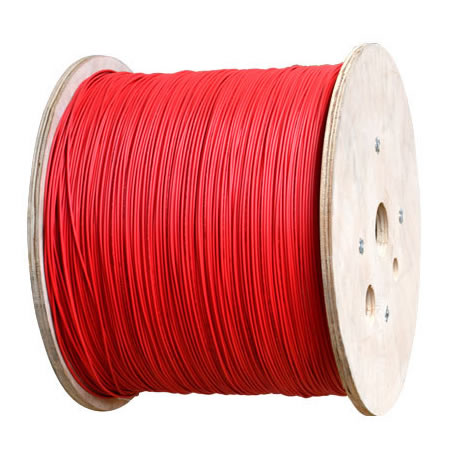
INNO faseroptische Temperatursensoren ,Temperaturüberwachungssysteme.
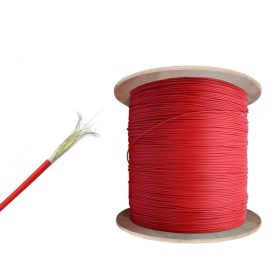

Das verteilte faseroptische Temperaturmesssystem nutzt fortschrittliche optoelektronische Technologie, Kommunikationstechnologie, Mikroprozessortechnik, digitale Temperaturerfassungstechnologie, und einzigartig gestaltete Niedertemperatur, starkes elektrisches Feld, und feuchte Umgebungsbetriebstechnik. It can monitor the temperature in different environments separately, detect accident hazards early, and minimize losses. Gleichzeitig, it can also provide a large amount of online monitoring data, providing reliable basis for operators to comprehensively understand the operation of heating pipelines.
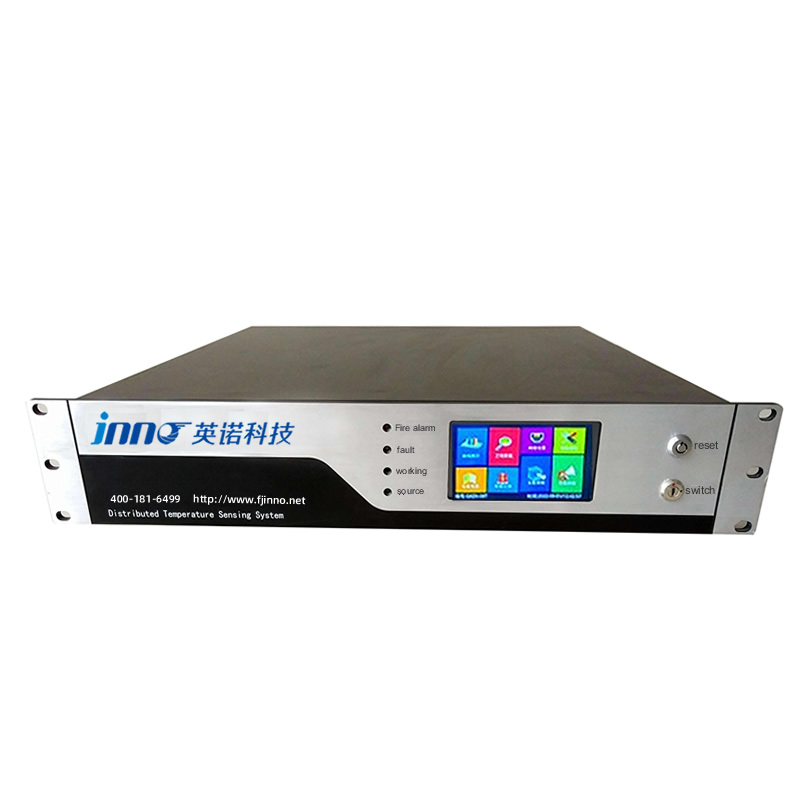
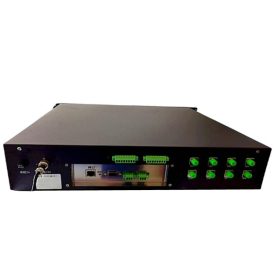
Der verteilte Glasfaser sensing temperature analyzer is the main body of the DTS distributed fiber optic temperature measurement system. The fiber optic temperature measurement host is responsible for the signal acquisition, Signalverarbeitung, Datenanalyse, Übertemperaturalarm, network transmission and other functions of the entire system. It is composed of an optical frequency generator, switching power supply, microprocessor, network interface, usw., and is the core device for photoelectric conversion and information processing.
Fully distributed: DTS can detect the complete temperature distribution along the entire fiber optic cable in seconds without any omissions.
Long distance monitoring: Single mode and multi-mode monitoring hosts, with a maximum length of 40 Kilometer.
Electromagnetic inertness: Temperature measuring optical fibers are composed of quartz, electrically insulated, not subject to any electrical interference, and do not emit electromagnetic waves, making them particularly suitable for various complex and strong electrical environments.
Eigensicherheit: The temperature sensing element is a temperature measuring optical fiber, and the average power of the optical signal transmitted internally is at the micro watt level; Eigensicherheit
Genaue Positionierung: The positioning accuracy reaches ± 1M.
Schnelle Antwort: Single channel scanning time less than 3 Sekunden
The temperature measurement of DTS is most based on the spontaneous Raman scattering effect. After high-power narrow pulse laser pulse LD is incident on the sensing fiber, the laser interacts with the fiber molecules, producing extremely weak backscattered light. The scattered light has three wavelengths, namely Rayleigh, Anti-Stokes, und Stokes Licht: anti Stokes is temperature sensitive, is signal light; Stokes is temperature insensitive, is reference light. The backscattered signal light from the sensing fiber passes through the splitter module WF and the isolated Rayleigh scattered light again. It passes through the temperature sensitive anti sokes signal light and the temperature insensitive Stokes reference light, and is received by the same detector (APD). The temperature can be calculated based on the ratio of the two light intensities. Die Positionsbestimmung basiert auf der optischen Zeitbereichsreflexions-OTDR-Technologie, Dabei wird eine Hochgeschwindigkeits-Datenerfassung genutzt, um die Echozeit des Streusignals zu messen und die dem Streusignal entsprechende Faserposition zu bestimmen.
Anwendungsszenarien für die verteilte faseroptische Temperaturmessung

Einführung in das verteilte faseroptische Temperaturmesssystem für Kabelgräben und Kabel
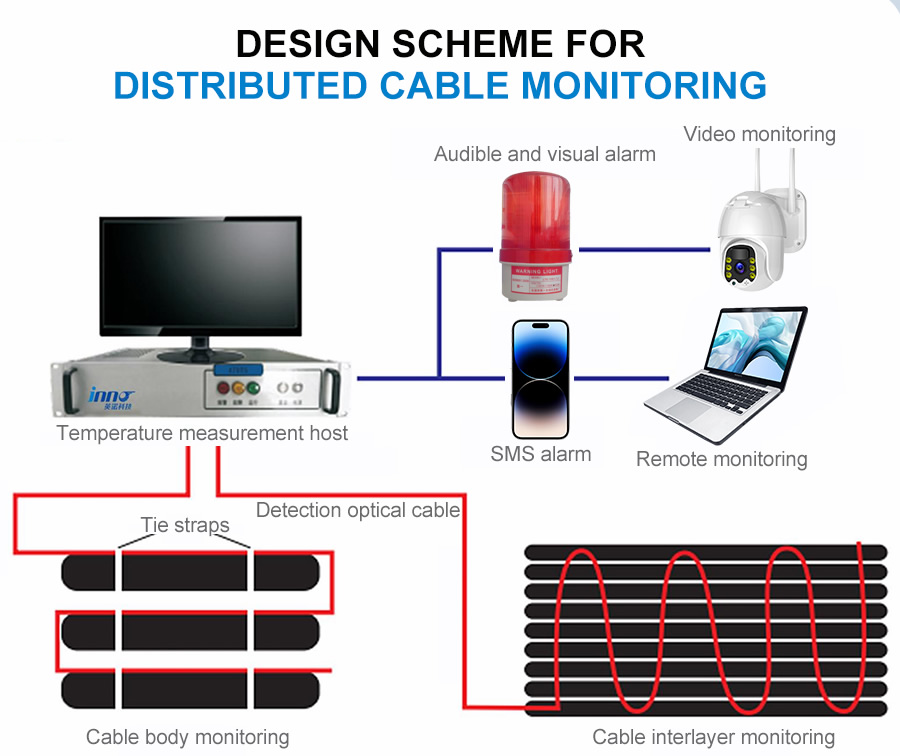
Das verteilte faseroptische Temperaturmesssystem kann in jeder komplexen Umgebung zeitnah Informationen und Änderungen zur Kabeltemperatur erhalten. Das Temperaturmesssystem kann einen oder mehrere Überwachungspunkte und Alarmtemperaturpunkte festlegen. Wenn die Kabeltemperatur in der Umgebung ungewöhnlich ist, and there is abnormal change in the cable temperature, if the cable temperature reaches or exceeds the set temperature, the temperature curve of the cable will be displayed in the workstation system, and the temperature measurement system will send alarm information to the PLC at any time. After receiving instructions from various monitoring points, the PLC’s internal program can control the environment of the cables based on the set temperature data. It can open the exhaust system, automatically close the fire doors, prevent the spread of fires, and ensure that the entire system is in a safe and controlled environment.
Application of Distributed Fiber Optic Temperature Measurement in Pipeline Temperature Monitoring
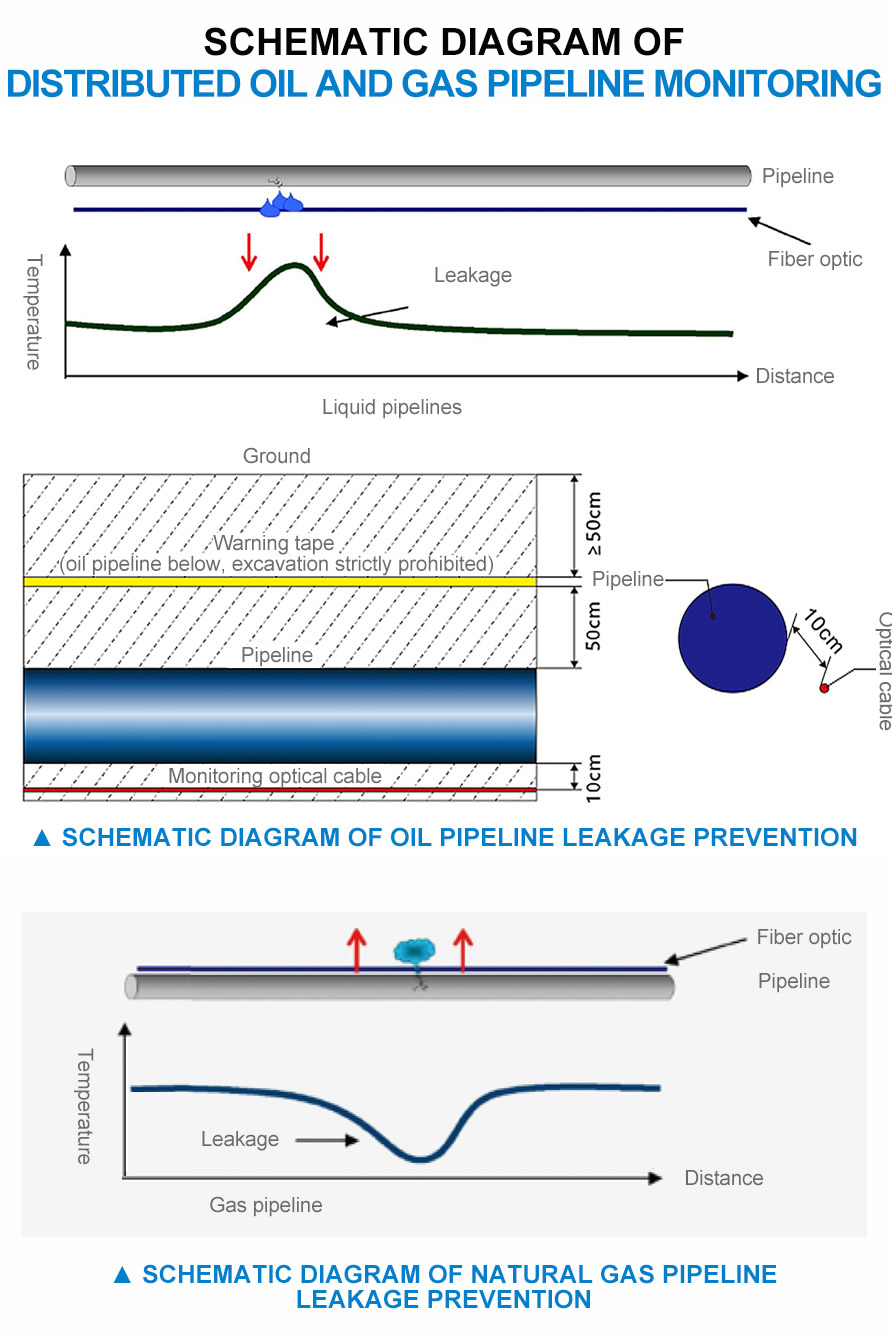
The entire fiber in the distributed Raman fiber optic temperature measurement system serves as both a data signal transmission medium and a temperature detection along the pipeline to achieve comprehensive monitoring of the pipeline. The alarm detection at each point can achieve any combination of three methods: konstante Temperatur, Differenztemperatur, and temperature uniformity, ensuring the reliability of the alarm. daher, a reasonable fiber optic installation method provides reliable guarantees for the normal operation of the entire fiber optic temperature measurement system. The installation method of optical fibers varies for different functions of conveying pipelines.
Application of Distributed Fiber Optic Temperature Measurement System in Oil Tank Monitoring

Temperature monitoring of oil storage tanks
In oil storage tanks, temperature monitoring is crucial due to the characteristics of oil and changes in the storage environment. The traditional temperature monitoring method requires a large number of temperature sensors to be placed in the storage tank, which not only causes cost waste, but also has problems such as errors and difficulty in maintenance. By adopting a distributed fiber optic temperature measurement system, only one fiber optic cable needs to be buried in the storage tank to achieve monitoring of the internal temperature of the entire storage tank. This not only saves costs, but also improves the accuracy and reliability of monitoring.
Refinery temperature monitoring
There are a large number of high-temperature equipment and pipelines in refineries, and real-time monitoring of their temperature is very important. Using traditional temperature monitoring methods requires the installation of a large number of sensors, and the maintenance and replacement of sensors are also very difficult. The distributed fiber optic temperature measurement system can monitor the internal temperature of the entire refinery by burying a fiber optic cable, which not only greatly reduces the use of sensors, but also improves the accuracy and reliability of temperature monitoring.
Application of distributed fiber optic bus duct temperature monitoring

Das verteilte faseroptische Temperaturmesssystem verfügt über einen Echtzeit-Überwachungs- und Warnmechanismus für dichte Buskanäle, was die Energieeffizienz verbessert, gewährleistet die Sicherheit der Stromversorgung, verbessert die Verwaltungseffizienz und spart Kosten, und passt sich an komplexe Anwendungsumgebungen an, um die Stabilität und den sicheren Betrieb des Energiesystems zu gewährleisten.
Das verteilte faseroptische Temperaturmesssystem besteht aus faseroptischen Temperaturmesskabeln, Host zur Temperaturmessung, Tor, Systemplattform, usw. Der faseroptische Temperaturmess-Host und die Kommunikationsverwaltungsmaschine sind im Überwachungsraum installiert, und die Glasfaserkabel zur Temperaturmessung werden entlang der Oberfläche des Buskanals verlegt. The cover plate at the connection of the bus duct ensures that each connector can measure the temperature of the cover plate. The data of the fiber optic temperature measurement host is uploaded to the system platform through the communication management machine.