 INNO faseroptische Temperatursensoren ,Temperaturüberwachungssysteme.
- Fluoreszierende faseroptische Temperatursensoren measure from −40 °C bis +250 °C (bis zu +300 °C with enhanced probes), delivering ±1 °C accuracy for power equipment and switchgear.
- Faser-Bragg-Gitter (FBG) Sensoren cover −40 °C bis +300 °C in standard form, and can extend to +700 °C oder sogar +1000 °C with regenerated gratings and metal-coated fiber.
- Raman distributed temperature sensing (DTS) systems operate from −40 °C bis +300 °C over distances up to 30–50 km, ideal for pipeline and cable monitoring.
- Brillouin BOTDA/BOTDR systems share a similar range of −40 °C bis +300 °C but can reach 100+ km sensing length.
- Sapphire fiber blackbody sensors push the upper limit beyond +2000 °C for extreme industrial environments.
Inhaltsverzeichnis
- What Is Fiber Optic Temperature Range
- Fiber Optic Temperature Sensing Technologies and Their Ranges
- Key Factors That Determine Fiber Optic Temperature Range
- Typical Applications Across Different Temperature Ranges
- So wählen Sie den richtigen faseroptischen Temperatursensor aus
- FAQs About Fiber Optic Temperature Range
1. What Is Fiber Optic Temperature Range

Der Temperaturbereich der Glasfaser bezieht sich auf die minimalen und maximalen Temperaturen, die a faseroptischer Temperatursensor genau und zuverlässig messen kann. Diese Spezifikation variiert erheblich je nach Sensortechnologie, Fasermaterialien, Beschichtungen, und Verpackungsdesigns. Eine fluoreszierende faseroptische Sonde, die für die Überwachung von Transformatorwicklungen entwickelt wurde, verarbeitet ein ganz anderes Temperaturfenster als eine Saphirfasersensor Gebaut für die Prüfung von Strahltriebwerken.
Warum der Temperaturbereich das erste Auswahlkriterium ist
Der Temperaturbereich bestimmt direkt, ob ein Sensor in Ihrer Zielumgebung sicher und genau arbeiten kann. Die Wahl eines Sensors mit unzureichender Reichweite führt zu Messfehlern, Signalverlust, Andernfalls kann es zu dauerhaften Schäden an der Sonde kommen. Überspezifizierung des Bereichs, auf der anderen Seite, bedeutet oft, dass man auf die Auflösung verzichten oder deutlich mehr bezahlen muss. Matching your actual operating temperature envelope to the right sensing technology is the most critical step in any faseroptische Temperaturüberwachung project.
What This Article Covers
This guide breaks down the temperature ranges of four mainstream fiber optic sensing technologies, explains the physical and material factors that set those limits, maps each temperature zone to real-world applications, and provides practical selection guidance. Every specification referenced reflects current commercially available products and published industry data.
2. Faseroptische Temperaturmessung Technologies and Their Ranges

Fluoreszierende faseroptische Temperatursensoren
Fluoreszierende faseroptische Temperatursensoren (also called fluorescence lifetime decay sensors) work by exciting a phosphor material at the probe tip with a light pulse and measuring the decay time of the resulting fluorescence. This decay time changes predictably with temperature, providing a direct and highly accurate reading.
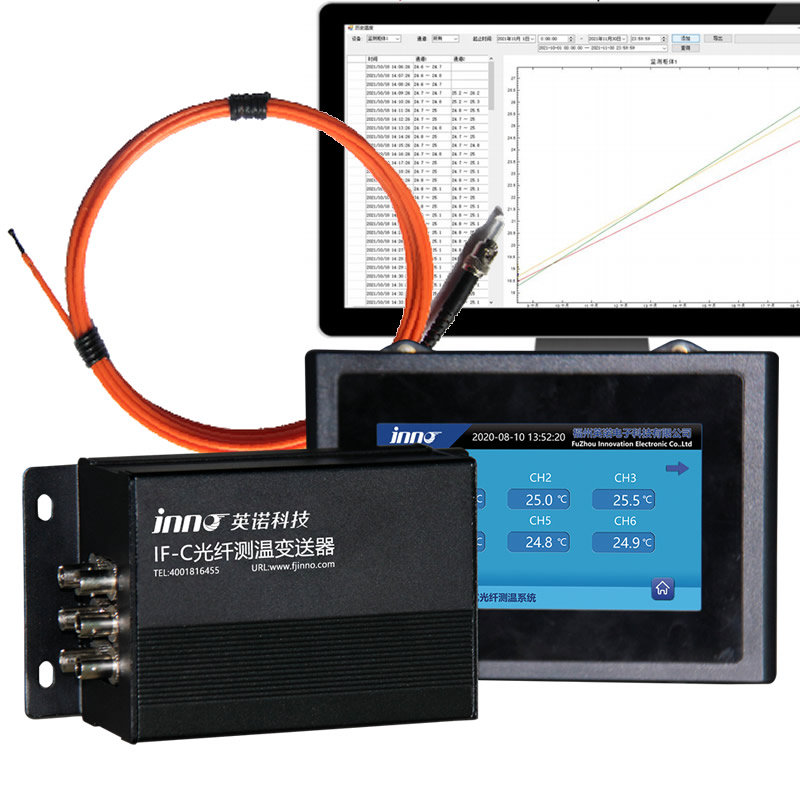
Standard fluoreszierende faseroptische Sonden cover −40 °C bis +200 °C. Enhanced versions using optimized phosphor compounds and high-temperature packaging extend the range to +250 °C or +300 °C. Accuracy is typically ±0,5 °C bis ±1 °C, mit Reaktionszeiten unter 1 zweite. This is a point-measurement technology — each probe reads temperature at a single location. The key advantage is complete immunity to electromagnetic interference, Herstellung fluoreszierende faseroptische Sensoren the standard choice for power transformer winding temperature, Kontakttemperatur der Schaltanlage, Und motor winding monitoring.
Faser-Bragg-Gitter (FBG) Temperatursensoren
FBG-Temperatursensoren use a periodic refractive-index structure written into the fiber core. This grating reflects a narrow wavelength of light (die Bragg-Wellenlänge), which shifts linearly with temperature. By tracking this wavelength shift, the system determines temperature at the grating location.
Standard FBG-Sensoren operate from −40 °C bis +300 °C. With regenerated or femtosecond-written gratings and polyimide or metal-coated fiber, the range extends to +700 °C Und, in specialized configurations, beyond +1000 °C. Multiple gratings can be multiplexed on a single fiber (quasiverteilte Messung), making FBG systems efficient for structural health monitoring. Note that FBG sensors respond to both temperature and strain simultaneously, so proper decoupling is necessary for accurate thermal-only measurements.
Verteilte Raman-Temperaturmessung (Raman DTS)

Raman DTS systems inject a laser pulse into an optical fiber and analyze the backscattered Raman signal. The ratio of anti-Stokes to Stokes Raman scattering intensity is temperature-dependent, enabling continuous temperature profiling along the entire fiber length.
Standard Raman DTS systems measure from −40 °C bis +300 °C, limited primarily by the fiber coating material. Sensing distances reach 30–50 km with spatial resolution of approximately 1 Meter. This makes Raman DTS the go-to solution for power cable temperature monitoring, Erkennung von Pipeline-Lecks, tunnel fire alarm systems, und Perimetersicherheit. Die Messzeit pro Scan liegt je nach Entfernung und gewünschter Genauigkeit zwischen Sekunden und Minuten.
Verteilte Temperaturmessung von Brillouin (BOTDA/BOTDR)
Brillouin-Glasfasersensorik misst die Temperatur durch die Verschiebung der Brillouin-Streufrequenz, die linear mit der Temperatur entlang der Faser variiert. BOTDA (Optische Zeitbereichsanalyse nach Brillouin) nutzt stimulierte Streuung für eine höhere Leistung, während BOTDR (Optische Zeitbereichsreflektometrie nach Brillouin) nutzt spontane Streuung für den Single-Ended-Zugriff.
Der Temperaturbereich ähnelt dem von Raman DTS −40 °C bis +300 °C, Brillouin-Systeme erreichen jedoch häufig deutlich längere Erfassungsabstände 100 km oder mehr. Wie FBG, Die Brillouin-Streuung ist sowohl temperatur- als auch spannungsempfindlich, erfordern geeignete Trenntechniken. Diese Systeme werden häufig zur Überwachung von Infrastrukturen über große Entfernungen, einschließlich Unterseekabeln, eingesetzt, Dämme, und große Pipelinenetze.
Technologie-Vergleichstabelle
| Technologie | Standardsortiment | Erweiterte Reichweite | Messtyp | Typische Genauigkeit |
|---|---|---|---|---|
| Fluoreszierende Glasfaser | −40 °C bis +200 °C | Bis zu +300 °C | Punkt | ±0,5 °C bis ±1 °C |
| FBG | −40 °C bis +300 °C | Bis zu +1000 °C | Quasi-verteilt | ±0,5 °C bis ±2 °C |
| Raman DTS | −40 °C bis +300 °C | Bis zu +700 °C | Vollständig verteilt | ±1 °C bis ±2 °C |
| Brillouin BOTDA/BOTDR | −40 °C bis +300 °C | Bis zu +400 °C | Vollständig verteilt | ±1 °C bis ±2 °C |
3. Key Factors That Determine Fiber Optic Temperature Range
Fiber Material and Coating
The optical fiber itself is made of fused silica, which can theoretically withstand temperatures above +1000 °C. Jedoch, the fiber coating — applied to protect the glass from mechanical damage — is almost always the first limiting factor. Standard telecom-grade fiber uses acrylate coating, rated for −40 °C bis +85 °C. Polyimide-coated fiber extends the upper limit to approximately +300 °C. Metal-coated fiber (Aluminium, copper, or gold) pushes it further to +500 °C bis +700 °C. Beyond that, specialty bare or carbon-coated fibers are used in controlled environments.
Sensing Element Limitations
Each sensing technology has inherent physical limits. Fluorescent phosphor compounds lose luminescence efficiency or undergo irreversible changes above their rated temperature. Standard Type I FBG gratings begin to anneal (erase) above approximately +300 °C — regenerated gratings solve this but add complexity. Raman and Brillouin scattering themselves are not temperature-limited, but the fiber they rely on is.
Packaging and Encapsulation Materials
The probe housing, sealing adhesive, protective tubing, and connector materials often impose stricter temperature limits than the fiber or sensing element alone. A stainless steel probe housing can handle much higher temperatures than a plastic connector. For applications above +200 °C, every component in the probe assembly — from the ceramic ferrule zum high-temperature epoxy — must be individually rated for the target range.
Low-Temperature Constraints
At cryogenic temperatures (unter −100 °C), standard fiber becomes brittle, phosphor response curves change significantly, and FBG sensitivity drops. Specialized cryogenic calibration, low-temperature adhesives, and protective routing are required for reliable operation in LNG, superconductor, und Luft- und Raumfahrtanwendungen. Manche fiber optic cryogenic sensors are validated down to −200 °C oder auch −269 °C (liquid helium temperature).
Umweltstressfaktoren
Vibration, Luftfeuchtigkeit, chemische Belastung, and radiation can all degrade sensor performance within its nominal temperature range over time. For long-term deployment in harsh environments, selecting appropriate protective cable jackets, hermetic seals, and corrosion-resistant probe materials is just as important as matching the temperature specification.
4. Typical Applications Across Different Temperature Ranges
Cryogenic Range: −200 °C to −40 °C
This range covers LNG storage tank monitoring, superconducting magnet cooling systems, cryogenic research facilities, and aerospace fuel systems. Fiber optic sensors offer critical safety advantages in these environments: no electrical spark risk, no interference from strong magnetic fields, and reliable operation in vacuum or inert atmospheres.
Ambient Range: −40 °C bis +85 °C
Standard telecom-grade fiber handles this range easily at the lowest cost. Typical applications include structural health monitoring for bridges and buildings, data center temperature surveillance, Geotechnische Überwachung, and environmental sensing. Beide Raman DTS Und FBG-Systeme are commonly deployed in these scenarios.
Mittlere Reichweite: +85 °C bis +250 °C — The Power Industry Sweet Spot

This is the core operating zone for fluoreszierende faseroptische Temperatursensoren. The most common applications include power transformer winding hot-spot temperature measurement, high-voltage switchgear busbar and contact monitoring, cable joint temperature monitoring, generator and motor winding temperature tracking, and downhole oil and gas well temperature measurement. Fluorescent sensors dominate this zone because they combine high accuracy, complete dielectric isolation, elektromagnetische Immunität, und bewährte Langzeitstabilität in spannungsführenden Hochspannungsumgebungen.
Hohe Reichweite: +250 °C bis +700 °C
Zu den Anwendungen in diesem Bereich gehören Wärmebehandlungsöfen, Glasherstellung, Dampfturbinen, Kunststoff-Extrusionsdüsen, und chemische Hochtemperaturreaktoren. Hochtemperatur-FBG-Sensoren mit Polyimid oder metallbeschichteten Fasern und einer speziellen Verkapselung sind die primäre Lösung. Einige mit erweiterter Reichweite Fluoreszenzsonden kann auch das untere Ende dieser Zone erreichen.
Extreme Reichweite: Über +700 °C
Turbinenschaufeln von Strahltriebwerken, Komponenten von Kernreaktoren, Stahlschmelze, und Keramiksinteröfen fallen in diese Kategorie. Schwarzkörper-Strahlungssensoren aus Saphirfaser kann Temperaturen darüber messen +2000 °C. Diese Systeme sind teuer und spezialisiert, Die Glasfasertechnologie bleibt jedoch eine der wenigen praktikablen berührungslosen Lösungen für kontinuierliche Messungen in solch extremen thermischen Umgebungen.
5. So wählen Sie den richtigen faseroptischen Temperatursensor aus

Schritt 1: Define Your Temperature Envelope
Identify the minimum and maximum temperatures your sensor will encounter — not just the target measurement range, but also ambient and transient extremes. Add a safety margin of at least 10–20 % beyond your expected maximum.
Schritt 2: Determine Measurement Type
Decide whether you need single-point measurement (fluorescent sensor), Mehrpunktmessung (FBG-Sensor), or continuous distributed profiling (Raman DTS oder Brillouin system). Point sensors are simpler and more accurate for localized hot-spot monitoring. Distributed systems are efficient for long linear assets.
Schritt 3: Bewerten Sie die Umgebungsbedingungen
Consider electromagnetic interference levels, chemische Belastung, mechanische Vibration, Feuchtigkeit, and required cable routing. High-voltage and high-EMI environments strongly favor fluoreszierende faseroptische Sensoren because the all-dielectric fiber eliminates ground loops and interference pickup entirely.
Schritt 4: Balance Accuracy, Distance, and Budget
Höhere Genauigkeit und größerer Erfassungsabstand erhöhen im Allgemeinen die Systemkosten. Fluoreszierende Punktsensoren bieten das beste Genauigkeit-Kosten-Verhältnis für lokale Messungen im Temperaturbereich von −40 °C bis +250 °C-Bereich. Raman DTS bietet den besten Wert für die verteilte Überwachung über mehrere Kilometer. FBG bietet einen guten Mittelweg für Mehrpunktinstallationen, bei denen die Anforderungen an Abstand und Temperatur moderat sind.
6. FAQs About Fiber Optic Temperature Range
Q1: Was ist die maximale Temperatur, die ein faseroptischer Sensor messen kann??
Schwarzkörper-Strahlungssensoren aus Saphirfaser können Temperaturen darüber messen +2000 °C. Für gängigere Technologien, FBG-Sensoren mit regenerierten Gittern erreichen bis zu +1000 °C, während Standard-Fluoreszenz- und Raman-Systeme die Nase vorn haben +300 °C.
Q2: Können faseroptische Sensoren bei kryogenen Temperaturen funktionieren??
Ja. Specialty fiber optic sensors with cryogenic-rated materials and calibration can operate reliably down to −200 °C and, in some laboratory configurations, as low as −269 °C (liquid helium temperature).
Q3: What limits the temperature range of a fiber optic sensor?
The primary limiting factors are the fiber coating material, the sensing element properties (phosphor stability, grating annealing threshold), and the packaging materials (adhesives, housings, Anschlüsse). The silica fiber itself can withstand over +1000 °C.
Q4: Which fiber optic sensor is best for transformer temperature monitoring?
Fluoreszierende faseroptische Temperatursensoren are the industry standard for transformer winding hot-spot monitoring. They provide ±1 °C accuracy, full electromagnetic immunity, and complete dielectric isolation in the −40 °C to +250 °C range required for oil-immersed and dry-type transformers.
F5: What is the temperature range of a standard Raman DTS system?
Most commercial Raman DTS systems operate from −40 °C to +300 °C, depending on the sensing cable construction. The fiber coating type (acrylate, Polyimid, oder Metall) determines the actual upper limit.
F6: Do FBG sensors measure temperature and strain at the same time?
FBG sensors are inherently sensitive to both temperature and strain. For accurate temperature-only measurement, strain must be decoupled through mechanical isolation of the grating or by using a reference grating that is strain-free.
F7: How does fiber coating type affect temperature range?
Acrylate coating is rated to approximately +85 °C, polyimide coating to +300 °C, and metal coatings (Aluminium, copper, gold) Zu +500 °C–+700 °C. Selecting the right coating is essential for matching the sensor to your operating temperature.
F8: Can I use a single fiber optic system for both high and low temperature zones?
Distributed systems like Raman DTS and Brillouin BOTDA measure the full temperature profile along the fiber, so a single system can cover sections at different temperatures — as long as every point falls within the system’s rated range and the sensing cable is rated accordingly at each section.
F9: How accurate are fiber optic temperature sensors compared to thermocouples?
Fluorescent fiber optic sensors achieve ±0.5 °C to ±1 °C, comparable to or better than standard K-type thermocouples. The key advantage of fiber optic sensors is not just accuracy but immunity to electromagnetic interference, which can cause significant errors in thermocouple readings in high-voltage environments.
F10: Welche Wartung benötigen faseroptische Temperatursensoren??
Fiber optic sensors require minimal maintenance. There are no consumable parts, no recalibration due to EMI drift, and no degradation from electrical surges. Periodic inspection of fiber connectors for contamination and verification of calibration at scheduled intervals are the main maintenance tasks.
Haftungsausschluss: The information provided in this article is for general reference purposes only. Specific temperature ranges, Genauigkeitsangaben, and application suitability vary by manufacturer, product model, and deployment conditions. Always consult the product datasheet and the manufacturer’s engineering team before making purchasing or installation decisions. FJINNO (www.fjinno.net) übernimmt keine Haftung für Entscheidungen, die auf der Grundlage des Inhalts dieses Artikels getroffen werden.

Faseroptischer Temperatursensor, Intelligentes Überwachungssystem, Verteilter Glasfaserhersteller in China
 |
 |
 |