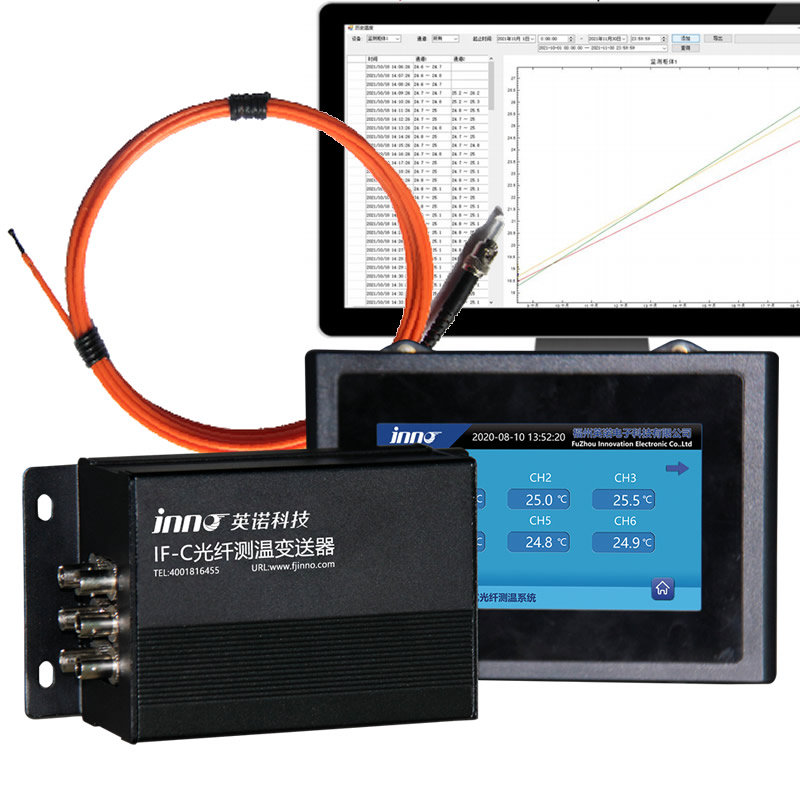
 Оптоволоконні датчики температури INNO ,системи контролю температури.
- Флуоресцентні волоконно-оптичні датчики температури measure from від −40 °C до +250 °C (до +300 °C with enhanced probes), delivering ±1 °C accuracy for power equipment and switchgear.
- Волокниста решітка Брегга (FBG) датчики cover від −40 °C до +300 °C in standard form, and can extend to +700 °C або навіть +1000 °C with regenerated gratings and metal-coated fiber.
- Raman distributed temperature sensing (DTS) systems operate from від −40 °C до +300 °C over distances up to 30–50 km, ideal for pipeline and cable monitoring.
- Brillouin BOTDA/BOTDR systems share a similar range of від −40 °C до +300 °C but can reach 100+ km sensing length.
- Sapphire fiber blackbody sensors push the upper limit beyond +2000 °C for extreme industrial environments.
Зміст
- What Is Fiber Optic Temperature Range
- Fiber Optic Temperature Sensing Technologies and Their Ranges
- Key Factors That Determine Fiber Optic Temperature Range
- Typical Applications Across Different Temperature Ranges
- Як вибрати правильний волоконно-оптичний датчик температури
- FAQs About Fiber Optic Temperature Range
1. What Is Fiber Optic Temperature Range

Fiber optic temperature range refers to the minimum and maximum temperatures that a волоконно-оптичний датчик температури can accurately and reliably measure. This specification varies significantly across different sensing technologies, fiber materials, coatings, and packaging designs. A fluorescent fiber optic probe designed for transformer winding monitoring handles a very different temperature window than a sapphire fiber sensor built for jet engine testing.
Why Temperature Range Is the First Selection Criterion
Temperature range directly determines whether a sensor can operate safely and accurately in your target environment. Choosing a sensor with insufficient range leads to measurement failure, signal loss, or permanent probe damage. Over-specifying the range, з іншого боку, often means sacrificing resolution or paying significantly more. Matching your actual operating temperature envelope to the right sensing technology is the most critical step in any оптоволоконний моніторинг температури демонструвати.
What This Article Covers
This guide breaks down the temperature ranges of four mainstream fiber optic sensing technologies, explains the physical and material factors that set those limits, maps each temperature zone to real-world applications, and provides practical selection guidance. Every specification referenced reflects current commercially available products and published industry data.
2. Волоконно-оптичний датчик температури Technologies and Their Ranges

Флуоресцентні волоконно-оптичні датчики температури
Флуоресцентні волоконно-оптичні датчики температури (also called fluorescence lifetime decay sensors) work by exciting a phosphor material at the probe tip with a light pulse and measuring the decay time of the resulting fluorescence. Цей час розпаду змінюється передбачувано з температурою, providing a direct and highly accurate reading.
Стандартний флуоресцентні волоконно-оптичні зонди cover від −40 °C до +200 °C. Enhanced versions using optimized phosphor compounds and high-temperature packaging extend the range to +250 °C or +300 °C. Accuracy is typically ±0,5 °C до ±1 °C, with response times under 1 другий. This is a point-measurement technology — each probe reads temperature at a single location. The key advantage is complete immunity to electromagnetic interference, виготовлення флуоресцентні волоконно-оптичні датчики the standard choice for power transformer winding temperature, switchgear contact temperature, і motor winding monitoring.
Волокниста решітка Брегга (FBG) Датчики температури
Датчики температури FBG use a periodic refractive-index structure written into the fiber core. This grating reflects a narrow wavelength of light (the Bragg wavelength), which shifts linearly with temperature. By tracking this wavelength shift, the system determines temperature at the grating location.
Стандартний Датчики FBG operate from від −40 °C до +300 °C. With regenerated or femtosecond-written gratings and polyimide or metal-coated fiber, the range extends to +700 °C і, in specialized configurations, beyond +1000 °C. Multiple gratings can be multiplexed on a single fiber (quasi-distributed measurement), making FBG systems efficient for structural health monitoring. Note that FBG sensors respond to both temperature and strain simultaneously, so proper decoupling is necessary for accurate thermal-only measurements.
Раманівське розподілене вимірювання температури (Раман DTS)

Raman DTS systems inject a laser pulse into an optical fiber and analyze the backscattered Raman signal. The ratio of anti-Stokes to Stokes Raman scattering intensity is temperature-dependent, enabling continuous temperature profiling along the entire fiber length.
Стандартний Раман DTS systems measure from від −40 °C до +300 °C, limited primarily by the fiber coating material. Sensing distances reach 30–50 км with spatial resolution of approximately 1 метр. This makes Raman DTS the go-to solution for power cable temperature monitoring, pipeline leak detection, tunnel fire alarm systems, та охорона периметра. Measurement time per scan ranges from seconds to minutes depending on distance and desired accuracy.
Brillouin Distributed Temperature Sensing (BOTDA/BOTDR)
Brillouin fiber optic sensing measures temperature through the shift in Brillouin scattering frequency, which varies linearly with temperature along the fiber. БОТДА (Brillouin Optical Time Domain Analysis) uses stimulated scattering for higher performance, while BOTDR (Оптична рефлектометрія у часовій області Бріллюена) uses spontaneous scattering for single-ended access.
The temperature range is similar to Raman DTS at від −40 °C до +300 °C, but Brillouin systems achieve significantly longer sensing distances — often 100 km or more. Like FBG, Brillouin scattering is sensitive to both temperature and strain, requiring appropriate separation techniques. These systems are widely used for long-distance infrastructure monitoring including subsea cables, греблі, and large-scale pipeline networks.
Таблиця порівняння технологій
| технології | Стандартний діапазон | Розширений радіус дії | Тип вимірювання | Типова точність |
|---|---|---|---|---|
| Флуоресцентна волоконна оптика | від −40 °C до +200 °C | До +300 °C | точка | ±0,5 °C до ±1 °C |
| FBG | від −40 °C до +300 °C | До +1000 °C | Квазірозподілений | ±0,5 °C до ±2 °C |
| Раман DTS | від −40 °C до +300 °C | До +700 °C | Повністю роздано | ±1 °C to ±2 °C |
| Brillouin BOTDA/BOTDR | від −40 °C до +300 °C | До +400 °C | Повністю роздано | ±1 °C to ±2 °C |
3. Key Factors That Determine Fiber Optic Temperature Range
Fiber Material and Coating
The optical fiber itself is made of fused silica, which can theoretically withstand temperatures above +1000 °C. Проте, the fiber coating — applied to protect the glass from mechanical damage — is almost always the first limiting factor. Standard telecom-grade fiber uses acrylate coating, rated for від −40 °C до +85 °C. Polyimide-coated fiber extends the upper limit to approximately +300 °C. Metal-coated fiber (алюміній, мідь, or gold) pushes it further to +500 °C до +700 °C. Beyond that, specialty bare or carbon-coated fibers are used in controlled environments.
Sensing Element Limitations
Each sensing technology has inherent physical limits. Fluorescent phosphor compounds lose luminescence efficiency or undergo irreversible changes above their rated temperature. Standard Type I FBG gratings begin to anneal (erase) above approximately +300 °C — регенеровані решітки вирішують це, але додають складності. Самі комбінаційне та бріллюенівське розсіяння не обмежені температурою, але волокно, на яке вони покладаються, є.
Пакувальні та капсульні матеріали
Корпус зонда, герметизуючий клей, захисна трубка, і матеріали з’єднувача часто накладають суворіші температурні обмеження, ніж волокно або чутливий елемент окремо. А корпус зонда з нержавіючої сталі може витримувати набагато вищі температури, ніж пластиковий з’єднувач. Для програм вище +200 °C, кожен компонент зонда — від керамічний наконечник до високотемпературна епоксидна смола — повинні бути індивідуально оцінені для цільового діапазону.
Низькотемпературні обмеження
При кріогенних температурах (нижче −100 °C), стандартне волокно стає крихким, криві реакції люмінофора істотно змінюються, і чутливість ФБГ падає. Спеціалізоване кріогенне калібрування, низькотемпературні клеї, and protective routing are required for reliable operation in LNG, superconductor, and aerospace applications. Деякі fiber optic cryogenic sensors are validated down to −200 °C or even −269 °C (liquid helium temperature).
Environmental Stress Factors
Вібрація, вологість, хімічний вплив, and radiation can all degrade sensor performance within its nominal temperature range over time. For long-term deployment in harsh environments, selecting appropriate protective cable jackets, hermetic seals, and corrosion-resistant probe materials is just as important as matching the temperature specification.
4. Typical Applications Across Different Temperature Ranges
Cryogenic Range: −200 °C to −40 °C
This range covers LNG storage tank monitoring, системи охолодження надпровідних магнітів, cryogenic research facilities, and aerospace fuel systems. Fiber optic sensors offer critical safety advantages in these environments: no electrical spark risk, no interference from strong magnetic fields, і надійна робота у вакуумі або інертній атмосфері.
Діапазон навколишнього середовища: від −40 °C до +85 °C
Стандартне волокно телекомунікаційного класу легко справляється з цим діапазоном за найнижчої вартості. Серед типових застосувань – моніторинг стану конструкцій мостів і будівель, спостереження за температурою в центрі обробки даних, geotechnical monitoring, та зондування навколишнього середовища. Обидва Раман DTS і Системи FBG зазвичай розгортаються в цих сценаріях.
Medium Range: +85 °C до +250 °C — найкраще місце для енергетики

Це основна операційна зона для флуоресцентні волоконно-оптичні датчики температури. Найпоширеніші програми включають вимірювання температури гарячої точки обмотки силового трансформатора, контроль шин і контактів високовольтних комутаційних пристроїв, контроль температури з'єднання кабелю, відстеження температури обмоток генератора та двигуна, вимірювання температури нафтових і газових свердловин. Флуоресцентні датчики домінують у цій зоні, оскільки вони поєднують високу точність, повна діелектрична ізоляція, електромагнітний імунітет, і підтверджена довгострокова стабільність в середовищах високої напруги під напругою.
Високий діапазон: +250 °C до +700 °C
Застосування в цій зоні включають печі для термічної обробки, glass manufacturing, парові турбіни, пластикові прес-форми, і високотемпературні хімічні реактори. Високотемпературні датчики FBG з поліімідним або металевим волокном і спеціалізованим капсулюванням є основним рішенням. Деякі з розширеним діапазоном флуоресцентні зонди також може досягати нижнього кінця цієї зони.
Екстремальний діапазон: вище +700 °C
Лопатки турбіни реактивного двигуна, компоненти ядерного реактора, steel smelting, і печі для спікання кераміки належать до цієї категорії. Датчики випромінювання чорного тіла з сапфірового волокна може вимірювати температуру вище +2000 °C. Ці системи дорогі та спеціалізовані, але волоконно-оптична технологія залишається одним із небагатьох життєздатних безконтактних рішень для безперервного вимірювання в таких екстремальних теплових середовищах.
5. Як вибрати правильний волоконно-оптичний датчик температури

Крок 1: Визначте свій температурний конверт
Identify the minimum and maximum temperatures your sensor will encounter — not just the target measurement range, but also ambient and transient extremes. Add a safety margin of at least 10–20 % beyond your expected maximum.
Крок 2: Determine Measurement Type
Decide whether you need single-point measurement (fluorescent sensor), багатоточкове вимірювання (Датчик FBG), or continuous distributed profiling (Раман DTS або Brillouin system). Point sensors are simpler and more accurate for localized hot-spot monitoring. Distributed systems are efficient for long linear assets.
Крок 3: Evaluate Environmental Conditions
Consider electromagnetic interference levels, хімічний вплив, механічна вібрація, вологи, and required cable routing. High-voltage and high-EMI environments strongly favor флуоресцентні волоконно-оптичні датчики because the all-dielectric fiber eliminates ground loops and interference pickup entirely.
Крок 4: Balance Accuracy, Distance, and Budget
Higher accuracy and longer sensing distance generally increase system cost. Fluorescent point sensors offer the best accuracy-to-cost ratio for localized measurements in the −40 °C to +250 діапазон °C. Raman DTS provides the best value for distributed monitoring over several kilometers. FBG offers a good middle ground for multi-point installations where distance and temperature demands are moderate.
6. FAQs About Fiber Optic Temperature Range
Q1: What is the maximum temperature a fiber optic sensor can measure?
Sapphire fiber blackbody radiation sensors can measure temperatures exceeding +2000 °C. For more common technologies, FBG sensors with regenerated gratings reach up to +1000 °C, while standard fluorescent and Raman systems top out around +300 °C.
Q2: Can fiber optic sensors work at cryogenic temperatures?
так. Спеціальні волоконно-оптичні датчики з кріогенними матеріалами та калібруванням можуть надійно працювати до –200 °C і, в деяких лабораторних конфігураціях, до −269 °C (liquid helium temperature).
Q3: Що обмежує температурний діапазон оптоволоконного датчика?
Основними обмежуючими факторами є матеріал волокнистого покриття, властивості чутливого елемента (стабільність люмінофору, поріг відпалу решітки), та пакувальні матеріали (клеї, корпуси, роз'єми). Саме кремнеземне волокно може витримати понад +1000 °C.
Q4: Який волоконно-оптичний датчик краще для контролю температури трансформатора?
Флуоресцентні волоконно-оптичні датчики температури є промисловим стандартом для моніторингу гарячих точок обмотки трансформатора. Вони забезпечують точність ±1 °C, повна електромагнітна стійкість, і повна діелектрична ізоляція від -40 °C до +250 Діапазон °C, необхідний для масляних і сухих трансформаторів.
Q5: What is the temperature range of a standard Raman DTS system?
Most commercial Raman DTS systems operate from −40 °C to +300 °C, depending on the sensing cable construction. The fiber coating type (acrylate, polyimide, або метал) determines the actual upper limit.
Q6: Do FBG sensors measure temperature and strain at the same time?
FBG sensors are inherently sensitive to both temperature and strain. For accurate temperature-only measurement, strain must be decoupled through mechanical isolation of the grating or by using a reference grating that is strain-free.
Q7: How does fiber coating type affect temperature range?
Acrylate coating is rated to approximately +85 °C, polyimide coating to +300 °C, and metal coatings (алюміній, мідь, gold) до +500 °C–+700 °C. Selecting the right coating is essential for matching the sensor to your operating temperature.
Q8: Чи можна використовувати одну волоконно-оптичну систему для зон високої та низької температури?
Розподілені системи, такі як Raman DTS і Brillouin BOTDA, вимірюють повний профіль температури вздовж волокна, тому одна система може охоплювати секції з різними температурами — за умови, що кожна точка потрапляє в номінальний діапазон системи, а чутливий кабель має відповідний рейтинг на кожній ділянці.
Q9: Наскільки точні волоконно-оптичні датчики температури порівняно з термопарами?
Флуоресцентні волоконно-оптичні датчики досягають температури від ±0,5 °C до ±1 °C, порівняти або краще, ніж стандартні термопари K-типу. Ключовою перевагою волоконно-оптичних датчиків є не тільки точність, але й стійкість до електромагнітних перешкод, що може спричинити значні помилки в показаннях термопари в середовищах високої напруги.
Q10: Яке обслуговування потребують волоконно-оптичні датчики температури?
Fiber optic sensors require minimal maintenance. There are no consumable parts, no recalibration due to EMI drift, and no degradation from electrical surges. Periodic inspection of fiber connectors for contamination and verification of calibration at scheduled intervals are the main maintenance tasks.
Відмова від відповідальності: The information provided in this article is for general reference purposes only. Specific temperature ranges, характеристики точності, and application suitability vary by manufacturer, product model, and deployment conditions. Always consult the product datasheet and the manufacturer’s engineering team before making purchasing or installation decisions. FJINNO (www.fjinno.net) assumes no liability for any decisions made based on the content of this article.

Оптоволоконний датчик температури, Інтелектуальна система моніторингу, Розповсюджений виробник оптоволокна в Китаї
 |
 |
 |